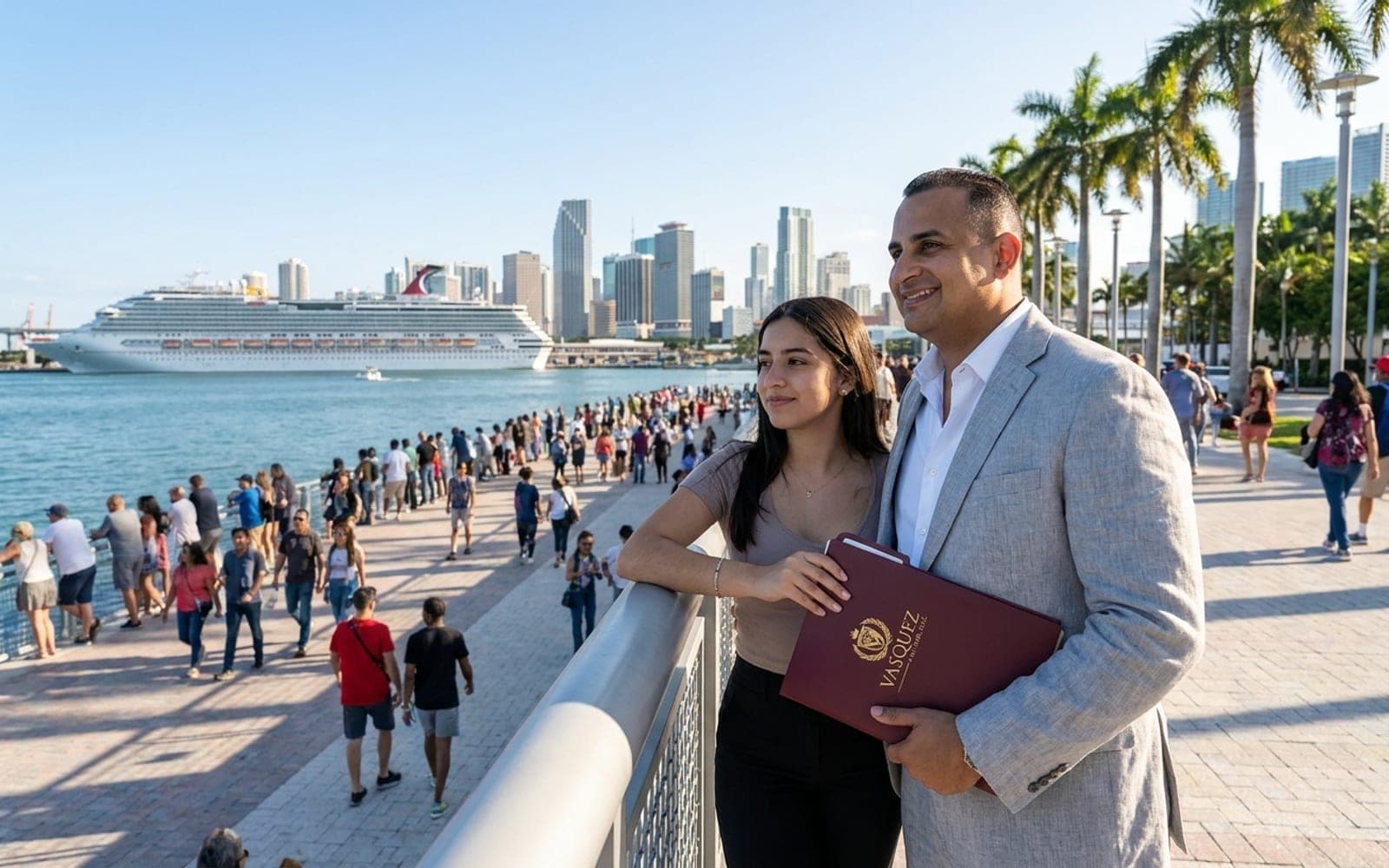
When a non-citizen has an arrest, charge or conviction, two separate problems appear at once: the criminal case and the immigration consequences. Our firm handles the second problem. We advise on how a record affects status, applications and removal proceedings, and we work alongside the client's criminal defense lawyer; we do not defend criminal charges or appear in criminal court. Whether an offense triggers immigration consequences depends on the statute, the sentence and the record, so the details of a plea matter. The safest approach is for both lawyers to talk before any plea is entered.
- We advise on immigration consequences and do not defend criminal charges.
- The details of a plea matter, and both lawyers should talk before it is entered.
- Immigration consequences depend on the statute, the sentence and the record.
- Miami clients can work with our Orlando office by video and phone.
Introduction
When a Miami resident who is not a U.S. citizen has an arrest, a charge or a conviction, two separate legal problems appear at once: the criminal case and the immigration consequences. Vasquez Law Firm handles the second problem. We advise on how a record affects status, applications and removal proceedings, and we work alongside the client's criminal defense lawyer; call 1-844-YO-PELEO or contact us to discuss the immigration side.
We serve clients in Miami and across Miami-Dade by video and phone from our only office, at 1111 E Amelia Street in Orlando. This page explains what people mean when they search for this kind of help, why the details of a plea matter, how removal proceedings and appeals work, and how to work with us from Miami.
It is general information, not legal advice. Whether an offense triggers immigration consequences depends on the statute, the sentence and the record, so a lawyer must read the actual documents.
What People Mean by Immigration Criminal Defense
Searches that combine immigration and criminal defense join two fields, and it helps to be precise. A criminal defense lawyer represents you in the criminal court. An immigration lawyer explains what the charge or plea could mean for your visa, green card, citizenship application or ability to stay in the country. If you are looking for help in Miami, the safest approach is to have both professionals talk before any plea is entered.
To be clear about our role: we do not defend criminal charges and we do not appear in criminal court. We analyze the immigration side and give the criminal defense lawyer the information needed to avoid a plea that creates avoidable immigration damage. The name for this work is crimmigration, and our deportation defense page describes how it fits into removal cases.
Why the Details of a Plea Matter
Immigration law has its own definitions. Whether an offense counts as a crime involving moral turpitude, an aggravated felony, a controlled substance offense or a firearm offense depends on the statute of conviction, the sentence and how the record is written, not just on what the police report says. Two people with similar facts can face very different outcomes. A few points are worth knowing:
- A conviction for immigration purposes is defined differently than in criminal law, so a withheld adjudication or a sealed record may still matter.
- Even minor offenses can affect applications for a green card, naturalization or a renewal.
- Travel after an arrest can lead to trouble at the airport, so ask before leaving the country.
- Some convictions limit the forms of relief that an immigration judge can grant.
A lawyer reviewing your file will ask for the charging document, the plea paperwork, the judgment and the sentence. Bring them even if the case ended years ago.
The timing of a plea can matter as much as its content. Once a plea is entered and a sentence imposed, it can be very difficult to change the immigration result. That is why we encourage clients and their criminal defense lawyers to talk early. The criminal defense lawyer knows the evidence and the prosecutor's position, and the immigration lawyer knows how the immigration agencies read the resulting record. Together they can sometimes find a resolution that is workable on both sides, though no one can promise one in advance.
When a Record Leads to Removal Proceedings
The government starts removal proceedings by issuing a Notice to Appear that lists the allegations and the charges of removability. The case then goes before an immigration judge. Depending on the facts, there may be defenses to the charges, challenges to whether the conviction qualifies, or applications for relief such as cancellation of removal, adjustment of status with a waiver, asylum-related protection or other forms. Relief often requires proof of a specific period of residence, family ties or fear of harm abroad, and it may be limited by the kind of conviction. Eligibility depends heavily on your history and on the record of conviction, so a lawyer must read the actual documents before saying what is possible.
A removal case generally moves through these steps:
- The Notice to Appear is served and filed with the immigration court.
- A first master calendar hearing sets the schedule and addresses the charges.
- The lawyer files any motions, challenges to the charges and applications for relief.
- An individual hearing takes place where evidence and testimony are presented.
- The judge issues a decision, which may be granted, denied or partly granted.
- Either side may consider an appeal within the deadline.
Detention and Bond Questions
When a person is detained, timing becomes even more urgent. Some people may request a bond hearing before an immigration judge; others are held under rules that limit that option because of their record. A lawyer can tell you which category applies, and will ask about the exact statute, the sentence and the date of release. Families should gather the detained person's A-number, the facility name and the arrest paperwork. Our bond information page gives the general framework.
Document Checklist for a Criminal Record Review
- The charging document, arrest report and docket for each case.
- The plea paperwork, judgment and sentence, including any probation terms.
- Proof of completion of sentence, fines or programs.
- Notices and orders from the immigration court, including the Notice to Appear.
- Any order from an immigration judge or the Board of Immigration Appeals.
- Passport, visas, green card and a timeline of your entry and status history.
- Names and contact details of your criminal defense lawyer, if you have one.
Send clear copies through secure upload before the first call if you can, and tell us at the start if you have a hearing or a deadline coming up. If a record is hard to obtain, tell us rather than guessing; court clerks can provide official copies, and the lawyer can explain which documents matter most.
Timeline and Processing Expectations
The timing of an immigration case after an arrest depends on whether the person is detained, which court has the case and whether there are appeals or motions. The Executive Office for Immigration Review and USCIS publish current information about courts and processing, and your notice will state the next hearing.
Appeals and motions carry short deadlines. A lawyer cannot promise a result or a timeline, but can identify the deadlines that apply and act within them.
| Stage | What happens | Who acts |
|---|
| Arrest or conviction | Criminal case ends or a plea is considered | Criminal court; criminal defense lawyer |
| Immigration review | Lawyer reads the record and explains consequences | Immigration lawyer |
| Notice to Appear | Government starts removal proceedings, if it does | DHS and the immigration court |
| Hearings | Master calendar and individual hearings | Immigration judge; client and lawyer attend |
| Decision | Judge grants or denies relief or orders removal | Immigration judge |
| Appeal or motion | Board review or other filing within the deadline | Lawyer files; Board or court decides |
Immigration Appeals in Miami
If the immigration judge rules against you, the decision may not be the end. A lawyer will first check the deadline, because appeals to the Board of Immigration Appeals have a short deadline counted from the judge's decision, and missing it can end the right to appeal. The appeal is based on the written record and the legal arguments, not on a new hearing.
People asking about appeals often have the same practical questions:
- What can be appealed? Orders of removal, denials of relief and certain other rulings by the immigration judge.
- What happens to the order while the appeal is pending? It depends on the case and on whether you are detained; ask a lawyer about the specific effect.
- What if the Board denies the appeal? In some cases a petition for review can be filed with the federal court of appeals, which for Florida is the Eleventh Circuit, and that also has a short deadline.
- Is a motion to reopen an option? Sometimes, but it has its own rules and time limits.
A lawyer reviewing an appeal should read the hearing transcript, identify legal errors, and explain honestly how strong the arguments are. No lawyer can promise a result, and anyone who does should be questioned.
Related Options: Waivers, Protection Claims and Records
Depending on the facts, several different tools may be worth considering. A waiver may forgive certain grounds of inadmissibility for people who have a qualifying relative and can show hardship, but waivers are not available for every offense. Protection claims such as asylum, withholding of removal or protection under the Convention Against Torture have their own eligibility rules, and some convictions limit them, though some forms of protection remain available even when others are barred. Separately, some people ask whether a criminal conviction can be changed or vacated in the state court. That is a question for a criminal defense lawyer, and the immigration lawyer can explain whether such a change would actually be recognized for immigration purposes. Each of these options depends on the exact record, which is why the documents come first.
Whatever the route, tell your lawyer everything. Facts that look unhelpful, such as an old arrest in another state, will usually surface in a background check or a fingerprint search, and it is far better for the lawyer to learn them from you than from a government notice.
Choosing a Lawyer for an Appeal
Recommendations are only a starting point. Ask these questions:
- Will the lawyer review the full record?
- Who writes the brief?
- How will you be updated?
- What are the risks of appealing, including the effect on any current detention or release?
Appeals are technical, so choose a lawyer who handles immigration court matters as part of regular practice and who explains the strategy clearly, including a candid view of the weaknesses in your case.
How to Work With Us From Miami
We schedule an initial consultation by video or phone, in English or Spanish, and ask you to send documents securely beforehand. In-person meetings are available in Orlando. Helpful documents include notices from the immigration court, any order from the judge, the criminal court judgment and sentence, your passport and a timeline of your entry and status history. Some clients also ask whether they should travel to Orlando; most do not need to, because the consultation, document review and preparation can all be done remotely. If you have a deadline coming up, say so when you contact us through the contact page.
Cost Factors and Fee Breakdown
The table below lists the kinds of costs that usually come up, without quoting figures that change over time.
| Item | Amount | Notes |
|---|
| Immigration court filings | Check the court or agency for current fees | Varies by application and motion |
| Board of Immigration Appeals appeal | Check the court or agency for current fees | Applies only if a decision is appealed |
| Federal court petition for review | Check the court or agency for current fees | Set by the federal court |
| Attorney fees | Varies by case | Appeals and hearings may be separate; ask for a written scope |
| Court records and copies | Varies by case | Obtained from the clerk of the issuing court |
Government filing fees are set by the agency and change from time to time, so check the current fee schedule on the agency's website before you file. Legal fees are separate and vary with the complexity of the case, the number of people included and the amount of work involved. Ask for the scope of work and the fee arrangement in writing before you sign anything.
Other costs may include medical exams, translations, travel to appointments and the cost of obtaining records from other countries or from courts. A lawyer can help you plan for these in advance so there are fewer surprises. Be cautious about any lawyer who guarantees an outcome, and about anyone who quotes a price without first reviewing your documents.
Common Mistakes to Avoid
- Entering a plea without asking an immigration lawyer about the consequences.
- Assuming a dismissed, sealed or withheld case does not matter for immigration.
- Traveling abroad after an arrest without legal advice.
- Missing the deadline for an appeal or a motion.
- Giving a lawyer an incomplete record or leaving out an old case.
- Believing anyone who promises that an appeal will succeed.
When to Call a Lawyer
Call a lawyer before any plea, as soon as you receive a Notice to Appear, and immediately after an adverse decision from an immigration judge, because appeal deadlines are short. If a relative is detained, call right away. You can reach us at 1-844-YO-PELEO or through the contact page.
About Vasquez Law Firm
Vasquez Law Firm practices immigration law only. Our one and only office is at 1111 E Amelia Street in Orlando, and we serve clients throughout Florida by phone and secure video, with in-person meetings at the Orlando office whenever a client prefers. We do not have an office in Miami; we serve the area by phone and secure video, with in-person meetings in Orlando. William J. Vásquez is the founding attorney of the firm. Consultations are held in English and Spanish. To talk about your situation, call 1-844-YO-PELEO or contact us.
Sources and References
Related services: deportation defense, immigration lawyers in Florida
Other ways people search for this
People look for this help under different names. Related searches include withholding of removal lawyer; immigration criminal defense lawyer in miami; immigration criminal defense lawyer miami; miami immigration criminal defense lawyer; immigration appeals attorney miami; immigration appeals lawyer miami; appeal removal order miami lawyer; immigration appeal attorney miami fl; miami immigration appeals attorney; miami immigration appeals lawyer.
This article is general information, not legal advice. Every case is different; speak with an immigration lawyer about your situation.