PERM Labor Certification in Florida: A 2026 Guide
Learn all about the PERM labor certification process in Florida, essential for employers sponsoring green card applicants. Understand the steps, document requirements, and common mistakes to avoid in this 2026 guide.
PERM labor certification in Florida is a crucial step for employers sponsoring employees for a green card. It involves proving that there are no qualified U.S. workers for the position. Key takeaways include:
- Employers must demonstrate recruitment efforts.
- The process includes prevailing wage determination.
- Complying with Department of Labor regulations is essential.
Introduction
If you're an employer in Orlando, Florida, looking to sponsor a foreign national for a green card, understanding the PERM labor certification process is essential. The process ensures that hiring a foreign worker won't negatively affect U.S. workers. This article will guide you through each step of the PERM process, helping you avoid common pitfalls.
The U.S. immigration system, particularly for employment-based green cards, is designed with a dual purpose: to attract global talent that fuels economic growth and innovation, while simultaneously safeguarding the job market for American workers. The Program Electronic Review Management (PERM) process stands at the intersection of these objectives, acting as a gatekeeper to ensure that foreign workers fill genuine labor shortages rather than displacing qualified U.S. citizens or permanent residents.
Navigating the PERM landscape requires meticulous attention to detail, strict adherence to Department of Labor (DOL) regulations, and a proactive approach to recruitment. For businesses in Florida, a state with a dynamic and diverse economy, securing PERM certification can be a strategic move to retain valuable talent. However, the complexity of the rules means that even minor errors can lead to significant delays or outright denials. This is precisely why engaging with experienced legal counsel, such as Florida Immigration Lawyers, is not just recommended but often critical for a successful outcome. Our team at 1-844-YO-PELEO is ready to provide a free case review to help you understand your options.
Call Florida Immigration Lawyers at 1-844-YO-PELEO for a free case review.
What is PERM Labor Certification?
As of 2026, the PERM labor certification process is a prerequisite for most employer-sponsored green cards in the U.S. It involves the U.S. Department of Labor (DOL) verifying that hiring a foreign worker won't displace a qualified U.S. worker.
Employers must show efforts to recruit U.S. workers and that the job requirements are standard for the occupation. This ensures the protection of the domestic labor market.
Specifically, PERM is a mandatory step for most employment-based second preference (EB-2) and third preference (EB-3) green card petitions. These categories are typically for professionals holding advanced degrees or baccalaureate degrees, as well as skilled workers and other workers. The core principle behind PERM is to test the U.S. labor market to confirm that there are no qualified, willing, and available U.S. workers for the specific job opportunity being offered to the foreign national. This "labor market test" is the cornerstone of the entire process.
The employer bears the burden of proof to demonstrate that they have conducted good faith recruitment efforts in accordance with DOL regulations and that these efforts failed to yield any qualified U.S. applicants. This isn't merely a formality; it requires a genuine attempt to find a U.S. worker. The job requirements themselves must also be scrutinized to ensure they are normal for the occupation and do not unduly restrict U.S. applicants. An experienced immigration attorney from Florida Immigration Lawyers can help employers meticulously navigate these requirements, ensuring all recruitment efforts are compliant and documented correctly.
Why is PERM Required?
The PERM certification is required to ensure that employment of foreign nationals does not adversely affect the job opportunities, wages, and working conditions of U.S. workers. It is a safeguard for the domestic workforce.
Historically, the U.S. government recognized the need to balance the benefits of immigration with the protection of its domestic labor force. The PERM process, streamlined in 2005, was designed to make this labor market test more efficient while maintaining its integrity. It prevents situations where employers might prefer to hire foreign workers at lower wages or with less favorable working conditions, thereby undermining U.S. labor standards.
This requirement is a critical component of U.S. immigration policy, reflecting a commitment to fair labor practices. By mandating a rigorous recruitment process and a prevailing wage determination, the DOL ensures that foreign workers are not used to depress wages or displace qualified U.S. workers. For employers in Florida, understanding this foundational principle is key to approaching the PERM process with the seriousness and diligence it demands. Our attorneys at Florida Immigration Lawyers are well-versed in the policy underpinnings and practical applications of PERM regulations, offering invaluable guidance.
How Does the PERM Process Work?
Employers must conduct a series of recruitment activities to demonstrate that there are no willing, qualified, and able U.S. workers for the position. This includes advertising the job in newspapers, using online job portals, and documenting all recruitment efforts.
The recruitment phase is perhaps the most critical and heavily scrutinized aspect of the PERM process. It requires employers to place advertisements in specific media outlets, such as two Sunday newspaper advertisements (for professional positions), a 30-day job order with the State Workforce Agency (SWA), and a notice of filing posted at the worksite. For professional occupations, additional recruitment steps are mandatory, which may include using professional organizations, campus recruitment, employee referral programs, or job search websites. Each step must be carefully planned and executed within strict timeframes to ensure compliance.
Beyond merely placing ads, employers must genuinely evaluate all U.S. applicants who respond to the recruitment efforts. This involves reviewing resumes, conducting interviews if necessary, and documenting the lawful, job-related reasons for rejecting any U.S. applicants. The DOL's primary concern is that employers are not simply going through the motions but are making a good faith effort to find a U.S. worker. Maintaining detailed records of all recruitment activities, including copies of advertisements, resumes received, interview notes, and rejection letters, is paramount. Florida Immigration Lawyers can assist in developing a robust recruitment strategy and ensuring all documentation meets DOL standards.
The process involves several steps:
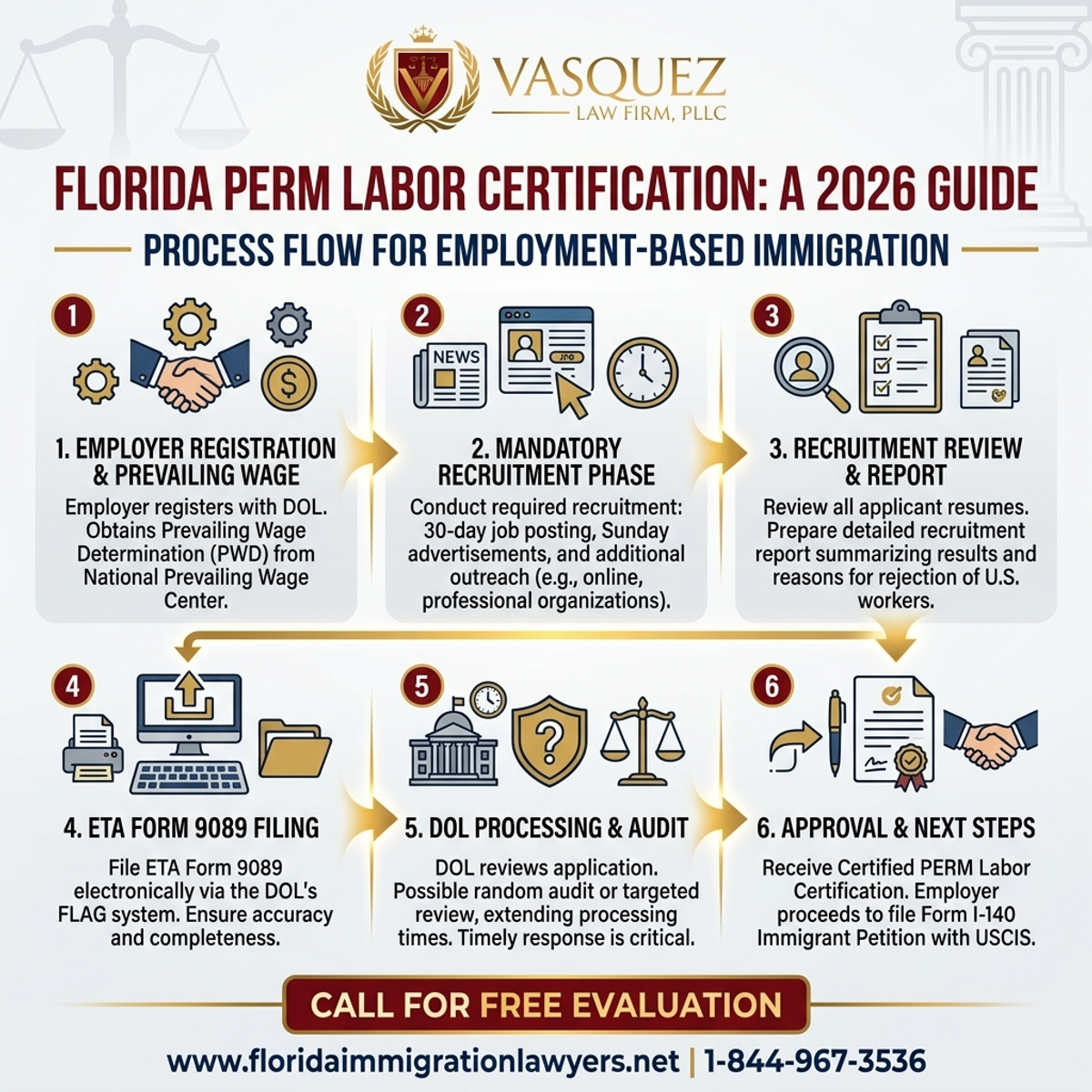
Step-by-Step Process — PERM Labor Certification in Florida: A 2026 Guide
- Prevailing Wage Determination: Employers must obtain a prevailing wage determination from the DOL. This critical step involves submitting a request to the National Prevailing Wage Center (NPWC) to determine the appropriate wage for the specific job in the intended area of employment. The wage must meet or exceed this determined amount to ensure that hiring a foreign worker does not adversely affect the wages of U.S. workers. Factors like job duties, education, experience, and geographic location all play a role in this determination.
- Recruitment: Conduct recruitment efforts and document the process. As detailed above, this involves placing various advertisements and meticulously documenting every aspect of the recruitment process, including the content of ads, placement dates, and the disposition of all U.S. applicants. This phase is typically a 30-day active recruitment period, preceded by other advertising requirements.
- Filing ETA Form 9089: Submit the form to the DOL for certification. Once all recruitment efforts are complete and no qualified U.S. workers have been found, the employer can electronically file ETA Form 9089, Application for Permanent Employment Certification. This form consolidates all information about the job offer, the foreign worker, the recruitment efforts, and the employer's attestations. Accuracy is paramount, as any discrepancies can lead to audits or denials.
- Wait for Approval: The DOL reviews and approves or denies the application. After filing, the DOL reviews the application for compliance with all regulations. This review can result in a certification, a denial, or an audit. An audit requires the employer to submit all supporting documentation to prove compliance. Successfully navigating an an audit often requires expert legal assistance to respond comprehensively and accurately.
What Documents Are Needed for PERM?
As part of the PERM application, employers must prepare a detailed document package. Key documents include:
- Job advertisements and recruitment documentation: This is a comprehensive collection of evidence proving the employer's good faith efforts to recruit U.S. workers. It includes tear sheets or printouts of all newspaper ads, copies of online job postings, the job order placed with the State Workforce Agency, the internal notice of filing, and documentation of any additional recruitment steps taken (e.g., professional journal ads, employee referral program details). Crucially, this package must also contain a detailed recruitment report summarizing all applications received, the qualifications of each applicant, and the specific, job-related reasons for rejecting any U.S. workers.
- Prevailing wage determination: The official document issued by the National Prevailing Wage Center (NPWC) specifying the minimum wage the employer must offer for the position in the specific geographic area. This document is essential for proving that the offered wage meets or exceeds the prevailing wage, thereby protecting U.S. workers' wage standards.
- Completed ETA Form 9089: The electronic application form itself, meticulously filled out with accurate information about the employer, the foreign beneficiary, the job offer, and all recruitment activities. This form serves as the official record of the PERM application and must precisely reflect all supporting documentation.
- Supporting evidence of recruitment efforts: Beyond the ads themselves, this includes internal company documents like the notice of filing posted at the worksite, internal job descriptions, and any company policies related to recruitment. It also encompasses all resumes received from U.S. applicants, interview notes, and formal rejection letters, all maintained in a retrievable format. The thoroughness of this documentation is often the deciding factor in audit situations, emphasizing the need for meticulous record-keeping from the outset. Florida Immigration Lawyers can guide you in compiling and organizing this extensive documentation.
Timeline and Processing Expectations
Understanding the timeline for PERM processing can help in planning. Typically, the process involves several stages:
It's crucial for employers to recognize that the PERM timeline is not static and can be influenced by various factors, including the Department of Labor's workload, the complexity of the job offered, and whether the application is selected for an audit. While the table below provides general estimates, actual processing times can fluctuate significantly. Strategic planning and prompt action at each stage are essential to minimize delays. For instance, a delay in obtaining the prevailing wage or in commencing recruitment can cascade throughout the entire process.
Furthermore, the DOL may issue an audit request if they have questions or concerns about the recruitment process or the job requirements. Responding to an audit adds several months to the overall timeline, as it requires careful compilation and submission of all supporting documentation. Proactive preparation and meticulous record-keeping from the very beginning can help mitigate the risk of an audit or, at least, streamline the response process. Florida Immigration Lawyers are adept at managing these timelines and preparing clients for potential audits, ensuring the process moves as efficiently as possible.
| Stage | Typical Timeframe | Notes |
|---|---|---|
| Prevailing Wage Determination | 2-3 months | Can vary depending on DOL workload |
| Recruitment | 60 days | Must be completed before filing |
| Filing and DOL Processing | 6-9 months | Includes DOL review time |
Sources and References
- U.S. Citizenship and Immigration Services (USCIS)
- Executive Office for Immigration Review (EOIR)
- U.S. Department of State
- Immigration and Nationality Act (INA), 8 U.S.C. Chapter 12
Do Not Navigate This Process Alone
Our experienced immigration attorneys are ready to fight for you. Get a free, confidential case review today.
Se Habla Español
Or leave your details and we’ll call you:
Free Evaluation in 24 Hours
Or talk to us right now

AI voice assistant — available 24/7
FreeFrequently Asked Questions

William J. Vásquez
Founding Attorney · Vasquez Law Firm
U.S. Air Force veteran and immigration attorney with years of hands-on U.S. immigration experience. J.D., NCCU School of Law. AILA member. Admitted to the 4th, 5th, and 11th Circuit Courts.
Available 24/7 - Free Evaluations
Reviewed for legal accuracy by William J. Vásquez
Licensed in North Carolina; U.S. immigration is federal practice.
Related Legal Services
Our Florida immigration attorneys can help you with deportation defense, family immigration services and immigration lawyer cost in Florida. Call today at 1-844-YO-PELEO for a free case review.
Related Links
Related Topics
Free Legal Case Review
Discuss your case with our experienced attorneys. We're available 24/7.
Se Habla Español - Estamos aquí para ayudarle.
Related Articles
DUI Immigration Consequences in Florida 2026
A DUI conviction in Florida can have severe immigration consequences, potentially leading to inadmissibility, deportation, or denial of immigration benefits. For non-citizens, a DUI is not just a traffic offense but a serious criminal matter that federal immigration law scrutinizes closely. Factors like multiple offenses, injury, or property damage can escalate a simple DUI to a Crime Involving Moral Turpitude (CIMT) or even an aggravated felony, triggering mandatory detention and removal proceedings. Understanding the specific nature of your Florida conviction and its interpretation under the Immigration and Nationality Act (INA) is crucial. This article outlines how DUIs impact immigration status, the grounds for inadmissibility and deportation, a step-by-step guide to navigating the process, essential documentation, and expected timelines for 2026. We also highlight common mistakes to avoid and when to seek legal counsel from an experienced immigration attorney. Florida Immigration Lawyers offers comprehensive support for individuals facing these challenging situations, providing expert guidance through complex legal landscapes.
Immigration Lawyer Orlando Free Consultation in Florida
For individuals and families in Orlando, Florida, navigating the complexities of U.S. immigration law requires expert guidance. An immigration lawyer in Orlando offers crucial support for everything from visa applications and green card processes to naturalization and deportation defense. This comprehensive guide details what a free consultation covers, providing a step-by-step overview of immigration pathways, essential document checklists, and expected timelines in 2026. We also highlight common mistakes to avoid, discuss the critical role of legal counsel in deportation and asylum cases, and explain why choosing a local Orlando immigration attorney is beneficial. Florida Immigration Lawyers is dedicated to serving the diverse community of Orlando with compassionate, effective legal solutions, ensuring you receive personalized advice and robust representation for a successful immigration journey.
EAD Advance Parole Combo Card in Florida: What You Need
An EAD advance parole combo card allows individuals with pending adjustment applications to both work and travel abroad without jeopardizing their green card application. Learn how to apply in Florida, what documents you need, and common mistakes to avoid.
Dual Citizenship Lawyer in Florida: What You Need to Know
For Florida residents, the concept of dual citizenship, or holding two passports, offers a compelling blend of opportunities and challenges. While the U.S. generally permits dual nationality, the path to achieving this status requires a meticulous understanding of both U.S. immigration laws and the citizenship policies of your country of origin. This guide explores the definition of dual citizenship, the detailed step-by-step process for U.S. naturalization, and the significant benefits and potential pitfalls involved. We cover essential documentation, typical timelines, and cost considerations for 2026, providing crucial insights for anyone in Orlando, Miami, or across Florida considering this important legal step. Learn about common mistakes to avoid and understand when to seek professional legal counsel to navigate this complex process successfully. Florida Immigration Lawyers is here to provide expert, bilingual support for your dual citizenship journey.