Dual Citizenship Lawyer in Florida: What You Need to Know
For Florida residents, the concept of dual citizenship, or holding two passports, offers a compelling blend of opportunities and challenges. While the U.S. generally permits dual nationality, the path to achieving this status requires a meticulous understanding of both U.S. immigration laws and the citizenship policies of your country of origin. This guide explores the definition of dual citizenship, the detailed step-by-step process for U.S. naturalization, and the significant benefits and potential pitfalls involved. We cover essential documentation, typical timelines, and cost considerations for 2026, providing crucial insights for anyone in Orlando, Miami, or across Florida considering this important legal step. Learn about common mistakes to avoid and understand when to seek professional legal counsel to navigate this complex process successfully. Florida Immigration Lawyers is here to provide expert, bilingual support for your dual citizenship journey.

Dual citizenship in Florida refers to a person holding citizenship in both the United States and another country simultaneously. The U.S. generally permits dual nationality, meaning you do not typically have to renounce your prior citizenship when becoming a U.S. citizen, provided the other country also allows it. A dual citizenship lawyer in Florida can guide you through the complex naturalization process, clarify eligibility requirements, ensure proper documentation, and help you understand the legal implications, including tax obligations and travel considerations, to safeguard your rights and future.
- The U.S. generally allows dual citizenship, but other countries may not.
- Obtaining dual citizenship often involves naturalization in one country while retaining citizenship in another.
- A lawyer can help navigate eligibility, application processes, and potential legal pitfalls.
- Benefits include increased travel freedom and property rights, while challenges may involve tax obligations.
- Florida residents can naturalize through USCIS field offices in Orlando or Miami.
Navigating the complexities of immigration law can be daunting, especially when considering something as significant as dual citizenship. For many residents in Florida, the dream of holding two passports—one for the United States and another for their country of origin—represents a profound connection to their heritage and a pathway to new opportunities. However, the path to achieving dual citizenship is filled with specific legal requirements, potential pitfalls, and nuanced considerations that demand careful attention.
Understanding the rules, benefits, and challenges of dual nationality is crucial for anyone contemplating this important step. From the initial eligibility criteria for U.S. naturalization to the specific laws of your home country, every detail matters. This comprehensive guide, updated for 2026, will demystify the process, provide essential information for those in Florida, and highlight why expert legal guidance is indispensable.
Whether you're a long-term resident in Orlando, Miami, or any other part of the Sunshine State, preparing for naturalization, or simply exploring your options, having the right information is your first step towards success. Do not embark on this journey alone; expert legal advice can make all the difference. Call Florida Immigration Lawyers at 1-844-YO-PELEO for a free case review and let our experienced team illuminate your path to dual citizenship.
What is Dual Citizenship in Florida, and is it Allowed?
Dual citizenship, also known as dual nationality, refers to a person's status as a citizen of two countries simultaneously. In the United States, dual citizenship is generally permitted, meaning that becoming a U.S. citizen does not typically require you to renounce your citizenship in another country. This policy allows individuals in Florida to maintain ties to their country of origin while fully embracing their new life in the U.S.
The U.S. Immigration and Nationality Act (INA) does not explicitly prohibit dual nationality, nor does it explicitly endorse it. Instead, U.S. law is primarily concerned with ensuring that individuals seeking U.S. citizenship demonstrate allegiance to the United States. When taking the Oath of Allegiance, applicants pledge to renounce allegiance to any foreign state. However, the U.S. Supreme Court has interpreted this oath as an expression of intent, not an absolute renunciation of all foreign ties. Therefore, if your country of origin also permits dual citizenship, you may legally hold two passports. It is crucial to understand the laws of both countries involved, as some nations automatically revoke citizenship upon naturalization in another country. For Florida residents, this flexibility offers significant advantages, but it necessitates careful planning and understanding of both U.S. and foreign legal frameworks.
How Do I Obtain Dual Citizenship in Florida?
Obtaining dual citizenship typically involves becoming a citizen of one country while retaining citizenship in another. For many in Florida, this means naturalizing as a U.S. citizen while their home country's laws allow them to keep their original nationality. The primary path for most eligible residents in Florida is through the U.S. naturalization process.
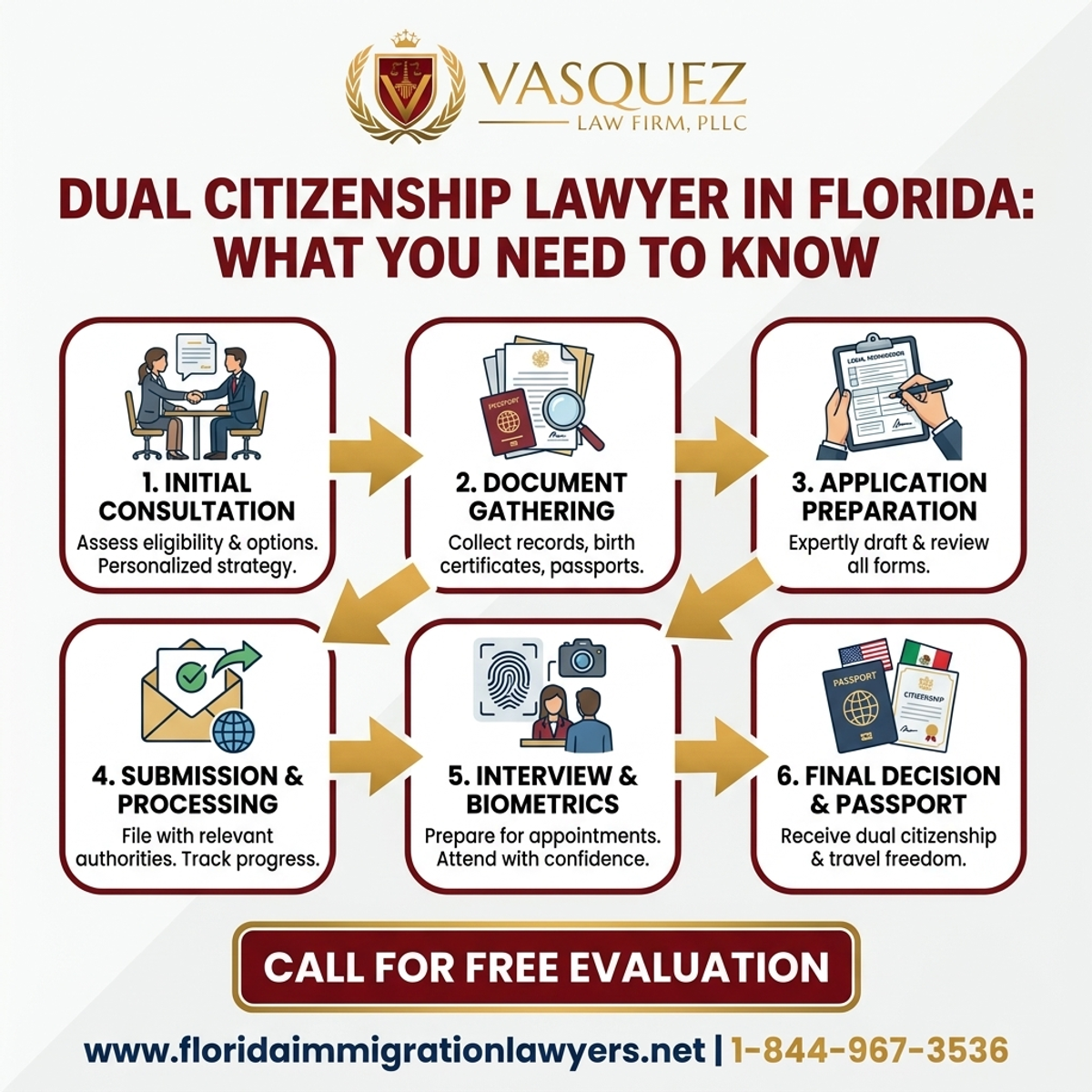
The process of U.S. naturalization requires meeting specific eligibility criteria and successfully completing several steps. As of 2026, the general requirements include being at least 18 years old, holding a Green Card for a specified period (typically five years, or three years if married to a U.S. citizen), demonstrating continuous residence and physical presence in the U.S., showing good moral character, and proving an ability to read, write, and speak basic English, along with a knowledge of U.S. history and government. The journey culminates in taking an Oath of Allegiance to the United States. Here is a step-by-step guide to the U.S. naturalization process:
-
Determine Eligibility for U.S. Naturalization: Review the requirements under 8 U.S.C. § 1427 of the Immigration and Nationality Act. Ensure you meet criteria such as age, continuous residence, physical presence, good moral character, and English/civics proficiency. Certain exemptions may apply, particularly for older applicants or those with specific disabilities.
-
Fulfill Residency and Physical Presence Requirements: You must have been a lawful permanent resident (Green Card holder) for at least five years (or three years if married to and living with a U.S. citizen). Additionally, you must have been physically present in the U.S. for at least half of that period, and resided for at least three months in the state or USCIS district where you apply (e.g., Florida). Extended trips outside the U.S. can impact these requirements.
-
Prepare and File Form N-400, Application for Naturalization: This extensive application form gathers detailed information about your background, residency, travel history, and good moral character. Accuracy is paramount, as any discrepancies or omissions can lead to delays or denial. Supporting documents must be compiled and submitted with the application.
-
Attend Biometrics Appointment: After filing Form N-400, you will receive a notice to attend a biometrics appointment at a local Application Support Center (ASC), such as the one in Orlando, Florida. Here, your fingerprints, photograph, and signature will be collected for background checks by the FBI.
-
Pass the English and Civics Test: During your naturalization interview, you will be tested on your ability to read, write, and speak basic English, and your knowledge of U.S. history and government. The civics test consists of 10 questions from a list of 100, and you must answer at least six correctly. Resources are available on the USCIS website to help you prepare.
-
Attend Naturalization Interview: An interview with a USCIS officer will be scheduled at a field office, such as the USCIS Orlando Field Office or the Miami Field Office, depending on your residence. The officer will review your N-400 application, verify your eligibility, and administer the English and civics tests. They will also ask questions to confirm your good moral character and attachment to the U.S. Constitution.
-
Receive Decision and Attend Oath of Allegiance Ceremony: If your application is approved, you will be scheduled for an Oath of Allegiance ceremony. This is the final step where you officially become a U.S. citizen. You will receive your Certificate of Naturalization at this ceremony. It is at this point that your dual citizenship status is solidified, assuming your country of origin permits it.
-
Maintain Foreign Citizenship (if allowed): After becoming a U.S. citizen, if your original country also allows dual nationality, you will retain your foreign citizenship. It is advisable to consult with an attorney specializing in U.S. Citizenship and foreign law to understand the specific implications and requirements for maintaining both citizenships, including any obligations to your country of origin.
What are the Benefits and Challenges of Holding Two Passports?
Holding two passports offers a range of significant benefits, including increased travel freedom, property rights, and voting, but it also comes with specific challenges such as complex tax obligations and potential military service requirements in your country of origin. Understanding both sides is crucial for making an informed decision about dual citizenship.
For individuals in Florida, the advantages of dual citizenship can be substantial. It provides greater flexibility for international travel, often allowing entry into both countries without the need for visas, and can simplify residency and work permits. Dual citizens may also enjoy expanded property rights, the ability to inherit assets more easily, and access to social benefits in both nations. Furthermore, it allows for political participation, such as voting and holding office, in both countries, fostering a deeper connection to both cultures. However, these benefits come with responsibilities. Dual citizens are typically subject to the laws and tax obligations of both countries, which can lead to complex financial reporting requirements, such as those under the Foreign Account Tax Compliance Act (FATCA) for U.S. citizens. There may also be potential military service obligations in the foreign country, and in rare cases, issues of political allegiance, especially during times of international tension. Consulting with an immigration attorney from Florida Immigration Lawyers can help you weigh these factors carefully.
Step-by-Step Process — Dual Citizenship Lawyer in Florida: What You Need to Know
What Documents Do I Need for Naturalization in Florida?
A comprehensive set of documents is required to support your Form N-400 application for naturalization. Gathering these documents accurately and completely is a critical step in the process, as any missing or incorrect information can lead to significant delays. The specific documents needed can vary based on your individual circumstances, but a general checklist includes:
- Your Permanent Resident Card (Green Card).
- Your state-issued identification (e.g., Florida Driver's License or ID card).
- All passports, both U.S. and foreign, for the last five years (or three years if applying based on marriage to a U.S. citizen).
- Certified copies of any marriage certificates, divorce decrees, or annulment decrees.
- Birth certificates for any children, whether born in the U.S. or abroad.
- Proof of selective service registration (for male applicants aged 18-26).
- Income tax returns or transcripts for the last five years (or three years).
- Certified court records for any arrests, citations, or convictions, even if expunged.
- Proof of payment for any child support or alimony obligations.
- Evidence of your continuous residence and physical presence, such as utility bills, leases, or employment records.
- Travel history documentation, including dates of all trips outside the U.S. and countries visited.
- Any other documents requested by USCIS to support your eligibility.
It is important that all foreign language documents are accompanied by a certified English translation. Organizing these documents meticulously before filing can significantly streamline your application process at the USCIS Orlando Field Office or other locations. For personalized guidance on your specific documentation needs, consider reaching out to Florida Immigration Lawyers.
What is the Timeline and Cost for Dual Citizenship in Florida?
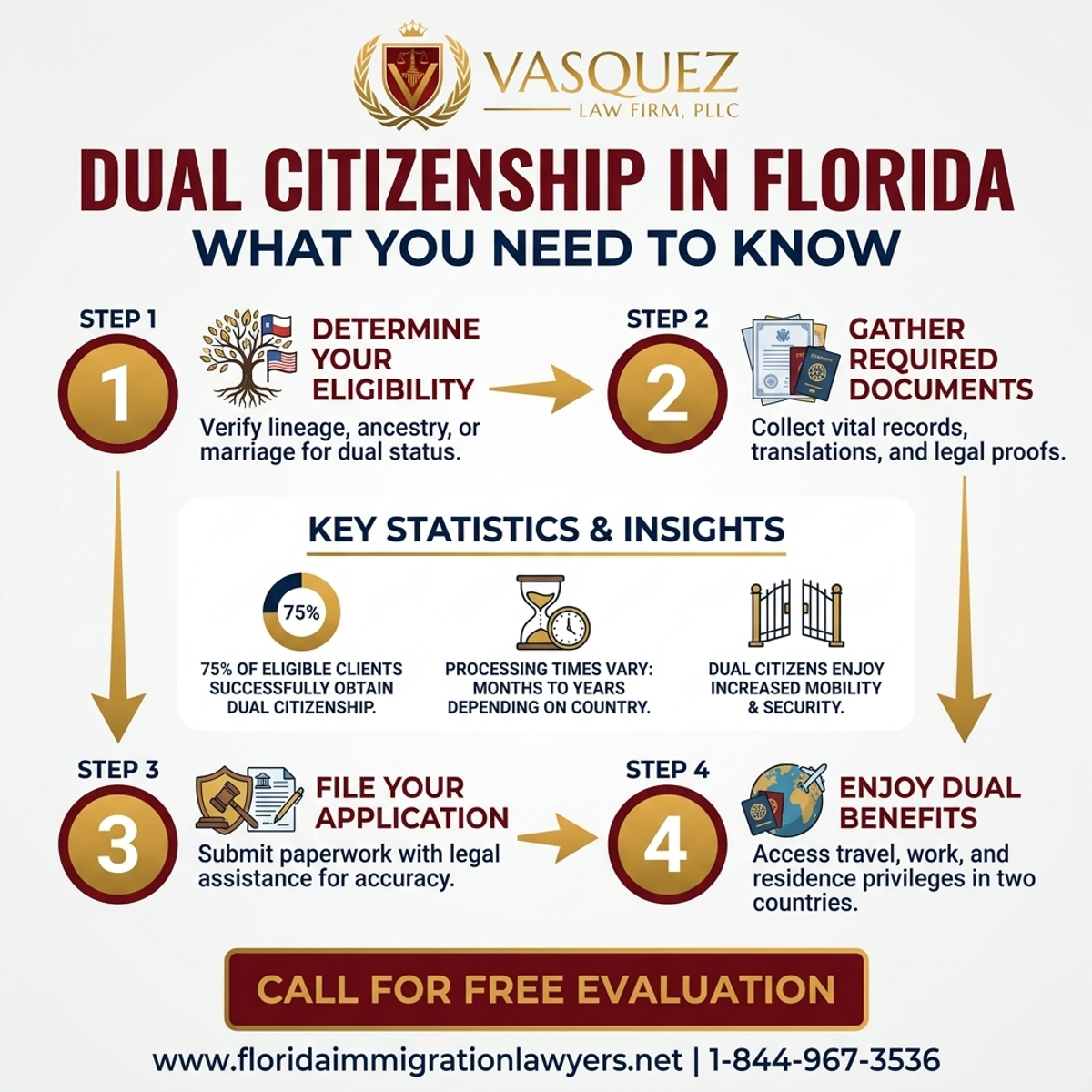
The timeline and cost for obtaining dual citizenship in Florida primarily depend on the U.S. naturalization process, which can vary based on USCIS processing times and individual case complexities. As of 2026, applicants should anticipate several months to over a year for the entire process, alongside specific filing and legal fees.
Processing times for Form N-400, Application for Naturalization, can fluctuate significantly. While USCIS provides estimated processing times, factors such as the volume of applications, the specific USCIS field office (e.g., Orlando vs. Miami), and the completeness of your application can influence the duration. The fees involved include the USCIS filing fee for Form N-400, which is subject to change, and potential fees for biometrics. Additionally, many applicants choose to retain an immigration attorney, incurring legal fees for professional guidance and representation. These costs are an investment in ensuring a smooth and successful application. It is crucial to check the most current fee schedule on the USCIS website before filing.
Timeline and Processing Expectations (As of 2026)
| Stage | Typical Timeframe | Notes |
|---|---|---|
| Form N-400 Filing to Receipt Notice | 1-3 weeks | Acknowledgement of application submission. |
| Receipt Notice to Biometrics Appointment | 4-8 weeks | Appointment at a local Application Support Center (ASC). |
| Biometrics to Interview Notice | 4-12 months | Background checks and scheduling of interview. |
| Interview to Decision | 1-4 months | Immediate decision possible, but often a wait for written notice. |
| Decision to Oath Ceremony | 2-8 weeks | Final step to become a U.S. citizen and receive Certificate of Naturalization. |
| Total Estimated Process | 10-24 months | Varies significantly by USCIS field office (e.g., Orlando, Miami) and case complexity. |
Cost Factors and Fee Breakdown (As of 2026)
| Item | Typical Fee | Notes |
|---|---|---|
| USCIS Form N-400 Filing Fee | Varies (check current USCIS fee schedule) | Required for naturalization application. Fee waivers may be available for eligible applicants. |
| Biometrics Services Fee | Included in N-400 filing fee | Covers fingerprinting and background checks. |
| Attorney Fees | Varies widely based on complexity and firm | For legal advice, document preparation, and representation. Essential for complex cases. |
| Document Translation Costs | Varies by vendor and document volume | Required for non-English documents. Must be certified translations. |
| Medical Exam Fees (if applicable) | Varies by civil surgeon | Only if specific health-related waivers or issues arise. |
Key Statistics — Dual Citizenship Lawyer in Florida: What You Need to Know
These timelines and costs are estimates and can change. For the most up-to-date information and to ensure your financial planning is accurate, always refer to the official USCIS website. Investing in legal counsel can often prevent costly delays and ensure a smoother process.
Do not navigate this process alone. Contact Florida Immigration Lawyers today to discuss your options and get expert guidance for your dual citizenship journey.
Common Mistakes to Avoid When Pursuing Dual Citizenship
The path to dual citizenship can be complex, and even minor errors can lead to significant delays or even denial. Being aware of common pitfalls can help you avoid unnecessary complications.
-
Not Verifying Foreign Country's Dual Citizenship Laws: Assuming your country of origin allows dual citizenship without verifying can lead to the unexpected loss of your original nationality. Always confirm the specific laws of both countries.
-
Incomplete or Inaccurate N-400 Application: Errors, omissions, or inconsistencies on Form N-400 are a leading cause of delays. Double-check every detail and ensure all questions are answered truthfully and completely.
-
Failing to Meet Continuous Residence Requirements: Long absences from the U.S. during the Green Card period can break your continuous residence, making you ineligible for naturalization. Understand the rules for extended travel.
-
Lack of Good Moral Character: Certain criminal offenses, even minor ones, can impact your ability to demonstrate good moral character, a strict requirement for naturalization under 8 U.S.C. § 1427(a). Disclose all legal history truthfully.
-
Not Preparing for English and Civics Tests: Underestimating the difficulty of the English and civics tests can lead to failure. Dedicated study and practice are essential, especially if English is not your first language.
-
Missing Deadlines or Appointments: Failing to respond to USCIS requests for evidence or missing biometrics or interview appointments can result in application denial. Keep track of all correspondence and deadlines.
-
Not Disclosing All Travel History: USCIS requires a complete list of all trips outside the U.S. since becoming a permanent resident. Incomplete travel records can raise red flags during your interview.
-
Improperly Translated Documents: Any foreign language document must be accompanied by a certified English translation. Submitting uncertified or poorly translated documents will cause delays.
-
Not Updating USCIS of Address Changes: You are legally required to notify USCIS of any address changes within 10 days. Failure to do so can result in missed notices and jeopardized application status.
-
Ignoring Tax Obligations: U.S. citizens, including dual citizens, are subject to worldwide taxation. Failing to understand and comply with U.S. tax laws and international reporting requirements (like FATCA) can lead to severe penalties.
-
Attempting to Conceal Foreign Citizenship: The U.S. government does not require you to hide your foreign citizenship. Attempting to do so can be viewed as misrepresentation and have serious consequences for your U.S. immigration status.
When to Call a Dual Citizenship Lawyer in Florida
While the prospect of dual citizenship offers many benefits, the process is rarely straightforward. There are specific scenarios where engaging a Florida immigration lawyer is not just helpful but essential. Our team at Florida Immigration Lawyers is dedicated to providing expert guidance for residents across the state, including those served by the USCIS Orlando Field Office and the Miami Field Office.
You should consider contacting an attorney if you:
- Have a complex immigration history, including previous denials or issues with your Green Card.
- Have any criminal record, even minor arrests or convictions, as this can severely impact your good moral character requirement.
- Have spent significant time outside the U.S. and are concerned about meeting continuous residence or physical presence requirements.
- Are unsure about your eligibility for naturalization or the specific laws of your country of origin regarding dual nationality.
- Need assistance gathering and organizing extensive documentation, especially if foreign documents require certified translations.
- Are facing challenges during the application process, such as requests for additional evidence (RFEs) or notices of intent to deny (NOIDs).
- Have concerns about the naturalization interview or need help preparing for the English and civics tests.
- Want to understand the full implications of dual citizenship, including tax obligations, military service, and travel restrictions.
- Are applying for asylum or deportation defense, which adds layers of complexity to any citizenship application.
Our experienced attorneys can assess your individual situation, identify potential red flags, and develop a robust strategy to maximize your chances of success. We handle all aspects of the naturalization process, ensuring compliance with all U.S. and relevant international laws. With Florida Immigration Lawyers, you gain a trusted advocate committed to protecting your rights and achieving your dual citizenship goals.
About Florida Immigration Lawyers
Florida Immigration Lawyers is a leading law firm dedicated to providing comprehensive and compassionate immigration legal services throughout the state of Florida. With an unwavering commitment to our clients, we understand the profound impact immigration matters have on individuals and families. Our experienced team of attorneys specializes in a wide array of immigration law, from naturalization and family-based visas to complex deportation defense and asylum cases.
Located strategically to serve clients across Central Florida, including Orlando and surrounding areas, our firm is equipped to handle cases involving any USCIS field office or immigration court in the state. We pride ourselves on offering personalized attention, strategic legal advice, and tenacious representation. We are available 24/7, offering free case reviews to help you understand your options without financial commitment. Our bilingual team, fluent in English and Spanish, ensures clear communication and culturally sensitive support every step of the way. When you choose Florida Immigration Lawyers, you're choosing a partner dedicated to fighting for your future. To learn more about our services or to schedule a free consultation, call us at 1-844-YO-PELEO.
Sources and References
- U.S. Citizenship and Immigration Services (USCIS)
- Executive Office for Immigration Review (EOIR)
- U.S. Department of State
- 8 U.S.C. Chapter 12 - Immigration and Nationality Act (INA)
- 8 U.S.C. § 1427 - Requirements for Naturalization
- Code of Federal Regulations (CFR) - Title 8, Aliens and Nationality
- USCIS Policy Manual
Related services: citizenship test preparation, dual citizenship guidance, family-based immigration.
This article provides general legal information and is not intended as legal advice. Every case is unique, and outcomes depend on specific facts and circumstances. Contact an attorney for advice about your particular situation.
Your journey towards dual citizenship in Florida is a significant step, and having knowledgeable legal support is invaluable. Let Florida Immigration Lawyers be your trusted guide. We offer free case reviews and are available 24/7 to answer your questions. Call us today at 1-844-YO-PELEO for a free consultation. Se Habla Espanol - Estamos aqui para ayudarle.
Do Not Navigate This Process Alone
Our experienced immigration attorneys are ready to fight for you. Get a free, confidential case review today.
Se Habla Español
Or leave your details and we’ll call you:
Free Evaluation in 24 Hours
Or talk to us right now

AI voice assistant — available 24/7
FreeFrequently Asked Questions

William J. Vásquez
Founding Attorney · Vasquez Law Firm
U.S. Air Force veteran and immigration attorney with years of hands-on U.S. immigration experience. J.D., NCCU School of Law. AILA member. Admitted to the 4th, 5th, and 11th Circuit Courts.
Available 24/7 - Free Evaluations
Reviewed for legal accuracy by William J. Vásquez
Licensed in North Carolina; U.S. immigration is federal practice.
Related Legal Services
Our Florida immigration attorneys can help you with immigration lawyer cost in Florida, experienced immigration attorneys and asylum protection. Call today at 1-844-YO-PELEO for a free case review.
Related Links
Related Topics
Free Legal Case Review
Discuss your case with our experienced attorneys. We're available 24/7.
Se Habla Español - Estamos aquí para ayudarle.
Related Articles
Immigration Lawyer Orlando Free Consultation in Florida
For individuals and families in Orlando, Florida, navigating the complexities of U.S. immigration law requires expert guidance. An immigration lawyer in Orlando offers crucial support for everything from visa applications and green card processes to naturalization and deportation defense. This comprehensive guide details what a free consultation covers, providing a step-by-step overview of immigration pathways, essential document checklists, and expected timelines in 2026. We also highlight common mistakes to avoid, discuss the critical role of legal counsel in deportation and asylum cases, and explain why choosing a local Orlando immigration attorney is beneficial. Florida Immigration Lawyers is dedicated to serving the diverse community of Orlando with compassionate, effective legal solutions, ensuring you receive personalized advice and robust representation for a successful immigration journey.
EAD Advance Parole Combo Card in Florida 2026
For individuals with a pending Form I-485, Application to Register Permanent Residence or Adjust Status, the EAD Advance Parole Combo Card is an essential document. This single card combines the authorization to work legally in the U.S. (Employment Authorization Document - EAD) with permission to travel internationally and re-enter without abandoning your green card application (Advance Parole). This guide from Florida Immigration Lawyers provides a comprehensive overview for applicants in Florida in 2026, covering eligibility, the step-by-step application process, required documents, expected processing times, and associated costs. We also highlight common mistakes to avoid and when to seek legal counsel to ensure a smooth and successful immigration journey. Understanding this vital card is key to maintaining stability while awaiting your permanent residency approval.
Immigration Backlog Solutions in Florida: 2026 Guide
Facing prolonged immigration backlogs and USCIS delays in Florida can be incredibly challenging. This 2026 guide from Florida Immigration Lawyers offers practical solutions and legal strategies for residents dealing with extended processing times. Learn how to navigate the system, expedite your case, understand current timelines, and avoid common mistakes. From meticulous application preparation to exploring legal remedies like mandamus, we provide actionable advice. Discover how an experienced immigration attorney can be your strongest advocate, offering personalized guidance and fighting for your rights. Get informed and take control of your immigration journey with expert support.
Naturalization Ceremony Locations & Schedule in Florida 2026
For those seeking U.S. citizenship in Florida, understanding the naturalization ceremony locations and schedule for 2026 is a critical final step. This guide from Florida Immigration Lawyers provides comprehensive information on the entire naturalization process, from eligibility and filing Form N-400 to preparing for your interview and attending the oath ceremony. We cover essential requirements, expected timelines, necessary documents, and associated costs. With USCIS field offices in Orlando, Miami, Tampa, and Jacksonville coordinating ceremonies, applicants will receive specific details via Form N-445. Learn how to avoid common mistakes and when to seek professional legal assistance to ensure a smooth and successful journey to becoming a U.S. citizen. Our experienced team is dedicated to guiding you through every stage, offering free case reviews and bilingual support.