DUI Immigration Consequences in Florida 2026
A DUI conviction in Florida can have severe immigration consequences, potentially leading to inadmissibility, deportation, or denial of immigration benefits. For non-citizens, a DUI is not just a traffic offense but a serious criminal matter that federal immigration law scrutinizes closely. Factors like multiple offenses, injury, or property damage can escalate a simple DUI to a Crime Involving Moral Turpitude (CIMT) or even an aggravated felony, triggering mandatory detention and removal proceedings. Understanding the specific nature of your Florida conviction and its interpretation under the Immigration and Nationality Act (INA) is crucial. This article outlines how DUIs impact immigration status, the grounds for inadmissibility and deportation, a step-by-step guide to navigating the process, essential documentation, and expected timelines for 2026. We also highlight common mistakes to avoid and when to seek legal counsel from an experienced immigration attorney. Florida Immigration Lawyers offers comprehensive support for individuals facing these challenging situations, providing expert guidance through complex legal landscapes.
Quick Answer: DUI & Immigration in Florida
A Driving Under the Influence (DUI) conviction in Florida can have profound and often severe immigration consequences, potentially leading to inadmissibility to the U.S., deportability, or denial of immigration benefits like a green card or citizenship. While a single, simple DUI might not always be considered a Crime Involving Moral Turpitude (CIMT), specific aggravating factors—such as injury, multiple offenses, or driving with a suspended license due to a prior DUI—can elevate it to an aggravated felony or a serious criminal offense under immigration law. These consequences are complex and depend heavily on the specifics of the Florida conviction and an individual's immigration history. Seeking immediate legal counsel from an experienced immigration attorney is crucial.
- A single DUI without aggravating factors may not be a CIMT, but multiple DUIs or those with serious injury often are.
- Aggravated felonies, even for misdemeanors under state law, can lead to mandatory detention and deportation.
- DUI convictions can affect visa applications, green card adjustments, and naturalization eligibility.
- Florida DUI laws can interact uniquely with federal immigration statutes, making expert legal advice essential.
- Waivers may be available in some cases, but eligibility is highly restricted and complex.
Navigating the complex intersection of criminal and immigration law in Florida can be daunting, especially when a DUI conviction threatens your immigration status. For non-citizens, a seemingly minor traffic offense like Driving Under the Influence (DUI) carries far more weight than it does for U.S. citizens, potentially jeopardizing years of living and working in the country. In Orlando and across Central Florida, a DUI conviction can trigger a chain of events that leads to inadmissibility, deportation proceedings, or the denial of crucial immigration benefits.
This comprehensive guide from Florida Immigration Lawyers aims to demystify the immigration consequences of a DUI conviction in Florida, offering clarity on potential risks, legal pathways, and essential steps to protect your future. We will explore how different types of DUI offenses are viewed under federal immigration law, outline the processes involved, and discuss the critical role of experienced legal representation. Understanding these nuances is vital for anyone facing a DUI charge while on a visa, green card, or pursuing naturalization.
If you are a non-citizen in Florida facing a DUI charge or dealing with the aftermath of a conviction, do not delay in seeking expert legal guidance. The stakes are incredibly high, and timely intervention can make a significant difference in your immigration case. Call Florida Immigration Lawyers at 1-844-YO-PELEO for a free case review today. Our team is ready to provide the compassionate and strategic representation you need.
How Does a DUI Conviction Impact Immigration Status in Florida?
A DUI conviction can profoundly impact an individual's immigration status, potentially leading to inadmissibility, deportability, or the denial of immigration benefits. The specific consequences depend on the severity of the DUI offense, any aggravating factors, and the individual's current immigration status.
In Florida, a DUI conviction, even for a first offense, can trigger a series of adverse immigration consequences. Federal immigration law, primarily the Immigration and Nationality Act (INA), classifies certain criminal offenses as grounds for inadmissibility (preventing entry or adjustment of status) or deportability (grounds for removal from the U.S.). While a simple, first-time DUI without aggravating factors is typically not considered a Crime Involving Moral Turpitude (CIMT) by itself, multiple DUIs, DUIs involving injury or death, or DUIs combined with other offenses (like driving without a license) can lead to far more severe classifications. For example, a DUI that results in serious bodily injury might be deemed an aggravated felony under immigration law, even if it's a misdemeanor under Florida state law. This distinction is critical because an aggravated felony conviction often leads to mandatory detention, no bond eligibility, and mandatory deportation, with very limited options for relief. Understanding the specific nature of your Florida DUI conviction and how it is interpreted by federal immigration authorities, such as USCIS or the Executive Office for Immigration Review (EOIR), is the first step in assessing your risks and formulating a defense strategy. The impact extends to all stages of the immigration process, from initial visa applications to green card renewals and naturalization.
What Are the Grounds for Inadmissibility and Deportation Related to DUIs?
DUI convictions can lead to inadmissibility or deportability primarily through classifications such as Crimes Involving Moral Turpitude (CIMT), aggravated felonies, or multiple criminal convictions. The specific immigration consequences hinge on how the Florida DUI statute aligns with federal immigration definitions.
Federal immigration law outlines several categories under which a non-citizen can be deemed inadmissible or deportable due to criminal activity. For DUI convictions, the most common grounds include Crimes Involving Moral Turpitude (CIMT) and aggravated felonies. A single, uncomplicated DUI conviction is generally not considered a CIMT. However, if the DUI involved aggravating factors such as reckless driving, injury to another person, property damage, or a combination with other criminal elements (e.g., driving with a suspended license knowing it's suspended due to a prior DUI), it can be reclassified as a CIMT. A conviction for a CIMT can lead to inadmissibility under INA Section 212(a)(2)(A)(i)(I) or deportability under INA Section 237(a)(2)(A)(i) if committed within five years of admission and punishable by a year or more. More critically, a DUI conviction, particularly a felony DUI in Florida (e.g., third DUI within 10 years, DUI with serious bodily injury, or vehicular homicide), can be classified as an aggravated felony under INA Section 101(a)(43). This is a severe designation, as an aggravated felony conviction often results in mandatory detention, no eligibility for most forms of relief, and mandatory deportation under INA Section 237(a)(2)(A)(iii). Even certain misdemeanors under Florida law can be considered aggravated felonies under federal immigration law if they meet specific criteria, such as a crime of violence for which the term of imprisonment is at least one year. Furthermore, multiple criminal convictions, even if individually minor, can be a ground for deportability under INA Section 237(a)(2)(A)(ii). It is crucial to analyze the specific Florida statute under which you were convicted and the judicial findings to determine its precise impact on your immigration case. Consulting with an attorney who understands both Florida criminal law and federal immigration law is paramount to understanding and defending against these severe consequences.
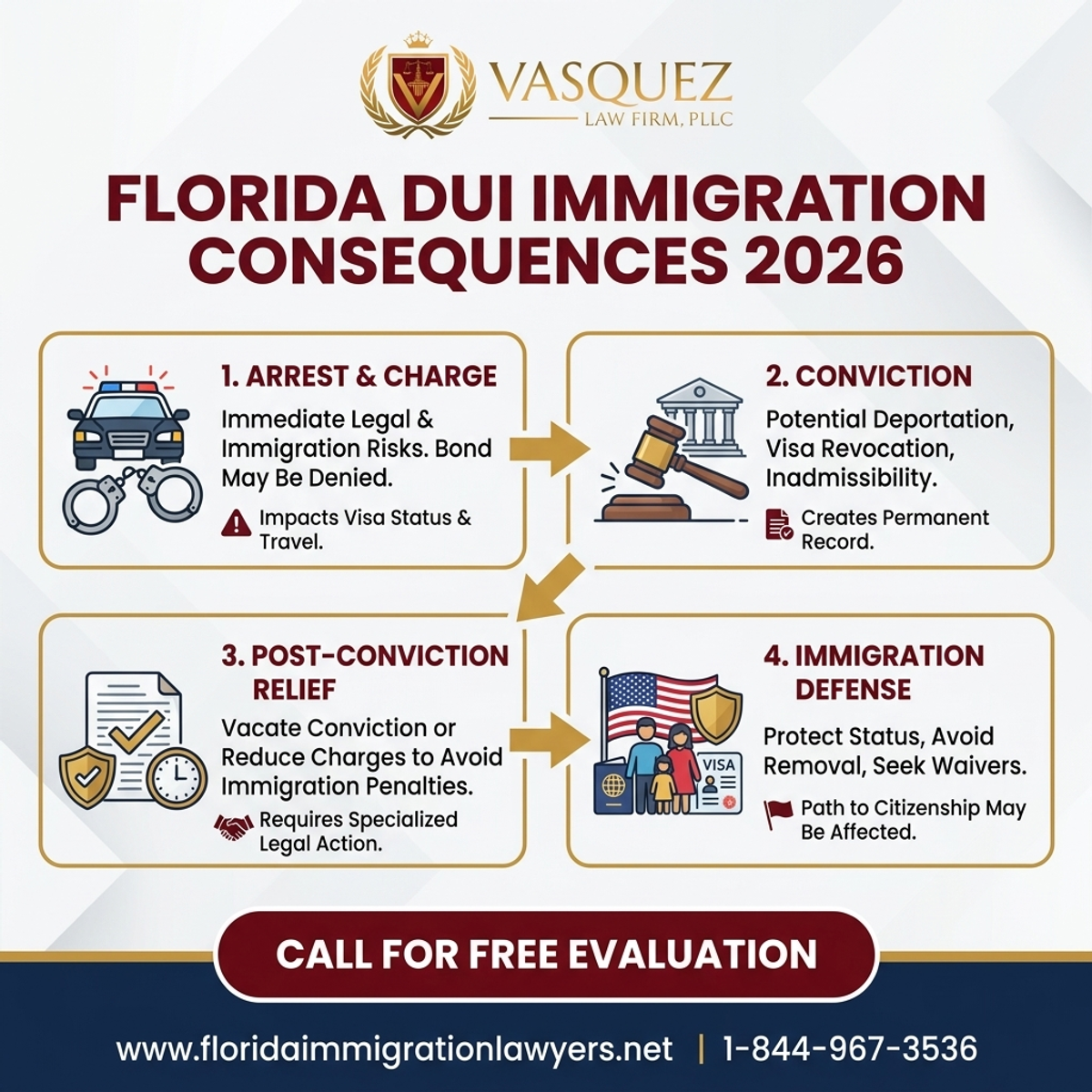
Step-by-Step Process — DUI Immigration Consequences in Florida 2026
Navigating the Immigration Process After a DUI: A Step-by-Step Guide
Successfully navigating the immigration process after a DUI conviction in Florida requires meticulous attention to detail, strategic legal planning, and a deep understanding of both state and federal laws. This multi-step process often begins with the criminal charge itself and extends through various immigration proceedings.
-
Immediate Legal Consultation (Criminal & Immigration): As soon as you are charged with a DUI in Florida, contact both a criminal defense attorney and an immigration lawyer. Your criminal attorney can advise on how to mitigate the criminal charges, while your immigration attorney will explain the potential immigration consequences of different plea bargains or convictions. The goal is to achieve an outcome in criminal court that is least damaging to your immigration status. This might involve exploring options like a plea to a lesser charge that does not carry immigration penalties, if available and advisable.
-
Criminal Case Resolution: Your criminal case will proceed through Florida's court system. This could involve arraignment, pre-trial motions, plea negotiations, or a trial. The final conviction, whether by plea or verdict, will dictate the specific immigration consequences. Even if the criminal case seems resolved, the immigration implications can linger for years, affecting future applications or leading to removal proceedings.
-
Immigration Status Assessment: After your criminal case is resolved, your immigration attorney will conduct a thorough assessment of your current immigration status, the nature of your conviction, and how it impacts any pending or future immigration applications. This involves reviewing court documents, police reports, and your entire immigration history. They will determine if the conviction renders you inadmissible or deportable.
-
Addressing Inadmissibility or Deportability: If the DUI conviction makes you inadmissible or deportable, your attorney will explore available waivers or relief options. For example, waivers under INA Section 212(h) might be available for certain CIMT convictions if extreme hardship to a qualifying relative can be proven. However, waivers are often unavailable for aggravated felonies. If you are placed in removal proceedings before an Immigration Judge at an EOIR court, such as the one in Orlando, your attorney will represent you and present your defense.
-
Application for Immigration Benefits (if applicable): If you are applying for a green card, visa, or naturalization, the DUI conviction must be disclosed. USCIS will review your criminal record to determine your eligibility. For naturalization, a DUI can affect your ability to prove Good Moral Character (GMC), which is a prerequisite for U.S. citizenship. Even if a waiver is not needed, the conviction can cause significant delays and require additional evidence or interviews.
-
Compliance and Monitoring: Even after resolving immediate issues, it's crucial to comply with all terms of probation and any immigration requirements. Your immigration attorney can help monitor changes in immigration law or policy that might affect your case and advise on future steps.
Required Documents and Evidence for a DUI-Affected Immigration Case
When dealing with immigration consequences stemming from a Florida DUI conviction, meticulous documentation is paramount. Gathering and presenting the correct evidence is critical for any application or defense strategy, whether you are applying for a benefit, seeking a waiver, or defending against deportation.
Your immigration attorney will require a comprehensive set of documents to properly analyze your situation and build a robust case. These documents typically include:
- Certified Court Disposition: An official, certified copy of the final disposition of your DUI case from the Florida court. This document outlines the charges, the plea entered, the verdict, and the sentence imposed. It is the most critical piece of evidence.
- Police Report and Arrest Records: Copies of the police report, arrest affidavit, and any other law enforcement records related to your DUI. These documents provide details about the incident, which can be crucial in determining how the conviction is classified under immigration law.
- Plea Agreement Transcript: If you entered a plea bargain, a copy of the plea agreement and the transcript of the plea colloquy (the court discussion where you entered your plea). This helps establish the elements of the crime you admitted to.
- Sentencing Order: The official order detailing your sentence, including fines, probation terms, community service, and any jail time served.
- Proof of Completion of Sentence: Documentation showing that you have completed all aspects of your sentence, such as a certificate of completion for DUI school, proof of fine payment, or probation discharge papers. This demonstrates rehabilitation and good moral character.
- Immigration Records: Your complete immigration file, including all previous visa applications, green card applications, entry/exit records, and any notices from USCIS or EOIR.
- Personal Statements and Character References: Affidavits or letters from family, friends, employers, or community leaders attesting to your good character, rehabilitation efforts, and contributions to the community.
- Evidence of Rehabilitation: Documentation of any counseling, substance abuse treatment, or educational programs you have voluntarily undertaken since the conviction.
- Proof of Family Ties and Hardship (if applicable): If seeking a waiver (e.g., I-601 waiver for inadmissibility), you will need extensive evidence of family relationships, the extreme hardship your U.S. citizen or lawful permanent resident spouse or parent would face if you were removed, and other compelling factors.
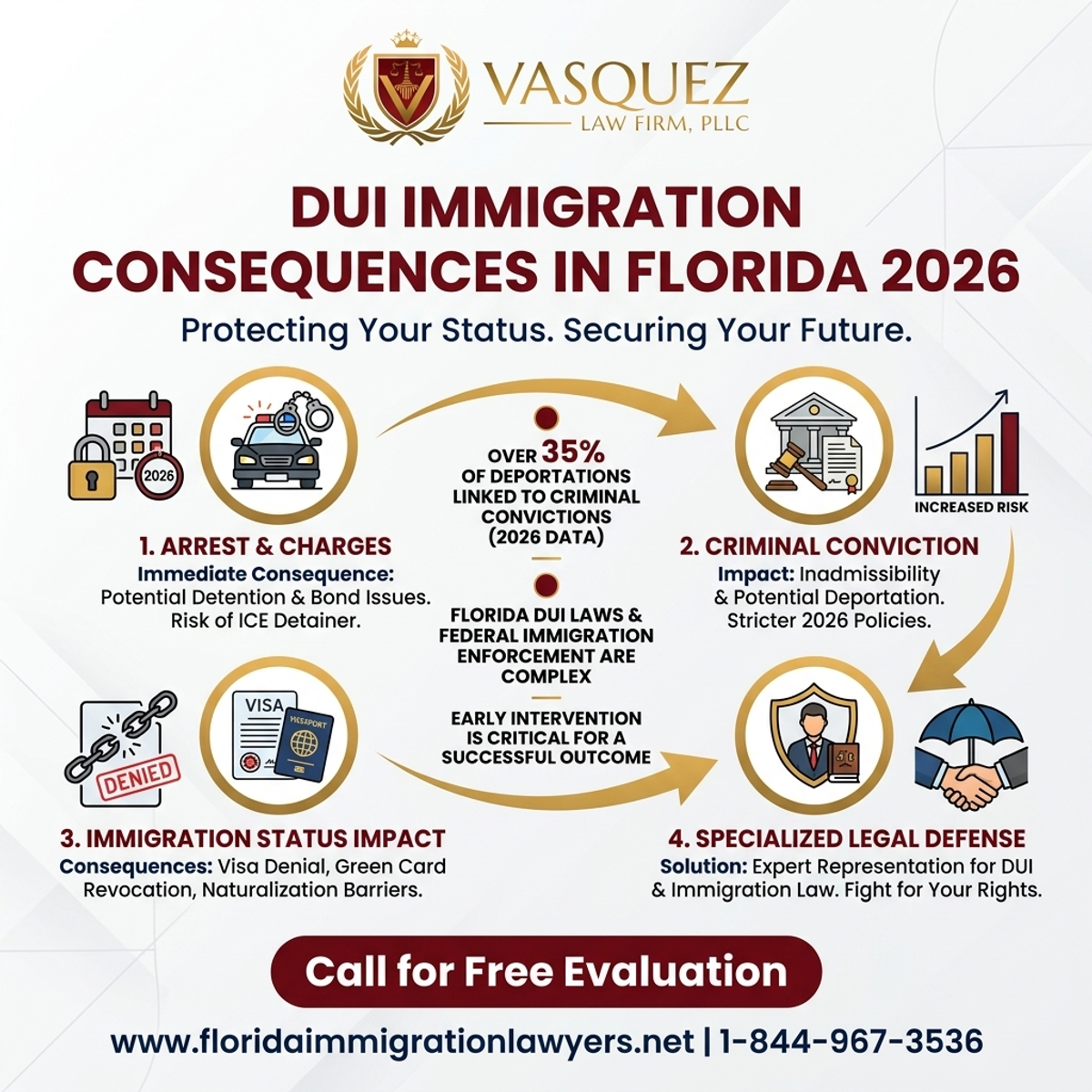
Key Statistics — DUI Immigration Consequences in Florida 2026
It is crucial that all foreign-language documents are accompanied by certified English translations. Your attorney at Florida Immigration Lawyers will guide you through gathering these essential documents to ensure your case is presented thoroughly and accurately to immigration authorities.
DUI Immigration Case Timelines and What to Expect in 2026
The timeline for immigration cases involving a DUI conviction in Florida can vary significantly depending on multiple factors, including the type of immigration benefit sought, the severity of the DUI, and the specific USCIS field office or EOIR court handling the case. As of 2026, applicants should anticipate potential delays due to increased scrutiny of criminal records.
Understanding the typical timeframes can help manage expectations, though it's important to remember that each case is unique. Here is a general overview of what to expect:
| Stage | Typical Timeframe | Notes |
|---|---|---|
| Criminal Case Resolution | 6 months - 2+ years | Depends on complexity, court backlog in Florida (e.g., Orlando courts), and whether the case goes to trial. |
| Immigration Impact Assessment | 1-3 weeks | After criminal case resolution, an attorney reviews all documents to determine immigration consequences. |
| Filing Immigration Applications/Waivers | 2-6 months | Time to prepare and file forms like I-485 (Adjustment of Status), I-130 (Petition for Alien Relative), I-601 (Waiver of Grounds of Inadmissibility). |
| USCIS Processing (Adjustment of Status, Naturalization) | 12 months - 3+ years | Varies greatly by form type, service center, and field office (e.g., USCIS Orlando Field Office). Criminal history often prolongs processing. |
| Removal Proceedings (EOIR) | 18 months - 5+ years | If placed in deportation proceedings, cases before an Immigration Judge (e.g., Orlando Immigration Court) can be lengthy due to continuances and appeals. |
| Appeals (BIA, Federal Courts) | 1-3+ years | If an adverse decision is appealed to the Board of Immigration Appeals (BIA) or federal circuit courts, additional significant time is added. |
| Consular Processing (Outside U.S.) | 6 months - 2+ years | If applying for a visa abroad, processing times at U.S. consulates vary, and a DUI can require additional administrative processing or a waiver. |
These timelines are estimates and can be influenced by policy changes, agency backlogs, and the specific facts of your case. Proactive engagement with an immigration attorney from Florida Immigration Lawyers is essential to anticipate and mitigate delays, ensuring all documentation is accurate and submitted promptly.
Costs and Fees Associated with DUI Immigration Cases
The financial costs associated with an immigration case impacted by a DUI conviction in Florida can be substantial, encompassing government filing fees, legal representation fees, and potential expenses for expert witnesses or other necessary services. These costs vary widely based on the complexity of the case and the legal strategies employed.
It is important to understand that while government filing fees are generally fixed (though subject to change), legal fees will depend on the extent of work required by your attorney. Below is a breakdown of typical cost factors:
| Item | Typical Fee | Notes |
|---|---|---|
| USCIS Filing Fees | Varies by form (e.g., I-485, I-130, I-601) | Required for applications like adjustment of status, relative petitions, or waivers. Fees are set by USCIS and are non-refundable. Check the USCIS website for current amounts. |
| EOIR Filing Fees | Varies by form (e.g., BIA appeal) | If your case proceeds to Immigration Court or involves an appeal to the Board of Immigration Appeals. |
| Attorney Fees (Criminal Defense) | $3,000 - $15,000+ | For representation in Florida criminal court to mitigate the DUI charge. Varies based on attorney experience, case complexity, and whether it goes to trial. |
| Attorney Fees (Immigration) | $4,000 - $25,000+ | For representation in immigration proceedings, including inadmissibility waivers, adjustment of status with criminal history, or removal defense. Highly dependent on case complexity, number of hearings, and appeals. |
| Court Record Fees | $10 - $100+ | For obtaining certified copies of court dispositions, police reports, and other necessary criminal records from Florida courts. |
| Translation Services | $20 - $50 per page | If any documents are not in English, certified translations are required. |
| Expert Witness Fees | $500 - $5,000+ | In complex cases, an expert witness (e.g., for drug/alcohol evaluation, psychological evaluation for hardship) may be necessary. |
| Travel Expenses | Varies | For attending interviews at USCIS field offices (like Orlando) or hearings at Immigration Court. |
These costs can add up quickly, making transparent communication with your legal team about fees and payment structures essential. Florida Immigration Lawyers offers free case reviews to help you understand the potential costs involved and develop a strategic plan.
Do not navigate this process alone. The complexities of immigration law combined with criminal convictions demand specialized expertise. Contact Florida Immigration Lawyers today to protect your rights and explore your options. Our dedicated team is here to provide the guidance you need.
Common Mistakes to Avoid in DUI Immigration Cases
Navigating a DUI charge when you are a non-citizen involves unique challenges, and making missteps can have irreversible consequences for your immigration future. Avoiding these common mistakes is crucial for protecting your status:
-
Failing to Disclose a DUI Conviction: Many individuals mistakenly believe that if a DUI is a misdemeanor or occurred long ago, it doesn't need to be disclosed on immigration forms. This is a critical error. Any criminal history, including DUIs, must be fully and truthfully disclosed to USCIS or a U.S. consular officer. Failure to disclose can lead to charges of misrepresentation or fraud, which are separate grounds for inadmissibility and deportability, often more severe than the DUI itself.
-
Not Understanding the Immigration Impact of a Plea: Accepting a plea bargain in criminal court without first consulting an immigration attorney is a significant mistake. What seems like a favorable plea in state court (e.g., reducing jail time) might inadvertently trigger severe immigration consequences, such as making you deportable as an aggravated felon. An immigration attorney can advise on pleas that minimize immigration harm.
-
Assuming a DUI is Never a CIMT or Aggravated Felony: While a simple, first-time DUI may not be a Crime Involving Moral Turpitude (CIMT), specific aggravating factors (like injury, property damage, multiple offenses, or driving with a suspended license due to a prior DUI) can elevate it to a CIMT or even an aggravated felony under immigration law. Do not make assumptions; always seek expert legal analysis.
-
Delaying Legal Consultation: Waiting to consult an immigration attorney until after your criminal case is resolved or until you receive a Notice to Appear (NTA) can severely limit your options. Early intervention allows your criminal defense attorney to factor in immigration consequences during plea negotiations and allows your immigration attorney to prepare a proactive strategy.
-
Traveling Internationally Without Legal Advice: If you have a DUI conviction, attempting to travel outside the U.S. without first consulting an immigration attorney is risky. You could be denied re-entry at the border or face challenges at a U.S. consulate if applying for a new visa, as your conviction will be scrutinized. Always confirm your eligibility for re-entry.
-
Not Gathering All Criminal Records: Immigration authorities require certified copies of all court documents related to your DUI, including the arrest report, charging documents, plea agreement, and final disposition. Failing to provide complete and accurate records can lead to delays or denials.
-
Misinterpreting State vs. Federal Law: What constitutes a misdemeanor or felony under Florida state law may be interpreted differently under federal immigration law. For instance, a Florida misdemeanor DUI with certain elements could be considered an aggravated felony for immigration purposes. This crucial distinction often trips up individuals and even attorneys unfamiliar with immigration law.
-
Failing to Complete Your Sentence: Non-compliance with the terms of your Florida DUI sentence (e.g., not completing DUI school, not paying fines, violating probation) can negatively impact your ability to demonstrate good moral character for naturalization or other benefits, and can even lead to further criminal charges.
-
Self-Representation in Immigration Court: Immigration court proceedings are highly complex and adversarial. Representing yourself, especially with a criminal conviction on your record, significantly reduces your chances of a favorable outcome. An experienced attorney can identify defenses and forms of relief you might not be aware of.
When to Call a Lawyer for DUI Immigration Issues
The moment you are charged with a DUI in Florida, or if you have a past DUI conviction and are concerned about its impact on your immigration status, it is imperative to contact an immigration attorney. The complexities of how state criminal law interacts with federal immigration law are vast, and specific scenarios demand immediate legal intervention to protect your future.
You should call Florida Immigration Lawyers immediately if:
- You have been arrested or charged with a DUI in Florida, regardless of whether it's your first offense or if there were aggravating factors.
- You have a past DUI conviction and are applying for a green card, visa, or U.S. citizenship.
- You are a lawful permanent resident with a DUI conviction and are facing deportation proceedings or are concerned about re-entering the U.S. after international travel.
- USCIS has issued a Request for Evidence (RFE) or Notice of Intent to Deny (NOID) regarding your immigration application due to a DUI or other criminal record.
- You have received a Notice to Appear (NTA) in Immigration Court in Orlando or any other location, indicating that the government intends to deport you.
- You are seeking to understand if a DUI conviction makes you inadmissible or deportable and what waivers, if any, might be available to you.
- You are considering a plea bargain for a DUI charge and need to understand its potential immigration consequences before accepting.
Our attorneys at Florida Immigration Lawyers specialize in these intricate cases. We understand the unique challenges faced by non-citizens in Central Florida and across the state. We can provide a comprehensive assessment of your situation, advise on the best course of action, and represent you vigorously in both criminal and immigration proceedings. Do not take chances with your immigration status; let our expertise guide you.
About Florida Immigration Lawyers
Florida Immigration Lawyers is a leading immigration law firm dedicated to serving individuals and families throughout Florida. With a deep understanding of U.S. immigration laws and a commitment to our clients, we provide compassionate, effective, and personalized legal representation. Our experienced attorneys are well-versed in the complexities of immigration law, including the critical intersection of criminal convictions like DUIs and immigration status.
We pride ourselves on our client-focused approach, offering strategic advice and vigorous advocacy to help you navigate even the most challenging immigration matters. From family-based petitions and business visas to asylum claims, deportation defense, and citizenship applications, we cover a broad spectrum of immigration practice areas. We understand that every case is unique, and we tailor our strategies to meet your specific needs and goals. Our firm is available 24/7, offering free case reviews to ensure you have access to expert legal counsel when you need it most. We serve clients across all of Florida, including those residing in Orlando and the wider Central Florida region, and are proud to offer bilingual services. For dedicated and knowledgeable representation, trust Florida Immigration Lawyers.
Sources and References
- U.S. Citizenship and Immigration Services (USCIS)
- Executive Office for Immigration Review (EOIR)
- U.S. Department of State
- 8 U.S.C. § 1182 - Grounds for Inadmissibility (Immigration and Nationality Act Section 212)
- 8 U.S.C. § 1227 - Grounds for Deportation (Immigration and Nationality Act Section 237)
- 8 U.S.C. § 1101(a)(43) - Definition of Aggravated Felony (Immigration and Nationality Act Section 101(a)(43))
- Florida Statutes Chapter 316 - State Uniform Traffic Control (DUI offenses)
- Matter of Jean, 23 I&N Dec. 373 (AG 2002) - BIA precedent regarding Crimes Involving Moral Turpitude
Related services: asylum and refugee protection, immigration waivers, humanitarian protection programs, DACA renewal and applications.
This article provides general legal information and is not intended as legal advice. Every case is unique, and outcomes depend on specific facts and circumstances. Contact an attorney for advice about your particular situation.
A DUI conviction can cast a long shadow over your immigration journey in Florida, but you don't have to face it alone. The experienced immigration attorneys at Florida Immigration Lawyers are here to offer the strategic guidance and robust representation you need. We understand the nuances of these complex cases and are committed to protecting your rights and your future. Don't let a DUI derail your dreams. Take the first step towards a secure future by contacting us today.
Call Florida Immigration Lawyers at 1-844-YO-PELEO for a free case review. Se Habla Espanol - Estamos aqui para ayudarle.
If you need legal assistance, learn more about speak with a deportation defense lawyer, or call us at 1-844-967-3536 for a free case review.
Do Not Navigate This Process Alone
Our experienced immigration attorneys are ready to fight for you. Get a free, confidential case review today.
Se Habla Español
Or leave your details and we’ll call you:
Free Evaluation in 24 Hours
Or talk to us right now

AI voice assistant — available 24/7
FreeFrequently Asked Questions

William J. Vásquez
Founding Attorney · Vasquez Law Firm
U.S. Air Force veteran and immigration attorney with years of hands-on U.S. immigration experience. J.D., NCCU School of Law. AILA member. Admitted to the 4th, 5th, and 11th Circuit Courts.
Available 24/7 - Free Evaluations
Reviewed for legal accuracy by William J. Vásquez
Licensed in North Carolina; U.S. immigration is federal practice.
Related Legal Services
Our Florida immigration attorneys can help you with family immigration services, immigration lawyer cost in Florida and experienced immigration attorneys. Call today at 1-844-YO-PELEO for a free case review.
Related Links
Related Topics
Free Legal Case Review
Discuss your case with our experienced attorneys. We're available 24/7.
Se Habla Español - Estamos aquí para ayudarle.
Related Articles
Dual Citizenship Lawyer in Florida: What You Need to Know
For Florida residents, the concept of dual citizenship, or holding two passports, offers a compelling blend of opportunities and challenges. While the U.S. generally permits dual nationality, the path to achieving this status requires a meticulous understanding of both U.S. immigration laws and the citizenship policies of your country of origin. This guide explores the definition of dual citizenship, the detailed step-by-step process for U.S. naturalization, and the significant benefits and potential pitfalls involved. We cover essential documentation, typical timelines, and cost considerations for 2026, providing crucial insights for anyone in Orlando, Miami, or across Florida considering this important legal step. Learn about common mistakes to avoid and understand when to seek professional legal counsel to navigate this complex process successfully. Florida Immigration Lawyers is here to provide expert, bilingual support for your dual citizenship journey.
Immigration Lawyer Orlando Free Consultation in Florida
For individuals and families in Orlando, Florida, navigating the complexities of U.S. immigration law requires expert guidance. An immigration lawyer in Orlando offers crucial support for everything from visa applications and green card processes to naturalization and deportation defense. This comprehensive guide details what a free consultation covers, providing a step-by-step overview of immigration pathways, essential document checklists, and expected timelines in 2026. We also highlight common mistakes to avoid, discuss the critical role of legal counsel in deportation and asylum cases, and explain why choosing a local Orlando immigration attorney is beneficial. Florida Immigration Lawyers is dedicated to serving the diverse community of Orlando with compassionate, effective legal solutions, ensuring you receive personalized advice and robust representation for a successful immigration journey.
EAD Advance Parole Combo Card in Florida 2026
For individuals with a pending Form I-485, Application to Register Permanent Residence or Adjust Status, the EAD Advance Parole Combo Card is an essential document. This single card combines the authorization to work legally in the U.S. (Employment Authorization Document - EAD) with permission to travel internationally and re-enter without abandoning your green card application (Advance Parole). This guide from Florida Immigration Lawyers provides a comprehensive overview for applicants in Florida in 2026, covering eligibility, the step-by-step application process, required documents, expected processing times, and associated costs. We also highlight common mistakes to avoid and when to seek legal counsel to ensure a smooth and successful immigration journey. Understanding this vital card is key to maintaining stability while awaiting your permanent residency approval.
DUI and Immigration Lawyer: Consequences in Florida 2026
A DUI conviction in Florida can dramatically jeopardize an immigrant's legal status, leading to severe consequences such as inadmissibility, deportation, or denial of green cards and citizenship. This article, from Florida Immigration Lawyers, provides a comprehensive overview of how DUI charges intersect with U.S. immigration law, outlining the specific impacts on various immigration statuses, the dual criminal and immigration processes involved, and the critical documents required. We explore potential waivers and relief options available, highlight common mistakes to avoid, and emphasize the urgent need for specialized legal counsel. For non-citizens in Florida, including those in Central Florida, understanding these complex legal implications and securing experienced representation is paramount to safeguarding their future in the U.S.