Removal Proceedings Defense Lawyer Florida: 2026 Guide
Receiving a Notice to Appear (NTA) for immigration removal proceedings in Florida can be terrifying, signaling the start of a complex legal battle to avoid deportation. This comprehensive 2026 guide provides essential information on what removal proceedings entail, the step-by-step process in Florida immigration courts, and the critical role of a skilled defense lawyer. Learn about key defense strategies like Cancellation of Removal, asylum, and waivers, and understand the crucial documents and evidence required for your case. We also detail typical timelines and cost factors, as well as common mistakes to avoid that could jeopardize your ability to remain in the U.S. Florida Immigration Lawyers are dedicated to protecting your rights and fighting for your future. Don't navigate this challenging journey alone; understand your options and secure expert legal representation.
Immigration removal proceedings in Florida are formal legal processes initiated by the U.S. government to deport non-citizens from the country. These proceedings typically begin with a Notice to Appear (NTA) and unfold in immigration courts, such as those in Miami or Orlando. Defending against removal requires intricate knowledge of immigration law, including various forms of relief like Cancellation of Removal, asylum, waivers, or adjustment of status. An experienced removal proceedings defense lawyer Florida is crucial to navigate these complex procedures, present compelling evidence, and protect your rights, significantly increasing your chances of a favorable outcome in 2026.
- Removal proceedings are formal legal actions to deport non-citizens.
- The process starts with a Notice to Appear (NTA) and occurs in immigration court.
- Key defenses include Cancellation of Removal, asylum, waivers, and adjustment of status.
- Expert legal representation is vital to protect your rights and navigate complex laws.
- Florida Immigration Lawyers offer comprehensive support for individuals facing deportation.
Facing immigration removal proceedings can be one of the most frightening and stressful experiences imaginable. The threat of deportation from the United States, leaving behind your family, job, and life, is a daunting prospect. For many non-citizens in Florida, receiving a Notice to Appear (NTA) in immigration court signals the start of a complex and often overwhelming legal battle. Understanding your rights and the available defense strategies is paramount to protecting your future.
This comprehensive guide, updated for 2026, will demystify immigration removal proceedings in Florida. We will explore the process, common defense strategies, essential documentation, and what to expect regarding timelines and costs. Our goal is to empower you with the knowledge needed to face these challenges. Remember, you do not have to navigate this alone. For immediate assistance and a free case review, call Florida Immigration Lawyers at 1-844-YO-PELEO today.
What Are Immigration Removal Proceedings in Florida and How Do They Work?
Immigration removal proceedings are the formal legal mechanisms through which the U.S. government seeks to deport non-citizens from the country. These proceedings are presided over by an Immigration Judge within the Executive Office for Immigration Review (EOIR), distinct from federal criminal courts. In Florida, individuals typically face these proceedings at the Miami Immigration Court or, less commonly, through video conferences to other courts, especially for those detained in facilities like Krome Service Processing Center.
The process generally begins when U.S. Immigration and Customs Enforcement (ICE) issues a Notice to Appear (NTA), which is a charging document outlining why the government believes you are removable. As defined under 8 U.S.C. § 1229a (INA Section 240), these proceedings are adversarial, meaning the government (represented by an ICE attorney) acts as a prosecutor, and you (the respondent) are the defendant. The Immigration Judge acts as a neutral arbiter, deciding whether you are removable and if any forms of relief from removal apply to your case. A skilled removal proceedings defense lawyer Florida can significantly impact the outcome by challenging the government's allegations and presenting your case for relief.
How Can a Florida Immigration Lawyer Defend Against Deportation?
An experienced Florida immigration lawyer can employ various strategies to defend against deportation, tailoring the approach to your specific circumstances. The goal is always to demonstrate that you are either not removable under the law or that you qualify for a form of relief that allows you to remain in the U.S. These defenses are complex and require a deep understanding of immigration statutes and case law, making legal representation indispensable. For example, if you are a lawful permanent resident, you may be eligible for Cancellation of Removal for Certain Permanent Residents, as outlined in 8 U.S.C. § 1229b(a) (INA 240A(a)).
Common defense strategies include challenging the Notice to Appear, arguing that you are not deportable as charged, or seeking affirmative relief. Affirmative relief options often include Cancellation of Removal for Non-Permanent Residents (8 U.S.C. § 1229b(b)), Asylum or Withholding of Removal (8 U.S.C. § 1158), Adjustment of Status to lawful permanent resident, or various waivers of inadmissibility. The Public Charge Rule, which has seen changes in recent years, can impact adjustment of status cases, making it crucial to demonstrate you are not likely to become a public charge, as detailed in 8 CFR 212.21. Your removal proceedings defense lawyer Florida will assess all potential avenues, including seeking voluntary departure if other options are exhausted, to achieve the best possible outcome.
Step-by-Step: Navigating the Florida Immigration Court Process in 2026
Navigating the immigration court process in Florida can be daunting due to its procedural complexities and lengthy timelines. Understanding each stage is vital for effective defense. The process begins with a formal document and can extend through multiple hearings and potential appeals. A dedicated deportation defense attorney Orlando can guide you through each step, ensuring deadlines are met and your rights are protected.
-
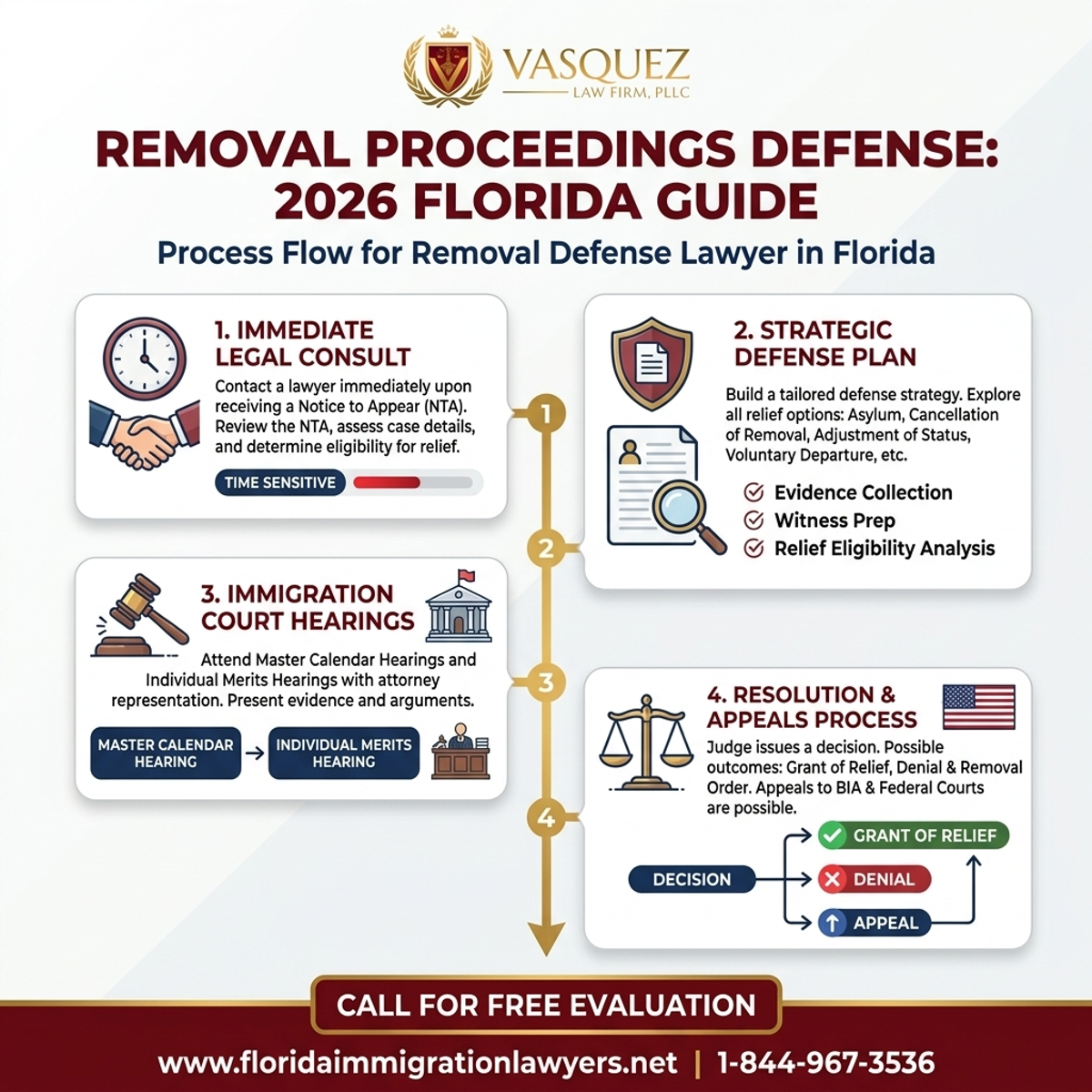
Notice to Appear (NTA): This is the charging document issued by ICE, informing you of the government's intent to remove you and the alleged reasons. It specifies the date and location of your first hearing. It is crucial to read this document carefully and contact an attorney immediately upon receipt.
-
Master Calendar Hearing (MCH): This is the initial court appearance where you, or your attorney, formally respond to the allegations in the NTA. The Immigration Judge will confirm your identity, ensure you understand the charges, and ask if you admit or deny the allegations. This is also where you may request forms of relief from removal, such as asylum or cancellation of removal, and schedule future hearings.
-
Individual Hearing (Merits Hearing): If you seek relief from removal, the judge will schedule an individual hearing. This is a full trial where you and your attorney present evidence, call witnesses, and cross-examine government witnesses. The ICE attorney will present their case for your removal. This hearing can last several hours or even days, depending on the complexity.
Step-by-Step Process — Removal Proceedings Defense Lawyer Florida: 2026 Guide
-
Immigration Judge's Decision: After the individual hearing, the Immigration Judge will issue a decision. They may grant the relief you requested, order your removal, or grant voluntary departure. This decision can be delivered orally in court or in writing at a later date.
-
Appeals Process: If either you or the government is dissatisfied with the Immigration Judge's decision, you typically have 30 days to file an appeal with the Board of Immigration Appeals (BIA). The BIA reviews the judge's decision for legal errors. Further appeals can be made to a U.S. Court of Appeals if the BIA's decision is unfavorable. This entire process can take several years, highlighting the need for persistent legal advocacy.
Essential Documents and Evidence for Your Removal Defense Case
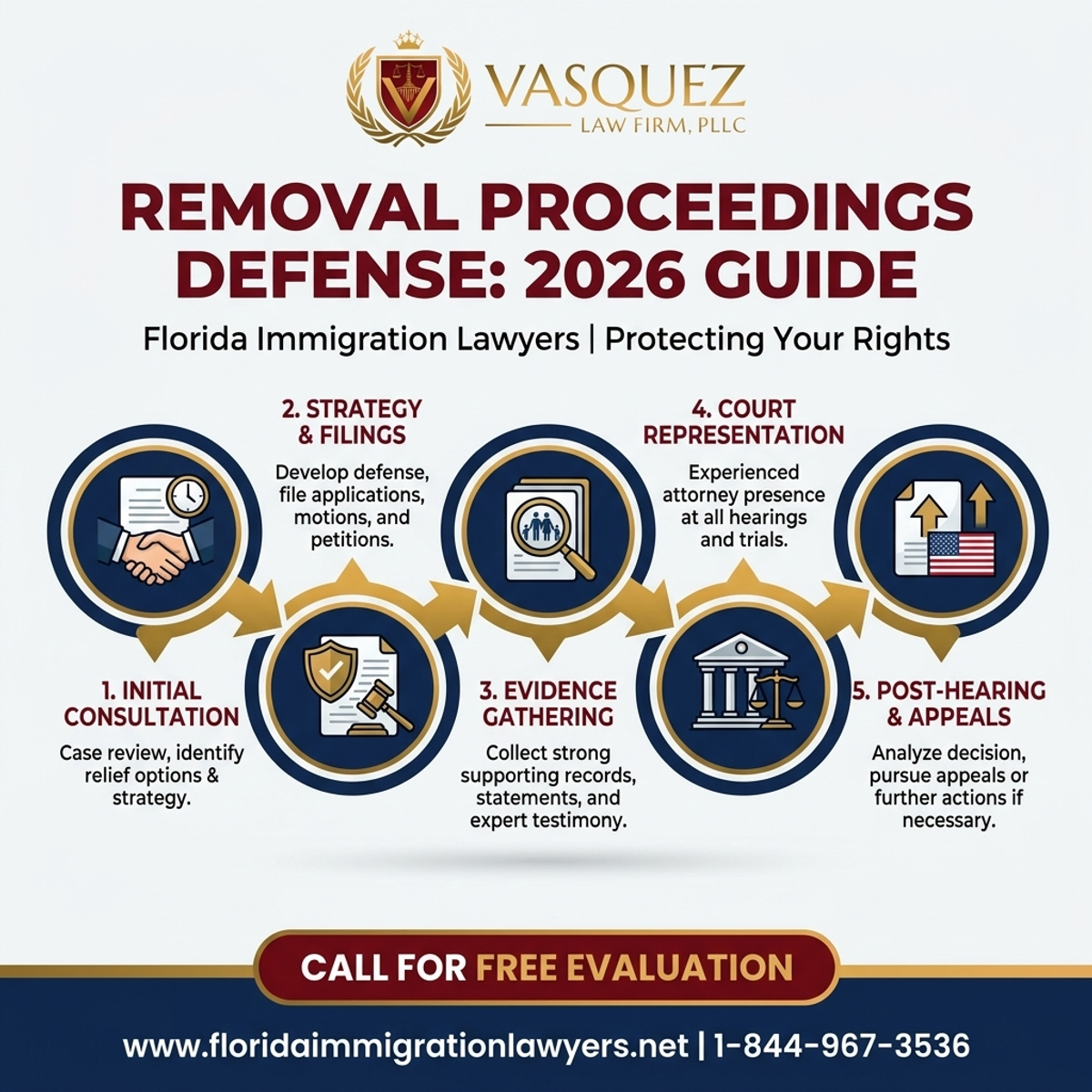
Successfully defending against removal proceedings in Florida hinges on presenting a robust and well-supported case with compelling evidence. Gathering the right documents is a critical step, as these materials will corroborate your claims, establish your eligibility for relief, and present you in the best possible light to the Immigration Judge. Your removal proceedings defense lawyer Florida will help you identify and organize the necessary documentation, which can vary significantly depending on the specific relief you are seeking.
While the exact list of documents will be personalized to your case, generally you should prepare to gather the following:
- Personal Identification: Birth certificates, passports, national identity cards, and any previous U.S. visas or immigration documents.
- Proof of Entry and Residence: I-94 records, travel history, utility bills, rental agreements, and employment records demonstrating your physical presence in the U.S.
- Family Relationships: Marriage certificates, birth certificates of U.S. citizen or lawful permanent resident children, divorce decrees, and affidavits from family members.
- Financial Stability: Tax returns, pay stubs, bank statements, and evidence of any assets or property ownership. This is especially important if the Public Charge Rule is a factor in your case.
- Good Moral Character: Letters of recommendation from employers, community leaders, and religious figures; proof of community involvement; and evidence of rehabilitation if you have a criminal record.
- Country Conditions (for Asylum/Withholding): Reports from human rights organizations, news articles, and expert testimonies detailing persecution or threats in your home country.
- Medical Records: Documentation of any serious health conditions or specialized medical needs that would be difficult to meet outside the U.S.
- Police and Court Records: Certified copies of any arrest records, court dispositions, or criminal history, even for minor offenses. Full disclosure is critical.
- Affidavits: Sworn statements from individuals who can attest to your character, family ties, or the hardships you would face upon removal.
For specific forms and official guidance on required documents, refer to the U.S. Citizenship and Immigration Services (USCIS) website.
Timelines and Costs: What to Expect in Florida Removal Proceedings
The duration and financial implications of removal proceedings in Florida can be substantial, often extending over several years due to court backlogs and the complexity of individual cases. As of 2026, the average wait times for an individual hearing in an immigration court Florida can range from 18 months to over five years, depending on the court's caseload and the judge assigned. Understanding these factors is crucial for planning and managing expectations.
| Stage | Typical Timeframe | Notes |
|---|---|---|
| NTA Issuance to Master Calendar Hearing | 3-12 months | Varies based on court docketing and detention status. |
| Master Calendar Hearings (multiple) | 6-24 months | Often involves several short hearings to set issues and schedule. |
| Individual Hearing (Merits) | 18 months - 5+ years from NTA | Lengthy wait due to court backlogs; may span multiple days. |
| Immigration Judge Decision | Immediately to 6 months post-hearing | Can be oral in court or written later. |
| Board of Immigration Appeals (BIA) Review | 12-36 months | If an appeal is filed by either party. |
| Federal Circuit Court Appeal | 12-24 months | If BIA decision is appealed; rare for most cases. |
Understanding Legal Fees and Associated Costs
The costs associated with defending against removal proceedings primarily involve attorney fees and government filing fees. Government fees for applications like Adjustment of Status or Waivers are set by USCIS and can change. Attorney fees vary significantly based on the complexity of your case, the type of relief sought, the number of hearings required, and the attorney's experience. A comprehensive defense against removal is a significant investment, but it is an investment in your future in the U.S.
Key Statistics — Removal Proceedings Defense Lawyer Florida: 2026 Guide
| Item | Typical Fee (Consult an Attorney for Specifics) | Notes |
|---|---|---|
| Initial Consultation | Often free or nominal | Opportunity to discuss your case and understand options. |
| Attorney Fees (Hourly/Flat) | Varies widely based on complexity and duration | Depends on type of relief, number of hearings, and firm. |
| Application Filing Fees (USCIS/EOIR) | Set by government, subject to change | For forms like I-485, I-601, I-589, etc. Fee waivers may be available. |
| Expert Witness Fees | Case-dependent | For country condition experts, psychological evaluations, etc. |
| Translation Services | Per document/hour | For non-English documents required by the court. |
| Court Transcripts | Per page/hearing | Required for appeals or detailed review. |
Do not navigate this complex process alone. Contact Florida Immigration Lawyers today for a free case review and to discuss your defense options with an experienced removal proceedings defense lawyer Florida. We are here to help you understand the potential costs and strategies for your situation.
Common Mistakes to Avoid in Removal Proceedings
Navigating immigration removal proceedings is fraught with potential pitfalls that can jeopardize your case. Avoiding these common mistakes is as crucial as building a strong defense. Even seemingly minor errors can have significant, long-lasting consequences, potentially leading to a deportation order. An experienced deportation defense attorney Orlando can help you steer clear of these errors.
-
Missing Deadlines: Immigration court operates on strict deadlines for filing documents, applications, and appeals. Missing a deadline, even by a day, can result in the automatic denial of relief or an order of removal without further review.
-
Providing Inaccurate or Inconsistent Information: Any inconsistencies between your testimony, applications, and previous statements can be used against you by the government attorney, undermining your credibility and case.
-
Failing to Disclose Criminal History: Attempting to hide or misrepresent past arrests or convictions, even minor ones, can lead to charges of misrepresentation and potentially bar you from future immigration benefits. Full disclosure to your attorney is always best.
-
Attending Hearings Without Legal Counsel: Representing yourself in immigration court is highly discouraged. The legal complexities are immense, and an unrepresented individual is at a significant disadvantage against a trained government attorney.
-
Not Gathering Sufficient Evidence: A weak case often stems from a lack of compelling, well-organized evidence. Failing to provide adequate documentation to support your claims for relief significantly reduces your chances of success.
-
Voluntarily Leaving the U.S. Without Permission: If you are in removal proceedings, leaving the country without a specific grant of voluntary departure or other authorization can be considered a self-deportation and may trigger inadmissibility bars upon re-entry.
-
Ignoring the Public Charge Rule: For those seeking adjustment of status, failing to understand and address the implications of the Public Charge Rule (8 CFR 212.21) regarding the use of public benefits can lead to a denial of your green card application.
-
Failing to Update Your Address with EOIR: If you move, you must immediately update your address with the immigration court. Failure to do so can result in missed hearing notices and an in absentia (in your absence) removal order.
-
Not Appealing an Unfavorable Decision on Time: If the Immigration Judge denies your relief, you typically have 30 days to file an appeal with the Board of Immigration Appeals. Missing this window means you lose the opportunity for a review of the decision.
-
Underestimating the Government's Case: The government attorney is trained to argue for your removal. Underestimating their arguments or failing to adequately prepare for cross-examination can be detrimental to your defense.
When to Call a Removal Proceedings Defense Lawyer in Florida
The moment you suspect you might be facing removal proceedings, or if you have already received a Notice to Appear (NTA), is the critical time to contact a qualified removal proceedings defense lawyer Florida. Early intervention by an attorney can significantly impact the trajectory and outcome of your case. Waiting until your first court date or after a preliminary hearing can limit your defense options and opportunities.
Specific scenarios that warrant immediate legal consultation include:
- You have received a Notice to Appear (NTA) from ICE.
- You or a family member has been arrested by ICE or detained at a port of entry.
- You have a past criminal conviction, even a minor one, that immigration authorities may consider a ground for deportability or inadmissibility.
- Your green card or visa application has been denied, and you received a notice that you are being placed into removal proceedings.
- You have previously been ordered removed or deported and are now back in the U.S.
- Your case involves complex legal issues, such as asylum claims, waivers, or eligibility for Cancellation of Removal.
At Florida Immigration Lawyers, our attorneys specialize in deportation defense and are ready to provide the urgent legal assistance you need. We understand the stress and uncertainty you face and are committed to protecting your rights and fighting for your ability to remain in the U.S. Do not hesitate to schedule a free consultation with us.
About Florida Immigration Lawyers
Florida Immigration Lawyers is a leading law firm dedicated to providing comprehensive and compassionate legal services to individuals and families throughout Florida. With our office strategically located in Central Florida, we are uniquely positioned to serve clients across the entire state, offering expert guidance in all areas of immigration law. Our team of skilled attorneys understands the profound impact immigration issues have on our clients' lives and are committed to delivering personalized, effective legal solutions.
We specialize in a wide range of immigration matters, including deportation defense, family-based immigration, business visas, asylum claims, and citizenship applications. Our firm is founded on the principles of integrity, advocacy, and unwavering client support. We pride ourselves on being accessible and responsive, ensuring that our clients are informed and empowered at every stage of their legal journey. Call us at 1-844-YO-PELEO for a free case review. We are available 24/7, serving all of Florida, and proudly offer bilingual services (English and Spanish) to better assist our diverse community.
Sources and References
- U.S. Citizenship and Immigration Services (USCIS)
- Executive Office for Immigration Review (EOIR)
- U.S. Department of State
- 8 U.S.C. Chapter 12 - Immigration and Nationality Act (INA)
- 8 U.S.C. § 1229a - Removal Proceedings (INA Section 240)
- 8 U.S.C. § 1229b - Cancellation of Removal; Adjustment of Status (INA Section 240A)
- 8 U.S.C. § 1158 - Asylum (INA Section 208)
- 8 CFR 212.21 - Public Charge Inadmissibility
Related services: immigration practice areas, family immigration services, citizenship and naturalization, business immigration.
This article provides general legal information and is not intended as legal advice. Every case is unique, and outcomes depend on specific facts and circumstances. Contact an attorney for advice about your particular situation.
Do not face the complexities of immigration court alone. Your future in the U.S. depends on a strong defense. Contact Florida Immigration Lawyers today at 1-844-YO-PELEO for your free case review. Se Habla Espanol - Estamos aqui para ayudarle.
Do Not Navigate This Process Alone
Our experienced immigration attorneys are ready to fight for you. Get a free, confidential case review today.
Se Habla Español
Or leave your details and we’ll call you:
Free Evaluation in 24 Hours
Or talk to us right now

AI voice assistant — available 24/7
FreeFrequently Asked Questions

William J. Vásquez
Founding Attorney · Vasquez Law Firm
U.S. Air Force veteran and immigration attorney with years of hands-on U.S. immigration experience. J.D., NCCU School of Law. AILA member. Admitted to the 4th, 5th, and 11th Circuit Courts.
Available 24/7 - Free Evaluations
Reviewed for legal accuracy by William J. Vásquez
Licensed in North Carolina; U.S. immigration is federal practice.
Related Legal Services
Our Florida immigration attorneys can help you with family immigration services, immigration lawyer cost in Florida and experienced immigration attorneys. Call today at 1-844-YO-PELEO for a free case review.
Related Links
Related Topics
Free Legal Case Review
Discuss your case with our experienced attorneys. We're available 24/7.
Se Habla Español - Estamos aquí para ayudarle.
Related Articles
Immigration Lawyer Orlando Free Consultation in Florida
For individuals and families in Orlando, Florida, navigating the complexities of U.S. immigration law requires expert guidance. An immigration lawyer in Orlando offers crucial support for everything from visa applications and green card processes to naturalization and deportation defense. This comprehensive guide details what a free consultation covers, providing a step-by-step overview of immigration pathways, essential document checklists, and expected timelines in 2026. We also highlight common mistakes to avoid, discuss the critical role of legal counsel in deportation and asylum cases, and explain why choosing a local Orlando immigration attorney is beneficial. Florida Immigration Lawyers is dedicated to serving the diverse community of Orlando with compassionate, effective legal solutions, ensuring you receive personalized advice and robust representation for a successful immigration journey.
EAD Advance Parole Combo Card in Florida 2026
For individuals with a pending Form I-485, Application to Register Permanent Residence or Adjust Status, the EAD Advance Parole Combo Card is an essential document. This single card combines the authorization to work legally in the U.S. (Employment Authorization Document - EAD) with permission to travel internationally and re-enter without abandoning your green card application (Advance Parole). This guide from Florida Immigration Lawyers provides a comprehensive overview for applicants in Florida in 2026, covering eligibility, the step-by-step application process, required documents, expected processing times, and associated costs. We also highlight common mistakes to avoid and when to seek legal counsel to ensure a smooth and successful immigration journey. Understanding this vital card is key to maintaining stability while awaiting your permanent residency approval.
Immigration Lawyer Services in Gulf Coast Florida
Navigating the U.S. immigration system can be complex, especially with recent policy changes. This article explores how immigration lawyers in Gulf Coast Florida can assist with visa applications, deportation defense, and more. For personalized assistance, contact Florida Immigration Lawyers at 1-844-YO-PELEO for a free case review.
USCIS Oath Ceremony Schedule 2026 in Florida: Your Guide
For those awaiting U.S. citizenship, understanding the USCIS oath ceremony schedule for 2026 in Florida is paramount. This comprehensive guide from Florida Immigration Lawyers delves into the naturalization process, explaining how oath ceremonies are scheduled, where USCIS field offices are located in Florida (Orlando, Miami, Tampa, Jacksonville), and what to expect at this final, symbolic step. We cover everything from filing your N-400 application and attending your biometrics appointment and interview, to preparing for the Oath of Allegiance. Learn about typical timelines, associated costs, and crucial documents to bring. We also highlight common mistakes to avoid and provide clear guidance on when to seek professional legal assistance to navigate potential complexities or delays, ensuring a smooth transition to becoming a U.S. citizen.