I-589 Withholding of Removal Defense in Florida
Facing deportation and fearing return to your home country? Learn about withholding of removal, a vital protection in U.S. immigration law. This comprehensive guide from Florida Immigration Lawyers explains eligibility for withholding of removal and Convention Against Torture (CAT) claims, the step-by-step process, essential documentation, and common pitfalls to avoid. Discover why legal counsel is critical for navigating the complex immigration court system in Florida, especially in areas like Coral Springs. We offer free consultations to help you understand your options and build a strong defense against removal.

Withholding of removal is a crucial form of protection for non-citizens in the U.S. who fear persecution or torture if returned to their home country. Unlike asylum, it does not lead to a green card but prevents deportation, offering a vital safe haven. Eligibility requires proving a clear probability of future harm, a higher standard than asylum.
- Prevents deportation for those fearing persecution or torture.
- Requires proving a "more likely than not" chance of future harm.
- Does not offer a direct path to lawful permanent residency.
- Often sought in conjunction with or as an alternative to asylum.
- Legal counsel is essential for navigating the complex process.
Imagine facing the terrifying prospect of being sent back to a country where your life or freedom is at grave risk. For many non-citizens in Florida, this fear is a harsh reality. The U.S. immigration system offers certain protections, and withholding of removal is one of the most critical.
This comprehensive guide from Florida Immigration Lawyers will walk you through what withholding of removal entails, how it differs from asylum, the application process, and why legal representation is indispensable for your defense in 2026. We understand the stakes are incredibly high for you and your family.
Do not face this complex legal challenge alone. Call Florida Immigration Lawyers at 1-844-YO-PELEO for a free consultation today. Our dedicated team is ready to help you understand your options and build a strong defense.
Understanding Withholding of Removal in Florida
Withholding of removal is a form of protection granted to individuals who demonstrate that their life or freedom would be threatened in their home country due to race, religion, nationality, membership in a particular social group, or political opinion. This relief is mandated by Section 241(b)(3) of the Immigration and Nationality Act (INA), codified at 8 U.S.C. § 1231(b)(3).
It is a mandatory form of relief, meaning that if you meet the eligibility criteria, an immigration judge must grant it. However, the burden of proof is significant. You must show that it is more likely than not that you would be persecuted or tortured upon return.
Unlike asylum, which allows for eventual lawful permanent residency, withholding of removal only prevents your deportation from the United States. It does not provide a direct path to a green card or citizenship. However, it offers immediate safety and the ability to live and work legally in the U.S.
For individuals in Florida, including those in Coral Springs, Miami, Orlando, or Tampa, understanding these nuances is critical. The immigration courts in Florida, such as those in Orlando, Miami, and Pompano Beach, handle numerous such cases annually.
The Convention Against Torture (CAT)
In addition to traditional withholding of removal based on persecution, individuals may also seek protection under the Convention Against Torture (CAT). This form of relief is available to those who can demonstrate that it is more likely than not they would be tortured if removed to their country of origin. The regulations for CAT are found in 8 CFR Part 208.
Torture is defined specifically under CAT and involves severe pain or suffering intentionally inflicted by or at the instigation of, or with the consent or acquiescence of, a public official or other person acting in an official capacity. This is a critical distinction from persecution, which is based on protected grounds like political opinion.
CAT protection is often a last resort for individuals who may be barred from asylum or statutory withholding of removal due to certain criminal convictions or other issues. An experienced Florida immigration attorney can help you determine if you qualify for CAT protection.
The Step-by-Step Process for Withholding of Removal Defense
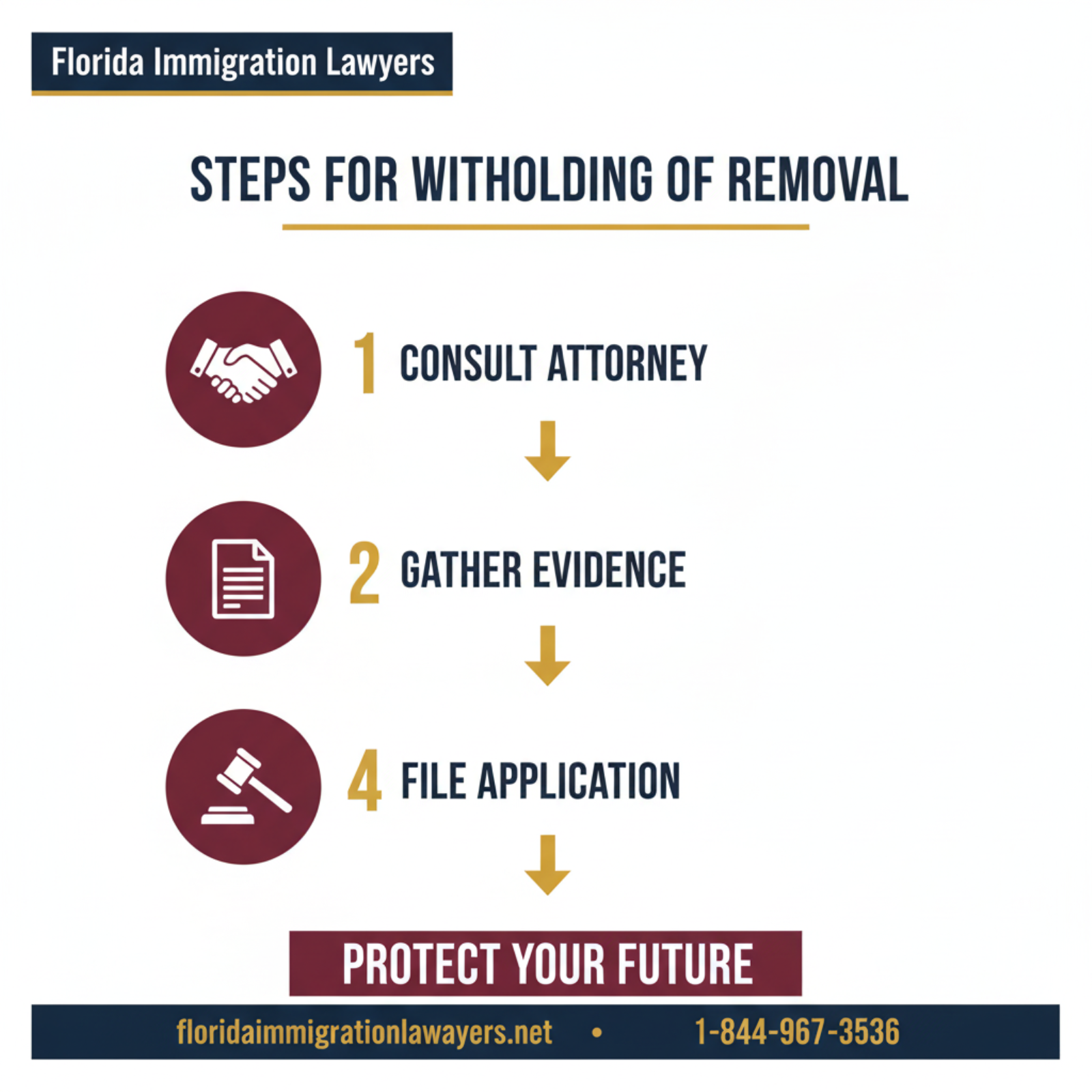
Navigating the immigration court system in Florida can be daunting. The process for seeking withholding of removal typically unfolds in several stages, requiring meticulous preparation and legal expertise.
-
Initial Consultation with an Attorney: Your first step should be to consult with an experienced immigration lawyer. They will assess your eligibility for withholding of removal, asylum, or CAT, and discuss potential bars to relief. This crucial initial assessment helps to determine the best legal strategy for your unique situation.
-
Filing Form I-589, Application for Asylum and for Withholding of Removal: If you are in removal proceedings, you will typically file Form I-589 with the immigration court. This form serves as your application for asylum, withholding of removal, and CAT protection. It is vital to complete this form accurately and comprehensively, detailing your fear and the basis of your claim.
-
Biometrics Appointment: After filing your I-589, you will receive a notice for a biometrics appointment at an Application Support Center (ASC). Here, your fingerprints, photograph, and signature will be collected for background and security checks. This is a standard part of the immigration process.
-
Master Calendar Hearings: These are preliminary hearings before an immigration judge. During these hearings, the judge confirms your identity, clarifies the charges against you, and sets a schedule for your case. Your attorney will enter an appearance and may address initial legal motions.
-
Individual Hearing (Merits Hearing): This is the most critical stage. You will testify before the immigration judge, presenting evidence and arguments to support your claim for withholding of removal. The government attorney (DHS counsel) will have the opportunity to cross-examine you. Your attorney will also present witnesses and expert testimony if necessary.
-
Decision and Appeals Process: After the individual hearing, the immigration judge will issue a decision. If your application for withholding of removal is denied, you generally have the right to appeal the decision to the Board of Immigration Appeals (BIA). Further appeals may be possible to a U.S. Circuit Court of Appeals. For effective deportation defense, timely appeals are crucial.
Essential Documents for Your Withholding of Removal Case
Building a strong case for withholding of removal requires compelling evidence. Thorough documentation is paramount to meeting the high burden of proof. Your Florida immigration lawyer will guide you in gathering and organizing these materials.
- Form I-589, Application for Asylum and for Withholding of Removal: The fully completed and signed application form, including all necessary addendums detailing your narrative of fear.
- Identity Documents: Copies of your passport, birth certificate, national ID, or any other documents proving your identity and nationality.
- Evidence of Persecution or Torture: This is the core of your case. It can include police reports, medical records documenting injuries, psychological evaluations, newspaper articles, human rights reports, and affidavits from witnesses who can corroborate your story.
- Country Conditions Reports: Up-to-date reports from reputable organizations (e.g., U.S. Department of State, Amnesty International, Human Rights Watch) detailing the human rights situation in your home country. These reports provide crucial context for your claim.
- Witness Statements: Sworn statements from individuals who have personal knowledge of your persecution or the conditions in your country.
- Travel Documents: Records of your entry into the U.S. and any previous travel.
- Any Prior Immigration Applications or Decisions: Copies of any previous applications for asylum, visas, or other immigration benefits, along with their outcomes.
- Supporting Affidavits: Letters of support from family, friends, or community members who can attest to your character and the circumstances leading to your fear.
Navigating Timelines and Processing Expectations in 2026
The processing times for withholding of removal cases can vary significantly, often extending over several years. This is particularly true in busy immigration courts across Florida. Factors like court backlogs, the complexity of your case, and the specific judge assigned can all influence the timeline.
After filing your I-589, there's typically a waiting period before your first master calendar hearing. The individual hearing, where your case is heard on its merits, might not be scheduled for months or even years after your initial filings. Patience and consistent communication with your attorney are key.
While your case is pending, you may be eligible to apply for an Employment Authorization Document (EAD), also known as a work permit, based on your pending withholding of removal application. This allows you to work legally in the U.S. while awaiting a decision, providing much-needed stability for you and your family in Florida.
Factors Affecting Processing Speed
Several elements can impact how quickly your withholding of removal case moves through the Florida immigration courts. The specific court location, for example, can play a role; some courts, like those in Miami, may have heavier caseloads than others.
The complexity of your case, including the amount of evidence required and the number of witnesses, can also affect the timeline. Furthermore, the presence of an experienced immigration attorney can often help streamline the process by ensuring all documentation is correct and deadlines are met, though no attorney can guarantee specific processing speeds.
Understanding Cost Factors and Fee Breakdown
When pursuing withholding of removal, it is important to understand the associated costs. While there is generally no filing fee for Form I-589 itself when filed in immigration court, other expenses will arise. These costs primarily relate to legal representation, which is highly recommended for such complex cases.
Legal fees will vary depending on the complexity of your case, the experience of your attorney, and the amount of time required to prepare and present your defense. These fees typically cover consultations, legal research, document preparation, court appearances, and communication with government agencies.
Beyond legal fees, you may incur costs for obtaining necessary documents, such as certified translations of foreign documents, expert witness fees (if required), and travel expenses to attend hearings. Florida Immigration Lawyers offers transparent fee structures and can discuss payment options during your free consultation.
Do not navigate this process alone. Contact Florida Immigration Lawyers today to ensure your case is handled with the experience and care it deserves. Call us at 1-844-YO-PELEO.
Common Mistakes to Avoid in Your Withholding of Removal Claim
The path to obtaining withholding of removal is fraught with potential pitfalls. Avoiding common errors can significantly increase your chances of a successful outcome. Here are some critical mistakes to steer clear of:
-
Failing to File on Time: While there isn't a strict one-year filing deadline for withholding of removal as there is for asylum, delays can still negatively impact your credibility and case strength. Always file your Form I-589 as soon as possible after receiving your Notice to Appear (NTA).
-
Lack of Corroborating Evidence: Your testimony is crucial, but it must be supported by objective evidence. Failing to provide country conditions reports, medical records, police reports, or witness affidavits can weaken your claim significantly. The "more likely than not" standard is difficult to meet without strong corroboration.
-
Inconsistent Testimony: Any discrepancies between your written application, statements to asylum officers, or testimony in court can severely damage your credibility. Ensure your narrative is consistent and truthful throughout the entire process.
-
Not Disclosing All Information: Withholding relevant details, even if seemingly minor or embarrassing, can lead to accusations of misrepresentation. Be completely transparent with your attorney so they can prepare for all eventualities.
-
Misunderstanding the Burden of Proof: Many applicants confuse the burden for asylum (well-founded fear) with withholding of removal (more likely than not). Failing to prove it is more probable than not that you will face persecution or torture will result in a denial.
-
Failing to Address Statutory Bars: Certain factors, such as serious criminal convictions or having persecuted others, can make you ineligible for withholding of removal. Your attorney must thoroughly review your history to identify and address any potential bars to relief.
-
Not Preparing for Cross-Examination: The government attorney will rigorously question your testimony and evidence. Being unprepared for this intense scrutiny can undermine your case. Practice your testimony with your attorney to build confidence and clarity.
-
Appearing Without Legal Counsel: Navigating immigration court is incredibly complex. Representing yourself dramatically reduces your chances of success, especially in cases involving withholding of removal or CAT. A lawyer understands the law, court procedures, and how to present evidence effectively.
-
Ignoring Changes in Country Conditions: Conditions in your home country can change, impacting your claim. Your attorney will help you stay informed and adapt your case if, for example, the threat of persecution diminishes or intensifies.
-
Not Appealing in Time: If an immigration judge denies your application, you have a limited time to file an appeal with the Board of Immigration Appeals (BIA). Missing this deadline means losing your opportunity to challenge the decision.
When to Call Florida Immigration Lawyers for Your Defense
The complexities of immigration law, particularly concerning deportation defense and relief like withholding of removal, make legal representation not just beneficial, but often essential. You should contact Florida Immigration Lawyers immediately if any of the following apply to your situation:
- You have received a Notice to Appear (NTA) and are facing removal proceedings in a Florida immigration court.
- You fear returning to your home country due to persecution or torture and believe you may be eligible for withholding of removal or CAT protection.
- Your asylum application has been denied, and you need to explore alternative forms of relief.
- You have a complex immigration history, including prior arrests, convictions, or previous immigration applications.
- You are unsure whether you meet the eligibility requirements for withholding of removal or if there are any statutory bars that apply to your case.
- You need assistance gathering compelling evidence, securing expert testimony, or preparing for court hearings.
Our attorneys at Florida Immigration Lawyers are dedicated to protecting your rights and fighting for your future. We serve clients across all of Florida, including Orlando and beyond. We understand the specific challenges and procedures within Florida's immigration courts.
About Florida Immigration Lawyers
Florida Immigration Lawyers is a law firm dedicated to providing exceptional legal representation to immigrants across the entire state of Florida. Our team of experienced attorneys is committed to offering compassionate and effective legal solutions for a wide range of immigration matters.
We focus on immigration law, including complex deportation defense cases, asylum claims, withholding of removal, family-based petitions, business immigration, and citizenship applications. Our firm's mission is to be a steadfast advocate for our clients, guiding them through every step of the legal process with integrity and professionalism.
Why Choose Florida Immigration Lawyers?
- Experienced Advocates: Our attorneys possess in-depth knowledge of immigration law and extensive experience in immigration courts.
- Client-Centered Approach: We prioritize your needs, offering personalized strategies and empathetic support.
- Bilingual Services: We proudly offer services in both English and Spanish to ensure clear communication.
- Free Consultations: We provide complimentary initial consultations to discuss your case and outline your options.
- Available 24/7: We understand immigration matters can arise at any time, which is why we are available around the clock to assist you.
Contact Florida Immigration Lawyers today at 1-844-YO-PELEO or visit our website at https://www.floridaimmigrationlawyers.net to schedule your free consultation. We are here to help you.
Sources and References
- U.S. Citizenship and Immigration Services (USCIS)
- Executive Office for Immigration Review (EOIR)
- 8 U.S.C. Chapter 12 - Immigration and Nationality Act (INA)
- INA Section 241(b)(3) - Withholding of Removal
- 8 U.S.C. § 1231(b)(3) - Restriction on removal to a country where alien's life or freedom would be threatened
- 8 CFR Part 208 - Procedures for Asylum and Withholding of Removal
This article provides general legal information and is not intended as legal advice. Every case is unique, and outcomes depend on specific facts and circumstances. Contact an attorney for advice about your particular situation.
Your future and safety are too important to leave to chance. If you are facing deportation and believe you qualify for withholding of removal in Florida, take action now. Contact Florida Immigration Lawyers for a free, confidential consultation. Our experienced team is ready to provide the compassionate and effective legal representation you deserve.
Call us today at 1-844-YO-PELEO. Se Habla Español - Estamos aquí para ayudarle.
Do Not Navigate This Process Alone
Our experienced immigration attorneys are ready to fight for you. Get a free, confidential case review today.
Se Habla Español
Or leave your details and we’ll call you:
Free Evaluation in 24 Hours
Or talk to us right now

AI voice assistant — available 24/7
FreeFrequently Asked Questions

William J. Vásquez
Founding Attorney · Vasquez Law Firm
U.S. Air Force veteran and immigration attorney with years of hands-on U.S. immigration experience. J.D., NCCU School of Law. AILA member. Admitted to the 4th, 5th, and 11th Circuit Courts.
Available 24/7 - Free Evaluations
Reviewed for legal accuracy by William J. Vásquez
Licensed in North Carolina; U.S. immigration is federal practice.
Related Legal Services
Our Florida immigration attorneys can help you with experienced immigration attorneys, asylum protection and citizenship and naturalization. Call today at 1-844-YO-PELEO for a free case review.
Related Links
Related Topics
Free Legal Case Review
Discuss your case with our experienced attorneys. We're available 24/7.
Se Habla Español - Estamos aquí para ayudarle.
Related Articles
Dual Citizenship Lawyer in Florida: What You Need to Know
For Florida residents, the concept of dual citizenship, or holding two passports, offers a compelling blend of opportunities and challenges. While the U.S. generally permits dual nationality, the path to achieving this status requires a meticulous understanding of both U.S. immigration laws and the citizenship policies of your country of origin. This guide explores the definition of dual citizenship, the detailed step-by-step process for U.S. naturalization, and the significant benefits and potential pitfalls involved. We cover essential documentation, typical timelines, and cost considerations for 2026, providing crucial insights for anyone in Orlando, Miami, or across Florida considering this important legal step. Learn about common mistakes to avoid and understand when to seek professional legal counsel to navigate this complex process successfully. Florida Immigration Lawyers is here to provide expert, bilingual support for your dual citizenship journey.
Immigration Lawyer Orlando Free Consultation in Florida
For individuals and families in Orlando, Florida, navigating the complexities of U.S. immigration law requires expert guidance. An immigration lawyer in Orlando offers crucial support for everything from visa applications and green card processes to naturalization and deportation defense. This comprehensive guide details what a free consultation covers, providing a step-by-step overview of immigration pathways, essential document checklists, and expected timelines in 2026. We also highlight common mistakes to avoid, discuss the critical role of legal counsel in deportation and asylum cases, and explain why choosing a local Orlando immigration attorney is beneficial. Florida Immigration Lawyers is dedicated to serving the diverse community of Orlando with compassionate, effective legal solutions, ensuring you receive personalized advice and robust representation for a successful immigration journey.
EAD Advance Parole Combo Card in Florida 2026
For individuals with a pending Form I-485, Application to Register Permanent Residence or Adjust Status, the EAD Advance Parole Combo Card is an essential document. This single card combines the authorization to work legally in the U.S. (Employment Authorization Document - EAD) with permission to travel internationally and re-enter without abandoning your green card application (Advance Parole). This guide from Florida Immigration Lawyers provides a comprehensive overview for applicants in Florida in 2026, covering eligibility, the step-by-step application process, required documents, expected processing times, and associated costs. We also highlight common mistakes to avoid and when to seek legal counsel to ensure a smooth and successful immigration journey. Understanding this vital card is key to maintaining stability while awaiting your permanent residency approval.
F-1 to H-4 Change of Status Processing in Florida
Explore the F-1 to H-4 change of status process in Florida, including I-539 processing times, steps involved, and common pitfalls. Call Florida Immigration Lawyers for a free case review.