Special Immigrant Juvenile Status Florida: Your Guide
Special Immigrant Juvenile Status (SIJS) offers a critical pathway to legal permanent residency for vulnerable children in Florida who have experienced abuse, neglect, or abandonment. This comprehensive guide details the unique two-step process, beginning with obtaining a predicate order from a Florida state court and culminating in a petition to USCIS. We cover eligibility, essential documentation, processing timelines, and cost factors, emphasizing the importance of expert legal representation. Navigating these complex state and federal regulations can be overwhelming, especially for children and their guardians. Florida Immigration Lawyers provides compassionate and dedicated support to ensure all requirements are met, protecting the future of these young individuals. Learn how our West Palm Beach-based firm helps children across Florida secure their future.

Quick Answer: Special Immigrant Juvenile Status (SIJS) in Florida
Special Immigrant Juvenile Status (SIJS) offers a pathway to legal permanent residency (a Green Card) for certain undocumented children in Florida who have been abused, neglected, or abandoned by one or both parents. To qualify, a Florida state court must first issue a "predicate order" making specific findings about the child's dependency, inability to reunite with parents, and that it's not in their best interest to return to their home country. This state court order is a crucial first step before filing a petition with USCIS. Navigating this complex process requires experienced legal guidance to ensure all requirements are met and to protect the child's future.
- SIJS helps abused, neglected, or abandoned children in Florida obtain lawful status.
- A Florida state court must issue a predicate order confirming dependency and eligibility.
- This status offers a pathway to a Green Card for eligible minors.
- The process involves both state court and federal immigration agencies (USCIS).
- Legal representation is vital to successfully navigate the complex requirements.
Special Immigrant Juvenile Status Florida: A Comprehensive Guide for Vulnerable Minors
Imagine being a child in Florida, far from home, facing immense challenges, and without the protection of your parents. Many vulnerable young people arrive in our state seeking safety, only to find themselves in complex legal and personal situations. For these children, Special Immigrant Juvenile Status (SIJS) in Florida can be a lifeline, offering a path to stability and a secure future in the United States. This crucial immigration provision is designed to protect minors who have suffered abuse, neglect, or abandonment.
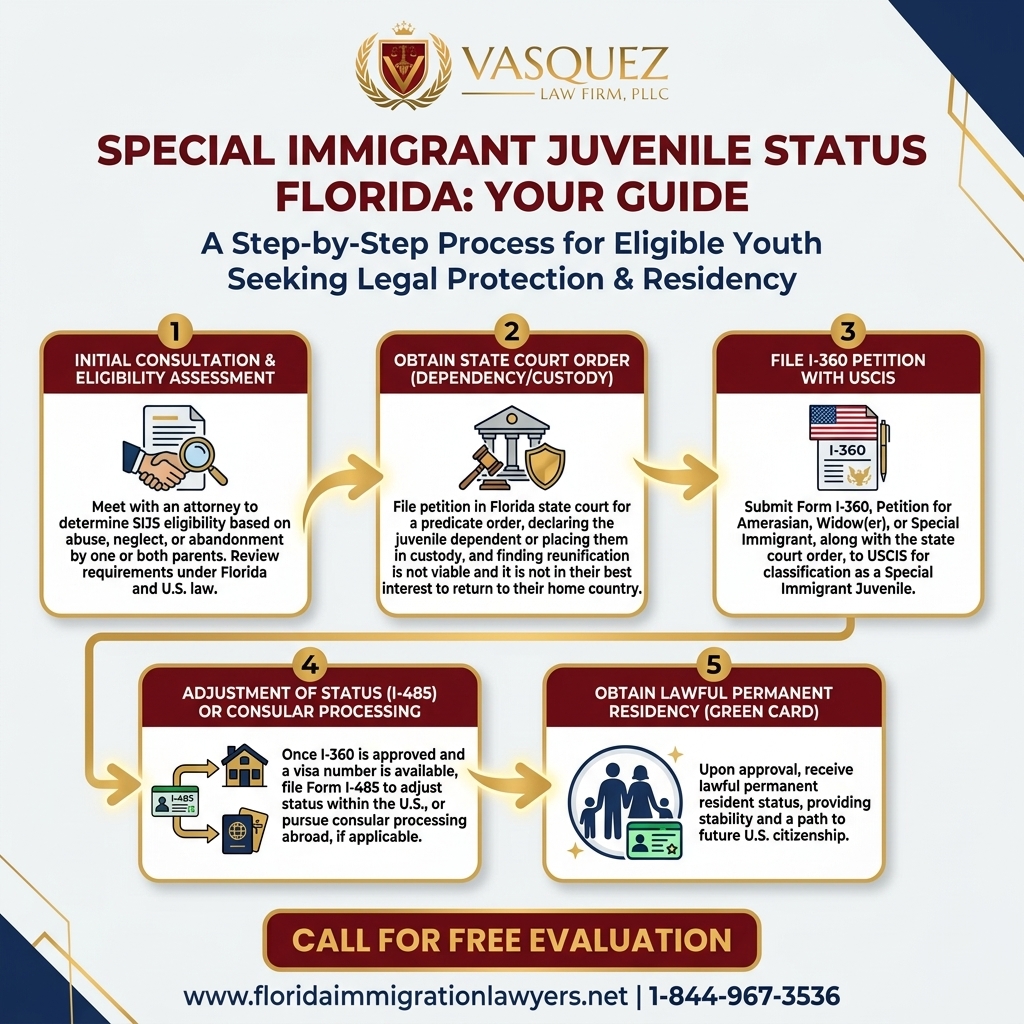
Navigating the intricacies of SIJS requires a deep understanding of both Florida state family law and complex federal immigration regulations. The process involves a unique two-step approach, starting in a local Florida court and culminating with U.S. Citizenship and Immigration Services (USCIS). This journey can be daunting, especially for children and their guardians who may not be familiar with the legal system. Understanding each step, from obtaining a predicate order in a Florida circuit court to filing an I-360 petition, is essential for a successful outcome.
At Florida Immigration Lawyers, we understand the immense challenges faced by these young individuals and their families. Our dedicated team of immigration attorneys in West Palm Beach and across Florida is committed to providing compassionate and effective legal representation. We guide children and their advocates through every stage of the SIJS application process, ensuring their rights are protected and their voices are heard. We believe every child deserves a chance at a safe and stable life. Do not navigate this complex process alone. Call Florida Immigration Lawyers at 1-844-967-3536 for a free consultation and let us help you understand if Special Immigrant Juvenile Status Florida is the right path for your child.
Understanding Special Immigrant Juvenile Status (SIJS) in Florida
Special Immigrant Juvenile Status (SIJS) is a vital immigration provision specifically designed to protect vulnerable children. It offers a pathway to lawful permanent residency for those under 21 who have been abused, neglected, or abandoned by one or both parents. The legal framework for SIJS is found in Section 101(a)(27)(J) of the Immigration and Nationality Act (INA). This status acknowledges that certain noncitizen children cannot be safely returned to their home countries due to the harm they've suffered and the lack of parental support.
In Florida, the process begins with the state court system. Before a child can apply for SIJS with USCIS, they must first obtain a specific order from a Florida state court, typically a circuit court handling dependency or family matters. This order, often called a "predicate order," must make specific findings. These findings include that the child is dependent on the court or has been committed to the custody of a state agency or an individual, that reunification with one or both parents is not possible due to abuse, neglect, abandonment, or a similar basis under Florida law, and that it is not in the child's best interest to return to their country of nationality or last habitual residence.
The involvement of Florida's state courts is a unique aspect of the SIJS process, highlighting the state's commitment to protecting children. Whether a child is in West Palm Beach, Miami, Orlando, or any other part of Florida, the local circuit court plays a critical role in establishing eligibility. This dual jurisdiction, involving both state and federal law, underscores the complexity of SIJS cases. Our firm specializes in bridging the gap between state dependency proceedings and federal immigration applications, ensuring a seamless and effective approach for our clients. We work closely with guardians, social workers, and state court attorneys to build a strong foundation for the SIJS petition.
The Dual-Step Process for SIJS Approval in Florida
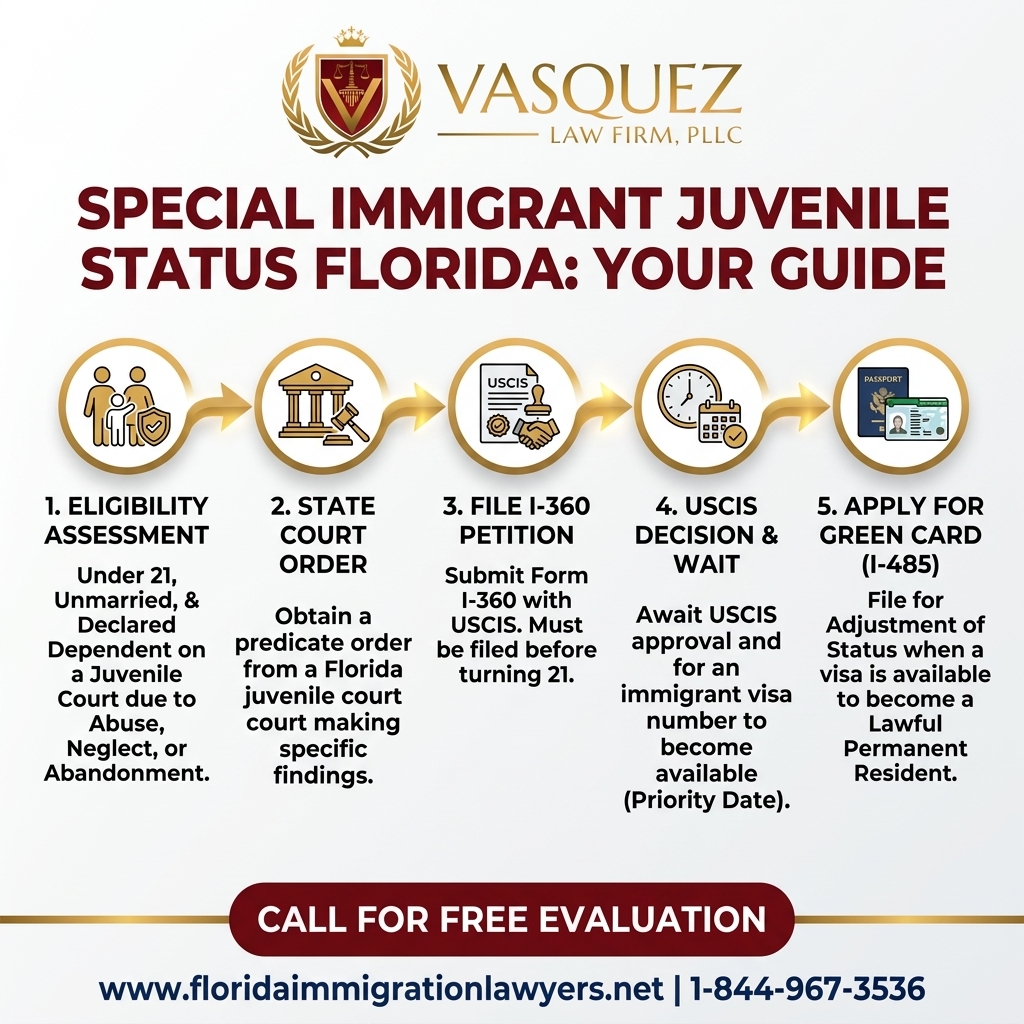
Obtaining Special Immigrant Juvenile Status (SIJS) in Florida involves a distinct two-step legal process. Both steps are crucial, and a misstep in either can jeopardize a child's eligibility. Understanding this dual track is paramount for anyone considering this path. Our experienced attorneys are adept at navigating both state and federal requirements, providing comprehensive support throughout.
Step 1: Obtaining a Predicate Order from a Florida State Court
The initial and often most challenging step is securing a "predicate order" from a Florida state court. This typically occurs within the context of a dependency proceeding in a Florida Circuit Court, such as the Circuit Court for Palm Beach County. The child must be found dependent on the court or committed to the custody of the Florida Department of Children and Families (DCF) or an individual appointed by the court. The court must then make specific findings, which are critical for the SIJS petition. These findings include:
- That the child is dependent on the court or has been placed in the custody of an individual or entity appointed by the court.
- That reunification with one or both of the child's parents is not viable due to abuse, neglect, abandonment, or a similar basis found under Florida state law. This often requires detailed evidence and testimony regarding the parent-child relationship and the harm suffered.
- That it is not in the child's best interest to be returned to their country of nationality or last habitual residence. This finding considers the dangers and lack of parental care the child would face if repatriated.
The timeline for obtaining a state court order can vary significantly, ranging from several months to over a year, depending on the court's caseload, the complexity of the case, and the availability of evidence. It's a meticulous process that demands careful preparation and presentation of facts to the state court judge. Legal representation is invaluable during this phase to ensure all necessary findings are made in the order.
Step 2: Filing Form I-360 with USCIS
Once the predicate order is successfully obtained from the Florida state court, the next step is to file Form I-360, Petition for Amerasian, Widow(er), or Special Immigrant, with U.S. Citizenship and Immigration Services (USCIS). This federal petition formally requests SIJS classification. The I-360 package must include the certified state court order and other supporting evidence, such as the child's birth certificate, identity documents, and detailed affidavits explaining the circumstances of abuse, neglect, or abandonment. USCIS reviews the petition to ensure it meets all federal SIJS eligibility requirements, including those outlined in 8 CFR § 204.11.
Many SIJS petitioners are also eligible to concurrently file Form I-485, Application to Register Permanent Residence or Adjust Status, if an immigrant visa number is immediately available. This allows the child to apply for a Green Card at the same time as their SIJS petition. Florida has several USCIS field offices, including those in Miami, Orlando, and Tampa, where interviews for adjustment of status may take place. The concurrent filing can streamline the process, but careful attention to the visa bulletin is necessary to confirm visa availability. Our team meticulously prepares these applications, ensuring all documentation is accurate and complete, maximizing the chances of approval for vulnerable children throughout Florida, including those in West Palm Beach and surrounding areas.
Essential Documents for Your SIJS Petition
A successful Special Immigrant Juvenile Status (SIJS) petition hinges on meticulously prepared documentation. Gathering and organizing all required forms and supporting evidence can be an overwhelming task, but it is absolutely critical for demonstrating eligibility to both the Florida state court and USCIS. Missing or incorrect documents can lead to delays or even denial. Our firm helps clients in West Palm Beach and across Florida compile a robust application package.
Here is a comprehensive checklist of documents typically required:
- Child's Identity and Biographical Documents:
- Birth Certificate (original or certified copy, with certified English translation if applicable).
- Passport, national identity card, or other proof of identity and nationality.
- Proof of child's entry into the U.S. (e.g., I-94 Arrival/Departure Record, if available).
- Current photographs of the child.
- Florida State Court Order:
- A certified copy of the final state court order (e.g., dependency order, guardianship order) issued by a Florida Circuit Court. This order MUST contain the specific SIJS findings: dependency, inability to reunite with one or both parents due to abuse, neglect, or abandonment, and that it is not in the child's best interest to return to their home country.
- Any supporting court documents, such as petitions, motions, and transcripts, that led to the final order.
- USCIS Forms:
- Form I-360, Petition for Amerasian, Widow(er), or Special Immigrant.
- Form G-28, Notice of Entry of Appearance as Attorney or Accredited Representative (if represented by counsel).
- If concurrently filing for a Green Card (Adjustment of Status):
- Form I-485, Application to Register Permanent Residence or Adjust Status.
- Form I-765, Application for Employment Authorization (optional).
- Form I-131, Application for Travel Document (optional, for advance parole).
- Form I-693, Report of Medical Examination and Vaccination Record (completed by a USCIS-approved civil surgeon).
- Form G-325A, Biographic Information (if applicable).
- Evidence of Abuse, Neglect, or Abandonment:
- Affidavits from the child, guardians, social workers, teachers, or other knowledgeable individuals.
- Police reports, court records, or child protective services reports related to the abuse or neglect.
- School records detailing attendance, performance, or any reported issues.
- Medical records documenting injuries or psychological evaluations.
- Proof of Custody/Guardianship:
- Court orders granting custody or guardianship to an individual or state agency.
Remember, all documents not in English must be accompanied by a certified English translation. This meticulous approach ensures that USCIS has a complete picture of the child's situation and eligibility for Special Immigrant Juvenile Status Florida. Our legal team is here to assist with every aspect of document preparation and submission.
Navigating SIJS Timelines and Processing Expectations in Florida
The journey to obtaining Special Immigrant Juvenile Status (SIJS) and eventually a Green Card can be lengthy and varies significantly from case to case. Understanding the typical timelines and potential delays is crucial for managing expectations. The process is divided into two main phases, each with its own set of processing times:
Florida State Court Proceedings (Predicate Order)
The first phase involves obtaining the predicate order from a Florida state court. This can be the most unpredictable part of the process. Depending on the specific circumstances of the child's case, the caseload of the local circuit court (e.g., in West Palm Beach, Miami-Dade, or Orange County), and the cooperation of all parties involved, this stage can take anywhere from **6 months to over 18 months**. Factors influencing this timeline include:
- The complexity of establishing dependency or neglect.
- The need for investigations by the Florida Department of Children and Families (DCF).
- Scheduling availability for court hearings and judicial decisions.
- The ability to locate and serve parents, if necessary.
Our firm works diligently to streamline this process, collaborating with all relevant parties to present a clear and compelling case to the state court.
USCIS Processing (I-360 Petition and I-485 Adjustment)
Once the predicate order is secured, the federal immigration process begins with the filing of Form I-360 with USCIS. Processing times for the I-360 can vary based on the service center handling the petition. Generally, these can range from **12 to 24 months, or even longer**, depending on current backlogs and agency priorities. You can check current processing times on the USCIS website by selecting Form I-360 and the appropriate service center.
If the child is eligible for concurrent filing of Form I-485 (Adjustment of Status), the timeline for Green Card approval is also subject to USCIS processing times and, critically, visa availability. While SIJS petitioners are generally exempt from annual visa caps for the I-360 petition itself, the adjustment of status to a Green Card often depends on the availability of a visa number in the appropriate category (Employment-Based Fourth Preference, EB-4). Due to high demand, there can be significant backlogs, especially for individuals from certain countries. The Visa Bulletin, published monthly by the Department of State, indicates when visa numbers become available. This can add several years to the overall process for some applicants, making it crucial to monitor the bulletin closely.
During the USCIS phase, applicants will typically attend a biometrics appointment to provide fingerprints and photos. An interview at a local USCIS field office (such as Miami, Orlando, or Tampa) may also be required for the I-485 application. Our attorneys prepare clients thoroughly for these interviews, ensuring they understand what to expect and how to present their case effectively. Understanding these timelines helps manage expectations and allows for strategic planning throughout the SIJS journey in Florida.
Cost Factors and Fee Breakdown for SIJS Cases
Pursuing Special Immigrant Juvenile Status (SIJS) involves various costs, and understanding these financial aspects is important for planning. While some fees are waived for SIJS petitioners, others still apply. It's crucial to remember that USCIS fees can change, so always check the most current fees on the official USCIS website. Our goal is to provide transparent information about potential expenses for clients in West Palm Beach and across Florida.
Here's a breakdown of potential cost factors:
- USCIS Filing Fees:
- Form I-360, Petition for Amerasian, Widow(er), or Special Immigrant: Generally, there is no filing fee for SIJS petitioners. This is a significant relief for vulnerable children.
- Form I-485, Application to Register Permanent Residence or Adjust Status: Typically, there is no filing fee for SIJS petitioners when filed concurrently with or after the I-360. This waiver applies to the primary application fee itself.
- Biometrics Services Fee: While the I-360 and I-485 fees are often waived, a biometrics fee is usually required for applicants filing Form I-485. This fee covers fingerprinting and photographs.
- Form I-765, Application for Employment Authorization (EAD): If the child wishes to obtain work authorization while their I-485 is pending, this form typically has a filing fee. However, if filed concurrently with a fee-waived I-485, the I-765 fee may also be waived.
- Form I-131, Application for Travel Document (Advance Parole): If the child needs to travel outside the U.S. while their I-485 is pending, this form is required and typically has a filing fee. Similar to the I-765, it may be waived if filed concurrently with a fee-waived I-485.
- Medical Examination Fee (Form I-693): All applicants for adjustment of status must undergo a medical examination by a USCIS-approved civil surgeon. The cost of this exam is paid directly to the civil surgeon and is typically several hundred dollars. This fee is generally not waived by USCIS.
- Translation Costs: Any documents not in English must be translated by a certified translator. The cost of translations can vary widely depending on the number of documents and the language pairs involved.
- Attorney Fees: Legal representation is highly recommended for SIJS cases due to their complexity. Attorney fees will vary based on the firm's experience, the complexity of the case, and the services provided. Many firms, including Florida Immigration Lawyers, offer flexible payment plans or flat fees for SIJS cases. These fees cover legal research, document preparation, court appearances (for the predicate order), communication with USCIS, and representation during interviews. A consultation can provide a clear estimate of legal fees.
- State Court Costs: For the initial predicate order, court filing fees in Florida state courts are generally minimal or waived for children in dependency proceedings. However, there might be costs associated with obtaining certified copies of court documents.
While some federal filing fees are waived, other significant costs remain. Investing in experienced legal counsel can prevent costly errors and delays, ultimately offering peace of mind and a higher likelihood of success for the child's future in Florida.
Do not navigate this process alone. The complexities of Special Immigrant Juvenile Status, particularly when dealing with both state and federal legal systems, require specialized knowledge. Contact Florida Immigration Lawyers today at 1-844-967-3536 for a free consultation. Our team is ready to provide the dedicated legal support you need.
Common Mistakes to Avoid in Special Immigrant Juvenile Status Florida Cases
Navigating the complex landscape of Special Immigrant Juvenile Status (SIJS) in Florida can be fraught with potential pitfalls. Even minor errors can lead to significant delays, requests for additional evidence, or even outright denial of the petition. Avoiding these common mistakes is crucial for a successful outcome for vulnerable children.
- Failing to Obtain a Proper Predicate Order: This is arguably the most critical mistake. The Florida state court order must contain *all* the specific findings required by SIJS law (dependency, inability to reunite with parents due to abuse/neglect/abandonment, and not in the child's best interest to return to their home country). An order missing even one of these findings will be rejected by USCIS, leading to substantial delays and potentially requiring a return to state court.
- Missing Deadlines and Age-Out Risk: Immigration laws are strict about age. While SIJS generally applies to those under 21, the predicate order must be obtained before the child turns 21. Missing this deadline, or other crucial filing deadlines, can result in permanent ineligibility.
- Submitting Incomplete or Inaccurate Documentation: USCIS requires comprehensive evidence. Submitting an I-360 petition with missing forms, unsigned documents, uncertified translations, or insufficient supporting evidence will inevitably lead to a Request for Evidence (RFE) or denial.
- Lack of Certified Translations: Any document not in English, such as a birth certificate or foreign court records, must be accompanied by a complete and certified English translation. Failing to provide this will result in rejection.
- Misrepresenting Facts or Omitting Information: All information provided to both the state court and USCIS must be truthful and accurate. Any misrepresentation, even if unintentional, can have severe consequences, including findings of fraud and permanent bars to immigration benefits.
- Not Understanding the Visa Bulletin for Adjustment of Status: While SIJS itself doesn't have a visa cap, the final step of adjusting status to a Green Card (I-485) often depends on the availability of a visa number. Failing to monitor the Visa Bulletin can lead to delays in filing the I-485 or managing expectations about the overall timeline, especially for children from high-demand countries.
- Leaving the U.S. Without Advance Parole: If a child has a pending I-485 application and leaves the United States without first obtaining an Advance Parole travel document (Form I-131), their I-485 application will be considered abandoned, potentially jeopardizing their entire path to a Green Card.
- Attempting to Self-File Without Legal Counsel: The SIJS process is incredibly complex, requiring expertise in both Florida state family law and federal immigration law. Attempting to navigate this without an experienced attorney often leads to critical errors, missed opportunities, and ultimately, a denied petition. The nuances of legal arguments and evidence presentation are best handled by professionals.
- Ignoring Communication from USCIS or State Court: Failure to respond promptly and adequately to Requests for Evidence (RFEs), Notices of Intent to Deny (NOIDs), or court-ordered deadlines can result in the denial of a petition or the closure of a case.
- Failing to Attend Biometrics or Interviews: Missing scheduled appointments for biometrics or interviews without proper rescheduling can lead to the abandonment or denial of the application.
Avoiding these common mistakes is paramount for a successful SIJS case in Florida. Partnering with a knowledgeable immigration attorney can provide the guidance and expertise needed to navigate these challenges effectively.
When to Call a Lawyer for Special Immigrant Juvenile Status in Florida
The decision to pursue Special Immigrant Juvenile Status (SIJS) for a child in Florida is significant, and the process itself is highly complex. While some individuals might consider navigating parts of the immigration system alone, SIJS cases almost always benefit from the expertise of an experienced immigration attorney. Knowing when to seek legal counsel can make all the difference in the success of a child's petition and their future in the U.S.
You should call a lawyer, specifically one specializing in family immigration and juvenile law, if:
- You are unsure about eligibility: The criteria for SIJS are specific. An attorney can assess the child's circumstances against both Florida state law for the predicate order and federal immigration law for the I-360 petition.
- The child is approaching their 21st birthday: Age-out issues are a critical concern. An attorney can help expedite the process or advise on alternative strategies if the child is close to turning 21.
- There are complications in obtaining the state court order: If a Florida state court is hesitant to make the required SIJS findings, or if the case involves complex family dynamics, an attorney's advocacy is invaluable.
- The child is in removal (deportation) proceedings: SIJS can sometimes be a defense against deportation. An attorney can help coordinate the SIJS application with the immigration court process.
- There are previous immigration issues or criminal history: Any prior immigration violations, even minor ones, or any involvement with law enforcement can complicate an SIJS case. An attorney can assess these issues and advise on potential waivers or solutions.
- You need help gathering evidence: Collecting all necessary documents, including certified translations and detailed affidavits, can be daunting. A lawyer can guide this process and ensure everything is correctly prepared.
- You receive a Request for Evidence (RFE) or Notice of Intent to Deny (NOID) from USCIS: These notices require a precise and timely response. An attorney can formulate a strong rebuttal and submit additional evidence.
- You want to ensure the best possible outcome: The SIJS process is not just about filing forms; it's about advocating for a child's safety and future. An attorney provides expert guidance, reduces the risk of errors, and increases the likelihood of a successful approval.
Florida Immigration Lawyers has extensive experience with Special Immigrant Juvenile Status cases throughout Florida, including West Palm Beach, Miami, Orlando, and Tampa. Our team understands the unique challenges faced by vulnerable minors and their guardians. We are dedicated to providing compassionate, effective, and tailored legal solutions. Don't leave a child's future to chance.
About Florida Immigration Lawyers
Florida Immigration Lawyers is a leading law firm dedicated to providing comprehensive and compassionate immigration legal services throughout the state of Florida. With offices serving clients in West Palm Beach and across the entire state, our firm has built a reputation for excellence, integrity, and unwavering commitment to our clients' success. We understand that immigration matters are often life-changing, and we approach each case with the seriousness and personalized attention it deserves.
Our experienced attorneys specialize in a wide range of immigration services, including Special Immigrant Juvenile Status (SIJS), asylum claims, family-based petitions, deportation defense, citizenship applications, and business immigration. We pride ourselves on our deep knowledge of ever-evolving immigration laws and our ability to craft strategic solutions for even the most complex cases. Our team is fluent in multiple languages, ensuring clear and effective communication with our diverse clientele.
Choosing Florida Immigration Lawyers means partnering with a firm that genuinely cares about your outcome. We offer free consultations to help you understand your options and develop a clear legal strategy. Our firm is available 24/7, because we know that immigration emergencies and questions don't adhere to a 9-to-5 schedule. We are here to be your trusted advocates, fighting tirelessly to protect your rights and help you achieve your immigration goals. Contact us today at 1-844-967-3536 or visit www.floridaimmigrationlawyers.net to learn how we can assist you.
Sources and References
- U.S. Citizenship and Immigration Services (USCIS)
- Executive Office for Immigration Review (EOIR)
- U.S. Department of State - Visa Bulletin
- 8 U.S.C. § 1101(a)(27)(J) - Immigration and Nationality Act (INA) Section 101(a)(27)(J)
- 8 CFR § 204.11 - Regulations for Special Immigrant Juveniles
- Florida Statutes, Chapter 39 - Proceedings Relating to Children
Related services: immigration practice areas, citizenship and naturalization, free immigration consultation.
This article provides general legal information and is not intended as legal advice. Every case is unique, and outcomes depend on specific facts and circumstances. Contact an attorney for advice about your particular situation. Immigration laws are subject to change.
Securing Special Immigrant Juvenile Status in Florida is a profound step towards a brighter future for vulnerable children. With its intricate legal requirements and dual jurisdictional nature, expert legal guidance is not just beneficial, but often essential for success. Florida Immigration Lawyers stands ready to champion the rights of these young individuals, offering dedicated and compassionate representation across the state. We are committed to helping children find safety and stability. Don't hesitate to seek the professional help you need. Call us today for a free consultation at 1-844-967-3536. Se Habla Español - Estamos aquí para ayudarle.
Do Not Navigate This Process Alone
Our experienced immigration attorneys are ready to fight for you. Get a free, confidential consultation today.
Se Habla Español
Frequently Asked Questions
Florida Immigration Lawyers
Immigration Attorney | Founder, Vasquez Law Firm
U.S. Air Force veteran and immigration attorney with thousands of cases resolved. J.D., NCCU School of Law. AILA member. Admitted to the 4th, 5th, and 11th Circuit Courts.
Available 24/7 - Free Evaluations
Related Legal Services
Our Florida immigration attorneys can help you with business immigration, asylum protection and deportation defense. Call today at 1-844-967-3536 for a free consultation.
Related Links
Related Topics
Free Legal Consultation
Discuss your case with our experienced attorneys. We're available 24/7.
Se Habla Español - Estamos aquí para ayudarle.
Related Articles
Expungement Effect on Immigration in Florida | VLF Florida
Discover how expungement impacts immigration in Florida. Learn about eligibility, the process, and potential consequences. Contact Florida Immigration Lawyers at 1-844-967-3536 for a free consultation.
Immigration Services in Kissimmee Florida | VLF Florida
Discover essential immigration services in Kissimmee, Florida. Learn about the resources available for immigrants, including Puerto Rican residents in Osceola County. Contact Florida Immigration Lawyers at 1-844-967-3536 for expert guidance and a free consultation.
Child Status Protection Act (CSPA) Florida: Preventing 'Aging
Understand the Child Status Protection Act (CSPA) in Florida and how it prevents 'aging out' for derivative beneficiaries. Navigate complex immigration laws
I-360 Widow Self-Petition in Florida: A Complete Guide
Learn how to navigate the I-360 widow self-petition process in Florida. This comprehensive guide covers eligibility, documentation, and common mistakes. Call Florida Immigration Lawyers for expert assistance.
