Orlando Cancellation of Removal Attorney: Your Guide
Facing deportation in Orlando, Florida? Learn about cancellation of removal, a form of relief available in immigration court. Understand eligibility requirements, application processes, and the importance of legal representation. Discover common mistakes to avoid and when to seek legal help. Call Florida Immigration Lawyers for guidance.
If you're facing deportation, seeking cancellation of removal can be a viable option for relief. This involves proving eligibility under specific criteria in immigration court. Key takeaways include:
- Eligibility depends on residency, character, and hardship factors.
- Legal representation significantly improves success chances.
- Understand the process and timelines involved.
Introduction
Facing deportation is a daunting experience, particularly if you are unfamiliar with the legal system. For those in Orlando, Florida, understanding the process of cancellation of removal is crucial for seeking relief from deportation. This guide will provide a comprehensive overview of how to navigate this complex process, discuss the eligibility criteria, and highlight the importance of legal representation. Call Florida Immigration Lawyers at 1-844-YO-PELEO for a free case review.
The threat of being removed from the United States can be overwhelming, impacting not only the individual but also their entire family, often separating loved ones and disrupting established lives. Cancellation of removal offers a glimmer of hope, providing a pathway for eligible individuals to remain in the U.S. and continue contributing to their communities. However, this form of relief is not easily granted and requires a thorough understanding of immigration law, meticulous preparation, and compelling evidence.
Navigating the intricate details of immigration court procedures, understanding the nuances of legal definitions like “continuous physical presence” or “exceptional and extremely unusual hardship,” and presenting a strong case requires specialized legal expertise. For individuals and families in Florida, securing the assistance of experienced immigration attorneys, like those at Florida Immigration Lawyers, is paramount to building a robust defense against deportation and pursuing cancellation of removal effectively.
What is Cancellation of Removal?
Cancellation of removal is a form of relief available to certain undocumented individuals facing deportation. As of 2026, this relief is available for both lawful permanent residents and non-permanent residents under specific conditions. For lawful permanent residents, the requirements include maintaining a continuous physical presence in the U.S. for at least seven years, having a green card for at least five years, and not having been convicted of an aggravated felony. Non-permanent residents must demonstrate ten years of continuous physical presence, good moral character, and that their removal would cause exceptional and extremely unusual hardship to a U.S. citizen or lawful permanent resident family member.
It's important to distinguish between the two primary forms of cancellation of removal: Cancellation of Removal for Certain Permanent Residents (INA § 240A(a), also known as Form EOIR-42A) and Cancellation of Removal and Adjustment of Status for Certain Nonpermanent Residents (INA § 240A(b), also known as Form EOIR-42B). While both offer a chance to avoid deportation, their eligibility criteria are distinct and rigorously applied. For permanent residents, the focus is often on their history in the U.S. and lack of serious criminal offenses, while non-permanent residents face a much higher burden of proof regarding hardship to qualifying family members.
The concept of "continuous physical presence" is critical for both categories. For permanent residents, the seven-year period of continuous residence can be broken by certain events, most notably the issuance of a Notice to Appear (NTA) in immigration court or the commission of certain crimes. For non-permanent residents, the ten-year period is similarly strict, with any single absence from the U.S. exceeding 90 days, or aggregate absences exceeding 180 days, potentially breaking continuity. Understanding these precise calculations and potential breaks is where an experienced attorney from Florida Immigration Lawyers can provide invaluable guidance, ensuring your eligibility is accurately assessed and presented.
Furthermore, the requirement of "good moral character" is subjective but generally refers to an individual's adherence to societal norms and laws. This involves demonstrating that you have not committed certain crimes, paid your taxes, been truthful in your interactions with the government, and generally been a law-abiding member of your community. For non-permanent residents, the "exceptional and extremely unusual hardship" standard is particularly challenging to meet. It requires proving that the hardship to a U.S. citizen or lawful permanent resident spouse, parent, or child would be far beyond what is ordinarily experienced by families separated by deportation. This often necessitates extensive documentation and expert testimony regarding medical, psychological, educational, or financial impacts. For example, a child with severe medical needs who relies solely on the applicant for care might constitute such hardship, whereas general emotional distress, while real, typically does not meet the high legal threshold.
How to Apply for Cancellation of Removal?
To apply for cancellation of removal, the process begins with filing the appropriate application, Form EOIR-42A or EOIR-42B, depending on your status. This application must be submitted during removal proceedings in immigration court. The steps include:
- Consultation with an Attorney: Before filing, consult with an experienced immigration attorney to assess eligibility.
- Gathering Documentation: Collect evidence of residency, character, and hardship.
- Filing the Application: Submit Form EOIR-42A or EOIR-42B during your court hearing.
- Attending Court Hearings: Be prepared to present your case and evidence in court.
- Awaiting Decision: The judge will issue a decision based on the evidence presented.
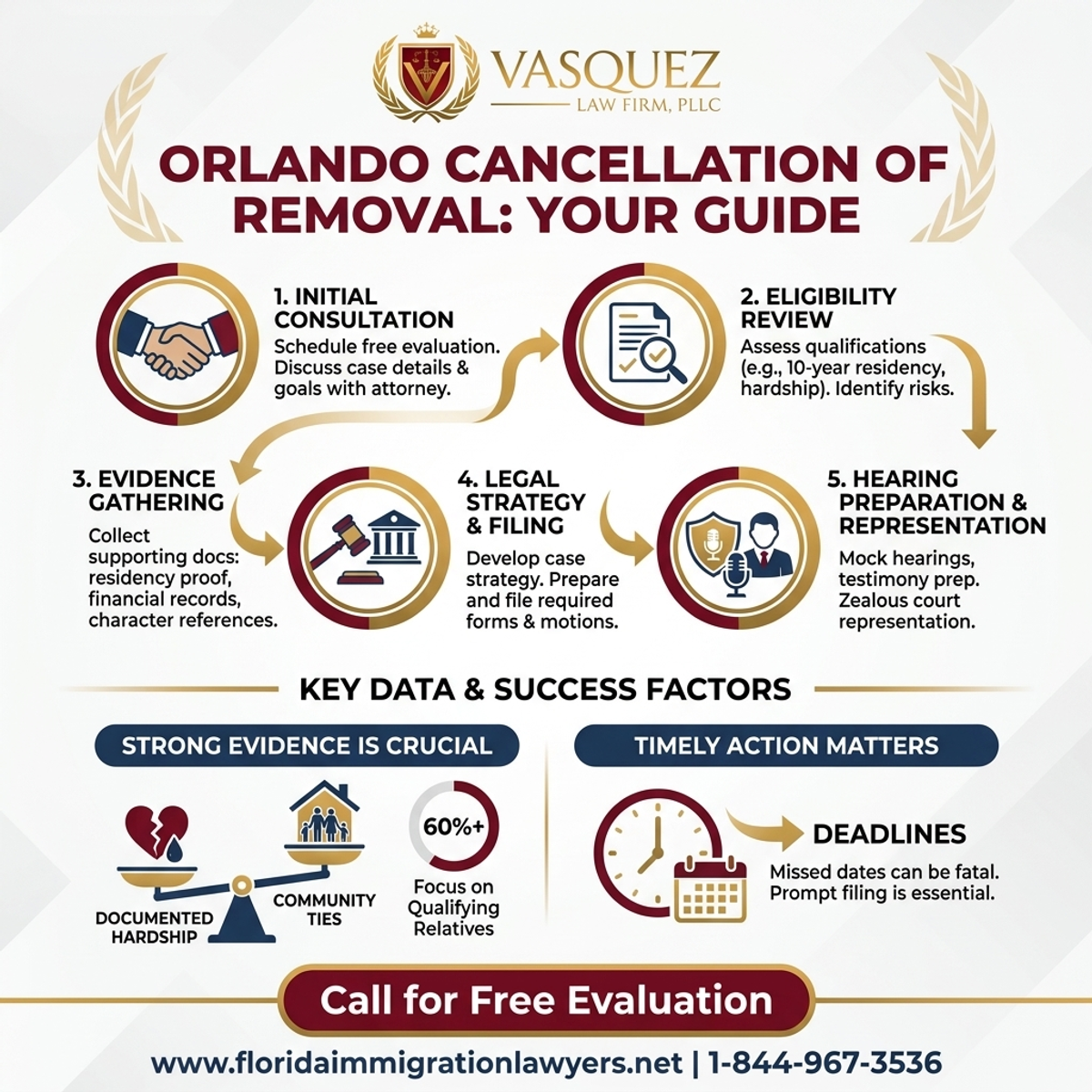
Step-by-Step Process — Orlando Cancellation of Removal Attorney: Your Guide
It is crucial to follow each step carefully, as errors can result in denial of relief.
The initial consultation with an attorney, such as those at Florida Immigration Lawyers, is not just a formality; it's a critical strategic session. An attorney will meticulously review your entire immigration history, criminal record, and family circumstances to determine if you meet the stringent legal requirements for cancellation of removal. They can identify potential red flags, advise on gathering specific evidence, and help you understand the strengths and weaknesses of your case before you commit to the lengthy and often costly process.
Gathering documentation is an ongoing process that requires diligence and organization. It's not enough to simply have documents; they must be relevant, authentic, and presented in a clear, coherent manner. For instance, proving continuous physical presence might involve utility bills, school records, employment history, and tax returns spanning many years. Demonstrating good moral character could involve letters from employers, community leaders, and religious figures, alongside proof of civic engagement. For hardship, medical records, psychological evaluations, school reports, and financial statements are often essential. Your legal team will guide you on what specific documents are most impactful for your unique situation.
Filing the application correctly and on time is non-negotiable. Missing deadlines or submitting incomplete forms can lead to immediate denial or significant delays. Your attorney will ensure that Form EOIR-42A or EOIR-42B is accurately completed, all supporting exhibits are properly indexed, and the application is filed with the immigration court during your removal proceedings. This includes preparing you for your master calendar hearings and individual merits hearing, where you will present your case before an immigration judge. Effective testimony, cross-examination, and legal arguments are all part of a successful court appearance, highlighting why skilled representation is indispensable.
Documents Needed for Cancellation of Removal
Preparing the necessary documents is vital for a successful application. Required documents typically include:
- Proof of residency (lease agreements, utility bills)
- Character references (letters from employers, community leaders)
- Evidence of family ties (birth certificates, marriage certificates)
- Documentation of hardship (medical records, financial statements)
- Photographs and identification documents
Ensure all documents are current and accurately reflect your situation.
Beyond the basic list, understanding the *purpose* of each document category is key. For example, proof of residency should not just be a single utility bill, but a comprehensive collection of documents spanning the entire required period of continuous physical presence. This could include old lease agreements, mortgage statements, school transcripts, employment records, bank statements, and even old photo albums with dated pictures showing you in the U.S. during those years. The more robust and consistent your evidence, the stronger your claim for continuous presence.
Character references, while helpful, gain more weight when they come from individuals with standing in the community who can genuinely attest to your moral character, civic engagement, and positive contributions. These letters should be detailed, signed, dated, and ideally notarized, explaining how the writer knows you and why they believe you possess good moral character. Similarly, evidence of family ties should go beyond simple certificates to include photographs, joint financial accounts, and affidavits from family members detailing your relationship and interdependence. For example, if you are the primary caregiver for an elderly parent or a child with special needs, detailed medical records, therapy notes, and letters from doctors or teachers will be crucial to illustrate the depth of your family's reliance on you.
Hardship documentation is perhaps the most critical and often the most challenging to compile. For non-permanent residents, proving "exceptional and extremely unusual hardship" requires overwhelming evidence. This might involve extensive medical records detailing a qualifying relative's serious health condition and the specific impact of your removal on their care, psychological evaluations from licensed professionals detailing the severe emotional distress separation would cause, and detailed financial records demonstrating your indispensable contribution to the household's stability. Educational records for children, highlighting their integration into U.S. schools and the potential trauma of relocation, also serve as powerful evidence. Florida Immigration Lawyers can help you identify and organize the most impactful documents for your specific hardship claim.
Timeline and Processing Expectations
The timeline for cancellation of removal cases can vary significantly. As of 2026, typical timeframes are as follows:
| Stage | Typical Timeframe | Notes |
|---|---|---|
| Initial Application | 3-6 months | Filing and preliminary hearings |
| Immigration Court Hearings | 6-12 months | Multiple hearings may be required |
| Judge's Decision | 1-3 months | Decision issuance |
| Appeals (if necessary) | 6-12 months | Depends on complexity and backlog |
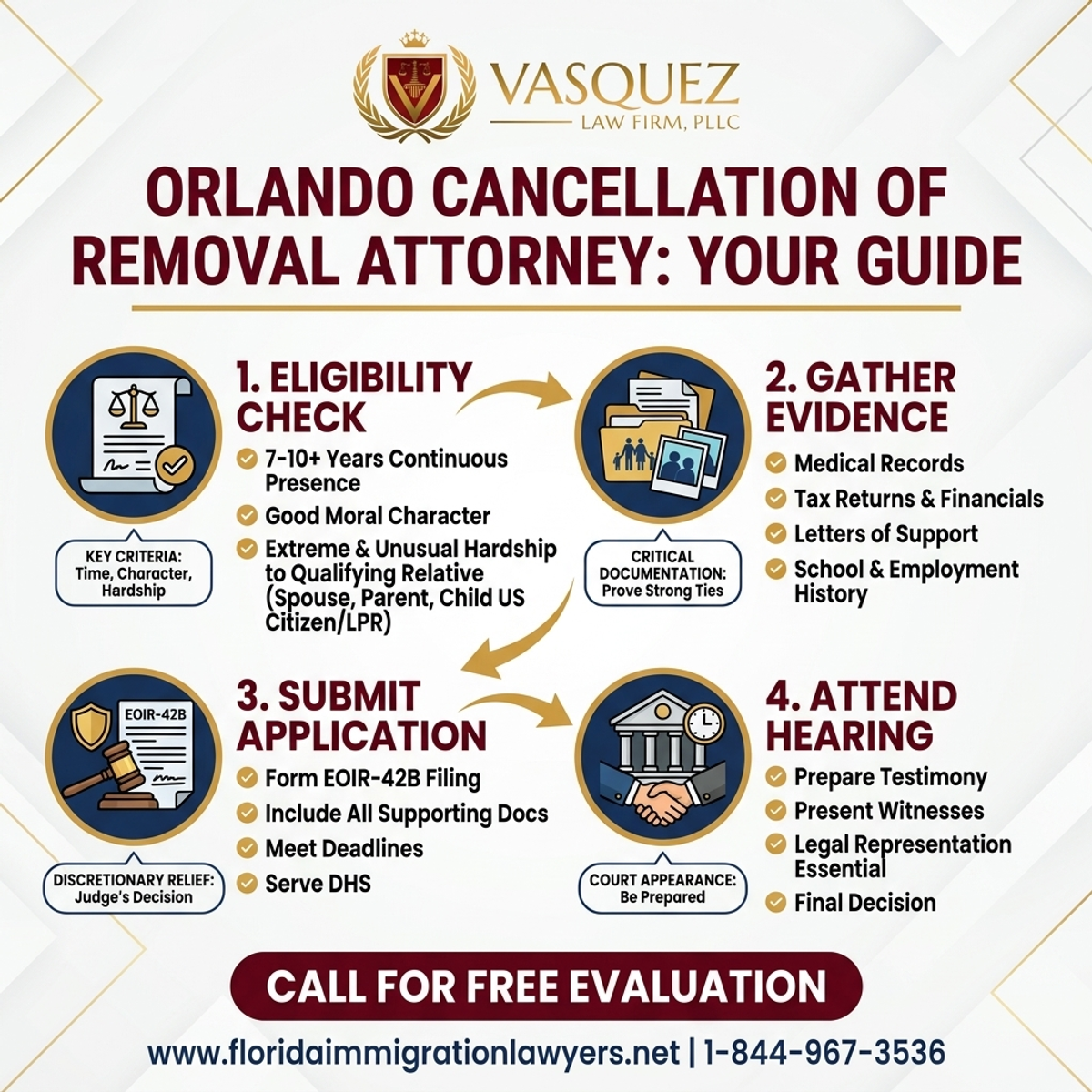
Key Statistics — Orlando Cancellation of Removal Attorney: Your Guide
Due to backlogs in immigration courts, particularly in Florida, delays are common.
Several factors contribute to these varying timelines, including the sheer volume of cases in immigration courts, the complexity of individual cases, the judge's schedule, and the need for additional evidence or expert testimony. Cases involving criminal history or multiple dependents may naturally take longer to adjudicate. Furthermore, changes in immigration policy or judicial priorities can also impact processing times, making it essential to have an attorney who stays abreast of the latest developments.
Managing expectations during this period is crucial for your mental and emotional well-being. While frustrating, delays do not necessarily indicate a negative outcome. Instead, they often reflect the systemic challenges within the immigration court system. Your attorney at Florida Immigration Lawyers will keep you informed of any developments, prepare you for potential delays, and strategically utilize any extra time to strengthen your case further, perhaps by gathering more recent hardship evidence or additional character references. Patience, combined with proactive legal representation, is key to navigating this extended process successfully.
Costs and Fees for Cancellation of Removal
Various costs are associated with seeking cancellation of removal. While these can fluctuate, here's a general breakdown:
| Item | Typical Fee | Notes |
|---|---|---|
| Application Filing Fee | Varies | Set by EOIR |
| Attorney Fees | Varies | Depends on case complexity |
| Documentation Costs | Varies | Cost of obtaining necessary documents |
Consulting with a lawyer can provide a clearer understanding of potential costs.
While the initial outlay for legal services and associated fees can seem substantial, viewing it as an investment in your future and your family's stability is important. The cost of legal representation typically reflects the complexity of immigration law, the extensive time commitment required for court appearances, evidence gathering, and legal research, and the high stakes involved in deportation proceedings. Many law firms, including Florida Immigration Lawyers, offer payment plans or flexible fee structures to make legal assistance more accessible. Discussing these options during your initial consultation can help you plan financially.
Beyond the application filing fee and attorney fees, other potential costs might include fees for obtaining certified copies of documents, translation services for foreign-language documents, expert witness fees (e.g., for psychologists or medical professionals providing hardship evaluations), and travel expenses for court appearances. A comprehensive discussion with your attorney will provide a transparent breakdown of all anticipated expenses, allowing you to budget accordingly and avoid unexpected financial burdens. Investing in experienced legal counsel significantly increases your chances of a favorable outcome, potentially saving you far greater costs and hardships in the long run.
Common Mistakes to Avoid
- Incomplete Applications: Missing information or documentation can lead to denial.
- Missing Deadlines: Failure to meet deadlines can result in automatic denial.
- Not Consulting an Attorney: Legal guidance can significantly impact your case's chances.
- Lack of Evidence: Insufficient proof of hardship or residency weakens your application.
- Inconsistent Statements: Discrepancies in your story can harm credibility.
- Ignoring Court Notices: Failing to attend hearings can result in deportation orders.
- Assuming Eligibility: Not every case qualifies, even if circumstances seem to fit.
An incomplete application is one of the quickest ways to receive a denial. Immigration judges and USCIS officers expect thorough, well-organized submissions. Omitting crucial details or failing to provide all requested supporting documents can lead to Requests for Evidence (RFEs) or outright rejection, prolonging your case or ending it prematurely. An experienced attorney from Florida Immigration Lawyers will meticulously review your application to ensure it is complete and accurate before submission.
Immigration court operates on strict deadlines for filing applications, submitting evidence, and responding to motions. Missing any of these deadlines, even by a single day, can lead to the automatic denial of your application or even a deportation order in absentia. It is imperative to work closely with your legal team to ensure all filings are submitted promptly and correctly, avoiding any procedural missteps that could jeopardize your case.
Attempting to navigate the complexities of cancellation of removal without legal representation is a significant risk. Immigration law is notoriously intricate, constantly evolving, and highly procedural. An attorney brings expertise in legal strategy, understanding of case law, and experience in court advocacy that is almost impossible for a layperson to replicate. Studies consistently show that individuals with legal representation have a significantly higher success rate in immigration court compared to those without counsel. Florida Immigration Lawyers are dedicated to providing that critical support.
The success of a cancellation of removal case hinges on the strength and persuasiveness of your evidence. Vague claims of hardship or insufficient proof of continuous physical presence will not meet the high legal thresholds. You must provide clear, compelling, and corroborated documentation to support every aspect of your eligibility. Your attorney will help you identify, gather, and present the most effective evidence to build a robust case.
Consistency in your statements, whether in written applications, affidavits, or oral testimony, is vital for maintaining credibility with the immigration judge. Any discrepancies, even minor ones, can be seized upon by the opposing counsel or the judge to cast doubt on your entire narrative. It is crucial to be truthful and consistent throughout the entire process, and your attorney will help you prepare thoroughly for any testimony you may need to give.
Ignoring notices from the immigration court, such as those for master calendar hearings or individual merits hearings, is extremely dangerous. Failure to appear can result in an order of deportation issued in your absence, making it much harder to reopen your case and seek relief. Always open and review all mail from the court or your attorney promptly, and ensure your contact information is up-to-date with both the court and your legal counsel.
Many individuals mistakenly assume they are eligible for cancellation of removal simply because they have lived in the U.S. for a long time or have U.S. citizen family members. However, the legal criteria, particularly the "exceptional and extremely unusual hardship" standard for non-permanent residents, are very strict and not easily met. A professional assessment by an immigration attorney is essential to determine genuine eligibility and avoid pursuing a path that is unlikely to succeed.
When to Call a Lawyer
Engaging a lawyer is essential when facing removal proceedings. If you're unsure about your eligibility for cancellation of removal, have complex immigration history, or need representation in court, contact Florida Immigration Lawyers. Our team can guide you through the process, ensuring your rights are protected and your case is effectively presented.
The moment you receive a Notice to Appear (NTA) in immigration court, or if you are detained by immigration authorities, is the critical juncture to seek immediate legal counsel. Delaying can severely limit your options and jeopardize your ability to seek relief. An experienced immigration attorney can assess your situation, explain your rights, and begin building a defense strategy tailored to your specific circumstances, including evaluating your eligibility for cancellation of removal.
Even if you believe your case is straightforward, the nuances of immigration law are vast. For instance, certain criminal convictions, even minor ones from years ago, can have significant immigration consequences and may bar you from relief. A lawyer can identify these potential hurdles, advise on possible waivers, and present your case in the most favorable light. Florida Immigration Lawyers are available 24/7 to provide the urgent assistance you need during such a challenging time.
Do not navigate this process alone. Contact Florida Immigration Lawyers today.
About Florida Immigration Lawyers
Florida Immigration Lawyers is dedicated to providing legal services across all of Florida. Our experienced team focuses on immigration law, including deportation defense, family immigration, and business immigration. With a commitment to client success and a free case review, we are available 24/7 to assist you. Call 1-844-YO-PELEO or visit our contact page to schedule a consultation.
Sources and References
- U.S. Citizenship and Immigration Services (USCIS)
- Executive Office for Immigration Review (EOIR)
- 8 U.S.C. Chapter 12 - Immigration and Nationality Act
Related services: asylum and refugee protection, immigration waivers, humanitarian protection programs, DACA renewal and applications.
This article provides general legal information and is not intended as legal advice. Every case is unique, and outcomes depend on specific facts and circumstances. Contact an attorney for advice about your particular situation.
Contact Florida Immigration Lawyers at 1-844-YO-PELEO for your free consultation. Se Habla Espanol - Estamos aqui para ayudarle.
If you need legal assistance, learn more about deportation defense lawyers in Florida, or call us at 1-844-YO-PELEO for a free case review.
Do Not Navigate This Process Alone
Our experienced immigration attorneys are ready to fight for you. Get a free, confidential case review today.
Se Habla Español
Or leave your details and we’ll call you:
Free Evaluation in 24 Hours
Or talk to us right now

AI voice assistant — available 24/7
FreeFrequently Asked Questions

William J. Vásquez
Founding Attorney · Vasquez Law Firm
U.S. Air Force veteran and immigration attorney with years of hands-on U.S. immigration experience. J.D., NCCU School of Law. AILA member. Admitted to the 4th, 5th, and 11th Circuit Courts.
Available 24/7 - Free Evaluations
Reviewed for legal accuracy by William J. Vásquez
Licensed in North Carolina; U.S. immigration is federal practice.
Related Legal Services
Our Florida immigration attorneys can help you with citizenship and naturalization, immigration practice areas and free immigration consultation. Call today at 1-844-YO-PELEO for a free case review.
Related Links
Related Topics
Free Legal Case Review
Discuss your case with our experienced attorneys. We're available 24/7.
Se Habla Español - Estamos aquí para ayudarle.
Related Articles
EAD Advance Parole Combo Card in Florida: What You Need
An EAD advance parole combo card allows individuals with pending adjustment applications to both work and travel abroad without jeopardizing their green card application. Learn how to apply in Florida, what documents you need, and common mistakes to avoid.
PERM Labor Certification in Florida: A 2026 Guide
Learn all about the PERM labor certification process in Florida, essential for employers sponsoring green card applicants. Understand the steps, document requirements, and common mistakes to avoid in this 2026 guide.
Dual Citizenship Lawyer in Florida: What You Need to Know
For Florida residents, the concept of dual citizenship, or holding two passports, offers a compelling blend of opportunities and challenges. While the U.S. generally permits dual nationality, the path to achieving this status requires a meticulous understanding of both U.S. immigration laws and the citizenship policies of your country of origin. This guide explores the definition of dual citizenship, the detailed step-by-step process for U.S. naturalization, and the significant benefits and potential pitfalls involved. We cover essential documentation, typical timelines, and cost considerations for 2026, providing crucial insights for anyone in Orlando, Miami, or across Florida considering this important legal step. Learn about common mistakes to avoid and understand when to seek professional legal counsel to navigate this complex process successfully. Florida Immigration Lawyers is here to provide expert, bilingual support for your dual citizenship journey.
Immigration Lawyer Orlando Free Consultation in Florida
For individuals and families in Orlando, Florida, navigating the complexities of U.S. immigration law requires expert guidance. An immigration lawyer in Orlando offers crucial support for everything from visa applications and green card processes to naturalization and deportation defense. This comprehensive guide details what a free consultation covers, providing a step-by-step overview of immigration pathways, essential document checklists, and expected timelines in 2026. We also highlight common mistakes to avoid, discuss the critical role of legal counsel in deportation and asylum cases, and explain why choosing a local Orlando immigration attorney is beneficial. Florida Immigration Lawyers is dedicated to serving the diverse community of Orlando with compassionate, effective legal solutions, ensuring you receive personalized advice and robust representation for a successful immigration journey.