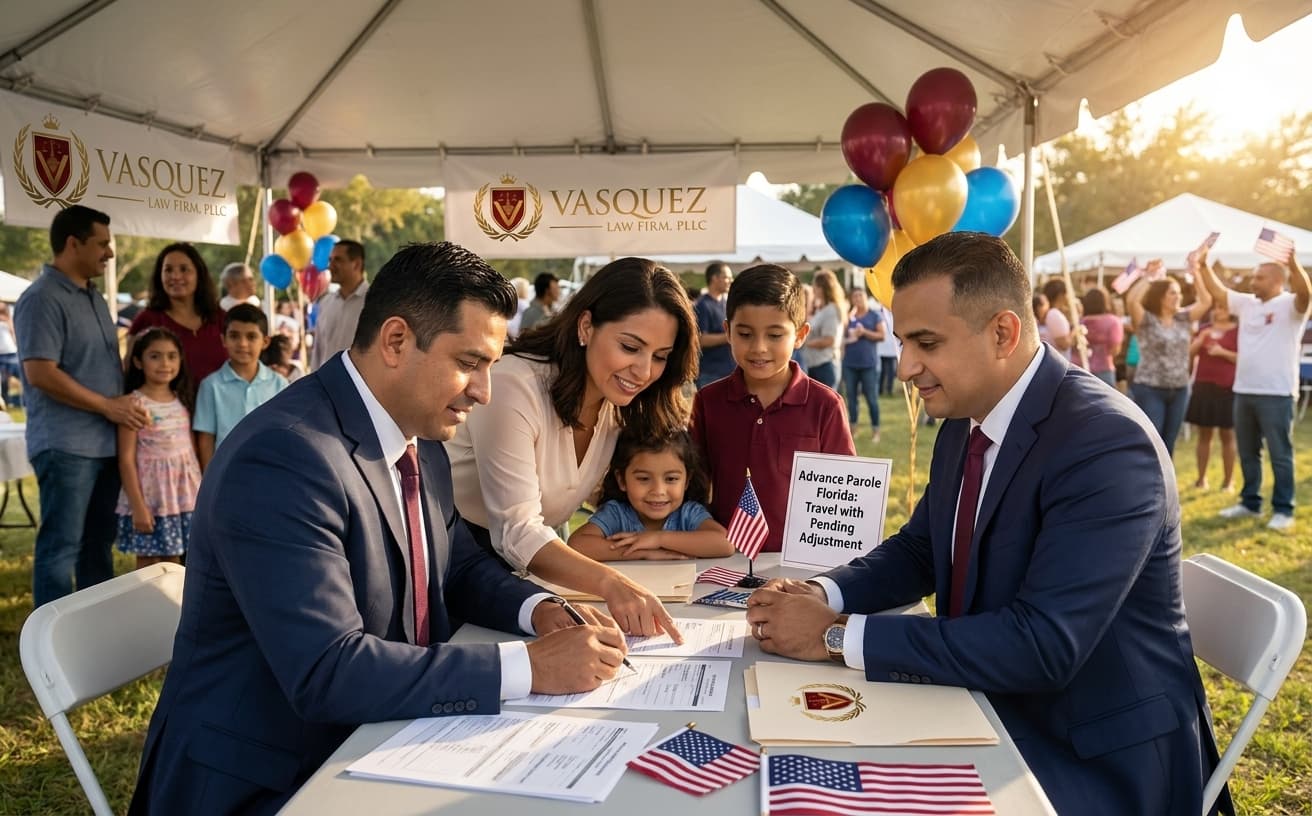
Parole in immigration law means permission to enter or remain in the United States temporarily, granted case by case. It is not a visa or a green card, but for many families it makes a later green card possible. Humanitarian parole lets someone outside the country come for urgent humanitarian reasons or significant public benefit, generally by filing Form I-131 with evidence of the emergency. Parole in place, military parole in place and advance parole are different tools. These programs are discretionary and change, so confirm current rules with USCIS and review your facts with a lawyer.
- Parole is temporary permission to enter or remain, granted case by case.
- Humanitarian parole is requested generally on Form I-131 with evidence of an urgent reason.
- Parole in place, military parole in place and advance parole are separate tools.
- Parole programs are discretionary, change over time and have been challenged in court.
Introduction
"Parole" in immigration law means permission to enter or remain in the United States for a temporary period, granted case by case. It is not a visa and not a green card, but for many families it is the step that makes a later green card possible. This page explains humanitarian parole, parole in place, military parole in place and advance parole, and how a lawyer helps in each. To talk about your situation, call 1-844-YO-PELEO or contact us.
A humanitarian parole lawyer helps you choose the right type of parole, document the reasons for it and understand what it will and will not do for you. Vasquez Law Firm serves families across Florida from our Orlando office by phone and secure video, and the information below is meant to help you prepare for that conversation.
This page is general information, not legal advice. Parole programs are discretionary, are created and changed by the government, and have been challenged in court, so confirm the current rules with USCIS and speak with a lawyer about your own facts.
Humanitarian Parole for Someone Outside the United States
Humanitarian parole allows a person outside the country to come to the United States temporarily for urgent humanitarian reasons or a significant public benefit. Examples include a relative who needs medical treatment that is not available at home, a person who needs to attend to a dying family member, or someone facing an emergency where no visa is available in time. Requests are generally filed with USCIS on Form I-131, with evidence of the emergency and of who will support the person financially in the United States.
A humanitarian parole attorney focuses on the evidence. Officers look for a clear, documented reason why the person must come now, why a regular visa is not a realistic option, and how long the stay will last. Parole is discretionary and is usually granted for a limited period, so planning what happens when it ends is part of the conversation from the start. Our humanitarian protection services page describes related forms of relief.
Parole in Place for Military Families
Parole in place is granted to someone who is already inside the United States after entering without inspection. The most widely known program is military parole in place, available case by case to certain spouses, children and parents of active-duty service members, members of the Selected Reserve, and veterans.
Why does it matter? A person who entered without inspection generally cannot adjust status to permanent residence in the United States, because the law requires having been "inspected and admitted or paroled." A grant of parole in place can satisfy that requirement. For the spouse of a U.S. citizen service member, that may open the door to a green card without leaving the country. A lawyer prepares the I-131 request with proof of the family relationship, the service member's military status, identity documents and evidence supporting a favorable exercise of discretion.
Military families often move, deploy or train away from home, which makes paperwork hard to coordinate. A firm that works by video and secure file sharing can keep the case moving even when the service member is away. The lawyer also reviews any criminal history or prior removal orders before filing, since those can affect both parole and the later green card.
Other Parole in Place Programs
Over the years, the government has announced other parole in place programs for certain family members of U.S. citizens, and some of them have been challenged in federal court. Whether any program beyond military parole in place is available can change quickly. A lawyer checks the rules in effect at the time you consult, rather than relying on what a friend did a few years ago. When you speak with a lawyer, ask directly which program applies, what happens if it is paused, and whether you have any other path to status.
A lawyer will also look at the next step. Parole in place is usually not the goal itself; it is a bridge to adjustment of status through a family petition. The lawyer should explain whether you have a qualifying relative, whether you need a waiver for any other ground of inadmissibility, and how the timing works. See our green card services page for that later stage.
Advance Parole: Traveling While an Application Is Pending
Advance parole is a travel document issued before you leave the country. It is commonly used by people with a pending adjustment of status application, DACA recipients when travel is authorized for a permitted purpose, and certain other applicants. Leaving the United States without it while a green card application is pending is generally treated as abandoning the application, with limited exceptions for some visa holders.
A lawyer reviews more than the form. Before you travel, the attorney looks at your entry history, any period of unlawful presence, any prior removal order and any criminal record, because these can create problems when you try to return. Even with the document in hand, re-entry is decided by Customs and Border Protection at the port of entry. A lawyer will tell you plainly if your history makes travel risky.
Applicants should also understand that advance parole does not ensure admission, and that its effect depends on the type of application it is attached to. For some people, such as certain visa holders, travel may be possible without it, but the rules are specific. Never assume that a friend's experience applies to you, because small differences in status or history can change the result.
Families sometimes ask whether parole can be used to bring a relative in quickly when a family petition has a long wait. In general, parole is not a substitute for the visa process, and officers will not grant it simply because the wait is long. It is meant for urgent humanitarian reasons or a significant public benefit, and the request should explain why those reasons exist in your case.
Cuban Nationals, Parole and the Cuban Adjustment Act
Florida has a large Cuban community, and parole questions come up often in Cuban cases. Under the Cuban Adjustment Act, a native or citizen of Cuba who was admitted or paroled into the United States after January 1, 1959, and who has been physically present for at least one year, may apply for permanent residence. A Cuban immigration lawyer reviews the documents you received when you arrived to determine whether you were paroled. That question is not always obvious: some people were released with documents other than a parole document, and how those cases are treated has been the subject of litigation and changing guidance.
A lawyer also reviews spouses and children who are not Cuban, since they may qualify as derivatives in some situations, and looks at any criminal history that could affect eligibility.
How a Parole Request Works
The details depend on the type of parole, but most requests follow this outline:
- Consult a lawyer to identify the type of parole and whether it fits your facts.
- Gather identity documents, proof of the relationship or emergency and, for humanitarian parole, financial support evidence.
- Prepare Form I-131 or the relevant request, with a written explanation of why parole is warranted.
- File with the correct agency and keep the receipt notice.
- Respond to any request for more evidence by its deadline.
- If parole is granted, follow the conditions, keep track of the end date and plan the next step, such as an adjustment application or departure.
Because parole is discretionary, a denial is possible even when the paperwork is good. A lawyer can explain whether a new request or another option makes sense after a decision.
Document Checklist for a Parole Consultation
- Passports, I-94 records and every document you received at entry or release.
- Any Notice to Appear, prior applications or USCIS notices.
- For military parole in place, proof of the service member's status and your relationship.
- For humanitarian parole, medical records, letters or other proof of the emergency, and information about the financial sponsor.
- Birth and marriage certificates for the family members involved.
- Court records for any arrest, even if the case was dismissed.
If you do not have a document, tell the lawyer. Some papers can be replaced, and others can be explained or supported with different evidence.
Timeline and Processing Expectations
Parole requests do not follow a single schedule. Urgent humanitarian requests may be handled differently from other filings, military parole in place and advance parole have their own processing patterns, and policies can change quickly. USCIS publishes current processing information on its website, and we do not quote times because they change. No lawyer can promise a timeline or a result.
Plan carefully around dates. If you need advance parole to travel, do not book a trip until you have the document in hand. If you are relying on parole to adjust status, keep copies of every approval and mark the end date of the parole period.
| Stage | What happens | Who acts |
|---|
| Eligibility review | Choose the type of parole and check history | Client and lawyer |
| Evidence gathering | Collect proof of the relationship, emergency or status | Client, sponsor and lawyer |
| Filing | File Form I-131 or the relevant request | Lawyer and USCIS |
| Review | Officer reviews evidence and may ask for more | USCIS, with client response |
| Decision and next step | Parole granted or denied; adjustment or other filing follows | USCIS, client and lawyer |
Responding to a Request for Evidence or a Denial
If USCIS asks for more evidence, the notice will state what is missing and set a deadline. The response should answer the specific question, with documents organized so that the officer can find them quickly. In humanitarian parole cases, that often means stronger proof of the emergency, a clearer explanation of why a visa is not available in time or more detail about who will provide financial support. In military parole in place cases, it may mean clearer proof of the service member's status or the family relationship.
If a request is denied, parole is discretionary, so the options are different from those for an ordinary application. A lawyer can review the notice and explain whether a new request with stronger evidence, a request to reconsider or another path is realistic. Do not assume that a denial ends every option, and do not repeat the same request without fixing the weakness that led to the denial.
Throughout this process, be honest. Exaggerating an emergency or hiding a history can damage a later green card case, and a lawyer cannot repair a misstatement once it has been made to the government.
Cost Factors and Fee Breakdown
Costs depend on the type of parole and the later filings that depend on it.
| Item | Amount | Notes |
|---|
| Form I-131 filing fee | Check USCIS for the current fee | Fees can differ by the type of request; check the form instructions |
| Adjustment of status filings | Check USCIS for the current fee | Applies if parole leads to a green card application |
| Medical records and translations | Varies by case | Costs of documents supporting the request |
| Consular or travel costs | Check the court or agency for current fees | Applies when the person travels from abroad |
| Legal fees | Varies by case | Depends on the type of parole and the evidence needed |
Fee rules for parole requests and related forms can change, and some categories are treated differently, so check the current USCIS instructions before filing.
Legal fees depend on the complexity of the case. A parole request supported by detailed medical and financial evidence takes more preparation than a simple travel document request. Ask for a written fee agreement that explains what is included.
Keep your own record of the process. Save copies of every form, every piece of evidence you submitted and every notice, and keep a calendar of deadlines and expiration dates. Parole periods can end sooner than people expect, and the next step, such as an adjustment application, often needs to be filed while the parole is still valid.
Common Mistakes to Avoid
- Assuming parole is the same as a visa or a green card.
- Traveling abroad while an application is pending without advance parole.
- Filing for humanitarian parole without clear evidence of the emergency and a financial sponsor.
- Relying on an old program that may have been paused or changed.
- Leaving out a criminal record or prior removal order from the request.
- Forgetting the end date of the parole period.
- Relying on a notario or unlicensed preparer instead of a licensed attorney.
When to Call a Lawyer
Call a lawyer before you file a parole request, before you travel with a pending application, when you receive a notice or denial, and if you have a prior removal order or criminal history. For urgent humanitarian situations, call as early as possible so that the evidence can be gathered. To discuss parole or a related application, call 1-844-YO-PELEO or contact us to schedule a consultation.
About Vasquez Law Firm
Vasquez Law Firm practices immigration law only. Our only office is at 1111 E Amelia Street in Orlando. We serve clients throughout Florida by secure video and phone, and in person in Orlando, in English and Spanish. William J. Vásquez is the founding attorney. Call 1-844-YO-PELEO or contact us.
Sources and References
Related services: humanitarian protection lawyers, immigration lawyers in Florida
Other ways people search for this
People look for this help under different names. Related searches include immigration lawyer for parole; parole in place lawyer; military parole in place attorney; military parole in place lawyer; immigration parole in place lawyer; parole in place attorney; parole in place immigration attorney; military parole in place lawyers; advance parole attorney.
This article is general information, not legal advice. Every case is different; speak with an immigration lawyer about your situation.