Parole in Place for Military Families in Florida: What You
Parole in place (PIP) offers a pathway for military families in Florida to adjust immigration status without leaving the U.S. Learn about eligibility, process, and benefits in this comprehensive guide. Call Florida Immigration Lawyers at 1-844-YO-PELEO for a free case review.
- PIP applies to spouses, children, and parents of military members.
- PIP provides temporary lawful status.
- No need for family members to leave the U.S.
- Helps prevent deportation of military family members.
Parole in Place for Military Families in Florida: A Comprehensive Guide
Imagine being part of a military family residing in Orlando, Florida, and facing immigration challenges that could separate you from your loved ones. Parole in place (PIP) offers a vital lifeline for military families, providing a pathway to adjust immigration status without leaving the U.S. In this guide, we'll explore what PIP is, who qualifies, and how it benefits military families in Florida. Call Florida Immigration Lawyers at 1-844-YO-PELEO for a free case review.
What Is Parole in Place and Who Qualifies?
Parole in place is an immigration policy that allows certain family members of active-duty military personnel, veterans, or reservists to adjust their status while remaining in the U.S. This program primarily benefits spouses, children, and parents of military members, helping them avoid the risks associated with leaving the country to reapply for entry. These risks can include lengthy separation from family, potential bars to re-entry, and the uncertainty of navigating complex consular processing abroad. PIP is a crucial tool designed to keep military families united, recognizing the sacrifices made by service members.
To qualify for PIP, applicants must be immediate family members of U.S. military personnel and demonstrate a valid relationship. The military member must be a U.S. citizen or a lawful permanent resident, and can be active duty, a reservist, or a veteran. The program extends to spouses, unmarried children under 21, and parents of the qualifying service member. It's important to note that step-relationships are often recognized if they meet specific legal criteria, further broadening the scope of eligible family members.
The process is discretionary, meaning that approval is not guaranteed, but it can significantly ease immigration issues for those eligible. USCIS considers each case on its individual merits, often looking for compelling humanitarian factors or significant public benefit. For example, a spouse who entered the U.S. without inspection but is now married to a deployed service member would face immense hardship if forced to leave the country. PIP provides a pathway for such individuals to regularize their status without enduring separation, allowing them to continue supporting their service member and family unit within the U.S.
How Does the Parole in Place Process Work?
As of 2026, the PIP process involves several steps:
- Application Submission: Applicants must submit Form I-131, Application for Travel Document, along with supporting documents such as proof of family relationship and military service.
- USCIS Review: The U.S. Citizenship and Immigration Services (USCIS) reviews the application and may request additional information or documentation.
- Decision: USCIS will grant or deny the parole request. If granted, the applicant receives a parole document, allowing them to remain in the U.S. legally.
It's important to note that PIP is not a permanent solution but provides temporary relief while pursuing other immigration benefits. This temporary lawful status is a critical stepping stone. Once parole is granted, individuals become eligible to apply for adjustment of status to lawful permanent resident (Green Card) under Section 245(a) of the Immigration and Nationality Act, provided they meet all other eligibility requirements. This means that, unlike many who entered the U.S. without inspection, a PIP recipient can apply for a Green Card from within the United States, bypassing the need for potentially risky and lengthy consular processing abroad.
The grant of parole also makes individuals eligible to apply for an Employment Authorization Document (EAD), allowing them to work legally in the U.S. This can significantly improve the family's financial stability and overall well-being. A successful PIP application effectively cures the 'unlawful entry' issue for adjustment of status purposes, paving the way for a more secure future for military families. Florida Immigration Lawyers can guide you through these subsequent steps, ensuring a seamless transition from PIP to a Green Card application.
What Documents Are Required for Parole in Place?
- Completed Form I-131
- Proof of military service (e.g., military ID, deployment orders)
- Proof of family relationship (e.g., birth or marriage certificates)
- Two passport-sized photos
- Any previous immigration documents
Ensuring all documents are accurate and complete can significantly impact the success of your application. Beyond the basic requirements, it's highly recommended to include a cover letter explaining the purpose of the application and detailing the eligibility criteria met. For proof of military service, a copy of the service member's military identification card (front and back), current deployment orders, or a Certificate of Release or Discharge from Active Duty (DD-214) for veterans are essential. For reservists or National Guard members, specific orders or official letters confirming their status are crucial.
Proof of family relationship requires official, government-issued documents. For spouses, a marriage certificate is necessary. For children, a birth certificate showing the relationship to the military member, or adoption decrees for adopted children. For parents, a birth certificate of the military member showing the parent's name. If any of these documents are not in English, they must be accompanied by a certified English translation. Furthermore, affidavits from reliable witnesses who can attest to the relationship or military service can strengthen an application, especially in cases where primary documentation might be challenging to obtain. Always keep copies of everything you submit.
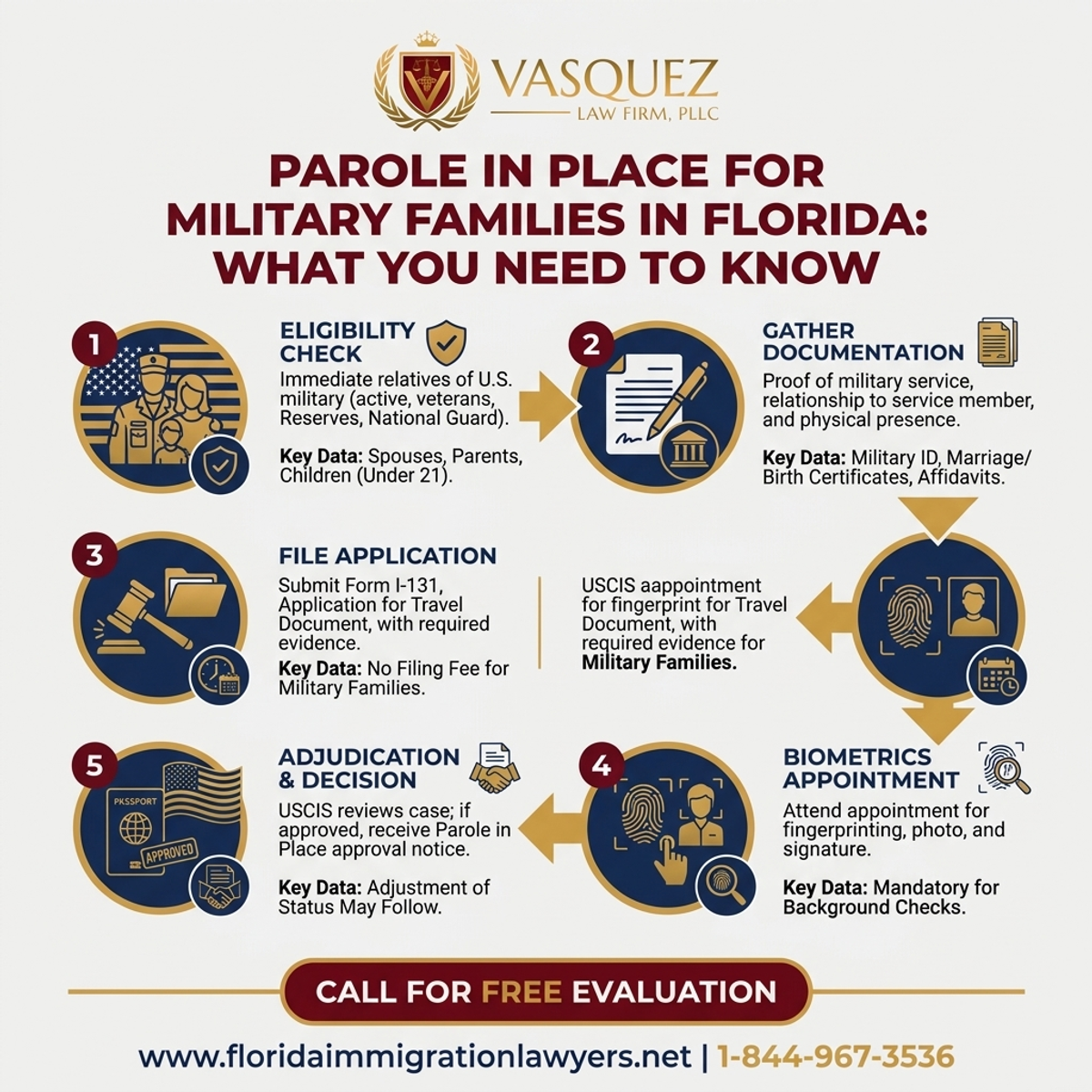
Step-by-Step Process — Parole in Place for Military Families in Florida: What You Need to Know
What to Expect: Timeline and Processing
| Stage | Typical Timeframe | Notes |
|---|---|---|
| Application Review | 3-6 months | Timeframe may vary depending on USCIS workload |
| Additional Document Requests | 1-2 months | Respond promptly to avoid delays |
| Final Decision | 1-3 months | Decision is at USCIS's discretion |
Applicants should stay informed about their application's status and be prepared for potential requests for additional information. While the typical timeframes provide a general idea, several factors can influence the actual processing duration. These include the specific USCIS service center handling the application, the volume of applications they are processing, and the complexity of your individual case. For instance, if there are any discrepancies in your submitted documents or if USCIS requires further clarification on your military family member's service record, it could lead to delays and additional document requests.
It is crucial to respond to any Requests for Evidence (RFEs) promptly and thoroughly. An RFE means USCIS needs more information to make a decision, and a delayed or incomplete response can result in a denial. Keeping your contact information updated with USCIS is also vital to ensure you receive all correspondence. If your case seems to be taking an unusually long time, or if you receive an RFE, consulting with experienced legal counsel like Florida Immigration Lawyers can help you understand the next steps and ensure your response is comprehensive and timely.
Cost Factors and Fee Breakdown
While PIP does not have a direct filing fee, there are associated costs:
| Item | Typical Fee | Notes |
|---|---|---|
| Form I-131 Filing | No fee required | USCIS policy specifically waives the fee for I-131 when filed for PIP. |
| Biometrics | No fee required | No fee required for biometrics associated with a PIP application. |
| Legal Assistance | Varies | Consider hiring an attorney for guidance |
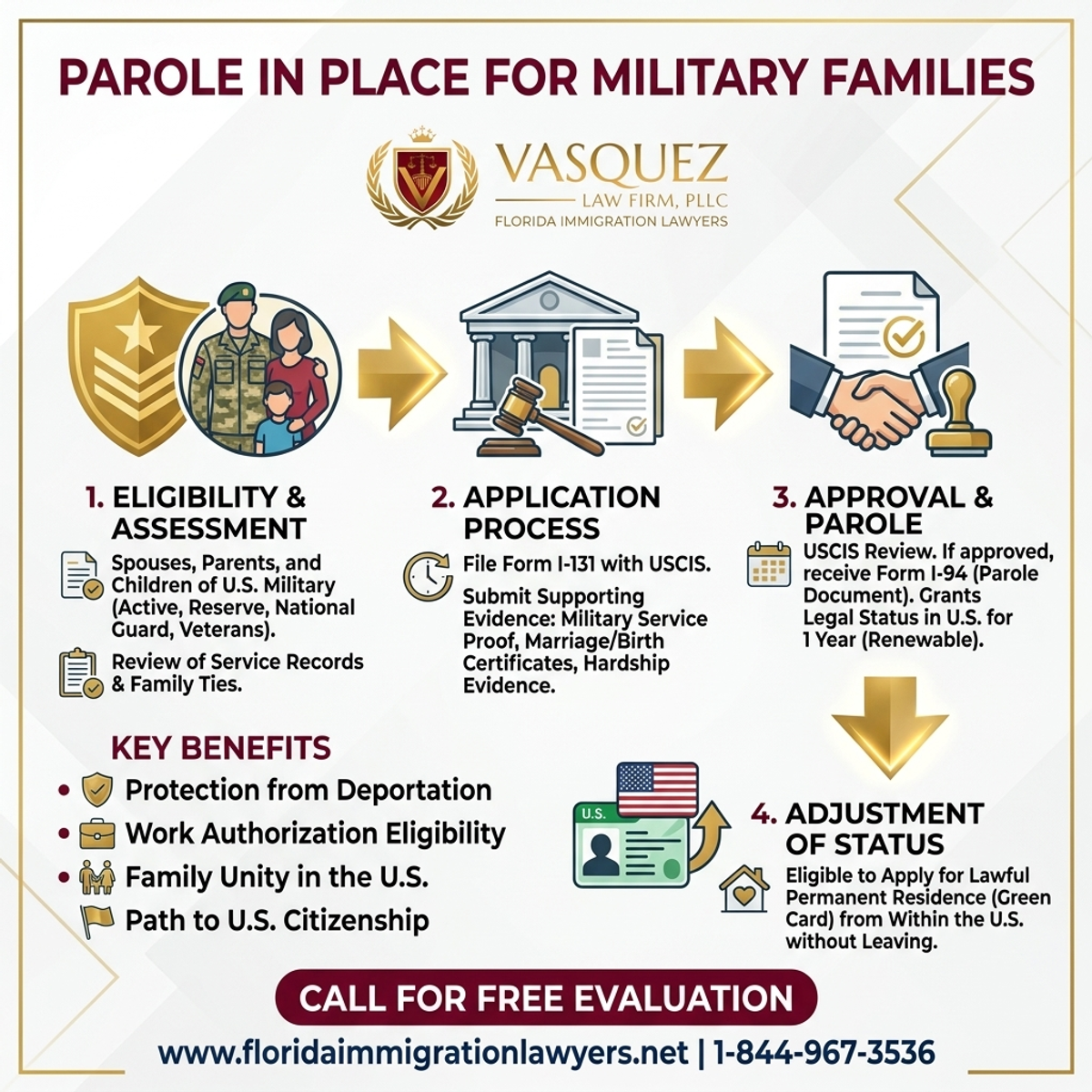
Key Statistics — Parole in Place for Military Families in Florida: What You Need to Know
It's important to clarify that while the application itself is fee-exempt, applicants should budget for other potential expenses. These can include costs for obtaining certified copies of birth or marriage certificates, professional translation services for any foreign documents, and potentially travel expenses to a USCIS Application Support Center for biometrics if required (though biometrics for PIP are often waived or handled administratively). While these may seem minor, they add up and should be considered during the planning phase. Florida Immigration Lawyers offers transparent fee structures for their legal assistance, ensuring you understand all potential costs upfront.
Beyond the initial PIP application, remember that the goal is often adjustment of status to a Green Card. This subsequent application (Form I-485) does have significant filing fees and typically requires a medical examination by a USCIS-approved civil surgeon, which incurs its own costs. Planning for these future expenses is part of a comprehensive immigration strategy. Engaging with Florida Immigration Lawyers early can help you understand the entire financial roadmap for achieving permanent residency.
Do not navigate this process alone. Contact Florida Immigration Lawyers today.
Common Mistakes to Avoid in PIP Applications
Navigating the Parole in Place application process can be complex, and even minor errors can lead to significant delays or even denial. Understanding and avoiding common pitfalls is essential for a successful outcome. Many applicants, eager to reunite their families, inadvertently make mistakes that could be easily prevented with careful attention to detail and, ideally, professional guidance.
- Incomplete Forms: Submitting incomplete or incorrect forms can lead to delays or denials.
- Insufficient Documentation: Failing to provide adequate proof of relationship or military service.
- Missing Deadlines: Not responding to USCIS requests for additional information in a timely manner.
- Not Consulting an Attorney: Navigating PIP without legal guidance can increase the risk of errors.
- Ignoring Updates: Failing to stay updated on immigration policy changes.
- Incorrect Fee Payments: Sending incorrect fees can delay the process.
- Lack of Preparation: Not preparing for possible interviews or additional documentation requests.
These common mistakes underscore the importance of meticulous preparation and expert review. A single oversight, such as an unsigned form or an outdated fee, can derail an otherwise strong application. By being aware of these potential traps, applicants can approach the process with greater confidence and efficiency. When in doubt, always seek clarification, and remember that Florida Immigration Lawyers are available to provide the necessary support to prevent these errors and ensure your application is as robust as possible.
When to Call a Lawyer
If you're facing complexities in your immigration status or have been denied parole in place, it's crucial to contact an attorney. Legal professionals can offer guidance, help rectify mistakes, and improve the chances of a successful application. Florida Immigration Lawyers offer personalized services to assist military families with their PIP applications. Our team brings extensive experience in immigration law, understanding the nuances of military-related cases and the specific requirements set forth by USCIS.
Beyond denials, there are several scenarios where legal counsel becomes invaluable. If the military member has a complex service history, if there are any criminal convictions (even minor ones) for the applicant, or if the applicant has prior immigration violations or deportation orders, the case can become significantly more complicated. An attorney can assess these complexities, advise on potential waivers, and help present a compelling case to USCIS. Proactive legal consultation can often prevent issues before they arise, saving time, stress, and resources in the long run.
Moreover, if you are unsure about your eligibility, the required documentation, or how to articulate the humanitarian reasons for your parole request, a lawyer can provide clarity and strategic advice. The discretionary nature of PIP means a well-prepared and thoroughly documented application can make all the difference. Don't hesitate to reach out to Florida Immigration Lawyers at 1-844-YO-PELEO for a free case review to understand your options and strengthen your application.
About Florida Immigration Lawyers
Florida Immigration Lawyers is a dedicated firm specializing in immigration services throughout Florida. We offer personalized assistance for PIP applications, asylum, deportation defense, and more. Our team is committed to helping families navigate the complex immigration landscape. Available 24/7, we provide free case reviews. Schedule a free consultation today. We pride ourselves on our deep understanding of both immigration law and the unique challenges faced by military families. Our mission is to provide compassionate, effective, and results-driven legal representation.
We understand the immense sacrifices made by service members and their families, and we are dedicated to ensuring their loved ones can remain united and secure in the U.S. Our services extend beyond just filing forms; we offer comprehensive support, from initial consultation and eligibility assessment to document preparation, strategic advice, and representation throughout the entire immigration process. Whether you are seeking a Green Card through PIP, fighting a deportation order, or pursuing citizenship, Florida Immigration Lawyers stands ready to advocate for you.
Sources and References
- U.S. Citizenship and Immigration Services (USCIS)
- Executive Office for Immigration Review (EOIR)
- 8 U.S.C. Chapter 12 - Immigration and Nationality Act
Related services: immigration practice areas, family immigration services, citizenship and naturalization.
This article provides general legal information and is not intended as legal advice. Every case is unique, and outcomes depend on specific facts and circumstances. Contact an attorney for advice about your particular situation.
Frequently Asked Questions About Parole in Place
Here are some common questions about Parole in Place for military families, with practical advice to guide you:
Can I work legally while on Parole in Place?
Yes, once your Parole in Place application is approved, you become eligible to apply for an Employment Authorization Document (EAD), also known as a work permit. This allows you to work legally in the U.S. while your status is being adjusted. Applying for the EAD is a separate step after PIP approval, and it's essential for financial stability. Florida Immigration Lawyers can help you file the necessary forms accurately and efficiently.
Does Parole in Place automatically lead to a Green Card?
No, PIP itself does not automatically grant you a Green Card. It provides temporary lawful status and 'cures' the unlawful entry, making you eligible to apply for adjustment of status to a lawful permanent resident (Green Card) from within the U.S. You must still file Form I-485, Application to Register Permanent Residence or Adjust Status, and meet all other eligibility requirements. PIP is a crucial prerequisite, not the final step.
What if my military family member is a veteran, not active duty?
Parole in Place is available for immediate family members of active-duty military personnel, reservists, and veterans. This means that if your spouse, parent, or child served in the U.S. armed forces and received an honorable discharge, you may still be eligible. The veteran status must be properly documented, typically with a DD-214 form. Florida Immigration Lawyers can help ensure all veteran documentation is correctly submitted.
Can I travel outside the U.S. if I have Parole in Place?
Generally, it is not advisable to travel outside the U.S. if you are on Parole in Place and have not yet adjusted your status to a Green Card. Leaving the country could be considered an abandonment of your adjustment of status application and might trigger re-entry bars. If travel is absolutely necessary, you would need to apply for Advance Parole (Form I-131) and receive approval before departing, but even then, it carries risks. Always consult with Florida Immigration Lawyers before making travel plans.
What happens if my Parole in Place application is denied?
A denial of a PIP application can be disheartening, but it's not necessarily the end of the road. USCIS decisions are discretionary, and a denial might be due to incomplete documentation, a misunderstanding of eligibility, or other factors. You may be able to reapply or explore other immigration avenues. It is crucial to consult with an experienced immigration attorney, such as Florida Immigration Lawyers, immediately after a denial to understand the reasons and strategize your next steps.
Final CTA
To ensure the best outcome for your immigration process, contact Florida Immigration Lawyers at 1-844-YO-PELEO for a free consultation. Se Habla Espanol - Estamos aqui para ayudarle.
If you need legal assistance, learn more about immigration lawyers in Florida, or call us at 1-844-967-3536 for a free case review.
Don't let immigration complexities add undue stress to your military family's life. The path to lawful status can be challenging, but with expert legal guidance, it becomes manageable. Our commitment is to provide clear, actionable advice and robust representation, ensuring that you and your loved ones can focus on what truly matters. Take the first step towards securing your family's future by connecting with Florida Immigration Lawyers today.
Do Not Navigate This Process Alone
Our experienced immigration attorneys are ready to fight for you. Get a free, confidential case review today.
Se Habla Español
Or leave your details and we’ll call you:
Free Evaluation in 24 Hours
Or talk to us right now

AI voice assistant — available 24/7
FreeFrequently Asked Questions

William J. Vásquez
Founding Attorney · Vasquez Law Firm
U.S. Air Force veteran and immigration attorney with years of hands-on U.S. immigration experience. J.D., NCCU School of Law. AILA member. Admitted to the 4th, 5th, and 11th Circuit Courts.
Available 24/7 - Free Evaluations
Reviewed for legal accuracy by William J. Vásquez
Licensed in North Carolina; U.S. immigration is federal practice.
Related Legal Services
Our Florida immigration attorneys can help you with citizenship and naturalization, immigration practice areas and free immigration consultation. Call today at 1-844-YO-PELEO for a free case review.
Related Links
Related Topics
Free Legal Case Review
Discuss your case with our experienced attorneys. We're available 24/7.
Se Habla Español - Estamos aquí para ayudarle.
Related Articles
DUI Immigration Consequences in Florida 2026
A DUI conviction in Florida can have severe immigration consequences, potentially leading to inadmissibility, deportation, or denial of immigration benefits. For non-citizens, a DUI is not just a traffic offense but a serious criminal matter that federal immigration law scrutinizes closely. Factors like multiple offenses, injury, or property damage can escalate a simple DUI to a Crime Involving Moral Turpitude (CIMT) or even an aggravated felony, triggering mandatory detention and removal proceedings. Understanding the specific nature of your Florida conviction and its interpretation under the Immigration and Nationality Act (INA) is crucial. This article outlines how DUIs impact immigration status, the grounds for inadmissibility and deportation, a step-by-step guide to navigating the process, essential documentation, and expected timelines for 2026. We also highlight common mistakes to avoid and when to seek legal counsel from an experienced immigration attorney. Florida Immigration Lawyers offers comprehensive support for individuals facing these challenging situations, providing expert guidance through complex legal landscapes.
Immigration Lawyer Orlando Free Consultation in Florida
For individuals and families in Orlando, Florida, navigating the complexities of U.S. immigration law requires expert guidance. An immigration lawyer in Orlando offers crucial support for everything from visa applications and green card processes to naturalization and deportation defense. This comprehensive guide details what a free consultation covers, providing a step-by-step overview of immigration pathways, essential document checklists, and expected timelines in 2026. We also highlight common mistakes to avoid, discuss the critical role of legal counsel in deportation and asylum cases, and explain why choosing a local Orlando immigration attorney is beneficial. Florida Immigration Lawyers is dedicated to serving the diverse community of Orlando with compassionate, effective legal solutions, ensuring you receive personalized advice and robust representation for a successful immigration journey.
EAD Advance Parole Combo Card in Florida 2026
For individuals with a pending Form I-485, Application to Register Permanent Residence or Adjust Status, the EAD Advance Parole Combo Card is an essential document. This single card combines the authorization to work legally in the U.S. (Employment Authorization Document - EAD) with permission to travel internationally and re-enter without abandoning your green card application (Advance Parole). This guide from Florida Immigration Lawyers provides a comprehensive overview for applicants in Florida in 2026, covering eligibility, the step-by-step application process, required documents, expected processing times, and associated costs. We also highlight common mistakes to avoid and when to seek legal counsel to ensure a smooth and successful immigration journey. Understanding this vital card is key to maintaining stability while awaiting your permanent residency approval.
EAD Advance Parole Combo Card in Florida: What You Need
An EAD advance parole combo card allows individuals with pending adjustment applications to both work and travel abroad without jeopardizing their green card application. Learn how to apply in Florida, what documents you need, and common mistakes to avoid.