Parole in Place for Military Families in Florida: A Guide
For military families in Florida, Parole in Place (PIP) offers a vital path to legal residency for undocumented spouses, children, and parents. This discretionary program allows eligible family members of U.S. service members or veterans to apply for a green card from within the United States, circumventing bars to re-entry often faced by those who entered without inspection. Learn about eligibility requirements, the step-by-step application process, necessary documents, and what to expect regarding processing times and costs in 2026. Avoid common mistakes and understand when legal counsel from Florida Immigration Lawyers is crucial to protect your family's future and ensure a smooth journey to permanent residency.
Parole in Place (PIP) for military families is a crucial immigration program that allows certain undocumented spouses, children, and parents of U.S. service members or veterans to remain in the United States and apply for a green card. This discretionary relief helps keep military families together, recognizing the immense sacrifices they make. It is still available in 2026, offering a pathway to lawful permanent residency without needing to leave the country for a visa interview.
- PIP is available for spouses, children, and parents of U.S. military personnel.
- It allows eligible individuals to adjust status to a green card holder from within the U.S.
- Disqualifying factors include serious criminal offenses or national security concerns.
- PIP generally does not apply to siblings of service members.
Serving in the U.S. military is a profound act of patriotism and sacrifice. Our brave service members and veterans dedicate their lives to protecting our nation, often enduring long separations and dangerous deployments. Yet, for many military families in Florida, the challenge extends beyond the battlefield; it involves navigating complex immigration laws to keep their loved ones together.
If your family includes a service member or veteran and you are grappling with immigration challenges, you are not alone. The concept of Parole in Place (PIP) offers a vital pathway for certain undocumented family members to gain legal status without leaving the United States. This article will provide a comprehensive guide to PIP, focusing on its application for military families across Florida, including Fort Lauderdale.
At Florida Immigration Lawyers, we understand the unique pressures military families face. We are dedicated to providing compassionate and effective legal assistance. Do not let immigration concerns add to your burdens. Call Florida Immigration Lawyers at 1-844-YO-PELEO for a free consultation today. Our team is here to help you navigate this process with confidence.
Understanding Parole in Place for Military Families in Florida
Parole in Place (PIP) is a discretionary immigration benefit that allows certain undocumented foreign nationals to be 'paroled' into the United States. This legal fiction treats them as if they were lawfully admitted, making them eligible to apply for adjustment of status (a green card) from within the U.S. Ordinarily, individuals who entered without inspection cannot adjust status without leaving the country, which often triggers a 3-year or 10-year bar to re-entry.
The U.S. Citizenship and Immigration Services (USCIS) grants Parole in Place on a case-by-case basis. It is specifically designed to support the families of those who serve, or have served, our country. This program acknowledges the unique hardships faced by military families and aims to prevent their separation due to immigration status.
Who is Eligible for Parole in Place?
To be eligible for Parole in Place, the applicant must be the spouse, widow(er), child (unmarried and under 21), or parent of a U.S. citizen who is currently serving in the active-duty U.S. armed forces, in the Selected Reserve of the Ready Reserve, or has previously served in the U.S. armed forces or Selected Reserve. The service member or veteran must be a U.S. citizen.
This relief is not extended to siblings or other extended family members. The primary purpose is to keep immediate military families intact. The request for PIP must be made on humanitarian grounds or for significant public benefit, with the military connection serving as the compelling factor.
Benefits of Parole in Place for Florida Military Families
For eligible individuals in Florida, Parole in Place offers several critical advantages. Foremost, it eliminates the need to depart the U.S. to obtain a visa, thereby avoiding the automatic re-entry bars. This means families can stay together throughout the application process, reducing emotional and financial strain.
Once paroled, an individual becomes eligible to apply for employment authorization (work permit) and, critically, for a green card through adjustment of status. This provides a clear path to lawful permanent residency, offering stability and peace of mind for military families residing in Fort Lauderdale, Miami, Orlando, and across the state.
Step-by-Step Guide to Applying for Parole in Place in Florida
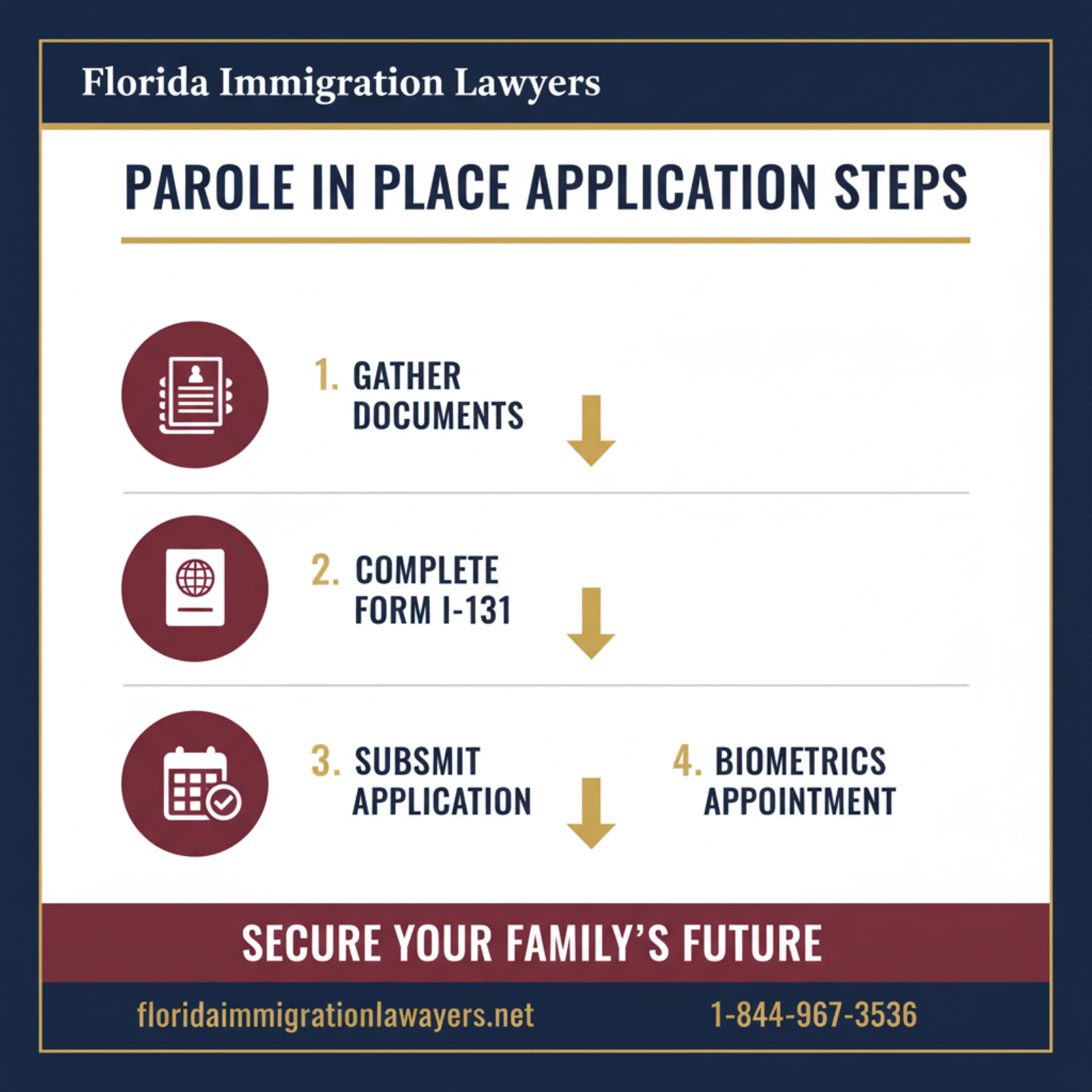
Applying for Parole in Place involves a series of specific steps and requires meticulous attention to detail. This process is handled by USCIS, and while it may seem daunting, understanding each stage can help you prepare effectively.
-
Determine Eligibility: First, confirm that you meet the relationship and service member status requirements. Ensure the service member or veteran is a U.S. citizen and that you are their spouse, child, or parent. This initial assessment is crucial before proceeding.
-
Gather Supporting Documentation: Collect all necessary documents, including proof of the qualifying relationship, evidence of the service member's status, and personal identification documents. This step is detailed further in the 'Document Checklist' section.
-
Prepare Form I-131, Application for Travel Document: Although PIP is not for travel, USCIS uses Form I-131 to request parole. You must clearly state that you are requesting Parole in Place under the military family provisions. You will also need to submit a written statement explaining your request and why it should be granted.
-
Prepare Form I-485, Application to Register Permanent Residence or Adjust Status (Concurrent Filing): If immediately eligible for a green card through a family petition (Form I-130, Petition for Alien Relative), you can often file Form I-485 concurrently with your I-131. This is common for spouses and unmarried children of U.S. citizens.
-
File Your Application Packet with USCIS: Submit your completed forms, supporting documents, and required fees to the appropriate USCIS Lockbox facility. The filing location depends on the form and your specific circumstances. For Florida residents, this typically means a Dallas or Chicago Lockbox. Always check the USCIS website for the most current filing addresses.
-
Attend Biometrics Appointment: After filing, USCIS will send you a notice to attend a biometrics appointment at an Application Support Center (ASC). This involves fingerprinting and photographing for background checks.
-
Interview (If Required): While not always required for PIP itself, an interview is typically part of the adjustment of status process. This interview would likely take place at a local USCIS field office, such as the Miami, Orlando, or Jacksonville USCIS Field Office, depending on your residence in Florida.
-
Receive Decision: USCIS will issue a decision on your Parole in Place application and, subsequently, your adjustment of status application. If approved, you will receive your green card.
Required Documents and Evidence: The PIP Military Checklist
A comprehensive and accurate submission of documents is vital for a successful Parole in Place application. Missing or incorrect documentation can lead to delays or even denial. Here is a general checklist of documents you will typically need to prepare:
- Form I-131, Application for Travel Document: Completed and signed.
- Form I-485, Application to Register Permanent Residence or Adjust Status: If filing concurrently for adjustment.
- Form I-765, Application for Employment Authorization: If you wish to apply for a work permit.
- Form I-130, Petition for Alien Relative: If not already approved, and if adjusting status based on a family relationship.
- Proof of U.S. Citizenship of Service Member/Veteran: Copy of birth certificate, passport, or naturalization certificate.
- Proof of Military Service: Copies of the service member's military ID (front and back), DD Form 214 (Certificate of Release or Discharge from Active Duty), active duty orders, or official letters from a commanding officer.
- Proof of Qualifying Relationship:
- For Spouses: Marriage certificate, joint financial documents, birth certificates of common children, affidavits from friends/family.
- For Children: Your birth certificate showing the service member as a parent, marriage certificate of parents (if applicable).
- For Parents: Your birth certificate showing the service member as your child.
Step-by-Step Process Guide - Proof of Identity: Copy of your passport, birth certificate, or other government-issued ID.
- Proof of Entry into the U.S.: While PIP is for those who entered without inspection, any available evidence of entry (even if not lawful) can be helpful, such as flight itineraries or affidavits.
- Photographs: Passport-style photographs for each form requiring them.
- Filing Fees: Check the USCIS website for current fee amounts for Forms I-131, I-485, I-765, and I-130 (if applicable).
- Personal Statement/Letter of Request: A detailed letter from the applicant explaining the request for Parole in Place, emphasizing the military connection and any hardship.
- Affidavits from Service Member/Veteran: A letter from the service member/veteran supporting the application.
- Background Check Documents: Police clearances, court records for any arrests or convictions (even if minor).
Parole in Place Processing Time and Expectations for 2026
The processing time for Parole in Place applications can vary significantly. Factors such as the volume of applications, the complexity of your case, and the specific USCIS service center handling your petition all play a role. While it's difficult to provide an exact timeframe for 2026, we can offer general expectations based on past trends.
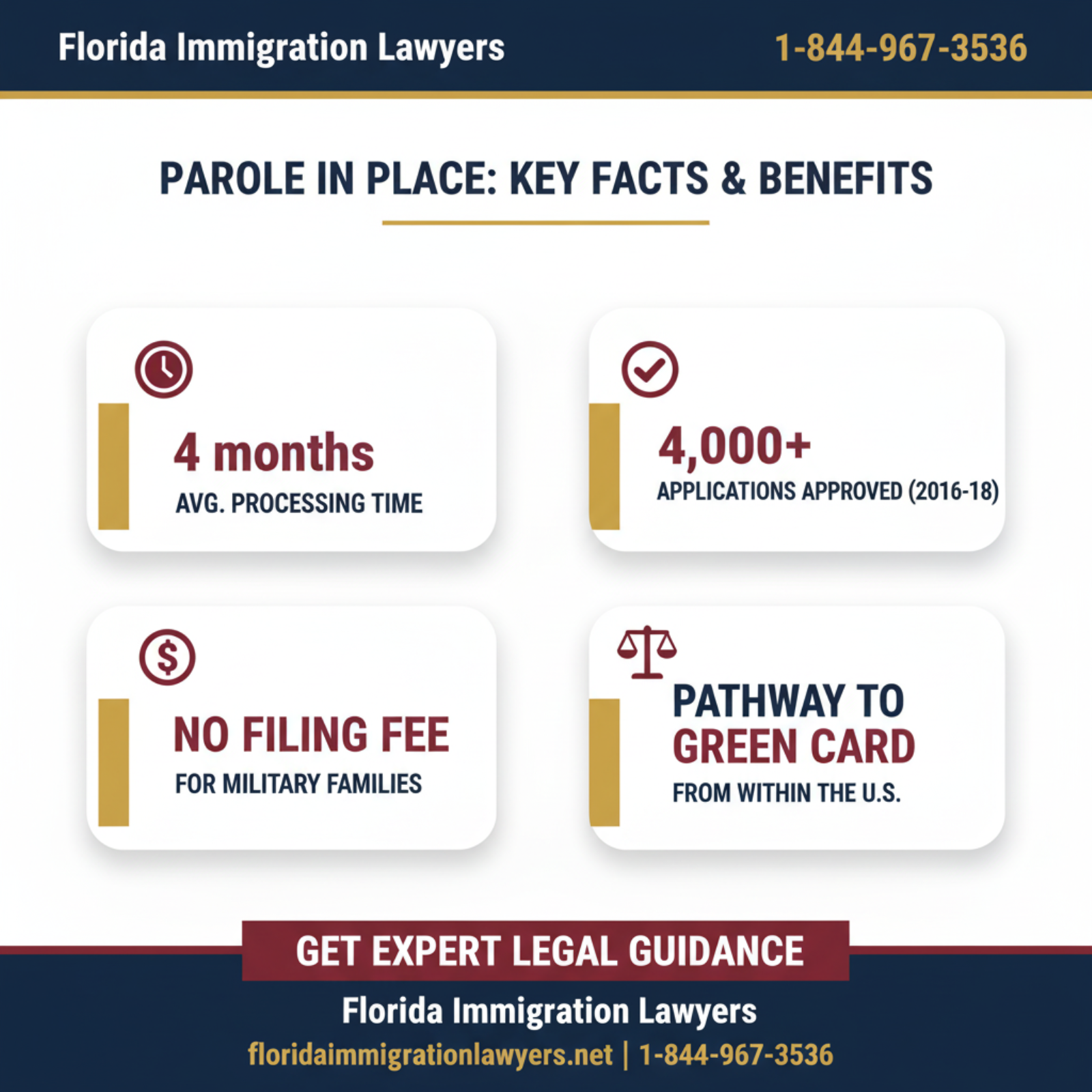
Typically, after submitting Form I-131 for PIP, applicants can expect to receive a biometrics appointment notice within a few weeks to a few months. The actual decision on the PIP request itself can take several months, often ranging from 3 to 12 months. If you are concurrently filing for adjustment of status (Form I-485), the entire process to receive a green card can extend further, potentially taking 12 to 24 months or even longer in some complex cases.
Factors Influencing Processing Times
Several elements can impact how quickly your Parole in Place and adjustment of status applications are processed. Complete and accurate documentation is paramount; any requests for evidence (RFEs) will inevitably extend your timeline. Thorough background checks are also a significant component, and any criminal history, even minor, can prolong the process.
The specific USCIS Field Office in Florida where your interview (if required) takes place, such as the office serving Fort Lauderdale, can also have its own processing nuances. It is always advisable to check the USCIS website's processing times page for the most up-to-date estimates for your specific form and field office.
Cost Factors and Fee Breakdown for PIP Applications
Understanding the costs associated with applying for Parole in Place and subsequent adjustment of status is crucial for financial planning. While USCIS fees are subject to change, they generally consist of filing fees for the various forms involved. It is important to note that fees are typically non-refundable, regardless of the outcome of your application.
The primary forms that often incur fees are Form I-485 (Application to Register Permanent Residence or Adjust Status), Form I-765 (Application for Employment Authorization), and Form I-130 (Petition for Alien Relative), if applicable. Importantly, there is generally no separate filing fee for Form I-131 when requesting Parole in Place as a military family member, although you will still need to pay the biometrics fee.
Additional Potential Costs
Beyond USCIS filing fees, there are other potential costs to consider. These may include fees for obtaining necessary documents such as birth certificates, marriage licenses, or police records. You might also incur costs for medical examinations required for adjustment of status, as well as translation services if any of your documents are not in English.
Engaging an experienced immigration attorney, like those at Florida Immigration Lawyers, is another investment that can significantly increase your chances of success. While legal fees represent an additional cost, the expertise and guidance provided can be invaluable in navigating the complexities of immigration law and avoiding costly mistakes.
Do not navigate this complex process alone. The stakes are too high for your family's future. Contact Florida Immigration Lawyers today at 1-844-YO-PELEO to schedule your free consultation. We are here to provide the dedicated support you need.
Common Mistakes to Avoid in Your PIP Application
-
Failing to Prove the Qualifying Relationship: Inadequate evidence of your relationship to the service member (spouse, child, or parent) is a common pitfall. USCIS requires clear, compelling proof. Consequences: Request for Evidence (RFE) or denial.
-
Insufficient Proof of Military Service: Submitting incomplete or unclear documentation of the service member's active duty or veteran status can lead to questions about eligibility. Consequences: Delays, RFEs, or denial.
-
Omitting Criminal History: Failing to disclose any criminal history, no matter how minor or old, is a serious mistake. USCIS conducts thorough background checks. Consequences: Finding discrepancies can lead to accusations of misrepresentation, denial, or even deportation proceedings.
-
Inaccurate or Incomplete Forms: Simple errors, missing signatures, or unanswered questions on any form (I-131, I-485, etc.) can cause your application to be rejected or returned. Consequences: Significant delays and re-filing.
-
Not Providing a Compelling Personal Statement: A strong personal statement explaining why Parole in Place should be granted, highlighting the military connection and any hardships, is crucial. A weak or absent statement can undermine your case. Consequences: USCIS may not see the humanitarian or public benefit.
-
Missing Filing Deadlines or Fee Payments: While PIP doesn't have strict deadlines like some other applications, failure to submit fees or respond to RFEs within the specified timeframe can lead to rejection. Consequences: Application rejection or abandonment.
-
Assuming Eligibility for Siblings or Extended Family: PIP is strictly limited to spouses, children, and parents of U.S. citizen service members/veterans. Applying for ineligible relatives will be rejected. Consequences: Automatic denial and loss of filing fees.
-
Incorrectly Filing Form I-131: Using Form I-131 for Parole in Place requires specific instructions and documentation beyond typical travel parole. Failing to specify the military PIP request can cause confusion. Consequences: Application processed incorrectly or denied.
-
Not Seeking Legal Advice for Complex Cases: If you have previous deportations, extensive criminal history, or other immigration complications, attempting to navigate PIP alone is risky. Consequences: High likelihood of denial, potential for removal proceedings.
-
Neglecting to Keep Copies of All Submitted Documents: Always keep a complete copy of everything you send to USCIS. This is essential for your records and if USCIS requests additional information or loses parts of your file. Consequences: Difficulty responding to RFEs or proving submission.
When to Call a Florida Immigration Lawyer for PIP
While the information provided here offers a solid foundation, Parole in Place applications, especially those intertwined with adjustment of status, are complex. The stakes are incredibly high for military families in Florida, and even minor errors can have significant consequences. There are specific scenarios where seeking professional legal guidance from Florida Immigration Lawyers becomes not just helpful, but essential.
You should strongly consider contacting an attorney if:
- You have any prior criminal history: Even minor arrests or convictions can complicate your case and potentially render you inadmissible. An attorney can assess the impact and advise on waivers.
- You have a previous deportation order or removal proceedings: These are extremely serious issues that require expert legal intervention.
- You have been previously denied for any immigration benefit: Understanding the reasons for past denials is crucial for a successful PIP application.
- You are unsure about your eligibility or the required documentation: An attorney can conduct a thorough eligibility assessment and ensure all necessary evidence is gathered.
- You received a Request for Evidence (RFE) from USCIS: Responding to an RFE correctly and comprehensively is critical to keeping your application on track.
- Your case involves complex family dynamics or unusual circumstances: Non-traditional family structures or unique situations may require specialized legal strategies.
- You desire peace of mind and want to avoid costly mistakes: An attorney can streamline the process, reduce stress, and significantly increase your chances of approval.
Florida Immigration Lawyers has extensive experience assisting military families throughout Florida, including those in Fort Lauderdale, Miami, and Tampa. We understand the nuances of Parole in Place and are committed to protecting your family's future. Our attorneys provide personalized attention and strategic advice, ensuring your application is as strong as possible.
About Florida Immigration Lawyers
Florida Immigration Lawyers is an immigration law firm dedicated to serving individuals and families across the entire state of Florida. With a deep understanding of U.S. immigration laws and a compassionate approach, we strive to provide exceptional legal representation to our diverse clientele. Our firm is built on a foundation of integrity, experience, and a genuine commitment to achieving favorable outcomes for our clients.
We offer a comprehensive range of immigration services, including but not limited to family-based immigration, business immigration, deportation defense, asylum applications, citizenship and naturalization, and all forms of general immigration matters. Our team of experienced attorneys is well-versed in the latest immigration policies and procedures, ensuring that your case is handled with the utmost care and professionalism.
Choosing Florida Immigration Lawyers means partnering with a firm that genuinely cares about your journey. We pride ourselves on clear communication, strategic planning, and aggressive advocacy. We understand that immigration challenges can be overwhelming, and we are here to simplify the process for you. Our commitment to excellence and our client-centered approach make us the trusted choice for immigration legal services in Florida.
Contact Florida Immigration Lawyers today:
- Phone: 1-844-YO-PELEO
- Website: https://www.floridaimmigrationlawyers.net
- Availability: 24/7
- Consultations: Free
- Service Area: All of Florida
Sources and References
- U.S. Citizenship and Immigration Services (USCIS) - Parole in Place
- USCIS Policy Manual, Volume 7, Part B, Chapter 2 - Parole
- 8 U.S.C. § 1182(d)(5)(A) - Admission of aliens; parole; conditional entry
- 8 CFR § 212.5 - Parole of aliens into the United States
- Executive Office for Immigration Review (EOIR)
This article provides general legal information and is not intended as legal advice. Every case is unique, and outcomes depend on specific facts and circumstances. Contact an attorney for advice about your particular situation.
Your family's future in Florida is too important to leave to chance. If you are a military family navigating the complexities of Parole in Place, let our experienced attorneys guide you. We are committed to helping you achieve your immigration goals and keep your family united.
Contact Florida Immigration Lawyers for a free consultation at 1-844-YO-PELEO. Se Habla Español - Estamos aquí para ayudarle.
Do Not Navigate This Process Alone
Our experienced immigration attorneys are ready to fight for you. Get a free, confidential case review today.
Se Habla Español
Or leave your details and we’ll call you:
Free Evaluation in 24 Hours
Or talk to us right now

AI voice assistant — available 24/7
FreeFrequently Asked Questions

William J. Vásquez
Founding Attorney · Vasquez Law Firm
U.S. Air Force veteran and immigration attorney with years of hands-on U.S. immigration experience. J.D., NCCU School of Law. AILA member. Admitted to the 4th, 5th, and 11th Circuit Courts.
Available 24/7 - Free Evaluations
Reviewed for legal accuracy by William J. Vásquez
Licensed in North Carolina; U.S. immigration is federal practice.
Related Legal Services
Our Florida immigration attorneys can help you with experienced immigration attorneys, asylum protection and citizenship and naturalization. Call today at 1-844-YO-PELEO for a free case review.
Related Links
Related Topics
Free Legal Case Review
Discuss your case with our experienced attorneys. We're available 24/7.
Se Habla Español - Estamos aquí para ayudarle.
Related Articles
Immigration Lawyer Orlando Free Consultation in Florida
For individuals and families in Orlando, Florida, navigating the complexities of U.S. immigration law requires expert guidance. An immigration lawyer in Orlando offers crucial support for everything from visa applications and green card processes to naturalization and deportation defense. This comprehensive guide details what a free consultation covers, providing a step-by-step overview of immigration pathways, essential document checklists, and expected timelines in 2026. We also highlight common mistakes to avoid, discuss the critical role of legal counsel in deportation and asylum cases, and explain why choosing a local Orlando immigration attorney is beneficial. Florida Immigration Lawyers is dedicated to serving the diverse community of Orlando with compassionate, effective legal solutions, ensuring you receive personalized advice and robust representation for a successful immigration journey.
EAD Advance Parole Combo Card in Florida 2026
For individuals with a pending Form I-485, Application to Register Permanent Residence or Adjust Status, the EAD Advance Parole Combo Card is an essential document. This single card combines the authorization to work legally in the U.S. (Employment Authorization Document - EAD) with permission to travel internationally and re-enter without abandoning your green card application (Advance Parole). This guide from Florida Immigration Lawyers provides a comprehensive overview for applicants in Florida in 2026, covering eligibility, the step-by-step application process, required documents, expected processing times, and associated costs. We also highlight common mistakes to avoid and when to seek legal counsel to ensure a smooth and successful immigration journey. Understanding this vital card is key to maintaining stability while awaiting your permanent residency approval.
Immigration Lawyer Southwest Florida: What You Need to Know
Discover how an immigration lawyer in Southwest Florida can help you navigate complex immigration processes. Learn about costs, timelines, and common mistakes to avoid. Call Florida Immigration Lawyers for a free case review.
Change of Status from B-2 to F-1 in Florida: What You Need
Learn how to change your immigration status from a B-2 tourist visa to an F-1 student visa in Florida. This comprehensive guide covers the 2026 processing timelines, required documentation, and common mistakes to avoid. Call Florida Immigration Lawyers for personalized assistance.