H-4 EAD: Spouse Work Permit for H-1B Families in Florida
The H-4 EAD provides crucial work authorization for eligible spouses of H-1B visa holders, enabling them to pursue employment or start businesses across Florida, from Hialeah to Orlando. This guide from Florida Immigration Lawyers details eligibility criteria, the step-by-step application process for Form I-765, required documentation, and current processing timelines as of 2026. We also cover associated costs, the scope of work authorization including entrepreneurship, and how to avoid common application mistakes. Understanding these rules is vital for H-1B families seeking to enhance their financial stability and professional growth in the U.S. Contact Florida Immigration Lawyers for a free consultation to navigate your H-4 EAD application with confidence.
Quick Answer: H-4 EAD Spouse Work Permit in Florida
The H-4 EAD (Employment Authorization Document) allows certain H-4 visa holders, primarily spouses of H-1B nonimmigrants, to legally work in the United States. In Florida, this means eligible H-1B spouses can pursue employment, start businesses, or engage in self-employment, contributing significantly to their families and the local economy. Eligibility hinges on the H-1B principal having an approved Form I-140 (Immigrant Petition for Alien Worker) or having been granted an H-1B extension beyond the six-year limit. The application involves filing Form I-765 with USCIS, supported by extensive documentation. Understanding the specific requirements and navigating the process correctly is crucial for H-1B families across Florida, from Hialeah to Orlando.
- Eligibility: H-4 spouses whose H-1B partner has an approved I-140 or has received H-1B extensions beyond the 6-year limit.
- Application: File Form I-765, Application for Employment Authorization, with U.S. Citizenship and Immigration Services (USCIS).
- Benefits: Provides legal work authorization, allowing H-4 spouses to pursue career goals and support their families.
- Florida Specifics: A vital pathway for H-1B families in Florida's diverse and growing professional sectors.
For H-1B visa holders and their families in Florida, the prospect of a spouse being able to work legally in the U.S. is often a game-changer. The H-4 EAD, or Employment Authorization Document, provides this crucial opportunity, allowing H-4 spouses to contribute their skills and talents to the workforce. Whether you reside in the bustling corridors of Hialeah, the vibrant communities of Miami, or the growing tech hubs of Orlando, understanding the intricacies of the H-4 EAD spouse work permit is essential for your family's stability and future in the Sunshine State.
This comprehensive guide from Florida Immigration Lawyers will walk you through everything you need to know about the H-4 EAD, from eligibility requirements and the application process to common pitfalls and critical timelines. We aim to demystify this important immigration benefit, providing clear, actionable information for H-1B families across Florida. Our goal is to empower you with the knowledge to navigate this path successfully, ensuring your family can thrive together.
Do not let complex immigration laws deter you from securing your family's future. For personalized guidance and assistance with your H-4 EAD application, call Florida Immigration Lawyers at 1-844-YO-PELEO for a free consultation today. We are here to help you every step of the way.
What is an H-4 EAD and Who is Eligible in Florida?
An H-4 EAD is an Employment Authorization Document issued to certain H-4 nonimmigrants, allowing them to legally work in the United States. This work authorization is specifically granted to H-4 spouses of H-1B nonimmigrants who meet particular criteria, providing significant relief and economic opportunity for families. The H-4 visa status itself is for the spouse and unmarried children under 21 of H-1B principal visa holders. Without an EAD, H-4 visa holders are generally not permitted to work. The H-4 EAD rule, codified under 8 CFR 274a.12(c)(9), was introduced to alleviate the financial and professional burdens on H-1B families, particularly those facing long waits for green cards.
To be eligible for an H-4 EAD, the H-4 spouse must meet one of two primary conditions related to their H-1B principal spouse's status. First, the H-1B principal must be the beneficiary of an approved Form I-140, Immigrant Petition for Alien Worker. This signifies that the H-1B worker is on the path to obtaining lawful permanent residence. Second, the H-1B principal must have been granted H-1B status under sections 106(a) and (b) of the American Competitiveness in the Twenty-first Century Act of 2000 (AC21), which permits H-1B extensions beyond the standard six-year limit. These extensions are typically granted while the H-1B principal's green card application is pending. Florida, with its robust economy and diverse industries, attracts a large number of H-1B professionals, particularly in metropolitan areas like Miami-Dade County, including Hialeah, as well as Orlando and Tampa. Consequently, many H-1B families in Florida stand to benefit from the H-4 EAD program.
Understanding the H-4 Visa Status
The H-4 visa is a nonimmigrant dependent visa issued to the immediate family members (spouse and unmarried children under 21) of H-1B visa holders. While an H-4 visa allows dependents to reside in the U.S., attend school, and obtain a driver's license, it traditionally did not permit employment. The introduction of the H-4 EAD has significantly changed this, offering H-4 spouses the flexibility to pursue their professional aspirations. It's crucial that the H-4 status remains valid throughout the EAD application and employment period. Any lapse in the H-1B principal's status or the H-4's dependent status could jeopardize the EAD.
Key Eligibility Requirements for H-4 EAD
Beyond being an H-4 nonimmigrant spouse, the core eligibility criteria revolve around the H-1B principal. An H-4 spouse is eligible if their H-1B spouse:
- Has an approved Form I-140, Immigrant Petition for Alien Worker. This approval demonstrates that the H-1B worker has initiated the employment-based green card process.
- Has been granted H-1B status under AC21 sections 106(a) and (b), extending their H-1B status beyond the six-year limit. This typically occurs when an I-140 is pending for at least 365 days or an approved I-140 exists but the priority date is not current.
Both the H-1B principal and the H-4 spouse must maintain their valid nonimmigrant status throughout the application and employment period. Any changes in the H-1B principal's employment or immigration status must be carefully monitored, as they can directly impact the H-4 EAD holder's authorization. Consulting an immigration attorney in Florida, especially in areas with high H-1B populations like Hialeah, can help ensure continuous compliance.
How Do I Apply for an H-4 EAD Work Permit in Florida?
Applying for an H-4 EAD work permit in Florida involves a structured process with U.S. Citizenship and Immigration Services (USCIS). The primary step is accurately completing and submitting Form I-765, Application for Employment Authorization, along with a comprehensive set of supporting documents. It is crucial to ensure all information is consistent with your existing immigration records and that all required evidence is included to avoid delays or requests for evidence (RFEs). Many H-1B families in Florida choose to file their H-4 EAD applications concurrently with their H-4 visa extension applications to streamline the process. USCIS has designated specific lockbox facilities for filing, and the correct address depends on the type of application and your current residence.
The application process begins with gathering all necessary documentation, which will be detailed in the next section. Once prepared, Form I-765 and all supporting materials are mailed to the appropriate USCIS Lockbox facility. After USCIS receives your application, they will send a receipt notice (Form I-797C) confirming receipt. Subsequently, you may receive an appointment notice for biometrics collection at a local Application Support Center (ASC). For applicants in Florida, this could be in cities like Miami, Orlando, or Tampa. These biometrics appointments are mandatory and involve fingerprinting and photographing. Finally, USCIS adjudicates your application, and if approved, you will receive your Employment Authorization Document (EAD) card by mail. This card is your proof of legal work authorization in the U.S. and is essential for employment purposes.
The Initial Application Packet
Your H-4 EAD application packet must be meticulously assembled. It includes:
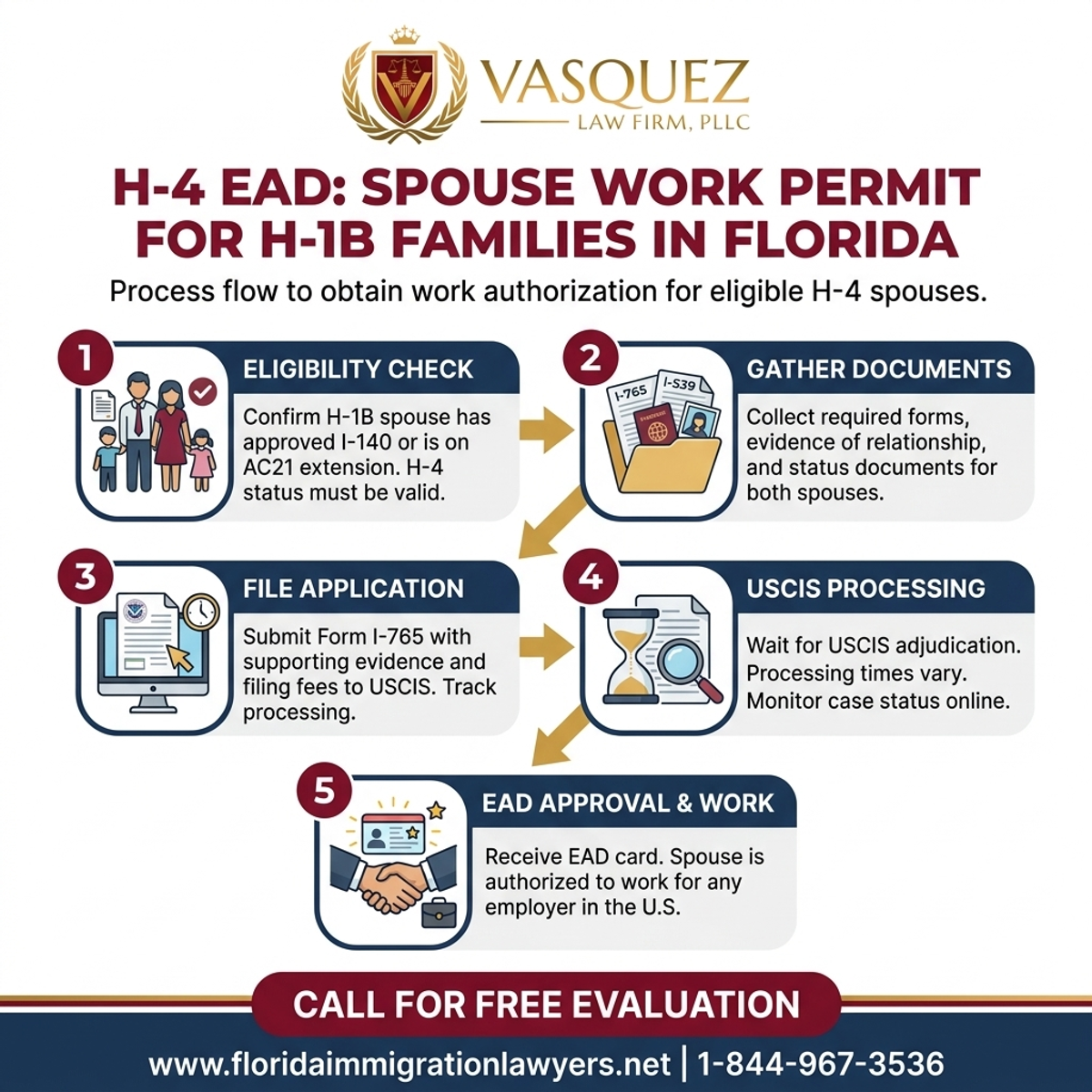
Step-by-Step Process — H-4 EAD: Spouse Work Permit for H-1B Families in Florida
- Form I-765: Completed and signed Application for Employment Authorization. Ensure you select the correct eligibility category (c)(26).
- Proof of H-4 Status: Copy of your most recent Form I-797 (Approval Notice for H-4 status), I-94 Arrival/Departure Record, and H-4 visa stamp in your passport.
- Proof of Marriage: Copy of your marriage certificate to the H-1B principal.
- H-1B Principal's Documents: Copy of their H-1B I-797 Approval Notice, I-94, and passport bio page.
- H-1B Principal's I-140 Approval: Copy of the H-1B principal's Form I-797 Approval Notice for Form I-140, Immigrant Petition for Alien Worker. This is a critical piece of evidence for eligibility. If the H-1B principal is relying on AC21 extensions beyond the 6-year limit, evidence of such extensions and pending green card process must be included.
- Photographs: Two identical passport-style photos taken within 30 days of filing.
- Filing Fee: Check or money order payable to the U.S. Department of Homeland Security for the Form I-765 fee.
- Previous EADs (if applicable): Copy of any previously issued EAD cards.
What Happens After Filing?
Once your application is mailed, USCIS will send a Form I-797C, Notice of Action, acknowledging receipt. This notice will contain your receipt number, which you can use to track your case status online on the USCIS website. The next step is typically a biometrics appointment notice, which will direct you to an Application Support Center (ASC) in Florida. After biometrics, your case will be pending adjudication. USCIS may issue a Request for Evidence (RFE) if they require additional information or clarification. Responding to an RFE promptly and comprehensively is vital to avoid delays or denials. If approved, you will receive a new EAD card in the mail, signaling your authorization to work.
What Documents Do I Need for an H-4 EAD Application?
To successfully apply for an H-4 EAD, a precise collection of documents is essential. USCIS requires comprehensive evidence to confirm your eligibility and identity. Any missing or incorrect documentation can lead to significant delays, including Requests for Evidence (RFEs), or even denial of your application. It is advisable to gather all necessary documents well in advance of your desired filing date, paying close attention to expiration dates and ensuring all copies are clear and legible. For applicants in Florida, particularly those in diverse communities like Hialeah, ensuring translations of non-English documents are certified is a common but crucial step. Always make a complete copy of your entire application package for your records before mailing.
The list below outlines the primary documents you will need. Each document plays a vital role in establishing your H-4 status, your relationship to the H-1B principal, and the H-1B principal's eligibility for the underlying green card process or extended H-1B status. This attention to detail helps streamline the adjudication process and reduces the likelihood of complications. Remember, the quality and completeness of your application directly impact its processing time and outcome.
Document Checklist for H-4 EAD Application:
- Completed Form I-765, Application for Employment Authorization (ensure category (c)(26) is selected).
- Copy of your current H-4 visa stamp in your passport (if applicable).
- Copy of your most recent I-94 Arrival/Departure Record (front and back, if paper; printout from CBP website if electronic).
- Copy of your H-4 Form I-797 Approval Notice (if you changed status to H-4 or extended H-4 in the U.S.).
- Copy of your passport's biographic page (photo page).
- Copy of your birth certificate (and certified English translation if not in English).
- Copy of your marriage certificate to the H-1B principal (and certified English translation if not in English).
- Two identical passport-style photographs (taken within 30 days of filing, light background, no glasses, no shadows).
- Copy of your H-1B principal spouse's current H-1B Form I-797 Approval Notice.
- Copy of your H-1B principal spouse's most recent I-94 Arrival/Departure Record.
- Copy of your H-1B principal spouse's passport's biographic page.
- Crucially: Copy of your H-1B principal spouse's Form I-797 Approval Notice for Form I-140, Immigrant Petition for Alien Worker. If the H-1B principal is relying on AC21 extensions, include proof of such extensions and the pending PERM or I-140 petition.
- Copy of any previously issued EAD cards (front and back).
- Proof of payment for the Form I-765 filing fee (check, money order, or Form G-1450 for credit card payments).
Ensure that all photocopies are clear and legible. If any document is not in English, it must be accompanied by a complete and accurate English translation, certified by the translator. This meticulous preparation is key to a smooth application process for H-4 EAD holders throughout Florida.
How Long Does H-4 EAD Processing Take in 2026?
As of July 2026, the processing times for H-4 EAD applications (Form I-765) can vary significantly depending on the USCIS service center handling your case, current caseload volumes, and whether you submitted a complete application. While USCIS aims for efficiency, applicants should generally prepare for a waiting period that can range from a few months to over a year. It is important to check the official USCIS processing times webpage regularly for the most up-to-date estimates for the specific service center processing your application. Historically, service centers like California and Vermont have handled a large volume of H-4 EAD cases, and their backlogs can influence overall timelines. Florida residents' applications are routed to these national centers, not local field offices for initial processing.
Several factors can influence how long your H-4 EAD application takes to process. A common cause for delay is the issuance of a Request for Evidence (RFE), which occurs if USCIS determines that your initial submission lacked necessary documentation or clarification. Responding promptly and thoroughly to an RFE is critical to avoid further delays. Additionally, if your H-4 EAD application is filed concurrently with an H-4 extension or change of status, the processing time for the EAD may be tied to the adjudication of the underlying H-4 petition. While premium processing is not available for H-4 EAD applications, maintaining valid H-4 status throughout the waiting period is paramount. Planning for potential delays and filing for renewal well in advance of your current EAD's expiration date is a recommended strategy for H-1B families in Florida.
Typical Timeline and Processing Expectations (As of July 2026):
| Stage | Typical Timeframe | Notes |
|---|---|---|
| Application Submission to Receipt Notice | 1-3 weeks | USCIS sends Form I-797C confirming receipt. |
| Receipt Notice to Biometrics Appointment | 3-8 weeks | Appointment at a local Application Support Center (ASC) in Florida (e.g., Miami, Orlando). |
| Biometrics to Adjudication | 6-15 months (or more) | Highly variable; depends on service center workload and case complexity. Check USCIS website for current estimates. |
| Adjudication to EAD Card Delivery | 1-2 weeks | After approval, the card is mailed to your address. |
| Request for Evidence (RFE) Response | Adds 2-4 months | If issued, requires a timely and comprehensive response. |
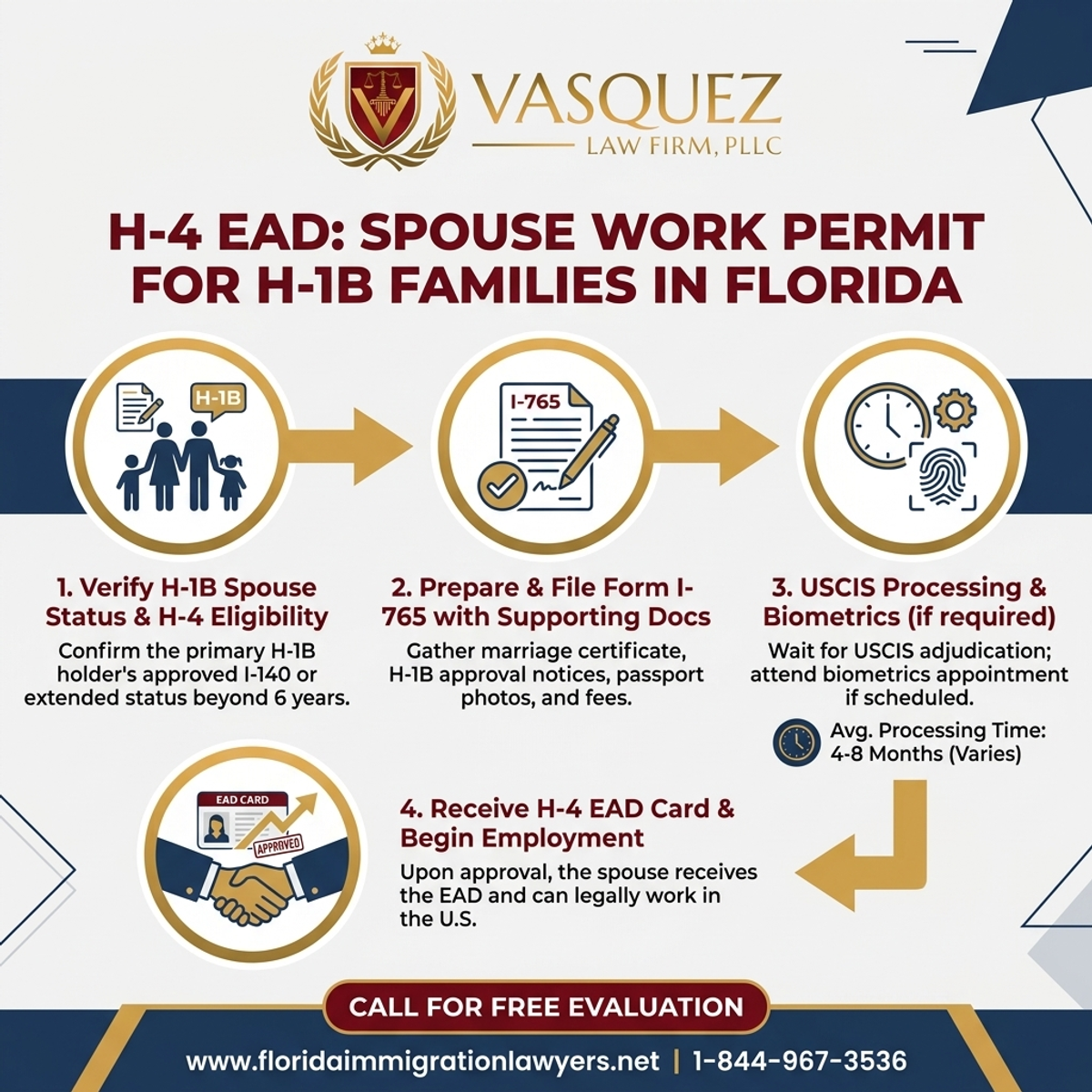
Key Statistics — H-4 EAD: Spouse Work Permit for H-1B Families in Florida
Factors Influencing Processing Times
The duration of your H-4 EAD application processing is subject to several variables. The specific USCIS service center (e.g., California, Vermont) assigned to your case plays a significant role, as each center has different backlogs and processing capacities. The completeness and accuracy of your application packet are also critical; even minor errors can trigger RFEs, extending the timeline by several months. Furthermore, government policy changes, budget allocations, and overall immigration application volumes can impact processing speeds across the board. For H-1B families in Florida, staying informed via official USCIS channels and preparing a robust application are the best ways to manage expectations.
Do not navigate this complex process alone. Contact Florida Immigration Lawyers today for experienced legal assistance with your H-4 EAD application. We offer free consultations to help you understand your options and ensure a smooth application process.
What Are the Costs Associated with an H-4 EAD Application?
Applying for an H-4 EAD involves several costs, primarily the USCIS filing fee for Form I-765. As of July 2026, USCIS fees are subject to change, so it is always crucial to verify the most current fee schedule directly on the USCIS website for Form I-765 before submitting your application. These fees are non-refundable, regardless of the application's outcome, emphasizing the importance of a well-prepared and accurate submission. Beyond the government filing fees, applicants may incur additional expenses related to preparing their application, such as legal fees for attorney assistance, costs for passport-style photos, and mailing expenses. Understanding the full financial commitment upfront helps H-1B families in Florida budget appropriately for this vital immigration benefit.
The primary cost is the USCIS filing fee for Form I-765, which must be submitted with your application. This fee covers the administrative costs associated with processing your employment authorization request. While USCIS does not typically offer fee waivers for H-4 EAD applications, it is essential to ensure your payment method is correct and the amount matches the current fee schedule. If you choose to retain an immigration attorney, their legal fees will be an additional cost. These fees vary based on the attorney's experience and the complexity of your case but can provide invaluable peace of mind and significantly increase the likelihood of a successful application. For many H-1B families in Florida, the investment in legal counsel is worthwhile given the importance of securing work authorization for the H-4 spouse.
Cost Factors and Fee Breakdown (As of July 2026):
| Item | Typical Fee (USD) | Notes |
|---|---|---|
| USCIS Form I-765 Filing Fee | Varies (check current USCIS fee schedule) | This is a mandatory fee payable to the U.S. Department of Homeland Security. |
| Legal Fees (Attorney Assistance) | Varies significantly | Covers consultation, application preparation, document review, and communication with USCIS. Highly recommended for complex cases or peace of mind. |
| Passport-Style Photos | $10-$20 per set | Required for Form I-765. Can be obtained at pharmacies or photo studios. |
| Mailing/Courier Fees | $10-$50 | For sending your application to USCIS via certified mail or courier service. Recommended for tracking. |
| Document Translation Fees | Varies ($20-$50 per page) | If any supporting documents (e.g., marriage certificate, birth certificate) are not in English, they require certified translations. |
Potential Additional Costs
Beyond the direct application fees, H-4 EAD applicants in Florida might encounter other indirect costs. These could include travel expenses to attend biometrics appointments at USCIS Application Support Centers located in cities like Miami, Orlando, or Tampa. If an RFE is issued, there might be additional costs associated with gathering new evidence or obtaining further legal advice. It is prudent to account for these potential expenses when planning your H-4 EAD application budget. While the costs can accumulate, the benefits of gaining work authorization for an H-4 spouse often far outweigh these initial investments, providing long-term financial stability and professional fulfillment for H-1B families.
Can an H-4 EAD Holder Start a Business in Florida?
Yes, an H-4 EAD holder is authorized to engage in any form of legal employment in the United States, including starting and operating a business in Florida. The H-4 EAD provides unrestricted work authorization, meaning there are no limitations on the type of employer, industry, or work schedule, unlike some other work visas. This flexibility is one of the most significant advantages of the H-4 EAD, empowering spouses of H-1B workers to pursue entrepreneurial ventures, work as freelancers, or accept employment with any U.S. employer. For those in Florida, this opens up a world of possibilities, from launching a tech startup in Miami to opening a boutique in Orlando, or providing specialized services in Hialeah. The key is to ensure that the business activities are legal and comply with all federal, state, and local regulations.
Starting a business in Florida as an H-4 EAD holder involves the same steps as any other U.S. citizen or permanent resident. This includes registering the business with the Florida Department of State, obtaining necessary business licenses and permits from state and local authorities, and complying with tax obligations. The unrestricted nature of the H-4 EAD means you do not need a sponsoring employer, nor are you limited to specific job codes or industries. This autonomy allows H-4 spouses to leverage their skills, education, and professional experience fully, contributing to Florida's vibrant economy. It's important to remember that the H-4 EAD is tied to the H-1B principal's status; therefore, maintaining the H-1B status is crucial for the H-4 EAD to remain valid. Any changes to the principal's H-1B status, such as a job change or loss, should be carefully managed to avoid jeopardizing the H-4 EAD.
Types of Employment Permitted
The H-4 EAD grants broad employment authorization. This means an H-4 EAD holder can:
- Work for any U.S. employer in any industry.
- Change jobs or employers without needing a new petition.
- Work part-time or full-time.
- Engage in self-employment or freelancing.
- Start and operate their own business.
- Work in multiple jobs concurrently.
This flexibility is a stark contrast to the H-1B visa itself, which is employer-specific. For H-1B families in Florida, this enables the H-4 spouse to build their own career independent of their H-1B partner's employment, fostering greater financial independence and professional satisfaction.
Self-Employment and Entrepreneurship
For H-4 EAD holders with an entrepreneurial spirit, Florida offers a favorable environment for starting a business. The process involves:
- Business Formation: Deciding on a business structure (sole proprietorship, LLC, corporation) and registering with the Florida Department of State.
- Licenses and Permits: Obtaining federal, state, and local licenses and permits specific to the industry and location (e.g., Hialeah, Miami, Orlando).
- Employer Identification Number (EIN): Applying for an EIN from the IRS for tax purposes.
- Banking: Opening a business bank account.
- Compliance: Adhering to all labor laws, tax regulations, and industry-specific rules.
While the H-4 EAD grants the legal right to work and operate a business, navigating the legal and regulatory landscape of entrepreneurship still requires careful planning. Consulting with both an immigration attorney and a business attorney in Florida can provide comprehensive guidance for H-4 EAD holders looking to launch their ventures successfully.
How Have Recent Policy Changes Impacted H-4 EAD in Florida?
As of July 2026, the H-4 EAD rule remains a stable and critical component of U.S. immigration policy, despite various administrative changes and judicial challenges over the years. While there have been past attempts to rescind the H-4 EAD, these efforts have not succeeded, and the current administration has generally supported its continuation. The legal basis for the H-4 EAD, as established under 8 CFR 274a.12(c)(9), has withstood scrutiny, providing a reliable pathway for H-1B spouses to gain work authorization. This stability is crucial for thousands of H-1B families across Florida, including those residing in Hialeah, Miami, and Orlando, who depend on this benefit for their economic well-being and professional growth. The recent news context, such as broader debates on immigration policy or specific federal lawsuits, often highlights the dynamic nature of immigration law but has not directly impacted the core H-4 EAD regulation.
The resilience of the H-4 EAD rule underscores its importance to the U.S. economy and the high-skilled immigrant community. Policy discussions around immigration, such as those concerning direct care workers or sanctuary policies, as seen in recent news from KFF or WBAL-TV, typically address different facets of the immigration system and do not directly target the H-4 EAD program. While the broader immigration landscape is constantly evolving, the specific regulatory framework supporting H-4 EAD has remained intact. For H-1B families in Florida, this provides a degree of certainty in planning their careers and lives. However, it's always wise to stay informed about potential legislative or regulatory changes that could indirectly affect H-4 status or EAD eligibility in the future. Immigration law is complex and subject to change, so legal counsel is always recommended to stay ahead of any developments.
The Durability of H-4 EAD Regulations
The H-4 EAD rule, initially implemented in 2015, has faced legal challenges, but the courts have upheld its validity. This judicial endorsement has contributed to its current stability. The regulation acknowledges the economic contributions of H-1B workers and their families, recognizing that enabling H-4 spouses to work helps retain high-skilled talent in the U.S. and supports family unity. For Florida, a state with a significant concentration of H-1B professionals, the H-4 EAD is indispensable for attracting and retaining skilled workers who contribute to sectors like technology, healthcare, and engineering across the state.
Potential Future Changes to Monitor
While the H-4 EAD rule is currently stable, the broader immigration environment is always subject to change. Congress could propose new legislation, or a future administration could initiate new rulemaking processes. For instance, discussions around federal policy changes impacting the workforce, as noted by KFF, could influence the broader employment landscape for immigrants. Similarly, judicial rulings on unrelated immigration cases, like those mentioned by PBS regarding immigration judge sentiments, highlight the ongoing legal scrutiny of immigration policies. H-1B families in Florida should remain vigilant, follow official government announcements, and consult with immigration attorneys to understand any potential impacts on their H-4 EAD status. Proactive monitoring and advice are the best defenses against unexpected policy shifts.
Common H-4 EAD Application Mistakes to Avoid
Navigating the H-4 EAD application process can be complex, and even minor errors can lead to significant delays or outright denials. Avoiding these common mistakes is crucial for a smooth and successful application, especially for H-1B families in Florida who are eager to secure work authorization. Being meticulous with your submission can save you time, stress, and additional costs.
- Filing Without Valid H-4 Status Approval: You must have an approved H-4 status (or a pending H-4 change of status/extension) before your EAD can be approved. Filing for the EAD before your H-4 is established can lead to denial.
- Incomplete or Incorrect Form I-765: Failing to fill out every required field, selecting the wrong eligibility category (it should be (c)(26) for H-4 EAD), or not signing the form can result in an immediate rejection or RFE.
- Missing Required Supporting Documents: The absence of critical documents, such as the H-1B principal's I-140 approval notice, marriage certificate, or valid H-4 I-94, will lead to an RFE or denial. Always double-check the USCIS checklist.
- Expired H-1B or H-4 Status: If the H-1B principal's status or your H-4 status expires during processing, your EAD application may be denied unless a timely extension or change of status was filed.
- Not Responding Promptly to an RFE: USCIS provides a deadline for responding to Requests for Evidence. Missing this deadline or providing an incomplete response will likely lead to a denial without further consideration.
- Applying Before H-1B I-140 Approval (if applicable): If your eligibility is based on the H-1B principal's approved I-140, you cannot apply for the H-4 EAD until that I-140 is officially approved.
- Working Before EAD Approval: Beginning employment before you receive your physical H-4 EAD card is illegal and can have severe immigration consequences, including deportation. Always wait for the card.
- Incorrect Passport-Style Photos: Submitting photos that do not meet USCIS specifications (e.g., incorrect size, outdated, poor quality, wearing glasses) can cause delays.
- Not Renewing in Time: H-4 EADs are typically valid for the duration of the H-4 status. Failing to file for renewal at least 120-180 days before expiration can lead to a lapse in work authorization.
- Assuming Automatic Approval: Even if you meet all criteria, approval is not guaranteed. USCIS reviews each case individually.
- Providing Uncertified Translations: Any document not in English must have a complete and certified English translation. Uncertified translations are not accepted.
- Ignoring Florida-Specific Nuances: While H-4 EAD is federal, local Florida requirements for business registration or specific professional licenses can impact H-4 EAD holders starting businesses.
When to Call a Florida Immigration Lawyer for H-4 EAD Assistance
While the H-4 EAD application process appears straightforward, complexities can arise, making legal counsel invaluable. You should consider calling a Florida immigration lawyer, especially Florida Immigration Lawyers, if you encounter any of the following scenarios. Our experienced attorneys are well-versed in the nuances of H-4 EAD regulations and can provide the guidance needed to ensure a successful outcome. We serve H-1B families across the state, from the vibrant communities of Hialeah and Miami to the growing professional hubs of Orlando and Tampa.
It is particularly wise to seek legal assistance if your H-1B principal's immigration situation is complex, or if you have any doubts about your eligibility. A lawyer can help you navigate intricate requirements, prepare a strong application, and respond effectively to any challenges. Our firm offers free consultations to assess your unique situation and provide clear, actionable advice.
Specific Scenarios Requiring Legal Help:
- Complex Eligibility Questions: If the H-1B principal's I-140 is not yet approved, or if their H-1B status involves multiple extensions and transfers, determining H-4 EAD eligibility can be tricky.
- Previous Denials or RFEs: If your H-4 EAD application was previously denied, or you received a Request for Evidence, an attorney can help analyze the issues and formulate a strong response.
- Criminal History or Immigration Violations: Any past criminal record or immigration violation for either the H-1B principal or the H-4 applicant can complicate the process and may require legal expertise to address.
- Concurrent Filings: If you are filing your H-4 EAD application concurrently with an H-4 extension or H-1B extension, an attorney can ensure all petitions are coordinated correctly.
- Expiring Status or EAD: If your current H-4 status or EAD is nearing expiration, an attorney can help expedite the renewal process and prevent gaps in work authorization.
- Desire for Peace of Mind: If you want to ensure your application is perfect and minimize the risk of delays, having an expert review and submit your documents is invaluable.
Florida Immigration Lawyers has extensive experience with H-4 EAD applications. We can help you gather the correct documents, prepare a robust application, and represent your interests throughout the process. Don't leave your family's future to chance.
About Florida Immigration Lawyers
Florida Immigration Lawyers is an immigration law firm dedicated to serving individuals and families across the entire state of Florida. With a deep understanding of U.S. immigration laws and a strong commitment to our clients, we provide comprehensive legal services tailored to your unique needs. Our experienced attorneys focus on a wide range of immigration matters, including H-4 EAD applications, family-based visas, business immigration, asylum claims, deportation defense, and naturalization.
We pride ourselves on our empathetic, client-focused approach, recognizing that every immigration journey is personal and often life-changing. Our team is passionate about helping H-1B families in Florida, from Hialeah to Jacksonville, achieve their dreams of working and living legally in the United States. We offer accessible, high-quality legal representation, ensuring you receive the strongest possible guidance through complex legal procedures.
Why choose Florida Immigration Lawyers?
- Experienced Attorneys: Our team possesses extensive knowledge of immigration law and experience.
- Client-Centered Approach: We prioritize your needs, offering personalized strategies and unwavering support.
- Bilingual Services: We speak English and Spanish fluently to serve Florida's diverse communities effectively.
- Available 24/7: We understand that immigration issues don't adhere to a 9-5 schedule.
- Free Consultations: Get advice without upfront cost to discuss your case.
Your immigration success is our mission. Contact Florida Immigration Lawyers today at 1-844-YO-PELEO or visit www.floridaimmigrationlawyers.net to schedule your free consultation. We are here to help you secure your future in Florida.
Sources and References
- U.S. Citizenship and Immigration Services (USCIS) - Form I-765, Application for Employment Authorization
- USCIS Policy Manual - Volume 7, Part A, Chapter 5: Employment Authorization for H-4 Spouses
- Executive Office for Immigration Review (EOIR)
- 8 Code of Federal Regulations (CFR) § 274a.12(c)(9) - Classes of Aliens Authorized to Accept Employment
- Immigration and Nationality Act (INA) § 204.5(i) - Petitions for Employment-Based Immigrants
- American Competitiveness in the Twenty-first Century Act of 2000 (AC21)
Related services: family petition process, family-based green cards, fiancé visa (K-1).
This article provides general legal information and is not intended as legal advice. Every case is unique, and outcomes depend on specific facts and circumstances. Contact an attorney for advice about your particular situation.
Securing an H-4 EAD is a significant step towards achieving your professional and financial goals in Florida. Do not let the complexities of immigration law become a barrier. Let the dedicated team at Florida Immigration Lawyers provide the guidance and support you need for a successful application. We are committed to helping H-1B families across Florida thrive.
Call Florida Immigration Lawyers today at 1-844-YO-PELEO for your free consultation. Se Habla Español - Estamos aqui para ayudarle.
If you need legal assistance, learn more about Florida family immigration legal team, or call us at 1-844-YO-PELEO for a free consultation.
Do Not Navigate This Process Alone
Our experienced immigration attorneys are ready to fight for you. Get a free, confidential case review today.
Se Habla Español
Or leave your details and we’ll call you:
Free Evaluation in 24 Hours
Or talk to us right now
AI voice assistant — available 24/7
FreeFrequently Asked Questions

William J. Vásquez
Founding Attorney · Vasquez Law Firm
U.S. Air Force veteran and immigration attorney with years of hands-on U.S. immigration experience. J.D., NCCU School of Law. AILA member. Admitted to the 4th, 5th, and 11th Circuit Courts.
Available 24/7 - Free Evaluations
Reviewed for legal accuracy by William J. Vásquez
Licensed in North Carolina; U.S. immigration is federal practice.
Related Legal Services
Our Florida immigration attorneys can help you with business immigration, deportation defense and family immigration services. Call today at 1-844-YO-PELEO for a free case review.
Related Links
Related Topics
Free Legal Case Review
Discuss your case with our experienced attorneys. We're available 24/7.
Se Habla Español - Estamos aquí para ayudarle.
Related Articles
DUI Immigration Consequences in Florida 2026
A DUI conviction in Florida can have severe immigration consequences, potentially leading to inadmissibility, deportation, or denial of immigration benefits. For non-citizens, a DUI is not just a traffic offense but a serious criminal matter that federal immigration law scrutinizes closely. Factors like multiple offenses, injury, or property damage can escalate a simple DUI to a Crime Involving Moral Turpitude (CIMT) or even an aggravated felony, triggering mandatory detention and removal proceedings. Understanding the specific nature of your Florida conviction and its interpretation under the Immigration and Nationality Act (INA) is crucial. This article outlines how DUIs impact immigration status, the grounds for inadmissibility and deportation, a step-by-step guide to navigating the process, essential documentation, and expected timelines for 2026. We also highlight common mistakes to avoid and when to seek legal counsel from an experienced immigration attorney. Florida Immigration Lawyers offers comprehensive support for individuals facing these challenging situations, providing expert guidance through complex legal landscapes.
PERM Labor Certification in Florida: A 2026 Guide
Learn all about the PERM labor certification process in Florida, essential for employers sponsoring green card applicants. Understand the steps, document requirements, and common mistakes to avoid in this 2026 guide.
Immigration Lawyer Orlando Free Consultation in Florida
For individuals and families in Orlando, Florida, navigating the complexities of U.S. immigration law requires expert guidance. An immigration lawyer in Orlando offers crucial support for everything from visa applications and green card processes to naturalization and deportation defense. This comprehensive guide details what a free consultation covers, providing a step-by-step overview of immigration pathways, essential document checklists, and expected timelines in 2026. We also highlight common mistakes to avoid, discuss the critical role of legal counsel in deportation and asylum cases, and explain why choosing a local Orlando immigration attorney is beneficial. Florida Immigration Lawyers is dedicated to serving the diverse community of Orlando with compassionate, effective legal solutions, ensuring you receive personalized advice and robust representation for a successful immigration journey.
EAD Advance Parole Combo Card in Florida: What You Need
An EAD advance parole combo card allows individuals with pending adjustment applications to both work and travel abroad without jeopardizing their green card application. Learn how to apply in Florida, what documents you need, and common mistakes to avoid.