DACA Work Permit Process in Florida 2026
Explore the process of obtaining a DACA work permit in Florida. This guide covers eligibility, application steps, and common mistakes to avoid. Call Florida Immigration Lawyers for assistance.
- Eligibility review for DACA
- Filing Form I-765
- Providing required documentation
- Paying fees
Introduction
If you're living in Gainesville, Florida, and seeking to obtain or renew a DACA work permit, understanding the process is crucial. The Deferred Action for Childhood Arrivals (DACA) program allows eligible individuals to work legally in the United States by obtaining an Employment Authorization Document (EAD). This article covers everything you need to know about applying for a DACA work permit in Florida, including eligibility, application steps, and common pitfalls to avoid. Call Florida Immigration Lawyers at 1-844-YO-PELEO for a free consultation.
The DACA program has profoundly impacted the lives of hundreds of thousands of young people, often referred to as Dreamers, by providing them with a sense of stability and the opportunity to pursue their educational and career aspirations without the constant fear of deportation. For Florida's diverse communities, DACA recipients are integral, contributing to local economies and enriching the cultural fabric of cities like Gainesville.
Navigating the complexities of immigration law, especially with programs like DACA that have seen various legal challenges and policy shifts, can be daunting. This guide aims to demystify the application and renewal process, offering practical advice and highlighting the critical importance of accurate, timely submissions. Remember, professional guidance from experienced attorneys, such as Florida Immigration Lawyers, can be invaluable in ensuring a smooth and successful application.
What is DACA and How Does It Affect Employment?
DACA is a policy that allows certain individuals who came to the United States as children and meet specific guidelines to request consideration of deferred action. As of 2026, those approved for DACA can receive an EAD, which permits legal employment. This program is vital for many young immigrants in Florida, providing them with the opportunity to work and contribute to the economy.
To qualify for DACA, applicants must have arrived in the U.S. before their 16th birthday, continuously resided in the U.S. since June 15, 2007, and meet other criteria. For detailed eligibility requirements, visit the USCIS website.
It's important to understand that DACA grants temporary protection from deportation and provides work authorization; however, it does not confer lawful permanent resident status or a pathway to U.S. citizenship. This distinction is critical for DACA recipients to comprehend their legal standing and plan for their future. While DACA provides significant relief, it remains a temporary solution, underscoring the ongoing need for comprehensive immigration reform.
Beyond the age and continuous residence requirements, DACA eligibility also mandates that applicants must be currently in school, have graduated or obtained a certificate of completion from high school, have obtained a general education development (GED) certificate, or be an honorably discharged veteran of the U.S. Coast Guard or Armed Forces. Furthermore, applicants must not have been convicted of a felony, a significant misdemeanor, or three or more other misdemeanors, and must not pose a threat to national security or public safety.
The ability to work legally through an EAD empowers DACA recipients to secure stable jobs, pursue higher education, and build careers that might otherwise be inaccessible. In Florida, DACA recipients contribute significantly to various sectors, including healthcare, education, and agriculture, bolstering the state's economy and enriching its communities. This economic participation not only benefits individuals but also strengthens the overall prosperity of the state.
How to Apply for a DACA Work Permit in Florida?
Applying for a DACA work permit involves several steps. As of 2026, the process includes:
- Completing Form I-821D for DACA consideration.
- Filing Form I-765 for an EAD.
- Submitting biometric data at a local USCIS office.
- Paying the application fee (check current fees on the USCIS website).
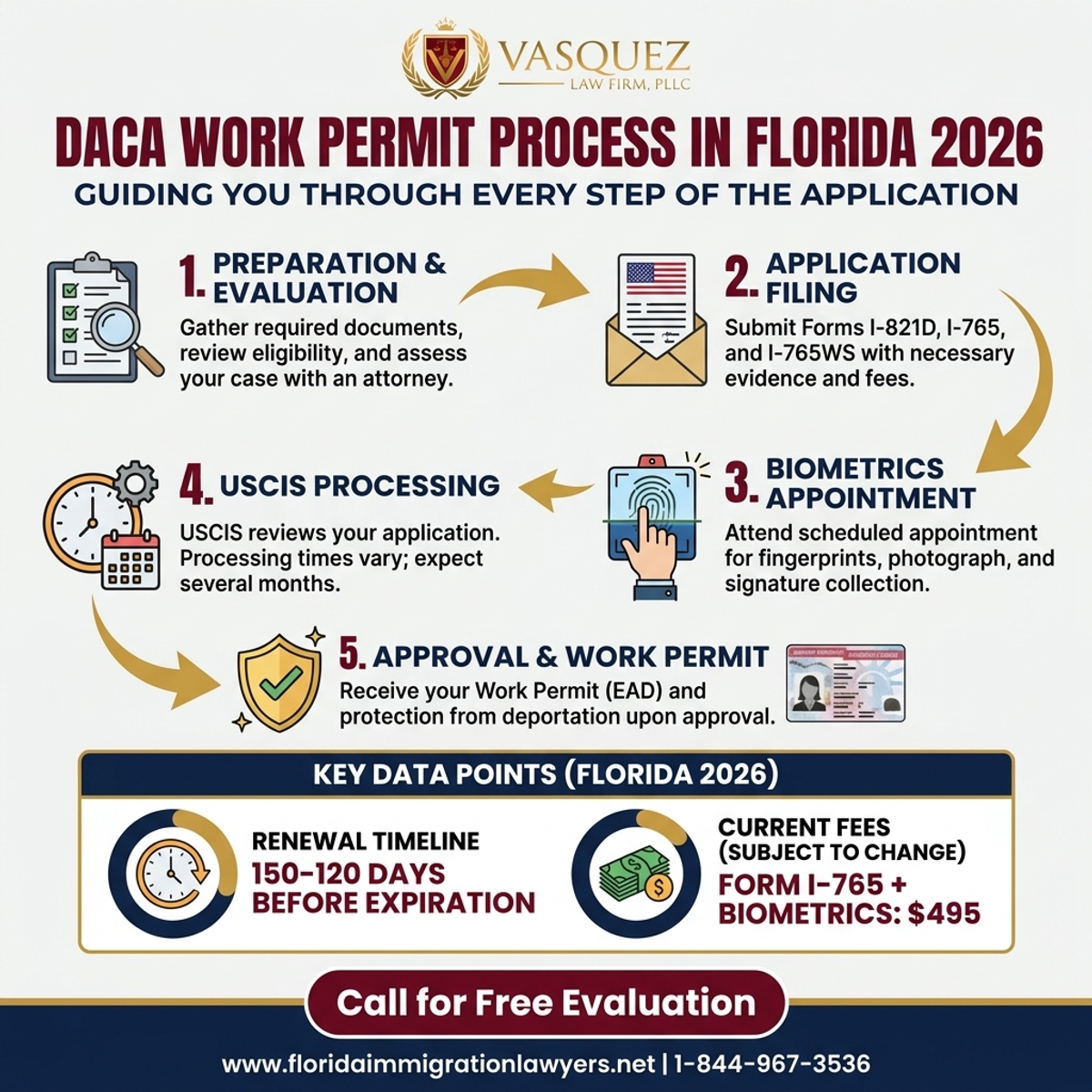
Step-by-Step Process — DACA Work Permit Process in Florida 2026
Ensure all forms are filled accurately to avoid delays. It's advisable to consult with an immigration attorney to help navigate the application process.
Form I-821D, officially known as "Consideration for Deferred Action for Childhood Arrivals," is the cornerstone of your DACA application. This form requires detailed personal history, including all addresses, employment, and educational institutions since your arrival in the U.S. Accuracy and consistency are paramount; any discrepancies with previous applications or records could trigger further scrutiny or delays. Take your time to review every section meticulously.
Following the DACA request, you must file Form I-765, "Application for Employment Authorization." This is the form that directly requests your work permit (EAD). When completing this form, ensure you select the correct eligibility category, which for DACA recipients is typically (c)(33). Submitting this form correctly is crucial for receiving your EAD, which allows you to legally work in Florida.
The biometric appointment is a mandatory step where you provide fingerprints, photographs, and a signature. This data is used for background checks to ensure you meet the DACA eligibility criteria, particularly regarding criminal history. It's essential to attend this appointment as scheduled; missing it without proper rescheduling can lead to the denial of your application. Always respond promptly to any notices from USCIS regarding your appointment.
Given the intricacies and potential pitfalls, many DACA applicants in Florida find immense value in seeking professional legal assistance. An experienced immigration attorney can review your entire application package, ensuring all forms are correctly filled, all necessary evidence is included, and all fees are properly submitted. This proactive approach can significantly reduce the risk of errors, delays, or even denial, providing peace of mind throughout the process. Florida Immigration Lawyers are well-versed in DACA applications and can provide comprehensive support.
What Documents Are Needed for the DACA Work Permit?
- Proof of identity (passport, birth certificate).
- Proof of entry before age 16 (school records, medical records).
- Proof of continuous residence since June 15, 2007.
- Documents showing physical presence on June 15, 2012.
- Proof of education or military service status.
Gathering these documents ahead of time can expedite the process and help avoid unnecessary delays.
For proof of identity, beyond a passport or birth certificate, you can also submit a state-issued identification card, a school ID with a photograph, or a consular identification document. The goal is to clearly establish your identity to USCIS. Ensure that any names used on these documents match or are supported by legal name change documents.
Demonstrating proof of entry before age 16 and continuous residence since June 15, 2007, requires a robust collection of documents. This can include school transcripts, report cards, medical records, utility bills in your name or your parents' name, rental agreements, employment records, bank statements, tax returns, and even dated photographs with verifiable context. USCIS looks for a consistent paper trail over the years to confirm your presence.
Specifically, documents showing your physical presence on June 15, 2012, are critical. While many documents proving continuous residence will also cover this date, it's wise to ensure you have at least one strong piece of evidence specifically dated around June 15, 2012, such as a school report, a pay stub, or a medical bill from that exact period. This date is a non-negotiable eligibility criterion for DACA.
To satisfy the education or military service requirement, applicants should provide official high school diplomas, GED certificates, college transcripts, or, for veterans, military discharge papers (Form DD-214). These documents verify that you meet the educational or service criteria, which is a fundamental part of DACA eligibility. If you are currently enrolled in school, provide enrollment verification letters or current transcripts.
A practical tip for organizing your documents is to create a detailed checklist and make copies of everything you plan to submit. Label each document clearly according to the category it fulfills (e.g., "Proof of Identity," "Continuous Residence"). Keep the original documents safe and submit only copies unless USCIS specifically requests originals. This meticulous organization can prevent confusion and demonstrate your thoroughness to immigration officers.
Timeline and Processing Expectations
| Stage | Typical Timeframe | Notes |
|---|---|---|
| Application Submission | 2-3 weeks | Initial processing and receipt notice |
| Biometrics Appointment | 4-6 weeks | At a local USCIS office |
| EAD Issuance | 6-8 months | Depends on backlog and accuracy of submitted documents |
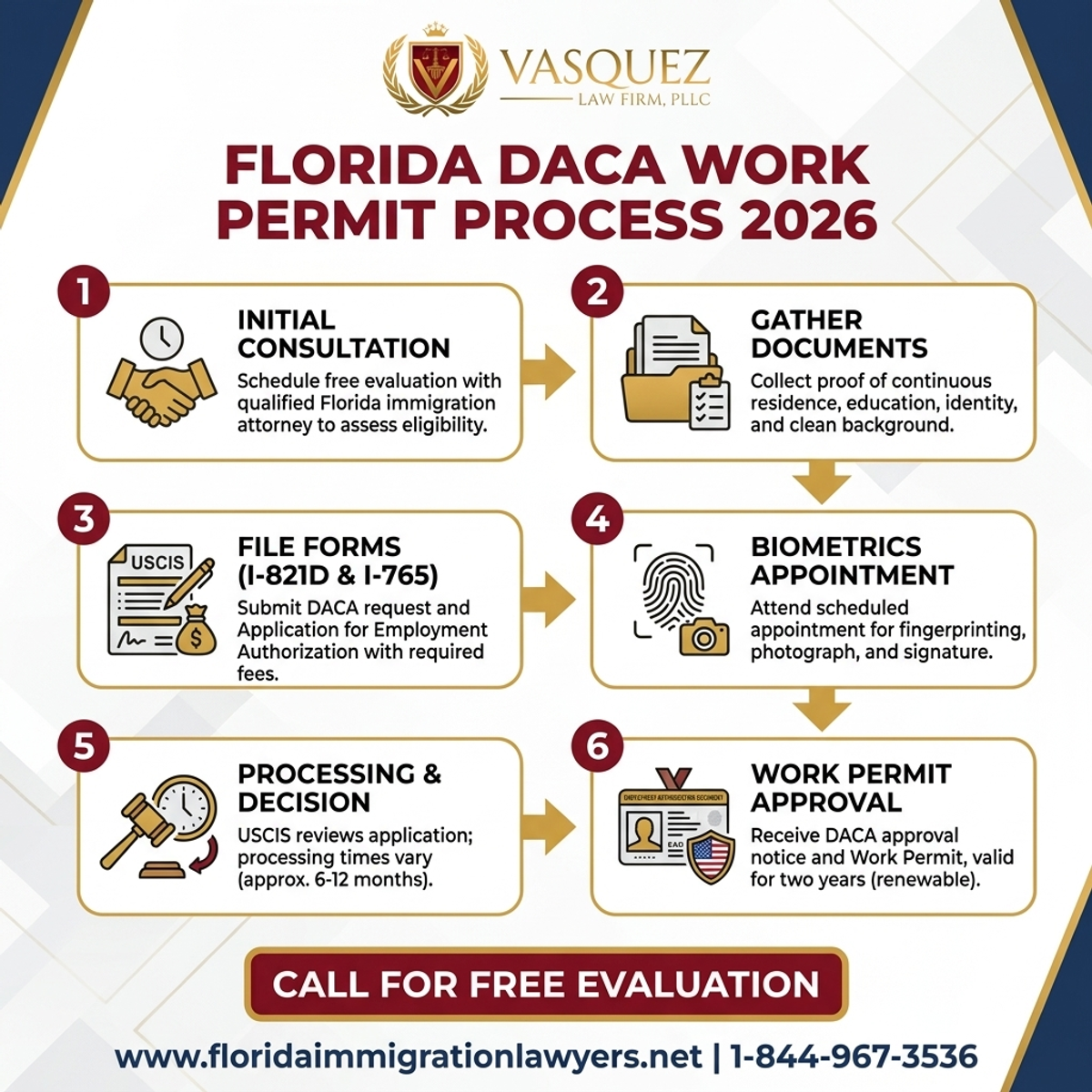
Key Statistics — DACA Work Permit Process in Florida 2026
The typical timeframes provided are estimates and can fluctuate significantly based on various factors, including the current USCIS workload, policy changes, and the completeness and complexity of your individual application. For instance, if USCIS issues a Request for Evidence (RFE) because your initial submission was incomplete, it will add substantial delays to your processing time.
Applicants can track their case status online using the receipt number provided by USCIS after initial submission. While patience is key, it's also important to know when to follow up if processing times exceed the published estimates. In such cases, or if you receive an RFE, consulting with Florida Immigration Lawyers can provide clarity and assist in responding effectively to USCIS, ensuring your application stays on track.
Cost Factors and Fee Breakdown
| Item | Typical Fee | Notes |
|---|---|---|
| Form I-765 Filing Fee | Check USCIS | Varies, check current rates |
| Biometrics Fee | Check USCIS | Standard for all applicants |
For the most accurate and up-to-date fee information, visit the USCIS website.
It's important for applicants to be aware that while the DACA application itself (Form I-821D) does not have a separate filing fee, the associated Form I-765 for employment authorization and the biometrics fee are mandatory. These fees can change, so always verify the current amounts directly on the USCIS website before submitting your application to avoid rejection due to incorrect payment.
For individuals facing financial hardship, USCIS offers the possibility of a fee waiver. However, applying for a fee waiver (using Form I-912) requires meeting specific poverty guidelines and providing significant supporting documentation. Fee waivers are not guaranteed and are often subject to strict review, so it's advisable to consult with an attorney to assess your eligibility and prepare a strong waiver application.
Beyond the government filing fees, applicants should also budget for potential legal fees if they choose to work with an immigration attorney. While this represents an additional cost, the value of professional guidance often outweighs the expense, especially for complex cases or those who wish to ensure their application is meticulously prepared. Florida Immigration Lawyers offer transparent fee structures and free consultations to help you understand the costs involved.
Frequently Asked Questions (FAQs)
Understanding the nuances of DACA and the work permit process can lead to many questions. Here are some of the most frequently asked questions, with practical advice to guide you.
Common Mistakes to Avoid in the DACA Work Permit Process
Navigating the DACA work permit process requires meticulous attention to detail. Avoiding common pitfalls is as crucial as accurately completing each step. Many delays and denials stem from preventable errors that can be easily sidestepped with careful preparation and awareness.
- Submitting incomplete forms: Can lead to application rejection.
- Not updating personal information: May cause delays in processing.
- Missing biometric appointments: Essential for verification.
- Using outdated forms: Always check the USCIS site for the latest versions.
- Ignoring deadlines: Late submissions can impact eligibility.
- Not keeping copies of all documents: Important for personal records and future renewals.
- Filing without professional help: Errors can be costly, consider consulting an attorney.
By being proactive and thorough, DACA applicants can significantly improve their chances of a smooth and successful application process. Always double-check all information, adhere to deadlines, and maintain comprehensive records. When in doubt, seeking clarification and professional assistance from Florida Immigration Lawyers is the best course of action to safeguard your application.
When to Call a Lawyer
Consider calling an immigration lawyer if you're unsure about your eligibility, need help with complex documentation, or have been previously denied. Legal expertise can be invaluable in ensuring a smooth application process. Florida Immigration Lawyers offer comprehensive services to guide you through DACA applications.
There are specific scenarios where legal counsel becomes not just advisable, but essential. If you have any criminal history, even minor offenses, or if you've had previous encounters with immigration enforcement, such as a prior deportation order or multiple entries/exits from the U.S., your DACA application will be significantly more complex. An attorney can assess the impact of these issues and advise on the best course of action.
An experienced immigration attorney can also provide critical assistance in gathering obscure or difficult-to-obtain documentation, prepare compelling arguments for discretionary factors that USCIS considers, and represent you in communications with the agency. This proactive legal support minimizes stress, reduces the risk of errors, and significantly maximizes your chances of a successful outcome, particularly with dedicated firms like Florida Immigration Lawyers.
About Florida Immigration Lawyers
Florida Immigration Lawyers is a dedicated firm committed to helping immigrants navigate complex legal processes. From our Orlando office, serving clients across Florida, we offer bilingual services and free consultations. Call us at 1-844-YO-PELEO or visit our website for more information.
Our team of experienced attorneys possesses a deep understanding of the ever-evolving landscape of U.S. immigration law, including the specific challenges and opportunities within DACA. We are committed to staying abreast of all policy changes and legal developments to provide the most current and effective guidance to our clients across Florida.
At Florida Immigration Lawyers, we pride ourselves on our client-centered approach, offering empathetic, clear communication and personalized strategies for each unique case. We understand the profound impact immigration matters have on individuals and families, and we strive to make legal assistance accessible through our bilingual services and free initial consultations, ensuring everyone in the Florida community can seek the help they need.
Sources and References
- U.S. Citizenship and Immigration Services (USCIS)
- Executive Office for Immigration Review (EOIR)
- 8 U.S.C. Chapter 12 - Immigration and Nationality Act
Related services: H-1B specialty occupation visas, L-1 intracompany transfer visas, work visas for professionals.
This article provides general legal information and is not intended as legal advice. Every case is unique, and outcomes depend on specific facts and circumstances. Contact an attorney for advice about your particular situation.
Contact Florida Immigration Lawyers at 1-844-YO-PELEO for your DACA work permit needs. Se Habla Espanol - Estamos aqui para ayudarle.
If you need legal assistance, learn more about experienced business immigration attorneys, or call us at 1-844-YO-PELEO for a free consultation.
Do Not Navigate This Process Alone
Our experienced immigration attorneys are ready to fight for you. Get a free, confidential case review today.
Se Habla Español
Or leave your details and we’ll call you:
Free Evaluation in 24 Hours
Or talk to us right now
AI voice assistant — available 24/7
FreeFrequently Asked Questions

William J. Vásquez
Founding Attorney · Vasquez Law Firm
U.S. Air Force veteran and immigration attorney with years of hands-on U.S. immigration experience. J.D., NCCU School of Law. AILA member. Admitted to the 4th, 5th, and 11th Circuit Courts.
Available 24/7 - Free Evaluations
Reviewed for legal accuracy by William J. Vásquez
Licensed in North Carolina; U.S. immigration is federal practice.
Related Legal Services
Our Florida immigration attorneys can help you with immigration lawyer cost in Florida, experienced immigration attorneys and asylum protection. Call today at 1-844-YO-PELEO for a free case review.
Related Links
Related Topics
Free Legal Case Review
Discuss your case with our experienced attorneys. We're available 24/7.
Se Habla Español - Estamos aquí para ayudarle.
Related Articles
DUI Immigration Consequences in Florida 2026
A DUI conviction in Florida can have severe immigration consequences, potentially leading to inadmissibility, deportation, or denial of immigration benefits. For non-citizens, a DUI is not just a traffic offense but a serious criminal matter that federal immigration law scrutinizes closely. Factors like multiple offenses, injury, or property damage can escalate a simple DUI to a Crime Involving Moral Turpitude (CIMT) or even an aggravated felony, triggering mandatory detention and removal proceedings. Understanding the specific nature of your Florida conviction and its interpretation under the Immigration and Nationality Act (INA) is crucial. This article outlines how DUIs impact immigration status, the grounds for inadmissibility and deportation, a step-by-step guide to navigating the process, essential documentation, and expected timelines for 2026. We also highlight common mistakes to avoid and when to seek legal counsel from an experienced immigration attorney. Florida Immigration Lawyers offers comprehensive support for individuals facing these challenging situations, providing expert guidance through complex legal landscapes.
PERM Labor Certification in Florida: A 2026 Guide
Learn all about the PERM labor certification process in Florida, essential for employers sponsoring green card applicants. Understand the steps, document requirements, and common mistakes to avoid in this 2026 guide.
Immigration Lawyer Orlando Free Consultation in Florida
For individuals and families in Orlando, Florida, navigating the complexities of U.S. immigration law requires expert guidance. An immigration lawyer in Orlando offers crucial support for everything from visa applications and green card processes to naturalization and deportation defense. This comprehensive guide details what a free consultation covers, providing a step-by-step overview of immigration pathways, essential document checklists, and expected timelines in 2026. We also highlight common mistakes to avoid, discuss the critical role of legal counsel in deportation and asylum cases, and explain why choosing a local Orlando immigration attorney is beneficial. Florida Immigration Lawyers is dedicated to serving the diverse community of Orlando with compassionate, effective legal solutions, ensuring you receive personalized advice and robust representation for a successful immigration journey.
EAD Advance Parole Combo Card in Florida: What You Need
An EAD advance parole combo card allows individuals with pending adjustment applications to both work and travel abroad without jeopardizing their green card application. Learn how to apply in Florida, what documents you need, and common mistakes to avoid.