H-2A Visa Florida: Agricultural Worker Guide for Growers
Florida's agricultural sector heavily relies on the H-2A visa program to address seasonal labor shortages. This comprehensive guide provides Florida growers, particularly those in West Palm Beach and surrounding areas, with essential information on navigating the H-2A visa application process. Learn about eligibility, step-by-step procedures, crucial documentation, and associated costs. We detail employer responsibilities regarding wages, housing, and transportation, emphasizing the importance of compliance with federal regulations. Discover common mistakes to avoid and understand when expert legal counsel from Florida Immigration Lawyers is indispensable to secure your temporary agricultural workforce efficiently and legally. We offer free consultations to help you protect your harvest and ensure your operations thrive.

The H-2A visa program offers Florida agricultural employers a vital solution to address seasonal or temporary labor shortages by allowing them to bring nonimmigrant foreign workers into the U.S. for agricultural work. This program is crucial for Florida's robust agricultural sector, ensuring crops are harvested and operations run smoothly when domestic workers are unavailable. Employers must demonstrate a temporary need for workers and comply with strict regulations regarding wages, housing, and transportation, all designed to protect both foreign and domestic workers. Successfully navigating this process is key for growers in regions like West Palm Beach and across the state.
- Eligibility: U.S. agricultural employers with a temporary or seasonal labor need.
- Application Steps: Labor certification from DOL, then petition to USCIS, followed by consular processing for workers.
- Employer Responsibilities: Providing fair wages, suitable housing, and transportation.
- Key Benefits: Access to a reliable workforce, compliance with labor laws, and support for agricultural operations.
Florida's agricultural industry is a cornerstone of its economy, renowned for its citrus, sugar cane, tomatoes, and ornamental crops. However, growers across the state, from the fertile fields surrounding West Palm Beach to the vast farmlands of Central and North Florida, frequently face significant challenges in securing sufficient labor, particularly during peak harvest seasons. The demand for skilled agricultural workers often outstrips the local supply, threatening crop yields and economic stability. This is where the H-2A visa program becomes an indispensable tool, offering a legal and structured pathway for employers to bring in nonimmigrant foreign workers to fill these critical temporary positions.
Understanding the intricacies of the H-2A visa process is not just about compliance; it's about ensuring the sustainability and profitability of your farm. From proving a temporary need to navigating labor certification, petition filing, and consular processing, each step requires meticulous attention to detail and adherence to strict federal regulations. This comprehensive guide will illuminate the path for Florida growers, offering insights into eligibility, application procedures, crucial timelines, and cost considerations for the H-2A visa program. We will also highlight common pitfalls and explain when expert legal counsel from Florida Immigration Lawyers can make all the difference. Call Florida Immigration Lawyers at 1-844-967-3536 for a free consultation today and secure your harvest with confidence.
What is the H-2A Visa Program for Florida Agricultural Workers?
The H-2A visa program allows U.S. agricultural employers who anticipate a shortage of domestic workers to bring foreign nationals to the United States to perform agricultural labor or services of a temporary or seasonal nature. This program is authorized by the Immigration and Nationality Act (INA) section 101(a)(15)(H)(ii)(a), codified at 8 U.S.C. § 1101(a)(15)(H)(ii)(a). It is designed to meet the specific, often fluctuating, labor needs of the agricultural sector, which is vital for Florida's economic health. The program ensures that essential crops can be planted, cultivated, and harvested, preventing significant losses for growers.
For Florida growers, the H-2A program offers a reliable source of labor when domestic workers are unavailable. It provides a structured framework that includes specific requirements for wages, housing, and transportation, which employers must meet to protect the rights and welfare of both H-2A workers and U.S. workers. The program is jointly administered by the U.S. Department of Labor (DOL) and U.S. Citizenship and Immigration Services (USCIS). DOL is responsible for the temporary labor certification process, ensuring that no qualified U.S. workers are available and that the employment of foreign workers will not adversely affect the wages and working conditions of similarly employed U.S. workers. USCIS then adjudicates the petition for nonimmigrant workers. This dual oversight ensures a balance between employer needs and worker protections, which is particularly important in Florida's diverse agricultural landscape.
The temporary nature of the H-2A visa is a key component; the employment must be for a limited period, typically less than one year, tied to a season or specific event like a harvest. This contrasts with permanent employment visas and is strictly enforced. Employers in Florida, from small family farms to large agricultural corporations, rely on this program to manage their seasonal workforce demands effectively. Understanding this fundamental aspect is crucial for compliance and successful participation in the program. The H-2A program is not a pathway to permanent residency for the workers, but rather a temporary solution to a temporary labor need. This distinction is important for both employers and prospective workers to understand.
How Do Florida Growers Apply for H-2A Agricultural Workers?
Florida growers apply for H-2A agricultural workers through a multi-step process involving both the U.S. Department of Labor (DOL) and U.S. Citizenship and Immigration Services (USCIS). The process begins with securing a temporary labor certification from the DOL, followed by filing a petition with USCIS. This structured approach ensures that the temporary labor need is legitimate and that U.S. workers are not displaced.
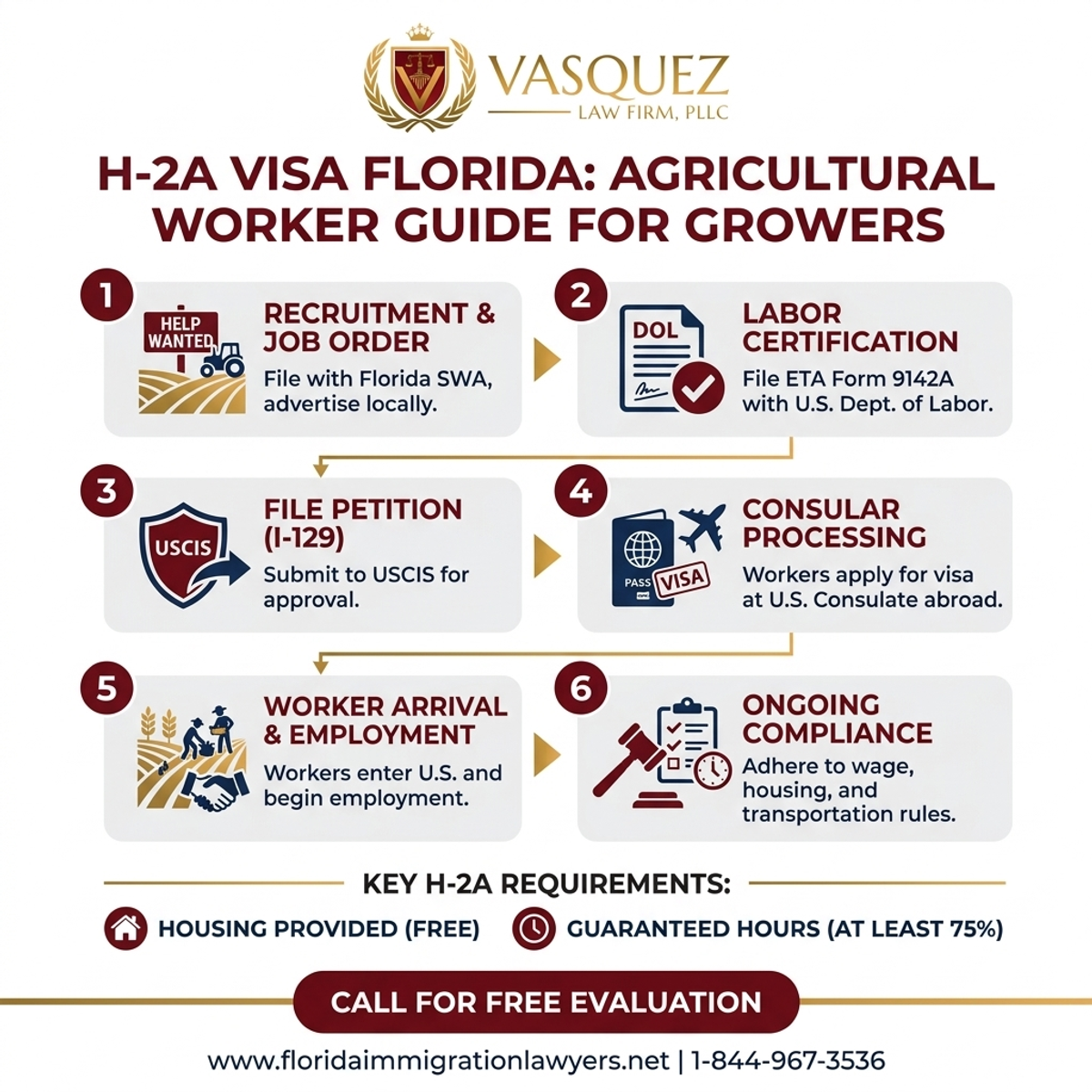
The application journey for Florida growers seeking H-2A workers is comprehensive, designed to ensure compliance with federal labor and immigration laws. It is a detailed sequence of actions that must be performed diligently and within specific timelines to avoid delays or denials. Here is a step-by-step guide to the H-2A application process:
- Step 1: Obtain a Temporary Labor Certification from the DOL (ETA Form 9142A).
- File a Job Order: The employer must first submit an agricultural job order to the Florida Department of Economic Opportunity (now FloridaCommerce) or the appropriate State Workforce Agency (SWA) in the state of intended employment. This must be done between 60 and 75 calendar days before the date of need. The job order must clearly describe the job duties, wages, and conditions.
- Recruitment Efforts: Concurrently, the employer must conduct active recruitment of U.S. workers. This includes advertising in newspapers of general circulation, posting notices at the worksite, and contacting former employees. The goal is to demonstrate that there are not sufficient U.S. workers who are able, willing, and qualified for the positions.
- File Application for Temporary Employment Certification: The employer then submits ETA Form 9142A, Application for Temporary Employment Certification, to the Chicago National Processing Center (CNPC) of the DOL's Office of Foreign Labor Certification (OFLC). This form must be filed between 45 and 75 calendar days before the date of need.
- DOL Review and Determination: The DOL reviews the application, job order, and recruitment efforts. If all requirements are met, and the employer demonstrates a temporary need and that no qualified U.S. workers are available, the DOL will issue a Temporary Labor Certification. This certification is crucial as it confirms the employer's need for foreign workers and authorizes the next step.
- Step 2: File Form I-129, Petition for a Nonimmigrant Worker, with USCIS.
- Once the DOL certification is received, the employer files Form I-129, Petition for a Nonimmigrant Worker, with USCIS. This petition requests authorization for the foreign workers to come to the U.S. under H-2A classification.
- The petition must include the approved DOL labor certification and evidence of the employer's ability to meet the program requirements. This includes details about the job offer, housing, and transportation arrangements.
- USCIS reviews the petition to ensure all immigration eligibility requirements are met. If approved, USCIS sends an approval notice, Form I-797, which the workers will need for their visa application.
- Step 3: H-2A Visa Application and Consular Processing.
- After USCIS approves the I-129 petition, prospective H-2A workers located outside the U.S. must apply for an H-2A visa at a U.S. Embassy or Consulate in their home country. They will need the approved I-129 petition number (from Form I-797), a valid passport, a visa application form (DS-160), and any other required documents.
- During the visa interview, consular officers will verify the worker's eligibility and intent to return to their home country after the temporary employment concludes.
- Step 4: Entry into the U.S.
- Upon successful visa approval, workers can travel to the U.S. and present their H-2A visa and passport at a U.S. port of entry. Customs and Border Protection (CBP) officers will make the final decision on admission.
Navigating these steps requires precision and a thorough understanding of both labor and immigration laws. For Florida growers, particularly those in areas like West Palm Beach where agricultural operations are extensive, seeking legal guidance from experienced immigration attorneys can streamline this complex process. Florida Immigration Lawyers specializes in business immigration and can assist with every stage of the H-2A application, ensuring compliance and maximizing the chances of a successful outcome.
What Documents Are Required for the H-2A Visa Process in 2026?
For the H-2A visa process in 2026, Florida employers and foreign workers must compile a comprehensive set of documents to satisfy both the Department of Labor (DOL) and U.S. Citizenship and Immigration Services (USCIS) requirements. These documents attest to the employer's temporary labor need, recruitment efforts, and ability to meet worker protections, as well as the worker's eligibility for the visa. Accuracy and completeness are paramount to avoid delays or denials.
The H-2A visa application demands meticulous documentation from both the employer and the prospective workers. Missing or incorrect documents are among the most common reasons for processing delays. Here is a detailed checklist of the typical documents required:
- Employer-Related Documents for DOL (Labor Certification):
- Completed ETA Form 9142A, Application for Temporary Employment Certification.
- Copies of newspaper advertisements for U.S. worker recruitment.
- Proof of job order placement with the State Workforce Agency (e.g., FloridaCommerce).
- Detailed description of the job duties, qualifications, and working conditions.
- Documentation of housing arrangements (e.g., lease agreements, inspection reports) confirming compliance with DOL and OSHA standards.
- Evidence of ability to provide transportation for workers.
- Proof of workers' compensation insurance or equivalent coverage.
- Business registration documents and proof of good standing for the Florida agricultural operation.
- Employer-Related Documents for USCIS (I-129 Petition):
- Completed Form I-129, Petition for a Nonimmigrant Worker.
- Original or certified copy of the approved ETA Form 9142A (Temporary Labor Certification).
- Employer's Federal Employer Identification Number (FEIN).
- Letter of support from the employer explaining the temporary need and job offer.
- Any additional evidence requested by USCIS to prove the legitimacy of the temporary need.
Step-by-Step Process — H-2A Visa Florida: Agricultural Worker Guide for Growers
- Foreign Worker-Related Documents (Consular Processing):
- Valid passport from the worker's country of nationality.
- Completed DS-160, Online Nonimmigrant Visa Application form.
- Confirmation page of the DS-160 and appointment confirmation.
- One (1) 2x2 inch color photograph meeting U.S. visa requirements.
- Original or copy of the USCIS Form I-797, Petition Approval Notice (containing the H-2A petition number).
- Proof of ties to home country (e.g., property deeds, family records, bank statements) to demonstrate non-immigrant intent.
- Any other documents requested by the U.S. Embassy or Consulate.
It is important to note that specific requirements can vary slightly based on individual circumstances or updates to immigration policy. As of 2026, maintaining organized records of all submitted documents and correspondence is highly recommended for all Florida growers participating in the H-2A program. A dedicated legal team can help ensure every piece of documentation is correctly prepared and submitted.
What is the H-2A Visa Processing Timeline for Florida Employers?
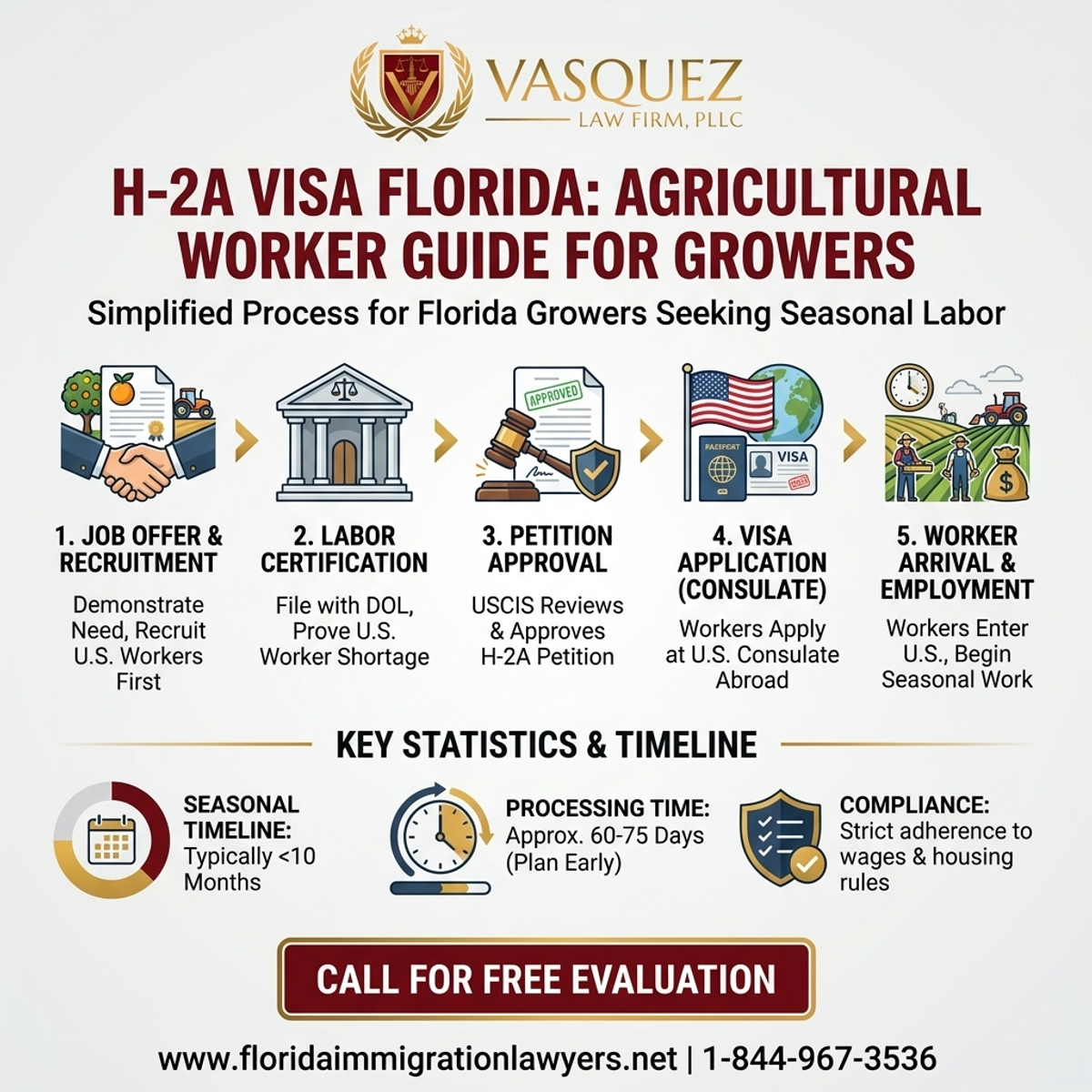
The H-2A visa processing timeline for Florida employers can vary, but generally, the entire process from initial labor certification filing to worker arrival takes approximately 2-5 months. This timeframe is influenced by various factors, including the responsiveness of the Department of Labor (DOL) and U.S. Citizenship and Immigration Services (USCIS), the completeness of the application, and the efficiency of consular processing. Planning well in advance of the needed start date is crucial for Florida's seasonal agriculture.
Successful H-2A program participation hinges on careful planning and adherence to deadlines. Delays can have severe consequences for Florida growers, potentially impacting crop cycles and financial stability. As of 2026, here is a typical breakdown of the H-2A visa processing timeline:
| Stage | Typical Timeframe (As of 2026) | Notes |
|---|---|---|
| Pre-filing/Job Order with SWA | 60-75 days prior to 'date of need' | Employer submits job order to FloridaCommerce or relevant State Workforce Agency. Critical for initiating recruitment. |
| DOL ETA Form 9142A Filing | 45-75 days prior to 'date of need' | Application for Temporary Employment Certification submitted to DOL. Coincides with ongoing recruitment. |
| DOL Review and Certification | ~30-45 days after filing | DOL reviews application, recruitment results, and issues a Temporary Labor Certification. |
| USCIS Form I-129 Filing | Immediately after DOL certification | Petition for Nonimmigrant Worker submitted to USCIS. Must include the certified ETA Form 9142A. |
| USCIS I-129 Processing | ~2-3 weeks (Premium Processing) or 2-3 months (Regular Processing) | Standard processing times can vary. Premium processing is available for an additional fee for faster adjudication. |
| Consular Processing/Visa Interview | ~2-4 weeks after I-129 approval | Foreign workers apply for visas at a U.S. Embassy/Consulate. Appointment availability can impact this stage. |
| Worker Travel and Entry | Varies, typically within days of visa issuance | Workers travel to the U.S. and are admitted by CBP. |
| Total Estimated Time | 2-5 months | From initial job order to worker arrival. Factors like RFE (Request for Evidence) or consular backlogs can extend this. |
It is imperative for Florida agricultural employers, especially those operating near West Palm Beach where seasonal demands are high, to submit their applications as early as possible within the allowable windows. Unexpected delays are common in immigration processes, and having a buffer can prevent critical labor shortages. Monitoring processing times on the USCIS website and the DOL's OFLC website is advisable. Engaging with an experienced immigration law firm like Florida Immigration Lawyers can help anticipate and mitigate potential delays, ensuring that your workforce arrives precisely when needed. Our team stays current with processing trends and can advise on the most strategic filing approach.
What Are the Costs Associated with the H-2A Visa Program?
The H-2A visa program involves several categories of costs for Florida agricultural employers, encompassing government filing fees, recruitment expenses, and operational costs related to housing and transportation. While specific fee amounts are subject to change by federal agencies, understanding the typical cost components is essential for budget planning. These expenses are a significant investment, reflecting the employer's commitment to securing a legal and compliant workforce for their Florida operations.
Participating in the H-2A program requires a financial commitment from Florida growers, but it is an investment in securing a stable and authorized workforce. As of 2026, here is a breakdown of the typical cost factors involved:
| Item | Typical Fee (As of 2026) | Notes |
|---|---|---|
| DOL Application Fee (ETA Form 9142A) | No fee | The Department of Labor does not charge a fee for the labor certification application. |
| USCIS I-129 Petition Fee | Applicable USCIS filing fee | This fee is paid to USCIS when filing Form I-129. Fees are subject to change; always check the latest USCIS fee schedule. |
| Premium Processing Fee (Optional) | Additional USCIS fee | Expedites USCIS processing of Form I-129 to 15 calendar days. Highly recommended for urgent needs. |
| Consular Processing Fee (DS-160) | Paid by worker (or employer on their behalf) | Nonimmigrant visa application fee. Varies by country and is subject to change. |
| Recruitment Costs | Varies (e.g., newspaper ads, job board postings) | Employers must advertise job openings to U.S. workers, incurring costs for publications. |
| Transportation Costs | Varies (e.g., airfare, bus tickets) | Employers are generally responsible for providing and paying for workers' transportation from their home country to the worksite in Florida, and return transportation. |
| Housing Costs | Varies (e.g., rent, utilities, maintenance) | Employers must provide free, clean, and safe housing for H-2A workers. This can be employer-owned or rented. |
| Workers' Compensation Insurance | Varies (based on state rates, number of workers) | Required by law to protect workers in case of injury. |
| Legal Fees | Varies (based on complexity, services) | Costs for legal consultation and representation from an immigration attorney to navigate the complex application process. |
Key Statistics — H-2A Visa Florida: Agricultural Worker Guide for Growers
It is crucial for Florida growers to budget for these various expenses when considering the H-2A program. While some costs, like visa application fees, may be paid by the workers, employers are generally obligated to reimburse certain travel and visa-related expenses once workers complete a specified portion of their contract. Understanding these financial obligations from the outset is vital for sound business planning. An experienced immigration attorney can provide a detailed breakdown of current fees and help structure your budget effectively, ensuring no hidden costs catch you by surprise. This is especially true for growers around West Palm Beach and other major agricultural hubs in Florida, where competitive labor practices are closely scrutinized.
Employer Responsibilities and Worker Protections under H-2A in Florida
Participating in the H-2A program entails significant responsibilities for Florida agricultural employers, primarily centered on ensuring fair treatment and adequate protections for temporary foreign workers. These obligations are legally mandated by the Department of Labor (DOL) and U.S. Citizenship and Immigration Services (USCIS) regulations (specifically 20 CFR Part 655, Subpart B, and 8 CFR Part 214.2(h)(5)), designed to prevent exploitation and uphold labor standards. Compliance is not optional; it is a fundamental requirement for all employers utilizing the H-2A visa program in Florida.
For growers in Florida, understanding and meticulously adhering to these responsibilities is critical for maintaining compliance and avoiding severe penalties. The primary areas of employer responsibility include:
- Wages: Employers must pay H-2A workers at least the Adverse Effect Wage Rate (AEWR) for Florida, the prevailing wage, the federal minimum wage, or the state minimum wage, whichever is highest. The AEWR is determined annually by the DOL to prevent the wages of U.S. workers from being adversely affected. As of 2026, Florida's AEWR is regularly updated, and employers must stay informed of the current rate.
- Housing: Employers must provide free, clean, safe, and sanitary housing for H-2A workers and any U.S. workers who are not reasonably able to return to their permanent residence at the end of each workday. The housing must meet all applicable federal and state safety and health standards, including those enforced by the Florida Department of Health and local authorities. Inspections are often required.
- Transportation: Employers must provide and pay for the workers' transportation from their home country to the worksite in Florida, and return transportation upon completion of the contract. Additionally, daily transportation between the housing and the worksite must be provided without cost.
- Meals or Cooking Facilities: Employers must provide either three meals a day or furnish free and convenient cooking and kitchen facilities where workers can prepare their own meals. If meals are provided, the employer may charge workers for the cost, but this charge is regulated and cannot exceed a specified daily amount.
- Tools and Supplies: All tools, supplies, and equipment required to perform the job duties must be provided by the employer without cost to the worker.
- Workers' Compensation: Employers are required to provide workers' compensation insurance coverage for all H-2A workers (and U.S. workers) at no cost, as required by Florida law.
- Record Keeping: Detailed records of hours worked, wages paid, deductions, and recruitment efforts must be maintained for a specified period and made available for inspection.
- Contract Compliance: Employers must abide by all terms and conditions of the job offer and temporary labor certification. Any changes to the employment terms must be approved by the DOL and USCIS.
These protections are in place to safeguard the welfare of temporary agricultural workers, many of whom may be unfamiliar with U.S. labor laws. For Florida Immigration Lawyers, ensuring that our clients, Florida growers, are fully compliant with these regulations is a top priority. Non-compliance can lead to significant fines, debarment from the H-2A program, and reputational damage. Our firm can provide comprehensive guidance to help you navigate these complex obligations, ensuring your operations in West Palm Beach or elsewhere in Florida remain compliant and ethical.
Navigating H-2A Visa Challenges with Florida Immigration Lawyers
The H-2A visa program, while incredibly beneficial for Florida's agricultural sector, presents numerous challenges for growers. From the initial complex application process to ongoing compliance with stringent federal regulations, employers often encounter hurdles that can delay or jeopardize their ability to secure a much-needed workforce. These challenges range from demonstrating a legitimate temporary need to navigating recruitment requirements, ensuring proper housing, and responding to government audits. The legal landscape surrounding temporary agricultural workers is constantly evolving, making expert guidance indispensable for Florida growers.
Florida Immigration Lawyers understands the unique pressures faced by agricultural businesses in West Palm Beach and across the state. We specialize in providing comprehensive legal support to help you overcome these challenges effectively:
- Complex Application Process: The H-2A application involves intricate forms, strict deadlines, and coordination between multiple federal agencies (DOL, USCIS, State Department). Our attorneys guide you through each step, ensuring all documentation is accurate and submitted on time, minimizing the risk of delays or denials. We help prepare the ETA Form 9142A, manage recruitment attestations, and file the Form I-129 petition with precision.
- Proving Temporary Need: A core requirement of the H-2A program is demonstrating that your need for labor is truly temporary or seasonal. We assist in articulating your specific agricultural cycle and labor demands, providing robust evidence to satisfy DOL and USCIS criteria. This is crucial for avoiding scrutiny and ensuring your application is approved.
- Recruitment Compliance: Employers must prove they have attempted to recruit U.S. workers without success. This involves specific advertising mandates and outreach efforts. We help design and document a compliant recruitment strategy, ensuring you meet all regulatory obligations and can confidently attest to the unavailability of domestic labor.
- Housing and Transportation Standards: Adhering to federal and state standards for worker housing and transportation can be complex. We advise on compliance with health, safety, and wage regulations, helping you ensure that your facilities and provisions meet all requirements before workers arrive. This proactive approach helps prevent costly violations and ensures worker welfare.
- Audits and Investigations: DOL and USCIS conduct audits and investigations to ensure ongoing compliance. Our firm can represent you during these inquiries, helping you prepare for inspections, respond to Requests for Evidence (RFEs), and address any allegations of non-compliance. Our goal is to protect your business and your ability to participate in the H-2A program.
- Renewals and Extensions: Many Florida growers rely on the H-2A program year after year. We assist with the renewal process, ensuring continuity of your workforce and helping you navigate any changes in regulations or requirements for subsequent seasons.
By partnering with Florida Immigration Lawyers, growers gain a strategic advantage. Our deep understanding of immigration law, combined with our commitment to serving Florida's agricultural community, allows us to provide tailored solutions. We help you navigate these complexities, secure your workforce, and focus on what you do best: cultivating Florida's bounty. Contact Florida Immigration Lawyers today for a free consultation to discuss your specific H-2A visa needs.
Do not navigate this process alone. The complexities of the H-2A visa program require expert legal guidance to ensure compliance and success. From initial application to ongoing employer responsibilities, Florida Immigration Lawyers is here to support Florida growers every step of the way. Contact Florida Immigration Lawyers today for a free consultation and let us help you secure your agricultural workforce.
Common H-2A Visa Mistakes to Avoid
Navigating the H-2A visa program is fraught with potential pitfalls that can lead to significant delays, denials, or even legal penalties for Florida growers. Avoiding these common mistakes is crucial for a successful application and compliant operation. Here are 7-12 common errors and their consequences:
- Inadequate Recruitment of U.S. Workers: Failing to conduct a diligent and timely recruitment effort for U.S. workers is a primary reason for DOL labor certification denials. Employers must follow specific advertising requirements, including placing job orders with the SWA and advertising in newspapers, to prove that no qualified U.S. workers are available. Consequences include application denial and inability to hire foreign workers.
- Incorrect Adverse Effect Wage Rate (AEWR) Offer: Offering wages below the current Florida AEWR or the highest applicable wage (federal/state minimum, prevailing wage) is a serious violation. This can lead to DOL denial, back pay requirements, and debarment from the program. Always verify the latest AEWR.
- Non-Compliant Housing: Providing housing that does not meet federal and state health and safety standards is a major issue. Inspections are strict, and deficiencies can lead to delays, fines, and an inability to house H-2A workers. Ensure housing is inspected and approved well in advance.
- Missing Deadlines: The H-2A program has very strict filing windows for both the DOL and USCIS applications. Missing these deadlines can result in the rejection of your application, forcing you to restart the entire process and causing critical labor shortages during your peak season.
- Incomplete or Inaccurate Documentation: Submitting an application with missing forms, incorrect information, or insufficient supporting evidence (e.g., job descriptions, proof of temporary need) will almost certainly lead to Requests for Evidence (RFEs) or outright denials. This prolongs processing and adds significant stress.
- Failure to Prove Temporary Need: The H-2A program is for temporary or seasonal labor. Employers must clearly articulate and provide evidence that their need is not permanent. Vague explanations or insufficient documentation can lead to a determination that the need is not temporary, resulting in denial.
- Not Providing Required Transportation: Employers are responsible for providing and paying for inbound, outbound, and daily worksite transportation. Failure to do so is a violation of H-2A regulations and can lead to penalties and program debarment.
- Improper Deductions from Worker Wages: While some deductions are permissible, unauthorized or excessive deductions from H-2A workers' paychecks are strictly prohibited. This can result in wage claims, significant fines, and legal action.
- Lack of Workers' Compensation Insurance: Operating without proper workers' compensation coverage for H-2A workers is a serious legal and ethical lapse, exposing both the employer and workers to significant risk and legal liability.
- Not Consulting Legal Counsel: Attempting to navigate the complex H-2A process without expert legal guidance often leads to costly mistakes. An experienced immigration attorney can prevent errors, ensure compliance, and streamline the entire process, saving time and resources in the long run.
When to Call a Florida Immigration Lawyer for H-2A Visas
The decision to utilize the H-2A visa program is a significant one for Florida agricultural employers, and the complexities involved often warrant professional legal assistance. While some experienced growers may manage parts of the process independently, there are specific scenarios where engaging a Florida immigration lawyer becomes not just beneficial, but essential. Protecting your business from potential legal pitfalls and ensuring a smooth, compliant process is paramount, especially in a state with such a vital agricultural sector like Florida.
You should consider contacting Florida Immigration Lawyers if you encounter any of the following situations:
- First-Time H-2A Applicant: If you are new to the H-2A program, the learning curve can be steep. An attorney can guide you through every step, from assessing eligibility to final worker arrival, establishing a strong foundation for future applications.
- Previous Denials or RFEs: If your H-2A application has been denied in the past or you've received Requests for Evidence (RFEs) from DOL or USCIS, it indicates underlying issues that require expert analysis and strategic remediation.
- Complex Labor Needs: If your agricultural operation has unique or particularly complex labor needs, or if you are unsure how to articulate your temporary need effectively, an attorney can help craft a compelling case.
- Compliance Concerns: Doubts about meeting housing, transportation, wage, or recruitment requirements should prompt legal consultation. Proactive compliance is far less costly than reactive defense against violations.
- Government Audits or Investigations: If your farm is selected for a DOL audit or investigation, or if you receive any notice of potential non-compliance, immediate legal representation is critical to protect your interests.
- Worker Disputes: Should any disputes arise with H-2A workers regarding wages, working conditions, or other terms of employment, an attorney can provide guidance on resolution and compliance.
- Expedited Processing Needs: If you have urgent labor needs that require premium processing or careful management of timelines, an attorney can help strategize the most efficient path.
- Changes in Regulations: Immigration and labor laws are subject to frequent changes. An attorney stays updated on the latest regulations, ensuring your application and operations remain compliant.
Florida Immigration Lawyers provides comprehensive H-2A visa services, offering tailored solutions to Florida growers. We understand the specific challenges of agricultural businesses in West Palm Beach and across Florida and are dedicated to helping you secure your workforce legally and efficiently.
About Florida Immigration Lawyers
Florida Immigration Lawyers is a leading immigration law firm dedicated to serving individuals and businesses across the entire state of Florida. With a deep understanding of complex U.S. immigration laws and a steadfast commitment to our clients, we provide strategic legal solutions for a wide range of immigration matters. Our experienced attorneys specialize in business immigration, family immigration, deportation defense, asylum, and citizenship, ensuring that every client receives personalized and effective representation.
We pride ourselves on our client-focused approach, offering compassionate and knowledgeable guidance through every step of the immigration journey. For Florida agricultural employers navigating the H-2A visa program, our firm offers unparalleled expertise, helping you secure the temporary workforce essential for your operations. We understand the unique challenges faced by growers in West Palm Beach, Miami, Orlando, and all other agricultural regions of Florida. Our commitment extends to being available 24/7, offering free consultations, and providing services in both English and Spanish to ensure clear communication and comprehensive support for all our diverse clients. Trust Florida Immigration Lawyers to be your dedicated partner in achieving your immigration goals.
Sources and References
- U.S. Citizenship and Immigration Services (USCIS) - H-2A Temporary Agricultural Workers
- U.S. Department of Labor (DOL) - H-2A Temporary Agricultural Program
- U.S. Department of State - H-2A Temporary Agricultural Worker Visa
- Immigration and Nationality Act (INA) Section 101(a)(15)(H)(ii)(a) - 8 U.S.C. § 1101(a)(15)(H)(ii)(a)
- 20 Code of Federal Regulations (CFR) Part 655, Subpart B - H-2A Temporary Agricultural Labor Certification
- 8 Code of Federal Regulations (CFR) Part 214.2(h)(5) - H-2A Petitions
Related services: immigration practice areas, family immigration services, citizenship and naturalization.
This article provides general legal information and is not intended as legal advice. Every case is unique, and outcomes depend on specific facts and circumstances. Contact an attorney for advice about your particular situation. Immigration laws are subject to change.
Securing a reliable agricultural workforce is essential for the success of your farm in Florida. The H-2A visa program offers a critical solution, but its complexities demand experienced legal guidance. Don't risk your harvest or your business's compliance. Contact Florida Immigration Lawyers today for a free consultation. Our dedicated team is ready to assist you. Call us at 1-844-967-3536. Se Habla Español - Estamos aquí para ayudarle.
Do Not Navigate This Process Alone
Our experienced immigration attorneys are ready to fight for you. Get a free, confidential consultation today.
Se Habla Español
Frequently Asked Questions
Harold Estrada-Rodriguez
Florida Immigration Attorney · FL Bar No. 1041171
Florida Bar attorney handling Florida-jurisdiction immigration matters. Bilingual representation, free consultations.
Available 24/7 - Free Evaluations
Related Legal Services
Our Florida immigration attorneys can help you with family immigration services, immigration practice areas and free immigration consultation. Call today at 1-844-967-3536 for a free consultation.
Related Links
Related Topics
Free Legal Consultation
Discuss your case with our experienced attorneys. We're available 24/7.
Se Habla Español - Estamos aquí para ayudarle.
Related Articles
Immigration Lawyer Fort Lauderdale: Expert Legal Help
Navigating the U.S. immigration system in Fort Lauderdale can be challenging. This comprehensive guide details how an expert immigration lawyer in Fort Lauderdale, Florida, can assist with visas, green cards, naturalization, asylum, and crucial deportation defense. Learn about essential services, how to choose the right attorney in Broward County, common mistakes to avoid, and when legal representation is critical. Florida Immigration Lawyers offers free consultations and dedicated support for all your immigration needs across Florida.
Refugee Status Florida Resettlement Guide 2026 | VLF Florida
Navigating refugee status and resettlement in Florida for 2026 demands a clear understanding of complex U.S. immigration laws and the support systems available. This comprehensive guide details the rigorous application process, from international referral to integration into communities like St. Petersburg. Learn about eligibility criteria, necessary documentation, typical timelines, and associated costs. We also highlight common pitfalls to avoid and crucial moments when legal counsel is indispensable. Florida Immigration Lawyers offers expert guidance for refugees and asylum seekers, ensuring a smoother transition to a new life in Florida. Contact us for a free consultation to protect your rights and secure your future.
Family Petition Immigration Lawyer in Miami | VLF Florida
Learn about family petition processes in Miami with expert legal guidance from Florida Immigration Lawyers. Discover how to navigate the complexities of immigration law to reunite with your loved ones. Contact us at 1-844-967-3536 for a free consultation today.
Florida Work Permit & EAD Application: Your 2026 Guide
For immigrants in Florida, obtaining an Employment Authorization Document (EAD), or work permit, is essential for lawful employment. This 2026 guide from Florida Immigration Lawyers details the Form I-765 application process, eligibility categories, required documents, and typical processing times. We cover critical aspects like fee structures, common mistakes to avoid, and when to seek legal counsel to navigate the complexities of federal immigration law. Whether you are in Miami, Orlando, or elsewhere in Florida, understanding these steps is vital to securing your right to work. Learn how our firm can provide expert assistance for your EAD application and ensure compliance with all USCIS requirements. We offer free consultations and are available 24/7.
