I-360 Widow Self-Petition in Florida: Guide for 2026
For non-citizen spouses of deceased U.S. citizens in Florida, the I-360 widow self-petition offers a critical pathway to permanent residency. This detailed 2026 guide from Florida Immigration Lawyers explains eligibility, step-by-step filing, required documentation, typical processing timelines, and associated costs. We cover essential criteria such as the two-year filing deadline, the necessity of proving a good faith marriage, and the importance of not remarrying before petition approval. Additionally, we highlight common mistakes to avoid and specific scenarios where legal counsel is invaluable, particularly within Florida's unique demographic and legal environment. Our goal is to provide clear, actionable information to help surviving spouses navigate this complex process during a difficult time. Contact Florida Immigration Lawyers for a free consultation and personalized support.

Quick Answer: I-360 Widow Self-Petition in Florida
The I-360 Widow Self-Petition allows a qualifying non-citizen spouse of a deceased U.S. citizen to apply for a Green Card without needing their spouse to file Form I-130. To be eligible, you must have been legally married to a U.S. citizen at the time of their death, not have remarried, and file the petition within two years of your spouse's passing. This process is complex, requiring detailed documentation proving a good faith marriage and the U.S. citizen spouse's death. Navigating the requirements, especially in Florida with its diverse immigration landscape, often benefits from experienced legal guidance to ensure all criteria are met and to avoid common pitfalls.
- File Form I-360 within two years of your U.S. citizen spouse's death.
- You must not have remarried before the petition is approved.
- Prove a valid, good faith marriage to the deceased U.S. citizen.
- The deceased spouse must have been a U.S. citizen at the time of death.
- Seek legal assistance for complex cases or to ensure compliance with USCIS regulations.
Losing a spouse is an incredibly difficult experience, fraught with emotional pain and practical challenges. For non-citizen spouses of U.S. citizens, this tragedy can also bring immense anxiety about their immigration status. The U.S. immigration system offers a lifeline through the I-360 widow self-petition, allowing eligible individuals to pursue a Green Card even after their U.S. citizen spouse has passed away. This vital provision recognizes the profound commitment of these marriages and provides a path to continued residency.
Navigating the complexities of immigration law, particularly under such emotional circumstances, can be overwhelming. From understanding eligibility criteria to compiling extensive documentation and meeting strict deadlines, the process demands careful attention to detail. This comprehensive guide from Florida Immigration Lawyers aims to demystify the I-360 self-petition process for widows and widowers residing in Florida, offering clarity on the requirements, timelines, and potential challenges you may face in 2026. We understand the unique needs of our community, from Hollywood to Miami and across the state, and are here to help you secure your future.
Do not face this challenging journey alone. If you are a non-citizen widow or widower of a U.S. citizen in Florida, our compassionate and experienced legal team is ready to assist. Call Florida Immigration Lawyers at 1-844-967-3536 for a free consultation today. We are committed to providing dedicated support and expert guidance every step of the way.
What is an I-360 Widow Self-Petition and Who is Eligible?
The I-360 Widow Self-Petition is an immigration benefit designed for certain non-citizen spouses whose U.S. citizen husband or wife has died. This petition allows the surviving spouse to apply for lawful permanent residency (a Green Card) without the need for their deceased spouse to have filed an I-130 Petition for Alien Relative on their behalf before passing. It's a crucial humanitarian provision under U.S. immigration law, specifically governed by Sections 204(a)(1)(A)(ii) and 204(a)(1)(A)(iv) of the Immigration and Nationality Act (INA), found in 8 U.S.C. § 1154(a)(1)(A)(ii) and (iv). As of 2026, the fundamental eligibility requirements remain consistent, focusing on the legitimacy of the marriage and the timing of the petition.
To qualify for an I-360 widow self-petition, you must meet several strict criteria. First, you must have been legally married to a U.S. citizen at the time of their death. This includes common-law marriages if recognized in the jurisdiction where it was formed. Second, your U.S. citizen spouse must have been a U.S. citizen at the time of their death. Third, you must file Form I-360, Petition for Amerasian, Widow(er), or Special Immigrant, within two years of your spouse's death. This two-year window is critical and strictly enforced by USCIS. Fourth, you must not have remarried before the approval of your I-360 petition. Remarriage typically disqualifies a petitioner, though there are specific, rare exceptions for certain derivative beneficiaries. Lastly, you must demonstrate that you entered into the marriage in good faith, not solely for immigration purposes. USCIS scrutinizes evidence to ensure the marriage was bona fide, regardless of its duration. Our firm assists clients throughout Florida, including those in Hollywood and Fort Lauderdale, in gathering the necessary proofs.
If your U.S. citizen spouse had already filed Form I-130 on your behalf before their death, you may still be eligible to proceed with that petition, which USCIS can convert to an I-360 self-petition. This conversion is often more straightforward, as the deceased spouse had already initiated the process. However, even in these situations, proving a good faith marriage and meeting all other requirements is paramount. Understanding these nuances is where an experienced immigration attorney becomes invaluable. We help surviving spouses in Florida navigate these paths, ensuring they understand their options and meet every regulatory benchmark set forth in 8 CFR § 204.2(b).
How Do I File an I-360 Widow Self-Petition in Florida? (Step-by-Step Guide)
Filing an I-360 widow self-petition in Florida involves a series of precise steps, beginning with preparing your application and ending with a potential interview. The process requires meticulous attention to detail to avoid delays or denials. As of 2026, the general filing procedures remain consistent across the U.S., but understanding the specific USCIS field offices and their jurisdictions in Florida can be beneficial. Successful navigation of this process typically involves thorough documentation, accurate form completion, and adherence to all deadlines.
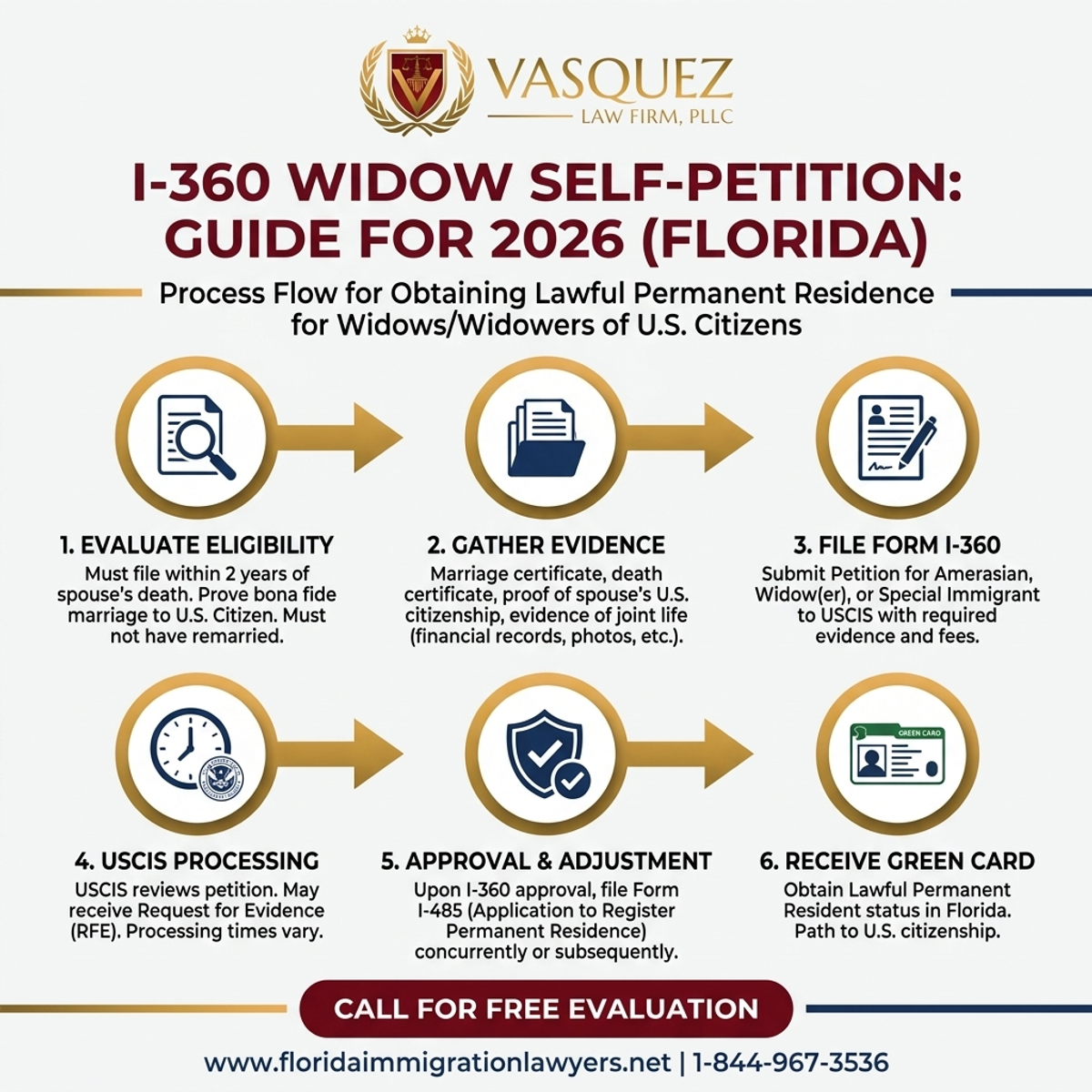
Here is a step-by-step guide to filing your I-360 self-petition:
-
Determine Eligibility: Before anything else, confirm you meet all the criteria mentioned above: U.S. citizen spouse, death within the last two years, no remarriage, and a good faith marriage. This initial assessment is crucial. If your spouse passed away more than two years ago, you may have limited options unless an I-130 was filed prior to their death.
-
Gather Required Documents: Collect all supporting evidence, including your marriage certificate, your spouse's death certificate, proof of your spouse's U.S. citizenship (e.g., birth certificate, naturalization certificate), and extensive evidence of a bona fide marriage (joint bank accounts, property deeds, photos, affidavits from friends/family, utility bills in both names, children's birth certificates). Also include your birth certificate and passport copies. The more comprehensive and compelling your evidence, the stronger your petition will be.
-
Complete Form I-360: Fill out Form I-360, Petition for Amerasian, Widow(er), or Special Immigrant, accurately and completely. Ensure all sections are addressed and signed. Any omissions or errors can lead to Requests for Evidence (RFEs) or even denial. Pay close attention to the section specifically for widows/widowers.
-
Prepare the Filing Package: Organize your completed Form I-360, all supporting documents, and the appropriate USCIS filing fee. Make copies of everything for your records. It's often helpful to create an index or cover letter to list all included documents, which assists USCIS in processing your application efficiently. For current filing fees, always check the official USCIS website.
-
Mail Your Petition: Send your complete package to the correct USCIS lockbox facility. The specific address depends on the type of application and your mailing service. Always use a trackable mailing method. For residents of Florida, petitions are typically sent to the USCIS Chicago Lockbox, but this can change, so verify on the USCIS website.
Step-by-Step Process — I-360 Widow Self-Petition in Florida: Guide for 2026
-
Receive Receipt Notice: USCIS will send you Form I-797C, Notice of Action, confirming receipt of your petition. This notice will include your receipt number, which you can use to track the status of your case online. Keep this notice safe.
-
Attend Biometrics Appointment: You will receive an appointment notice for biometrics (fingerprints, photos, signature) at a local Application Support Center (ASC). For Florida residents, these centers are located in cities like Miami, Orlando, Tampa, and Jacksonville. This step is mandatory for background checks.
-
Respond to RFEs (if any): If USCIS needs more information or clarification, they will send a Request for Evidence (RFE). Respond promptly and thoroughly by the deadline provided. Failure to do so can lead to denial.
-
Interview (if required): While many I-360 petitions for widows are approved without an interview, USCIS may still call you for one. If an interview is scheduled, it will likely be at a Florida USCIS field office, such as the Miami Field Office or Orlando Field Office. Be prepared to answer questions about your marriage and provide further evidence if requested. An attorney can prepare you for this interview or even attend with you.
-
Decision: Upon review, USCIS will issue a decision. If approved, you may then be able to file Form I-485, Application to Register Permanent Residence or Adjust Status, if you are in the U.S., or proceed with consular processing if you are abroad.
What Documents Are Required for the I-360 Widow Petition? (Document Checklist)
A successful I-360 widow self-petition hinges on submitting a robust and comprehensive set of documents. These documents serve to prove your eligibility, the validity of your marriage, and your deceased spouse's U.S. citizenship. Failing to provide adequate evidence is one of the most common reasons for delays or denials. It is critical to provide original documents or certified copies where specified, and translations for any documents not in English.
Here is a detailed document checklist for your I-360 petition:
- Form I-360: Completed and signed petition.
- Proof of U.S. Citizenship of Deceased Spouse: Copy of birth certificate, naturalization certificate, U.S. passport, or Form FS-240 (Report of Birth Abroad of a U.S. Citizen).
- Proof of Marriage: Your official marriage certificate.
- Proof of Spouse's Death: Certified copy of the death certificate.
- Proof of Petitioner's Identity and Nationality: Copy of your birth certificate, passport, or national identity card.
- Proof of Good Faith Marriage (Bona Fide Marriage Evidence): This is arguably the most crucial category and requires extensive documentation. The goal is to demonstrate that you entered the marriage with a genuine intent to establish a life together, not just for immigration benefits. Examples include:
- Joint bank account statements, credit card statements, or loan documents.
- Joint property deeds, mortgage documents, or lease agreements.
- Utility bills, phone bills, or insurance policies with both names.
- Birth certificates of children born to you and your deceased spouse.
- Affidavits from friends, family, and employers attesting to the bona fides of the marriage.
- Photographs of the couple together over time (wedding, holidays, family events).
- Correspondence (letters, emails, text messages) exchanged between you and your spouse.
- Evidence of joint travel or vacations.
- Life insurance policies, wills, or trusts naming each other as beneficiaries.
- Proof of Not Having Remarried: An affidavit stating you have not remarried, and if applicable, divorce decrees from any prior marriages for both you and your deceased spouse.
- Translations: Certified English translations for any documents originally in another language.
- Passport-Style Photographs: Two recent passport-style photos of yourself.
Gathering these documents can be a daunting task, especially during a period of grief. Our attorneys at Florida Immigration Lawyers understand these challenges and can assist you in organizing your evidence, ensuring that your petition is as strong as possible. We work with clients throughout Florida, from the bustling cities to the quieter communities, providing support tailored to their specific needs.
What is the I-360 Widow Self-Petition Timeline and Processing in 2026?
The processing time for an I-360 widow self-petition can vary significantly based on several factors, including the volume of applications, the complexity of your case, and the specific USCIS service center handling your petition. As of 2026, USCIS aims to process these humanitarian petitions efficiently, but applicants should still prepare for a waiting period. It is important to note that the two-year filing window after your spouse's death is a strict eligibility requirement, not a processing timeline.
Here is a typical timeline for the I-360 widow self-petition process:
| Stage | Typical Timeframe | Notes |
|---|---|---|
| Preparation & Filing | 1-3 Months | Depends on how quickly you gather documents and complete Form I-360. Legal assistance can expedite this. |
| USCIS Receipt Notice (I-797C) | 2-4 Weeks | Issued after USCIS receives your petition package. Contains your case number for tracking. |
| Biometrics Appointment | 4-8 Weeks after Receipt | Scheduled at a local Application Support Center (ASC) in Florida (e.g., Miami, Orlando, Tampa). |
| Initial Review by USCIS | 3-8 Months | USCIS begins reviewing your submitted documents. This timeframe can fluctuate significantly. |
| Request for Evidence (RFE) (if any) | Variable | If issued, you typically have 60-90 days to respond. This pauses your case processing. |
| Interview (if required) | Variable | Not all I-360 widow petitions require an interview. If needed, it will be at a Florida field office. |
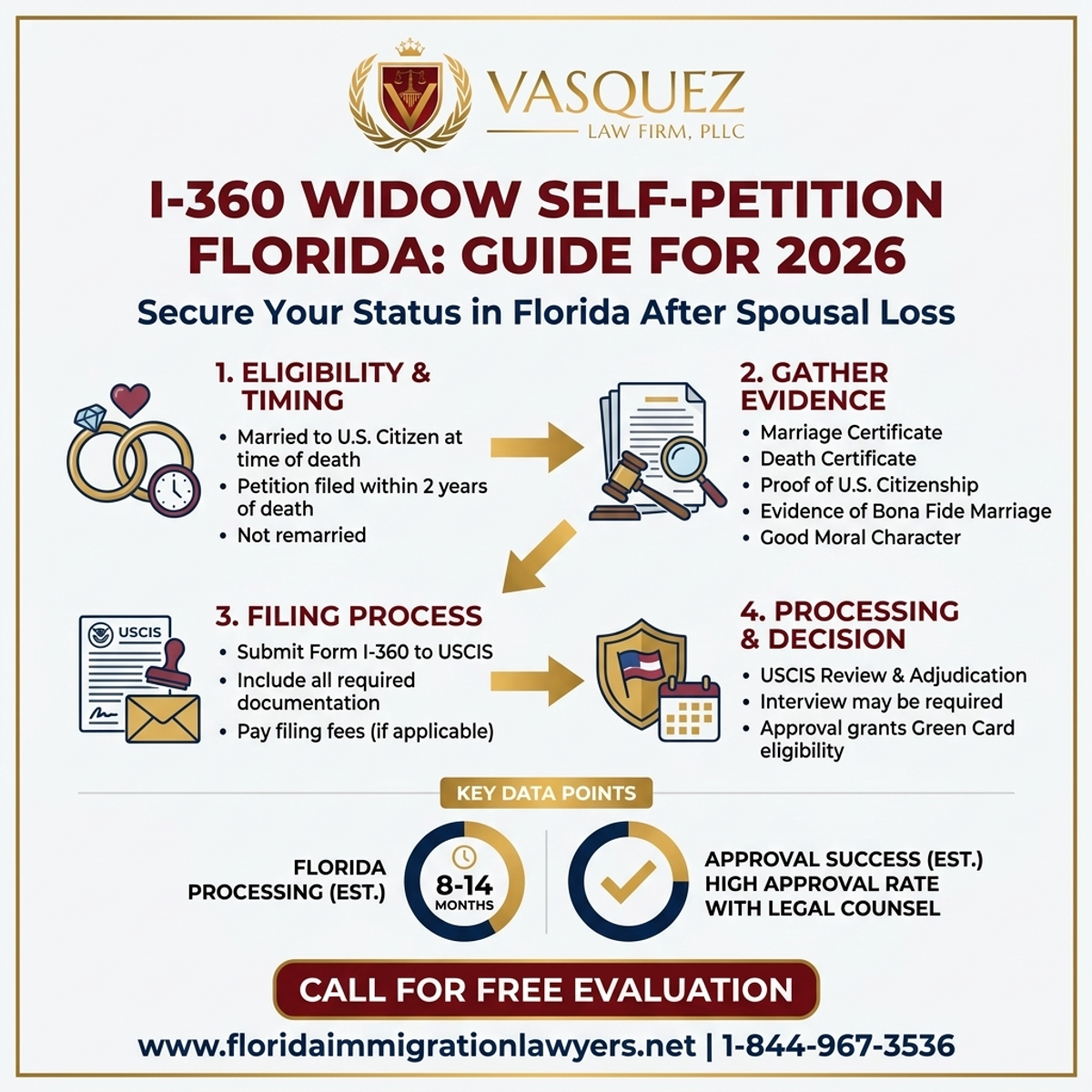
| Decision on I-360 Petition | 8-18 Months (or more) | This is the total time from filing to approval or denial. Check the USCIS online processing times tool for current estimates for your service center. |
| Adjustment of Status (I-485) or Consular Processing | 6-24 Months (additional) | If your I-360 is approved, you then apply for your Green Card. This is a separate process with its own timeline. |
Key Statistics — I-360 Widow Self-Petition in Florida: Guide for 2026
It's crucial to regularly check the USCIS website for updated processing times using your receipt number. The processing times can fluctuate based on national caseloads and policy changes. For Florida residents, understanding these potential delays and preparing meticulously can help manage expectations. An attorney can help you monitor your case status and respond promptly to any USCIS requests, streamlining the process as much as possible.
What Are the Costs and Fees for an I-360 Widow Petition?
The financial aspect of filing an I-360 widow self-petition involves several fees, primarily the USCIS filing fee for Form I-360 and potential legal fees if you choose to hire an attorney. It's important to budget for these costs, as they are mandatory components of the application process. As of 2026, USCIS fees are subject to change, so always verify the most current amounts directly on the official USCIS website before filing. These fees are generally non-refundable, regardless of the outcome of your petition.
Here is a breakdown of typical costs associated with an I-360 widow petition:
| Item | Typical Fee | Notes |
|---|---|---|
| USCIS Form I-360 Filing Fee | Varies (Check USCIS website) | Mandatory fee for filing the petition. USCIS fees can change, so always verify the current amount. |
| Biometrics Fee | Included in I-360 fee (as of 2026) | This fee covers fingerprinting, photos, and signature for background checks. |
| Attorney Legal Fees | Varies by case complexity and firm | Covers assistance with form preparation, document review, RFE responses, and representation. Highly recommended for complex cases. |
| Translation Fees | Varies by document volume | If any supporting documents are not in English, certified translations are required. |
| Document Retrieval Fees | Varies | Costs associated with obtaining certified copies of birth certificates, death certificates, marriage certificates, etc., from government agencies. |
| Postage/Courier Fees | Minor | Cost for sending your petition package to USCIS via trackable mail. |
| Medical Examination Fee (for I-485) | Varies (typically $200-$500) | Required if you adjust status (Form I-485) after I-360 approval. Performed by a USCIS-approved civil surgeon. |
| USCIS Form I-485 Filing Fee (for Adjustment of Status) | Varies (Check USCIS website) | Separate fee for the Green Card application itself, filed after I-360 approval. |
While the USCIS filing fees are standardized, legal fees can vary. Investing in legal representation can often save you money in the long run by preventing costly mistakes, delays, or denials that could require re-filing. Florida Immigration Lawyers offers transparent fee structures and can discuss payment options during your free consultation. We serve clients across Florida, including communities in Hollywood, Miami, and Orlando, providing clear guidance on the financial aspects of your immigration journey.
Navigating Unique Challenges for Widows/Widowers in Florida
Florida's diverse population and unique legal landscape can present specific challenges for individuals pursuing an I-360 widow self-petition. From varying cultural norms regarding death and mourning to the complexities of state-specific probate laws, understanding these local nuances is crucial. Florida is home to a large number of immigrants, and sadly, many face the tragedy of losing a U.S. citizen spouse. These situations often require not only immigration expertise but also an understanding of how state laws might intersect with federal immigration processes.
One common challenge in Florida relates to documentation. For instance, if a spouse passed away in a different state or even another country before the couple moved to Florida, obtaining certified copies of death certificates or marriage records can involve dealing with multiple jurisdictions. Additionally, if the deceased spouse had significant assets, the surviving spouse might be involved in Florida's probate process, which can be time-consuming and emotionally draining. This can delay the collection of joint financial documents needed for the I-360 petition, as these documents might be tied up in estate matters. Our firm often helps clients coordinate with estate attorneys to ensure timely access to necessary records.
Another aspect unique to Florida is its vulnerability to natural disasters. Events like hurricanes can disrupt mail services, close government offices, and cause delays in communication, potentially impacting critical deadlines for filing or responding to RFEs. While USCIS sometimes offers accommodations during declared emergencies, it's not guaranteed, and proactive planning is essential. Furthermore, Florida's large retirement population means that many petitioners may be older, potentially facing health challenges or limited mobility, which can complicate the process of attending appointments or gathering extensive evidence. Our team is equipped to assist clients with these practical considerations, providing support and resources to overcome such hurdles.
Finally, the sheer diversity of Florida's communities, especially in South Florida cities like Hollywood, Miami, and Hialeah, means that petitioners come from a vast array of cultural backgrounds. Some cultures may have specific mourning periods or traditions that could impact the immediate ability to focus on immigration paperwork. Our empathetic attorneys are sensitive to these cultural considerations, offering respectful and understanding guidance. We ensure that clients feel supported not just legally, but also personally, through this challenging time. Engaging with a law firm that understands both federal immigration law and the specific environment of Florida can make a significant difference in the success and ease of your I-360 petition.
Do not navigate the complexities of an I-360 widow self-petition in Florida without expert legal support. The process is intricate, and the stakes are high. Contact Florida Immigration Lawyers today to schedule your free consultation and let our dedicated team guide you through every step. We are here to help you secure your future.
Common Mistakes to Avoid in Your I-360 Widow Self-Petition
Filing an I-360 widow self-petition is a detailed process where even minor errors can lead to significant delays or outright denial. Being aware of common pitfalls can help you avoid them and ensure a smoother application journey. Here are some critical mistakes to watch out for:
-
Missing the Two-Year Filing Deadline: This is perhaps the most critical mistake. You must file Form I-360 within two years of your U.S. citizen spouse's death. If you miss this deadline, you generally lose eligibility unless your spouse filed an I-130 before their death. There are very limited exceptions, making timely filing paramount.
-
Remarrying Before I-360 Approval: If you remarry before your I-360 petition is approved, you will be disqualified. USCIS strictly enforces this rule, as the benefit is specifically for a surviving spouse who has not found a new partner. This can be a heartbreaking consequence for those unaware.
-
Insufficient Evidence of a Bona Fide Marriage: Simply having a marriage certificate is not enough. USCIS requires substantial evidence to prove your marriage was genuine and not entered into solely for immigration purposes. Lack of joint documents, photos, or affidavits can lead to an RFE or denial, forcing you to gather more proof under pressure.
-
Incomplete or Inaccurate Forms: Filling out Form I-360 incorrectly, leaving sections blank, or providing inconsistent information can trigger RFEs or rejection. Each question must be answered truthfully and completely, even if it seems irrelevant. Double-checking every entry is vital.
-
Failure to Translate Documents: Any supporting document not in English must be accompanied by a certified English translation. Forgetting this step will cause USCIS to return your application or issue an RFE, significantly delaying processing.
-
Not Responding to RFEs on Time: If USCIS requests additional evidence, you will have a specific deadline to respond. Failing to submit the requested documents by the due date will likely result in the denial of your petition, often requiring you to start the entire process over.
-
Lack of Proof of Spouse's U.S. Citizenship: You must provide clear, undeniable evidence that your deceased spouse was a U.S. citizen at the time of their death. A copy of a birth certificate, U.S. passport, or naturalization certificate is essential. Without this, your petition will fail.
-
Not Keeping Copies of Everything: Always make and keep copies of your entire petition package, including the forms, all supporting documents, and proof of mailing. This protects you if the original package is lost or if USCIS requests additional information later.
-
Ignoring Legal Advice: Attempting to navigate the complex I-360 process without legal counsel can be a costly mistake. An experienced attorney can identify potential issues, strengthen your evidence, and ensure compliance with all regulations, significantly improving your chances of success.
When to Call a Lawyer for Your I-360 Widow Self-Petition
While the information provided here can guide you, the I-360 widow self-petition process is rarely straightforward, especially when dealing with the emotional toll of loss. Knowing when to seek legal assistance is crucial to safeguarding your immigration future. Florida Immigration Lawyers are here to provide the expert guidance you need, offering compassionate support and strategic advice throughout your journey.
You should strongly consider contacting an attorney if any of the following scenarios apply to your situation:
- Your Spouse Died More Than 22 Months Ago: The two-year filing deadline is rigid. If you are close to or have passed this deadline, immediate legal consultation is imperative to explore any possible, albeit limited, options.
- You Have Limited Documentation: If you struggle to gather comprehensive evidence of a bona fide marriage, or if many documents were solely in your spouse's name, an attorney can help you strategize alternative proofs and affidavits.
- You Have a Complex Marital History: If either you or your deceased spouse had prior marriages, ensuring all divorces were legally finalized and documented can be complicated. An attorney can help verify these details.
- You Received a Request for Evidence (RFE) or Notice of Intent to Deny (NOID): These notices indicate that USCIS has concerns about your petition. Responding effectively requires legal expertise to address the specific issues raised and present compelling counter-evidence.
- You Are Unsure About Your Eligibility: If you have questions about whether you meet all the criteria, especially regarding good faith marriage or your spouse's citizenship, a lawyer can provide a thorough assessment.
- You Feel Overwhelmed or Stressed: Grief can make it incredibly difficult to focus on complex paperwork. An attorney can lift this burden, allowing you to mourn while ensuring your immigration case progresses correctly.
- You Have Any Criminal History: Even minor legal infractions can impact immigration eligibility. An attorney can assess potential inadmissibility issues and advise on waivers if available.
- Your Spouse Had Already Filed an I-130: While this can simplify things, an attorney can ensure the petition is properly converted to an I-360 and that all necessary steps are taken.
Florida Immigration Lawyers has extensive experience with I-360 self-petitions for widows and widowers. We understand the specific nuances of these cases and the emotional challenges our clients face. Our team serves individuals across Florida, from Hollywood to the Keys, offering tailored legal strategies and unwavering support. We are dedicated to helping you navigate the system effectively and secure your future in the U.S.
About Florida Immigration Lawyers
Florida Immigration Lawyers is a leading immigration law firm dedicated to serving individuals and families across the entire state of Florida. With a deep understanding of U.S. immigration laws and a compassionate approach, we provide comprehensive legal services to help our clients achieve their immigration goals. Our experienced attorneys specialize in a wide range of practice areas, including family immigration, asylum, deportation defense, citizenship, and business immigration. We pride ourselves on offering personalized attention, strategic advocacy, and unwavering support to every client.
Our firm is committed to making quality legal representation accessible. We offer free consultations to discuss your case and provide clear, honest advice. Understanding that immigration matters can arise at any time, our team is available 24/7 to provide assistance when you need it most. Whether you are in Miami, Orlando, Tampa, Hollywood, or any other part of Florida, our multilingual staff is ready to assist you. Trust Florida Immigration Lawyers to be your dedicated advocate in navigating the complexities of immigration law. Visit our website at floridaimmigrationlawyers.net or call us today.
Contact us at 1-844-967-3536 for a free consultation.
Sources and References
- U.S. Citizenship and Immigration Services (USCIS)
- Executive Office for Immigration Review (EOIR)
- 8 U.S.C. Chapter 12 - Immigration and Nationality Act (INA), specifically Sections 204(a)(1)(A)(ii) and 204(a)(1)(A)(iv)
- 8 CFR § 204.2(b) - Petitions for widows or widowers
- USCIS Policy Manual, Volume 7, Part D, Chapter 3 - Widows and Widowers
Related services: family petition process, family-based green cards, fiancé visa (K-1), marriage-based immigration.
This article provides general legal information and is not intended as legal advice. Every case is unique, and outcomes depend on specific facts and circumstances. Contact an attorney for advice about your particular situation. Immigration laws are subject to change.
Securing your immigration future after the loss of a U.S. citizen spouse is a profound step. The I-360 widow self-petition offers a path forward, but its intricate requirements demand careful navigation. Do not let uncertainty or the weight of grief prevent you from pursuing your rights. Our compassionate team at Florida Immigration Lawyers is here to provide the expert legal guidance and unwavering support you deserve. We are available 24/7 for a free consultation to discuss your specific situation and help you understand your options.
Call Florida Immigration Lawyers today at 1-844-967-3536. Se Habla Espanol - Estamos aqui para ayudarle.
If you need legal assistance, learn more about family immigration consultation, or call us at 1-844-967-3536 for a free consultation.
Do Not Navigate This Process Alone
Our experienced immigration attorneys are ready to fight for you. Get a free, confidential consultation today.
Se Habla Español
Frequently Asked Questions
Harold Estrada-Rodriguez
Florida Immigration Attorney · FL Bar No. 1041171
Florida Bar attorney handling Florida-jurisdiction immigration matters. Bilingual representation, free consultations.
Available 24/7 - Free Evaluations
Related Legal Services
Our Florida immigration attorneys can help you with deportation defense, citizenship and naturalization and family immigration services. Call today at 1-844-967-3536 for a free consultation.
Related Links
Related Topics
Free Legal Consultation
Discuss your case with our experienced attorneys. We're available 24/7.
Se Habla Español - Estamos aquí para ayudarle.
Related Articles
NIW National Interest Waiver for Florida Professionals
Discover how the NIW can benefit Florida professionals seeking U.S. residency without employer sponsorship. Learn about the application process, costs, and common mistakes to avoid. Contact Florida Immigration Lawyers for expert guidance.
OPT STEM Extension: Florida Graduates' 2026 Guide | VLF Florida
For F-1 international students graduating from Florida universities with STEM degrees, the OPT STEM extension offers a critical 24-month work authorization beyond their initial OPT. This comprehensive guide for 2026 details eligibility, a step-by-step application process involving USCIS and E-Verify employers, essential document checklists, and typical processing timelines. We also highlight common mistakes to avoid and explain when seeking professional legal assistance from Florida Immigration Lawyers can be invaluable. Secure your future career in Florida by understanding these vital immigration regulations and deadlines.
Immigration Lawyer Cape Coral: Your SW Florida Legal Guide
Navigating immigration law in Cape Coral, Fort Myers, or Southwest Florida demands expert legal guidance. Florida Immigration Lawyers offers comprehensive services for visas, green cards, citizenship, and deportation defense, ensuring your case is handled with precision and care. From understanding complex forms to representing you in court, our dedicated team simplifies the process. We provide tailored strategies for family and employment-based immigration, offering crucial support through evolving laws. Don't risk delays or denials; partner with a trusted immigration lawyer in Lee County. Contact us for a free consultation and secure your future in Florida.
K-3 Spouse Visa Timeline in Florida 2026 | VLF Florida
Navigating the K-3 spouse visa process in Florida can be complex. Learn about the timeline, costs, and common mistakes to avoid. Contact Florida Immigration Lawyers for expert guidance.