NIW National Interest Waiver for Florida Professionals
Discover how the NIW can benefit Florida professionals seeking U.S. residency without employer sponsorship. Learn about the application process, costs, and common mistakes to avoid. Contact Florida Immigration Lawyers for expert guidance.

NIW National Interest Waiver for Florida Professionals
For highly skilled professionals in Florida seeking a direct path to permanent residency without the need for a sponsoring employer, the National Interest Waiver (NIW) presents a unique and powerful opportunity. This specialized subcategory of the EB-2 employment-based green card allows individuals to self-petition, bypassing the often lengthy and complex PERM labor certification process. If your work holds substantial merit and national importance to the United States, and you are well-positioned to advance that endeavor, the NIW could be your gateway to a future in Florida and beyond. Understanding the nuances of this waiver is crucial, and that's where experienced legal guidance becomes invaluable. Our firm specializes in immigration law, helping professionals like you navigate these complex pathways.
Understanding the National Interest Waiver (NIW)
What is the NIW?
The National Interest Waiver (NIW) is a provision within the EB-2 (Employment-Based, Second Preference) immigrant visa category. Unlike most EB-2 petitions, which require a job offer and a PERM labor certification from a U.S. employer, the NIW allows individuals to petition for themselves. The core premise is that the applicant's work is so beneficial to the United States that it warrants waiving the standard job offer and labor certification requirements. This makes it an attractive option for researchers, scientists, entrepreneurs, artists, and other professionals whose contributions are deemed to be in the national interest of the U.S.
Key Benefits of the NIW
- Self-Petitioning: One of the most significant advantages is the ability to self-petition, eliminating the need for an employer sponsor. This provides greater control over your immigration process and career path.
- No Job Offer Required: You do not need a specific job offer from a U.S. employer to qualify for the NIW, as long as your proposed endeavor meets the national interest criteria.
- Bypasses PERM Labor Certification: The PERM process can be time-consuming and costly, requiring employers to demonstrate that no qualified U.S. workers are available for the position. The NIW waives this requirement entirely.
- Flexibility: The NIW offers greater flexibility in employment, allowing you to pursue your work independently or transition between roles that align with your approved national interest endeavor.
- Faster Processing for Some: While processing times vary, for individuals from countries where EB-2 visas are current, the NIW can offer a relatively quicker path to a green card compared to other employment-based categories.
- Concurrent Filing: In many cases, eligible applicants can file their I-140 (Immigrant Petition for Alien Worker) and I-485 (Application to Register Permanent Residence or Adjust Status) concurrently, further streamlining the process.
Eligibility Criteria for the NIW: The Dhanasar Test
To qualify for an NIW, applicants must first meet the general requirements for an EB-2 visa, which typically includes holding an advanced degree (Master's or higher, or a Bachelor's degree plus five years of progressive experience in the field) or demonstrating exceptional ability in their field. Beyond this, the U.S. Citizenship and Immigration Services (USCIS) applies a three-prong test established in the precedent case, Matter of Dhanasar, to determine if the national interest waiver is warranted.
Prong 1: Substantial Merit and National Importance
The applicant must demonstrate that their proposed endeavor has both substantial merit and national importance. This is not limited to specific fields like science or technology; endeavors in business, entrepreneurship, arts, sports, and education can also qualify. The key is to show that the work is significant and has a broad impact. For Florida professionals, this could mean:
- Developing innovative solutions for environmental challenges affecting Florida's unique ecosystems.
- Pioneering medical research that benefits public health across the nation.
- Creating jobs and fostering economic growth through a new business venture with national implications.
- Contributing to advancements in aerospace, marine science, or agricultural technology, all prominent sectors in Florida.
Evidence for this prong often includes detailed descriptions of the endeavor, letters from experts in the field, publications, patents, and evidence of significant achievements.
Prong 2: Well-Positioned to Advance the Proposed Endeavor
The applicant must prove they are well-positioned to successfully advance their proposed endeavor. USCIS considers several factors, including:
- The applicant's education, skills, knowledge, and track record of success in similar or related endeavors.
- A detailed plan for how they intend to advance the proposed endeavor.
- The progress already made towards the endeavor.
- The interest of potential customers, users, investors, or other relevant entities or individuals.
Simply having an advanced degree is not enough; you must show concrete evidence of your capacity to execute your plans. This might include business plans, research proposals, contracts, testimonials, and evidence of prior accomplishments that demonstrate your unique qualifications.
Prong 3: National Interest Justifies Waiving PERM
Finally, the applicant must demonstrate that, on balance, it would be beneficial to the United States to waive the requirements of a job offer and labor certification. This prong involves a balancing test, where USCIS evaluates whether the national interest in the applicant's contributions outweighs the government's interest in protecting U.S. workers through the PERM process. Considerations include:
- Whether the national interest would be adversely affected if a labor certification were required.
- The urgency and importance of the endeavor.
- The unique skills and abilities of the applicant that make them particularly well-suited to the endeavor, beyond what a U.S. worker might offer through the PERM process.
This prong often requires a compelling argument that the benefits of your work are so significant and unique that the standard hiring process would be detrimental to the national interest by delaying or preventing your contributions.
The NIW Application Process for Florida Professionals
Step-by-Step Guide
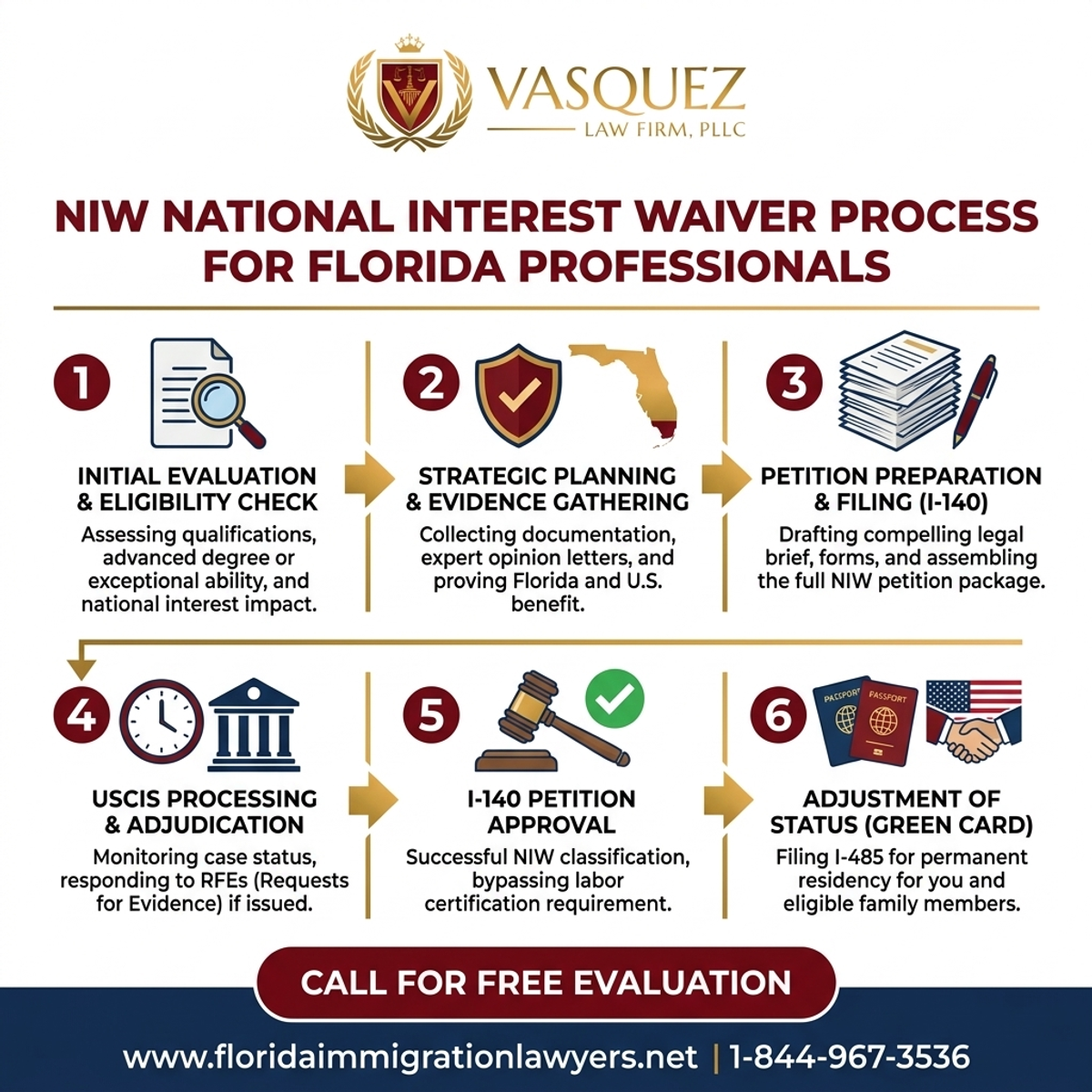
The NIW application process involves several critical stages, each requiring meticulous attention to detail and strategic planning. While the general steps are outlined below, working with an experienced immigration attorney is highly recommended to navigate the complexities.
- Gathering Evidence and Documentation: This is the foundational step. You'll need to compile comprehensive evidence supporting your claims under the Dhanasar test. This includes academic records, professional licenses, letters of recommendation from experts, publications, citations, awards, media mentions, business plans, and any other documentation that proves your qualifications and the national importance of your endeavor.
- Filing Form I-140, Immigrant Petition for Alien Worker: Once your evidence is assembled, your attorney will prepare and file Form I-140 with USCIS, along with all supporting documentation and the required filing fee. This petition is where you present your case for the NIW.
- Responding to Requests for Evidence (RFE): It is common for USCIS to issue an RFE if they require additional information or clarification on your petition. A timely and thorough response is crucial for the success of your application.
- I-140 Approval: If USCIS finds your petition meritorious, your I-140 will be approved. This signifies that you meet the NIW criteria.
- Filing Form I-485, Application to Register Permanent Residence or Adjust Status (or Consular Processing): If you are physically present in the U.S. and an immigrant visa is immediately available (based on your country of origin and current visa bulletin), you can file Form I-485 to adjust your status to a lawful permanent resident. Alternatively, if you are outside the U.S. or prefer to complete the process abroad, you will undergo consular processing at a U.S. embassy or consulate in your home country.
- Biometrics Appointment: For I-485 applicants, USCIS will schedule a biometrics appointment to collect fingerprints, photos, and signatures.
- Interview (if required): While not all I-485 applicants are interviewed, USCIS may schedule one to review your application and supporting documents.
- Green Card Approval: Upon successful completion of all steps, you will be granted lawful permanent resident status, and your green card will be mailed to you.
Required Documentation and Evidence
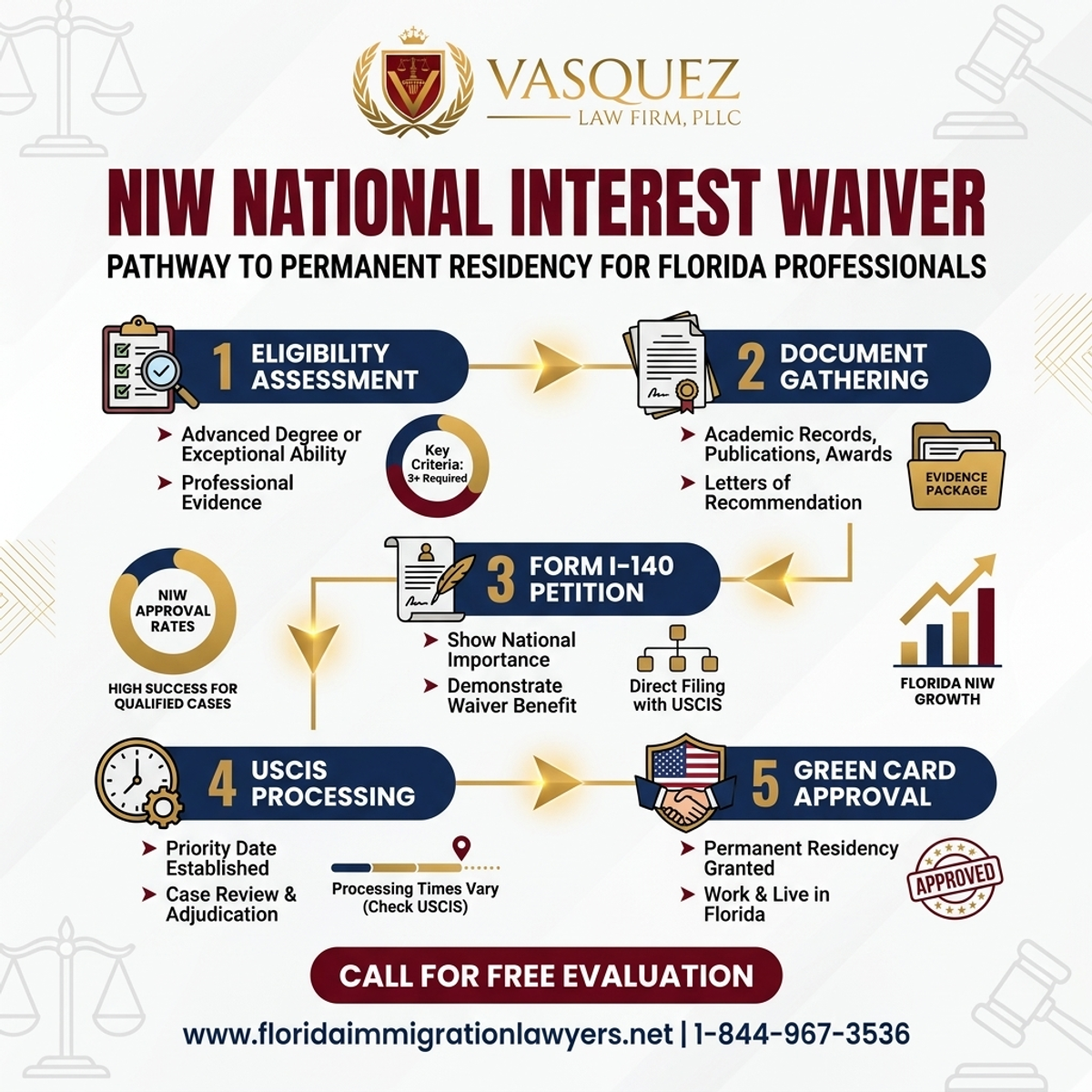
The strength of your NIW petition hinges on the quality and quantity of your supporting documentation. While specific requirements vary, common types of evidence include:
Step-by-Step Process — NIW National Interest Waiver for Florida Professionals
- Academic Credentials: Diplomas, transcripts, and professional licenses demonstrating your advanced degree or exceptional ability.
- Letters of Recommendation: From independent experts in your field, detailing your unique contributions, the national importance of your work, and your capacity to advance it. These should ideally come from individuals who have not directly supervised you.
- Publications and Citations: Articles in peer-reviewed journals, conference papers, books, and evidence of citations by others in your field.
- Awards and Recognition: National or international awards, grants, or other forms of recognition for your achievements.
- Media Coverage: Articles or features about your work in reputable media outlets.
- Patents or Copyrights: Evidence of intellectual property you have developed.
- Evidence of National Impact: Contracts, grants, funding, or testimonials demonstrating the widespread application or benefit of your work.
- Detailed Project Plan: A comprehensive description of your proposed endeavor, including objectives, methodologies, timelines, and expected national impact.
- Curriculum Vitae (CV) / Resume: A detailed professional history highlighting your accomplishments.
Advanced Strategies for Strengthening Your NIW Petition
Successfully navigating the NIW requires more than just meeting the basic criteria; it demands a strategic approach to present your case in the most compelling light. Many applicants possess the qualifications but struggle to articulate their national interest impact effectively. Here are advanced strategies to bolster your NIW petition and increase your chances of approval, particularly for professionals in dynamic fields within Florida.
Crafting a Compelling Proposed Endeavor
Your proposed endeavor is the cornerstone of your NIW petition. It must be clearly defined, forward-looking, and demonstrably beneficial to the U.S. national interest. Instead of merely stating your profession, articulate a specific project, research area, or business initiative that you plan to undertake. For instance, a software engineer might not just say they 'develop apps,' but rather 'develop AI-driven solutions to enhance cybersecurity for critical infrastructure in the U.S., thereby protecting national assets.' Focus on:
- Specificity: What exactly will you do?
- Impact: How will this endeavor benefit the U.S. nationally? Consider economic, health, environmental, educational, or cultural benefits.
- Feasibility: Demonstrate a realistic plan for how you will achieve your goals, including resources, timelines, and potential partnerships.
- Uniqueness: Highlight what makes your approach or contribution distinct and particularly valuable.
A well-articulated endeavor not only satisfies Prong 1 but also provides a strong foundation for demonstrating your position to advance it (Prong 2).
Securing Powerful Letters of Recommendation
Letters of recommendation (LORs) are critical third-party endorsements that can make or break your petition. Go beyond mere character references. Seek LORs from:
- Independent Experts: Individuals who are highly regarded in your field but have no direct supervisory or familial relationship with you. Their unbiased opinion carries significant weight.
- Individuals with National Recognition: Professors at top universities, leaders in national organizations, or government officials who can speak to the national importance of your work.
- Those Who Can Detail Impact: LORs should specifically address your unique skills, the substantial merit of your endeavor, its national importance, and why you are uniquely positioned to advance it. They should provide concrete examples of your contributions and their impact.
Guide your recommenders on what specific points to cover, providing them with a draft of your proposed endeavor and a summary of your key accomplishments. The quality and depth of these letters are far more important than the sheer number.
Leveraging Expert Opinions and Publications
Beyond LORs, consider including expert opinion letters from individuals who can provide an objective assessment of your field and the significance of your contributions within it. These can be academics, researchers, or industry leaders who can contextualize your work for USCIS. Furthermore, if you have published in reputable journals, ensure you provide evidence of citations by other researchers. This demonstrates that your work is recognized and utilized by your peers, underscoring its impact and importance. Even if your field isn't traditionally academic, evidence of presentations at national conferences, industry awards, or significant media coverage can serve a similar purpose.
Addressing Potential RFEs and Common Pitfalls
Anticipating and proactively addressing potential Requests for Evidence (RFEs) is a hallmark of a strong NIW strategy. Common RFE triggers include:
- Insufficient Evidence for National Importance: Not clearly demonstrating how your work benefits the U.S. broadly.
- Weak Link to Proposed Endeavor: Failing to show how your past achievements directly prepare you to advance your future plans.
- Lack of Independence in LORs: Relying too heavily on letters from supervisors or colleagues who are not independent experts.
- Insufficient Evidence of Exceptional Ability/Advanced Degree: Not meeting the basic EB-2 requirements.
A thorough initial petition, meticulously cross-referencing evidence with each prong of the Dhanasar test, can significantly reduce the likelihood of an RFE. If an RFE is issued, a prompt, comprehensive, and well-organized response, often with additional supporting documentation, is essential. This is where the expertise of a seasoned immigration defense attorney can be critical, as they understand USCIS's expectations and how to best present your case to overcome objections. For any complex immigration matter, including asylum cases, having a dedicated legal team is paramount.
Why Choose Experienced Florida Immigration Lawyers
Navigating the complexities of the National Interest Waiver requires a deep understanding of immigration law, meticulous attention to detail, and strategic case presentation. Our team of dedicated Florida Immigration Lawyers possesses extensive experience in successfully preparing and filing NIW petitions for professionals across various fields. We understand the unique challenges and opportunities that arise for individuals seeking to contribute their talents to the U.S. from Florida.
We provide personalized guidance through every step of the process, from assessing your eligibility and strategizing your petition to compiling robust evidence and responding to USCIS inquiries. Our commitment is to maximize your chances of approval, allowing you to focus on your groundbreaking work. We pride ourselves on our client-centered approach, ensuring clear communication and transparent processes. Let us put our expertise to work for you.
Key Statistics — NIW National Interest Waiver for Florida Professionals
Frequently Asked Questions (FAQ)
...
Take the Next Step: Contact Us Today
If you are a talented professional in Florida with an endeavor that holds national importance, the NIW could be your clearest path to permanent residency. Don't leave your future to chance. Contact Florida Immigration Lawyers today for a free consultation. Our experienced team is ready to assess your eligibility, answer your questions, and guide you through every stage of the National Interest Waiver process. Let us help you secure your future in the United States.
Sources and References
- U.S. Citizenship and Immigration Services (USCIS)
- Executive Office for Immigration Review (EOIR)
- U.S. Department of State - Bureau of Consular Affairs
- Immigration and Nationality Act (INA), 8 U.S.C. Chapter 12
Do Not Navigate This Process Alone
Our experienced immigration attorneys are ready to fight for you. Get a free, confidential consultation today.
Se Habla Español
Frequently Asked Questions
Harold Estrada-Rodriguez
Florida Immigration Attorney · FL Bar No. 1041171
Florida Bar attorney handling Florida-jurisdiction immigration matters. Bilingual representation, free consultations.
Available 24/7 - Free Evaluations
Related Legal Services
Our Florida immigration attorneys can help you with family immigration services, immigration practice areas and free immigration consultation. Call today at 1-844-967-3536 for a free consultation.
Related Links
Related Topics
Free Legal Consultation
Discuss your case with our experienced attorneys. We're available 24/7.
Se Habla Español - Estamos aquí para ayudarle.
Related Articles
I-360 Widow Self-Petition in Florida: Guide for 2026
For non-citizen spouses of deceased U.S. citizens in Florida, the I-360 widow self-petition offers a critical pathway to permanent residency. This detailed 2026 guide from Florida Immigration Lawyers explains eligibility, step-by-step filing, required documentation, typical processing timelines, and associated costs. We cover essential criteria such as the two-year filing deadline, the necessity of proving a good faith marriage, and the importance of not remarrying before petition approval. Additionally, we highlight common mistakes to avoid and specific scenarios where legal counsel is invaluable, particularly within Florida's unique demographic and legal environment. Our goal is to provide clear, actionable information to help surviving spouses navigate this complex process during a difficult time. Contact Florida Immigration Lawyers for a free consultation and personalized support.
OPT STEM Extension: Florida Graduates' 2026 Guide | VLF Florida
For F-1 international students graduating from Florida universities with STEM degrees, the OPT STEM extension offers a critical 24-month work authorization beyond their initial OPT. This comprehensive guide for 2026 details eligibility, a step-by-step application process involving USCIS and E-Verify employers, essential document checklists, and typical processing timelines. We also highlight common mistakes to avoid and explain when seeking professional legal assistance from Florida Immigration Lawyers can be invaluable. Secure your future career in Florida by understanding these vital immigration regulations and deadlines.
Immigration Lawyer Cape Coral: Your SW Florida Legal Guide
Navigating immigration law in Cape Coral, Fort Myers, or Southwest Florida demands expert legal guidance. Florida Immigration Lawyers offers comprehensive services for visas, green cards, citizenship, and deportation defense, ensuring your case is handled with precision and care. From understanding complex forms to representing you in court, our dedicated team simplifies the process. We provide tailored strategies for family and employment-based immigration, offering crucial support through evolving laws. Don't risk delays or denials; partner with a trusted immigration lawyer in Lee County. Contact us for a free consultation and secure your future in Florida.
K-3 Spouse Visa Timeline in Florida 2026 | VLF Florida
Navigating the K-3 spouse visa process in Florida can be complex. Learn about the timeline, costs, and common mistakes to avoid. Contact Florida Immigration Lawyers for expert guidance.