K-3 Spouse Visa Timeline in Florida 2026
Navigating the K-3 spouse visa process in Florida can be complex. Learn about the timeline, costs, and common mistakes to avoid. Contact Florida Immigration Lawyers for guidance.
The K-3 spouse visa allows nonimmigrant spouses of U.S. citizens to enter the United States while awaiting the processing of their immigrant visa. This visa is particularly relevant for couples residing in Florida, including areas like Tallahassee. Key points include:
- Designed to shorten the physical separation between spouses.
- Involves filing the Form I-129F.
- Subject to specific processing times and requirements.
- Consulting an immigration lawyer can help navigate complexities.
Introduction
If you're a U.S. citizen living in Tallahassee, Florida, and married to a foreign national, you might be considering the K-3 spouse visa to bring your partner to the United States. This visa provides a temporary solution, allowing your spouse to stay in the U.S. while the immigrant visa application is processed. In this blog, we'll explore the K-3 visa timeline, steps involved, and common pitfalls to avoid. For personalized assistance, call Florida Immigration Lawyers at 1-844-YO-PELEO for a free consultation.
The emotional toll of being separated from a loved one, especially a spouse, can be immense. The K-3 visa serves as a crucial bridge, allowing families to reunite sooner rather than enduring lengthy waits for traditional immigrant visas. For couples in Tallahassee and across Florida, navigating the nuances of U.S. immigration law can be particularly challenging due to varying local regulations and specific consular requirements. This article aims to demystify the K-3 process, offering clarity and practical advice to help you bring your spouse home.
Remember, while this guide provides valuable information, the complexities of immigration law often require assistance. Florida Immigration Lawyers are here to provide tailored guidance, ensuring your application is robust and compliant with all current regulations. Our goal is to help you achieve family reunification with confidence and efficiency.
What is the K-3 Visa?
The K-3 visa is a nonimmigrant visa for spouses of U.S. citizens. It allows them to enter the U.S. and reside temporarily while waiting for their immigrant visa. As of 2026, the K-3 visa remains a viable option for many couples.
The main purpose of the K-3 visa is to reduce the time spouses are separated. It is initiated through the filing of the Form I-129F, Petition for Alien Fiancé(e), a process that can be complex and time-consuming.
The K-3 visa was specifically created by the Legal Immigration Family Equity (LIFE) Act of 2000 to address the significant delays U.S. citizens faced when trying to bring their foreign spouses to the United States. Before the K-3, spouses often had to wait outside the U.S. for many months, or even years, while their immigrant visa petitions (Form I-130) were processed. This visa was designed to shorten that physical separation, allowing the foreign spouse to enter the U.S. as a nonimmigrant and reside here while their permanent residency application progresses. This means your spouse can be with you in Florida, rather than waiting abroad.
While the K-3 visa is a nonimmigrant visa, its ultimate goal is typically to facilitate the spouse's adjustment of status to a lawful permanent resident (Green Card holder) once their I-130 petition is approved. It provides a pathway for families to live together during what can often be a protracted administrative process. Understanding that the K-3 is a temporary solution that leads to a more permanent status is key. It's not an immigrant visa itself, but a transitional one. For residents of Florida, including the capital city of Tallahassee, utilizing this visa can significantly impact family unity and well-being. Our team at Florida Immigration Lawyers understands the urgency of family reunification and can help you determine if the K-3 visa is the right path for your specific circumstances.
How to Apply for a K-3 Visa in Florida?
Applying for a K-3 visa involves several steps designed to confirm the legitimacy of the marriage and the need for the visa. It’s a multi-stage process that requires careful attention to detail and timely submissions. Below is a step-by-step guide, with additional insights to help you navigate the journey:
- File Form I-130: Petition for Alien Relative. The U.S. citizen spouse must file Form I-130, Petition for Alien Relative, with the USCIS. This initial petition establishes the bona fide marital relationship between the U.S. citizen and the foreign national. It is the foundational document for any family-based immigration process and must be approved before your spouse can apply for permanent residency. For Florida residents, ensuring this petition is meticulously prepared is the first critical step towards reunification.
- File Form I-129F: Petition for Alien Fiancé(e). Crucially, after filing the I-130, the U.S. citizen must submit Form I-129F, Petition for Alien Fiancé(e). Although titled for fiancés, this form is also used for K-3 spouses. It specifically requests a nonimmigrant visa for the spouse, signaling your intent to bring them to the U.S. while the I-130 processes. Failing to file this form or filing it incorrectly is a common pitfall that can negate the K-3's purpose.
- Wait for Approval and NVC Processing. Once the I-129F is approved by USCIS, it is forwarded to the National Visa Center (NVC). The NVC then creates a case file and sends the approved petition to the U.S. Embassy or Consulate in the foreign spouse's country of residence. During this stage, the NVC will often provide instructions for the foreign spouse to begin gathering civil documents and completing the DS-160 (Online Nonimmigrant Visa Application) form. This period requires patience, but proactive preparation of documents can save time later.
- Consular Processing and Interview. The foreign spouse will attend an interview at the U.S. Embassy or Consulate. This interview is a critical step where a consular officer will verify the legitimacy of the marriage and the foreign spouse's eligibility for the K-3 visa. They must be prepared with all necessary original documents, including the marriage certificate, birth certificates, police certificates, medical examination results, and evidence of a bona fide relationship. Honesty and consistency in answers are paramount.
- Entry to the U.S. and Adjustment of Status. Upon successful visa issuance, the spouse can enter the U.S. with their K-3 visa. Once in the U.S., they are eligible to apply for work authorization (Employment Authorization Document or EAD) and travel authorization (Advance Parole). Concurrently, they will need to file Form I-485, Application to Register Permanent Residence or Adjust Status, to transition from K-3 nonimmigrant status to lawful permanent resident status. This final step is contingent on the prior approval of the I-130 petition.
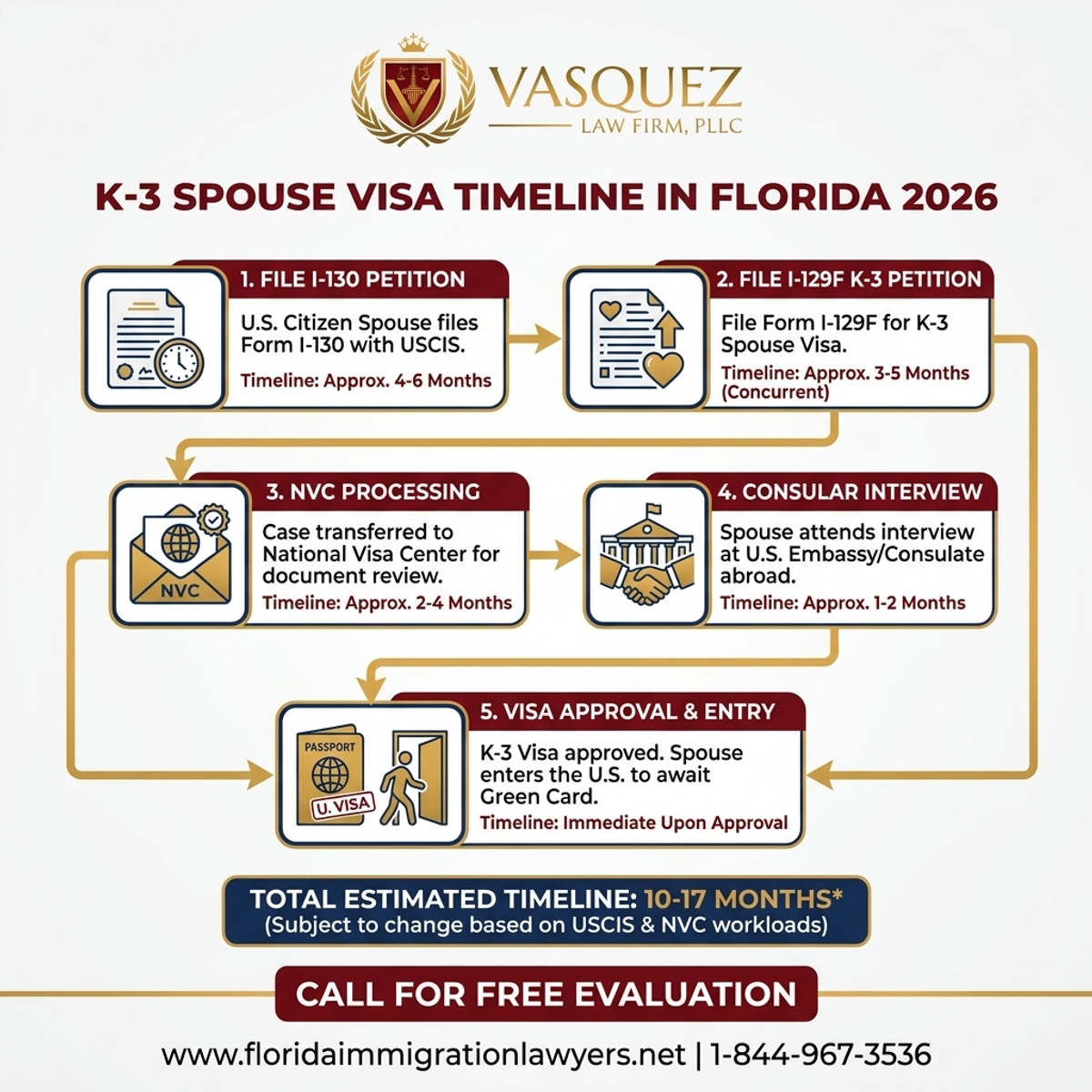
Step-by-Step Process — K-3 Spouse Visa Timeline in Florida 2026
Each step involves specific documentation and fees, which can vary, so consulting with an immigration expert is advisable. For couples in Florida, understanding these local and national requirements is essential. Florida Immigration Lawyers are well-versed in the complexities of K-3 visa applications and can provide comprehensive support from initial filing to adjustment of status, ensuring all details are handled correctly and efficiently.
Document Checklist for K-3 Visa
Proper documentation is key to a smooth K-3 visa application process. Any missing or incorrect document can lead to significant delays, including Requests for Evidence (RFEs) from USCIS or even visa denial. Here is an expanded checklist of essential documents, along with important considerations for each:
- **Completed Form I-129F:** This is the core petition for the K-3 visa. Ensure all sections are filled out accurately and completely, as any omissions can cause processing setbacks.
- **Proof of Marriage (Marriage Certificate):** A legally valid marriage certificate issued by the appropriate civil authority is mandatory. It must be an original or certified copy, and if not in English, it must be accompanied by a certified translation.
- **Proof of U.S. Citizenship (Passport or Birth Certificate):** The U.S. citizen petitioner must provide clear evidence of their citizenship, typically a copy of their valid U.S. passport, birth certificate, or naturalization certificate.
- **Evidence of Relationship (Photos, Correspondence):** To prove the marriage is bona fide and not solely for immigration purposes, submit compelling evidence. This can include shared photos (wedding, family events), joint bank accounts, property deeds, lease agreements, utility bills, insurance policies, and extensive communication records (emails, chat logs, call records). The more evidence you provide, the stronger your case.
- **Form DS-160 Confirmation Page:** The foreign spouse must complete the Online Nonimmigrant Visa Application (Form DS-160) and bring the confirmation page to their consular interview.
- **Medical Examination Results:** A medical examination must be conducted by an authorized panel physician in the foreign spouse's country of residence. This ensures the applicant meets health-related admissibility standards. Do not open the sealed envelope containing the results.
- **Financial Support Evidence (Form I-134, Affidavit of Support):** The U.S. citizen petitioner must demonstrate their ability to financially support their spouse, ensuring they will not become a public charge. Form I-134, Affidavit of Support, along with supporting financial documents like tax returns, pay stubs, and employment letters, is required.
Ensure all documents are current and accurate to avoid delays in processing. It's highly recommended to make multiple copies of all submitted documents and keep them organized. If any document is not in English, it must be accompanied by a certified English translation. Consulting with Florida Immigration Lawyers can help ensure your documentation is comprehensive and correctly prepared, minimizing the risk of RFEs or denials.
K-3 Visa Timeline and Processing Expectations
Understanding the timeline for obtaining a K-3 visa can help manage expectations and plan accordingly. While the K-3 was designed to be faster than waiting for an immigrant visa, actual processing times can fluctuate significantly due to various factors, including USCIS workload, consular office backlogs, and the complexity of individual cases. As of 2026, here is what applicants can typically expect, along with insights into potential variations:
| Stage | Typical Timeframe | Notes |
|---|---|---|
| Form I-130 Processing | 6-12 months | Initial step; must be filed first. This timeframe can be longer or shorter depending on the service center and current caseloads. |
| Form I-129F Processing | 3-6 months | Filing after I-130; shorter if expedited. The K-3's purpose is to allow entry while the I-130 is still pending, so its processing is often prioritized. |
| NVC Processing | 1-2 months | After USCIS approval. This stage involves administrative processing, document collection, and scheduling the consular interview. |
| Consular Interview | 1-2 months | Depends on consulate availability. Interview wait times vary greatly by country and embassy. Some may have immediate availability, while others have significant backlogs. |
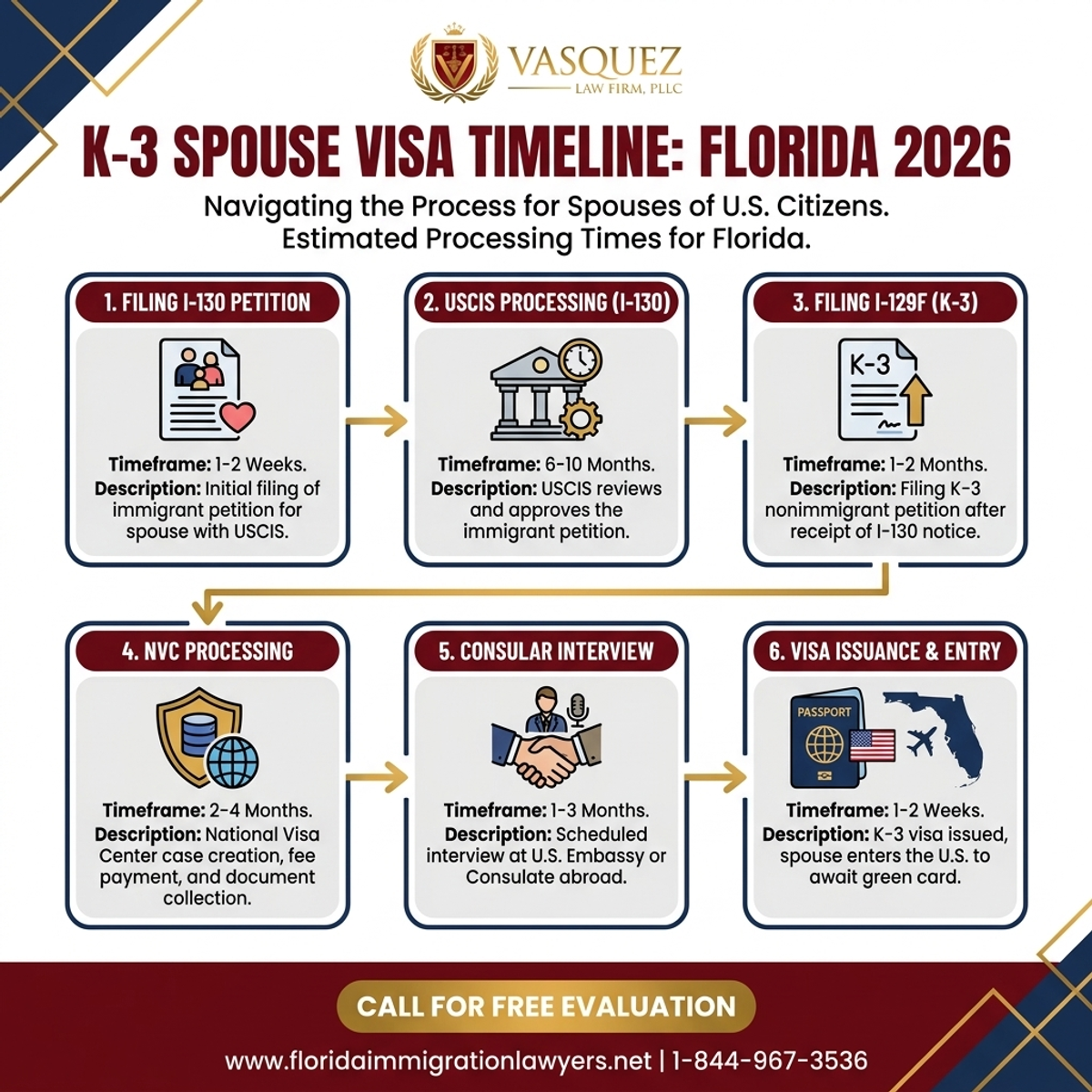
Key Statistics — K-3 Spouse Visa Timeline in Florida 2026
These timeframes are subject to change based on USCIS and consular processing capacities. It's advisable to check current processing times on the USCIS website and the relevant U.S. Embassy or Consulate website. Factors that can impact your specific timeline include the completeness of your application, the volume of petitions being processed, and any requests for additional evidence (RFEs). For example, a common delay occurs if the petitioner has a complicated immigration history or if the marriage itself raises questions.
To manage expectations, it's wise to assume the longer end of these estimates and prepare accordingly. While waiting, ensure all your documents are up-to-date and that you respond promptly to any communication from USCIS or the NVC. Florida Immigration Lawyers can help you monitor your case status and provide updates, offering peace of mind throughout the waiting period. We understand that every day apart feels like a lifetime, and we strive to keep you informed and prepared at every turn.
K-3 Visa Cost Factors and Fee Breakdown
The cost of a K-3 visa can vary depending on several factors, and it's essential to budget for all potential expenses to avoid unexpected financial burdens. Beyond the primary government filing fees, there are other costs associated with the application process. Here's a general breakdown of typical fees and additional considerations:
| Item | Typical Fee | Notes |
|---|---|---|
| Form I-130 Fee | Varies | Subject to change. This fee is for the initial petition to establish the relationship. Always check the USCIS website for the most current fee schedule. |
| Form I-129F Fee | Varies | Check USCIS for current fees. This fee is specifically for the K-3 nonimmigrant visa petition. |
| Medical Examination | Varies | Depends on location and specific requirements. This fee is paid directly to the authorized panel physician in the foreign spouse's country. Prices can differ significantly. |
| Consular Fees | Varies | Payable to the consulate. This typically includes the visa application processing fee (DS-160 fee) and sometimes an immigrant visa issuance fee, though the K-3 itself is nonimmigrant. |
It is crucial to verify the latest fees on the official State Department website and USCIS website, as these are subject to change without prior notice. Beyond these mandatory government fees, applicants should also consider other potential costs such as:
- **Attorney Fees:** Engaging an experienced immigration lawyer, like those at Florida Immigration Lawyers, can be a significant investment but often saves time, reduces stress, and prevents costly errors. Our firm offers transparent fee structures and free consultations to discuss your options.
- **Travel Expenses:** The foreign spouse will need to travel to the U.S. Embassy or Consulate for their interview and eventually to the U.S. itself.
- **Document Translation Costs:** If any supporting documents are not in English, they must be translated by a certified translator, incurring additional costs.
- **Postage and Courier Services:** Securely sending documents can also add up.
- **Biometrics Fee:** While typically associated with adjustment of status, some stages may require biometrics appointments with associated fees.
Do not navigate this process alone. Contact Florida Immigration Lawyers today at 1-844-YO-PELEO to discuss a comprehensive cost breakdown and receive guidance on managing your K-3 visa application effectively.
Do Not Navigate This Process Alone
Our experienced immigration attorneys are ready to fight for you. Get a free, confidential case review today.
Se Habla Español
Or leave your details and we’ll call you:
Free Evaluation in 24 Hours
Or talk to us right now
AI voice assistant — available 24/7
FreeFrequently Asked Questions

William J. Vásquez
Founding Attorney · Vasquez Law Firm
U.S. Air Force veteran and immigration attorney with years of hands-on U.S. immigration experience. J.D., NCCU School of Law. AILA member. Admitted to the 4th, 5th, and 11th Circuit Courts.
Available 24/7 - Free Evaluations
Reviewed for legal accuracy by William J. Vásquez
Licensed in North Carolina; U.S. immigration is federal practice.
Related Legal Services
Our Florida immigration attorneys can help you with business immigration, deportation defense and family immigration services. Call today at 1-844-YO-PELEO for a free case review.
Related Links
Related Topics
Free Legal Case Review
Discuss your case with our experienced attorneys. We're available 24/7.
Se Habla Español - Estamos aquí para ayudarle.
Related Articles
DUI Immigration Consequences in Florida 2026
A DUI conviction in Florida can have severe immigration consequences, potentially leading to inadmissibility, deportation, or denial of immigration benefits. For non-citizens, a DUI is not just a traffic offense but a serious criminal matter that federal immigration law scrutinizes closely. Factors like multiple offenses, injury, or property damage can escalate a simple DUI to a Crime Involving Moral Turpitude (CIMT) or even an aggravated felony, triggering mandatory detention and removal proceedings. Understanding the specific nature of your Florida conviction and its interpretation under the Immigration and Nationality Act (INA) is crucial. This article outlines how DUIs impact immigration status, the grounds for inadmissibility and deportation, a step-by-step guide to navigating the process, essential documentation, and expected timelines for 2026. We also highlight common mistakes to avoid and when to seek legal counsel from an experienced immigration attorney. Florida Immigration Lawyers offers comprehensive support for individuals facing these challenging situations, providing expert guidance through complex legal landscapes.
Immigration Lawyer Orlando Free Consultation in Florida
For individuals and families in Orlando, Florida, navigating the complexities of U.S. immigration law requires expert guidance. An immigration lawyer in Orlando offers crucial support for everything from visa applications and green card processes to naturalization and deportation defense. This comprehensive guide details what a free consultation covers, providing a step-by-step overview of immigration pathways, essential document checklists, and expected timelines in 2026. We also highlight common mistakes to avoid, discuss the critical role of legal counsel in deportation and asylum cases, and explain why choosing a local Orlando immigration attorney is beneficial. Florida Immigration Lawyers is dedicated to serving the diverse community of Orlando with compassionate, effective legal solutions, ensuring you receive personalized advice and robust representation for a successful immigration journey.
EAD Advance Parole Combo Card in Florida: What You Need
An EAD advance parole combo card allows individuals with pending adjustment applications to both work and travel abroad without jeopardizing their green card application. Learn how to apply in Florida, what documents you need, and common mistakes to avoid.
Dual Citizenship Lawyer in Florida: What You Need to Know
For Florida residents, the concept of dual citizenship, or holding two passports, offers a compelling blend of opportunities and challenges. While the U.S. generally permits dual nationality, the path to achieving this status requires a meticulous understanding of both U.S. immigration laws and the citizenship policies of your country of origin. This guide explores the definition of dual citizenship, the detailed step-by-step process for U.S. naturalization, and the significant benefits and potential pitfalls involved. We cover essential documentation, typical timelines, and cost considerations for 2026, providing crucial insights for anyone in Orlando, Miami, or across Florida considering this important legal step. Learn about common mistakes to avoid and understand when to seek professional legal counsel to navigate this complex process successfully. Florida Immigration Lawyers is here to provide expert, bilingual support for your dual citizenship journey.