CR-1 IR-1 Spouse Visa Consular Processing Florida
For U.S. citizens and green card holders in Florida, sponsoring a foreign national spouse for a CR-1 or IR-1 immigrant visa is a significant step towards family reunification. This comprehensive guide details the entire consular processing journey, from filing the initial I-130 petition with USCIS to navigating the National Visa Center (NVC) and attending the consular interview abroad. We break down the differences between conditional (CR-1) and immediate (IR-1) residency, provide crucial insights into current processing timelines and associated costs as of 2026, and highlight common mistakes to avoid. Florida Immigration Lawyers offers guidance to ensure a smooth and successful application process for families across the state, including St. Petersburg, Tampa, and Miami.
The CR-1 visa (Conditional Resident) and IR-1 visa (Immediate Relative) are immigrant visas for foreign national spouses of U.S. citizens or lawful permanent residents, processed via consular processing. The CR-1 is for marriages under two years at the time of entry, leading to a two-year conditional green card, while the IR-1 is for marriages two years or longer, granting a ten-year permanent green card. The process involves filing Form I-130 with USCIS, followed by National Visa Center (NVC) processing for document collection and fee payment, culminating in a consular interview at a U.S. Embassy or Consulate abroad. Florida residents sponsoring their spouses must meticulously follow each step to ensure a smooth transition and family reunification.
- CR-1 is for marriages under two years, IR-1 for two years or more.
- The process starts with an I-130 petition filed by the U.S. petitioner.
- National Visa Center (NVC) handles document collection and fee processing.
- A consular interview at a U.S. Embassy abroad is the final stage.
- Legal guidance is crucial for navigating complex requirements and potential challenges.
The journey to unite with your beloved spouse in the United States, especially through the intricate pathways of immigration law, can feel overwhelming. For many U.S. citizens and lawful permanent residents in Florida, the dream of bringing their foreign national spouse home is a deeply personal and significant endeavor. The CR-1 visa and IR-1 visa programs offer the primary routes for achieving this family reunification through consular processing, a multi-stage procedure that requires precision, patience, and a thorough understanding of U.S. immigration regulations. From the initial petition to the final interview, every step is critical.
This comprehensive guide from Florida Immigration Lawyers aims to demystify the CR-1 and IR-1 spouse immigrant visa process, with a particular focus on how it impacts residents of Florida, including communities like St. Petersburg, Miami, and Orlando. We will explore the nuances between these visa types, outline the step-by-step consular processing journey, provide insights into timelines and costs as of 2026, and highlight common pitfalls to avoid. Our goal is to equip you with the knowledge needed to navigate this complex system effectively and confidently. If you are ready to take the first step towards reuniting with your spouse, do not hesitate to call Florida Immigration Lawyers at 1-844-YO-PELEO for a free consultation. We are here to help you understand your options and guide you through every phase of this important process.
What is the Difference Between a CR-1 and an IR-1 Spouse Visa?
The CR-1 visa is for spouses married less than two years at the time the foreign national spouse enters the U.S. with their immigrant visa, resulting in conditional permanent residency. The IR-1 visa is for spouses married two years or more at the time of entry, granting immediate, unconditional permanent residency. Both facilitate family reunification for U.S. citizens or green card holders sponsoring their foreign national spouses.
Understanding the distinction between the CR-1 and IR-1 spouse visas is foundational for any U.S. citizen or lawful permanent resident in Florida looking to sponsor their foreign spouse. The key differentiator lies in the length of the marriage at the time the foreign spouse is approved for admission to the United States. If your marriage is less than two years old when your spouse arrives in the U.S. on their immigrant visa, they will receive a CR-1 visa, leading to conditional permanent resident status. This means their green card will be valid for two years, and you will need to file Form I-751, Petition to Remove Conditions on Residence, within 90 days before the green card expires. This additional step is crucial to prevent the loss of permanent resident status and potential deportation. This conditional status is governed by INA §216, designed to deter marriage fraud.
Conversely, if your marriage has lasted two years or longer when your foreign spouse enters the U.S., they will be granted an IR-1 visa, leading directly to unconditional permanent resident status. An IR-1 green card is valid for ten years and does not require the filing of Form I-751. This simplifies the long-term immigration process significantly, offering immediate stability and peace of mind for families across Florida. While both visa types ultimately lead to permanent residency, the IR-1 path avoids the extra step and potential complexities associated with removing conditions. Therefore, the timing of your spouse's entry into the U.S. is a critical factor determining which visa category applies and whether additional filings will be necessary in the future.
How Does CR-1/IR-1 Spouse Visa Consular Processing Work from Florida?
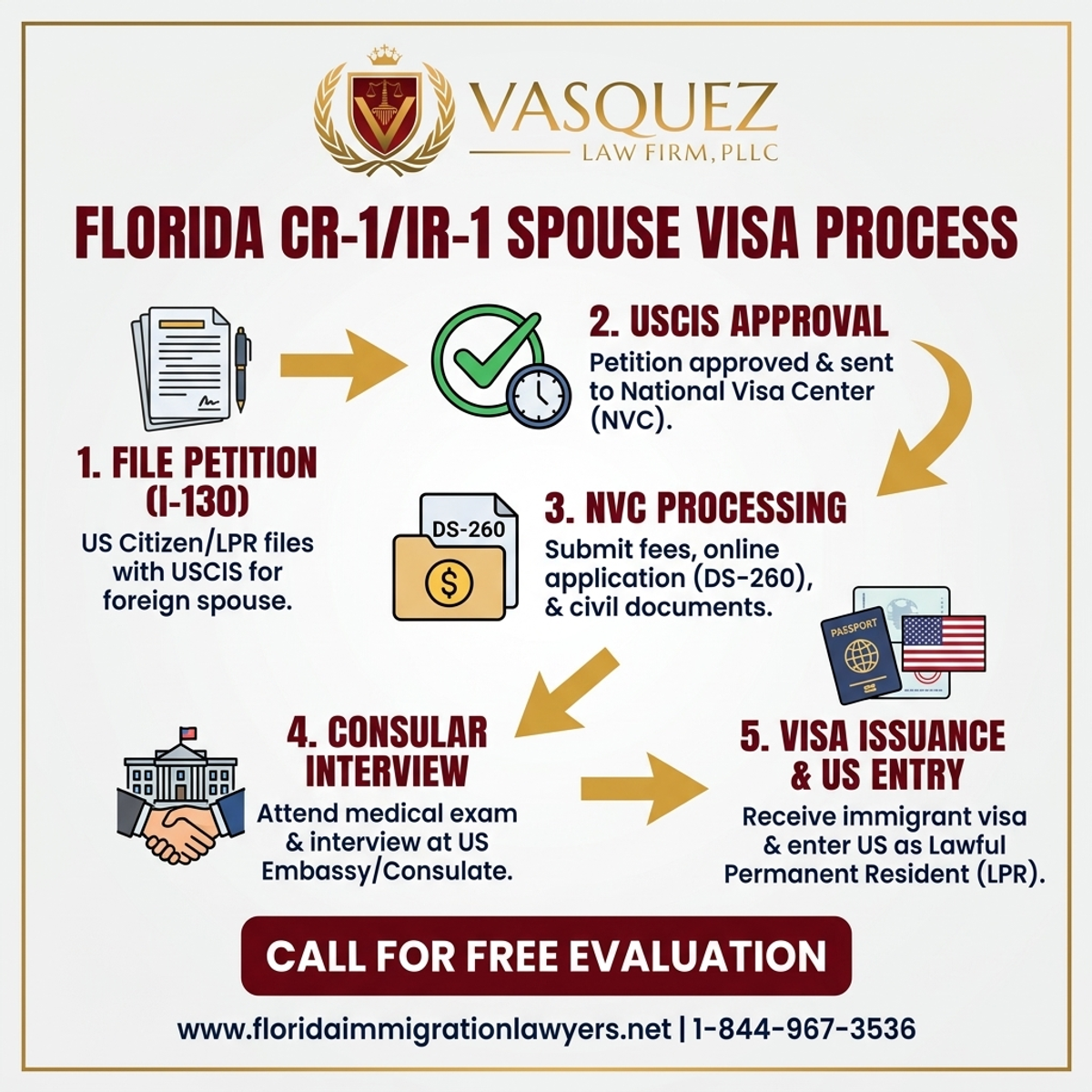
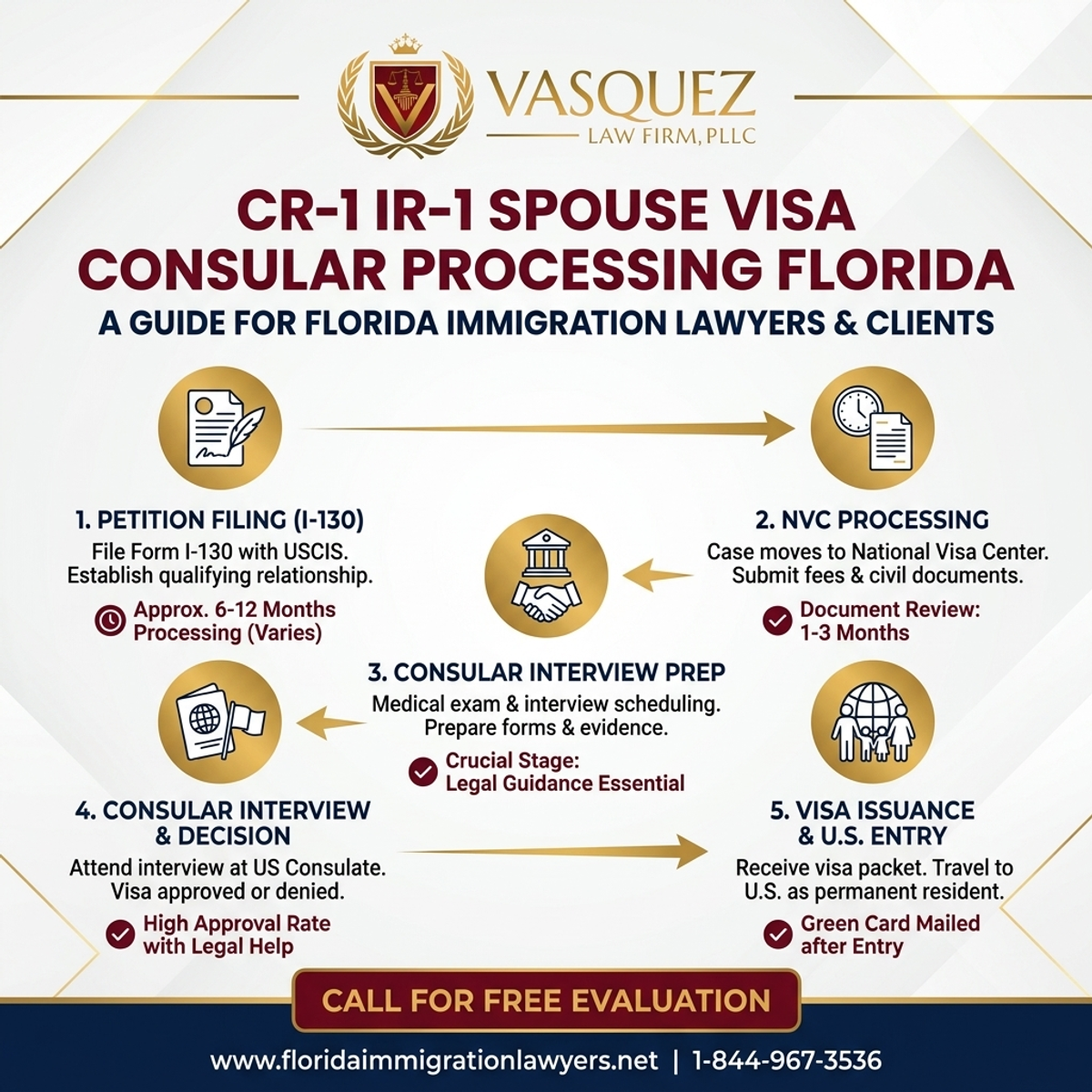
Consular processing for CR-1/IR-1 visas begins with an I-130 Petition for Alien Relative filed by the U.S. petitioner in Florida. Once approved by USCIS, the case transfers to the National Visa Center (NVC) for documentation collection and fee processing. The final step involves an interview at a U.S. Embassy or Consulate abroad in the foreign national's home country, followed by visa issuance. This structured process ensures thorough vetting before entry to the U.S.
For U.S. citizens and lawful permanent residents residing in Florida, the journey to obtain a spouse immigrant visa through consular processing involves several distinct stages, each managed by different government agencies. The process officially begins when the U.S. citizen or green card holder, known as the petitioner, files Form I-130, Petition for Alien Relative, with U.S. Citizenship and Immigration Services (USCIS). This initial petition, often filed electronically or mailed to a USCIS Lockbox facility, establishes the bona fide nature of the marital relationship. USCIS field offices in Florida, such as those in Miami, Orlando, or Tampa, play a role in processing certain applications, though I-130 petitions are typically handled by service centers.
Once USCIS approves the I-130 petition, the case is forwarded to the National Visa Center (NVC), a component of the U.S. Department of State. The NVC acts as a central hub for collecting all necessary documentation and fees before the case can be scheduled for a consular interview. During this phase, the petitioner and the foreign national spouse (beneficiary) will submit the immigrant visa application (Form DS-260), the Affidavit of Support (Form I-864), and various civil documents such as birth certificates, marriage certificates, police records, and passport copies. The NVC processing stage is highly detail-oriented, and any missing or incorrect documents can lead to significant delays. Florida Immigration Lawyers regularly assist clients in St. Petersburg and across the state in compiling comprehensive NVC packages.
After the NVC confirms that all documents and fees are correctly submitted, they will schedule an interview at the appropriate U.S. Embassy or Consulate in the foreign national spouse's country of residence. Before the interview, the foreign spouse must complete a medical examination with a USCIS-approved physician. The consular interview is the final critical step, where a Consular Officer will review the application, verify the relationship's authenticity, and determine the foreign spouse's eligibility for a visa under U.S. immigration law, including grounds of inadmissibility outlined in INA §212. Successfully navigating this process requires careful preparation and often benefits from experienced legal counsel, especially when dealing with any complexities or potential issues.
Step-by-Step Guide to the CR-1/IR-1 Visa Process
Navigating the CR-1/IR-1 visa process requires a methodical approach, ensuring each stage is completed accurately and on time. Here is a detailed, step-by-step guide:
-
File Form I-130 Petition with USCIS: The U.S. citizen or lawful permanent resident petitioner in Florida initiates the process by filing Form I-130, Petition for Alien Relative, with U.S. Citizenship and Immigration Services (USCIS). This form formally requests that the U.S. government recognize the marital relationship as legitimate for immigration purposes. Along with the I-130, you must submit supporting evidence such as your marriage certificate, proof of your U.S. citizenship or green card status, and evidence of a bona fide marriage, which can include joint bank statements, leases, utility bills, photos, and affidavits from friends and family. A well-prepared petition is crucial to avoid requests for evidence (RFEs) that can cause delays.
-
USCIS Approval and Transfer to NVC: Once USCIS reviews and approves the I-130 petition, they will send an approval notice (Form I-797). Subsequently, the case is electronically transferred to the National Visa Center (NVC) for further processing. The NVC will assign a case number and an invoice ID number, which are essential for accessing your case online and communicating with the NVC. This transition marks the end of the USCIS phase and the beginning of the NVC's role in collecting all necessary documentation from both the petitioner and the beneficiary.
-
NVC Processing - Fee Payments: The NVC will instruct the petitioner to pay the Affidavit of Support Fee and the Immigrant Visa Application Processing Fee. These fees must be paid online through the NVC's Consular Electronic Application Center (CEAC) portal. It is critical to pay these fees promptly, as the NVC will not proceed with processing your case until all required payments are received and processed. Delays in payment can significantly extend your overall processing time.
-
NVC Processing - Document Submission: After fees are paid, the petitioner (and sometimes the foreign spouse) will submit the required civil documents to the NVC. This includes the completed Form DS-260 (Immigrant Visa Application), Form I-864 (Affidavit of Support) and its supporting financial documents, the foreign spouse's birth certificate, marriage certificate, police certificates from all countries lived in, and copies of passport biographic data pages. All foreign documents must be accompanied by certified English translations. Organizing and submitting a complete and accurate document package is paramount to avoid NVC requests for additional documents, which can prolong the process.
-
Consular Interview Scheduling: Once the NVC determines that all necessary documents and fees have been submitted and accepted (referred to as "Documentarily Qualified"), they will schedule the foreign spouse for an interview at the U.S. Embassy or Consulate in their country of residence. The NVC will send an appointment letter detailing the date, time, and location of the interview, along with instructions for the medical examination. Interview availability can vary by embassy and workload, so patience is key during this stage.
-
Medical Examination: Before the consular interview, the foreign spouse must undergo a mandatory medical examination by a physician authorized by the U.S. Embassy or Consulate. This examination assesses the applicant's health and ensures they do not have any medical conditions that would make them inadmissible to the U.S. The results are typically sealed and given to the applicant to bring to their interview, or sent directly to the embassy. Failure to complete this exam with an approved doctor will result in delays or denial.
Step-by-Step Process — CR-1 IR-1 Spouse Visa Consular Processing Florida
-
Visa Interview: The foreign spouse attends the interview at the U.S. Embassy or Consulate. During the interview, a Consular Officer will review the application, verify the authenticity of the marriage, and confirm the applicant's eligibility for the visa. The officer may ask questions about the relationship, the petitioner, and the applicant's background. It is vital to answer truthfully and to bring all original civil documents and the medical exam results. Successful completion of this interview is the final hurdle before visa issuance.
-
Visa Issuance and Entry to U.S.: If the interview is successful, the consular officer will approve the visa. The visa will be stamped into the foreign spouse's passport, along with a sealed immigrant visa packet. The foreign spouse can then travel to the United States. Upon arrival at a U.S. Port of Entry, the Customs and Border Protection (CBP) officer will review the visa packet and grant admission as a lawful permanent resident. For CR-1 visa holders, this will be conditional permanent residency, necessitating the I-751 filing later.
Required Documents for NVC Submission
Preparing a comprehensive document package is crucial for efficient NVC processing. Here is a general checklist:
- Passport (valid for at least six months beyond intended entry date)
- Birth Certificate of the foreign national spouse
- Marriage Certificate (proving the legal union)
- Divorce or Death Certificates (for any previous marriages of either spouse)
- Police Certificates from all countries where the foreign spouse lived for certain periods
- Military Records (if applicable)
- Court and Prison Records (if applicable)
- Form DS-260 Confirmation Page
- Form I-864, Affidavit of Support, with supporting financial documents (tax returns, W-2s, employment verification letters, bank statements)
- Two passport-style photographs of the foreign national spouse
- Copies of the U.S. petitioner's U.S. passport or birth certificate/naturalization certificate
- Evidence of a bona fide marriage (joint bank accounts, property deeds, insurance policies, photos, letters, etc.)
- Medical examination results (submitted directly by the physician or carried in a sealed envelope)
What are the Current Timelines and Processing Expectations for Spouse Visas in 2026?
As of 2026, CR-1/IR-1 spouse visa processing can typically range from 12 to 24 months, varying based on USCIS caseloads, NVC efficiency, and embassy availability. The initial I-130 petition often takes 9-15 months, followed by 3-6 months for NVC processing, and then scheduling for the consular interview which can add several more months. These are general estimates, and individual cases may differ significantly.
The total processing time for a CR-1 or IR-1 spouse visa can be a source of significant anxiety for families in Florida and around the world. As of 2026, while the process is continually streamlined, various factors can influence how long it takes for a foreign spouse to finally arrive in the U.S. It is important to note that CR-1 and IR-1 visas are classified as "immediate relative" visas, meaning they are not subject to annual numerical limitations or the Visa Bulletin's cut-off dates for visa availability. However, processing times are still affected by the workload at USCIS service centers, the NVC, and individual U.S. Embassies or Consulates.
The initial stage, the filing and approval of Form I-130 by USCIS, can take a considerable portion of the overall timeline. As of 2026, USCIS processing times for I-130 petitions for immediate relatives generally range from 9 to 15 months, though some cases may be faster or slower depending on the specific service center and the completeness of the initial submission. You can check current processing times on the USCIS website. Once the I-130 is approved, the case moves to the National Visa Center (NVC), which typically takes 3 to 6 months to collect all required documents and fees and to become "Documentarily Qualified." This NVC stage can be expedited or delayed based on how quickly and accurately the petitioner and beneficiary respond to requests and submit documents. Incomplete submissions are a common cause of delays.
The final stage involves the scheduling and completion of the consular interview. This phase's duration is highly dependent on the specific U.S. Embassy or Consulate, their current caseload, and local conditions. After the NVC confirms document qualification, it can take anywhere from 2 to 4 months, or even longer in some high-demand locations, to receive an interview appointment. Following a successful interview, visa issuance typically occurs within 1-2 weeks. Factors such as administrative processing, requests for additional information, or security checks can extend these timelines unexpectedly. For Florida residents, understanding these varying timeframes and being prepared for potential delays is crucial. Working with an experienced immigration attorney can help mitigate some of these challenges by ensuring your application is as strong and complete as possible from the outset.
| Stage | Typical Timeframe (As of 2026) | Notes |
|---|---|---|
| I-130 Petition Filing & Approval | 9-15 Months | Handled by USCIS. Times vary by service center. |
| National Visa Center (NVC) Processing | 3-6 Months | Document collection, fee payment. Depends on applicant responsiveness. |
| Consular Interview Scheduling | 2-4 Months | Varies significantly by U.S. Embassy/Consulate workload. |
| Medical Examination | 1 Week - 1 Month | Must be completed with an embassy-approved physician before interview. |
| Visa Interview & Issuance | 1-2 Weeks (post-interview) | Assuming successful interview and no administrative processing. |
| Total Estimated Process | 12-24+ Months | Overall range, individual cases may vary. |
Understanding CR-1/IR-1 Visa Costs and Fee Breakdown in 2026
The overall cost for a CR-1/IR-1 spouse visa process involves several distinct fees paid to government agencies, as well as potential costs for medical exams, document translations, and legal assistance. As of 2026, these fees are subject to change, but typically include the USCIS I-130 petition fee, NVC processing fees for the Affidavit of Support and Immigrant Visa Application, and a USCIS Immigrant Fee. Budgeting for these expenses is a critical part of the planning process for Florida families.
When embarking on the CR-1 or IR-1 spouse visa journey, understanding the financial commitments involved is just as important as navigating the legal procedures. As of 2026, the costs associated with this process primarily consist of government filing fees, but also include other necessary expenses such as medical examinations, document translation, and optional legal representation. These fees are subject to change, so it is always advisable to check the official USCIS and Department of State websites for the most current figures before filing. Proper financial planning ensures that your application proceeds without unnecessary delays due to unpaid or incorrect fees.
The first significant cost is the filing fee for Form I-130, Petition for Alien Relative, paid to USCIS by the U.S. petitioner in Florida. Once the case moves to the National Visa Center (NVC), two additional fees are required: the Affidavit of Support processing fee and the Immigrant Visa Application processing fee (for Form DS-260). These fees are paid to the Department of State. Furthermore, the foreign spouse must undergo a medical examination by an authorized physician, and the cost for this exam is paid directly to the medical facility, varying significantly by country and clinic. Finally, after the visa is approved and before the foreign spouse enters the U.S., a USCIS Immigrant Fee must be paid online. This fee covers the cost of producing the physical green card. Beyond these mandatory government fees, applicants should also budget for expenses such as obtaining civil documents (birth certificates, marriage licenses), certified translations of foreign documents, passport photos, and travel costs to attend the consular interview. While not mandatory, investing in legal counsel from a firm like Florida Immigration Lawyers can be invaluable, helping to avoid costly mistakes and ensuring a smooth process. Legal citations like 8 CFR §103.7 outline the authority for collecting these fees.
Key Statistics — CR-1 IR-1 Spouse Visa Consular Processing Florida
| Item | Typical Fee (As of 2026) | Notes |
|---|---|---|
| Form I-130, Petition for Alien Relative | Varies (Check USCIS website) | Paid by the U.S. petitioner to USCIS. |
| Immigrant Visa Application Processing Fee (DS-260) | Varies (Check Department of State) | Paid to the NVC for the foreign national spouse. |
| Affidavit of Support Processing Fee (I-864) | Varies (Check Department of State) | Paid to the NVC by the U.S. petitioner. |
| Medical Examination | Varies by country and physician | Paid directly to the authorized medical facility. |
| USCIS Immigrant Fee | Varies (Check USCIS website) | Paid online after visa approval, before U.S. entry. |
| Attorney Fees | Varies by firm and case complexity | Optional but highly recommended for guidance. |
| Document Acquisition & Translation | Varies | Costs for obtaining birth/marriage certificates, police records, and certified translations. |
Do not navigate this complex and emotionally charged process alone. The stakes are too high, and the regulations are constantly evolving. Contact Florida Immigration Lawyers today to schedule a consultation and let our experienced team provide the guidance and support you need to reunite with your spouse. We serve clients throughout Florida, including St. Petersburg, Tampa, Miami, and Orlando, ensuring your case receives the attention it deserves.
Common Mistakes to Avoid in the CR-1/IR-1 Visa Process
Navigating the CR-1/IR-1 spouse visa process can be challenging, and even minor errors can lead to significant delays or even denials. Being aware of common pitfalls can help Florida residents avoid unnecessary headaches and ensure a smoother path to family reunification.
-
Incomplete or Inaccurate Forms: Submitting forms with missing information or errors is a frequent cause of Requests for Evidence (RFEs) or outright denials. USCIS and NVC are meticulous. Always double-check every field, ensure all questions are answered, and provide precise information. For example, if you reside in St. Petersburg, ensure your address is consistent across all forms. Even a simple typo can cause issues.
-
Insufficient Evidence of Bona Fide Marriage: A common reason for delays or denials is failing to provide enough compelling evidence that your marriage is legitimate and not solely for immigration purposes. Beyond the marriage certificate, you must submit joint financial documents (bank accounts, taxes, property deeds), shared utility bills, leases, photos together over time, birth certificates of joint children, and affidavits from friends and family. A lack of strong evidence can trigger intense scrutiny.
-
Inadequate Financial Support (Form I-864): The Affidavit of Support (Form I-864) is critical. The petitioner must demonstrate they can financially support their spouse at 125% above the poverty line. Failing to meet this threshold or submitting insufficient financial documentation (tax returns, W-2s, employment verification) will lead to delays. If the petitioner's income is insufficient, a joint sponsor from Florida or elsewhere may be needed, adding another layer of complexity.
-
Missing or Incorrect Civil Documents: Submitting outdated, uncertified, or improperly translated civil documents (birth certificates, marriage certificates, police records) is a common error. Ensure all documents are current, certified copies, and if not in English, accompanied by a certified English translation. Forgetting a police certificate from a country where the beneficiary lived for more than six months can be a serious setback.
-
Failure to Update Addresses: Both the petitioner and beneficiary must inform USCIS and NVC of any address changes. Failure to do so can result in missed notices, RFEs, or interview appointments, leading to significant delays or even case abandonment. Always use the official change of address procedures.
-
Not Preparing for the Consular Interview: Many applicants underestimate the importance of the consular interview. Failing to review your application, recall details of your relationship, or bring all original documents can lead to complications. Consular officers are trained to detect inconsistencies, and a lack of preparation can raise red flags about the authenticity of your marriage.
-
Traveling to the U.S. on a Non-Immigrant Visa During Processing: It is generally ill-advised for a foreign spouse to attempt to enter the U.S. on a non-immigrant visa (e.g., tourist visa) while their immigrant visa petition is pending. This can be interpreted as misrepresentation or immigrant intent, potentially jeopardizing the immigrant visa application and leading to denial of entry or future visa refusals. Always consult with an attorney before attempting such travel.
-
Ignoring Legal Advice or Attempting to Handle Complexities Alone: While some cases are straightforward, many have unique circumstances such as previous divorces, criminal histories, or prior immigration violations. Attempting to navigate these complexities without an experienced immigration attorney often leads to critical errors, missed opportunities for waivers, or unnecessary delays. For Florida residents, especially in areas with diverse immigrant populations like Miami, legal guidance is invaluable.
When to Call a Lawyer for Your CR-1/IR-1 Spouse Visa
While the CR-1/IR-1 visa process is designed to be followed by individuals, the reality is that U.S. immigration law is incredibly complex and constantly evolving. There are many situations where the expertise of a seasoned immigration attorney, like those at Florida Immigration Lawyers, becomes not just helpful but essential. Knowing when to seek legal counsel can save you time, stress, and potentially prevent costly mistakes or denials.
You should consider calling an immigration lawyer if your case involves any complexities beyond a simple, first-time marriage between two individuals with no prior immigration history. This includes situations where either spouse has a criminal record, previous immigration violations (such as overstays or illegal entries), prior visa denials, or multiple marriages and divorces. These factors can trigger grounds of inadmissibility and require waivers, which are intricate legal applications best handled by professionals. Furthermore, if you are struggling to gather sufficient evidence of a bona fide marriage, or if your income for the Affidavit of Support is borderline, an attorney can help strategize and present your case most effectively.
Florida Immigration Lawyers focus on family-based immigration, including CR-1 and IR-1 spouse visas. We understand the nuances of consular processing and are adept at identifying potential red flags in your application before they become major issues. Our team can assist with preparing all forms accurately, compiling robust evidence, preparing you and your spouse for the consular interview, and addressing any RFEs or administrative processing delays. We serve clients across Florida, from St. Petersburg to Jacksonville, offering tailored advice and unwavering support. Don't risk your family's future on guesswork. Our attorneys are here to provide clear guidance and peace of mind through every step of this vital journey. Contact us today for a free consultation to discuss your specific situation.
About Florida Immigration Lawyers
Florida Immigration Lawyers is an immigration law firm dedicated to serving individuals and families throughout the state of Florida. With a deep understanding of U.S. immigration law and a commitment to client success, we provide comprehensive legal services tailored to meet the unique needs of each case. Our experienced team of attorneys is passionate about helping clients achieve their immigration goals, from family reunification through CR-1 and IR-1 visas to citizenship, asylum, and deportation defense.
We pride ourselves on offering personalized attention, clear communication, and strategic legal solutions. We understand the emotional and practical challenges that come with immigration processes, and we strive to make your journey as smooth and stress-free as possible. Our firm is available 24/7 to answer your questions and provide support, offering free consultations to assess your situation and outline the best path forward. Whether you are in St. Petersburg, Miami, Orlando, or any other part of Florida, you can rely on Florida Immigration Lawyers for compassionate, effective, and results-driven legal representation. Call us at 1-844-YO-PELEO or visit www.floridaimmigrationlawyers.net to learn more about how we can assist you.
Sources and References
- U.S. Citizenship and Immigration Services (USCIS)
- U.S. Department of State (Travel.State.Gov)
- Executive Office for Immigration Review (EOIR)
- Immigration and Nationality Act (INA) §201, §203, §212, §216 (8 U.S.C. Chapter 12)
- 8 Code of Federal Regulations (CFR) §103.7
- USCIS Policy Manual
Related services: family petition process, family-based green cards, fiancé visa (K-1), marriage-based immigration.
This article provides general legal information and is not intended as legal advice. Every case is unique, and outcomes depend on specific facts and circumstances. Contact an attorney for advice about your particular situation.
Ready to take the next step in your CR-1 or IR-1 visa journey? Don't let the complexities of immigration law stand in the way of reuniting with your spouse. Call Florida Immigration Lawyers at 1-844-YO-PELEO for a free consultation. We are available 24/7 to provide guidance and support throughout Florida. Se Habla Español - Estamos aquí para ayudarle.
Do Not Navigate This Process Alone
Our experienced immigration attorneys are ready to fight for you. Get a free, confidential case review today.
Se Habla Español
Or leave your details and we’ll call you:
Free Evaluation in 24 Hours
Or talk to us right now

AI voice assistant — available 24/7
FreeFrequently Asked Questions

William J. Vásquez
Founding Attorney · Vasquez Law Firm
U.S. Air Force veteran and immigration attorney with years of hands-on U.S. immigration experience. J.D., NCCU School of Law. AILA member. Admitted to the 4th, 5th, and 11th Circuit Courts.
Available 24/7 - Free Evaluations
Reviewed for legal accuracy by William J. Vásquez
Licensed in North Carolina; U.S. immigration is federal practice.
Related Legal Services
Our Florida immigration attorneys can help you with deportation defense, family immigration services and immigration lawyer cost in Florida. Call today at 1-844-YO-PELEO for a free case review.
Related Links
Related Topics
Free Legal Case Review
Discuss your case with our experienced attorneys. We're available 24/7.
Se Habla Español - Estamos aquí para ayudarle.
Related Articles
DUI Immigration Consequences in Florida 2026
A DUI conviction in Florida can have severe immigration consequences, potentially leading to inadmissibility, deportation, or denial of immigration benefits. For non-citizens, a DUI is not just a traffic offense but a serious criminal matter that federal immigration law scrutinizes closely. Factors like multiple offenses, injury, or property damage can escalate a simple DUI to a Crime Involving Moral Turpitude (CIMT) or even an aggravated felony, triggering mandatory detention and removal proceedings. Understanding the specific nature of your Florida conviction and its interpretation under the Immigration and Nationality Act (INA) is crucial. This article outlines how DUIs impact immigration status, the grounds for inadmissibility and deportation, a step-by-step guide to navigating the process, essential documentation, and expected timelines for 2026. We also highlight common mistakes to avoid and when to seek legal counsel from an experienced immigration attorney. Florida Immigration Lawyers offers comprehensive support for individuals facing these challenging situations, providing expert guidance through complex legal landscapes.
PERM Labor Certification in Florida: A 2026 Guide
Learn all about the PERM labor certification process in Florida, essential for employers sponsoring green card applicants. Understand the steps, document requirements, and common mistakes to avoid in this 2026 guide.
Immigration Lawyer Orlando Free Consultation in Florida
For individuals and families in Orlando, Florida, navigating the complexities of U.S. immigration law requires expert guidance. An immigration lawyer in Orlando offers crucial support for everything from visa applications and green card processes to naturalization and deportation defense. This comprehensive guide details what a free consultation covers, providing a step-by-step overview of immigration pathways, essential document checklists, and expected timelines in 2026. We also highlight common mistakes to avoid, discuss the critical role of legal counsel in deportation and asylum cases, and explain why choosing a local Orlando immigration attorney is beneficial. Florida Immigration Lawyers is dedicated to serving the diverse community of Orlando with compassionate, effective legal solutions, ensuring you receive personalized advice and robust representation for a successful immigration journey.
EAD Advance Parole Combo Card in Florida: What You Need
An EAD advance parole combo card allows individuals with pending adjustment applications to both work and travel abroad without jeopardizing their green card application. Learn how to apply in Florida, what documents you need, and common mistakes to avoid.