K-3 Visa Timeline Florida: Spousal Immigration in 2026
For U.S. citizens in Florida seeking to bring their foreign spouses to the country, the K-3 visa offers a pathway to reunification while the immigrant visa petition is pending. This nonimmigrant visa aims to reduce the long periods of separation families often face. Our 2026 guide details the K-3 visa timeline, application steps, required documents, and associated costs. We cover everything from filing the I-129F petition to consular processing and eventual Adjustment of Status in Florida. Understanding this complex process, especially for residents of Coral Springs and surrounding areas, is crucial for success. Florida Immigration Lawyers provides guidance to navigate these challenges, offering free consultations to help your family reunite sooner.
The K-3 visa serves as a nonimmigrant option for foreign spouses of U.S. citizens, allowing them to enter the United States while their immigrant visa (Form I-130) is pending. As of 2026, the K-3 visa timeline in Florida and nationwide typically involves filing Form I-129F with USCIS, followed by consular processing abroad, and finally, adjustment of status within the U.S. This process aims to reduce the separation period for families, although its utility has decreased due to faster I-130 processing times. Seeking legal guidance from Florida Immigration Lawyers is crucial for navigating its complexities effectively.
- K-3 visa is for spouses of U.S. citizens with a pending I-130.
- It allows entry to the U.S. to await immigrant visa processing.
- The process includes USCIS filing (I-129F) and consular processing.
- Timelines vary, but generally involve several months to over a year.
- Adjustment of Status (I-485) is required after U.S. entry.
For many U.S. citizens in Florida, the dream of reuniting with a foreign spouse is paramount. The journey through U.S. immigration law, however, can often feel like a labyrinth of forms, interviews, and extensive waiting periods. If you are a U.S. citizen married to someone living abroad, and you are seeking to bring them to Florida, you may have heard about the K-3 visa. This nonimmigrant visa category was specifically designed to shorten the agonizing separation that often accompanies the traditional immigrant visa process, allowing spouses to enter the U.S. while their permanent resident application is still pending.
Understanding the K-3 visa timeline in Florida is critical for planning your family's future. While recent years have seen shifts in immigration processing speeds, making the K-3 less common than before, it remains a viable option for certain families. This comprehensive guide, updated for 2026, will demystify the K-3 visa process, outlining each step, required documents, associated costs, and what you can expect in terms of processing times. We will also highlight common pitfalls and explain why legal assistance from Florida Immigration Lawyers is invaluable, particularly for residents of Coral Springs and across the state. Call Florida Immigration Lawyers at 1-844-YO-PELEO for a free consultation to discuss your specific situation.
What is the K-3 Visa and How Does it Benefit Spouses in Florida?
The K-3 visa is a nonimmigrant visa that allows the foreign spouse of a U.S. citizen to enter the United States and reside here while their Form I-130, Petition for Alien Relative, is being processed by U.S. Citizenship and Immigration Services (USCIS). This visa was created by the Legal Immigration Family Equity (LIFE) Act of 2000 to mitigate the long separation times that spouses often endured when applying for an immigrant visa from abroad. While the K-3 visa holder is in the U.S., they can also apply for work authorization and eventually adjust their status to a lawful permanent resident.
The primary benefit of the K-3 visa, especially for families in Florida, is the ability for spouses to be together sooner rather than later. Instead of waiting for the entire immigrant visa process to conclude while living apart, the K-3 allows the foreign spouse to join their U.S. citizen partner in cities like Coral Springs, Miami, or Orlando much earlier. This can significantly reduce emotional strain and allow the couple to begin building their life together without further delay. However, it's important to note that the K-3 visa does not grant permanent residency; it is a temporary visa that serves as a bridge to the green card process, requiring a subsequent Adjustment of Status application once the spouse is in the U.S. This process is governed by the Immigration and Nationality Act (INA), specifically INA 101(a)(15)(K)(iii).
What is the K-3 Visa Application Process and Timeline in 2026?
As of 2026, the K-3 visa application process typically involves a multi-stage approach, beginning with a petition filed by the U.S. citizen spouse and culminating in an interview at a U.S. embassy or consulate abroad. While the process aims to be faster than traditional immigrant visas, timelines can fluctuate based on USCIS caseloads and consular efficiency. The overall duration can range from several months to over a year, depending on individual circumstances and the specific consulate involved.
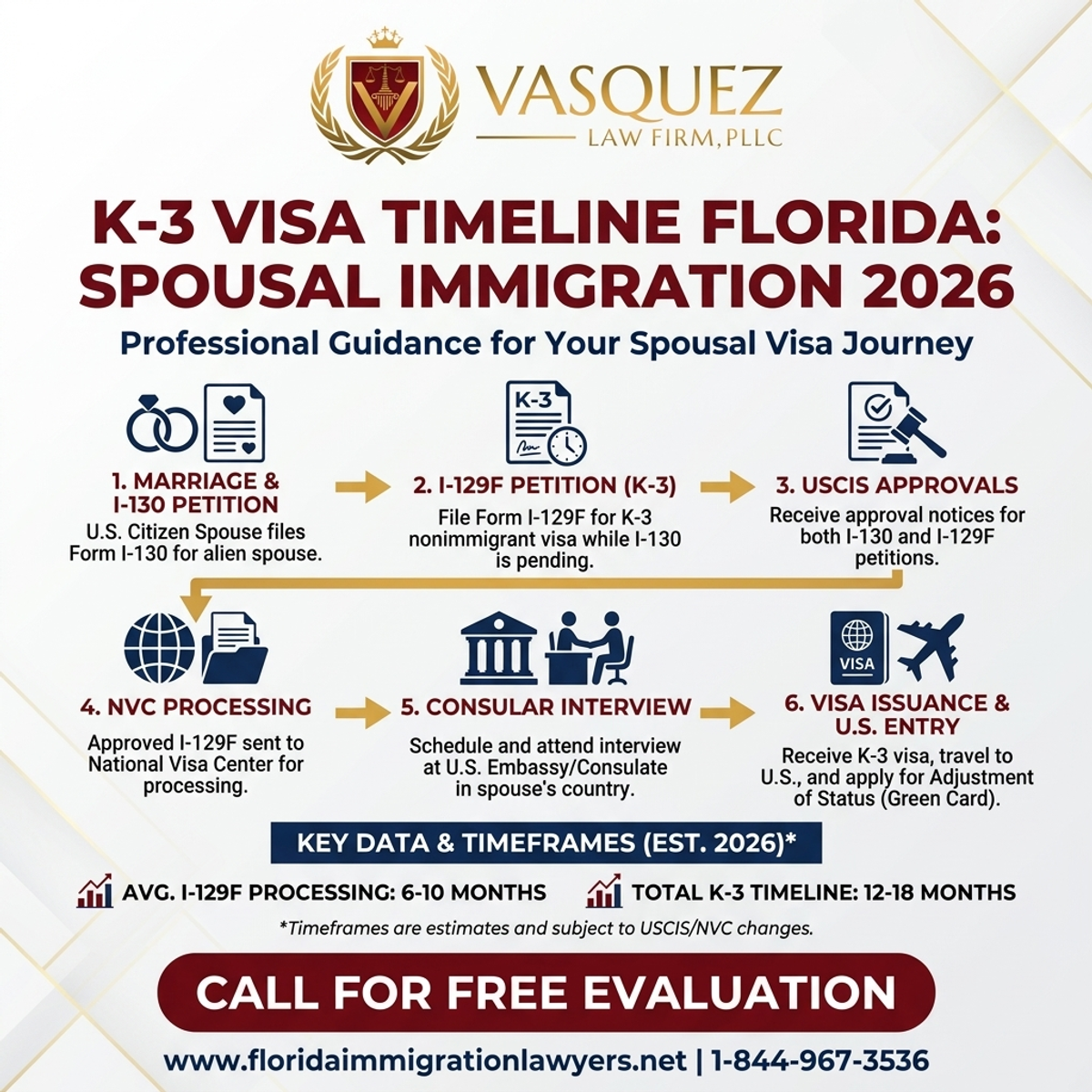
The K-3 visa process is intricate and requires careful attention to detail at each stage. Here is a step-by-step guide to help you understand the journey:
-
File Form I-130, Petition for Alien Relative: The U.S. citizen spouse must first file Form I-130 with USCIS on behalf of their foreign spouse. This petition establishes the validity of the marriage and the relationship. This is the foundational step for any family-based immigration. USCIS processing times for I-130s can vary significantly, but as of 2026, some centers are processing them more quickly than in previous years.
-
File Form I-129F, Petition for Nonimmigrant Fiance(e): Once USCIS receives the I-130 petition, the U.S. citizen can then file Form I-129F, Petition for Nonimmigrant Fiance(e), for the K-3 visa. It is crucial to indicate clearly that this petition is for a K-3 spouse and not a K-1 fiance(e). This form is filed with the USCIS Dallas Lockbox facility, regardless of where in Florida you reside.
-
USCIS Processing of I-129F: USCIS will review the I-129F petition. If approved, USCIS sends the approved petition to the National Visa Center (NVC). The NVC then forwards the petition to the appropriate U.S. Embassy or Consulate in the foreign spouse's country of residence. This stage involves background checks and verification of information.
-
National Visa Center (NVC) Processing: The NVC will create a case file for the K-3 visa applicant. They will send instructions to the foreign spouse regarding required documents, such as the DS-160 (Online Nonimmigrant Visa Application) and civil documents. Payment of applicable fees will also be required at this stage.
-
Consular Processing and Interview: The foreign spouse will attend a visa interview at the U.S. Embassy or Consulate. Prior to the interview, they must undergo a medical examination by an authorized physician and gather all necessary supporting documents, including police certificates from any country they have resided in for more than six months. During the interview, a consular officer will determine eligibility for the K-3 visa. More information can be found on the U.S. Department of State website.
-
Entry to the U.S. and Adjustment of Status: Upon approval, the K-3 visa is issued, allowing the foreign spouse to travel to the United States. Once in the U.S., the K-3 visa holder must then file Form I-485, Application to Adjust Status, with USCIS to become a lawful permanent resident. They can also apply for work authorization (Form I-765) and a travel document (Form I-131) while the I-485 is pending. This adjustment of status process will typically involve an interview at a local USCIS field office in Florida, such as those in Miami, Orlando, or Tampa.
Typical K-3 Visa Timeline and Processing Expectations (as of 2026)
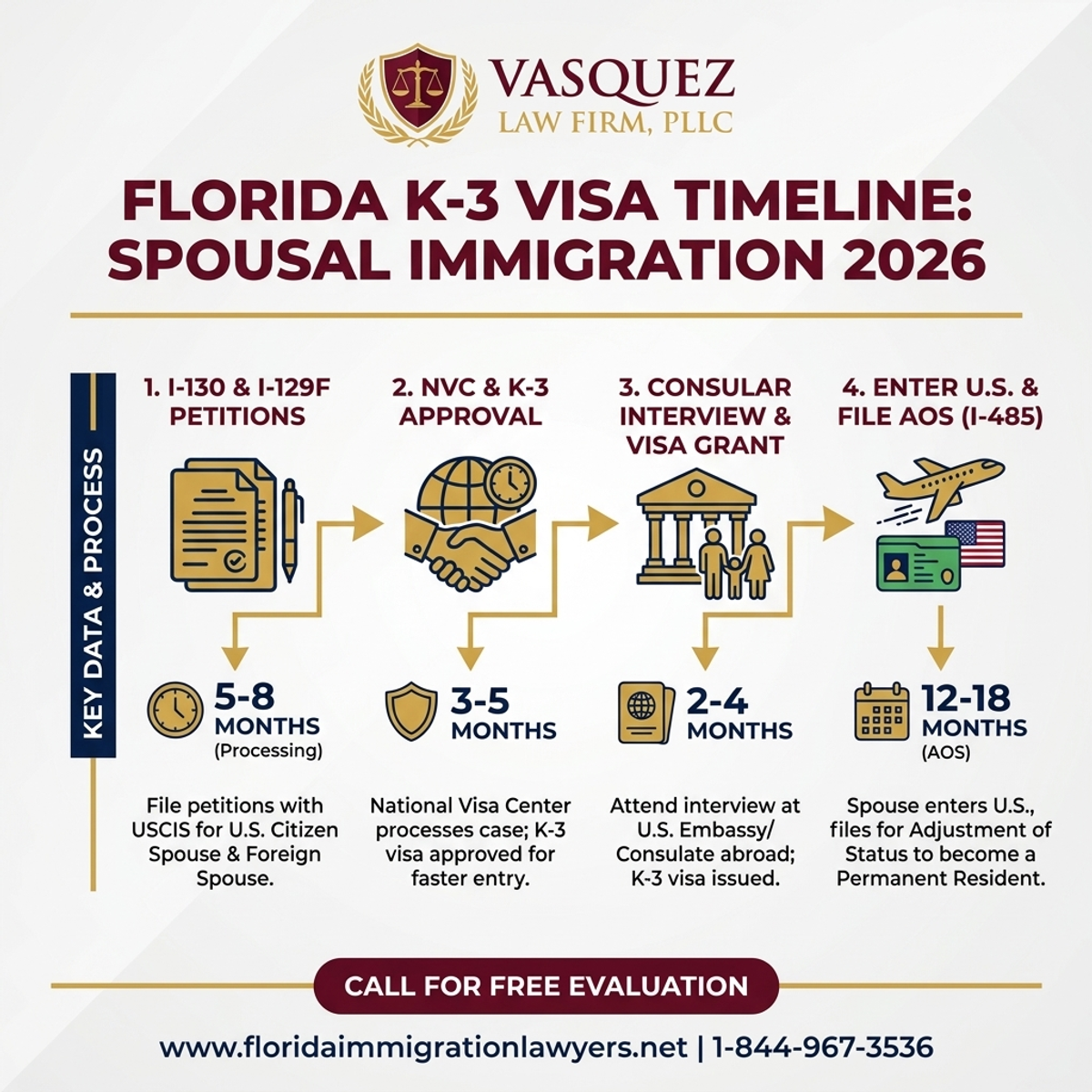
While exact times can vary, this table provides a general overview of the K-3 visa timeline in 2026:
| Stage | Typical Timeframe | Notes |
|---|---|---|
| Form I-130 Filing & Approval | 6-18 months | Can be faster in some cases, often longer than I-129F. |
| Form I-129F Filing & Approval | 5-12 months | Filed after I-130 receipt, processed by USCIS. |
| NVC Processing | 1-3 months | Case creation, fee payments, document collection. |
| Consular Interview Scheduling & Completion | 2-6 months | Varies greatly by embassy/consulate workload. |
| Travel to U.S. | Immediately after visa issuance | Visa is valid for multiple entries for two years. |
| Form I-485 Adjustment of Status | 8-24 months (after U.S. entry) | Filed with USCIS; includes interview at Florida field office. |
What Documents are Required for a K-3 Spouse Visa Application?
A successful K-3 visa application hinges on the submission of a comprehensive and accurate set of documents from both the U.S. citizen petitioner and the foreign spouse beneficiary. Missing or incorrect documents can lead to significant delays or even denials. It is essential to gather all required paperwork meticulously and ensure all foreign language documents are accompanied by certified English translations.
Below is a detailed checklist of the documents typically required for the K-3 visa process:
-
From the U.S. Citizen Petitioner:
- Proof of U.S. Citizenship (e.g., U.S. birth certificate, naturalization certificate, unexpired U.S. passport).
- Certified copy of marriage certificate (proving the valid marriage to the foreign spouse).
- Completed and signed Form I-130, Petition for Alien Relative.
- Completed and signed Form I-129F, Petition for Nonimmigrant Fiance(e) (clearly marked for K-3 spouse).
- Passport-style photographs of the U.S. citizen and the foreign spouse.
- Proof of termination of any prior marriages for both spouses (e.g., divorce decrees, death certificates).
- Evidence of a bona fide marriage (e.g., joint bank accounts, property deeds, shared bills, photos, affidavits from friends/family).
- Form I-864, Affidavit of Support (required during Adjustment of Status, but financial stability is considered throughout).
-
From the Foreign Spouse Beneficiary:
- Valid passport, valid for at least six months beyond the intended period of stay in the U.S.
- Birth certificate.
- Certified copy of marriage certificate.
- Police certificates from all countries where the spouse has lived for more than six months since age 16.
- Medical examination results from a USCIS-approved panel physician.
- Completed DS-160, Online Nonimmigrant Visa Application.
- Passport-style photographs.
- Evidence of a bona fide marriage (matching petitioner's evidence).
- Proof of termination of any prior marriages.
Step-by-Step Process — K-3 Visa Timeline Florida: Spousal Immigration in 2026
For individuals in Coral Springs or other parts of Florida with complex document situations, such as lost certificates or documents in obscure languages, working with an experienced immigration lawyer is highly recommended. They can help you navigate the process of obtaining replacement documents or ensuring proper translations and certifications.
How Much Does a K-3 Visa Cost and What are the Associated Fees?
The cost associated with obtaining a K-3 visa involves several distinct fees, which can accumulate over the different stages of the application process. These fees are subject to change, so it is always essential to check the official USCIS and Department of State websites for the most current amounts. Generally, the expenses include government filing fees, medical examination costs, and potential attorney fees. Planning your budget accordingly is a crucial step in the K-3 visa journey.
Here is a breakdown of the typical cost factors and associated fees for the K-3 visa process, as of 2026. Please note that specific dollar amounts are not provided as they frequently change. Always refer to the official government websites for the most up-to-date fee schedules.
| Item | Typical Fee | Notes |
|---|---|---|
| Form I-130, Petition for Alien Relative | Check USCIS website | Filed by the U.S. citizen spouse. |
| Form I-129F, Petition for Nonimmigrant Fiance(e) | Check USCIS website | Filed by the U.S. citizen spouse for the K-3. |
| DS-160, Nonimmigrant Visa Application Fee | Check Department of State website | Paid by the foreign spouse at the consulate. |
| Medical Examination Fee | Varies by country and physician | Required for the foreign spouse, paid directly to the doctor. |
| Form I-485, Application to Adjust Status | Check USCIS website | Filed after U.S. entry by the foreign spouse for green card. |
| Biometrics Fee (for I-485) | Check USCIS website | Required for identity verification and background checks. |
| Attorney Fees | Varies significantly | Highly recommended for navigating complex legal requirements. |
| Translation and Document Procurement | Varies | Costs for certified translations and obtaining civil documents. |
These costs do not include travel expenses for the foreign spouse to attend the interview or to move to Florida. It's crucial to factor in all potential expenses when planning for your spouse's immigration. Consulting with Florida Immigration Lawyers can provide clarity on expected costs and help you manage the financial aspects effectively.
Do not navigate this process alone. Contact Florida Immigration Lawyers today.
Navigating Adjustment of Status After K-3 Entry in Florida
Once your foreign spouse successfully obtains a K-3 visa and enters the United States, the journey is not yet complete. The K-3 visa is a nonimmigrant visa, meaning it does not grant permanent residency. To become a lawful permanent resident (green card holder), your spouse must file for Adjustment of Status (AoS) using Form I-485. This is a critical final step, and navigating it correctly is paramount for families settling in Florida.
The Adjustment of Status process begins with filing Form I-485, along with supporting documentation, including medical examination results, affidavits of support (Form I-864), and evidence of the ongoing bona fide marriage. It's important that the I-130 petition, which was filed at the very beginning, has already been approved or is concurrently filed with the I-485. After filing, USCIS will typically schedule a biometrics appointment at a local Application Support Center (ASC) in Florida, such as those serving Coral Springs, Fort Lauderdale, or West Palm Beach. Following this, an interview at a USCIS field office (e.g., Miami, Orlando, Tampa, Jacksonville) is generally required. During this interview, a USCIS officer will verify the information in your application and ensure the marriage is legitimate and ongoing. Understanding the specific requirements of 8 CFR 214.2(k) related to K nonimmigrants adjusting status is vital. If the marriage is less than two years old at the time of I-485 approval, the spouse will receive a conditional green card, requiring a subsequent petition (Form I-751) to remove the conditions after two years.
Key Statistics — K-3 Visa Timeline Florida: Spousal Immigration in 2026
Why Choose Florida Immigration Lawyers for Your K-3 Visa Case?
The K-3 visa process, though designed to expedite family reunification, is fraught with complexities and potential pitfalls. From ensuring proper documentation and meeting stringent deadlines to preparing for consular interviews and navigating the Adjustment of Status process, each step requires meticulous attention. This is especially true given the current climate of immigration policy, which can be marked by uncertainty, as seen in various policy shifts and judicial rulings in 2026. For families in Coral Springs and throughout Florida, having an experienced legal advocate on your side is not just beneficial, it's often essential.
At Florida Immigration Lawyers, we focus on helping families like yours achieve their immigration goals. Our team of dedicated attorneys possesses in-depth knowledge of U.S. immigration law, including the nuances of K-3 and other family-based visas. We understand the specific challenges faced by Florida residents, whether dealing with local USCIS offices or coordinating with international consulates. We provide personalized guidance, ensuring every form is correctly completed, every document is properly submitted, and you are thoroughly prepared for every interview. Our commitment is to make the process as smooth and stress-free as possible, allowing you to focus on reuniting with your loved one. We also offer robust support for subsequent steps, such as citizenship applications once eligible.
Common Mistakes to Avoid in the K-3 Visa Process
-
Filing I-129F without a pending I-130: The K-3 visa requires an underlying I-130 petition to be filed first. Filing the I-129F prematurely will result in rejection or denial, wasting time and money.
-
Incomplete or Inaccurate Forms: Even minor errors or omissions on forms like I-129F or DS-160 can lead to Requests for Evidence (RFEs), significant delays, or outright denials. Double-check every field.
-
Insufficient Evidence of a Bona Fide Marriage: USCIS and consular officers are vigilant against marriage fraud. Failing to provide ample evidence of a genuine, ongoing marriage can jeopardize your application. This includes joint documents, photos, and affidavits.
-
Missing Certified Translations: Any document not in English must be accompanied by a complete and certified English translation. Uncertified or incomplete translations are unacceptable and will cause delays.
-
Not Disclosing Prior Marriages: Both spouses must fully disclose all previous marriages and provide proof of their legal termination (divorce decrees, death certificates). Failure to do so is a serious misrepresentation.
-
Incorrectly Calculating Fees: USCIS and Department of State fees change periodically. Paying an incorrect amount will lead to the return of your application, causing substantial delays. Always verify current fees.
-
Missing Deadlines: Failing to respond to RFEs or NVC requests by the specified deadline can lead to case abandonment or denial. Keep track of all communication and deadlines.
-
Not Updating Address Changes: If either spouse moves, USCIS and NVC must be notified promptly using Form AR-11. Failure to do so can result in missed notices and critical information.
-
Traveling Internationally After K-3 Entry Without Parole: Once in the U.S. on a K-3 and while an I-485 is pending, the foreign spouse should not travel outside the U.S. without an approved Advance Parole document (Form I-131). Doing so can be considered abandonment of the Adjustment of Status application.
-
Providing Inconsistent Information: Discrepancies between information provided on different forms or during interviews can raise red flags and lead to suspicions of fraud. Ensure all statements are consistent.
When to Call a Florida Immigration Lawyer for Your K-3 Visa
While the K-3 visa process is designed to be straightforward, real-world scenarios are rarely simple. Certain situations make consulting an experienced Florida immigration lawyer not just beneficial, but absolutely essential. If you encounter any of the following circumstances, it's a clear signal to seek professional legal guidance:
- You or your spouse have a criminal history, even minor infractions.
- Your spouse has previously been denied a U.S. visa or has faced deportation.
- There have been previous immigration violations, such as overstaying a visa.
- Your marriage is relatively new, or there are significant age or cultural differences that might raise questions about its legitimacy.
- You have concerns about meeting the financial sponsorship requirements (Affidavit of Support).
- You have difficulty obtaining required civil documents from your spouse's home country.
- You receive a Request for Evidence (RFE) from USCIS or NVC.
- You need to navigate complex waivers for inadmissibility.
- You desire expedited processing or are facing an urgent family situation.
- You are not confident in preparing for the consular interview or the Adjustment of Status interview at a Florida USCIS office.
- Your spouse is currently out of status in the U.S. (though K-3 is for those abroad, this is relevant for subsequent AoS).
Florida Immigration Lawyers has extensive experience with K-3 visas and all aspects of family immigration. We understand the unique challenges faced by families in Coral Springs and across Florida and are prepared to offer the dedicated, knowledgeable support you need. Our goal is to ensure your application is as strong as possible, minimizing delays and maximizing your chances of a successful outcome.
About Florida Immigration Lawyers
Florida Immigration Lawyers is an immigration law firm dedicated to serving individuals and families across the entire state of Florida. With a deep understanding of the complexities of U.S. immigration law, our experienced attorneys provide compassionate and effective legal representation for a wide range of immigration matters, including K-3 spouse visas, family-based petitions, asylum, deportation defense, and business immigration. We pride ourselves on offering personalized attention, strategic advice, and unwavering advocacy for our clients. We understand the emotional toll that immigration challenges can take, which is why we are committed to guiding you through every step of the process with clarity and support. Our firm is available 24/7, offers free consultations, and proudly provides bilingual services to better assist Florida's diverse communities. Visit our website at Vasquez Law Firm or call us at 1-844-YO-PELEO to begin your journey with confidence.
Sources and References
- U.S. Citizenship and Immigration Services (USCIS) - K-3/K-4 Nonimmigrant Visas
- U.S. Department of State - K-3/K-4 Nonimmigrant Visas
- Executive Office for Immigration Review (EOIR)
- 8 U.S.C. Chapter 12 - Immigration and Nationality Act (INA)
- INA 101(a)(15)(K)(iii) - Definition of K-3 Nonimmigrant
- 8 CFR 214.2(k) - K Nonimmigrants
Related services: family petition process, family-based green cards, fiancé visa (K-1), marriage-based immigration.
This article provides general legal information and is not intended as legal advice. Every case is unique, and outcomes depend on specific facts and circumstances. Contact an attorney for advice about your particular situation.
Don't let the complexities of the K-3 visa process overwhelm you. Your dream of reuniting with your spouse in Florida is within reach, and Florida Immigration Lawyers is here to help make it a reality. We offer free, confidential consultations to discuss your case and chart the best path forward. Call us today at 1-844-YO-PELEO. Se Habla Espanol - Estamos aqui para ayudarle.
Do Not Navigate This Process Alone
Our experienced immigration attorneys are ready to fight for you. Get a free, confidential case review today.
Se Habla Español
Or leave your details and we’ll call you:
Free Evaluation in 24 Hours
Or talk to us right now

AI voice assistant — available 24/7
FreeFrequently Asked Questions

William J. Vásquez
Founding Attorney · Vasquez Law Firm
U.S. Air Force veteran and immigration attorney with years of hands-on U.S. immigration experience. J.D., NCCU School of Law. AILA member. Admitted to the 4th, 5th, and 11th Circuit Courts.
Available 24/7 - Free Evaluations
Reviewed for legal accuracy by William J. Vásquez
Licensed in North Carolina; U.S. immigration is federal practice.
Related Legal Services
Our Florida immigration attorneys can help you with family immigration services, immigration lawyer cost in Florida and experienced immigration attorneys. Call today at 1-844-YO-PELEO for a free case review.
Related Links
Related Topics
Free Legal Case Review
Discuss your case with our experienced attorneys. We're available 24/7.
Se Habla Español - Estamos aquí para ayudarle.
Related Articles
DUI Immigration Consequences in Florida 2026
A DUI conviction in Florida can have severe immigration consequences, potentially leading to inadmissibility, deportation, or denial of immigration benefits. For non-citizens, a DUI is not just a traffic offense but a serious criminal matter that federal immigration law scrutinizes closely. Factors like multiple offenses, injury, or property damage can escalate a simple DUI to a Crime Involving Moral Turpitude (CIMT) or even an aggravated felony, triggering mandatory detention and removal proceedings. Understanding the specific nature of your Florida conviction and its interpretation under the Immigration and Nationality Act (INA) is crucial. This article outlines how DUIs impact immigration status, the grounds for inadmissibility and deportation, a step-by-step guide to navigating the process, essential documentation, and expected timelines for 2026. We also highlight common mistakes to avoid and when to seek legal counsel from an experienced immigration attorney. Florida Immigration Lawyers offers comprehensive support for individuals facing these challenging situations, providing expert guidance through complex legal landscapes.
Immigration Lawyer Orlando Free Consultation in Florida
For individuals and families in Orlando, Florida, navigating the complexities of U.S. immigration law requires expert guidance. An immigration lawyer in Orlando offers crucial support for everything from visa applications and green card processes to naturalization and deportation defense. This comprehensive guide details what a free consultation covers, providing a step-by-step overview of immigration pathways, essential document checklists, and expected timelines in 2026. We also highlight common mistakes to avoid, discuss the critical role of legal counsel in deportation and asylum cases, and explain why choosing a local Orlando immigration attorney is beneficial. Florida Immigration Lawyers is dedicated to serving the diverse community of Orlando with compassionate, effective legal solutions, ensuring you receive personalized advice and robust representation for a successful immigration journey.
EAD Advance Parole Combo Card in Florida: What You Need
An EAD advance parole combo card allows individuals with pending adjustment applications to both work and travel abroad without jeopardizing their green card application. Learn how to apply in Florida, what documents you need, and common mistakes to avoid.
Dual Citizenship Lawyer in Florida: What You Need to Know
For Florida residents, the concept of dual citizenship, or holding two passports, offers a compelling blend of opportunities and challenges. While the U.S. generally permits dual nationality, the path to achieving this status requires a meticulous understanding of both U.S. immigration laws and the citizenship policies of your country of origin. This guide explores the definition of dual citizenship, the detailed step-by-step process for U.S. naturalization, and the significant benefits and potential pitfalls involved. We cover essential documentation, typical timelines, and cost considerations for 2026, providing crucial insights for anyone in Orlando, Miami, or across Florida considering this important legal step. Learn about common mistakes to avoid and understand when to seek professional legal counsel to navigate this complex process successfully. Florida Immigration Lawyers is here to provide expert, bilingual support for your dual citizenship journey.