O-1 Visa for Extraordinary Ability in Florida
Explore the O-1 visa for extraordinary ability in Florida and learn how it can open doors for talented individuals. Our guide covers qualifications, application steps, common mistakes, and when to seek legal assistance. Call Florida Immigration Lawyers at 1-844-967-3536 for expert guidance.

The United States offers various visa categories for individuals seeking to live and work within its borders. Among the most prestigious is the O-1 visa, specifically designed for individuals with extraordinary ability or achievement in their field. For talented professionals, artists, athletes, and scientists looking to make their mark in the Sunshine State, understanding the nuances of the O-1 Visa for Extraordinary Ability in Florida is crucial.
What is the O-1 Visa for Extraordinary Ability?
The O-1 nonimmigrant visa is reserved for individuals who possess extraordinary ability in the sciences, arts, education, business, or athletics, or who have a demonstrated record of extraordinary achievement in the motion picture or television industry and have been recognized nationally or internationally for those achievements. Unlike some other visa categories, the O-1 visa does not require a labor certification, making it an attractive option for highly skilled individuals.
This visa allows foreign nationals to come to the U.S. temporarily to continue working in their area of extraordinary ability. The initial period of stay can be up to three years, with unlimited extensions in one-year increments, as long as the individual continues to work in their field of expertise. This flexibility makes the O-1 visa a powerful tool for long-term career development in the U.S.
O-1A vs. O-1B: Understanding the Distinction
It's important to differentiate between the two primary categories of the O-1 visa:
- O-1A Visa: This category is for individuals with extraordinary ability in the sciences, education, business, or athletics. To qualify, applicants must demonstrate a level of expertise indicating that they are among the small percentage who have risen to the very top of their field.
- O-1B Visa: This category is for individuals with extraordinary ability in the arts or extraordinary achievement in the motion picture or television industry. For the arts, extraordinary ability means distinction, a high level of achievement in a field evidenced by a degree of skill and recognition substantially above that ordinarily encountered. For motion picture or television, it means a very high level of accomplishment in the industry.
While both require a high standard of proof, the specific criteria and types of evidence differ between O-1A and O-1B. An experienced immigration attorney can help you determine which category best fits your profile and guide you through the specific requirements.
Eligibility Criteria for O-1 Visa: Proving Extraordinary Ability
To qualify for an O-1 visa, applicants must demonstrate extraordinary ability by sustained national or international acclaim and that their achievements have been recognized in their field of expertise. This is typically proven by providing evidence of a major, internationally recognized award (such as a Nobel Prize or Olympic Medal) OR by satisfying at least three of the following eight criteria for O-1A (sciences, education, business, athletics) or six criteria for O-1B (arts, motion picture/TV):
For O-1A (Sciences, Education, Business, Athletics):
- Receipt of nationally or internationally recognized prizes or awards for excellence in the field of endeavor.
- Membership in associations in the field which require outstanding achievements of their members, as judged by recognized national or international experts in their fields.
- Published material in professional or major trade publications or other major media about the alien, relating to the alien's work in the field.
- Participation on a panel or individually as a judge of the work of others in the same or an allied field of specialization.
- Original scientific, scholarly, or business-related contributions of major significance in the field.
- Authorship of scholarly articles in professional journals or other major media in the field.
- A high salary or other remuneration for services as evidenced by contracts or other reliable evidence.
- Employment in a critical or essential capacity for organizations and establishments that have a distinguished reputation.
For O-1B (Arts, Motion Picture/Television):
- Has performed, and will perform, services as a lead or starring participant in productions or events which have a distinguished reputation.
- Achieved national or international recognition for achievements, as shown by critical reviews or other published materials by or about the alien in major newspapers, periodicals, journals, or other publications.
- Has performed, and will perform, services in a lead, starring, or critical role for organizations and establishments that have a distinguished reputation.
- Has a record of major commercial or critically acclaimed successes, as shown by box office receipts or other indicators.
- Has received significant recognition for achievements from organizations, critics, government agencies, or other recognized experts in the field.
- Has commanded a high salary or other substantial remuneration for services in relation to others in the field.
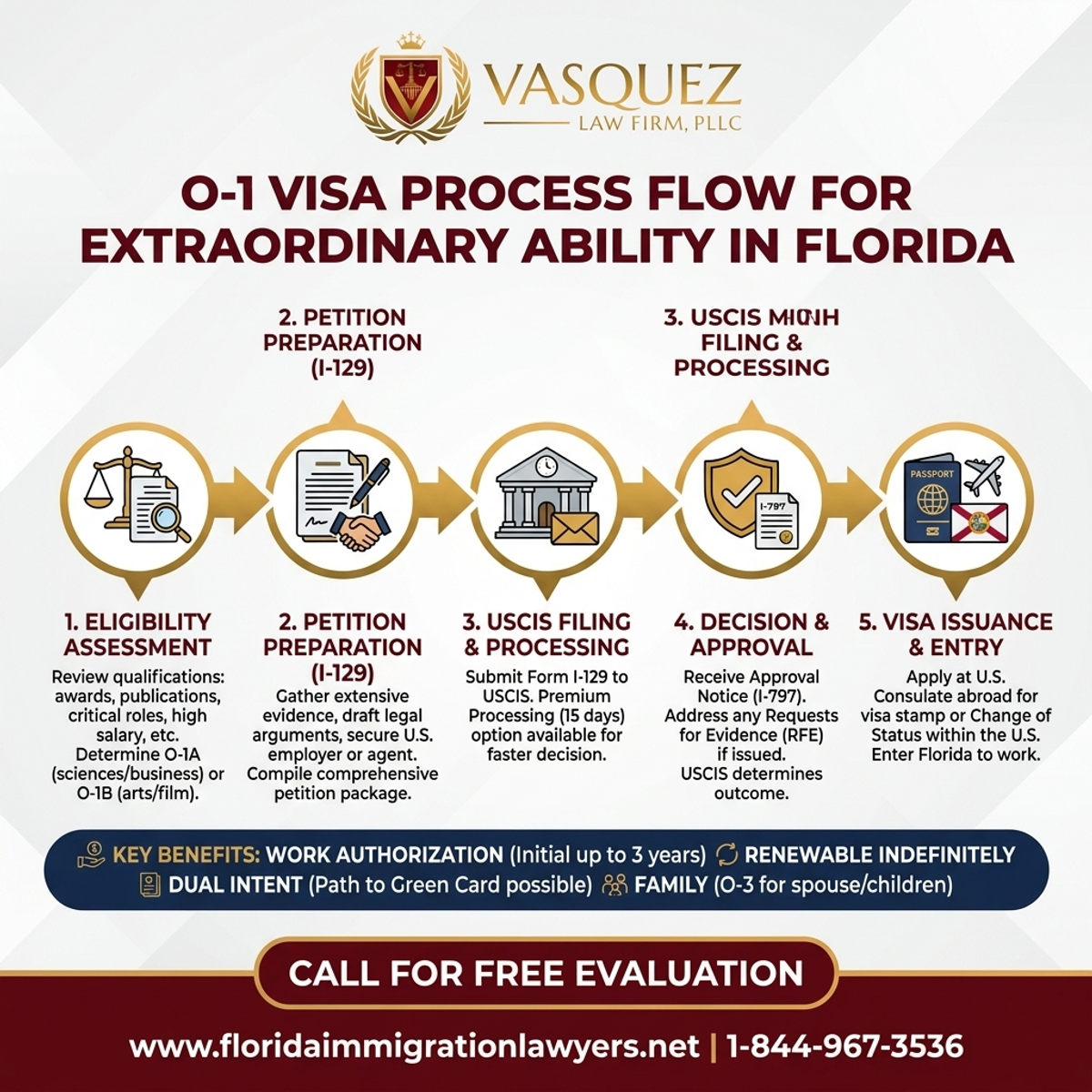
Step-by-Step Process — O-1 Visa for Extraordinary Ability in Florida | VLF Florida
Meeting these criteria requires meticulous documentation and strategic presentation. Each piece of evidence must clearly demonstrate how the applicant meets the standard of extraordinary ability. This is where the expertise of an immigration law firm becomes invaluable, helping to compile a robust petition.
Navigating the O-1 Visa Application Process: A Step-by-Step Guide
The O-1 visa application process, while straightforward in its steps, demands precision and comprehensive documentation. Understanding each phase is crucial for a successful outcome.
1. The Sponsoring Petitioner
Unlike some other visa categories, an O-1 visa applicant cannot self-petition. They must have a U.S. employer, a U.S. agent, or a foreign employer through a U.S. agent file the petition on their behalf. The petitioner will be responsible for filing Form I-129, Petition for a Nonimmigrant Worker, with U.S. Citizenship and Immigration Services (USCIS).
2. Consultation Requirement
A critical component of the O-1 petition is the consultation requirement. The petitioner must obtain a written advisory opinion from an appropriate peer group, labor organization, or management organization with expertise in the beneficiary's area of ability. This opinion should confirm the beneficiary's extraordinary ability and the nature of the proposed work. In cases where an appropriate peer group does not exist, this requirement may be waived.
3. Assembling the Petition Package
This is arguably the most intensive part of the process. The petition package must include:
- Form I-129, Petition for a Nonimmigrant Worker.
- The advisory opinion from a peer group or labor organization.
- Copies of all contracts between the petitioner and the beneficiary, or summaries of the terms of oral agreements.
- An itinerary of events or activities, if the beneficiary will be working for multiple employers or locations.
- Extensive evidence demonstrating the beneficiary's extraordinary ability, as per the criteria outlined above. This includes letters of recommendation from experts, awards, publications, media coverage, and evidence of high remuneration.
Every piece of evidence must be clearly labeled, organized, and accompanied by a detailed cover letter explaining how the evidence satisfies the regulatory requirements. The quality and quantity of this evidence directly impact the success of the petition.
4. Filing the Petition with USCIS
Once the complete package is assembled, the petitioner submits it to the appropriate USCIS service center. USCIS will then review the petition. Processing times can vary significantly, ranging from several months to over a year. However, petitioners have the option to request Premium Processing for an additional fee, which guarantees USCIS action on the petition within 15 calendar days.
5. Visa Interview (for those outside the U.S.)
If the beneficiary is outside the United States, once the I-129 petition is approved, they must apply for an O-1 visa stamp at a U.S. embassy or consulate in their home country. This usually involves an interview where the consular officer verifies the information provided in the petition and ensures the applicant meets all visa eligibility requirements. For those already in the U.S. on another valid nonimmigrant status, an approved I-129 can lead to a change of status without leaving the country.
Throughout this complex process, having dedicated legal counsel is not just helpful, but often essential. An attorney can ensure all forms are correctly filed, all evidence is compelling, and all deadlines are met, significantly increasing the chances of a successful O-1 visa approval.
Key Evidence Categories for O-1 Visa Applicants
Successfully demonstrating extraordinary ability hinges on presenting compelling and well-organized evidence. Here's a deeper look into the types of evidence that are highly valued:
- Awards and Prizes: Copies of certificates, plaques, and official announcements for national or international awards. The more prestigious and widely recognized the award, the stronger the evidence.
- Membership in Elite Associations: Documentation proving membership in organizations that require outstanding achievements for entry, judged by recognized experts.
- Published Material About You: Articles, interviews, or features in major newspapers, magazines, trade journals, or online publications discussing your work and achievements. This should be about you, not merely mentioning your name.
- Judging the Work of Others: Evidence of serving on a judging panel, peer review committee, or as an expert reviewer for publications, grants, or competitions in your field.
- Original Contributions of Major Significance: Letters from recognized experts in your field attesting to your original contributions and explaining their major significance. This could include patents, groundbreaking research, innovative business strategies, or artistic works that have influenced the field.
- Scholarly Articles: Copies of articles you have authored in professional journals, academic publications, or other major media outlets.
- High Remuneration: Contracts, pay stubs, tax returns, or other financial records demonstrating a significantly high salary or other forms of compensation compared to others in your field.
- Critical or Essential Role: Letters from high-ranking officials at distinguished organizations attesting to your critical or essential role within their establishment.
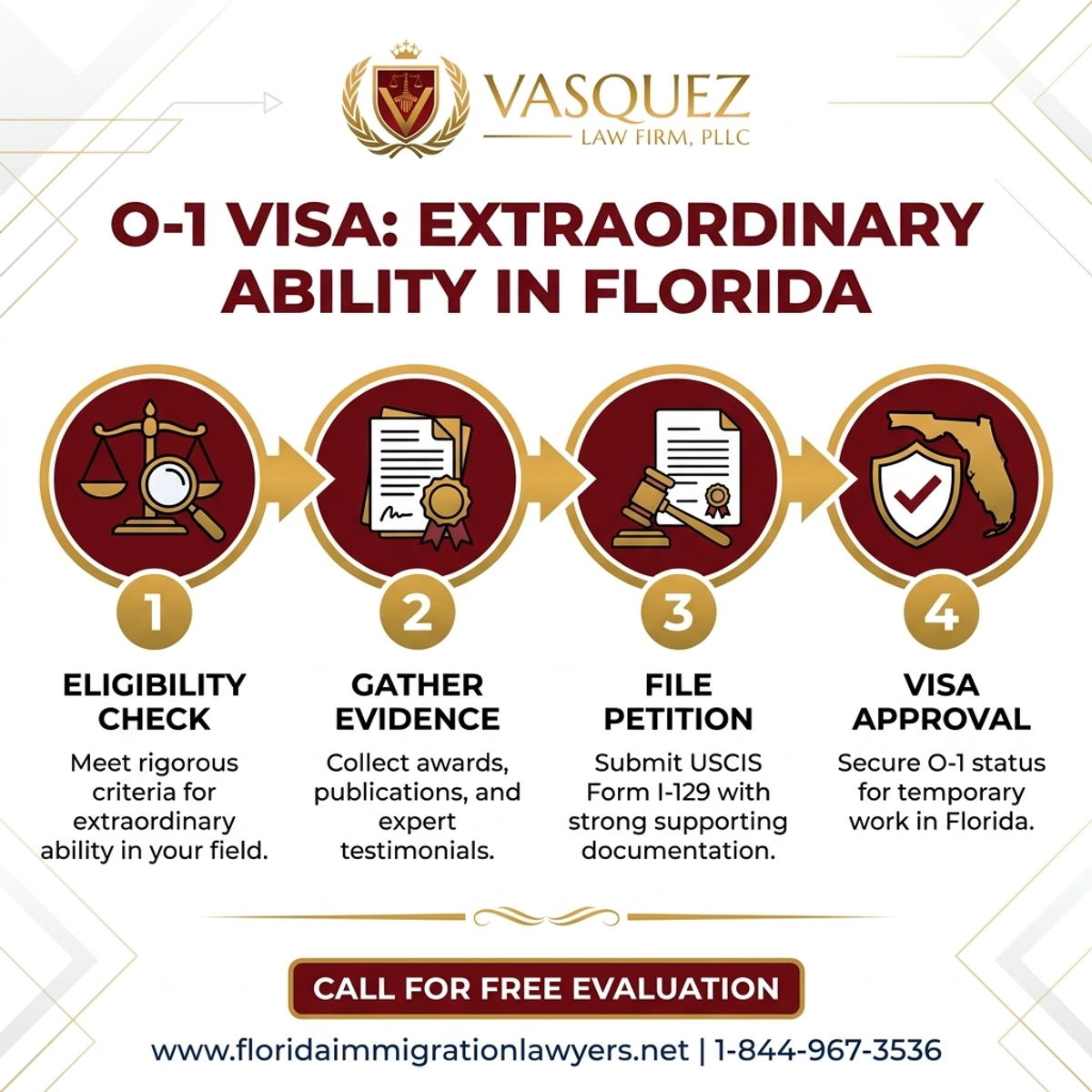
Key Statistics — O-1 Visa for Extraordinary Ability in Florida | VLF Florida
Each piece of evidence must be accompanied by a brief explanation of its relevance and how it supports your claim of extraordinary ability. The stronger and more diverse your evidence, the more compelling your petition will be.
Benefits of the O-1 Visa
The O-1 visa offers numerous advantages for individuals with extraordinary ability:
- Flexibility: The visa can be issued for up to three years initially and extended indefinitely in one-year increments, as long as the work continues in the field of expertise.
- Dual Intent: Unlike some other nonimmigrant visas, the O-1 visa is considered a 'dual intent' visa, meaning that O-1 visa holders can pursue permanent residency (Green Card) options without jeopardizing their O-1 status. This is a significant benefit for those planning a long-term future in the U.S.
- Family Inclusion: Spouses and unmarried children under 21 can apply for an O-3 dependent visa, allowing them to reside in the U.S. with the primary O-1 visa holder. O-3 visa holders can attend school but are generally not permitted to work.
- No Cap: There is no annual numerical cap on O-1 visas, meaning qualified individuals are not subject to the lottery system or lengthy backlogs often associated with other visa categories.
- Prestige: Holding an O-1 visa is a testament to an individual's exceptional talent and recognition in their field, opening doors to further opportunities and collaborations.
O-3 Visa for Dependents
The O-3 nonimmigrant visa is available to the spouse and unmarried children (under 21 years of age) of O-1 visa holders. O-3 visa holders are permitted to reside in the U.S. for the same duration as the O-1 principal applicant. While they can attend educational institutions, they are generally not authorized to work in the United States. This allows families to stay together while the O-1 visa holder pursues their extraordinary endeavors.
Maintaining Your O-1 Status and Extensions
Once granted, maintaining O-1 status requires adherence to certain regulations. The O-1 visa is tied to the specific employment or activities outlined in the approved petition. Any significant change in employment, such as a new employer or a substantial change in the nature of work, typically requires a new or amended I-129 petition to be filed with USCIS.
Extensions of the O-1 visa are possible in one-year increments, provided the O-1 holder continues to work in their area of extraordinary ability. The process for extension is similar to the initial petition, requiring updated evidence of continued extraordinary ability and a new I-129 form filed by the petitioner. Proactive planning for extensions is essential to avoid any lapse in status.
Common Challenges and How to Overcome Them
While the O-1 visa offers great opportunities, applicants often face challenges:
- Defining 'Extraordinary': The subjective nature of 'extraordinary ability' can make it difficult to know if one truly qualifies. A detailed assessment by an attorney can clarify this.
- Insufficient Documentation: Many applicants underestimate the volume and quality of evidence required. Gathering sufficient, compelling documentation is key.
- Weak Advisory Opinion: A lukewarm or unsupportive advisory opinion can severely weaken a petition. Ensuring the peer group understands the applicant's achievements is vital.
- Changes in Employment: As mentioned, changes in employers or job duties can necessitate new filings, adding complexity and cost.
- RFE (Request for Evidence): USCIS often issues RFEs when they need more information or clarification. Responding thoroughly and strategically to an RFE is critical for approval.
Overcoming these challenges often requires the guidance of an experienced legal professional who can anticipate potential issues, help gather robust evidence, and craft a persuasive argument for USCIS.
Why Choose a Florida Immigration Attorney for Your O-1 Visa?
Florida is a vibrant hub for innovation, arts, sports, and business, attracting extraordinary talent from around the globe. Navigating the complex U.S. immigration system, especially for a specialized visa like the O-1, requires expert guidance. A Florida-based immigration attorney brings several advantages:
- Local Expertise: Familiarity with local industries, professional organizations, and potential sponsors within Florida's diverse economy.
- Personalized Attention: The ability to meet in person, discuss your unique circumstances, and tailor a strategy specific to your field and achievements.
- Comprehensive Support: From initial assessment to petition filing and responding to RFEs, a dedicated legal team can manage all aspects of your O-1 application.
Our attorneys at VLF Florida are deeply committed to helping individuals with extraordinary ability achieve their American dreams. We understand the stringent requirements of the O-1 visa and work diligently to present the strongest possible case on your behalf. We pride ourselves on clear communication and strategic legal advice, ensuring you understand every step of the process.
Comparing O-1 with Other Visa Options (e.g., EB-1A)
For individuals with extraordinary ability, the O-1 visa is often a stepping stone or an alternative to other immigration pathways. One common comparison is with the EB-1A visa, which is an employment-based immigrant visa for individuals of extraordinary ability. While both require similar levels of achievement, the key difference is that O-1 is a nonimmigrant (temporary) visa, and EB-1A leads to permanent residency (a Green Card).
- O-1 Visa: Temporary, nonimmigrant, requires a U.S. petitioner.
- EB-1A Visa: Permanent residency, immigrant visa, allows for self-petitioning.
Many O-1 visa holders eventually transition to an EB-1A visa, leveraging the same evidence used for their O-1 petition. Understanding the long-term implications and aligning your visa strategy with your career goals is crucial. Our firm can help you explore all immigration options and determine the best path forward for your unique situation.
Beyond O-1: Other Immigration Pathways
While the O-1 visa is excellent for those with extraordinary ability, it's just one of many avenues for individuals seeking to live and work in the U.S. Depending on your circumstances, other options might be more suitable or necessary. For instance, individuals facing persecution in their home countries might qualify for asylum, offering a path to protection and eventual permanent residency. Similarly, those facing removal from the U.S. may require specialized legal assistance in deportation defense to protect their right to remain in the country. Our comprehensive immigration services cover a wide range of needs, ensuring that whatever your situation, you have access to expert legal counsel.
Contact VLF Florida Today
If you believe you possess extraordinary ability and are considering the O-1 visa as your pathway to the United States, particularly in Florida, don't navigate the complex immigration landscape alone. Our dedicated team at VLF Florida is here to provide expert legal guidance and support. We offer free consultations to assess your eligibility and discuss your options.
Call us today at (844) 967-3536 or contact us online to schedule your free consultation. Let us help you turn your extraordinary talent into an extraordinary future in Florida.
Sources and References
- U.S. Citizenship and Immigration Services (USCIS)
- Executive Office for Immigration Review (EOIR)
- U.S. Department of State - Bureau of Consular Affairs
- Immigration and Nationality Act (INA), 8 U.S.C. Chapter 12
Do Not Navigate This Process Alone
Our experienced immigration attorneys are ready to fight for you. Get a free, confidential consultation today.
Se Habla Español
Or leave your details and we’ll call you:
Free Evaluation in 24 Hours
Or talk to us right now
AI voice assistant — available 24/7
FreeFrequently Asked Questions

William J. Vásquez
Founding Attorney · Vasquez Law Firm
U.S. Air Force veteran and immigration attorney with years of hands-on U.S. immigration experience. J.D., NCCU School of Law. AILA member. Admitted to the 4th, 5th, and 11th Circuit Courts.
Available 24/7 - Free Evaluations
Reviewed for legal accuracy by William J. Vásquez
Licensed in North Carolina; U.S. immigration is federal practice.
Related Legal Services
Our Florida immigration attorneys can help you with asylum protection, citizenship and naturalization and immigration practice areas. Call today at 1-844-967-3536 for a free consultation.
Related Links
Related Topics
Free Legal Case Review
Discuss your case with our experienced attorneys. We're available 24/7.
Se Habla Español - Estamos aquí para ayudarle.
Related Articles
Immigration Lawyer Orlando Free Consultation in Florida
For individuals and families in Orlando, Florida, navigating the complexities of U.S. immigration law requires expert guidance. An immigration lawyer in Orlando offers crucial support for everything from visa applications and green card processes to naturalization and deportation defense. This comprehensive guide details what a free consultation covers, providing a step-by-step overview of immigration pathways, essential document checklists, and expected timelines in 2026. We also highlight common mistakes to avoid, discuss the critical role of legal counsel in deportation and asylum cases, and explain why choosing a local Orlando immigration attorney is beneficial. Florida Immigration Lawyers is dedicated to serving the diverse community of Orlando with compassionate, effective legal solutions, ensuring you receive personalized advice and robust representation for a successful immigration journey.
Work Permit Application in Florida 2026
For many non-citizens in Florida, an Employment Authorization Document (EAD) or work permit is essential for legal employment. This comprehensive guide from Florida Immigration Lawyers details the application process for 2026, covering who is eligible, the step-by-step procedure for filing Form I-765, and the critical documents required. Learn about current processing times, associated costs, and common mistakes to avoid. Whether you're an asylum seeker, adjusting your status, or an international student, understanding these requirements is vital. Our firm, serving all of Florida from Orlando, offers expert legal assistance, free case reviews, and bilingual support to help you navigate the complexities of obtaining and maintaining your work authorization.
Investor Visa Immigration Services Florida in 2026
Florida is a prime destination for foreign investors seeking U.S. immigration opportunities. This guide from Florida Immigration Lawyers explores the two primary investor visa categories: the EB-5 Immigrant Investor Program and the E-2 Treaty Investor Visa. The EB-5 offers a path to a Green Card through substantial investment and job creation in Florida's diverse economy, with options for reduced investment in Targeted Employment Areas. The E-2 visa provides a renewable non-immigrant status for entrepreneurs from treaty countries looking to operate a business in the state. We detail the rigorous eligibility requirements, the multi-stage application processes, the extensive documentation needed, and the typical timelines and costs involved for both visa types. Crucially, we highlight common mistakes to avoid, such as issues with source of funds or inadequate business plans, and emphasize when professional legal counsel is indispensable. Florida Immigration Lawyers provides expert guidance for investor visa immigration services in Florida, ensuring compliance and maximizing your chances of success. Contact us for a free case review.
Employment Immigration Attorney Florida: Your 2026 Guide
For foreign nationals seeking to work in the U.S. or Florida businesses hiring international talent, navigating employment immigration can be complex. An employment immigration attorney in Florida provides essential guidance on various work visas like H-1B, L-1, E-2, and O-1, as well as employment-based green cards (EB-1 to EB-5). This comprehensive 2026 guide covers eligibility criteria, the multi-step application process, required documentation, and typical costs involved. It also highlights common mistakes to avoid, such as incomplete forms or missed deadlines, which can lead to significant delays or denials. Whether you're an employer in Central Florida or a skilled professional, understanding the nuances of immigration law is crucial. Florida Immigration Lawyers offers expert legal support, ensuring compliance with federal regulations and providing strategic advice for successful outcomes. We offer free case reviews and serve clients across all of Florida.