Consular Processing for Florida Applicants
Consular processing is crucial for individuals in Florida seeking immigrant visas. This guide covers everything from document submission to the embassy interview. Contact Florida Immigration Lawyers for expert assistance.

- Consular processing is for obtaining immigrant visas.
- Applicants in Florida must follow specific guidelines.
- Prepare for the embassy interview thoroughly.
Introduction
Imagine you've just received notice that your family member's immigrant visa petition has been approved, and now you're looking at the next steps for consular processing. This process can seem complex, especially for applicants in Gainesville and other parts of Florida. In this article, we will cover everything you need to know about consular processing, including how to navigate the National Visa Center (NVC) and prepare for your embassy interview. Call Florida Immigration Lawyers at 1-844-967-3536 for a free consultation.
For many families in Florida, the journey to reunite with loved ones through an immigrant visa is a deeply personal and often challenging one. Understanding each phase of consular processing is not just about ticking boxes; it's about ensuring a smooth transition for your family member into their new life in the United States. From the initial petition approval to the final visa stamp, every detail matters.
Navigating the intricacies of U.S. immigration law from Florida requires careful attention and often, expert guidance. Whether you're in Miami, Orlando, or a smaller community, the principles of consular processing remain the same, but local support can make a significant difference. This guide aims to demystify the process, offering practical advice and highlighting crucial considerations for Florida residents sponsoring family members or employees.
What is Consular Processing?
Consular processing is the procedure that allows individuals outside the United States to apply for an immigrant visa through a U.S. embassy or consulate. This process is typically used by those who have an approved petition and are ready to immigrate to the U.S. legally. As of 2026, the process involves several stages, each requiring meticulous preparation and attention to detail.
Unlike adjustment of status, which is for individuals already present in the U.S. seeking to change their immigration status, consular processing is exclusively for those residing abroad. It's a critical pathway for family-based immigrant visas (like those sponsored by U.S. citizens or lawful permanent residents) and employment-based immigrant visas. The U.S. Department of State oversees this process, working in conjunction with U.S. Citizenship and Immigration Services (USCIS) and the National Visa Center (NVC).
The journey begins with USCIS, which approves the underlying immigrant petition (e.g., Form I-130 for family members or Form I-140 for employees). Once approved, the case transitions to the NVC, a central hub for collecting and pre-processing visa applications. The NVC ensures all required documents are submitted and fees are paid before forwarding the case to the specific U.S. embassy or consulate where the applicant will be interviewed. This multi-agency coordination underscores the need for thoroughness at every stage.
The first step in consular processing is submitting the necessary documents to the National Visa Center (NVC). Once the NVC has reviewed and accepted your documents, your case will be forwarded to the appropriate U.S. embassy or consulate for an interview, which is the final step before visa issuance.
How to Prepare for Your Embassy Interview in Florida?
Preparing for your embassy interview is crucial in the consular processing journey. The interview determines your eligibility for an immigrant visa and is conducted at the designated U.S. embassy or consulate.
As of 2026, you should ensure that all your documentation is complete and accurate. This includes your passport, visa application (DS-260), and any required financial and civil documents. It's also essential to be truthful and concise in your responses during the interview.
Beyond just gathering documents, effective preparation involves understanding the interview's purpose: to verify the information in your application and confirm your eligibility and intent to immigrate. Practice answering common questions about your relationship with the petitioner, your plans in the U.S., and your background. For example, if you are applying for a family-based visa, be ready to discuss how you met your spouse, significant dates in your relationship, and details about your family life. Consistency between your application and your interview responses is paramount.
Consider conducting mock interviews with a trusted friend or family member, or even better, with an experienced immigration lawyer from Florida Immigration Lawyers. This practice can help you feel more confident and articulate your answers clearly under pressure. Organize your documents meticulously in a binder, with tabs for easy access, ensuring you have both originals and copies. Being well-prepared demonstrates respect for the process and helps alleviate nervousness on the day of the interview.
To increase your chances of success, consider practicing common interview questions and reviewing your application thoroughly. Remember, the interview's purpose is to confirm your eligibility and intentions, so clarity and honesty are key.
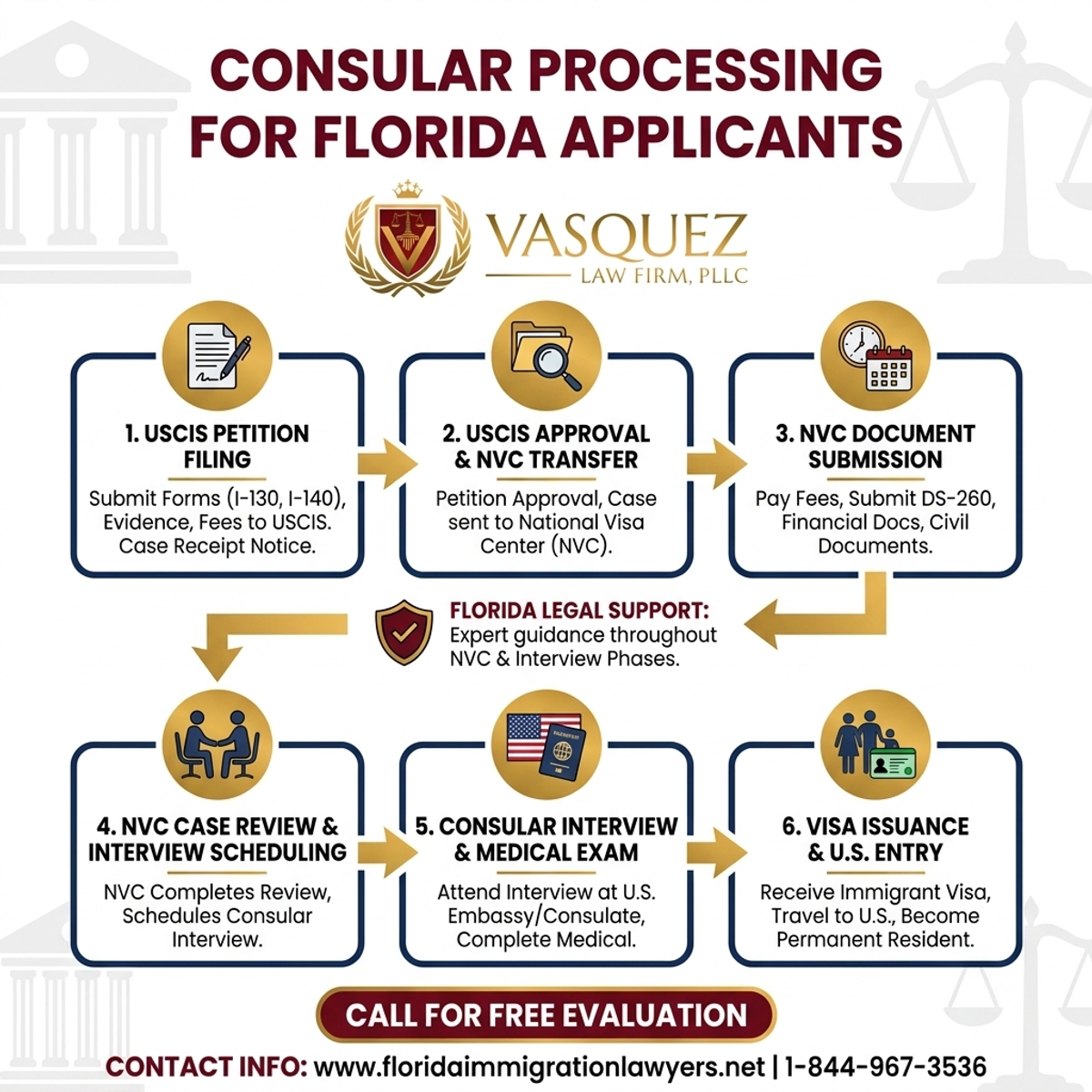
Step-by-Step Process — Consular Processing for Florida Applicants
What Documents are Required for Consular Processing?
The success of your consular processing application hinges significantly on the completeness and accuracy of your submitted documents. Gathering all necessary paperwork is a critical, often time-consuming, step that demands meticulous attention to detail. Missing or incorrect documents can lead to significant delays or even denial, making it essential to prepare thoroughly.
- Approved I-130 or I-140 petition
- DS-260 Immigrant Visa Application
- Passport (valid for at least six months beyond your intended entry date)
- Two photographs (meeting U.S. visa photo requirements)
- Birth certificate
- Marriage certificate (if applicable)
- Police certificates from all countries of residence since age 16
- Affidavit of Support (Form I-864)
- Medical examination results from a designated physician
Ensure all documents are originals or certified copies and are translated into English if necessary.
It is crucial to have all civil documents (birth, marriage, divorce certificates, police records) in their original form or as certified copies. Any document not in English must be accompanied by a certified English translation. Keep digital copies of everything submitted, and bring both originals and photocopies to your interview. A well-organized document portfolio can streamline your interview and demonstrate your readiness to the consular officer.
Timeline and Processing Expectations
Understanding the potential timeline for consular processing is vital for managing expectations, although it's important to remember that these are always estimates. Various factors, including the specific visa category, the country of origin, and current NVC and embassy workloads, can influence how long your case takes. Patience and proactive monitoring are key throughout this journey.
| Stage | Typical Timeframe | Notes |
|---|---|---|
| Petition Approval | 6-12 months | Varies by case and USCIS workload |
| NVC Processing | 4-6 weeks | After receiving all documents |
| Embassy Interview Scheduling | 1-3 months | Depends on embassy location |
| Visa Issuance | 1-2 weeks | Post-interview |
These timeframes are estimates and can vary based on individual circumstances and current processing conditions.
For instance, visa categories with annual numerical limits, such as certain family preference categories, are subject to the Visa Bulletin, which can introduce additional waiting periods based on the applicant's priority date. Economic or political events, global health crises, or staffing changes at specific embassies can also impact processing times. Regularly checking the USCIS and Department of State websites for updates is advisable.
While these estimates provide a general framework, it's always best to prepare for potential delays. Maintaining open communication with the NVC and responding promptly to any requests for additional information can help keep your case moving forward. If you notice unusually long delays or have concerns about your case status, contacting Florida Immigration Lawyers at 1-844-967-3536 can provide clarity and potential advocacy.
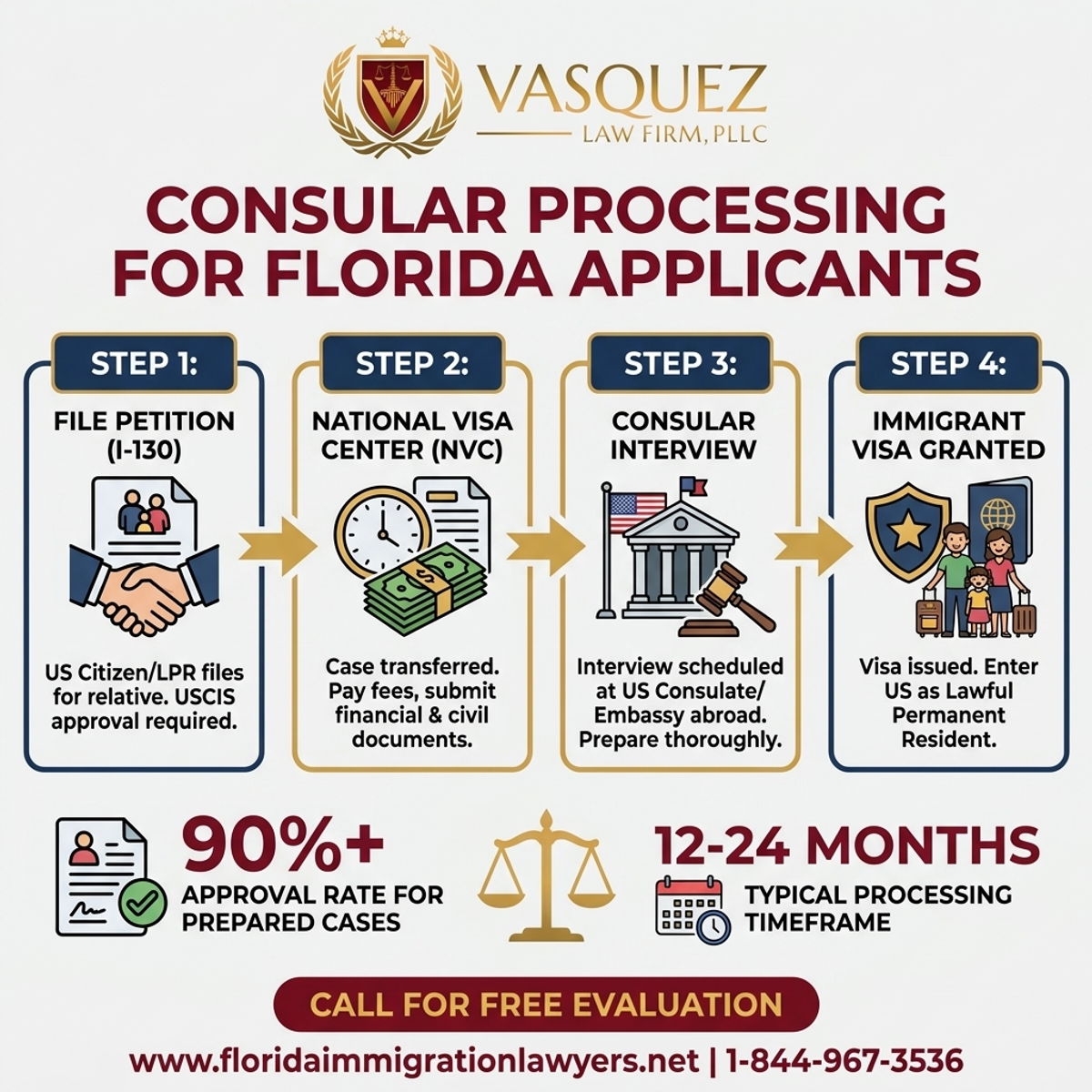
Key Statistics — Consular Processing for Florida Applicants
Cost Factors and Fee Breakdown
Embarking on the consular processing journey involves a series of fees that can add up, making financial planning an essential part of your preparation. Understanding the various costs involved, from application fees to travel expenses, will help you budget effectively and avoid unexpected financial burdens that could delay your application.
| Item | Typical Fee | Notes |
|---|---|---|
| Visa Application Fee | Varies | Payable to the NVC |
| Medical Examination | Varies | Costs depend on provider |
| Travel Expenses | Varies | Consider accommodations if traveling to an embassy |
Be sure to budget for both the application process and any additional travel-related expenses.
Beyond the direct government fees, applicants should account for costs such as document translation and certification, courier services for sending documents, and potential legal fees if you choose to work with an immigration attorney. Moreover, travel to the designated U.S. embassy or consulate for the interview can be a significant expense, especially if it requires international travel, accommodation, and local transportation. For applicants in Florida sponsoring family abroad, these costs can accumulate quickly.
It's advisable to create a detailed budget early in the process, factoring in all potential expenditures. Keep receipts for all payments made, as these may be useful for your records. Remember that fees are generally non-refundable, regardless of the outcome of your visa application. Consulting with Florida Immigration Lawyers can help you understand the full financial scope and ensure you are prepared for all required payments.
Do not navigate this process alone. Contact Florida Immigration Lawyers today.
Common Mistakes to Avoid
Consular processing is a detailed and often unforgiving process. Even minor errors can lead to significant delays, requests for additional evidence, or even outright denials. Being aware of the most common pitfalls and taking proactive steps to avoid them is crucial for a successful outcome and can save you considerable time, money, and stress.
- Missing Document Deadlines: Can delay the entire process significantly.
- Inaccurate Information on Forms: Leads to denials or requests for additional evidence.
- Not Preparing for the Interview: Results in failed interviews and visa denials.
- Ignoring NVC Correspondence: Causes missed deadlines and case closures.
- Incorrect Fee Payment: Can result in processing delays.
- Failure to Attend Medical Exam: Leads to incomplete application.
- Overlooking New Immigration Policies: Misses opportunities or exposes one to risks.
- Not Seeking Legal Advice: Can overlook critical legal requirements or options.
- Submitting Photocopies Without Originals: Causes delays or rejections.
- Assuming Timeline Guarantees: Processing times can vary greatly.
Many of these mistakes stem from a lack of understanding of the complex immigration regulations or simply from underestimating the strictness of the process. For instance, providing inconsistent information between different forms or during the interview can raise red flags for consular officers, leading to intensified scrutiny or even accusations of misrepresentation. It's always better to double-check every piece of information and document before submission.
To mitigate these risks, consider establishing a detailed checklist and timeline for your application. Engage with resources like the Department of State's website and, critically, consider professional legal assistance. An experienced immigration lawyer from Florida Immigration Lawyers can help you meticulously review your application, prepare for your interview, and ensure compliance with all requirements, significantly increasing your chances of success.
When to Call a Lawyer
If you're feeling overwhelmed by the consular processing steps or encounter any issues, it's wise to consult with an immigration lawyer. Specific scenarios, such as receiving a denial notice, unclear communication from the NVC, or complex family situations, warrant professional legal advice. Florida Immigration Lawyers are here to assist you with these complexities.
Beyond general overwhelm, certain red flags should immediately prompt you to seek legal counsel. These include a history of immigration violations, past criminal convictions (even minor ones), previous visa denials, or any doubts about meeting the financial support requirements (Affidavit of Support). These issues often involve waivers or complex legal arguments that are best handled by an expert.
For example, imagine a scenario where your sponsored family member had a minor misdemeanor conviction from years ago that you believe is irrelevant. Without legal guidance, you might overlook the need to address this in the application, potentially leading to a denial. An attorney can assess the conviction's impact, advise on potential waivers, and prepare a strong legal argument to present to the consular officer. Don't risk a denial due to an oversight; call Florida Immigration Lawyers at 1-844-967-3536 for peace of mind.
Furthermore, if there are changes in your family structure (e.g., marriage, divorce, birth of a child) after the initial petition is filed, or if you receive a Request for Evidence (RFE) from USCIS or the NVC, an attorney can guide you on how to properly update your case and respond to these requests, ensuring your application remains on track and compliant with current regulations.
About Florida Immigration Lawyers
Florida Immigration Lawyers is your trusted partner for navigating the immigration process. We provide comprehensive services, including consular processing, asylum, deportation defense, citizenship, family immigration, and business immigration. Contact us at 1-844-967-3536 or visit our website at https://www.floridaimmigrationlawyers.net for a free consultation. Available 24/7, we proudly serve all of Florida.
Our team of dedicated legal professionals understands the unique challenges faced by individuals and families in Florida seeking to navigate the complex U.S. immigration system. With years of experience and a deep commitment to our clients, we offer personalized strategies tailored to your specific situation, ensuring you receive the most effective and compassionate representation possible.
We pride ourselves on clear communication, keeping you informed at every stage of your consular processing journey. From meticulously preparing your application to coaching you for your embassy interview, we are with you every step of the way. Our goal is not just to process paperwork, but to provide peace of mind and help you achieve your immigration dreams. Call us today for a free, confidential consultation.
Frequently Asked Questions (FAQs)
Below are some common questions regarding consular processing, along with practical advice to help you navigate the process effectively.
What if my documents are not in English?
All documents submitted for consular processing that are not in English must be accompanied by a certified English translation. The translation must be complete and accurate, and the translator must certify that they are competent to translate and that the translation is accurate. Failure to provide certified translations can lead to significant delays, so ensure this step is completed meticulously.
Can I change my interview location?
Generally, immigrant visa interviews are scheduled at the U.S. embassy or consulate in the applicant's country of residence. While it is sometimes possible to request a change of interview location to another country, it is usually only granted in exceptional circumstances and at the discretion of the Department of State. Such requests can cause delays and are not guaranteed, so it's best to consult with Florida Immigration Lawyers if you need to explore this option.
What happens if my visa is denied?
If your immigrant visa is denied, the consular officer will typically provide a reason for the denial. This could be due to an ineligibility, missing documents, or other issues. Depending on the reason, you might be able to appeal the decision, submit additional documents, or apply for a waiver. It's crucial to understand the exact reason for denial and consult with an immigration attorney from Florida Immigration Lawyers immediately to discuss your options and potential next steps.
How long is the immigrant visa valid once issued?
An immigrant visa is typically valid for up to six months from the date of issuance. This means the visa holder must enter the United States within that six-month period. It's important to plan your travel accordingly to ensure you enter the U.S. before your visa expires. If you cannot travel within this timeframe, you might need to reapply for the visa, which can be a lengthy process.
Do I need to undergo a medical exam if I recently had one for another visa type?
Yes, for immigrant visas, you are generally required to undergo a specific medical examination by a panel physician authorized by the U.S. embassy or consulate, even if you've recently had a medical exam for a non-immigrant visa. The requirements for immigrant visa medical exams are very strict and comprehensive, focusing on public health concerns. Ensure you follow the specific instructions provided by the NVC and the embassy regarding the medical examination process.
Sources and References
- U.S. Citizenship and Immigration Services (USCIS)
- Executive Office for Immigration Review (EOIR)
- U.S. Department of State
- 8 U.S.C. Chapter 12 - Immigration and Nationality Act
Related services: immigration practice areas, family immigration services.
This article provides general legal information and is not intended as legal advice. Every case is unique, and outcomes depend on specific facts and circumstances. Contact an attorney for advice about your particular situation.
Final CTA
Ready to begin your consular processing journey? Call Florida Immigration Lawyers at 1-844-967-3536 for your free consultation. Se Habla Español - Estamos aquí para ayudarle.
Navigating the complexities of U.S. immigration law can be daunting, but you don't have to face it alone. Our experienced team is dedicated to providing the guidance and support you need to achieve your immigration goals efficiently and effectively. We understand the nuances of consular processing for Florida residents and their families abroad.
Take the first crucial step towards securing your future or reuniting with your loved ones. Our compassionate and knowledgeable attorneys are available 24/7 to answer your questions and provide personalized legal strategies. Don't let uncertainty delay your dreams – contact Florida Immigration Lawyers today and let us help you move forward with confidence.
If you need legal assistance, learn more about learn about our immigration practice, or call us at 1-844-967-3536 for a free consultation.
Do Not Navigate This Process Alone
Our experienced immigration attorneys are ready to fight for you. Get a free, confidential consultation today.
Se Habla Español
Frequently Asked Questions
Harold Estrada-Rodriguez
Florida Immigration Attorney · FL Bar No. 1041171
Florida Bar attorney handling Florida-jurisdiction immigration matters. Bilingual representation, free consultations.
Available 24/7 - Free Evaluations
Related Legal Services
Our Florida immigration attorneys can help you with deportation defense, citizenship and naturalization and family immigration services. Call today at 1-844-967-3536 for a free consultation.
Related Links
Related Topics
Free Legal Consultation
Discuss your case with our experienced attorneys. We're available 24/7.
Se Habla Español - Estamos aquí para ayudarle.
Related Articles
Immigration Attorney in Lakeland, Polk County | VLF Florida
Navigating immigration in Lakeland, Polk County, can be challenging. This guide helps you find the right immigration attorney to secure your future in the U.S. Learn how experienced legal help can make all the difference, especially amid 2026's shifting policies. Call 1-844-967-3536 for a free consultation.
Immigration Services in Jacksonville Florida | VLF Florida
Discover comprehensive immigration services in Jacksonville, Florida. From visa applications to deportation defense, learn how to navigate the U.S. immigration system effectively. Call Florida Immigration Lawyers at 1-844-967-3536 for a free consultation.
Fiance Visa Florida: K-1 Process Guide for 2026 | VLF Florida
For U.S. citizens in Florida, bringing a foreign fiance(e) to the U.S. via the K-1 visa involves intricate steps, from USCIS petitions to consular interviews and eventual Adjustment of Status. This comprehensive guide details the 2026 process, eligibility, required documents, timelines, and costs. Learn how to navigate the complexities, avoid common mistakes, and secure your future together in Florida. Florida Immigration Lawyers offers expert guidance, ensuring your application is meticulously prepared and submitted. We provide free consultations to help you understand your options and achieve your immigration goals.
Understanding Immigration Appeals with BIA in Florida
Navigating an immigration appeal with the Board of Immigration Appeals (BIA) in Florida requires understanding specific legal processes and requirements. This comprehensive guide covers everything from filing deadlines to common mistakes. Contact Florida Immigration Lawyers for expert legal assistance.