Dual Citizenship Florida: Your 2026 Guide to Two Passports
Exploring dual citizenship in Florida opens doors to expanded rights and opportunities, allowing individuals to hold two passports simultaneously. This detailed 2026 guide covers eligibility through naturalization, step-by-step processes, essential documentation, and expected timelines and costs. We delve into the benefits, such as enhanced travel freedom and property rights, alongside potential challenges like tax obligations. Learn how U.S. law generally permits dual nationality, but also understand the critical need to verify your country of origin's stance. Avoid common pitfalls and discover when expert legal counsel from Florida Immigration Lawyers is essential to navigate this intricate journey successfully. Our firm provides comprehensive support for residents across Florida.

Dual citizenship in Florida, as throughout the United States, is generally permissible, meaning U.S. law does not require you to renounce your previous nationality when becoming a U.S. citizen. This allows individuals to hold citizenship in both the U.S. and another country simultaneously, offering various benefits like increased travel freedom and property rights. Achieving dual citizenship often involves naturalization in the U.S. while maintaining your birth country's citizenship, or vice-versa. Understanding the specific laws of both nations is crucial, as some countries do not permit dual nationality. Consulting with an experienced Florida immigration lawyer is essential to navigate this complex process effectively.
- The U.S. generally permits dual nationality; you don't typically need to renounce foreign citizenship.
- Eligibility for U.S. citizenship is a key path, often through naturalization.
- Both your home country's laws and U.S. laws must allow for dual citizenship.
- Benefits include increased travel, property rights, and political participation.
- Seek legal advice from Florida Immigration Lawyers to ensure compliance and avoid pitfalls.
Imagine having the freedom to live, work, and travel with the full rights of two nations. For many residents of Florida, especially those with strong ties to their home countries, the concept of dual citizenship Florida offers just that opportunity. It means holding two passports and enjoying the privileges and responsibilities of both the United States and another country simultaneously. This pathway can unlock a world of possibilities, from easier international travel to expanded property ownership and political participation.
As of 2026, understanding the nuances of dual nationality is more important than ever. While the U.S. generally permits dual citizenship, the process involves navigating complex U.S. immigration laws and the specific regulations of your home country. This comprehensive guide from Florida Immigration Lawyers will demystify dual citizenship, covering eligibility, the naturalization process, common challenges, and how to successfully achieve your goal of holding two passports. We will focus on the unique aspects relevant to individuals residing in Florida, including USCIS field offices and local immigration courts.
Do you have questions about your eligibility or the steps involved? Navigating the intricate pathways to dual citizenship requires precise legal knowledge and strategic planning. Don't leave your future to chance. Call Florida Immigration Lawyers at 1-844-967-3536 for a free consultation and let our experienced team guide you through every stage of the process.
What is Dual Citizenship and How Does it Work in Florida?
Dual citizenship, also known as dual nationality, is the status of being a citizen of two countries simultaneously. In the United States, the concept of dual citizenship is generally permitted under U.S. law. This means that when an individual becomes a naturalized U.S. citizen, they are typically not required to formally renounce their prior citizenship. However, it is crucial to understand that while the U.S. allows dual nationality, your country of origin may not. Some nations have strict laws against holding multiple citizenships and may require you to forfeit your original nationality upon acquiring U.S. citizenship. This is why thorough research into the laws of both countries is paramount.
For individuals in Florida, the principle of dual citizenship operates identically to any other state. The U.S. Constitution and federal immigration laws govern citizenship matters, not state laws. Therefore, whether you reside in Orlando, Miami, or Tampa, the federal standards for acquiring U.S. citizenship and the U.S. government's stance on dual nationality apply uniformly. The process often involves becoming a naturalized U.S. citizen, which is the most common path for immigrants to gain citizenship. This involves meeting specific residency, moral character, and English language requirements, among others, as outlined in the Immigration and Nationality Act (INA).
Holding dual citizenship offers a range of benefits, including the right to vote, hold public office, and travel freely between both countries without needing a visa. It can also provide access to social services, property ownership rights, and business opportunities in both nations. Conversely, it also entails responsibilities such as tax obligations in both countries, depending on their tax treaties. Understanding these implications is vital for anyone considering this path. Florida Immigration Lawyers can help you assess your situation and ensure you meet all legal requirements in the U.S.
Who is Eligible for Dual Citizenship in the U.S. in 2026?
Eligibility for dual citizenship in the U.S. primarily revolves around how you acquire U.S. citizenship, as the United States does not explicitly grant dual citizenship but rather permits it. As of 2026, there are several common pathways. The most frequent path for foreign nationals residing in Florida is through naturalization, where an eligible lawful permanent resident (green card holder) applies to become a U.S. citizen. To qualify for naturalization, applicants must generally be at least 18 years old, have been a lawful permanent resident for a specified period (typically five years, or three years if married to a U.S. citizen), demonstrate continuous residency and physical presence in the U.S., possess good moral character, and pass English and civics tests.
Another significant pathway to dual citizenship is through birth. A child born in the United States to foreign parents automatically acquires U.S. citizenship under the 14th Amendment (birthright citizenship), regardless of their parents' immigration status. If one or both parents are also citizens of another country, the child may simultaneously acquire citizenship in that country, depending on its laws. Similarly, a child born outside the U.S. to at least one U.S. citizen parent may acquire U.S. citizenship at birth, often referred to as derivative citizenship, while also retaining citizenship of their birth country.
It is important to remember that while the U.S. permits dual nationality, the other country involved must also have laws that allow it. For example, some countries automatically revoke citizenship if you naturalize in another nation, while others require an oath of allegiance that may be interpreted as renouncing prior loyalties. Understanding these reciprocal laws is critical. Our team at Florida Immigration Lawyers can help you investigate the specific requirements and implications for your country of origin, providing tailored advice for your situation in Florida.
What is the Step-by-Step Process for Naturalization and Dual Nationality?
The step-by-step process for achieving U.S. naturalization, which often leads to dual nationality, involves careful preparation and adherence to USCIS regulations. As of 2026, the general steps remain consistent, requiring diligent attention to detail. This guide outlines the typical journey for individuals in Florida seeking to become U.S. citizens while potentially retaining their original citizenship. Each stage requires specific documentation and careful completion to avoid delays or denials. We recommend consulting with an attorney to ensure accuracy.
-
Determine Eligibility: First, ensure you meet the basic requirements for naturalization, such as age, continuous residency, physical presence, good moral character, and English/civics proficiency. For most applicants in Florida, this means being a lawful permanent resident for at least five years (or three years if married to a U.S. citizen) and having been physically present in the U.S. for at least half of that time. Review INA Section 316 for general requirements or INA Section 319(a) for spouses of U.S. citizens.
-
Prepare and File Form N-400, Application for Naturalization: This is the primary application form for U.S. citizenship. You will need to gather extensive supporting documents, including your Green Card, passports, birth certificate, marriage certificate (if applicable), tax returns, and records of any arrests or detentions. Ensure all information is accurate and consistent with your immigration records. Filing can be done online or by mail to the appropriate USCIS Lockbox facility.
-
Attend Biometrics Appointment: After filing, USCIS will send you an appointment notice for biometrics collection at an Application Support Center (ASC) in Florida, such as the one in Orlando or Miami. This involves fingerprinting, photographs, and a signature, which are used for background checks by the FBI.
-
Complete the Naturalization Interview: You will be scheduled for an interview with a USCIS officer at a local field office (e.g., Orlando, Tampa, or Miami). During the interview, the officer will review your N-400 application, test your English reading, writing, and speaking abilities, and administer a civics test. They will also assess your good moral character and confirm your eligibility. Be prepared to answer questions about your application truthfully and completely.
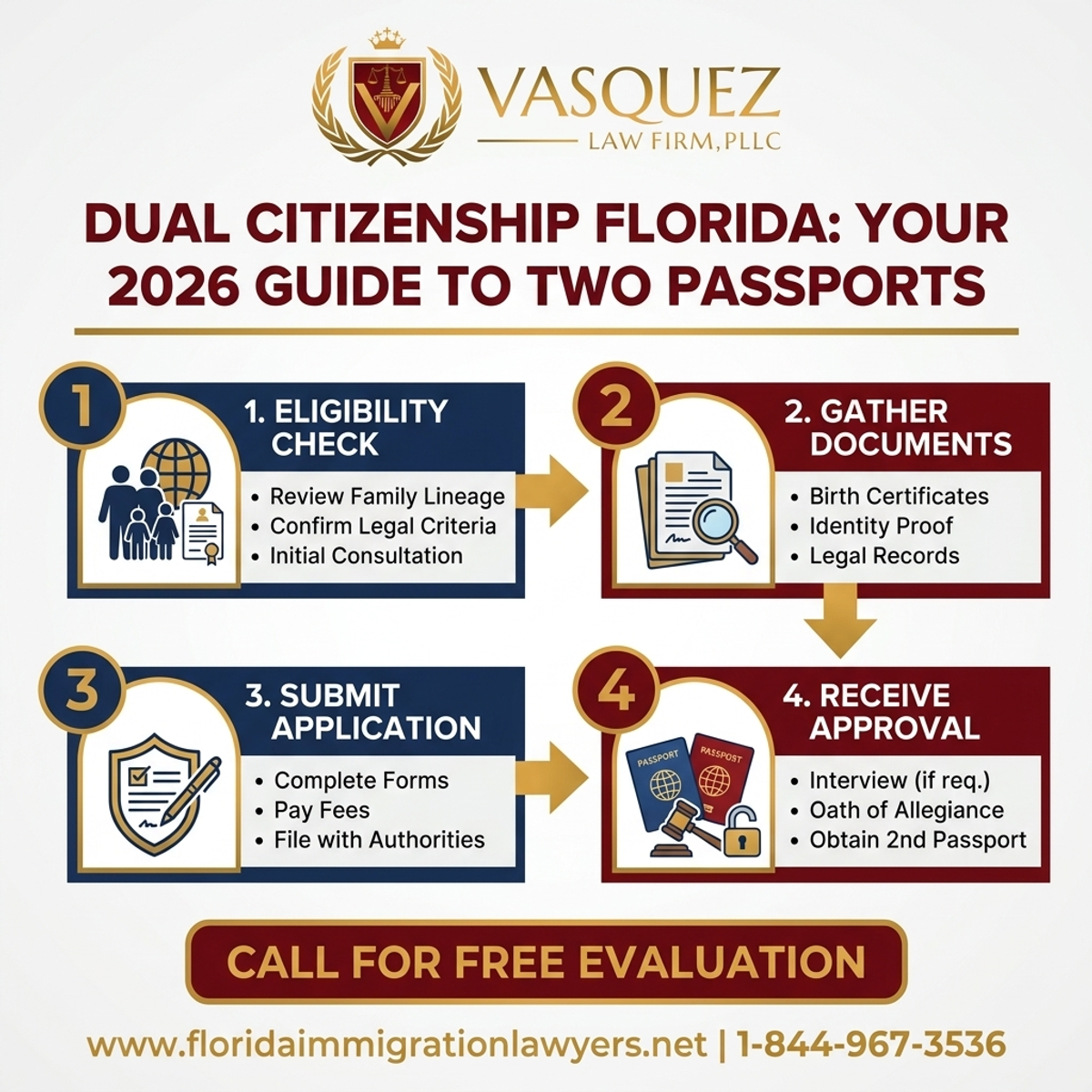
Step-by-Step Process — Dual Citizenship Florida: Your 2026 Guide to Two Passports
-
Receive Decision and Attend Oath of Allegiance Ceremony: If your application is approved, USCIS will send you a notice for the Oath of Allegiance Ceremony. This is the final step where you take an oath affirming your loyalty to the United States. Upon taking the oath, you officially become a U.S. citizen and receive your Certificate of Naturalization. This certificate is proof of your U.S. citizenship, which you can then use to apply for a U.S. passport.
-
Apply for a U.S. Passport: Once you have your Certificate of Naturalization, you can apply for a U.S. passport. This will be your primary travel document as a U.S. citizen. At this point, if your country of origin allows dual citizenship, you can maintain your foreign passport as well, effectively holding two passports.
What Documents Do I Need for Naturalization in Florida?
Gathering the correct documentation is a critical part of the naturalization process, especially for those in Florida aiming for dual citizenship. As of 2026, USCIS requires a comprehensive set of documents to support your Form N-400 application. Missing or incorrect documents can lead to significant delays or even denial. It is always advisable to make copies of everything you submit and to bring originals to your interview if requested. Our team can help you prepare a meticulous package of documents to ensure your application is complete and accurate.
Here is a general checklist of documents you will typically need:
- Lawful Permanent Resident Card (Green Card): Your original Form I-551.
- State-Issued Identification: Your driver's license or state ID card.
- Passports: All passports you have held, both U.S. (if applicable) and foreign.
- Birth Certificate: Your original birth certificate.
- Marriage Certificate (if applicable): If you are applying based on marriage to a U.S. citizen, your original marriage certificate.
- Divorce Decrees or Death Certificates (if applicable): For any previous marriages of yourself or your spouse.
- Evidence of Marital Union (if applicable): Joint bank accounts, utility bills, leases, mortgage statements, birth certificates of children, etc., to prove a bona fide marriage.
- Tax Returns: Federal income tax returns for the past 3-5 years, depending on your eligibility category.
- Selective Service Registration Card: If you are a male applicant between the ages of 18 and 26.
- Travel Records: Dates of all trips outside the U.S. since becoming a lawful permanent resident.
- Court and Arrest Records (if applicable): Certified copies of all arrest records, court dispositions, probation records, and evidence of fulfilling sentencing requirements, even if charges were dropped or expunged. This is crucial for demonstrating good moral character.
- Child Support/Alimony Orders (if applicable): Proof of compliance with any child support or alimony obligations.
- Form N-400 Application Fee: Check or money order payable to the U.S. Department of Homeland Security, or proof of fee waiver/reduction.
- Two Passport-Style Photos: If filing by mail (online applications often use digital photos).
This list is not exhaustive, and additional documents may be required based on your specific circumstances. For instance, if you have served in the U.S. military, you would need your Form DD-214. Consulting with a Florida immigration lawyer can help you identify all necessary documents and organize your application package efficiently, significantly reducing the risk of errors.
Do not navigate this process alone. Contact Florida Immigration Lawyers today for expert guidance and support.
How Long Does Naturalization Take in Florida in 2026, and What Are the Costs?
As of 2026, the timeline for naturalization in Florida can vary significantly based on the USCIS field office processing your application, current caseloads, and the complexity of your individual case. Generally, the entire process from filing Form N-400 to attending the Oath of Allegiance Ceremony can take anywhere from 6 to 24 months. For instance, the USCIS field office in Orlando might have different processing times than the one in Miami or Jacksonville. You can check the most up-to-date processing times on the USCIS website by selecting your form type (N-400) and the relevant field office.
Typical Naturalization Timeline (as of 2026):
| Stage | Typical Timeframe | Notes |
|---|---|---|
| Form N-400 Filing to Biometrics Appointment | 1-3 months | Appointment at an Application Support Center (ASC) in Florida. |
| Biometrics to Interview Scheduling | 3-10 months | Background checks are conducted during this period. |
| Interview to Decision | 1-4 months | Decision may be given on the spot or by mail. |
| Decision to Oath Ceremony | 1-3 months | Some field offices offer same-day ceremonies. |
| Total Estimated Time | 6-24 months | Varies greatly by USCIS office and case specifics. |
Regarding costs, the fees associated with naturalization are subject to change, so it's essential to check the most current fee schedule on the USCIS website or consult an attorney. As of early 2026, the primary cost is the filing fee for Form N-400, Application for Naturalization, which typically includes the biometrics fee. There are also potential costs for legal assistance. USCIS offers fee waivers or reduced fees for eligible low-income applicants, so it's worth exploring if you qualify. Additionally, there might be costs for obtaining necessary documents, such as birth certificates or translation services.
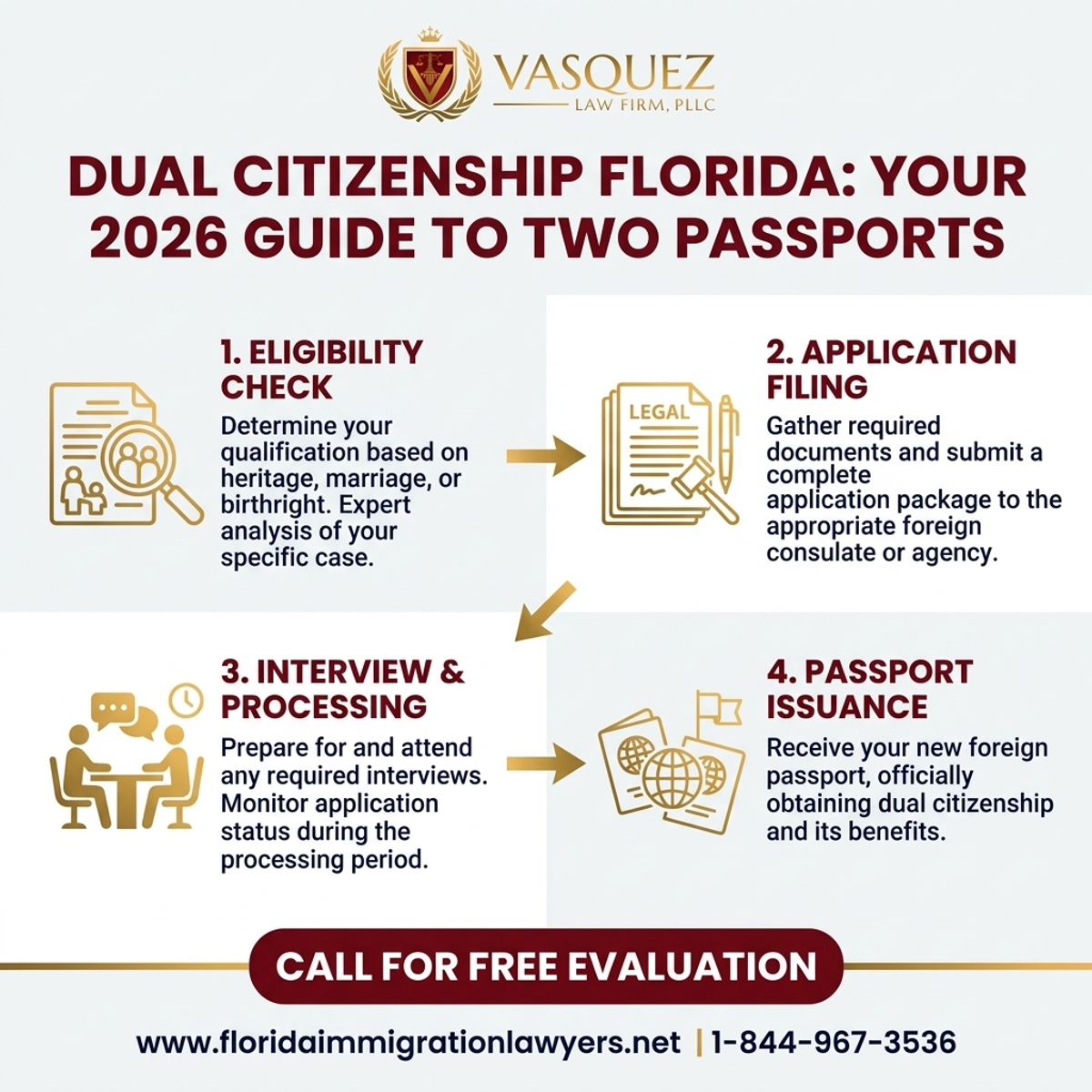
Key Statistics — Dual Citizenship Florida: Your 2026 Guide to Two Passports
Typical Naturalization Cost Factors (as of 2026):
| Item | Typical Fee | Notes |
|---|---|---|
| Form N-400 Filing Fee | Varies (check USCIS website) | Includes biometrics services fee. Subject to change. |
| Attorney Legal Fees | Varies significantly | Highly recommended for complex cases or to ensure accuracy. |
| Document Translation Costs | Varies by vendor | For non-English documents, certified translations are required. |
| Passport Application Fee | Varies (check State Department) | After naturalization, to obtain a U.S. passport. |
| Total Estimated Cost | Varies widely | Depends on self-preparation vs. legal assistance, and specific document needs. |
While the USCIS filing fee is a fixed cost, legal fees for an experienced immigration attorney can vary based on the complexity of your case and the services provided. Investing in legal counsel from Florida Immigration Lawyers can save you time and prevent costly mistakes, making the overall process smoother and more efficient. We provide transparent fee structures and comprehensive support.
What are the Benefits and Challenges of Holding Two Passports?
Holding two passports through dual citizenship Florida offers a compelling array of benefits, enhancing personal and professional opportunities. One of the most significant advantages is increased freedom of travel. With two passports, you can often enter and exit both countries more easily, bypassing visa requirements and potentially enjoying shorter queues at immigration. This is particularly beneficial for individuals with family or business ties in both nations. For example, a dual U.S.-Brazilian citizen in Orlando could travel to Brazil without a visa, leveraging their Brazilian passport, and return to the U.S. with their American passport, streamlining their international movements.
Beyond travel, dual nationality can provide expanded rights and protections. You gain the right to live and work indefinitely in both countries, access social services, and own property without restrictions often imposed on foreign nationals. Political participation, such as voting and even holding public office in both nations (where permitted), also becomes a possibility. For many, it offers a profound sense of belonging and security, knowing they have a legal home in two different parts of the world. This can be particularly reassuring during times of political or economic instability in one of the countries.
However, dual citizenship also comes with potential challenges and complexities that individuals in Florida should be aware of. One primary concern is tax obligations. U.S. citizens, including dual citizens, are generally subject to U.S. taxation on their worldwide income, regardless of where they reside. This means you might need to file tax returns in both countries, although tax treaties often exist to prevent double taxation. Military service obligations can also arise, as some countries require their citizens, including dual nationals, to serve in their armed forces. Furthermore, navigating the legal systems and bureaucratic processes of two different governments can be intricate and time-consuming.
There can also be issues with government protection. While traveling in your other country of citizenship, the U.S. government's ability to provide consular assistance may be limited. For example, if you are detained in your country of second citizenship, that country may view you solely as its own citizen and deny U.S. consular access. Understanding these potential challenges and planning for them is crucial. Florida Immigration Lawyers can help you weigh the benefits against the challenges and provide advice on how to manage the complexities of dual nationality effectively.
Common Mistakes to Avoid When Pursuing Dual Citizenship
-
Failing to Research Both Countries' Laws: Assuming both countries allow dual citizenship without verification can lead to automatic renunciation of your original citizenship. Always confirm the laws of both the U.S. and your home country.
-
Misrepresenting Information on Form N-400: Any false statements or omissions can result in denial of your naturalization application, charges of misrepresentation, and potential deportation. Always be truthful and accurate.
-
Not Meeting Continuous Residency Requirements: Extended trips outside the U.S. during the required residency period can break your continuous residency. Understand the rules for absences and plan accordingly to avoid disqualification.
-
Poor Preparation for the English and Civics Tests: Underestimating the difficulty of these tests can lead to failure and delays. Dedicate sufficient time to study U.S. history, government, and practice English skills.
-
Ignoring Good Moral Character Requirements: Criminal offenses, even minor ones, or failures to pay taxes or child support can jeopardize your application. Disclose all relevant information and seek legal advice on how past issues might impact your eligibility.
-
Missing Deadlines or Ignoring USCIS Requests: Failing to respond to Requests for Evidence (RFEs) or missing appointments can lead to the abandonment or denial of your application. Always respond promptly and thoroughly.
-
Filing an Incomplete Application: Submitting Form N-400 without all required supporting documents or with errors can result in rejection or significant delays. Double-check all forms and attachments carefully.
-
Not Updating Your Address with USCIS: Moving without informing USCIS can cause you to miss crucial notices, including interview appointments or RFEs, leading to application delays or denial. Always update your address promptly via Form AR-11.
-
Traveling Internationally After Filing N-400 Without Caution: While generally allowed, excessive travel, especially long trips, can impact your continuous residency or physical presence requirements. Consult an attorney before making significant travel plans.
-
Failing to Understand Tax Implications: Dual citizens have tax obligations to the U.S. on worldwide income. Not understanding these can lead to significant financial penalties. Seek advice from a tax professional familiar with international tax law.
When to Call a Florida Immigration Lawyer for Dual Citizenship
Navigating the path to dual citizenship Florida can be complex, and there are specific scenarios where the expertise of a seasoned immigration lawyer becomes invaluable. If you find yourself facing any of the following situations, it's a clear signal to seek professional legal assistance from Florida Immigration Lawyers:
- Complex Eligibility Issues: If you have a criminal record, past immigration violations, extended absences from the U.S., or any other factors that might impact your good moral character or continuous residency.
- Uncertainty About Foreign Country Laws: If you are unsure whether your country of origin permits dual citizenship or what the implications might be for retaining your original nationality.
- Difficulty with English or Civics: While waivers exist for age or disability, a lawyer can help assess your eligibility for such waivers or provide resources for preparation.
- Previous Application Denials: If your naturalization application has been denied in the past, an attorney can help you understand the reasons for denial and strategize for a successful reapplication.
- Responding to USCIS Requests: If you receive a Request for Evidence (RFE) or a Notice of Intent to Deny (NOID), a lawyer can help you prepare a comprehensive and timely response.
- Concerns About the Interview: If you are nervous about the naturalization interview, particularly if there are sensitive issues in your background, an attorney can prepare you thoroughly and, in some cases, attend the interview with you.
- Derivative Citizenship for Children: If you are a U.S. citizen seeking to confirm or obtain citizenship for your child born abroad, the process can be intricate, and legal guidance is highly beneficial.
Florida Immigration Lawyers has extensive experience assisting individuals across Florida, including Orlando, Miami, and Tampa, with their naturalization and dual citizenship goals. We offer personalized guidance, comprehensive application preparation, and robust representation to protect your interests. Don't risk making critical mistakes that could jeopardize your future. Our team is dedicated to providing clear, empathetic, and effective legal solutions.
About Florida Immigration Lawyers
Florida Immigration Lawyers is a leading immigration law firm dedicated to serving individuals and families across the entire state of Florida. With offices and a strong presence throughout the region, including Orlando, Miami, and Tampa, we provide unparalleled legal expertise in all areas of immigration law. Our compassionate and highly skilled attorneys are committed to helping our clients achieve their American dream, whether it involves obtaining a visa, securing a green card, defending against deportation, or pursuing U.S. citizenship and dual nationality.
We understand that immigration matters are deeply personal and often life-changing. That's why we offer personalized attention, strategic legal advice, and unwavering support to every client. Our firm prides itself on its accessibility, offering free consultations and being available 24/7 to address your urgent legal needs. We are fluent in multiple languages, including Spanish, ensuring that language is never a barrier to receiving top-tier legal representation. When you choose Florida Immigration Lawyers, you choose a partner who will stand by you every step of the way, fighting tirelessly for your rights and your future.
Visit our website at www.floridaimmigrationlawyers.net or call us today at 1-844-967-3536 to schedule your free consultation. Let us put our expertise to work for you.
Sources and References
- U.S. Citizenship and Immigration Services (USCIS)
- U.S. Department of State - Dual Nationality
- Executive Office for Immigration Review (EOIR)
- 8 U.S.C. Chapter 12 - Immigration and Nationality Act (INA)
- INA Section 316 - Requirements for Naturalization
- INA Section 319(a) - Naturalization of Spouses of U.S. Citizens
- 8 CFR Part 316 - General Requirements for Naturalization
Related services: citizenship test preparation, dual citizenship guidance, family-based immigration.
This article provides general legal information and is not intended as legal advice. Every case is unique, and outcomes depend on specific facts and circumstances. Contact an attorney for advice about your particular situation.
Don't let the complexities of immigration law deter you from pursuing your goal of dual citizenship Florida. The experienced attorneys at Florida Immigration Lawyers are ready to provide the clear guidance and dedicated representation you need. Take the first step towards securing your future with two passports.
Call us today at 1-844-967-3536 for a free, confidential consultation. Se Habla Espanol - Estamos aqui para ayudarle.
If you need legal assistance, learn more about speak with a citizenship lawyer, or call us at 1-844-967-3536 for a free consultation.
Do Not Navigate This Process Alone
Our experienced immigration attorneys are ready to fight for you. Get a free, confidential consultation today.
Se Habla Español
Frequently Asked Questions
Harold Estrada-Rodriguez
Florida Immigration Attorney · FL Bar No. 1041171
Florida Bar attorney handling Florida-jurisdiction immigration matters. Bilingual representation, free consultations.
Available 24/7 - Free Evaluations
Related Legal Services
Our Florida immigration attorneys can help you with family immigration services, immigration practice areas and free immigration consultation. Call today at 1-844-967-3536 for a free consultation.
Related Links
Related Topics
Free Legal Consultation
Discuss your case with our experienced attorneys. We're available 24/7.
Se Habla Español - Estamos aquí para ayudarle.
Related Articles
Understanding the Stokes Interview for Marriage Fraud in Florida
Discover the essentials of the Stokes interview process in Florida. Learn how to prepare effectively and understand the significance of legal assistance. Contact Florida Immigration Lawyers for expert guidance.
O-1 Visa for Extraordinary Ability in Florida | VLF Florida
Explore the O-1 visa for extraordinary ability in Florida and learn how it can open doors for talented individuals. Our guide covers qualifications, application steps, common mistakes, and when to seek legal assistance. Call Florida Immigration Lawyers at 1-844-967-3536 for expert guidance.
E-2 Visa for Florida Business Investors | VLF Florida
Explore the E-2 investor visa process for establishing a business in Florida. Learn about requirements, costs, and timelines specific to West Palm Beach.
Consular Processing for Florida Applicants | VLF Florida
Consular processing is crucial for individuals in Florida seeking immigrant visas. This guide covers everything from document submission to the embassy interview. Contact Florida Immigration Lawyers for expert assistance.