Florida Work Permit & EAD Application: Your 2026 Guide
For immigrants in Florida, obtaining an Employment Authorization Document (EAD), or work permit, is essential for lawful employment. This 2026 guide from Florida Immigration Lawyers details the Form I-765 application process, eligibility categories, required documents, and typical processing times. We cover critical aspects like fee structures, common mistakes to avoid, and when to seek legal counsel to navigate the complexities of federal immigration law. Whether you are in Miami, Orlando, or elsewhere in Florida, understanding these steps is vital to securing your right to work. Learn how our firm can provide assistance for your EAD application and ensure compliance with all USCIS requirements. We offer free consultations and are available 24/7.
Quick Answer: Applying for a Florida Work Permit (EAD)
As of 2026, obtaining a work permit, officially known as an Employment Authorization Document (EAD), in Florida requires filing Form I-765 with U.S. Citizenship and Immigration Services (USCIS). This document grants non-citizens legal permission to work in the U.S. Eligibility varies significantly by immigration status, including asylum seekers, individuals adjusting status, and certain visa holders. The process involves meticulous documentation, fee payment, and adherence to specific USCIS guidelines. Processing times can range from several months to over a year, making careful planning and legal guidance crucial for applicants in Miami, Orlando, and across Florida.
- Form I-765 is Key: The primary application for an EAD.
- Eligibility Varies: Your immigration status dictates your eligibility category.
- Be Prepared for Delays: Processing times can be extensive; apply early.
- Documentation is Critical: Missing or incorrect documents lead to delays or denials.
- Legal Help Recommended: An experienced immigration lawyer can streamline the process and prevent common mistakes.
Are you an immigrant in Florida dreaming of lawful employment and contributing to the vibrant economy of cities like Miami, Orlando, or Tampa? The ability to work legally in the United States is a cornerstone for many seeking a new life here. For non-citizens, this often means obtaining an Employment Authorization Document (EAD), commonly referred to as a work permit. Navigating the complex federal immigration system to secure your work permit Florida application can feel overwhelming, especially with ever-evolving policies and processing times.
As of 2026, understanding the precise steps, eligibility requirements, and potential pitfalls for an EAD application Florida is more critical than ever. Whether you are an asylum seeker, an individual adjusting your status to permanent resident, or a student seeking optional practical training (OPT), obtaining employment authorization is a vital step. This comprehensive guide from Florida Immigration Lawyers is designed to demystify the process, providing you with clear, actionable information tailored for applicants throughout Florida.
We will cover everything from determining your eligibility for employment authorization to completing Form I-765, understanding processing timelines, and avoiding common mistakes. Our goal is to empower you with the knowledge to pursue your work permit with confidence. Do not navigate this crucial process alone. Call Florida Immigration Lawyers at 1-844-YO-PELEO for a free consultation and let our experienced team guide you towards securing your legal right to work.
What is an EAD and Who Needs a Work Permit in Florida?
As of 2026, an Employment Authorization Document (EAD), commonly known as a work permit, is a card issued by USCIS that grants non-citizens legal permission to work in the United States, including Florida. Individuals applying for adjustment of status, asylum, or certain non-immigrant visas often need an EAD to lawfully seek and maintain employment.
An EAD is a physical card that serves as proof of your authorization to work in the U.S. for a specific period. It is distinct from a visa, which grants you permission to enter the country, or a green card, which grants permanent residency. Many different categories of non-citizens may be eligible for an EAD, based on their immigration status. For instance, individuals with pending asylum applications (category C08), those with pending applications for adjustment of status to lawful permanent resident (category C09), and certain non-immigrant visa holders like students on Optional Practical Training (OPT) or spouses of L-1 or E visa holders, all require an EAD to work legally. Without this document, working in the U.S. is considered unauthorized employment, which can lead to severe immigration consequences, including potential deportation or bars from future immigration benefits. It is crucial for anyone in Florida seeking employment to ensure they possess a valid employment authorization Florida document.
The Immigration and Nationality Act (INA), specifically 8 U.S.C. 1324a (INA 274A), outlines the prohibitions against the employment of unauthorized aliens. This statute makes it illegal for employers to knowingly hire or continue to employ individuals who are not authorized to work. Therefore, having a valid EAD is not just a personal benefit but also a legal necessity for both employees and employers across Florida, from the bustling markets of Miami to the agricultural fields of Central Florida. Understanding your specific eligibility category is the first and most vital step in your EAD application Florida journey.
How Do I Apply for a Work Permit (Form I-765) in Florida in 2026?
To apply for a work permit in Florida in 2026, you must generally file Form I-765, Application for Employment Authorization, with U.S. Citizenship and Immigration Services (USCIS). The process involves determining your eligibility category, gathering required documents, completing the form accurately, paying the filing fee, and submitting your application to the correct USCIS lockbox facility.
The application process for a work permit Florida, specifically using Form I-765, is a multi-step procedure that demands precision and attention to detail. Any errors or omissions can lead to delays, requests for evidence (RFEs), or even denial of your application, significantly impacting your ability to work. As of 2026, USCIS emphasizes electronic filing for many forms, but Form I-765 generally requires a paper submission unless filed concurrently with an electronically submitted primary application. The first step is always to identify your correct eligibility category, as this dictates the supporting evidence you must submit.
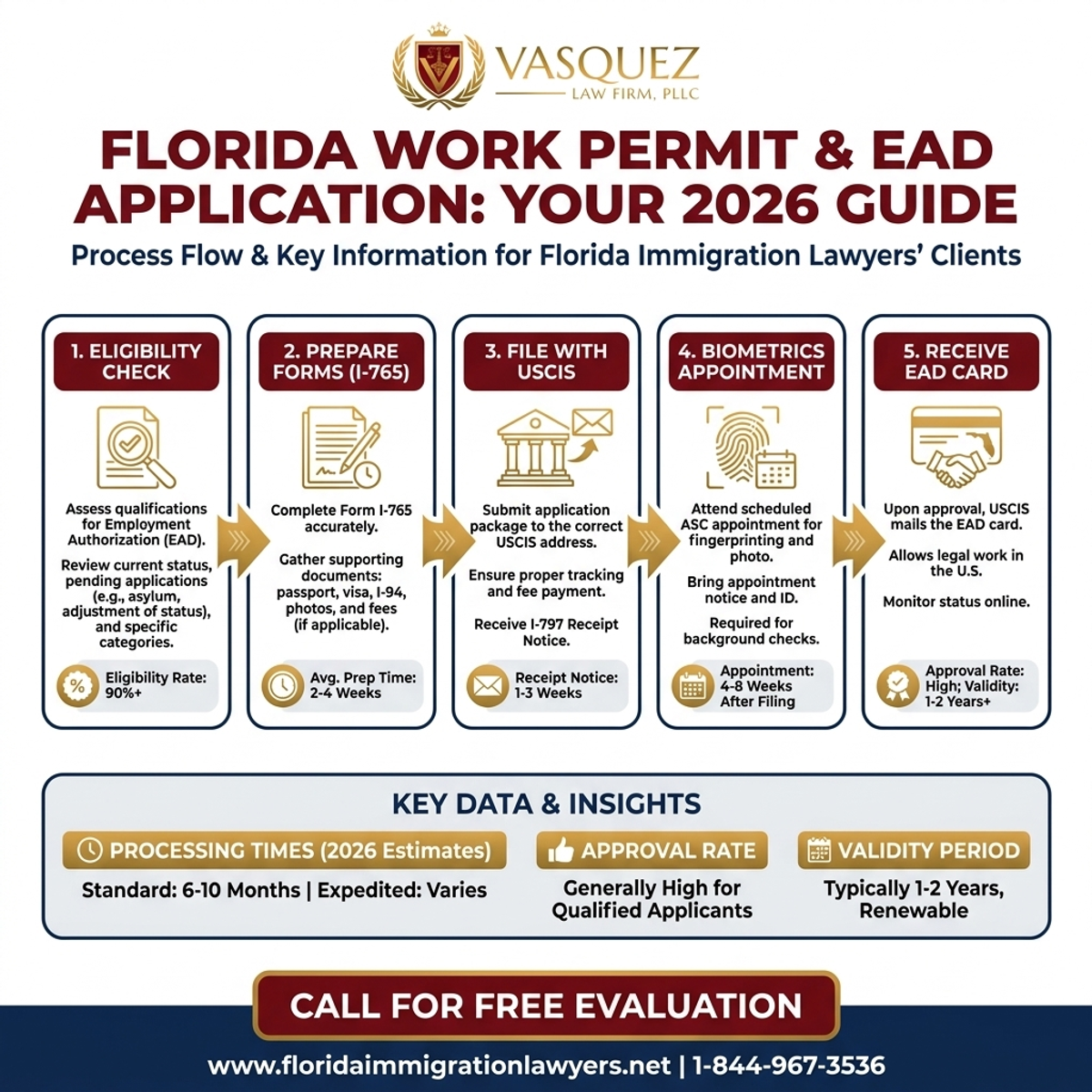
Step-by-Step Process — Florida Work Permit & EAD Application: Your 2026 Guide
Step-by-Step Guide to Filing Form I-765:
- Determine Your Eligibility Category: Review the USCIS instructions for Form I-765 to find the specific category code that applies to your immigration status (e.g., C08 for asylum applicants, C09 for adjustment of status applicants). This is critical because each category has unique requirements.
- Gather Required Documents: Collect all necessary supporting evidence. This typically includes identification documents, proof of your underlying immigration status, two passport-style photos, and any category-specific documents. (Detailed list below).
- Complete Form I-765 Accurately: Fill out every section of the form completely and truthfully. Use black ink if handwriting, or type your responses. Ensure all names, dates, and addresses match your supporting documents. Pay close attention to questions about previous EAD applications or immigration history.
- Calculate and Pay the Filing Fee: As of 2026, the filing fee for Form I-765 is subject to change, but typically ranges from $410 to $555. Some categories, like initial asylum applicants, may be exempt from the fee. You may also need to pay a biometric services fee. Always check the USCIS website for current fees. You can pay by money order, personal check, cashier’s check, or credit card using Form G-1450.
- Assemble Your Application Package: Organize your application packet logically. Place the filing fee check or money order on top, followed by Form I-765, and then all supporting documents, clearly labeled. Make a complete copy of your entire application for your records before mailing.
- Mail Your Application: Send your complete application package to the correct USCIS lockbox facility. The mailing address depends on your eligibility category and the state you reside in (e.g., Florida applications often go to the Dallas Lockbox). Consult the USCIS website for the most current filing addresses. Use a reputable mail service with tracking.
- Attend Biometrics Appointment (if required): After filing, you may receive an appointment notice (Form I-797C) for a biometrics services appointment at a local Application Support Center (ASC), such as those in Miami, Orlando, or Jacksonville. Attend this appointment to have your fingerprints, photograph, and signature taken.
- Monitor Your Case Status: Use the receipt number provided on your Form I-797C Notice of Action to track your case status online through the USCIS website.
What Documents Do I Need for an EAD Application in Florida?
A successful EAD application Florida hinges on submitting a complete and accurate set of documents. Missing even a single required piece of evidence can lead to significant delays or a Request for Evidence (RFE), prolonging your wait for employment authorization. The specific documents you need will depend on your eligibility category, but there are several essential items that almost all applicants for a work permit Florida must provide. It is always wise to provide copies of documents, not originals, unless specifically requested by USCIS.
Essential Documents for All Applicants:
- Form I-765, Application for Employment Authorization: The completed and signed form.
- Two Passport-Style Photos: Taken within 30 days of filing, unmounted, full frontal view, on a white to off-white background. Write your name and A-number (if applicable) lightly on the back of each photo.
- Copy of Government-Issued Photo Identification: This could be your passport identity page, birth certificate with photo ID, or national identity card.
- Copy of Form I-94, Arrival/Departure Record: If applicable, showing your lawful admission to the U.S. or parole. You can retrieve this online from the CBP website.
- Copy of Your Last EAD Card (if applicable): If you are renewing your EAD, include a copy of the front and back of your most recent card.
- Copy of your Visa (if applicable): A copy of the visa stamp in your passport.
- Proof of Fee Payment: Check, money order, or Form G-1450 for credit card payment.
Category-Specific Supporting Evidence:
Beyond the general requirements, your specific eligibility category will dictate additional documents. For example:
- Asylum Applicants (C08): Copy of Form I-589, Application for Asylum and for Withholding of Removal, or proof of a pending asylum application with the Executive Office for Immigration Review (EOIR) or USCIS.
- Adjustment of Status Applicants (C09): Copy of Form I-485, Application to Register Permanent Residence or Adjust Status, receipt notice.
- F-1 Student Seeking OPT (C03): Form I-20, Certificate of Eligibility for Nonimmigrant Student Status, endorsed by the Designated School Official (DSO), and academic transcripts.
- Spouse of L-1 Visa Holder (A18): Copy of the L-1 visa holder's Form I-94 and Form I-797 approval notice for L-1 status.
- Temporary Protected Status (TPS) Applicants (A12 or C19): Copy of Form I-821, Application for Temporary Protected Status, approval or receipt notice.
Always refer to the official USCIS instructions for Form I-765 for the most up-to-date and specific documentation requirements for your category. Organizing these documents meticulously and making copies for your records before submission is highly recommended.
How Long Does It Take to Get a Work Permit in Florida in 2026?
As of 2026, the processing time for a work permit (Form I-765) in Florida can vary significantly, typically ranging from 3 to 15 months, depending on the applicant's eligibility category, the specific USCIS service center handling the case, and current caseloads. Premium processing is available for some categories, potentially reducing wait times.
The waiting period for an employment authorization Florida can be one of the most challenging aspects for applicants eager to start working. Processing times are not static; they fluctuate based on national caseloads, policy changes, and the efficiency of the USCIS service centers. For applicants in Florida, whether you filed through the Texas Service Center, Nebraska Service Center, or another, these national trends directly impact your wait. USCIS posts estimated processing times online, which are updated regularly. It is essential to monitor these estimates, but also to understand they are averages and individual cases may take longer or shorter.
Factors that influence processing times include the complexity of your case, whether an RFE is issued, and the volume of applications USCIS is currently handling. For instance, initial EAD applications for asylum seekers (C08) may have different processing times than EADs filed concurrently with an I-485 for adjustment of status (C09). Some EAD categories, particularly those related to certain non-immigrant visas, might be eligible for premium processing, which guarantees a decision within 30 days for an additional fee. This option, however, is not available for all EAD categories and should be verified on the USCIS website.
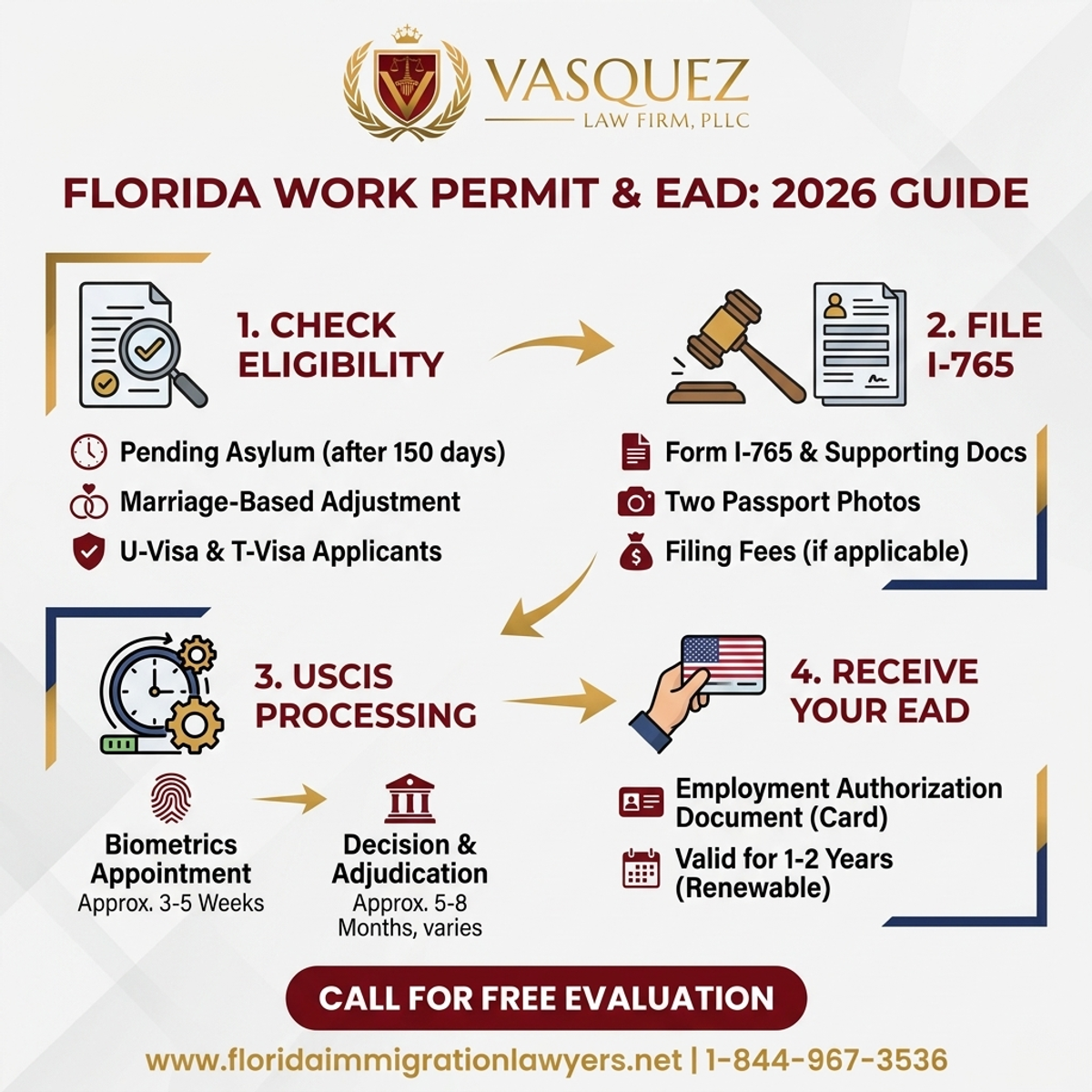
Key Statistics — Florida Work Permit & EAD Application: Your 2026 Guide
Typical EAD Processing Timelines (as of 2026):
| Stage | Typical Timeframe | Notes |
|---|---|---|
| Application Submission to Receipt Notice (I-797C) | 1-3 weeks | Confirmation that USCIS received your Form I-765. |
| Biometrics Appointment Scheduling | 3-8 weeks after receipt | Notice sent for appointment at a local ASC (e.g., Miami, Orlando). |
| Biometrics Appointment | Within 2-4 weeks of notice | Attend promptly; crucial for background checks. |
| Case Review and Decision | 3-15 months (varies widely) | Depends on eligibility category, service center workload, and RFEs. |
| EAD Card Production and Mailing | 1-2 weeks after approval | Card is mailed to your address of record. |
| Premium Processing (if available) | 30 days | Requires additional fee; check eligibility for your category. |
Given these varying timelines, it is highly advisable for applicants in Florida to apply for their EAD renewal well in advance of their current EAD's expiration date. USCIS generally recommends filing for renewal 180 days before expiration, and in some cases, certain categories may receive an automatic extension of their EAD validity while the renewal application is pending. Consulting with an immigration attorney can help you understand the most current processing trends and best strategies for your specific case.
What Are the Costs Associated with a Florida Work Permit Application?
The costs for a Florida work permit application primarily include the USCIS filing fee for Form I-765, which is subject to change but was approximately $410-$555 as of 2026, and a biometric services fee if applicable. Legal fees for attorney assistance are additional and vary based on the complexity of your case and the services provided.
Understanding the financial implications of an EAD application Florida is an important part of the planning process. The primary cost you will encounter is the filing fee for Form I-765, which is set by USCIS. These fees are subject to change, so always verify the current amounts directly on the official USCIS website before submitting your application. As of 2026, the fee can range significantly depending on whether a biometric services fee is included or if you qualify for a fee waiver.
Some applicants, such as those filing an initial EAD based on a pending asylum application (C08), may be exempt from the filing fee. However, most other categories will require payment. In addition to the USCIS fees, applicants should also budget for other potential costs, such as obtaining passport-style photos, photocopying documents, and mailing fees (especially if using certified mail with tracking). For many, the cost of legal representation by an experienced immigration lawyer in Florida is a worthwhile investment to ensure accuracy, compliance, and to navigate complex situations, potentially saving time and preventing costly errors in the long run.
Typical Costs for a Work Permit Application (as of 2026):
| Item | Typical Fee (USD) | Notes |
|---|---|---|
| USCIS Form I-765 Filing Fee | $410 - $555 | Varies by category and whether biometrics are included; check USCIS website for current fees. Some categories are exempt. |
| Biometric Services Fee | Included in I-765 fee for most; ~$85 if separate | Required for fingerprinting and photo; typically part of the I-765 fee for most categories as of 2026. |
| Passport-Style Photos | $10 - $20 | For two photos; can be done at pharmacies or photo studios. |
| Document Photocopies | Minimal | Cost for copying all supporting documents. |
| Postage/Shipping | $5 - $30 | Highly recommended to use certified mail with tracking for security. |
| Immigration Attorney Fees | Varies widely | Depends on complexity of case and services requested; provides guidance and peace of mind. |
Fee waivers are available for certain applicants who can demonstrate financial hardship. Eligibility for a fee waiver is determined by USCIS based on specific criteria, such as receiving a means-tested benefit or having an income below 150% of the Federal Poverty Guidelines. If you believe you qualify for a fee waiver, you must submit Form I-912, Request for Fee Waiver, along with your Form I-765 application and supporting documentation. Always consult with a legal professional to assess your eligibility for fee waivers and to get an accurate estimate of all costs involved in your work permit Florida application.
Do not navigate this complex immigration process alone. Contact Florida Immigration Lawyers today for a free consultation and let us help you understand your options and secure your future in Florida.
Understanding EAD Categories and Eligibility in Florida
The path to obtaining an employment authorization Florida is defined by specific eligibility categories, each rooted in U.S. immigration law. It is crucial to correctly identify your category when filing Form I-765, as this impacts the required documentation and can affect processing times. The regulations governing these categories are primarily found in 8 CFR 274a.12, which lists various classes of aliens authorized to accept employment.
For example, in Florida, a state with a significant immigrant population, particularly in areas like Miami-Dade and Broward counties, common EAD categories include those for asylum applicants, individuals adjusting status, and certain non-immigrant visa holders. An individual who has filed Form I-589, Application for Asylum and for Withholding of Removal, and whose application has been pending for at least 150 days, is typically eligible under category (c)(8). This provision, authorized by INA 208(c)(1)(B), allows asylum seekers to gain work authorization while their cases are adjudicated, which can often take several years at the Miami Immigration Court or the Orlando Immigration Court.
Another prevalent category in Florida is (c)(9), for individuals who have a pending Form I-485, Application to Register Permanent Residence or Adjust Status. This allows applicants to work while waiting for their green card application to be processed, often at the local USCIS Field Office in Miami or Orlando. Spouses of certain visa holders, such as E-1/E-2 treaty traders/investors (A-17) or L-1 intracompany transferees (A-18), may also be eligible. Additionally, students on F-1 visas engaging in Optional Practical Training (OPT) fall under category (c)(3) and are a common sight in Florida's many universities and colleges.
Understanding these distinctions is not merely administrative; it is fundamental to a successful application. Misidentifying your category can lead to immediate rejection or denial. Furthermore, some categories come with specific conditions, such as the requirement for an underlying petition to be approved or for a certain period to have passed since filing. For instance, the automatic extension of EADs for up to 540 days (as of early 2026) only applies to certain categories when filing for renewal, offering a crucial safety net for many Floridians awaiting their updated documents. Consulting with an immigration attorney is highly recommended to ensure you select the correct category and provide all necessary supporting evidence for your specific situation.
Renewing Your Employment Authorization Document (EAD) in Florida
For many immigrants in Florida, obtaining an EAD is not a one-time event but a recurring necessity. Renewing your employment authorization Florida is just as critical as the initial application to maintain continuous work authorization. The renewal process uses the same Form I-765 and generally follows similar steps to the initial application, but with specific considerations regarding timing and documentation. It is paramount to file your renewal application well in advance of your current EAD's expiration date to avoid gaps in employment authorization.
USCIS generally recommends filing your EAD renewal application approximately 180 days (or six months) before your current EAD expires. This proactive approach helps account for potential processing delays, which, as discussed, can be extensive. As of early 2026, USCIS has implemented temporary rules allowing for an automatic extension of certain EAD categories for up to 540 days from the expiration date printed on the current EAD card, provided the renewal application is timely filed and the applicant is in an eligible category. This automatic extension helps prevent employment gaps for many Floridians, but it is not universal and must be confirmed based on your specific category.
When renewing, ensure you use the most current version of Form I-765 and include a copy of your expiring EAD card, along with other required supporting documents. The filing fee will also apply, unless you qualify for a fee waiver. Any changes to your address or other personal information since your last application should be updated with USCIS. Failing to file your renewal on time, or submitting an incomplete application, can lead to a lapse in your work authorization, potentially resulting in job loss or other negative consequences. Given the importance of continuous employment, seeking legal counsel from a Florida immigration lawyer can provide invaluable assistance in navigating the EAD renewal process efficiently and correctly.
Common Mistakes to Avoid in Your Florida Work Permit Application
Applying for a work permit Florida can be a complex process, and even minor errors can lead to significant delays or even denial. Avoiding these common pitfalls is crucial for a smooth EAD application Florida. Here are some key mistakes to watch out for:
- Incorrect Eligibility Category: Selecting the wrong category on Form I-765 can cause immediate rejection or a request for evidence. Each category has specific requirements.
- Incomplete or Inaccurate Form I-765: Failing to fill out every required field, providing inconsistent information, or making typos can trigger RFEs or denials.
- Missing Required Documents: Forgetting to include copies of your passport, I-94, previous EAD, or category-specific evidence is a common cause of delays.
- Incorrect Filing Fee or Payment Method: Submitting the wrong fee amount, an expired check, or an improperly filled-out fee waiver form will lead to rejection. Always verify current fees on the USCIS website.
- Late Filing for Renewals: Allowing your current EAD to expire before filing for renewal can result in a lapse of work authorization, leading to job loss. File at least 180 days in advance.
- Not Attending Biometrics Appointment: Failing to appear for your scheduled biometrics appointment in locations like Miami or Orlando without rescheduling can lead to application abandonment.
- Submitting Original Documents: Unless specifically requested, always send copies of supporting documents, not originals, as USCIS may not return them.
- Failing to Update Address with USCIS: If you move, not updating your address promptly with USCIS via Form AR-11 means you might miss crucial notices, including RFEs or approval notices.
- Working Without Authorization: Engaging in any form of employment before receiving your EAD or after it expires is unauthorized and can have severe immigration consequences, including deportation.
- Misrepresenting Information: Providing false or misleading information on your application can lead to a finding of fraud, rendering you inadmissible for future immigration benefits.
When to Call a Florida Immigration Lawyer
While this guide provides comprehensive information, the complexities of immigration law, particularly concerning employment authorization Florida, often necessitate professional legal assistance. You should strongly consider contacting a Florida immigration lawyer in several key scenarios to protect your rights and ensure the strongest possible outcome for your work permit Florida application.
If you have a complex immigration history, such as previous denials, deportations, or criminal convictions, navigating an EAD application Florida becomes significantly more challenging. An attorney can assess the impact of these issues on your eligibility and strategize the best approach. Similarly, if your underlying immigration status is uncertain or involves multiple pending applications (e.g., asylum and adjustment of status), a lawyer can ensure proper coordination and prevent conflicts. If you receive a Request for Evidence (RFE) or a Notice of Intent to Deny (NOID) from USCIS, this is a clear red flag that expert intervention is needed. These notices require a precise and timely response, which an experienced attorney can provide.
Furthermore, if you are an employer in Florida seeking to ensure compliance with federal immigration laws when hiring non-citizens, legal counsel is essential. An attorney can help you understand I-9 verification requirements and prevent penalties for unauthorized employment. For individuals facing tight deadlines, needing to expedite their application, or simply seeking peace of mind through a meticulous review of their application packet, a Florida immigration lawyer offers invaluable support. Do not gamble with your future; consult with the experienced team at Florida Immigration Lawyers for personalized guidance.
About Florida Immigration Lawyers
Florida Immigration Lawyers is an immigration law firm dedicated to serving individuals and families across the entire state of Florida. With offices and a strong presence in key areas like Miami, Orlando, and Tampa, we are committed to providing compassionate, effective, and results-driven legal representation for all immigration matters. Our team of highly skilled attorneys understands the unique challenges faced by immigrants in Florida and is passionate about helping clients achieve their American dream.
We offer a comprehensive range of immigration services, including assistance with work permit Florida applications (EADs), asylum claims, deportation defense, citizenship and naturalization, family-based immigration, and business immigration. Our attorneys are known for their meticulous attention to detail, deep knowledge of immigration law, and unwavering dedication to client success. We pride ourselves on clear communication, ensuring you are informed and empowered throughout your legal journey.
Choosing Florida Immigration Lawyers means selecting a partner who will stand by you every step of the way. We offer free consultations to discuss your specific situation, are available 24/7 to address your urgent concerns, and provide bilingual services to ensure no language barrier prevents you from receiving top-tier legal advice. Visit our attorneys page to learn more about our team, or contact us directly. Let us put our experience to work for you. Call us today at 1-844-YO-PELEO.
Sources and References
- U.S. Citizenship and Immigration Services (USCIS)
- Executive Office for Immigration Review (EOIR)
- U.S. Customs and Border Protection (CBP) - I-94 Retrieval
- 8 U.S.C. Chapter 12 - Immigration and Nationality Act (INA)
- 8 U.S.C. § 1324a - Unlawful employment of aliens (INA 274A)
- 8 CFR § 274a.12 - Classes of aliens authorized to accept employment
- INA § 208(c)(1)(B) - Asylum applications
Related services: H-1B specialty occupation visas, work visas for professionals, investment and entrepreneur visas.
This article provides general legal information and is not intended as legal advice. Every case is unique, and outcomes depend on specific facts and circumstances. Contact an attorney for advice about your particular situation. Immigration laws are subject to change, and it is crucial to consult with a qualified legal professional for the most current information and guidance.
Do not let the complexities of immigration law deter you from achieving your goals. Secure your future and your right to work in Florida with legal guidance. Contact Florida Immigration Lawyers today for a free, confidential consultation. Call us at 1-844-YO-PELEO. Se Habla Espanol - Estamos aqui para ayudarle.
Do Not Navigate This Process Alone
Our experienced immigration attorneys are ready to fight for you. Get a free, confidential case review today.
Se Habla Español
Or leave your details and we’ll call you:
Free Evaluation in 24 Hours
Or talk to us right now

AI voice assistant — available 24/7
FreeFrequently Asked Questions

William J. Vásquez
Founding Attorney · Vasquez Law Firm
U.S. Air Force veteran and immigration attorney with years of hands-on U.S. immigration experience. J.D., NCCU School of Law. AILA member. Admitted to the 4th, 5th, and 11th Circuit Courts.
Available 24/7 - Free Evaluations
Reviewed for legal accuracy by William J. Vásquez
Licensed in North Carolina; U.S. immigration is federal practice.
Related Legal Services
Our Florida immigration attorneys can help you with asylum protection, citizenship and naturalization and immigration practice areas. Call today at 1-844-YO-PELEO for a free case review.
Related Links
Related Topics
Free Legal Case Review
Discuss your case with our experienced attorneys. We're available 24/7.
Se Habla Español - Estamos aquí para ayudarle.
Related Articles
DUI Immigration Consequences in Florida 2026
A DUI conviction in Florida can have severe immigration consequences, potentially leading to inadmissibility, deportation, or denial of immigration benefits. For non-citizens, a DUI is not just a traffic offense but a serious criminal matter that federal immigration law scrutinizes closely. Factors like multiple offenses, injury, or property damage can escalate a simple DUI to a Crime Involving Moral Turpitude (CIMT) or even an aggravated felony, triggering mandatory detention and removal proceedings. Understanding the specific nature of your Florida conviction and its interpretation under the Immigration and Nationality Act (INA) is crucial. This article outlines how DUIs impact immigration status, the grounds for inadmissibility and deportation, a step-by-step guide to navigating the process, essential documentation, and expected timelines for 2026. We also highlight common mistakes to avoid and when to seek legal counsel from an experienced immigration attorney. Florida Immigration Lawyers offers comprehensive support for individuals facing these challenging situations, providing expert guidance through complex legal landscapes.
PERM Labor Certification in Florida: A 2026 Guide
Learn all about the PERM labor certification process in Florida, essential for employers sponsoring green card applicants. Understand the steps, document requirements, and common mistakes to avoid in this 2026 guide.
Immigration Lawyer Orlando Free Consultation in Florida
For individuals and families in Orlando, Florida, navigating the complexities of U.S. immigration law requires expert guidance. An immigration lawyer in Orlando offers crucial support for everything from visa applications and green card processes to naturalization and deportation defense. This comprehensive guide details what a free consultation covers, providing a step-by-step overview of immigration pathways, essential document checklists, and expected timelines in 2026. We also highlight common mistakes to avoid, discuss the critical role of legal counsel in deportation and asylum cases, and explain why choosing a local Orlando immigration attorney is beneficial. Florida Immigration Lawyers is dedicated to serving the diverse community of Orlando with compassionate, effective legal solutions, ensuring you receive personalized advice and robust representation for a successful immigration journey.
EAD Advance Parole Combo Card in Florida: What You Need
An EAD advance parole combo card allows individuals with pending adjustment applications to both work and travel abroad without jeopardizing their green card application. Learn how to apply in Florida, what documents you need, and common mistakes to avoid.