H-2B Visa for Florida Hospitality: A 2026 Guide
For Florida's bustling hospitality industry, the H-2B visa program is crucial for addressing seasonal labor demands. This 2026 guide details the application process for employers seeking temporary non-agricultural workers, from securing Department of Labor certification to filing petitions with USCIS. We cover eligibility, required documents, typical timelines, and associated costs, emphasizing the importance of planning due to annual caps and strict compliance rules. Learn about common mistakes to avoid and when to seek legal counsel to navigate this complex immigration pathway successfully. Florida Immigration Lawyers offers expert guidance to businesses across the state, ensuring a smooth and efficient H-2B application process.

The H-2B visa program allows U.S. employers to temporarily hire foreign workers for non-agricultural jobs, addressing seasonal labor shortages, particularly vital for Florida's booming hospitality industry. As of 2026, employers in areas like Hollywood, Miami, and Orlando rely on H-2B visas for roles in hotels, resorts, and tourism-related businesses. The process involves demonstrating a temporary need, obtaining labor certification from the Department of Labor, and then filing a petition with USCIS. Navigating the H-2B cap and strict regulatory compliance is crucial for a successful application.
- H-2B visas address temporary, non-agricultural labor needs in the U.S.
- Florida's hospitality sector, especially in tourist hubs, heavily utilizes H-2B workers.
- The application involves Department of Labor certification and USCIS petition filing.
- Compliance with prevailing wage and recruitment rules is essential for employers.
- The program is subject to an annual cap, often requiring strategic planning.
Florida, with its vibrant tourism industry and stunning coastal resorts, experiences significant seasonal fluctuations in demand for workers. From the bustling beaches of Hollywood to the theme parks of Orlando and the vibrant nightlife of Miami, hospitality businesses often face challenges in finding enough domestic labor to meet their peak season needs. This is where the H-2B visa program becomes a critical tool for employers. Designed to allow U.S. employers to bring foreign nationals to the United States to fill temporary non-agricultural jobs, the H-2B visa helps sustain Florida’s economic engine, ensuring resorts, hotels, restaurants, and other service providers can maintain high standards of service during busy periods.
Understanding the H-2B visa process can be complex, involving multiple government agencies, strict deadlines, and precise documentation requirements. For Florida businesses, particularly those in the hospitality sector, securing these visas is not just about filling vacancies; it's about strategic workforce planning and ensuring operational continuity. This comprehensive guide, updated for 2026, will walk you through the intricacies of the H-2B program, from eligibility and application steps to common pitfalls and crucial compliance issues. Our goal is to provide clarity and actionable insights for both employers and potential H-2B workers looking to contribute to Florida's dynamic economy.
Do not navigate this intricate immigration landscape alone. The stakes are high, and even minor errors can lead to significant delays or denials. For personalized guidance and to ensure your H-2B visa application is handled with precision and expertise, we urge you to call Florida Immigration Lawyers at 1-844-967-3536 for a free consultation. Our experienced team is ready to assist you in Hollywood and across the Sunshine State.
What is the H-2B Visa Program for Seasonal Workers in Florida?
The H-2B visa program allows U.S. employers to temporarily hire foreign nationals for non-agricultural jobs that are seasonal, intermittent, peakload, or one-time occurrences, playing a crucial role in meeting the fluctuating labor demands of Florida's hospitality sector.
The H-2B nonimmigrant visa program is specifically designed for employers who anticipate a shortage of available U.S. workers to perform temporary or seasonal non-agricultural labor. In Florida, this often translates to roles such as housekeepers, cooks, waitstaff, lifeguards, landscapers, and construction workers needed during peak tourist seasons or for specific projects. For instance, hotels in Hollywood Beach might require additional staff from November to April, while theme parks near Orlando need extra hands during summer breaks and holiday periods. The program helps businesses thrive by ensuring they have the necessary workforce to deliver quality services, preventing potential economic losses due to understaffing. This visa is distinct from the H-2A visa, which is for agricultural workers.
Eligibility for the H-2B program rests primarily with the employer, who must demonstrate a temporary need for the workers. This temporary need can arise from four categories: a seasonal need (e.g., summer resort staff), a peakload need (e.g., additional staff during a busy holiday rush), an intermittent need (e.g., workers needed sporadically over a year), or a one-time occurrence (e.g., a special event or project). Crucially, the employer must also prove that there are not enough U.S. workers who are able, willing, qualified, and available to perform the temporary work, and that employing H-2B workers will not adversely affect the wages and working conditions of similarly employed U.S. workers. The program is subject to an annual cap, which can make securing these visas highly competitive, especially for start dates during popular seasons. As of 2026, the statutory annual cap is 66,000, split evenly between the first and second halves of the fiscal year, though Congress sometimes authorizes additional visas.
How Does the H-2B Application Process Work for Florida Employers in 2026?
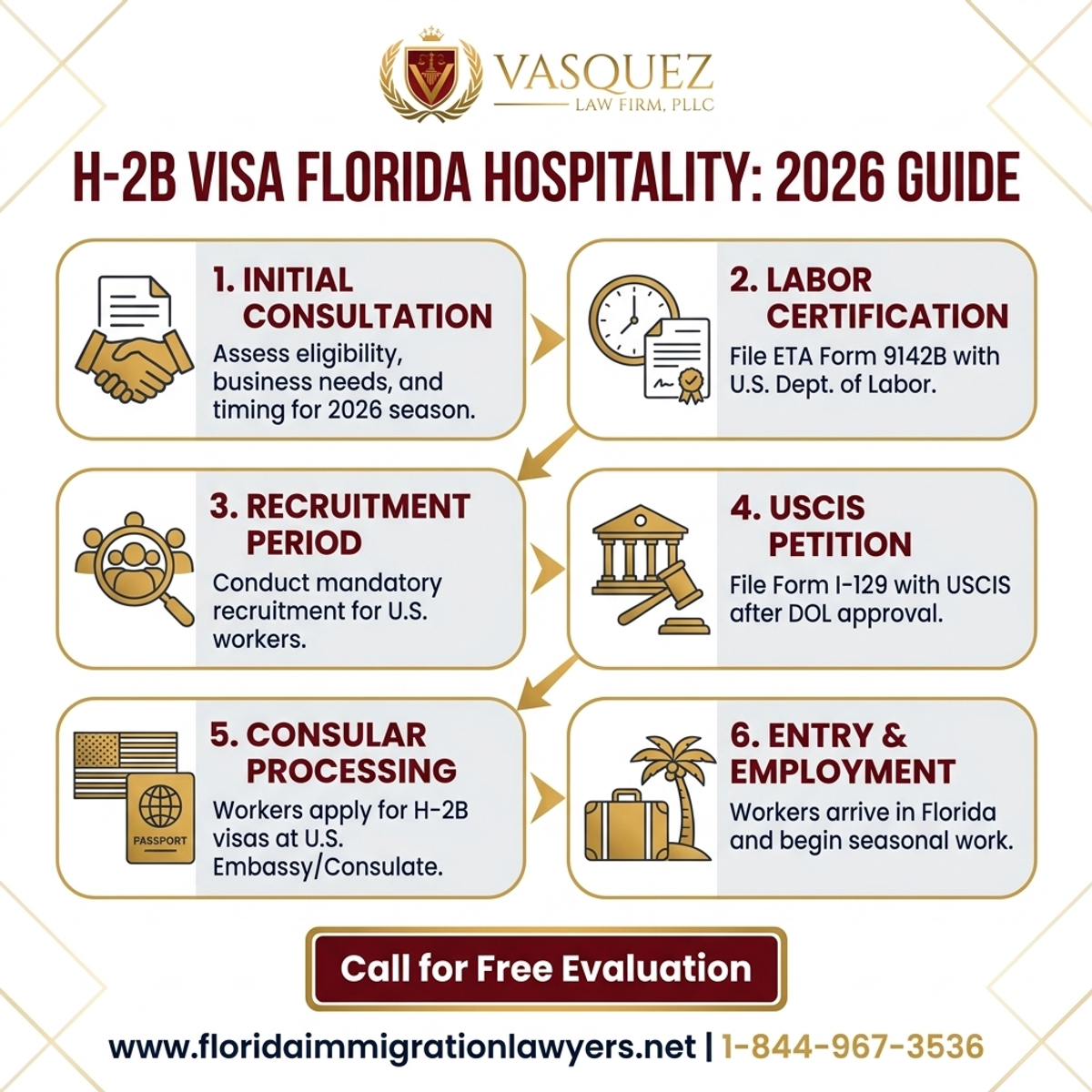
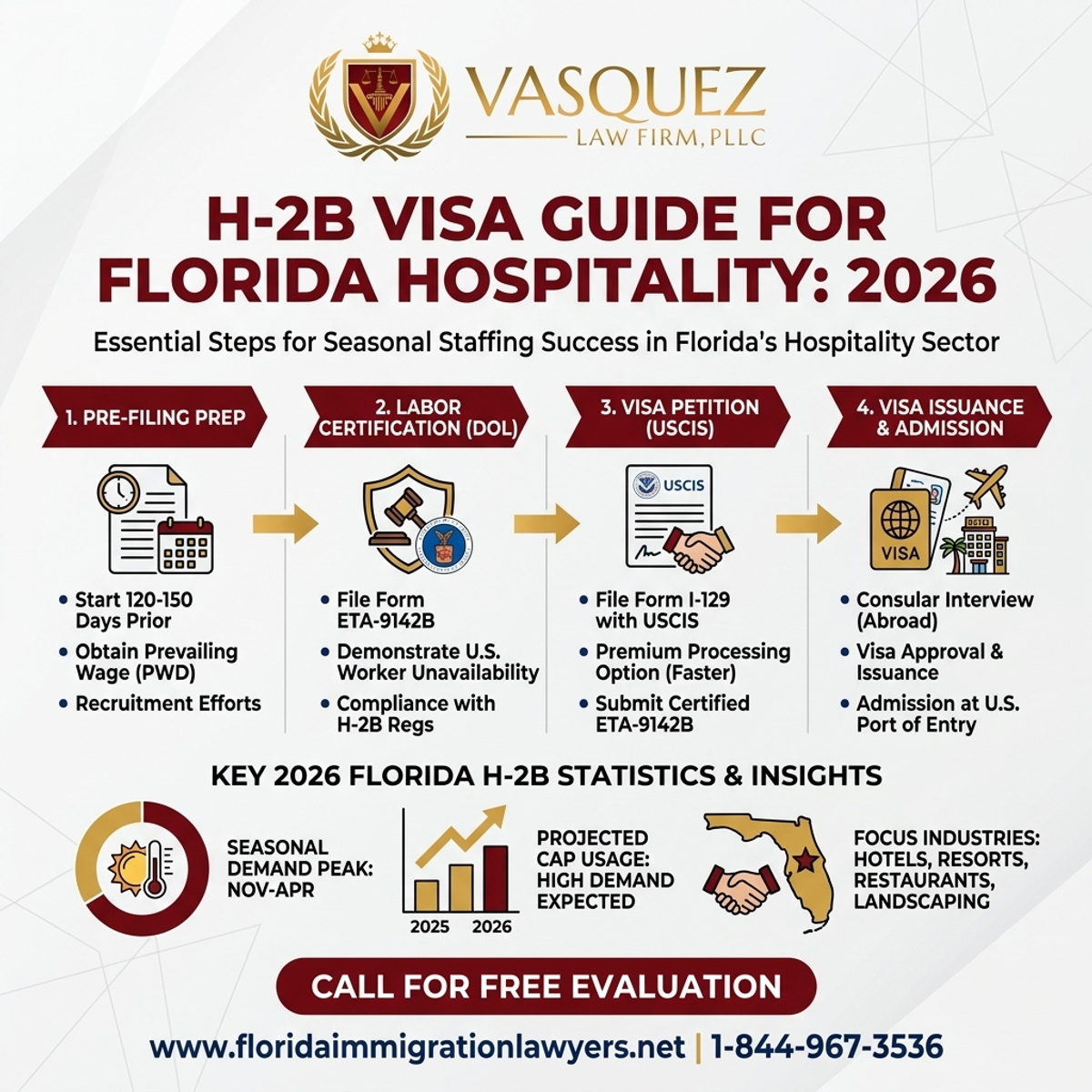
As of 2026, the H-2B application process for Florida employers involves a multi-stage approach, beginning with proving a temporary need and conducting recruitment efforts, followed by Department of Labor certification, a USCIS petition, and finally, consular processing for the workers.
Navigating the H-2B application process requires meticulous attention to detail and adherence to strict timelines. For Florida businesses, understanding each step is paramount to successfully securing the temporary workforce needed for their operations. This process typically begins well in advance of the desired start date, often 6-9 months prior, to account for processing times at various government agencies. Failure to meet deadlines or submit complete documentation can lead to significant delays or outright denials, impacting your business's ability to operate efficiently during crucial periods. The employer is responsible for initiating and sponsoring the petition, and for paying most of the associated fees, as outlined in 8 CFR Part 214.2(h)(6)(iii).
Step-by-Step Guide to the H-2B Visa Application:
-
Determine Temporary Need and File Prevailing Wage Request: The employer must first establish a legitimate temporary need for workers. This must fall into one of the four categories (seasonal, peakload, intermittent, or one-time). Concurrently, the employer must request a Prevailing Wage Determination (PWD) from the Department of Labor (DOL) using Form ETA-9141. The PWD ensures H-2B workers are paid at least the prevailing wage for the occupation in the area of intended employment, protecting both U.S. and foreign workers. This step typically takes 60-95 days.
-
File Temporary Labor Certification Application: After receiving the PWD, the employer files a Form ETA-9142B, Application for Temporary Employment Certification, with the DOL's Office of Foreign Labor Certification (OFLC). This application must describe the job duties, qualifications, and the temporary nature of the employment. This is where the employer commits to a specific number of workers and a specific period of employment. This filing must occur no more than 90 calendar days and no fewer than 75 calendar days before the date of need.
-
Conduct Recruitment Efforts: Once the ETA-9142B is accepted by the DOL, the employer must conduct a rigorous recruitment campaign to test the U.S. labor market. This involves advertising the job through various channels, including state workforce agencies (e.g., Florida Department of Economic Opportunity), local newspapers, and other appropriate media, as specified by the DOL. The employer must document all recruitment efforts and demonstrate that no qualified and available U.S. workers were found or hired. This phase typically lasts 15-20 days.
-
Receive Temporary Labor Certification: If the DOL is satisfied that the employer has met all requirements and that no qualified U.S. workers are available, it will issue a certified ETA-9142B. This certification is a prerequisite for filing a petition with U.S. Citizenship and Immigration Services (USCIS). Without this certification, the USCIS petition cannot proceed. This step can take an additional 30-45 days after recruitment is completed.
-
File Form I-129, Petition for a Nonimmigrant Worker: With the certified ETA-9142B in hand, the employer files Form I-129 with USCIS. This petition requests H-2B classification for the prospective workers. It must include the certified labor certification, a job offer letter, and evidence supporting the temporary nature of the employment and the employer's need. This is the stage where the H-2B cap becomes a critical factor; petitions for cap-subject workers must be filed during specific windows. USCIS processing times vary but can be lengthy, often 2-5 months, unless premium processing is requested.
-
Consular Processing (for workers outside the U.S.): Once USCIS approves the I-129 petition, foreign workers who are outside the U.S. must apply for an H-2B visa at a U.S. embassy or consulate in their home country. This involves completing Form DS-160, Online Nonimmigrant Visa Application, and attending a visa interview. During the interview, applicants must demonstrate they meet the visa requirements and intend to return to their home country after their temporary employment concludes. This stage typically takes 2-4 weeks, depending on interview availability and administrative processing.
-
Entry to the U.S.: Upon successful visa issuance, H-2B workers can travel to the U.S. and begin their employment with the sponsoring Florida employer. They are admitted for the period authorized on their visa and I-94 record.
What Documents are Required for an H-2B Visa Application?
Key documents for an H-2B visa application include the certified ETA-9142B, Form I-129, employer's proof of temporary need and recruitment, and the employee's valid passport, visa application (DS-160), and any required supporting personal documents.
A successful H-2B application hinges on the submission of a comprehensive and accurate set of documents from both the employer and the prospective employee. Missing or incorrect documentation is a primary reason for delays or denials. Employers in Florida, particularly those in the hospitality sector in high-demand areas like Hollywood, must ensure they maintain meticulous records throughout the entire process, from the initial prevailing wage request to the final visa approval. These documents serve as proof of compliance with federal regulations and demonstrate the legitimate need for temporary foreign workers. The complexity of documentation underscores the importance of legal guidance, especially when dealing with multiple workers or intricate employment scenarios.
Employer-Specific Document Checklist:
- Certified Form ETA-9142B: The Application for Temporary Employment Certification, approved by the Department of Labor. This is the cornerstone of the employer's petition.
- Form I-129, Petition for a Nonimmigrant Worker: Filed with USCIS, along with all required supplements and addenda specific to the H-2B classification.
- Prevailing Wage Determination (PWD): The official determination from the DOL for the specific job and geographic area.
- Proof of Temporary Need: Detailed justification demonstrating that the job is seasonal, peakload, intermittent, or a one-time occurrence. This can include past employment records, business projections, or contracts for specific projects. For instance, a hotel in Hollywood might provide booking data showing seasonal spikes.
- Recruitment Evidence: Comprehensive documentation of all efforts to recruit U.S. workers, including copies of advertisements, job orders, recruitment reports, and explanations for why U.S. applicants were not hired. This is a critical component for DOL certification.
- Business Documentation: Copies of business licenses, federal tax ID, articles of incorporation, and financial statements to prove the employer's legitimacy and ability to pay wages.
- Job Offer Letter: A detailed offer outlining the job duties, wage rate, work schedule, and terms of employment.
- Employer's Federal Employer Identification Number (FEIN): Required for all official filings.
Step-by-Step Process — H-2B Visa for Florida Hospitality: A 2026 Guide
Employee-Specific Document Checklist (for Consular Processing):
- Valid Passport: Must be valid for at least six months beyond the period of intended stay in the U.S.
- DS-160 Confirmation Page: The confirmation page for the Online Nonimmigrant Visa Application.
- Visa Interview Appointment Confirmation: Proof of scheduled interview at the U.S. embassy or consulate.
- One (1) Passport-Style Photograph: Meeting specific U.S. Department of State requirements.
- Form I-797, Notice of Action (Petition Approval Notice): Issued by USCIS to the employer, confirming the approval of the I-129 petition.
- Job Offer Letter/Contract: A copy of the employment contract from the Florida employer.
- Evidence of Intent to Return Home: Documents proving strong ties to the home country, such as property deeds, family obligations, bank statements, or letters from employers. This is crucial for overcoming the presumption of immigrant intent.
- Educational and Work Experience Documents: Diplomas, certificates, and letters of recommendation relevant to the H-2B job.
- Birth Certificate and Marriage Certificate (if applicable): For identity verification and to support any dependents.
Understanding H-2B Visa Timelines and Processing Expectations for 2026
As of 2026, H-2B processing times can vary significantly, typically ranging from 4 to 8 months from initial filing to visa issuance, depending on agency workload, cap availability, and whether premium processing is utilized.
The H-2B visa process is not a quick one, and employers in Florida's hospitality sector must plan well in advance to ensure their temporary workers arrive when needed. The overall timeline is influenced by several factors, including the efficiency of the Department of Labor (DOL) in issuing prevailing wage determinations and labor certifications, the processing speed of U.S. Citizenship and Immigration Services (USCIS), and the scheduling availability at U.S. embassies and consulates abroad for visa interviews. Furthermore, the annual H-2B cap, split into two halves for fiscal year (FY) 2026, often dictates when petitions can even be filed with USCIS, adding another layer of strategic planning. For instance, employers needing workers for the summer season (April 1 to September 30) must typically file their DOL applications in October/November of the prior year.
Understanding these timelines is crucial for Florida businesses, especially those in seasonal industries like tourism in areas such as Tampa, Miami, and Hollywood. Delays can mean lost revenue and operational disruptions. While the table below provides typical timeframes, it is important to remember that these are estimates. Unforeseen circumstances, RFE (Request for Evidence) from USCIS, or administrative processing at consulates can extend these periods. Employers should monitor official USCIS processing times and DOL announcements for the most current information.
Typical H-2B Visa Processing Timeline (As of 2026):
| Stage | Typical Timeframe | Notes |
|---|---|---|
| Prevailing Wage Determination (PWD) | 60-95 days | Filed with the DOL using Form ETA-9141. Essential first step. |
| Temporary Labor Certification (TLC) Filing | 75-90 days before need date | Form ETA-9142B filed with DOL. Includes recruitment period. |
| DOL Processing & Recruitment | 30-45 days (after filing) | Review of application, employer recruitment efforts, final certification. |
| USCIS Form I-129 Petition | 2-5 months | Filed with USCIS after DOL certification. Subject to cap. |
| USCIS Premium Processing (Optional) | 15 calendar days | Expedites I-129 processing for an additional fee. |
| Consular Processing | 2-4 weeks | Visa interview at U.S. Embassy/Consulate. Varies by location. |
| Total Estimated Time | 4-8 months | From PWD request to visa issuance. Plan accordingly. |
The H-2B cap significantly impacts these timelines. USCIS generally begins accepting petitions for the first half of the fiscal year (October 1 to March 31 start dates) in October, and for the second half (April 1 to September 30 start dates) in January. Petitions are processed on a first-come, first-served basis, and the cap is often reached very quickly. Employers must be prepared to file their I-129 petitions as soon as the filing window opens. Consulting with an experienced immigration attorney, like those at Florida Immigration Lawyers, can help streamline this complex process and strategize for optimal filing times.
What are the Costs Associated with the H-2B Visa Process?
H-2B visa costs involve various fees, including Department of Labor application fees, USCIS filing fees for Form I-129, and consular processing fees, which are primarily the employer's responsibility, alongside potential legal and travel expenses.
Understanding the financial commitment involved in the H-2B visa process is crucial for Florida employers. While the fees are subject to change, the employer is generally responsible for most of the costs associated with bringing H-2B workers to the U.S., as per federal regulations (20 CFR § 655.20(f)). This includes application and petition fees, recruitment costs, and transportation from the worker's home country to the place of employment. These costs are an investment in securing a reliable and legal temporary workforce for your Florida business, whether it's a bustling resort in Fort Lauderdale or a seasonal attraction in Kissimmee. It is important to budget for these expenses accurately and to be aware that specific fee amounts are set by the government agencies and can be updated annually. Always refer to the official USCIS website for the most current fee schedule.
Estimated H-2B Visa Cost Factors (As of 2026):
| Item | Typical Fee (Subject to Change) | Notes |
|---|---|---|
| Department of Labor (DOL) Filing Fee | No direct fee for ETA-9142B filing | Costs are primarily for recruitment efforts. |
| USCIS Form I-129 Filing Fee | $460 - $510+ | Base fee for petition. Varies based on latest fee schedule. |
| American Competitiveness and Workforce Improvement Act (ACWIA) Fee | $750 - $1,500 | Required for employers with 25 or more full-time equivalent employees, or $750 for fewer than 25. |
| Fraud Prevention and Detection Fee | $150 | Mandatory fee for H-2B petitions. |
| USCIS Premium Processing Fee (Optional) | $2,805 | Guarantees 15-calendar-day processing for I-129. Highly recommended for time-sensitive needs. |
| Consular Processing (DS-160) Fee (per worker) | $190 | Paid by the worker, but employers often cover this to attract talent. |
| Attorney Fees | Variable, $2,000 - $5,000+ | For legal assistance with DOL and USCIS filings, recruitment, and compliance. Highly advisable. |
| Recruitment Costs | Variable, $500 - $2,000+ | For advertising, job board postings, and other required recruitment efforts. |
| Travel and Transportation Costs | Variable, $500 - $2,000+ per worker | Employer is generally responsible for inbound and outbound transportation. |
| Other Potential Costs | Variable | Visa photos, medical exams (if required), mailing costs, etc. |
Key Statistics — H-2B Visa for Florida Hospitality: A 2026 Guide
It's important to note that employers are generally prohibited from passing these costs on to the H-2B workers. This rule is designed to protect workers from exploitation and ensure the H-2B program is used as intended. Employers must also ensure they are prepared to pay the prevailing wage determined by the DOL, which can be a significant ongoing expense. Careful financial planning and a clear understanding of all potential costs are essential for any Florida business considering the H-2B program.
Do not navigate this complex process alone. The success of your H-2B application directly impacts your business's ability to operate and thrive, especially in Florida's competitive hospitality market. Contact Florida Immigration Lawyers today at 1-844-967-3536 to schedule a free consultation. Our team can help you understand the current fee structures, manage the application process, and ensure compliance every step of the way.
Common Mistakes to Avoid in the H-2B Visa Process
The H-2B visa process is intricate, and even minor missteps can lead to significant delays, denials, or severe penalties. Employers in Florida, especially those new to the program or dealing with high volumes of seasonal workers, must be acutely aware of common errors. Avoiding these mistakes is critical for a smooth and successful application.
-
Failing to Prove Temporary Need Adequately: A frequent error is not sufficiently documenting that the job is truly temporary (seasonal, peakload, intermittent, or one-time). Employers must provide clear evidence, such as historical employment data, business projections, or specific project contracts. Simply stating a need without robust proof can lead to DOL or USCIS questioning the petition's validity, resulting in denials.
-
Inadequate Recruitment Efforts: The DOL requires employers to conduct rigorous recruitment of U.S. workers before seeking H-2B certification. Common mistakes include failing to advertise in the correct media, not advertising for the required duration, or not properly documenting all recruitment steps and responses. This can lead to a finding that the U.S. labor market was not adequately tested, resulting in a denial of the labor certification.
-
Missing Critical Deadlines: The H-2B process is highly time-sensitive, with strict deadlines for filing the Prevailing Wage Request, the Temporary Labor Certification, and the Form I-129. Missing these windows, particularly for cap-subject petitions, can mean waiting another half-year or even a full year to bring in workers, severely impacting seasonal operations in Florida's hospitality industry.
-
Incorrect Prevailing Wage Determination: Employers must obtain an accurate Prevailing Wage Determination (PWD) from the DOL and commit to paying H-2B workers at least this wage. Errors in requesting the PWD, such as misclassifying the job duties or geographic area, can lead to delays or a requirement to pay back wages, creating substantial financial liabilities.
-
Not Addressing Cap Limitations: The H-2B program has an annual statutory cap of 66,000 visas, split into two halves. Many employers fail to account for the competitive nature of the cap, missing the brief filing windows when petitions are accepted. This can result in their petitions being returned or denied if the cap is reached before their filing is processed, leaving them without their needed workforce.
-
Incomplete or Inaccurate Documentation: From the initial DOL filings to the USCIS petition and consular processing, every form and supporting document must be meticulously completed and accurate. Simple errors, omissions, or inconsistencies across documents can trigger Requests for Evidence (RFEs) from USCIS or even outright denials, prolonging the process and increasing costs.
-
Failure to Comply with Post-Approval Requirements: Obtaining the visa is not the end of the employer's responsibilities. Employers must adhere to the terms of the certified labor condition application, including paying the specified wages, providing adequate working conditions, and maintaining specific records. Non-compliance can lead to audits, fines, and debarment from future participation in immigration programs.
-
Not Consulting Legal Counsel: Attempting to navigate the H-2B process without experienced legal guidance is a common and often costly mistake. The rules are complex, constantly evolving, and require specialized knowledge. An attorney can help avoid errors, strategize for cap seasons, respond to RFEs, and ensure overall compliance, protecting your business from potential legal issues.
When to Call a Florida Immigration Lawyer for H-2B Visas
While the information provided here serves as a valuable guide, the complexities of immigration law, particularly regarding the H-2B visa program, often necessitate professional legal assistance. For Florida businesses, ensuring compliance and maximizing the chances of a successful application is paramount. There are specific scenarios and warning signs that indicate it's time to seek the expertise of a dedicated immigration attorney, like those at Florida Immigration Lawyers.
You should consider calling an attorney if your business is new to the H-2B program and needs comprehensive guidance from start to finish. If you've previously experienced denials, Requests for Evidence (RFEs), or audits from the Department of Labor or USCIS, legal counsel can help identify past errors and rectify them for future applications. Furthermore, if your temporary labor needs are complex, involving multiple job classifications, numerous workers, or unusual seasonal patterns, an attorney can help structure your petition to meet regulatory requirements. Businesses operating in highly competitive H-2B markets, such as the hospitality sectors in Miami-Dade, Broward, or Orange County, often benefit from strategic planning and timely filing assistance.
An attorney can also assist with crucial aspects like conducting proper recruitment efforts to satisfy DOL requirements, accurately determining prevailing wages, and preparing robust justifications for your temporary need. Moreover, if you face any post-approval compliance issues, such as wage disputes or workplace condition complaints, an immigration lawyer can provide crucial defense and ensure your business remains in good standing. Do not wait until a problem arises. Proactive legal consultation can save your business time, money, and potential legal headaches. Our firm, Florida Immigration Lawyers, specializes in business immigration and has a deep understanding of the unique demands of Florida's industries. We are ready to help you navigate the H-2B landscape effectively.
About Florida Immigration Lawyers
Florida Immigration Lawyers is a leading immigration law firm dedicated to serving individuals and businesses across the entire state of Florida. With a profound understanding of U.S. immigration law and its unique implications for the Sunshine State, our firm provides comprehensive and compassionate legal representation. We are committed to helping our clients achieve their immigration goals, from family-based petitions and asylum claims to complex business immigration solutions like the H-2B visa.
Our team of experienced attorneys offers personalized attention, ensuring that every client receives tailored strategies designed to meet their specific needs. We pride ourselves on our proactive approach, meticulous attention to detail, and unwavering advocacy. Whether you are an employer in Hollywood seeking to secure temporary workers for your hospitality business or an individual pursuing citizenship, we stand ready to guide you through every step of the process. We understand the challenges and anxieties associated with immigration matters, and we strive to make the legal journey as smooth and stress-free as possible.
We offer a wide range of services, including assistance with H-2B visas, business immigration, family immigration, deportation defense, asylum, and naturalization. Our firm is available 24/7 to address your urgent concerns and provides free consultations to help you understand your options. We proudly serve all of Florida, with a strong presence in areas like Hollywood, Miami, Orlando, and Tampa. Choose Florida Immigration Lawyers for trusted legal counsel and dedicated support in your immigration journey. Visit our attorneys page or contact us today!
Sources and References
- U.S. Citizenship and Immigration Services (USCIS)
- U.S. Department of Labor (DOL) - Office of Foreign Labor Certification (OFLC)
- U.S. Department of State - Bureau of Consular Affairs
- Immigration and Nationality Act (INA) §101(a)(15)(H)(ii)(b) (8 U.S.C. §1101(a)(15)(H)(ii)(b))
- 8 Code of Federal Regulations (CFR) Part 214 - Nonimmigrant Classes
- 20 Code of Federal Regulations (CFR) Part 655 - Temporary Employment of H-2B Aliens in Occupations Other Than Agriculture
- USCIS Policy Manual
Related services: immigration practice areas.
This article provides general legal information and is not intended as legal advice. Every case is unique, and outcomes depend on specific facts and circumstances. Contact an attorney for advice about your particular situation.
Your business's success in Florida's dynamic economy depends on having the right workforce at the right time. Do not let the complexities of the H-2B visa program hinder your operations. Let the experienced team at Florida Immigration Lawyers guide you through every step, ensuring compliance and maximizing your chances of success. Call us today for a free consultation at 1-844-967-3536. Se Habla Espanol - Estamos aqui para ayudarle.
If you need legal assistance, learn more about how our immigration attorneys can help, or call us at 1-844-967-3536 for a free consultation.
Do Not Navigate This Process Alone
Our experienced immigration attorneys are ready to fight for you. Get a free, confidential consultation today.
Se Habla Español
Or leave your details and we’ll call you:
Free Evaluation in 24 Hours
Or talk to us right now

AI voice assistant — available 24/7
FreeFrequently Asked Questions

William J. Vásquez
Founding Attorney · Vasquez Law Firm
U.S. Air Force veteran and immigration attorney with years of hands-on U.S. immigration experience. J.D., NCCU School of Law. AILA member. Admitted to the 4th, 5th, and 11th Circuit Courts.
Available 24/7 - Free Evaluations
Reviewed for legal accuracy by William J. Vásquez
Licensed in North Carolina; U.S. immigration is federal practice.
Related Legal Services
Our Florida immigration attorneys can help you with asylum protection, citizenship and naturalization and immigration practice areas. Call today at 1-844-967-3536 for a free consultation.
Related Links
Related Topics
Free Legal Case Review
Discuss your case with our experienced attorneys. We're available 24/7.
Se Habla Español - Estamos aquí para ayudarle.
Related Articles
Immigration Lawyer Orlando Free Consultation in Florida
For individuals and families in Orlando, Florida, navigating the complexities of U.S. immigration law requires expert guidance. An immigration lawyer in Orlando offers crucial support for everything from visa applications and green card processes to naturalization and deportation defense. This comprehensive guide details what a free consultation covers, providing a step-by-step overview of immigration pathways, essential document checklists, and expected timelines in 2026. We also highlight common mistakes to avoid, discuss the critical role of legal counsel in deportation and asylum cases, and explain why choosing a local Orlando immigration attorney is beneficial. Florida Immigration Lawyers is dedicated to serving the diverse community of Orlando with compassionate, effective legal solutions, ensuring you receive personalized advice and robust representation for a successful immigration journey.
221(g) Visa Denial & Consular Return in Florida 2026
A 221(g) visa denial is a temporary refusal, not a final rejection, indicating that your application requires additional documents or administrative processing before a final decision. For individuals in Florida, understanding this specific type of consular processing is crucial. This comprehensive guide explains the reasons behind a 221(g) notice, outlines the step-by-step process for responding, details what to expect during administrative processing, and discusses potential outcomes and associated costs. We cover common mistakes to avoid and highlight when expert legal assistance from Florida Immigration Lawyers can be invaluable. Our firm is dedicated to helping you navigate the complexities of immigration law, providing strategic guidance and advocacy to address your 221(g) denial and pursue a successful resolution. Contact us for a free case review and let our experienced team assist you.
F-1 Reinstatement Process in Florida 2026
For international students in Florida, falling out of F-1 status can be a daunting experience, threatening academic progress and future immigration prospects. The F-1 reinstatement process offers a vital pathway to regain legal standing without leaving the U.S. This comprehensive guide from Florida Immigration Lawyers details everything you need to know, from understanding eligibility requirements and compiling essential documents to navigating processing times and avoiding common pitfalls. We cover the step-by-step application for Form I-539, provide crucial insights into maintaining your status while your application is pending, and outline the associated costs. Whether your status violation was due to an administrative error, an unforeseen emergency, or a minor misunderstanding, prompt action and meticulous preparation are key. Discover why expert legal guidance is indispensable for a successful F-1 reinstatement in Florida, ensuring your academic journey remains on track. Contact Florida Immigration Lawyers for a free case review.
TPS Re-registration Florida Deadlines 2026: What You Need
For those holding Temporary Protected Status (TPS) in Florida, the upcoming re-registration deadlines for 2026 are crucial. This guide provides essential information on maintaining your TPS, covering eligibility criteria, a detailed step-by-step re-registration process, and a comprehensive document checklist. We also outline the anticipated timelines and cost factors, including options for fee waivers. With designations subject to change and strict filing windows, understanding the requirements is paramount to avoid the loss of your protected status and work authorization. Learn about common mistakes to steer clear of and when it is advisable to seek professional legal assistance from experienced immigration attorneys. Florida Immigration Lawyers offers expert guidance for TPS re-registration, ensuring you navigate the process accurately and efficiently.