Green Card Through Marriage in Florida
Learn how to obtain a green card through marriage in Florida. Discover the qualifications, steps, common mistakes, and when to seek legal help. Call Florida Immigration Lawyers for a free consultation.

Green Card Through Marriage in Florida | VLF Florida
For many, the dream of building a life together in the United States begins with a marriage-based green card. In Florida, a state known for its diverse communities and welcoming spirit, securing a green card through marriage can be a straightforward process with the right guidance, but it is also fraught with complexities and potential pitfalls. At VLF Florida, we understand the profound importance of uniting families and are dedicated to guiding couples through every step of this critical immigration journey. This comprehensive guide will illuminate the path to obtaining a marriage-based green card in Florida, ensuring you understand the requirements, processes, and how expert legal assistance can make all the difference.
Understanding the Marriage-Based Green Card Process in Florida
A marriage-based green card grants permanent residency to the spouse of a U.S. citizen or lawful permanent resident (LPR), allowing them to live and work permanently in the United States. This pathway is one of the most common routes to obtaining legal status, but it requires meticulous attention to detail and a thorough understanding of U.S. immigration law. The process hinges on proving the authenticity of the marriage – that it is ‘bona fide’ and not entered into solely for immigration purposes.
There are two primary paths depending on where the foreign national spouse resides:
- Adjustment of Status: If the foreign national spouse is already present in the U.S. and entered legally, they can apply to adjust their status to a permanent resident without leaving the country. This involves filing Form I-485.
- Consular Processing: If the foreign national spouse lives outside the U.S., they will go through consular processing. This involves the U.S. citizen or LPR spouse filing a petition, and once approved, the foreign national spouse attends an interview at a U.S. embassy or consulate in their home country.
Both processes require significant documentation and adherence to specific timelines. Understanding which path applies to your situation is the first crucial step, and an experienced immigration attorney can help you determine the most efficient and appropriate route.
Eligibility Requirements for Spouses
To successfully obtain a marriage-based green card, both the U.S. citizen/LPR spouse (the petitioner) and the foreign national spouse (the beneficiary) must meet specific criteria set by U.S. Citizenship and Immigration Services (USCIS).
For the U.S. Citizen or Lawful Permanent Resident Petitioner:
- Valid Marriage: You must be legally married to your foreign national spouse. This means the marriage must be recognized as valid in the place it occurred, and all previous marriages for both individuals must have been legally terminated.
- Age Requirement: You must be at least 18 years old to file the petition.
- Domicile: You must be domiciled in the U.S. or intend to re-establish domicile in the U.S. by the time the green card is issued.
- Financial Sponsorship: You must demonstrate the financial ability to support your spouse by meeting specific income requirements (at least 125% of the federal poverty guidelines). This is done by filing Form I-864, Affidavit of Support. If your income is insufficient, a joint sponsor may be required.
For the Foreign National Beneficiary:
- Valid Marriage: As with the petitioner, the marriage must be legally valid.
- Admissibility: You must be admissible to the U.S. This means you must not have certain criminal records, previous immigration violations, or specific health conditions that would make you ineligible for a green card. Waivers may be available in some circumstances.
- Legal Entry (for Adjustment of Status): If applying for adjustment of status within the U.S., you must generally have entered the U.S. legally (e.g., with a visa or through the Visa Waiver Program).
The cornerstone of any marriage-based green card application is proving that the marriage is genuine and not solely for immigration benefits. USCIS scrutinizes these petitions closely, looking for evidence of a shared life and commitment. This includes joint bank accounts, shared leases or property deeds, birth certificates of children born to the marriage, joint insurance policies, family photos, and affidavits from friends and family.
The Step-by-Step Application Journey
The process of obtaining a green card through marriage involves several stages, each requiring careful preparation and submission of specific forms and supporting documents.
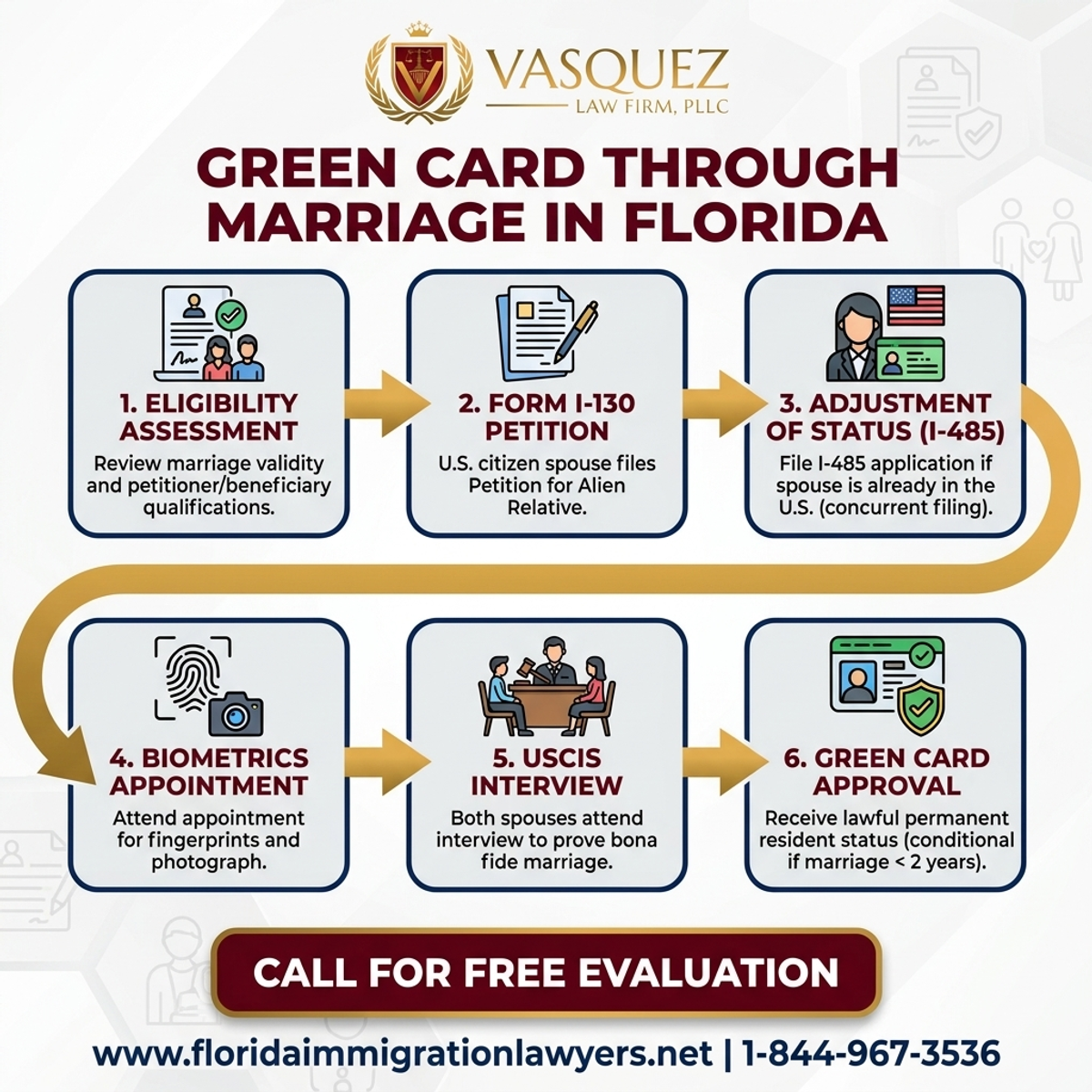
Filing Form I-130: The Foundation of Your Petition
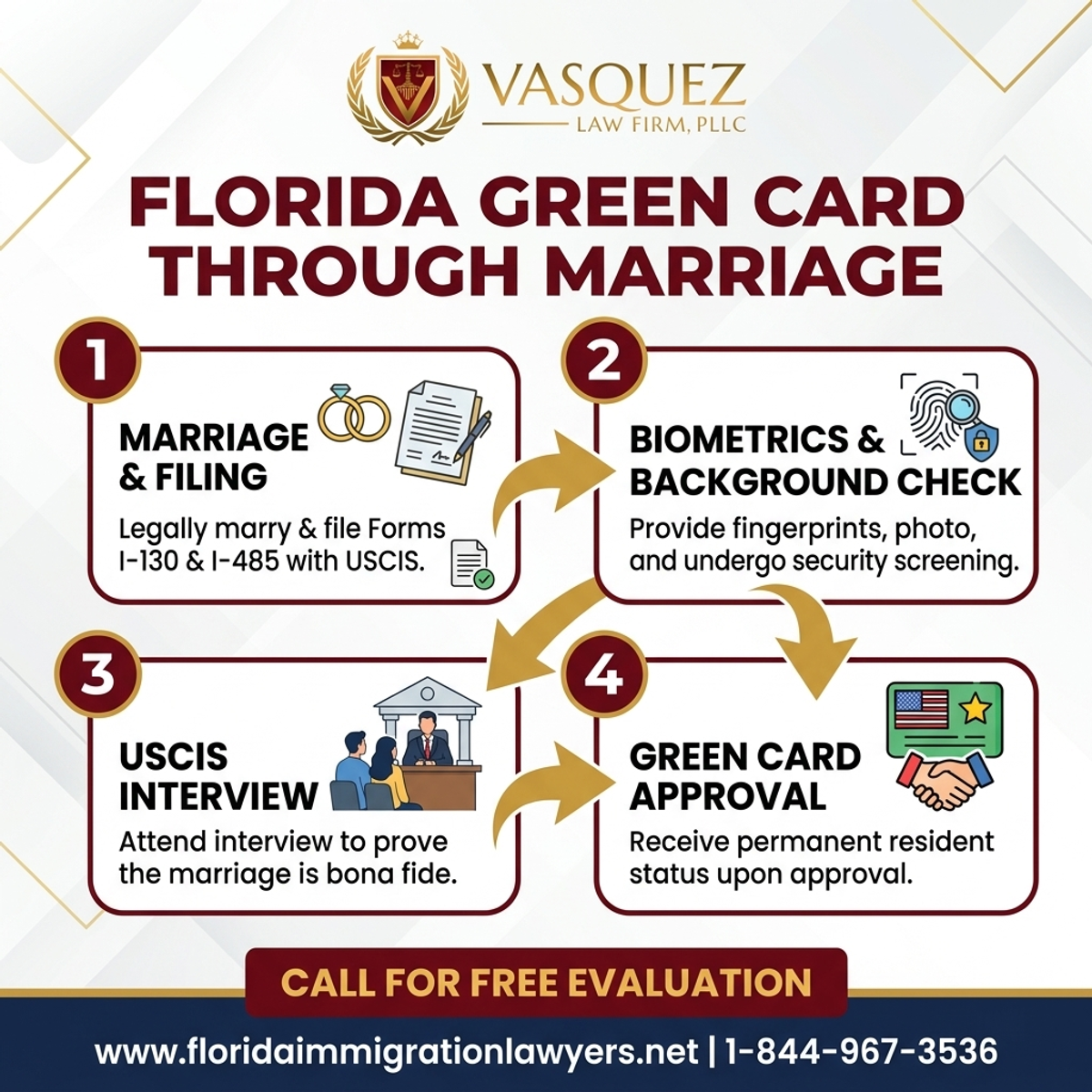
The journey begins with the U.S. citizen or LPR spouse filing Form I-130, Petition for Alien Relative, with USCIS. This form establishes the legal relationship between the petitioner and the beneficiary. Along with the I-130, you must submit proof of the petitioner's U.S. citizenship or LPR status, proof of a valid marriage (marriage certificate), and evidence that the marriage is bona fide. This initial step is crucial as it lays the groundwork for the entire process. Any errors or omissions here can lead to delays or even denial.
Adjustment of Status vs. Consular Processing: Choosing Your Path
Once the I-130 is filed (or concurrently, if eligible for adjustment of status), the next steps depend on the foreign spouse's location:
- Adjustment of Status (Form I-485): If the foreign spouse is in the U.S. and meets eligibility criteria, they can file Form I-485, Application to Register Permanent Residence or Adjust Status. This is typically filed concurrently with Form I-130, or after the I-130 is approved. This package also includes applications for work authorization (Form I-765) and travel permission (Form I-131), which can be invaluable during the processing period.
- Consular Processing: If the foreign spouse is outside the U.S., or ineligible for adjustment of status, the approved I-130 petition is sent to the National Visa Center (NVC). The NVC collects all necessary documents, fees, and forms (including the Affidavit of Support) before forwarding the case to the appropriate U.S. embassy or consulate abroad for an interview.
Assembling Your Comprehensive Documentation
Regardless of the path, extensive documentation is required. This includes:
Step-by-Step Process — Green Card Through Marriage in Florida | VLF Florida
- Birth certificates for both spouses.
- Marriage certificate.
- Divorce decrees or death certificates for any previous marriages.
- Passport photos.
- Proof of U.S. citizenship or green card for the petitioner.
- Financial documents (tax returns, employment letters, pay stubs) for the Affidavit of Support.
- Medical examination results.
- Most importantly, compelling evidence of a bona fide marriage: joint bank statements, utility bills, leases, property deeds, insurance policies, photos, travel itineraries, and affidavits from friends and family. The more evidence you can provide to demonstrate a shared life, the stronger your case.
The Biometrics Appointment: A Key Step
For those applying for adjustment of status, a biometrics appointment at a local Application Support Center (ASC) is a mandatory step. During this appointment, your fingerprints, photograph, and signature are collected. These biometrics are used for background checks and to verify your identity. This is a relatively quick appointment, but it is essential not to miss it.
Preparing for Your USCIS Interview
Both adjustment of status and consular processing typically culminate in an interview. For adjustment of status, the interview takes place at a USCIS field office in Florida, with both spouses present. For consular processing, the foreign spouse attends an interview at a U.S. embassy or consulate in their home country. The purpose of the interview is to verify the information provided in the application and to confirm the authenticity of the marriage. Interviewing officers will ask questions about your relationship, how you met, your daily life together, and future plans. Thorough preparation, including reviewing your application and supporting documents, is vital to ensure a smooth interview process.
Navigating the Conditional Green Card Period and Removing Conditions
If your marriage is less than two years old at the time your green card is approved, USCIS will issue a conditional green card valid for two years. This is a probationary period designed to further deter marriage fraud.
Understanding the Two-Year Conditional Status
The conditional green card grants the same rights and privileges as a permanent green card, but it has an expiration date. During these two years, you and your spouse are expected to continue building your life together and gathering evidence of your bona fide marriage. It's crucial to understand that this is not a permanent status until the conditions are removed.
The Petition to Remove Conditions (Form I-751)
To transition from a conditional green card to a permanent one, you and your spouse must jointly file Form I-751, Petition to Remove Conditions on Residence, within the 90-day period immediately preceding the expiration date of the conditional green card. This petition requires you to submit updated evidence of your ongoing bona fide marriage (e.g., new joint bank statements, updated leases, photos, birth certificates of any children born during this period). If the I-751 is not filed on time, the conditional green card will expire, and the foreign national spouse could face deportation.
There are also waivers available for the joint filing requirement in specific circumstances, such as divorce, spousal abuse, or if the U.S. citizen spouse has passed away. These waivers are complex and require strong supporting documentation, making legal counsel particularly important.
Addressing Complexities and Exploring Related Immigration Pathways
While the marriage-based green card process can be straightforward for many, various factors can introduce significant complexities. These might include a history of immigration violations, criminal convictions, previous deportations, or issues related to medical inadmissibility. Each of these can trigger additional scrutiny from USCIS and may require waivers or specialized legal strategies to overcome. Understanding these potential roadblocks early on is critical to avoiding delays or outright denials.
Furthermore, it's important to recognize that immigration law is a vast and interconnected field. While a marriage-based green card is a specific pathway, individuals may encounter situations where other areas of immigration law become relevant. For instance, if a foreign national is facing removal proceedings, they might need robust deportation defense strategies, potentially alongside their marriage petition. Similarly, individuals who have experienced persecution in their home countries may be eligible for asylum, which offers a different route to protection and eventual permanent residency, sometimes in conjunction with or as an alternative to a marriage petition if the latter is not feasible or safe. Our firm provides comprehensive immigration services, ensuring that all aspects of your unique situation are considered. Navigating these overlapping areas requires an in-depth understanding of the law and the ability to craft tailored solutions that address all legal challenges effectively.
Key Statistics — Green Card Through Marriage in Florida | VLF Florida
The Long-Term Benefits of a Green Card and the Path to U.S. Citizenship
Obtaining a green card through marriage is more than just a piece of identification; it's a gateway to a new life. As a lawful permanent resident, you gain the right to live and work permanently anywhere in the U.S., travel internationally with greater ease, and enjoy access to educational and healthcare benefits. You can also sponsor other eligible family members for green cards in the future.
Perhaps the most significant long-term benefit is the path to U.S. citizenship. After holding a green card for three years (if married to and living with a U.S. citizen), you become eligible to apply for naturalization, provided you meet other residency and good moral character requirements. U.S. citizenship offers the highest level of security and rights, including the right to vote and hold public office, and protection from deportation.
Why Expert Legal Guidance from VLF Florida is Indispensable
While the prospect of a marriage-based green card offers immense hope, the process itself is notoriously complex, with ever-changing regulations and stringent requirements. A single mistake on an application, an overlooked document, or an ill-prepared interview can lead to significant delays, requests for evidence, or even denial.
At VLF Florida, our dedicated team of experienced immigration attorneys specializes in marriage-based green card petitions. We provide comprehensive legal support, including:
- Personalized Case Assessment: We evaluate your unique situation, identify potential challenges, and determine the most effective strategy.
- Meticulous Document Preparation: We ensure all forms are correctly filled out and all supporting evidence is properly organized and submitted.
- Interview Preparation: We thoroughly prepare you and your spouse for the USCIS interview, equipping you with the confidence and knowledge to answer questions effectively.
- Navigating Complexities: We are adept at handling challenging cases, including those involving previous immigration issues, criminal records, or waivers.
- Ongoing Support: We remain by your side from the initial consultation through to the final approval, providing updates and addressing any concerns.
Our goal is to alleviate the stress and uncertainty of the immigration process, allowing you to focus on building your life together. With VLF Florida, you gain a trusted legal partner committed to achieving a successful outcome for your family.
Contact VLF Florida for a Free Consultation Today!
The journey to a green card through marriage in Florida is a significant step towards a shared future. Don't navigate this complex process alone. Let the experienced immigration attorneys at VLF Florida provide the expert guidance and support you need. We offer free consultations to discuss your specific situation and outline a clear path forward. Call us today at (844) 967-3536 or contact us online to schedule your free consultation and take the first step towards securing your future in the United States.
Frequently Asked Questions About Green Cards Through Marriage in Florida
Here are answers to common questions regarding the marriage-based green card process:
- How long does it take to get a green card through marriage in Florida?
The processing time can vary significantly based on factors like the USCIS service center workload, whether you're adjusting status or going through consular processing, and the complexity of your case. Generally, it can take anywhere from 10 months to over 2 years. Our attorneys can provide a more accurate estimate based on current processing times and your specific circumstances.
- What is a bona fide marriage?
A bona fide marriage is one that is entered into in good faith, with the genuine intention of establishing a life together, and not solely for immigration benefits. USCIS requires extensive evidence to prove the authenticity of your marriage.
- What kind of evidence do I need to prove a bona fide marriage?
Evidence can include joint bank accounts, shared leases or property deeds, utility bills in both names, joint insurance policies, birth certificates of children born to the marriage, family photos, travel itineraries, and affidavits from friends and family who can attest to your relationship.
- Can I apply for a green card if my spouse is a Lawful Permanent Resident (LPR) instead of a U.S. Citizen?
Yes, LPRs can petition for their spouses. However, the processing times for spouses of LPRs are typically longer than for spouses of U.S. citizens due to visa bulletin backlogs.
- What happens if my marriage ends before I get my permanent green card?
If you have a conditional green card and your marriage ends before you file Form I-751 to remove conditions, you may still be able to file the I-751 with a waiver of the joint filing requirement. This typically requires demonstrating that the marriage was bona fide at its inception and that you entered it in good faith.
- Do I need an attorney for a marriage-based green card?
While not legally required, hiring an experienced immigration attorney can significantly increase your chances of success, help you navigate complexities, avoid common pitfalls, and ensure all documentation is correctly prepared and submitted. This is especially true for cases with unique circumstances.
- What is the Affidavit of Support (Form I-864)?
The Affidavit of Support is a legally binding contract where the U.S. citizen or LPR petitioner agrees to financially support the immigrant spouse. This ensures the immigrant will not become a public charge. The petitioner must meet specific income thresholds, or a joint sponsor may be required.
- Can I travel outside the U.S. while my green card application is pending?
If you are applying for adjustment of status within the U.S., traveling abroad without an approved Advance Parole document (Form I-131) can lead to the abandonment of your I-485 application. It is crucial to obtain Advance Parole before any international travel.
Sources and References
- U.S. Citizenship and Immigration Services (USCIS)
- Executive Office for Immigration Review (EOIR)
- U.S. Department of State - Bureau of Consular Affairs
- Immigration and Nationality Act (INA), 8 U.S.C. Chapter 12
Do Not Navigate This Process Alone
Our experienced immigration attorneys are ready to fight for you. Get a free, confidential consultation today.
Se Habla Español
Frequently Asked Questions
Harold Estrada-Rodriguez
Florida Immigration Attorney · FL Bar No. 1041171
Florida Bar attorney handling Florida-jurisdiction immigration matters. Bilingual representation, free consultations.
Available 24/7 - Free Evaluations
Related Legal Services
Our Florida immigration attorneys can help you with business immigration, asylum protection and deportation defense. Call today at 1-844-967-3536 for a free consultation.
Related Links
Related Topics
Free Legal Consultation
Discuss your case with our experienced attorneys. We're available 24/7.
Se Habla Español - Estamos aquí para ayudarle.
Related Articles
DACA Work Permit Process in Florida 2026 | VLF Florida
Explore the process of obtaining a DACA work permit in Florida. This guide covers eligibility, application steps, and common mistakes to avoid. Call Florida Immigration Lawyers for expert assistance.
TPS to Green Card: Florida Pathway Explained | VLF Florida
Learn how to transition from TPS to a green card in Florida. Explore eligibility requirements, necessary documentation, and common pitfalls. Contact Florida Immigration Lawyers for guidance and support.
H-2B Visa for Florida Hospitality: A 2026 Guide | VLF Florida
For Florida's bustling hospitality industry, the H-2B visa program is crucial for addressing seasonal labor demands. This 2026 guide details the application process for employers seeking temporary non-agricultural workers, from securing Department of Labor certification to filing petitions with USCIS. We cover eligibility, required documents, typical timelines, and associated costs, emphasizing the importance of planning due to annual caps and strict compliance rules. Learn about common mistakes to avoid and when to seek legal counsel to navigate this complex immigration pathway successfully. Florida Immigration Lawyers offers expert guidance to businesses across the state, ensuring a smooth and efficient H-2B application process.
Immigration Scams Protection: Florida Legal Guide 2026
Immigration scams and notario fraud pose significant threats to individuals seeking legal status in Florida. These deceptive practices can lead to financial loss, legal complications, and even deportation. This comprehensive guide from Florida Immigration Lawyers provides crucial information on identifying common scams, understanding the dangers of unauthorized legal practitioners, and taking proactive steps to protect yourself. Learn how to verify credentials, demand written contracts, and report fraudulent activities to relevant authorities. We also outline the indispensable role of a qualified immigration lawyer in safeguarding your journey and ensuring compliance with federal and state laws. Empower yourself with knowledge and secure your future in Florida by recognizing red flags and seeking legitimate legal assistance.
