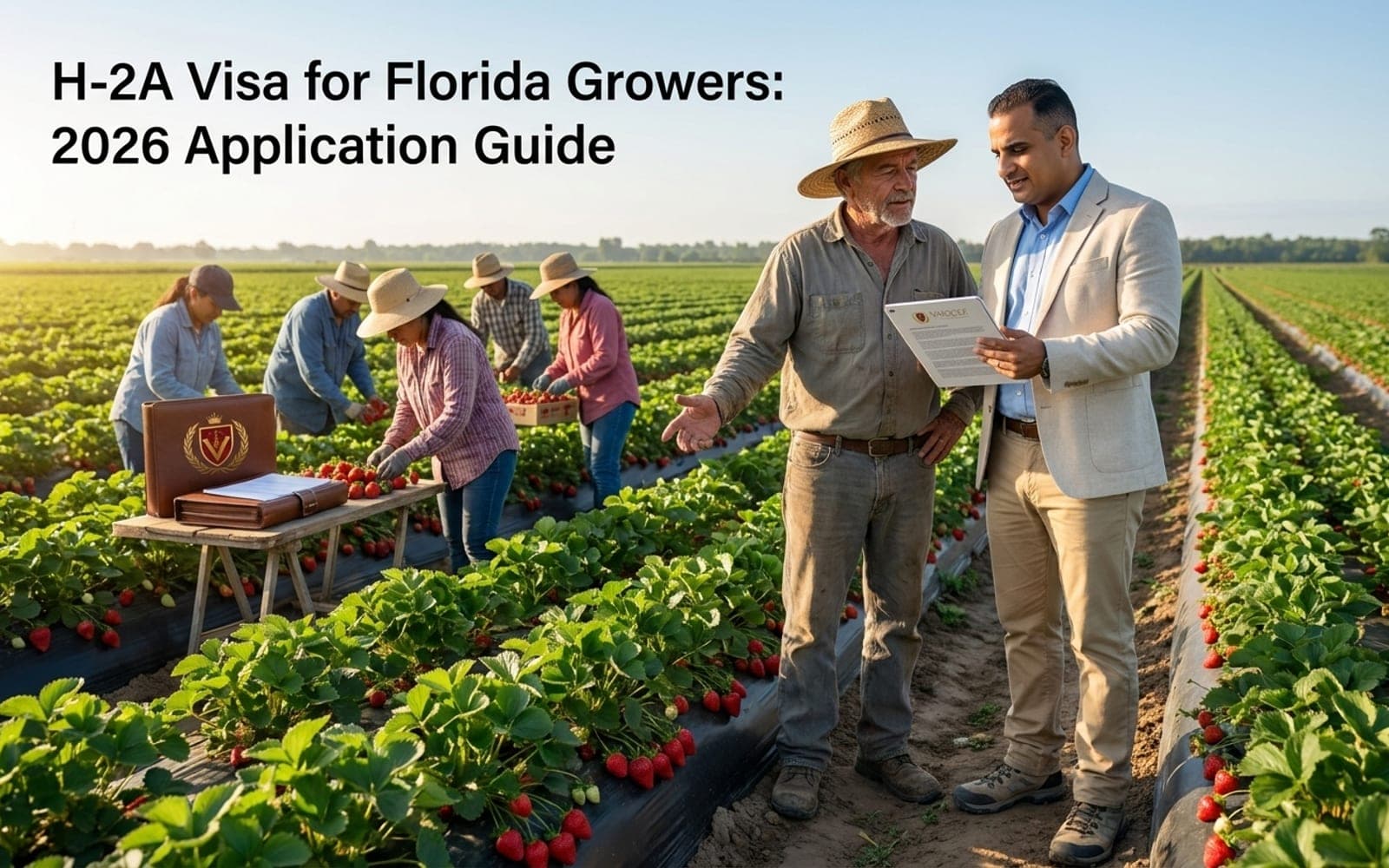
H-2A lets U.S. agricultural employers hire foreign workers for temporary or seasonal farm work when not enough U.S. workers are available. The process generally has three stages: a temporary labor certification from the Department of Labor, a USCIS petition on Form I-129, and visa applications at a consulate abroad. H-2A employers take on obligations such as wage requirements, recruitment of U.S. workers and, generally, housing and transportation. The guide also covers H-2B, H-3, H-4 and P categories and IR1 and CR1 spouse visas, since each category has different rules.
- H-2A has three stages: labor certification, a USCIS petition, and consular visa applications.
- H-2A employers take on obligations including wages, recruitment, and generally housing and transportation.
- H-2B, H-3, H-4 and P categories each have their own rules.
- IR1 and CR1 immigrant visas cover spouses of U.S. citizens.
Introduction
Florida's farms, nurseries, hotels, landscaping companies, and entertainment venues often depend on temporary workers, and the families of those workers have their own immigration needs. This guide covers the H-2A, H-2B, H-3, H-4, and P categories, plus the IR1 and CR1 immigrant visas for spouses, and explains how each generally works. To talk about your situation, call 1-844-YO-PELEO or contact us.
Each category has different rules, so the first job of an H-2A visa attorney or any immigration lawyer is to match the worker and the job to the right category. Employers need to know which program fits the business and the season, workers need to know what their status allows, and families need to know how to stay together.
This page is general information, not legal advice. Caps, wage rules, forms and fees change, so confirm current requirements with the agency before you rely on any summary, and speak with a lawyer about your facts.
H-2A: Temporary Agricultural Workers
The H-2A program lets U.S. agricultural employers hire foreign workers for temporary or seasonal farm work when there are not enough able, willing, and available U.S. workers. The process generally has three stages: the employer obtains a temporary labor certification from the Department of Labor, files a petition with USCIS on Form I-129, and the workers apply for visas at a U.S. consulate abroad.
H-2A employers take on specific obligations under program rules, including wage requirements, recruitment of U.S. workers, and, in general, housing and transportation for workers. An H-2A visa attorney helps growers in places like Immokalee, Homestead, and Plant City plan the season, file on time, and keep the records the program requires.
Because farm work follows the weather and the harvest, timing is critical. Employers who start planning only when the crop is ready may find that the labor certification and petition process cannot be completed in time, so planning months ahead is wise.
Workers also have a stake in the process. An H-2A worker is generally authorized to work only for the petitioning employer, so a worker who leaves the job or is asked to do a different kind of work can run into status problems. Workers who feel that they are being treated unfairly, for example through unpaid wages or unsafe housing, should seek advice promptly, since there are agencies and legal protections that may apply and the options depend on the facts.
H-2B: Seasonal Non-Agricultural Work
The H-2B program covers temporary non-agricultural jobs, such as hospitality, landscaping, seafood processing, and construction. The employer's need must be temporary, for example seasonal, peak-load, one-time, or intermittent. Like H-2A, it requires a temporary labor certification and a USCIS petition, but H-2B is also limited by an annual numerical cap, which means filing timing can decide whether workers arrive for the season.
A lawyer for H-2B cases helps the employer show that the need is truly temporary, prepare the labor certification, and coordinate the consular stage. For many Florida tourism and hospitality businesses, working with a lawyer well before the season starts is the difference between a planned season and a scramble. Employers comparing firms should ask how the firm tracks deadlines and communicates with workers abroad.
H-3: Trainees and Special Education Exchange Visitors
The H-3 classification is for people coming to receive training that is not available in their home country, in fields such as agriculture, commerce, communications, finance, or government. The training program must not be designed mainly to provide productive employment, and it must help the trainee's career outside the United States. A separate H-3 option covers special education exchange visitors training to work with children with disabilities.
An H-3 lawyer reviews the training plan carefully, because a program that looks too much like a regular job is a common reason for denial. Some businesses need both seasonal workers and a training program, and a lawyer can keep the two petitions distinct so that each meets its own requirements.
Training programs also need a credible plan for the trainee's return and career. A petition that does not explain how the training will be used outside the United States, or that offers training in a skill the trainee already has, invites questions. A well-written program includes a schedule, the qualifications of the supervisors, how progress will be measured and the ways in which the training differs from work that a U.S. employee would do.
H-3 and H-2B sometimes get confused. If the real purpose is to fill a seasonal job, H-2B is the right category and the training label will not help. If the real purpose is training, a lawyer can help present it honestly and keep it separate from production work.
H-4: Family Members of H Workers
Spouses and unmarried children under 21 of H-1B, H-2A, H-2B, and H-3 workers may come in H-4 status. H-4 dependents may study. Work authorization is limited: certain H-4 spouses of H-1B workers who are on the path to a green card may apply for an employment authorization document, and these rules have changed over time. A lawyer can confirm whether a spouse is eligible under current rules and handle extensions so that the family's status stays aligned with the principal worker's.
P Visas: Athletes, Entertainers, and Cultural Performers
A P visa lawyer works with three main groups:
- P-1 for internationally recognized athletes, athletic teams, and entertainment groups.
- P-2 for artists and entertainers coming under a reciprocal exchange program.
- P-3 for artists and entertainers coming to perform, teach, or coach in a program that is culturally unique, such as traditional music or dance.
P petitions generally need a written consultation from an appropriate labor organization, along with contracts and an itinerary of events. A lawyer helps show why the performance or instruction is culturally unique, using evidence such as reviews, statements from people who know the tradition, and event details.
Because a P petition depends on dates, venues and contracts, any change to the itinerary can affect the approval. Event organizers and agents should tell the lawyer about changes early, since an amended petition may be needed. Performers should also keep copies of reviews, programs and photographs that show the career or the cultural tradition, because the officer decides on the written record.
IR1 and CR1: Immigrant Visas for Spouses Abroad
Not every worker plans to stay temporarily. When a U.S. citizen marries someone who lives abroad, the spouse can immigrate through consular processing after the citizen files Form I-130. The visa type depends on how long the couple has been married when the spouse is admitted:
- CR1 if the marriage is less than two years old. The spouse receives conditional residence for two years and must later file Form I-751 to remove the conditions.
- IR1 if the marriage is two years old or more. The spouse receives a ten-year green card.
A lawyer prepares the petition, guides the couple through the National Visa Center stage, assembles the financial support documents, and prepares the spouse for the consular interview. Learn more on our marriage-based immigration page.
How the Visa Process Works for Florida Employers and Families
The details differ by category, but temporary worker and family cases often follow a similar outline:
- Consult a lawyer to identify the right category, the timing and the risks.
- For H-2A and H-2B, the employer prepares the job description and recruitment and applies for a temporary labor certification.
- The employer or petitioner files the petition with USCIS, with the evidence the category requires.
- After approval, workers or spouses abroad apply for a visa at a U.S. consulate and attend an interview.
- The worker or spouse travels to the United States and is inspected at the port of entry.
- The employer completes employment eligibility verification, and the family keeps records of status dates and extensions.
Your lawyer should explain which of these steps apply to your category and who is responsible for each.
For spouses abroad, the consular stage deserves special attention. The consulate will ask for civil documents, police certificates where required, a medical exam and financial support evidence, and it will interview the spouse about the marriage. Couples should keep their evidence organized from the start, because gathering records from another country can take longer than expected.
Employers who plan to use several programs in the same year, such as seasonal workers and a training program, should keep each program's records separate. Mixing job descriptions, wage records and recruitment documents across programs is a common source of confusion in compliance reviews.
Document Checklist for Employers and Families
- For H-2A and H-2B: business records, a description of the temporary need, payroll history, and recruitment plans.
- For H-3: a detailed training plan, the trainee's background, and why the training is not available at home.
- For P visas: contracts, an itinerary, evidence of recognition or cultural uniqueness, and labor organization contacts.
- For IR1 and CR1: the marriage certificate, proof the relationship is genuine, prior divorce records, and the sponsor's income documents.
- For H-4 dependents: the principal worker's approval notice, marriage and birth certificates, and passports.
- For all cases: passports, prior visa and approval notices, and records of any past denial or arrest.
Bring what you have, even if it feels incomplete, and ask the lawyer which gaps matter.
Timeline and Processing Expectations
Temporary worker cases involve several agencies, one after another: the Department of Labor for the certification, USCIS for the petition and the State Department for the visa. Seasonal programs also have fixed filing windows and annual caps, and family cases depend on the category and the consulate. These agencies publish current processing information on their websites, and we do not quote times because they change.
The practical lesson is to start early. A late filing can mean workers arrive after the harvest or tourist season has begun, and a late extension can mean a family loses status. A lawyer can build a calendar working backward from the date workers are needed.
| Stage | What happens | Who acts |
|---|
| Planning | Choose the category and calendar the deadlines | Employer or family and lawyer |
| Labor certification | Show the temporary need and recruitment (H-2A and H-2B) | Employer and Department of Labor |
| Petition | File with USCIS with supporting evidence | Employer or petitioner and USCIS |
| Visa stage | Consular application and interview abroad | Worker or spouse and consulate |
| Arrival and compliance | Entry, work start, record keeping and extensions | Worker, employer and family |
Responding to a Request for Evidence or Denial
Petitions sometimes draw a request for evidence, especially when the temporary need, the training plan or the claim of cultural uniqueness is not clearly documented. The notice states a deadline, and the response should address exactly what the officer asked for. Do not guess: if you do not understand a request, ask a lawyer before the deadline passes.
If a petition is denied, options may include a motion, an appeal or a new filing, depending on the reason and the time limits. Each has its own deadline and requirements, so act quickly. Often the practical answer is a stronger, better-organized new filing that fixes the weakness that led to the denial.
Cost Factors and Fee Breakdown
Costs include agency fees, program-related costs and legal fees.
| Item | Amount | Notes |
|---|
| USCIS petition fee (Form I-129) | Check USCIS for the current fee | Fees and added fees vary by classification and employer |
| Labor certification costs | Varies by case | Recruitment and advertising may be required |
| Consular visa fee | Check the court or agency for current fees | Set by the State Department |
| Form I-130 and immigrant visa fees (IR1 and CR1) | Check USCIS for the current fee | State Department fees are listed separately |
| Legal fees | Varies by case | Depends on the category and the number of workers |
Program rules may require the employer, not the worker, to pay certain costs, so ask for a written explanation of who pays what. Fee schedules change, so confirm current amounts before filing.
Legal fees vary with the number of workers, the complexity of the case and the amount of evidence needed. Ask what is included and what would be billed separately.
Common Mistakes to Avoid
- Starting H-2A or H-2B planning too late to meet the labor certification and filing timeline.
- Describing a seasonal need loosely instead of documenting a truly temporary need.
- Submitting an H-3 training plan that looks like ordinary employment.
- Assuming an H-4 spouse can work without checking the current rules.
- Choosing between IR1 and CR1 assumptions without counting the length of the marriage correctly.
- Passing recruitment costs or fees to workers in ways the program does not allow.
- Relying on a notario or unlicensed preparer instead of a licensed attorney.
When to Call a Lawyer
Call a lawyer before you recruit workers, before the season begins, before a petition or extension is filed, and right away if you receive a request for evidence, a denial or a notice about a compliance review. Families should call before filing a spousal petition if either spouse has had an immigration problem. Call 1-844-YO-PELEO or contact us to schedule a consultation.
About Vasquez Law Firm
Vasquez Law Firm practices immigration law only. Our only office is at 1111 E Amelia Street in Orlando, and we serve employers and families across Florida by secure video and phone, with in-person meetings in Orlando. William J. Vásquez is the founding attorney. We consult in English and Spanish, which helps when workers, supervisors, and families speak different languages. Call 1-844-YO-PELEO or contact our office. Read more about our work visa services.
Sources and References
Related services: marriage-based immigration lawyers, immigration lawyers in Florida
Other ways people search for this
Related searches include h-3 visa attorney; h-4 visa attorney; ir1 visa lawyer; p3 visa lawyer; cr1 visa lawyer; h2b visa attorney; p visa attorney; h-2b & h3 visa lawyer; h-2b visa lawyer for seasonal workers; h2b visa lawyers.
This article is general information, not legal advice. Every case is different; speak with an immigration lawyer about your situation.