H-2A Visa Florida Growers: Guide for Agricultural Workers
Discover a comprehensive guide to the H-2A visa program for Florida agricultural workers and growers. Learn about eligibility, the step-by-step application process, essential documents, and critical timelines. This article also covers the associated costs, crucial rights and protections for H-2A workers, and common mistakes to avoid. Florida Immigration Lawyers offers legal assistance for H-2A petitions, ensuring compliance and smooth processing for temporary farm labor needs in Kissimmee and across Florida. Contact us for a free consultation to navigate this complex immigration pathway successfully.
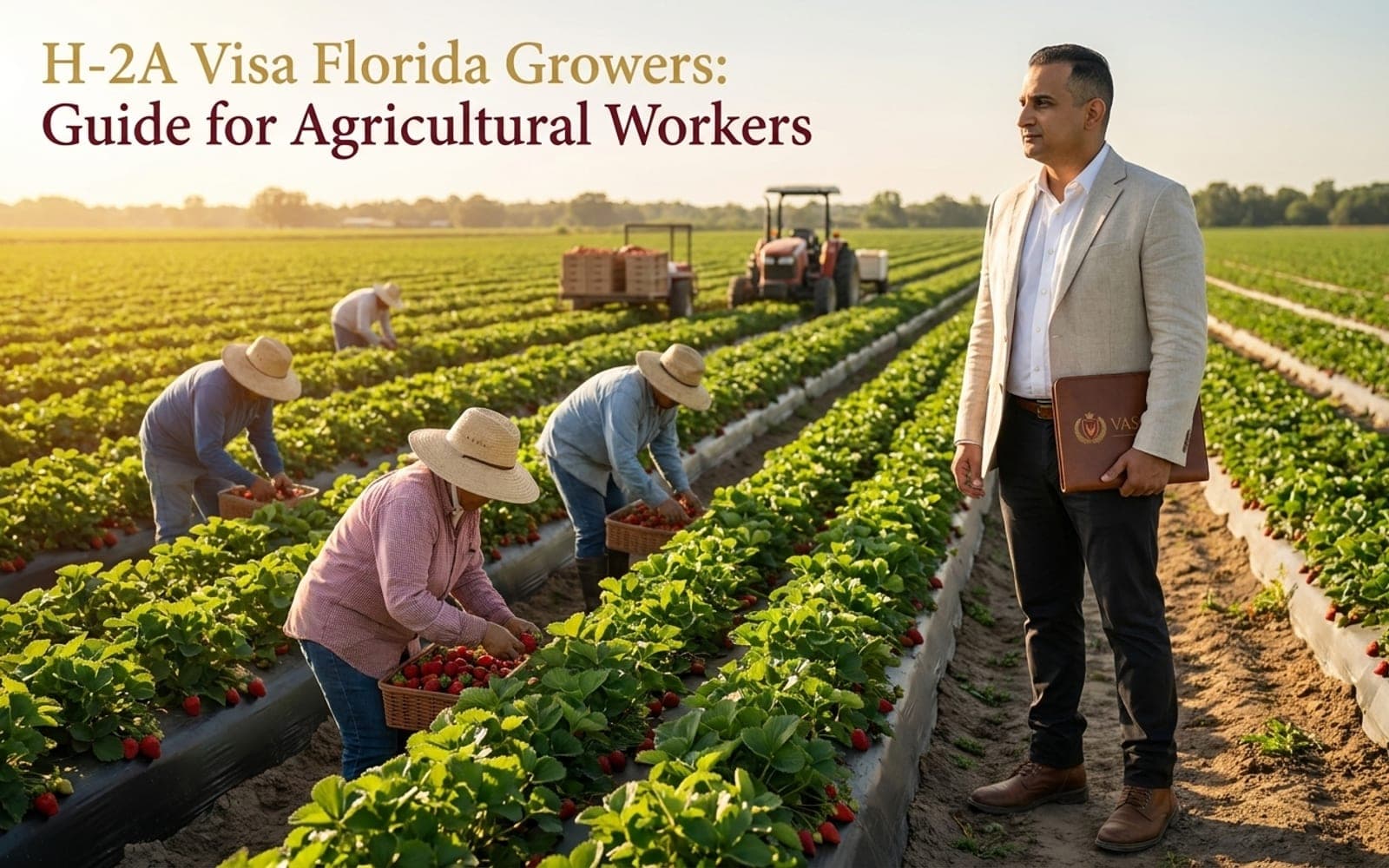
The H-2A visa program allows U.S. agricultural employers, including those in Florida, to bring foreign nationals to the U.S. to fill temporary or seasonal agricultural jobs. This program helps Florida growers address labor shortages when domestic workers are unavailable. Employers must meet specific requirements, including demonstrating a temporary need and offering fair wages and working conditions. The process involves multiple government agencies, including the Department of Labor (DOL) and U.S. Citizenship and Immigration Services (USCIS). Navigating these regulations can be complex, making legal guidance essential for both employers and workers.
- H-2A visas are for temporary or seasonal agricultural work.
- Florida growers rely on H-2A to meet labor demands.
- Employers must prove a labor shortage and offer fair terms.
- The process involves DOL, USCIS, and consular processing.
- Legal assistance is crucial for compliance and success.
Understanding the H-2A Visa Program for Florida Agriculture
Florida's agricultural industry is a cornerstone of its economy, producing a vast array of crops from citrus to vegetables. This demanding sector often faces critical labor shortages, especially during peak seasons. To address this, the H-2A visa program offers a vital solution, enabling Florida growers in areas like Kissimmee and across the state to hire foreign agricultural workers on a temporary or seasonal basis. This program is specifically designed for non-immigrant agricultural workers to perform agricultural labor or services of a temporary or seasonal nature, for which U.S. workers are not available.
The H-2A program ensures that essential farm labor needs are met while also providing protections for both employers and workers. It is governed by strict regulations enforced by the U.S. Department of Labor (DOL) and U.S. Citizenship and Immigration Services (USCIS). Understanding these regulations is paramount for any Florida grower considering the H-2A program. It helps ensure compliance and avoids costly delays or penalties. Our firm, Florida Immigration Lawyers, is dedicated to helping growers and workers navigate the complexities of this crucial immigration pathway.
Navigating the H-2A visa process can be intricate and time-consuming, requiring meticulous attention to detail and adherence to specific deadlines. From proving a temporary labor need to ensuring compliance with wage and housing standards, every step demands careful consideration. Without proper legal guidance, both employers and potential workers can encounter significant hurdles. If you are a Florida grower or an agricultural worker seeking to understand your options, do not hesitate to call Florida Immigration Lawyers at 1-844-YO-PELEO for a free consultation. Our experienced attorneys are here to provide the clarity and support you need.
Eligibility Requirements for Florida Growers Seeking H-2A Workers
For Florida growers to successfully petition for H-2A agricultural worker visas, they must meet a stringent set of eligibility criteria established by federal law. These requirements are designed to protect both domestic workers and the foreign nationals brought in under the program. First and foremost, the employer must demonstrate that their need for agricultural labor is truly temporary or seasonal. This typically means the work is tied to a certain time of year, such as planting, cultivating, or harvesting a specific crop, and generally lasts no longer than one year.
Secondly, the grower must prove that there are not enough U.S. workers who are able, willing, qualified, and available to perform the temporary agricultural labor. This is often done through a rigorous recruitment process, which includes advertising the job locally and contacting former employees. The Department of Labor (DOL) oversees this recruitment effort to ensure fair opportunities for domestic workers. Additionally, the employer must offer wages that meet or exceed the Adverse Effect Wage Rate (AEWR) for Florida, which is a minimum wage set by the DOL to prevent depressing the wages of U.S. workers.
Furthermore, employers must provide free housing to H-2A workers and U.S. workers who are not reasonably able to return to their permanent residence at the end of the workday. This housing must meet specific health and safety standards. Transportation from the workers' home country to the job site, and daily transportation between the housing and work site, must also be provided or reimbursed. These requirements, outlined in sections like 8 U.S.C. § 1101(a)(15)(H)(ii)(a) of the Immigration and Nationality Act (INA) and 20 CFR Part 655 Subpart B, are critical for H-2A program participation. Our team at Florida Immigration Lawyers can help other Florida growers navigate these complex rules, ensuring full compliance and a smooth application process.
The Step-by-Step H-2A Visa Application Process
Obtaining an H-2A visa for agricultural workers involves a multi-stage application process that requires careful coordination between several government agencies. Florida growers must meticulously follow each step to ensure a successful outcome. This process begins well in advance of the desired start date for the workers, typically requiring several months of preparation.
- Obtain a Temporary Labor Certification from DOL: The first critical step is to submit an Application for Temporary Employment Certification (Form ETA-9142A) to the U.S. Department of Labor. This application includes a job offer and details about the temporary need. The DOL reviews the application, ensures the wage offered meets the Adverse Effect Wage Rate (AEWR) for Florida, and oversees the employer's recruitment efforts to ensure no qualified U.S. workers are available. This phase also involves submitting an agricultural clearance order to the local State Workforce Agency.
- File Form I-129 with USCIS: Once the DOL certifies the temporary labor need, the Florida grower must file Form I-129, Petition for a Nonimmigrant Worker, with U.S. Citizenship and Immigration Services (USCIS). This petition requests approval for the H-2A workers. It must include the certified ETA-9142A and other supporting documentation, such as proof of the employer's business operations and financial stability. USCIS reviews the petition to ensure all immigration requirements are met.
- Visa Interview at U.S. Embassy/Consulate: If USCIS approves the I-129 petition, the prospective H-2A workers, if they are outside the U.S., must apply for their visas at a U.S. embassy or consulate in their home country. This involves completing Form DS-160, Online Nonimmigrant Visa Application, and attending an interview. During the interview, consular officers verify the worker's eligibility and intent to return to their home country after the temporary work period.
- Entry into the U.S. and Employment: Upon approval of the visa, workers can enter the U.S. for the period specified in their H-2A visa. They are authorized to work only for the petitioning employer in the specific agricultural job for which they were approved. Employers must adhere to all terms and conditions outlined in the certified labor application, including providing housing, transportation, and guaranteed wages.
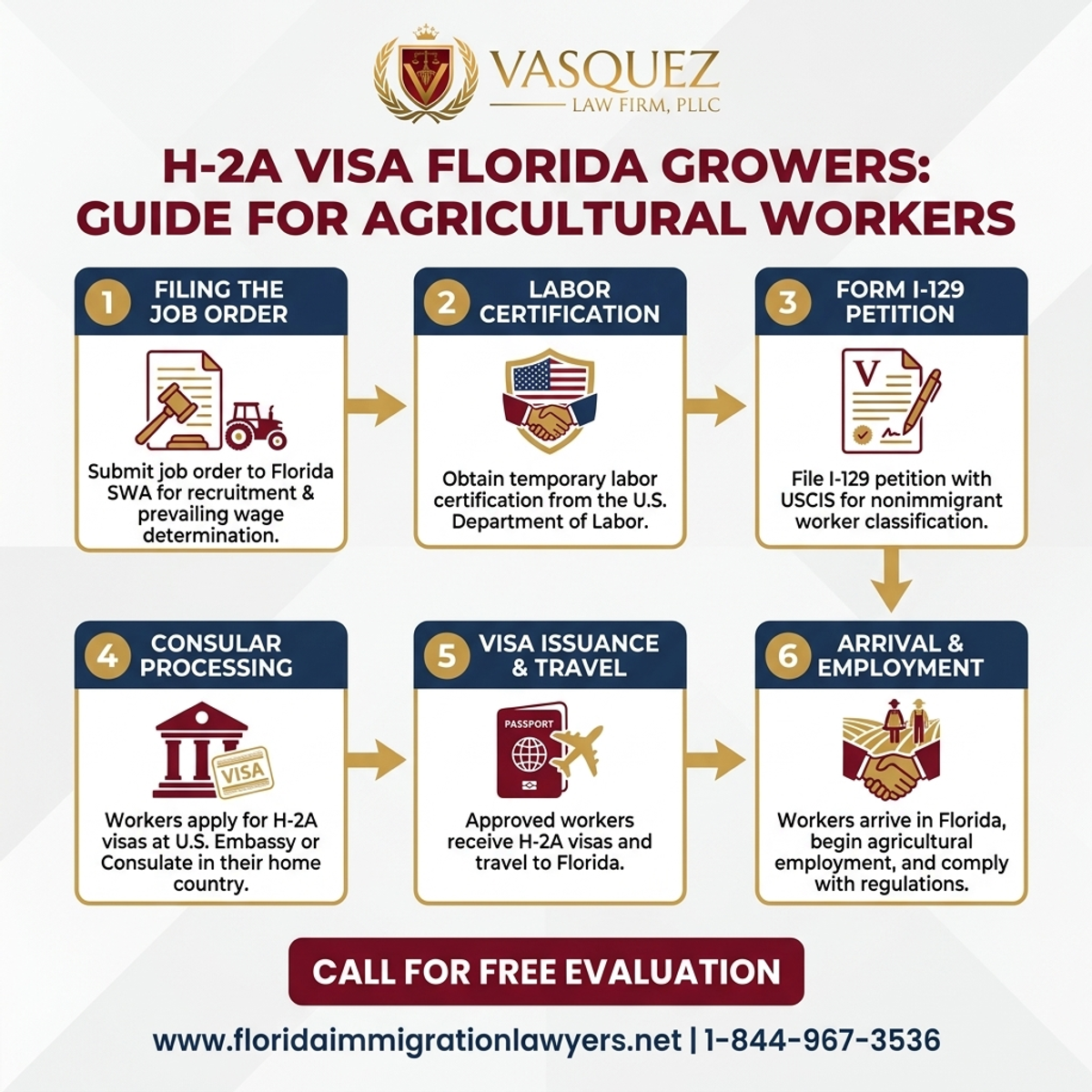
Step-by-Step Process — H-2A Visa Florida Growers: Guide for Agricultural Workers
Each stage has its own forms, fees, and processing times, which can vary. Given the strict deadlines and intricate requirements, working with an experienced immigration attorney from Florida Immigration Lawyers is highly recommended. We can guide Kissimmee and other Florida growers through each detail, from initial filing with the DOL to the workers' arrival, ensuring a streamlined and compliant process for their farm labor needs.
Essential Document Checklist for H-2A Petitions
A successful H-2A visa petition relies heavily on the submission of complete and accurate documentation. Florida growers must meticulously gather and prepare a comprehensive set of documents to support their application. Any missing or incorrect information can lead to significant delays or even denial of the petition, impacting critical planting or harvesting schedules. Here is a general checklist of essential documents:
- For the Employer (Petitioner):
- Completed Form ETA-9142A, Application for Temporary Employment Certification (certified by DOL).
- Completed Form I-129, Petition for a Nonimmigrant Worker.
- Employer's Federal Employer Identification Number (FEIN).
- Proof of business existence and agricultural operations (e.g., business license, tax returns, crop plans, property deeds or leases for farm land).
- Detailed job description, including duties, hours, wage rate (must meet AEWR), and conditions of employment.
- Proof of recruitment efforts (e.g., copies of newspaper advertisements, outreach to former employees, job orders placed with the State Workforce Agency).
- Documentation of housing availability and compliance with health and safety standards (e.g., housing inspection reports, lease agreements for housing).
- Evidence of financial ability to pay wages and cover transportation costs.
- For the Workers (Beneficiaries, for visa interview):
- Valid passport.
- Completed Form DS-160, Online Nonimmigrant Visa Application.
- Confirmation page and interview appointment letter.
- One passport-style photograph.
- Proof of intent to return to home country (e.g., property deeds, family ties, job offers in home country).
- Any educational or professional certificates relevant to the agricultural work.
It is crucial to note that this list is not exhaustive, and specific circumstances may require additional documentation. All documents must be presented in English or accompanied by certified English translations. Organizing these materials can be overwhelming, but our dedicated team at Florida Immigration Lawyers can assist Kissimmee growers in compiling and reviewing every piece of documentation, ensuring your temporary worker petition is as strong as possible. We understand the specific needs of Florida agriculture and are here to streamline this complex process for you.
H-2A Processing Timelines and Expectations for Florida Growers
Understanding the processing timelines for an H-2A visa petition is crucial for Florida growers planning their seasonal labor needs. The entire process, from initial DOL filing to worker arrival, can take several months, and careful planning is essential to ensure workers are available when needed for planting, cultivation, or harvest. While exact timelines can vary due to government backlogs, policy changes, and the completeness of the application, there are general expectations.
Typically, employers should begin the process at least 60 to 75 days before the start date of work, though many attorneys recommend starting even earlier, up to 90-120 days out. The Department of Labor (DOL) certification phase, including recruitment, usually takes 45-60 days. After DOL certification, the USCIS I-129 petition processing can range from 2-5 months, depending on the service center workload and whether premium processing is utilized. Premium processing, available for an additional fee, guarantees a 15-calendar-day processing time for the I-129 petition, which can significantly expedite the USCIS portion.
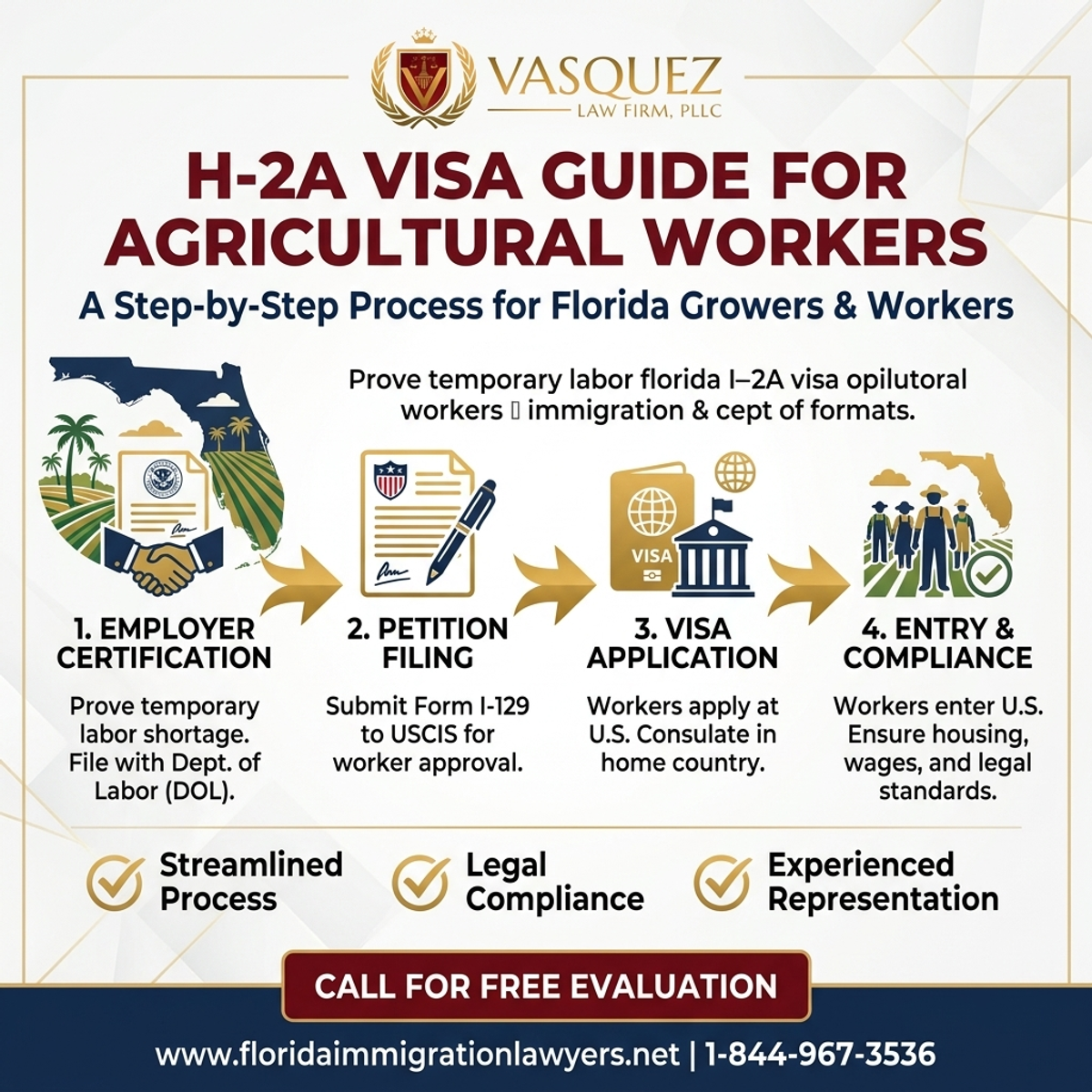
Key Statistics — H-2A Visa Florida Growers: Guide for Agricultural Workers
Following USCIS approval, the final stage involves visa interviews at U.S. consulates or embassies abroad, which can take a few weeks to schedule and process. Factors like the specific country, interview availability, and security clearances can influence this timeline. For example, a consulate in Mexico may have different wait times than one in Guatemala. Unexpected delays can arise from Requests for Evidence (RFEs) from USCIS or audits from the DOL, which extend processing times considerably. Monitoring the status of your petition through the USCIS and DOL online tools is advisable. Given these variables, proactive planning and consistent follow-up are vital for Florida growers. Florida Immigration Lawyers can help manage these expectations and provide strategic advice to mitigate potential delays, ensuring your farm labor needs are met efficiently in Kissimmee and across Florida.
Cost Factors and Fee Breakdown for H-2A Petitions
The financial investment in securing H-2A agricultural worker visas involves several distinct cost components for Florida growers. Understanding these fees and potential expenses upfront is important for budgeting and financial planning. While specific fee amounts are subject to change by government agencies, this overview provides a general breakdown of the types of costs involved in the H-2A process.
Key costs include government filing fees, which are non-refundable. There is an application fee for the Department of Labor (DOL) Temporary Labor Certification and a separate filing fee for the Form I-129, Petition for a Nonimmigrant Worker, submitted to U.S. Citizenship and Immigration Services (USCIS). As mentioned, premium processing for the I-129 petition is an optional but often recommended expense for faster USCIS adjudication. Additionally, H-2A visa applicants abroad will pay a non-immigrant visa application fee at their respective U.S. embassy or consulate.
Beyond government fees, employers are responsible for several other significant expenses. These include recruitment costs, such as advertising in newspapers and other media outlets, to demonstrate that no qualified U.S. workers are available. Employers must also provide free housing that meets federal and state safety standards, which may involve rental costs, maintenance, and utility expenses. Transportation costs are also substantial, covering the round-trip travel for workers from their home country to the job site in Florida, and daily transportation between housing and the work site. Legal fees for immigration attorneys, while an investment, are crucial for ensuring compliance and navigating the complex H-2A regulations. Our firm offers transparent fee structures. Contact Florida Immigration Lawyers for a free consultation to discuss the specific costs associated with your temporary worker petition and how we can provide cost-effective legal solutions for your operations in Kissimmee and throughout Florida.
Do not navigate this complex process alone. Contact Florida Immigration Lawyers today for guidance on your H-2A visa needs. Our dedicated team is ready to assist Florida growers and agricultural workers with comprehensive legal support. Call us at 1-844-YO-PELEO.
Rights and Protections for H-2A Agricultural Workers in Florida
H-2A agricultural workers in Florida are afforded specific rights and protections under U.S. labor and immigration laws. These safeguards are designed to ensure fair treatment, safe working conditions, and proper compensation for foreign nationals employed under the program. It is crucial for both employers and workers to understand these rights, as compliance is strictly enforced by government agencies like the Department of Labor (DOL) and state labor departments.
Among the fundamental rights, H-2A workers are entitled to receive the Adverse Effect Wage Rate (AEWR) or the prevailing wage, whichever is higher, for all hours worked. This wage is set to prevent negative impacts on domestic workers' wages. Employers must also guarantee at least three-fourths of the contract period's total work hours. Housing must be provided free of charge, meet strict health and safety standards, and be inspected by the appropriate authorities. Transportation from the worker's home country to the place of employment, and daily transportation to and from the worksite, must also be covered or reimbursed by the employer.
H-2A workers are also protected against discrimination, harassment, and retaliation. They have the right to organize, join a union, or refuse to join a union without fear of reprisal. Employers cannot confiscate workers' passports or other identification documents. Workers have the right to a safe working environment, access to medical care, and clear disclosure of all terms and conditions of employment in a language they understand. If an employer fails to comply with these terms, workers have avenues to report violations to the DOL Wage and Hour Division or seek legal redress. Understanding these protections is vital for any agricultural worker. Florida Immigration Lawyers is committed to advocating for the rights of H-2A workers in Kissimmee and across Florida, ensuring they are treated fairly and justly during their temporary employment.
Common Mistakes to Avoid in the H-2A Visa Process
The H-2A visa process is complex, and even minor errors can lead to significant delays, denials, or costly penalties. Florida growers and agricultural workers must be vigilant to avoid these common pitfalls:
- Failing to Prove Temporary Need: Employers sometimes struggle to clearly articulate or document that their labor need is truly temporary or seasonal. This can lead to DOL denial, as the program is not for permanent positions. Ensure your crop cycle and business model clearly support a temporary need.
- Inadequate Recruitment Efforts: Not properly advertising the job or failing to contact former U.S. employees can result in DOL finding that insufficient efforts were made to recruit domestic workers. Follow all DOL guidelines for advertising, including specific timeframes and media.
- Offering Below Adverse Effect Wage Rate (AEWR): Employers must pay the AEWR or the prevailing wage, whichever is higher. Offering a lower wage is a common mistake that will lead to certification denial and potential penalties. Always verify the current AEWR for Florida.
- Submitting Incomplete or Inaccurate Forms: Missing information, incorrect dates, or typographical errors on forms like ETA-9142A or Form I-129 can trigger Requests for Evidence (RFEs) or outright denials, significantly delaying the process.
- Late Filing of Petitions: The H-2A process has strict deadlines. Filing the DOL application or USCIS petition too late can mean workers are not approved in time for the planting or harvest season, causing severe operational disruptions.
- Non-Compliant Worker Housing: Providing housing that does not meet federal or state health and safety standards is a serious violation. This can lead to DOL audits, penalties, and even debarment from the H-2A program. Ensure housing inspections are up-to-date and compliant.
- Failing to Provide Required Transportation: Not covering or reimbursing workers for inbound and outbound transportation, or failing to provide daily transportation to worksites, is a common non-compliance issue. Understand and fulfill all transportation obligations.
- Ignoring Post-Certification Requirements: After initial approvals, employers must continue to adhere to program rules, including maintaining records, providing guaranteed work hours, and notifying DOL of material changes. Ongoing compliance is essential.
- Misunderstanding Visa Interview Requirements: Workers may fail to bring all necessary documents or adequately explain their intent to return home, leading to visa denials at the consulate. Proper preparation for interviews is vital.
- Attempting the Process Without Legal Counsel: The sheer complexity and evolving nature of immigration law make it challenging for non-attorneys to navigate successfully. Errors can be costly and jeopardize an entire season's operations. Seeking experienced legal advice is a proactive measure.
When to Call a Florida Immigration Lawyer for H-2A Assistance
The H-2A visa process is highly regulated and intricate, making legal assistance not just helpful, but often essential for Florida growers and agricultural workers. There are many specific scenarios where calling an experienced immigration lawyer can make a critical difference in the success and compliance of your petition. Do not wait for a problem to arise; proactive legal counsel can prevent many issues.
You should contact Florida Immigration Lawyers if you are a grower considering the H-2A program for the first time or if you have faced previous denials or challenges. We can help assess your eligibility, guide you through the initial DOL certification, and ensure all recruitment efforts meet federal standards. If you receive a Request for Evidence (RFE) from USCIS or are subject to a DOL audit, immediate legal intervention is crucial to respond effectively and protect your interests. Any significant changes to your business operations or the terms of employment for your farm labor should also prompt a consultation to ensure continued compliance.
For agricultural workers, if you have questions about your rights, suspect an employer is not adhering to H-2A regulations, or need assistance with your visa interview process, our attorneys can provide vital support. We can help you understand your wage, housing, and transportation entitlements and advocate on your behalf if violations occur. Immigration law is constantly evolving, with recent Supreme Court decisions affecting various aspects of immigration. This dynamic landscape underscores the need for up-to-date legal advice. Our firm, serving all of Florida, offers comprehensive services, including business immigration and general immigration assistance, ensuring a smooth and compliant H-2A experience for all parties involved.
About Florida Immigration Lawyers
Florida Immigration Lawyers is a leading law firm dedicated to providing comprehensive and compassionate legal services to individuals and businesses across Florida. With deep expertise in various areas of immigration law, including the complex H-2A visa program, we are committed to helping our clients achieve their immigration goals. Our attorneys understand the unique challenges faced by Florida growers seeking agricultural workers and the foreign nationals who come to the U.S. to contribute to our economy.
We pride ourselves on our client-focused approach, offering personalized strategies and diligent representation. Whether you need assistance with temporary work visas, family-based petitions, or deportation defense, our team is equipped to handle your case with professionalism and care. Our mission is to simplify complex immigration processes, providing clear guidance and strong advocacy every step of the way. We serve all of Florida, including the Orlando area and are available 24/7 to address your urgent legal needs. We offer free consultations to discuss your specific situation and explore the best path forward.
Sources and References
- U.S. Citizenship and Immigration Services (USCIS) - H-2A Temporary Agricultural Workers
- U.S. Department of Labor (DOL) - H-2A Temporary Agricultural Program
- U.S. Department of State - H-2A Temporary Agricultural Worker Visa
- 8 U.S.C. Chapter 12 - Immigration and Nationality Act (INA) § 101(a)(15)(H)(ii)(a)
- 20 CFR Part 655 Subpart B - Labor Certification Process for Temporary Agricultural Employment of H-2A Aliens in the United States
- 8 CFR Part 214.2(h) - Petitions for Nonimmigrant Workers
Related services: immigration practice areas, family immigration services, citizenship and naturalization, asylum protection.
This article provides general legal information and is not intended as legal advice. Every case is unique, and outcomes depend on specific facts and circumstances. Contact an attorney for advice about your particular situation. Immigration laws are subject to frequent change.
If you are a Florida grower or an agricultural worker seeking to navigate the H-2A visa process, do not face it alone. Florida Immigration Lawyers offers free consultations to discuss your needs and provide legal guidance. Call us today at 1-844-YO-PELEO to schedule your consultation. Se Habla Español - Estamos aquí para ayudarle.
Do Not Navigate This Process Alone
Our experienced immigration attorneys are ready to fight for you. Get a free, confidential case review today.
Se Habla Español
Or leave your details and we’ll call you:
Free Evaluation in 24 Hours
Or talk to us right now

AI voice assistant — available 24/7
FreeFrequently Asked Questions

William J. Vásquez
Founding Attorney · Vasquez Law Firm
U.S. Air Force veteran and immigration attorney with years of hands-on U.S. immigration experience. J.D., NCCU School of Law. AILA member. Admitted to the 4th, 5th, and 11th Circuit Courts.
Available 24/7 - Free Evaluations
Reviewed for legal accuracy by William J. Vásquez
Licensed in North Carolina; U.S. immigration is federal practice.
Related Legal Services
Our Florida immigration attorneys can help you with experienced immigration attorneys, asylum protection and citizenship and naturalization. Call today at 1-844-YO-PELEO for a free case review.
Related Links
Related Topics
Free Legal Case Review
Discuss your case with our experienced attorneys. We're available 24/7.
Se Habla Español - Estamos aquí para ayudarle.
Related Articles
EAD Advance Parole Combo Card in Florida: What You Need
An EAD advance parole combo card allows individuals with pending adjustment applications to both work and travel abroad without jeopardizing their green card application. Learn how to apply in Florida, what documents you need, and common mistakes to avoid.
PERM Labor Certification in Florida: A 2026 Guide
Learn all about the PERM labor certification process in Florida, essential for employers sponsoring green card applicants. Understand the steps, document requirements, and common mistakes to avoid in this 2026 guide.
Dual Citizenship Lawyer in Florida: What You Need to Know
For Florida residents, the concept of dual citizenship, or holding two passports, offers a compelling blend of opportunities and challenges. While the U.S. generally permits dual nationality, the path to achieving this status requires a meticulous understanding of both U.S. immigration laws and the citizenship policies of your country of origin. This guide explores the definition of dual citizenship, the detailed step-by-step process for U.S. naturalization, and the significant benefits and potential pitfalls involved. We cover essential documentation, typical timelines, and cost considerations for 2026, providing crucial insights for anyone in Orlando, Miami, or across Florida considering this important legal step. Learn about common mistakes to avoid and understand when to seek professional legal counsel to navigate this complex process successfully. Florida Immigration Lawyers is here to provide expert, bilingual support for your dual citizenship journey.
Immigration Lawyer Orlando Free Consultation in Florida
For individuals and families in Orlando, Florida, navigating the complexities of U.S. immigration law requires expert guidance. An immigration lawyer in Orlando offers crucial support for everything from visa applications and green card processes to naturalization and deportation defense. This comprehensive guide details what a free consultation covers, providing a step-by-step overview of immigration pathways, essential document checklists, and expected timelines in 2026. We also highlight common mistakes to avoid, discuss the critical role of legal counsel in deportation and asylum cases, and explain why choosing a local Orlando immigration attorney is beneficial. Florida Immigration Lawyers is dedicated to serving the diverse community of Orlando with compassionate, effective legal solutions, ensuring you receive personalized advice and robust representation for a successful immigration journey.