Dual Citizenship Lawyer: Navigating Delays in Florida
Facing citizenship delays in Florida can be challenging, but understanding the process and knowing your options is key. Learn how a dual citizenship lawyer can assist you in navigating N-400 processing and USCIS backlogs in Hialeah.

- Understanding the impact of USCIS backlogs on your application.
- Steps to take if you're experiencing delays.
- Importance of legal assistance in navigating the process.
Introduction
Imagine waiting for your citizenship application to be processed, only to face unexpected delays. This scenario is all too common for many immigrants in Florida, particularly in areas like Hialeah. The wait can be long and frustrating, but understanding the reasons behind these delays and knowing how to navigate them can make a significant difference.
The dream of U.S. citizenship represents security, opportunity, and a sense of belonging. When that dream is put on hold due to unforeseen processing delays, it can create immense stress and uncertainty for individuals and families alike. Navigating the complex landscape of immigration law requires not only patience but also a strategic approach to overcome potential hurdles.
This article explores the causes of citizenship delays in Florida, what you can do about it, and how a dual citizenship lawyer can assist you. We'll delve into the intricacies of the naturalization process, offer practical advice, and highlight the critical role of legal support. Call Florida Immigration Lawyers at 1-844-967-3536 for a free consultation to discuss your options and ensure your journey to citizenship is as smooth as possible.
Why Is My Citizenship Application Delayed in Florida?
As of 2026, many applicants experience delays due to a combination of USCIS backlogs and increased scrutiny on applications. Processing times for the N-400 form, or Application for Naturalization, have been extended, and applicants in Florida often face longer waits due to high demand.
Factors contributing to these delays include increased background checks and a surge in applications following policy changes. Local USCIS offices in areas like Hialeah are particularly impacted, leading to longer processing times.
One primary reason for these extensive waits is the systemic nature of USCIS backlogs. The agency often grapples with fluctuating immigration policies, staffing shortages, and a sheer volume of applications that consistently outpaces its processing capacity. This creates a ripple effect, extending wait times across all application types, including the N-400, and impacting hopeful citizens across Florida.
Furthermore, increased scrutiny on applications stems from evolving national security concerns and the need for thorough vetting. Cases with any complexities, such as prior arrests, extensive travel history, or even minor discrepancies, can be subjected to more intense review. This meticulous examination, while necessary, inevitably adds months to the processing timeline, especially in a diverse state like Florida where applicants often have intricate international backgrounds.
Florida's unique demographic landscape, especially in bustling areas like Hialeah, Miami, and Orlando, also plays a significant role. These regions experience consistently higher application volumes compared to other parts of the country. Each local field office has a finite processing capacity, and when demand consistently exceeds this, delays become an unavoidable reality. Additionally, temporary issues like technology infrastructure upgrades or system overhauls within USCIS can also temporarily slow down the entire naturalization process.
How Long Does N-400 Processing Take in 2026?
As of 2026, the typical processing time for the N-400 application can range from 12 to 18 months. However, this varies by location and individual circumstances. In areas like Hialeah, it might be longer due to higher application volumes.
These timelines are subject to change, and applicants should regularly check the USCIS website for the most current information.
It's important to understand that "individual circumstances" significantly influence your N-400 processing time. Factors such as the complexity of your personal history (e.g., multiple addresses, prior arrests, extensive international travel), how quickly and accurately you respond to Requests for Evidence (RFEs), and even your performance during the naturalization interview can impact your timeline. A well-prepared, accurate, and straightforward application generally moves through the system more efficiently.
When interpreting USCIS processing time charts, remember they provide historical averages and are not guarantees. Applicants should specifically look at the processing times for their particular USCIS field office and the N-400 form type. While these estimates offer a general idea, it's crucial to manage expectations, as your individual case might fall outside these averages due to unique factors or unforeseen administrative backlogs.
Managing expectations and staying prepared are key. Remain patient, but also proactive. Keep all your documents organized, respond promptly to any USCIS correspondence, and be ready for potential interviews or follow-up requests. Consulting with Florida Immigration Lawyers can help you understand realistic expectations for your specific case and ensure you are adequately prepared for every stage of the naturalization journey.
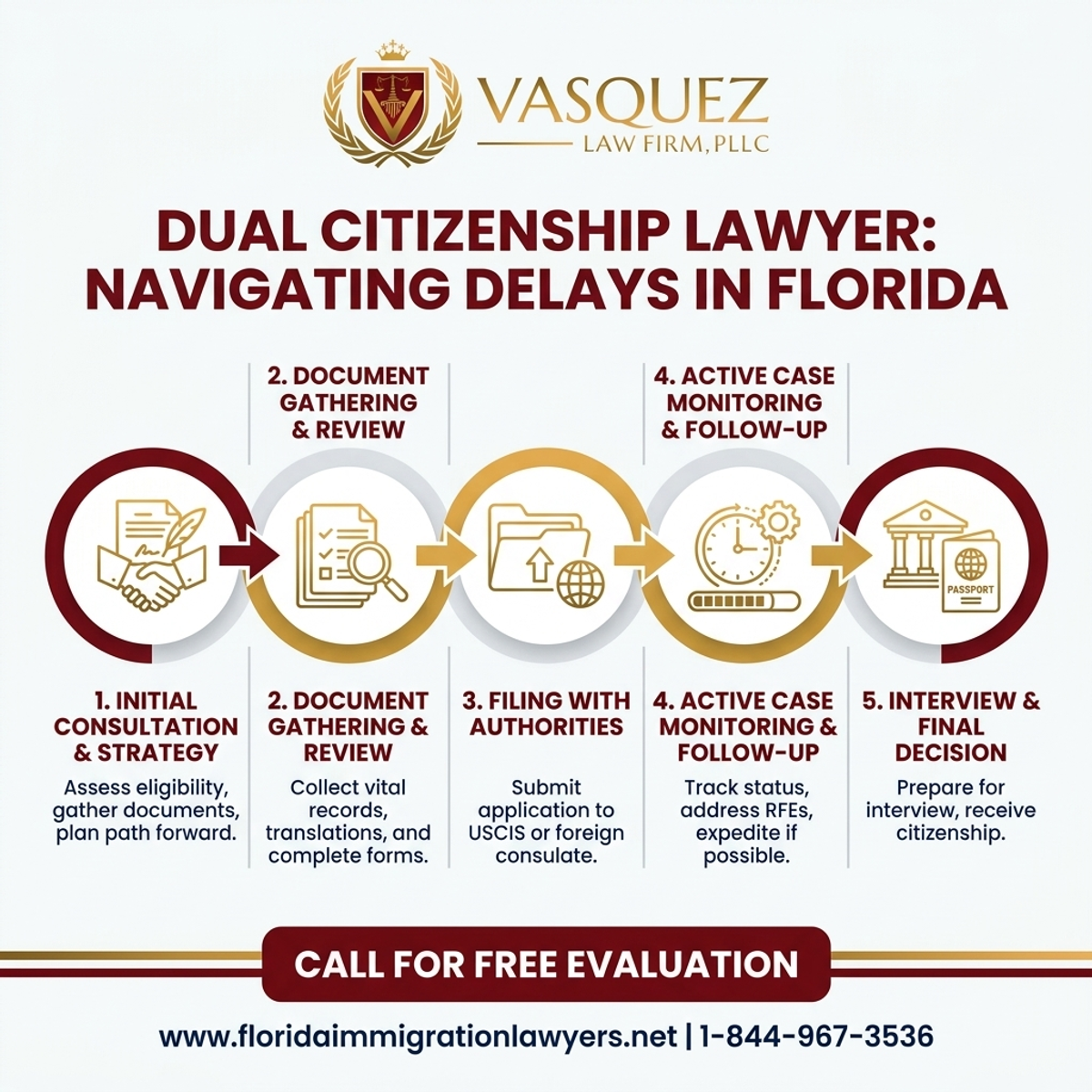
Step-by-Step Process — Dual Citizenship Lawyer: Navigating Delays in Florida
Steps to Take If Your Citizenship Application Is Delayed
If you're experiencing delays, there are several proactive steps you can take to address the issue and gain clarity on your application's status. Taking action can often expedite the process or at least provide valuable information.
- Check your application's status online: Utilize the USCIS case status tool on their website. You'll need your 13-character receipt number (found on your Form I-797C, Notice of Action). This tool provides real-time updates and can indicate if your case is still within normal processing times or if further action is required.
- Contact the USCIS Contact Center: If your case falls outside the normal processing time displayed on the USCIS website for your specific field office, you can call the USCIS Contact Center at 1-800-375-5283. Be prepared with your receipt number and personal information. While they may not offer specific case details, they can often confirm if an inquiry has been made or if there are any general issues.
- Consider filing a case inquiry or contacting your local congressperson: If the Contact Center cannot provide satisfactory answers, you can submit an e-Request for cases outside normal processing times. Alternatively, reaching out to your U.S. Representative or Senator's office can be effective. Congressional offices have liaisons with USCIS and can make inquiries on behalf of their constituents, sometimes prompting movement on stalled applications.
- Consult with a dual citizenship lawyer: For significant delays, complex legal issues, or if you've received a Request for Evidence (RFE) or Notice of Intent to Deny (NOID), professional legal assistance is paramount. A lawyer can assess the specifics of your case, identify potential legal remedies (such as filing a Writ of Mandamus in federal court), and advocate on your behalf. Florida Immigration Lawyers are experienced in navigating these challenges.
These actions can help expedite the process or at least provide clarity on your application's status. Remember, being proactive and informed is your best defense against prolonged delays. Don't hesitate to seek expert guidance from Florida Immigration Lawyers if you feel overwhelmed or unsure of the next steps.
Document Checklist for Citizenship Application
A complete and accurate document submission is crucial to avoid unnecessary delays or even denials. Meticulous preparation of your application package can significantly streamline the process.
- Completed N-400 form: Ensure every section is filled out accurately and completely. If a question does not apply to you, mark it as "N/A." Double-check all dates, addresses, and personal information for consistency.
- Copy of your Permanent Resident Card (Green Card): Provide clear photocopies of both the front and back of your current Green Card. Do not send the original unless specifically requested.
- Two passport-style photos: These photos must be recent (taken within the last 30 days), unmounted, in color, with a white background, and meet specific USCIS dimensions (2x2 inches). Write your name and A-number lightly on the back of each photo.
- Documentation of any name changes: If your name has changed since you received your Green Card, include certified copies of marriage certificates, divorce decrees, or court orders that legally document the change.
- Proof of residency in Florida: Provide documentation to prove you have continuously resided in the U.S. for the required period (typically 5 years, or 3 years if married to a U.S. citizen) and within Florida for at least three months. This can include utility bills, lease agreements, tax returns, bank statements, or employment records.
- Any relevant legal documents: This includes certified copies of court dispositions for any arrests or convictions, divorce decrees, child support orders, or Selective Service registration records (if applicable). Full disclosure is vital, even for minor infractions.
Ensure all documents are up-to-date and accurately reflect your current situation to avoid unnecessary delays. Organize your documents clearly, make copies for your records, and consider having Florida Immigration Lawyers review your checklist to ensure nothing is missed before submission.
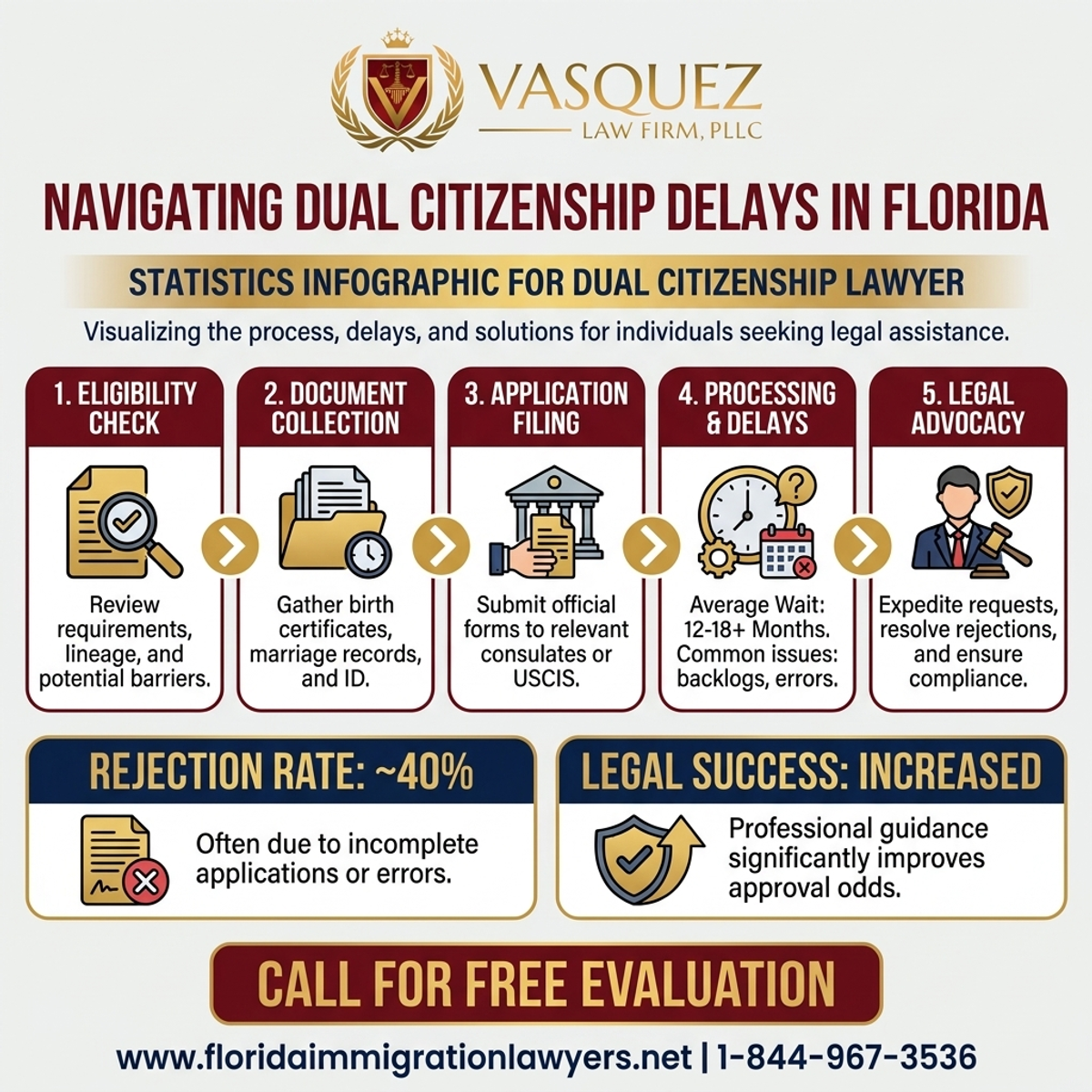
Key Statistics — Dual Citizenship Lawyer: Navigating Delays in Florida
Cost Factors and Fee Breakdown for Citizenship Applications
Understanding the financial commitment involved in applying for U.S. citizenship is a crucial step in your naturalization journey. Beyond the application fees, there can be other costs to consider, making proper budgeting essential.
| Item | Typical Fee | Notes |
|---|---|---|
| N-400 Application Fee | Check USCIS for current fee | Fees are subject to change. As of the latest update, this fee covers the processing of your naturalization application. Eligibility for a fee waiver (Form I-912) may apply to certain low-income applicants. |
| Biometrics Fee | Check USCIS for current fee | This fee is required for applicants aged 14-78 to cover the cost of fingerprinting and background checks. Often, this fee is now combined with the N-400 application fee, so always verify the total amount on the USCIS website. |
| Legal Assistance | Varies | The cost of legal assistance depends on the complexity of your case, the range of services required (e.g., consultation, application preparation, interview representation), and the law firm's expertise. Investing in a lawyer can prevent costly mistakes and long-term delays. |
Beyond the direct USCIS fees, applicants should also budget for potential hidden costs. These can include travel expenses for interviews at the USCIS field office, fees for obtaining certified copies of documents (like birth certificates or court records), translation services for any foreign documents not in English, and postage for mailing your application. While not always required, these can add up.
It's worth exploring if you qualify for a fee waiver. USCIS offers fee waivers for certain forms, including the N-400, for applicants who meet specific income guidelines or are receiving means-tested public benefits. Properly filing Form I-912, Request for Fee Waiver, can significantly reduce the financial burden, but it must be submitted with strong supporting documentation.
Consulting with a lawyer can help clarify these costs and potentially reduce unforeseen expenses by ensuring your application is complete and accurate from the start. Do not navigate this process alone. Contact Florida Immigration Lawyers today at 1-844-967-3536 for a free consultation.
Common Mistakes to Avoid When Applying for Citizenship
Applying for U.S. citizenship is a detailed process where even minor errors can lead to significant delays or outright denial. Being aware of common pitfalls can help you navigate the journey successfully.
- Incomplete Applications: Missing information, even a single blank field or an unsigned form, can lead to your application being rejected and returned, causing substantial delays. Always review your N-400 thoroughly before submission.
- Incorrect Fees: Submitting the wrong fee amount or an expired payment method can result in your application being rejected. Always double-check the current fee on the USCIS website and ensure your payment method is valid and correctly filled out.
- Failure to Attend Biometrics Appointment: Missing your scheduled biometrics appointment without a valid reason and proper rescheduling can halt your application process. If you absolutely cannot make it, contact USCIS immediately to request a reschedule.
- Not Updating Address: Failure to inform USCIS of a change of address (by filing Form AR-11 and updating online) can lead to lost correspondence, missed appointments, or crucial notices, jeopardizing your application.
- Ignoring USCIS Notices: Always respond promptly and thoroughly to any Requests for Evidence (RFEs) or other notices from USCIS. Ignoring them or providing an inadequate response can lead to a denial.
- Providing Incorrect Information: While honest mistakes can occur, providing false or misleading information, even unintentionally, can be viewed as fraudulent and lead to severe consequences, including denial and potential deportation. Always be truthful and accurate.
- Not Seeking Legal Help: Complex cases, such as those involving criminal history, previous immigration violations, or long periods of absence from the U.S., often benefit immensely from legal advice. A lawyer can help clarify requirements and prevent errors that could be detrimental.
Diligence and attention to detail are paramount throughout the citizenship application process. Avoiding these common mistakes will significantly increase your chances of a smooth and successful naturalization journey. If you are unsure about any aspect, contacting Florida Immigration Lawyers can provide the clarity and support you need.
When to Call a Lawyer
While some citizenship applications are straightforward, many applicants encounter situations where professional legal guidance becomes invaluable. Knowing when to seek legal counsel can make the difference between a smooth process and prolonged frustration or even denial.
- Significant delays beyond the typical processing time: If your N-400 application has been pending for an unreasonably long period, well past the published processing times for your field office, a lawyer can intervene. They can file inquiries, communicate directly with USCIS, or, in extreme cases, file a Writ of Mandamus in federal court to compel USCIS to make a decision.
- Complex legal issues or past immigration violations: Any history of arrests, criminal convictions (even minor ones), previous immigration denials, or extensive periods of absence from the U.S. can complicate your naturalization eligibility. A lawyer can assess the impact of these issues, advise on potential waivers, and help prepare a strong, well-documented case to address USCIS concerns.
- Received a Request for Evidence (RFE) or Notice of Intent to Deny (NOID): These notices indicate that USCIS has concerns or requires additional information. An RFE or NOID is a critical juncture where a lawyer's expertise is essential. They can help you understand the specific issues, gather the necessary evidence, and craft a comprehensive and timely response to prevent a denial.
- Desire to explore dual citizenship options: While the U.S. permits dual nationality, the implications can be complex, especially concerning the laws of your country of origin. A dual citizenship lawyer can explain the requirements and consequences, both in the U.S. and abroad, ensuring you make informed decisions about your future status.
A lawyer can provide personalized guidance and help navigate potential pitfalls, ensuring your application is robust and compliant. Don't wait until problems escalate; a proactive consultation with Florida Immigration Lawyers can save you time, stress, and potential heartbreak. Call us at 1-844-967-3536 for a free consultation to discuss your specific situation.
Frequently Asked Questions (FAQs) About Citizenship Delays
Understanding the nuances of citizenship applications can be challenging. Here are answers to some common questions regarding delays and the naturalization process.
- What is a Request for Evidence (RFE) and how should I respond?
An RFE is a request from USCIS for additional information or documentation to support your application. Failing to respond adequately or on time can lead to denial. It's crucial to gather all requested documents, ensure they are accurate and complete, and submit them before the deadline. Consulting Florida Immigration Lawyers at 1-844-967-3536 can help you formulate a robust response.
- Can I travel internationally while my N-400 application is pending?
Generally, yes, you can travel internationally with a valid Green Card while your N-400 is pending. However, extended trips outside the U.S. could impact your continuous residency requirement. It's always wise to consult with an immigration lawyer, like those at Florida Immigration Lawyers, before planning significant international travel to ensure it won't jeopardize your naturalization process.
- What happens during the naturalization interview?
During the naturalization interview, a USCIS officer will review your N-400 application, verify your identity, assess your English proficiency, and test your knowledge of U.S. history and government. They will also ask questions about your background and eligibility. Being well-prepared, honest, and having all your original documents is key.
- What if my N-400 application is denied?
If your N-400 application is denied, you typically have options, such as filing an N-336, Request for a Hearing on a Decision in Naturalization Proceedings, within 30 days of the denial. This allows you to appeal the decision before an immigration officer. A denial does not necessarily mean the end of your citizenship journey, but immediate legal counsel from Florida Immigration Lawyers is highly recommended to assess your best course of action.
- How can I check the status of my N-400 application online?
You can check your N-400 application status using the USCIS Case Status Online tool. You'll need the 13-character receipt number provided on your application receipt notice (Form I-797C). This tool provides real-time updates on your application's progress, from initial filing to decision. Regularly checking this status can help you stay informed and identify if your case falls outside normal processing times.
About Florida Immigration Lawyers
Florida Immigration Lawyers is dedicated to helping clients throughout Florida navigate the complexities of immigration law. Our team offers a range of services, including assistance with citizenship applications, deportation defense, and family immigration. Contact us at 1-844-967-3536 or visit our website for a free consultation. We are available 24/7 and offer bilingual services.
Our firm is built on a foundation of deep legal expertise, unwavering client commitment, and a profound understanding of the unique challenges faced by immigrants in Florida. We pride ourselves on providing compassionate, personalized service, ensuring every client feels heard and supported throughout their journey. From the initial consultation to the final resolution, we are your trusted advocates.
We understand that the path to U.S. citizenship can be daunting, especially with the added stress of delays and complex legal requirements. That's why Florida Immigration Lawyers is committed to simplifying this process for you, offering clear guidance, meticulous application preparation, and robust representation. Our 24/7 availability and bilingual services ensure that help is always within reach, making your dream of citizenship a tangible reality.
Sources and References
- U.S. Citizenship and Immigration Services (USCIS)
- Executive Office for Immigration Review (EOIR)
- 8 U.S.C. Chapter 12 - Immigration and Nationality Act
Related services: naturalization process, citizenship test preparation, dual citizenship guidance, family-based immigration.
This article provides general legal information and is not intended as legal advice. Every case is unique, and outcomes depend on specific facts and circumstances. Contact an attorney for advice about your particular situation.
Contact Florida Immigration Lawyers at 1-844-967-3536 for a free consultation. Se Habla Español - Estamos aquí para ayudarle.
If you need legal assistance, learn more about Florida citizenship legal team, or call us at 1-844-967-3536 for a free consultation.
Do Not Navigate This Process Alone
Our experienced immigration attorneys are ready to fight for you. Get a free, confidential consultation today.
Se Habla Español
Or leave your details and we’ll call you:
Free Evaluation in 24 Hours
Or talk to us right now

AI voice assistant — available 24/7
FreeFrequently Asked Questions

William J. Vásquez
Founding Attorney · Vasquez Law Firm
U.S. Air Force veteran and immigration attorney with years of hands-on U.S. immigration experience. J.D., NCCU School of Law. AILA member. Admitted to the 4th, 5th, and 11th Circuit Courts.
Available 24/7 - Free Evaluations
Reviewed for legal accuracy by William J. Vásquez
Licensed in North Carolina; U.S. immigration is federal practice.
Related Legal Services
Our Florida immigration attorneys can help you with free immigration consultation, experienced immigration attorneys and business immigration. Call today at 1-844-967-3536 for a free consultation.
Related Links
Related Topics
Free Legal Consultation
Discuss your case with our experienced attorneys. We're available 24/7.
Se Habla Español - Estamos aquí para ayudarle.
Related Articles
"ina § 208(a)(2)" One-Year Filing Deadline: Florida Asylum
Discover the importance of the "ina § 208(a)(2)" one-year filing deadline for asylum seekers in Florida. Learn about the steps, documents needed, and common mistakes to avoid in your asylum application process.
DV-2027 Registration Period: Your Green Card Lottery Guide
The DV-2027 Diversity Visa (DV) lottery offers a unique pathway to permanent residency for individuals from countries with historically low immigration rates to the U.S. Expected to open in Fall 2025, the registration period requires strict adherence to eligibility criteria, including country of birth and specific education or work experience. This guide from Florida Immigration Lawyers covers the step-by-step application process, essential documents, critical timelines, and associated costs. We highlight common mistakes to avoid and explain when legal counsel is indispensable, especially for residents in Florida. Understanding the nuances of the green card lottery is vital for a successful application. Contact us for expert guidance on your DV-2027 journey.
Blake Doughty: T Visa Eligibility for Florida Trafficking
For victims of human trafficking in Florida, like Blake Doughty, the T visa offers a critical pathway to safety and legal status. This comprehensive guide details the eligibility requirements, including demonstrating severe forms of trafficking, physical presence in the U.S. due to trafficking, and cooperation with law enforcement. Learn about the multi-step application process, the essential documents needed, and the typical timelines and costs involved in 2026. We also highlight common mistakes to avoid and when it's crucial to seek expert legal assistance. Florida Immigration Lawyers provides compassionate and dedicated support for T visa applicants across the state, ensuring victims receive the protection and resources they deserve. Contact us for a free consultation to understand your options and secure your future.
USCIS Oath Ceremony Schedule 2026 in Florida
Navigating the USCIS oath ceremony schedule for 2026 in Florida is crucial for new citizens. This guide provides insights into planning, processing times, and what to expect in Orlando. Call Florida Immigration Lawyers at 1-844-967-3536 for a free consultation.