USCIS Oath Ceremony Schedule 2026 in Florida
For those seeking U.S. citizenship in Florida, understanding the USCIS oath ceremony schedule for 2026 is a crucial final step. While specific dates for 2026 are not pre-published, oath ceremonies are regularly held at Florida USCIS field offices in Orlando, Miami, and Tampa, typically a few weeks to months after a successful naturalization interview. Applicants receive Form N-445, Notice of Naturalization Oath Ceremony, detailing their specific appointment. This guide provides comprehensive information on USCIS field office locations, naturalization requirements, what to expect during your interview, post-interview steps, and associated costs. We also highlight common mistakes to avoid and when to consult an experienced immigration lawyer. Florida Immigration Lawyers offers guidance to help you navigate the complexities of the naturalization process, ensuring a smooth journey to becoming a U.S. citizen. Contact us for a free case review.
The USCIS oath ceremony schedule for 2026 in Florida is not published far in advance, as dates are generally assigned after an applicant successfully completes their naturalization interview. Ceremonies are typically held monthly or more frequently at USCIS field offices in Florida, such as those in Orlando, Miami, and Tampa. After a successful interview, applicants will receive Form N-445, Notice of Naturalization Oath Ceremony, which details the specific date, time, and location. Factors like case volume, office capacity, and the type of ceremony (administrative or judicial) can influence how quickly an oath ceremony is scheduled. It's crucial to follow all instructions on Form N-445 to avoid delays in becoming a U.S. citizen.
- Oath ceremony dates are assigned post-interview, not pre-scheduled for 2026.
- Form N-445 provides specific ceremony details (date, time, location).
- Ceremonies occur regularly at Florida USCIS field offices.
- Administrative ceremonies are more common and quicker than judicial ones.
- Preparation is key, including returning your Permanent Resident Card.
Becoming a U.S. citizen is a monumental achievement, representing the culmination of a long and often challenging immigration journey. For many aspiring citizens in Florida, the final step is the naturalization oath ceremony, a deeply meaningful event where individuals pledge allegiance to the United States. As 2026 approaches, many applicants are eager to understand the process, particularly regarding the USCIS oath ceremony schedule and what to expect in the Sunshine State.
Navigating the complexities of immigration law and understanding the specific procedures for naturalization can be daunting. From filing the initial N-400 application to preparing for the interview and finally attending the oath ceremony, each step requires careful attention to detail and adherence to strict guidelines. This comprehensive guide will illuminate the path to citizenship in Florida, focusing on the oath ceremony schedule, requirements, and crucial preparation tips for 2026.
We understand the significance of this journey and are committed to providing clear, actionable information. Whether you're just starting your naturalization application or nearing the final ceremony, having guidance can make all the difference. Don't leave your future to chance. Call Florida Immigration Lawyers at 1-844-YO-PELEO for a free case review and let us help you achieve your dream of U.S. citizenship.
What are the USCIS Field Office Locations in Florida?
Florida is home to several key USCIS field office locations that serve the state's diverse immigrant population. These offices are crucial for processing various immigration applications, including naturalization interviews and oath ceremonies. Understanding where these offices are located and their primary functions is essential for applicants residing in different parts of Florida.
As of 2026, the main USCIS field offices in Florida are situated in strategic urban centers to provide accessible services. The Orlando Field Office, located in Central Florida, serves a broad region including Orange, Seminole, Osceola, and Brevard counties. This office is a primary hub for many naturalization applicants in our area. Further south, the Miami Field Office handles a significant volume of cases, serving Miami-Dade, Broward, and Palm Beach counties, reflecting South Florida's large immigrant communities. The Tampa Field Office caters to the west coast of Florida, covering areas like Hillsborough, Pinellas, and Sarasota counties. Each office operates with specific jurisdiction, and applicants are generally assigned to the office closest to their residence. These offices are responsible for conducting naturalization interviews, processing applications, and hosting oath ceremonies. They also handle other immigration matters such as adjustment of status interviews and certain petition adjudications. It's important to note that while these are the main field offices, other USCIS facilities like Application Support Centers (ASCs) are scattered across the state for biometric appointments.
How Does the USCIS Oath Ceremony Schedule 2026 Work in Florida?
The USCIS oath ceremony schedule for 2026 in Florida is not a fixed, publicly available calendar, but rather a dynamic process. Applicants are scheduled for their oath ceremony individually after successfully completing all prior naturalization requirements, including the interview.
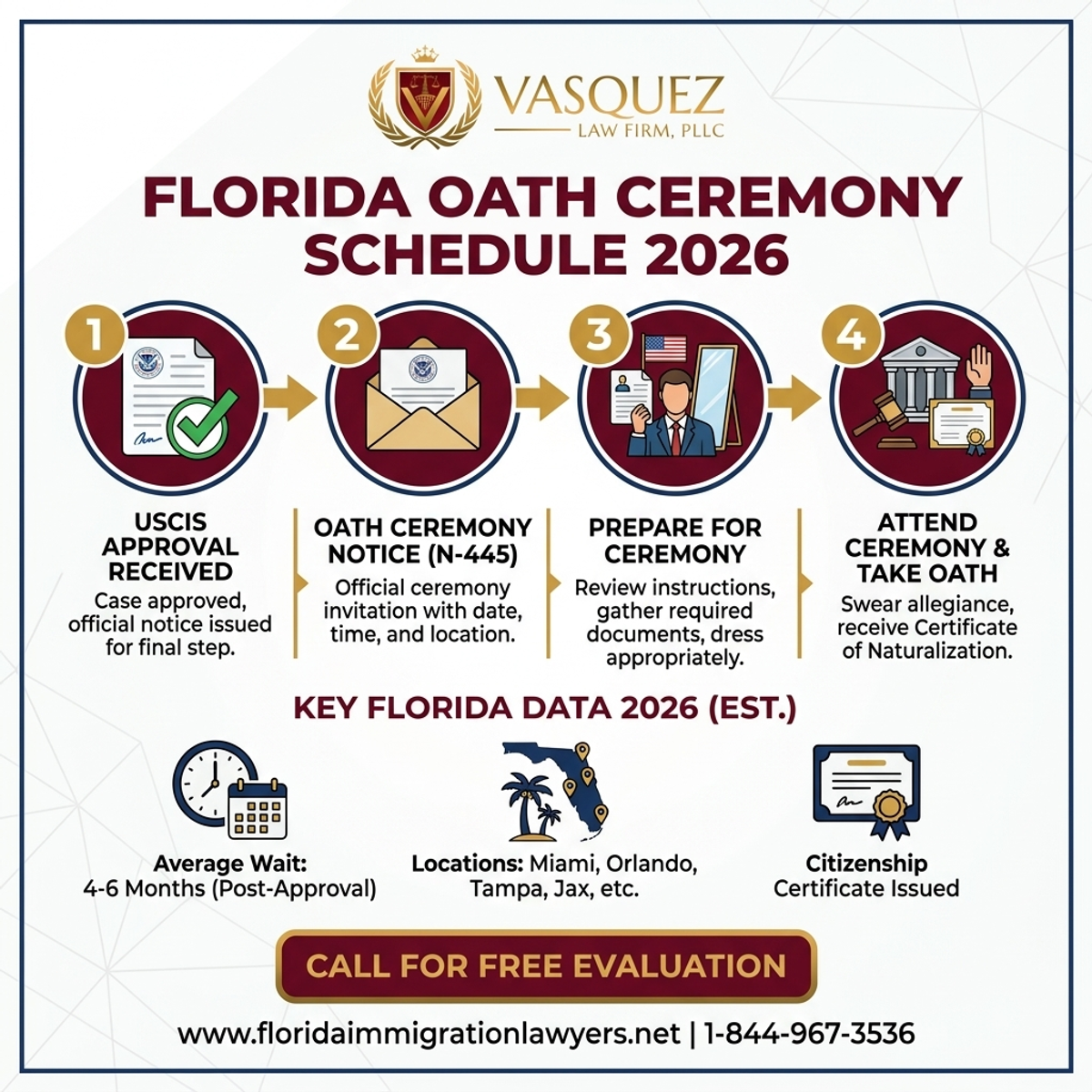
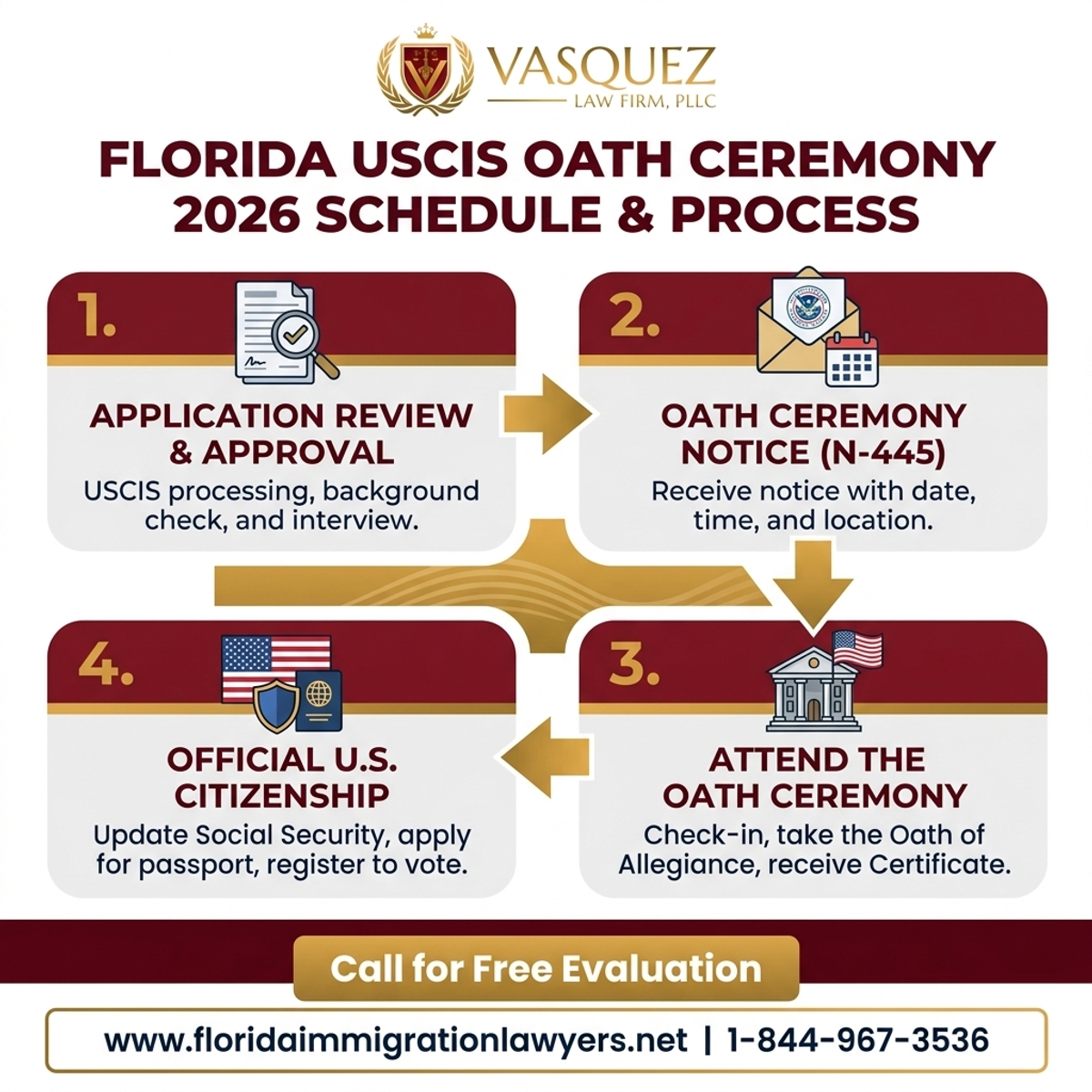
Once you have passed your naturalization interview and USCIS has determined you are eligible for citizenship, you will typically receive Form N-445, Notice of Naturalization Oath Ceremony. This form is your official invitation and will specify the exact date, time, and location of your ceremony. As of 2026, ceremonies are generally held within a few weeks to a few months after the interview, depending on the specific field office's caseload and capacity. Some applicants, particularly those whose cases are straightforward, might even be scheduled for an oath ceremony on the same day as their interview, known as a 'same-day oath'. However, this is not guaranteed and is more common for administrative ceremonies held at USCIS field offices rather than judicial ceremonies held in federal courthouses. Judicial ceremonies, which are less frequent, may involve a longer wait period as they are scheduled at the discretion of federal judges. It is crucial to read Form N-445 carefully, as it contains important instructions, including items you must bring and questions you must answer about your activities since your interview. Failure to follow these instructions could result in a delay or rescheduling of your ceremony. For detailed information on naturalization, refer to the USCIS website.
The general timeline for the naturalization process, including the oath ceremony, can vary:
| Stage | Typical Timeframe (As of 2026) | Notes |
|---|---|---|
| File Form N-400 | Initial receipt | Online filing often faster than mail. |
| Biometrics Appointment | 3-5 weeks after N-400 filing | Conducted at an Application Support Center (ASC). |
| Interview Scheduling | 6-12 months after biometrics | Varies by field office backlog. |
| Naturalization Interview | Scheduled date | English and civics test, review of application. |
| Oath Ceremony Scheduling | 2-8 weeks post-interview | Depends on office capacity; same-day possible for some. |
| Oath Ceremony | Scheduled date (Form N-445) | Final step to becoming a U.S. citizen. |
What are the Requirements for Naturalization in Florida?
To be eligible for naturalization in Florida, applicants must meet a comprehensive set of federal requirements established by the Immigration and Nationality Act (INA), specifically INA Section 316. These requirements ensure that only individuals who have demonstrated a commitment to the U.S. and its values are granted citizenship.
Generally, you must be at least 18 years old at the time of filing Form N-400, Application for Naturalization. You must also be a lawful permanent resident (green card holder) for at least five years, or three years if you are married to a U.S. citizen and meet other specific criteria. Continuous residence and physical presence in the U.S. are critical; you must have resided continuously in the U.S. for at least five years (or three years if married to a U.S. citizen) immediately preceding the filing of your application, and been physically present for at least half of that time. Furthermore, you must demonstrate good moral character for the statutory period, which typically spans five years (or three years) prior to filing. This includes having a clean criminal record and adhering to U.S. laws. Applicants must also show an attachment to the principles of the U.S. Constitution, pass an English language test (reading, writing, and speaking), and a civics test demonstrating knowledge of U.S. history and government. There are certain exceptions and waivers available for the English and civics tests, such as for older applicants or those with medical conditions. Meeting these requirements is foundational to a successful naturalization application. For assistance with your application, consider consulting with an experienced immigration lawyer.
Key Documents for Your Naturalization Application:
When preparing your Form N-400, Application for Naturalization, you'll need to gather a variety of supporting documents. A well-organized submission can prevent delays. Here's a general checklist:
Step-by-Step Process — USCIS Oath Ceremony Schedule 2026 in Florida
- Copy of your Permanent Resident Card (Green Card), front and back.
- Copies of all passports (U.S. and foreign) held during the statutory period.
- Marriage certificate (if applying based on 3-year rule).
- Divorce decrees or annulment certificates (if applicable).
- Birth certificates of children (if applicable).
- Evidence of selective service registration (for males 18-26).
- Tax returns for the past 5 years (or 3 years if applicable).
- Court disposition documents for any arrests, citations, or convictions, even if expunged.
- Proof of payment for child support or alimony (if applicable).
- Proof of continuous residence (e.g., utility bills, leases, bank statements, employment records).
- Two passport-style photos (if filing by mail, not usually needed for online filing).
What to Expect During Your Naturalization Interview in Florida
The naturalization interview is a critical step in the citizenship process, designed to verify the information on your Form N-400 and assess your eligibility. Preparing thoroughly for this interview at a Florida USCIS field office, such as the one in Orlando, is paramount.
Upon arrival at the USCIS field office, you will check in and wait for an immigration officer to call your name. The interview typically begins with an oath to tell the truth. The officer will then review your N-400 application in detail, asking questions about your personal history, family, residences, employment, travel outside the U.S., and any interactions with law enforcement. It is crucial to answer truthfully and consistently with your application. Any discrepancies could raise concerns. Following the review of your application, the officer will administer the English language test, which includes a reading test (reading one out of three sentences correctly), a writing test (writing one out of three sentences correctly), and an assessment of your ability to speak and understand English during the interview itself. After the English test, you will take the civics test, answering 6 out of 10 questions correctly from a list of 100 civics questions. The entire interview usually lasts between 20 to 45 minutes. At the end, the officer will inform you of the decision or if further documentation is needed. You may receive a decision notice (Form N-652) indicating approval, a request for more evidence, or a continuance. The atmosphere is professional, but officers are also looking for genuine intent and good moral character. Being calm, honest, and well-prepared will significantly improve your experience. Remember, seeking legal counsel from our experienced attorneys can help you prepare for this crucial interview.
Post-Interview Steps and Preparing for Your Oath Ceremony
After successfully completing your naturalization interview, there are a few important steps to take while you await your oath ceremony. This period is a time of anticipation and final preparations for becoming a U.S. citizen.
If your application is approved at the interview, or shortly thereafter, USCIS will mail you Form N-445, Notice of Naturalization Oath Ceremony. This form is extremely important and contains the date, time, and location of your ceremony. Before the ceremony, you must ensure that you have not committed any acts that would disqualify you from naturalization, such as certain crimes. The N-445 form includes a questionnaire that you must complete and bring with you to the ceremony, confirming that you meet all eligibility requirements up to the date of the oath. You will also be required to return your Permanent Resident Card (Green Card) at the ceremony. It is essential to keep your green card safe until this point, as it remains your valid proof of lawful permanent residency until you take the oath. On the day of the ceremony, arrive early and dress appropriately; while there is no formal dress code, business casual attire is generally recommended as a sign of respect for the solemnity of the event. You may bring family and friends to witness this significant moment, though seating may be limited depending on the venue. During the ceremony, you will take the Oath of Allegiance to the United States and receive your Certificate of Naturalization, which is your official proof of U.S. citizenship. Review this certificate immediately for any errors. This document is vital for obtaining a U.S. passport and other citizenship benefits. For more information on post-interview procedures, you can consult the Department of State's website regarding citizenship matters.
Key Statistics — USCIS Oath Ceremony Schedule 2026 in Florida
What are the Costs Associated with Naturalization and Oath Ceremonies?
Understanding the financial implications of naturalization is important for planning your path to U.S. citizenship. While the oath ceremony itself typically does not incur a separate fee, there are costs associated with the overall naturalization application process.
As of 2026, the primary cost for naturalization is the filing fee for Form N-400, Application for Naturalization. This fee is subject to change by USCIS, so it is crucial to check the most current fee schedule on the USCIS website before filing. There is also a separate fee for biometrics services, which covers the collection of your fingerprints, photograph, and signature. Certain low-income applicants may be eligible for a fee waiver (Form I-912, Request for Fee Waiver) for the N-400 application and biometrics. Beyond these government fees, applicants might incur additional costs. These can include legal fees if you choose to hire an immigration attorney to assist with your application, which is highly recommended to ensure accuracy and address any potential complications. There may also be costs for obtaining necessary supporting documents, such as certified copies of birth certificates, marriage certificates, or court records. Translation services for foreign-language documents, if required, also add to the expense. Travel costs to attend your biometrics appointment, interview, and oath ceremony at the designated USCIS field office in Florida (e.g., Orlando, Miami, or Tampa) should also be factored in. While the journey to citizenship has costs, the long-term benefits of becoming a U.S. citizen often far outweigh these initial investments. An attorney can help you understand all potential costs and ensure your application is submitted correctly the first time.
| Item | Typical Fee (As of 2026, subject to change) | Notes |
|---|---|---|
| Form N-400 Filing Fee | Varies (Check USCIS website) | Mandatory fee for naturalization application. |
| Biometrics Services Fee | Varies (Check USCIS website) | Covers fingerprinting, photos, signature. |
| Attorney Legal Fees | Highly variable | Recommended for complex cases or peace of mind. |
| Document Procurement | Varies by document | Costs for birth certificates, marriage licenses, court records. |
| Translation Services | Varies by document length | Required for non-English documents. |
| Travel Expenses | Varies by distance | For appointments at USCIS field offices or ASCs. |
Do not navigate this process alone. The journey to citizenship can be complex, with many forms, interviews, and deadlines. Contact Florida Immigration Lawyers today for personalized guidance and support throughout your naturalization process.
Common Mistakes to Avoid During the Naturalization Process
The naturalization process is meticulous, and even minor errors can lead to significant delays or even denial. Being aware of common pitfalls can help you avoid them.
- Failing to Disclose All Information: Omitting arrests, citations, or past immigration violations, even if they seem minor or were expunged, can be considered misrepresentation and lead to denial or even accusations of fraud. Always be completely truthful and provide all requested documentation.
- Inadequate Documentation: Submitting an application without all required supporting documents, or with incomplete or incorrect ones, will result in Requests for Evidence (RFEs) and significant delays.
- Missing Deadlines: Failing to respond to USCIS requests for information or attend scheduled appointments (biometrics, interview) by the given deadlines can lead to application abandonment or denial.
- Lack of English Proficiency: Underestimating the English test and not preparing adequately can lead to failing the reading, writing, or speaking portions, resulting in a re-test or denial.
- Insufficient Civics Knowledge: Similar to English, failing the civics test due to inadequate preparation can halt your application. Study the 100 civics questions thoroughly.
- Poor Moral Character Issues: Engaging in certain criminal activities, failing to pay taxes, or not supporting dependents during the statutory period can lead to a finding of lack of good moral character, making you ineligible for naturalization under 8 U.S.C. § 1427.
- Not Updating Address with USCIS: Moving without notifying USCIS using Form AR-11 can cause you to miss crucial notices, interview appointments, or even your N-445 oath ceremony notice.
- Excessive Absences from the U.S.: Spending too much time outside the U.S. can break your continuous residence requirement or physical presence requirement, making you ineligible.
- Signing the N-445 Incorrectly: On the day of the oath ceremony, ensure you answer all questions on Form N-445 truthfully and sign it correctly. Incorrect answers could lead to rescheduling or further review.
- Ignoring Legal Advice: Attempting to navigate complex issues, such as past criminal records or long absences, without consulting an immigration attorney can lead to critical errors that are difficult to rectify later.
- Not Reviewing Your Application: Before submitting, thoroughly review your Form N-400 for any typos, incorrect dates, or omissions. Even small errors can cause issues.
When to Call a Florida Immigration Lawyer
While the naturalization process might seem straightforward for some, many applicants face unique challenges that warrant the expertise of an immigration attorney. Deciding when to seek legal counsel can significantly impact the success and timeliness of your application.
You should consider contacting Florida Immigration Lawyers if you have a complex case, such as a history of arrests or convictions, even if they were minor or expunged. These issues can have serious implications for your good moral character requirement, and an attorney can help assess the impact and prepare a robust defense. Similarly, if you have had multiple or lengthy absences from the U.S. that might affect your continuous residence or physical presence requirements, a lawyer can help analyze your travel history and advise on eligibility. If you have previously been denied any immigration benefit, or if you anticipate difficulty with the English or civics tests due to age or disability, an attorney can help navigate waivers and special accommodations. Furthermore, if you are applying based on marriage to a U.S. citizen and there are any complexities in your marital history or joint residency, legal advice is invaluable. Our attorneys at Florida Immigration Lawyers are well-versed in the nuances of immigration law, including the specific practices of USCIS field offices in Florida. We can help you prepare your N-400 application, gather supporting documents, prepare for your interview, and address any unexpected issues that arise. Don't risk your chance at citizenship; let us provide the professional guidance you need.
About Florida Immigration Lawyers
Florida Immigration Lawyers is a leading law firm dedicated to providing comprehensive and compassionate immigration legal services to individuals and families across the entire state of Florida. With an unwavering commitment to our clients, we understand the profound impact that immigration matters have on lives, and we strive to achieve the strongest possible outcomes.
Our experienced legal team focuses on a wide range of immigration services, including naturalization and citizenship, family-based immigration, business immigration, asylum claims, and deportation defense. We pride ourselves on offering personalized attention, clear communication, and strategic advocacy tailored to each client's unique situation. Located in Central Florida, our firm serves clients from Orlando and beyond, offering bilingual services (English and Spanish) to ensure effective communication. We are available 24/7 to answer your questions and offer free, confidential case reviews. When you choose Florida Immigration Lawyers, you're choosing a dedicated partner committed to protecting your rights and helping you achieve your American dream. We are here to help you navigate every step of your immigration journey, including understanding the USCIS oath ceremony schedule 2026.
Sources and References
- U.S. Citizenship and Immigration Services (USCIS)
- Executive Office for Immigration Review (EOIR)
- U.S. Department of State
- 8 U.S.C. Chapter 12 - Immigration and Nationality Act (INA)
- 8 CFR Part 316 - General Requirements for Naturalization
- USCIS Policy Manual, Volume 12 - Citizenship and Naturalization
Related services: asylum and refugee protection, immigration waivers, humanitarian protection programs, DACA renewal and applications.
This article provides general legal information and is not intended as legal advice. Every case is unique, and outcomes depend on specific facts and circumstances. Contact an attorney for advice about your particular situation.
Ready to take the final step toward U.S. citizenship or have questions about your naturalization journey? Don't hesitate to reach out to the dedicated legal team at Florida Immigration Lawyers. We offer free case reviews and are available 24/7 to assist you. Call us today at 1-844-YO-PELEO. Se Habla Español - Estamos aquí para ayudarle.
Do Not Navigate This Process Alone
Our experienced immigration attorneys are ready to fight for you. Get a free, confidential case review today.
Se Habla Español
Or leave your details and we’ll call you:
Free Evaluation in 24 Hours
Or talk to us right now

AI voice assistant — available 24/7
FreeFrequently Asked Questions

William J. Vásquez
Founding Attorney · Vasquez Law Firm
U.S. Air Force veteran and immigration attorney with years of hands-on U.S. immigration experience. J.D., NCCU School of Law. AILA member. Admitted to the 4th, 5th, and 11th Circuit Courts.
Available 24/7 - Free Evaluations
Reviewed for legal accuracy by William J. Vásquez
Licensed in North Carolina; U.S. immigration is federal practice.
Related Legal Services
Our Florida immigration attorneys can help you with free immigration consultation, business immigration and deportation defense. Call today at 1-844-YO-PELEO for a free case review.
Related Links
Related Topics
Free Legal Case Review
Discuss your case with our experienced attorneys. We're available 24/7.
Se Habla Español - Estamos aquí para ayudarle.
Related Articles
Dual Citizenship Lawyer in Florida: What You Need to Know
For Florida residents, the concept of dual citizenship, or holding two passports, offers a compelling blend of opportunities and challenges. While the U.S. generally permits dual nationality, the path to achieving this status requires a meticulous understanding of both U.S. immigration laws and the citizenship policies of your country of origin. This guide explores the definition of dual citizenship, the detailed step-by-step process for U.S. naturalization, and the significant benefits and potential pitfalls involved. We cover essential documentation, typical timelines, and cost considerations for 2026, providing crucial insights for anyone in Orlando, Miami, or across Florida considering this important legal step. Learn about common mistakes to avoid and understand when to seek professional legal counsel to navigate this complex process successfully. Florida Immigration Lawyers is here to provide expert, bilingual support for your dual citizenship journey.
Immigration Lawyer Orlando Free Consultation in Florida
For individuals and families in Orlando, Florida, navigating the complexities of U.S. immigration law requires expert guidance. An immigration lawyer in Orlando offers crucial support for everything from visa applications and green card processes to naturalization and deportation defense. This comprehensive guide details what a free consultation covers, providing a step-by-step overview of immigration pathways, essential document checklists, and expected timelines in 2026. We also highlight common mistakes to avoid, discuss the critical role of legal counsel in deportation and asylum cases, and explain why choosing a local Orlando immigration attorney is beneficial. Florida Immigration Lawyers is dedicated to serving the diverse community of Orlando with compassionate, effective legal solutions, ensuring you receive personalized advice and robust representation for a successful immigration journey.
EAD Advance Parole Combo Card in Florida 2026
For individuals with a pending Form I-485, Application to Register Permanent Residence or Adjust Status, the EAD Advance Parole Combo Card is an essential document. This single card combines the authorization to work legally in the U.S. (Employment Authorization Document - EAD) with permission to travel internationally and re-enter without abandoning your green card application (Advance Parole). This guide from Florida Immigration Lawyers provides a comprehensive overview for applicants in Florida in 2026, covering eligibility, the step-by-step application process, required documents, expected processing times, and associated costs. We also highlight common mistakes to avoid and when to seek legal counsel to ensure a smooth and successful immigration journey. Understanding this vital card is key to maintaining stability while awaiting your permanent residency approval.
Immigration Interview Preparation in Florida 2026
For those seeking to live, work, or become citizens in Florida, the immigration interview is a pivotal moment requiring thorough preparation. This comprehensive guide from Florida Immigration Lawyers demystifies the process in 2026, offering actionable insights for applicants. Learn what to expect at your USCIS appointment, common pitfalls to avoid, essential documents for your checklist, and critical timelines. We cover specific interview types, cost factors, and when professional legal assistance becomes invaluable. Our goal is to empower you with the knowledge and confidence needed to present your case effectively and navigate the complex U.S. immigration system. For personalized advice and robust legal representation, contact Florida Immigration Lawyers today for a free case review.