I-601A Provisional Waiver in Florida: Key Insights
Explore the I-601A provisional waiver process in Florida, designed to help immigrants secure a waiver for unlawful presence before leaving the U.S. Learn about eligibility, application steps, and common pitfalls. Discover how Florida Immigration Lawyers can assist you in navigating this complex process.
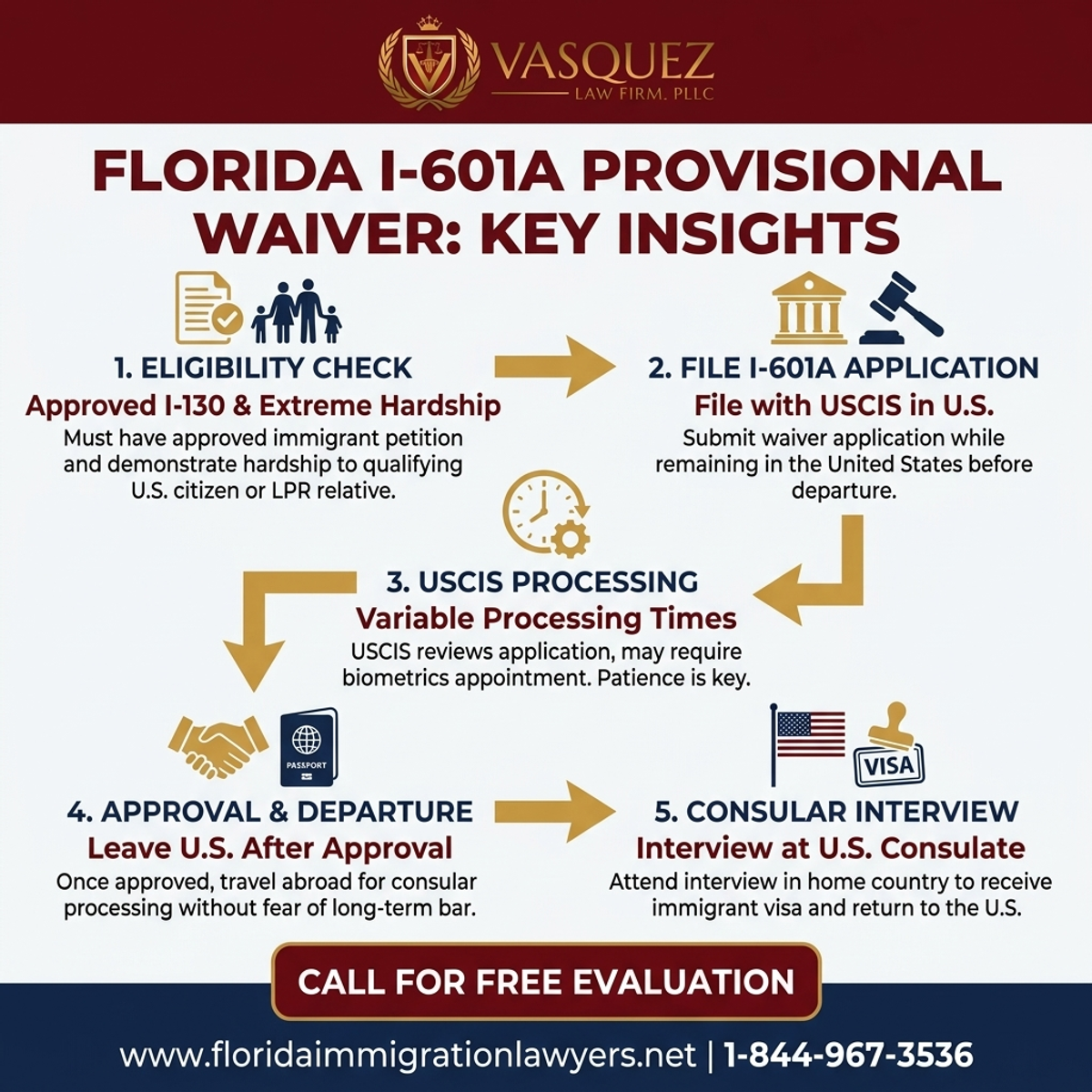
- Eligibility based on extreme hardship to a U.S. citizen or lawful permanent resident spouse or parent.
- Application must be filed while in the U.S.
- Approval significantly reduces time spent outside the U.S. during consular processing.
I-601A Provisional Waiver in Florida: Key Insights
Introduction
Many immigrants in Florida face the challenge of needing to leave the U.S. to apply for a visa at a consulate, risking a bar on re-entry due to unlawful presence. The I-601A provisional waiver provides a solution by allowing eligible individuals to apply for a waiver while still in the U.S. If you're in Orlando or anywhere in Florida and considering this process, understanding its intricacies can be crucial for a successful application. Call Florida Immigration Lawyers at 1-844-YO-PELEO for a free case review.
Florida, with its diverse population, sees a significant number of individuals who could benefit from this critical immigration pathway. Navigating the complexities of U.S. immigration law can be daunting, especially when the stakes involve family unity and the ability to live and work legally in the country. The I-601A waiver offers a beacon of hope, but only for those who meticulously follow the guidelines and prepare a robust case.
Understanding the nuances of the provisional waiver can make all the difference between a smooth process and prolonged separation or even denial. This guide aims to provide comprehensive insights, practical tips, and real-world considerations for those in Florida pursuing the I-601A, ensuring they are well-equipped to make informed decisions about their immigration journey.
What is the I-601A Provisional Waiver?
The I-601A provisional waiver is a form that certain immigrants can file to waive the unlawful presence ground of inadmissibility before departing the U.S. for consular processing. This waiver is designed to minimize the time the applicant needs to spend outside the United States. It applies to individuals who can demonstrate that their absence would cause extreme hardship to a U.S. citizen or lawful permanent resident spouse or parent.
The policy behind the I-601A waiver is to reduce family separation and provide a more predictable process for immigrants and their families. As of 2026, the process remains a critical option for those in Florida seeking to adjust their status without prolonged absences from their families.
To fully grasp its significance, it's important to understand the concept of "unlawful presence." Individuals who have been in the U.S. without authorization for more than 180 days but less than one year accrue a three-year bar to re-entry if they depart. Those present unlawfully for one year or more accrue a ten-year bar. The I-601A waiver provisionally waives these bars, meaning the waiver decision is made before the applicant leaves the U.S., significantly reducing the risk and uncertainty associated with consular processing abroad.
This waiver is particularly crucial for individuals who entered the U.S. without inspection or who overstayed a visa and are now pursuing an immigrant visa through a U.S. citizen or lawful permanent resident immediate relative. Without the I-601A, they would have to leave the U.S. to attend their visa interview, immediately triggering the unlawful presence bar upon departure. The provisional waiver allows them to seek approval while remaining in the U.S. with their families, only departing once the waiver is granted, ensuring a smoother path to legal permanent residency. For example, Maria, who has lived in Florida for 12 years with her U.S. citizen husband and children after entering without inspection, would face a 10-year bar from re-entry without an approved I-601A waiver.
How to Apply for the I-601A Waiver in Florida?
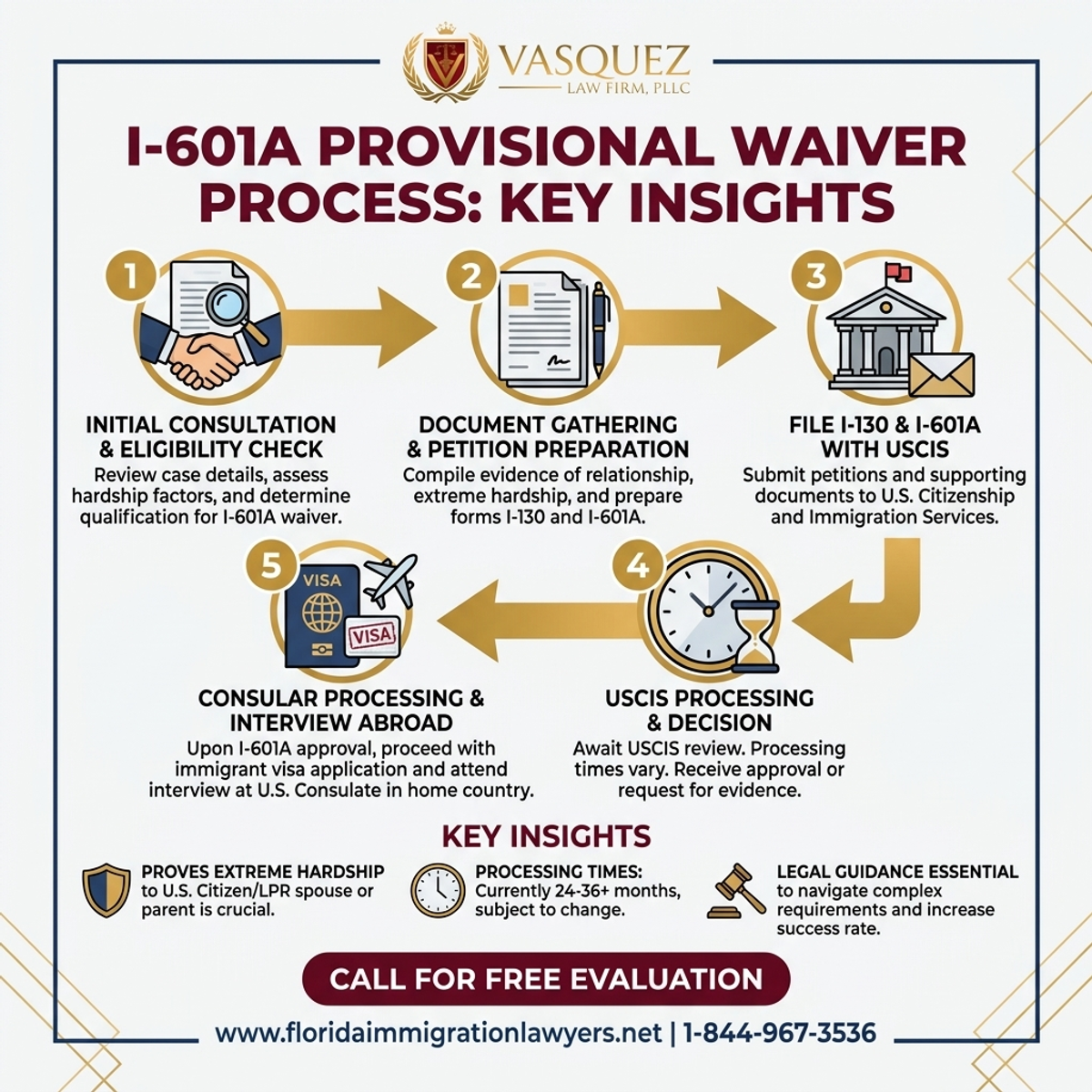
Applying for the I-601A provisional waiver involves several steps, each requiring careful attention to detail. Here is a step-by-step guide:
- Determine Eligibility: Ensure you meet the criteria, including demonstrating extreme hardship to a qualifying relative.
- Gather Documentation: Collect evidence of hardship, such as medical records, financial statements, and personal affidavits.
- Complete the Form I-601A: Accurately fill out the application form, ensuring all information is current and correct.
- Submit the Application: File your application with the appropriate fees to the designated USCIS location.
- Receive a Decision: USCIS will notify you of its decision. If approved, prepare for consular processing abroad.
Each step is crucial for a successful application, and errors can lead to delays or denials. It's advisable to consult with an immigration lawyer to ensure all aspects are correctly handled.
When determining eligibility, it's not enough to simply have a qualifying relative; you must prove "extreme hardship." This is a high legal standard, requiring compelling evidence that your U.S. citizen or lawful permanent resident spouse or parent would suffer more than the ordinary difficulties inherent in family separation. For instance, a qualifying relative with a severe medical condition requiring your constant care, or facing significant financial ruin without your income, could constitute extreme hardship. Documenting these specific burdens is paramount.
Gathering documentation is perhaps the most critical phase. This isn't just about collecting papers; it's about building a persuasive narrative. Beyond medical and financial records, think about psychological evaluations, letters from community leaders, school records of children, and detailed personal statements from both the applicant and the qualifying relative. A strong case tells a comprehensive story of interdependence and the profound negative impact your absence would have on your family in Florida.
Completing Form I-601A requires meticulous attention. Any inconsistencies with prior immigration applications or personal records can raise red flags. It's vital to be truthful and thorough, ensuring every question is answered accurately. Once submitted, USCIS will schedule a biometrics appointment in Florida, where your fingerprints and photos will be taken. This data is used for background checks, which are an integral part of the waiver process. Florida Immigration Lawyers can assist in reviewing your application before submission, catching potential issues early.
Step-by-Step Process — I-601A Provisional Waiver in Florida: Key Insights
What Documents Are Required for the I-601A Waiver?
- Proof of Relationship: Documents proving your relationship with a U.S. citizen or lawful permanent resident, such as marriage certificates or birth certificates.
- Evidence of Extreme Hardship: Medical records, financial documents, and affidavits from individuals familiar with your situation.
- Personal Statement: A detailed letter explaining your circumstances and the hardship your relative would face.
- Supporting Affidavits: Letters from employers, doctors, or community leaders that support your claims of hardship.
Beyond the basic relationship documents like marriage certificates for spouses or birth certificates for parents/children, it's important to provide a comprehensive package that leaves no doubt about the legitimacy of your family ties. For example, if you are applying based on a U.S. citizen spouse, include not just the marriage certificate but also joint bank statements, utility bills, property deeds, and photos showing a commingling of life, demonstrating a bona fide marriage. The more evidence of a shared life, the stronger your case.
The "Evidence of Extreme Hardship" category is where most applications succeed or fail. For medical hardship, include detailed doctor's notes, diagnoses, treatment plans, and a prognosis, explaining why the qualifying relative needs you specifically for care, transportation, or emotional support. For financial hardship, submit tax returns, pay stubs, mortgage statements, and evidence of debts, demonstrating how your absence would lead to severe financial instability for your family in Florida, such as potential loss of home or inability to cover essential living expenses.
Your "Personal Statement" should be a heartfelt, yet factual, narrative. It's your opportunity to explain your story, your contributions to your family, and the specific ways your qualifying relative depends on you. Do not generalize; provide concrete examples and dates. Similarly, "Supporting Affidavits" should be specific, detailing personal knowledge of your family's situation and the hardship your qualifying relative would endure without you. These letters gain credibility when they come from reputable individuals who can speak to your character and family dynamics.
Remember, all documents not in English must be accompanied by a certified English translation. This means the translator must provide a statement affirming their competence to translate and that the translation is accurate and complete. Failure to provide proper translations can lead to Requests for Evidence (RFEs) or even denial. Florida Immigration Lawyers can guide you through preparing and organizing this extensive documentation, ensuring compliance with all USCIS requirements.
Timeline and Processing Expectations for the I-601A Waiver
| Stage | Typical Timeframe | Notes |
|---|---|---|
| Application Preparation | 1-2 months | Includes gathering documents and consulting with a lawyer. |
| USCIS Processing | 4-6 months | Varies based on USCIS workload and completeness of application. |
| Consular Processing | 1-2 months | Time spent abroad depends on consulate efficiency. |
It's crucial to plan for potential delays and consult with an attorney to understand current processing times as they may fluctuate.
While the listed timeframes provide a general idea, actual processing times can fluctuate significantly due to various factors. USCIS workload, policy changes, and the complexity of individual cases all play a role. For instance, if your application requires a Request for Evidence (RFE) because of missing or insufficient documentation, this will undoubtedly extend your processing time. A well-prepared application, ideally with the assistance of Florida Immigration Lawyers, can help mitigate such delays.
Once the I-601A waiver is approved, the next phase is consular processing. This involves the National Visa Center (NVC) scheduling your interview at a U.S. consulate or embassy in your home country. While the I-601A significantly reduces the time spent abroad, applicants should still anticipate a period of a few weeks away from their families in Florida for the final interview and visa issuance. It's essential to have all required documents for the consular interview prepared in advance to avoid further delays.
Staying informed about current processing times is vital. USCIS provides online tools to check average processing times for different forms and service centers. However, these are estimates, and your individual experience may vary. Proactive communication with your legal team at Florida Immigration Lawyers and diligent tracking of your application status are key to managing expectations throughout this multi-stage process.
Key Statistics — I-601A Provisional Waiver in Florida: Key Insights
Cost Factors and Fee Breakdown for the I-601A Waiver
| Item | Typical Fee | Notes |
|---|---|---|
| Form I-601A Filing Fee | Varies | Check USCIS for current fees. |
| Biometric Services Fee | Varies | Required for applicants aged 14-79. |
| Attorney Fees | Varies | Depends on complexity and legal services required. |
Fees are subject to change, and it's essential to verify current amounts on the USCIS website or with a legal professional.
The "Varies" notation for filing fees is important because USCIS periodically updates its fee schedule. It's crucial to always check the official USCIS website for the most current Form I-601A filing fee before submitting your application. Payment typically needs to be made by check or money order drawn on a U.S. bank, payable to the "U.S. Department of Homeland Security." Incorrect fee amounts or improper payment methods are common reasons for applications being rejected and returned, causing significant delays.
The
Sources and References
- U.S. Citizenship and Immigration Services (USCIS)
- Executive Office for Immigration Review (EOIR)
- U.S. Department of State
- Immigration and Nationality Act (INA), 8 U.S.C. Chapter 12
Do Not Navigate This Process Alone
Our experienced immigration attorneys are ready to fight for you. Get a free, confidential case review today.
Se Habla Español
Or leave your details and we’ll call you:
Free Evaluation in 24 Hours
Or talk to us right now

AI voice assistant — available 24/7
FreeFrequently Asked Questions

William J. Vásquez
Founding Attorney · Vasquez Law Firm
U.S. Air Force veteran and immigration attorney with years of hands-on U.S. immigration experience. J.D., NCCU School of Law. AILA member. Admitted to the 4th, 5th, and 11th Circuit Courts.
Available 24/7 - Free Evaluations
Reviewed for legal accuracy by William J. Vásquez
Licensed in North Carolina; U.S. immigration is federal practice.
Related Legal Services
Our Florida immigration attorneys can help you with immigration lawyer cost in Florida, experienced immigration attorneys and asylum protection. Call today at 1-844-YO-PELEO for a free case review.
Related Links
Related Topics
Free Legal Case Review
Discuss your case with our experienced attorneys. We're available 24/7.
Se Habla Español - Estamos aquí para ayudarle.
Related Articles
Dual Citizenship Lawyer in Florida: What You Need to Know
For Florida residents, the concept of dual citizenship, or holding two passports, offers a compelling blend of opportunities and challenges. While the U.S. generally permits dual nationality, the path to achieving this status requires a meticulous understanding of both U.S. immigration laws and the citizenship policies of your country of origin. This guide explores the definition of dual citizenship, the detailed step-by-step process for U.S. naturalization, and the significant benefits and potential pitfalls involved. We cover essential documentation, typical timelines, and cost considerations for 2026, providing crucial insights for anyone in Orlando, Miami, or across Florida considering this important legal step. Learn about common mistakes to avoid and understand when to seek professional legal counsel to navigate this complex process successfully. Florida Immigration Lawyers is here to provide expert, bilingual support for your dual citizenship journey.
Immigration Lawyer Orlando Free Consultation in Florida
For individuals and families in Orlando, Florida, navigating the complexities of U.S. immigration law requires expert guidance. An immigration lawyer in Orlando offers crucial support for everything from visa applications and green card processes to naturalization and deportation defense. This comprehensive guide details what a free consultation covers, providing a step-by-step overview of immigration pathways, essential document checklists, and expected timelines in 2026. We also highlight common mistakes to avoid, discuss the critical role of legal counsel in deportation and asylum cases, and explain why choosing a local Orlando immigration attorney is beneficial. Florida Immigration Lawyers is dedicated to serving the diverse community of Orlando with compassionate, effective legal solutions, ensuring you receive personalized advice and robust representation for a successful immigration journey.
EAD Advance Parole Combo Card in Florida 2026
For individuals with a pending Form I-485, Application to Register Permanent Residence or Adjust Status, the EAD Advance Parole Combo Card is an essential document. This single card combines the authorization to work legally in the U.S. (Employment Authorization Document - EAD) with permission to travel internationally and re-enter without abandoning your green card application (Advance Parole). This guide from Florida Immigration Lawyers provides a comprehensive overview for applicants in Florida in 2026, covering eligibility, the step-by-step application process, required documents, expected processing times, and associated costs. We also highlight common mistakes to avoid and when to seek legal counsel to ensure a smooth and successful immigration journey. Understanding this vital card is key to maintaining stability while awaiting your permanent residency approval.
Immigration Interview Preparation in Florida 2026
For those seeking to live, work, or become citizens in Florida, the immigration interview is a pivotal moment requiring thorough preparation. This comprehensive guide from Florida Immigration Lawyers demystifies the process in 2026, offering actionable insights for applicants. Learn what to expect at your USCIS appointment, common pitfalls to avoid, essential documents for your checklist, and critical timelines. We cover specific interview types, cost factors, and when professional legal assistance becomes invaluable. Our goal is to empower you with the knowledge and confidence needed to present your case effectively and navigate the complex U.S. immigration system. For personalized advice and robust legal representation, contact Florida Immigration Lawyers today for a free case review.