F-1 to H-4 Change of Status Processing in Florida
Explore the F-1 to H-4 change of status process in Florida, including I-539 processing times, steps involved, and common pitfalls. Call Florida Immigration Lawyers for a free case review.
Introduction
Changing from an F-1 student visa to an H-4 dependent visa is a common transition for international students in Florida who have family members on H-1B visas. As of 2026, knowing the processing time and requirements is essential for a smooth transition. This guide will walk you through the process, common mistakes, and when to seek legal assistance. Call Florida Immigration Lawyers at 1-844-YO-PELEO for a free case review.
This transition often becomes necessary when an F-1 student completes their studies or Optional Practical Training (OPT) and their spouse or parent holds an H-1B nonimmigrant visa. The H-4 visa allows dependents to remain lawfully in the U.S. and, in some cases, even pursue further education or obtain work authorization if certain conditions are met by the H-1B principal.
Navigating the U.S. immigration system can be complex, and a seemingly straightforward change of status can quickly become complicated without proper guidance. Understanding the specific forms, required documentation, and potential pitfalls is crucial to avoid delays or denials that could jeopardize your legal status. Our aim is to provide clarity and practical advice for F-1 students considering this important step in their immigration journey.
What is the F-1 to H-4 Change of Status Process?
The F-1 to H-4 change of status involves applying with the USCIS to change your visa type while remaining in the U.S. As of 2026, this process requires submitting Form I-539 along with supporting documentation. The processing time at the Texas Service Center can vary, often taking several months.
It's crucial to maintain your current status until the change is approved. Failure to do so can lead to being out of status, which complicates future immigration processes.
The H-4 dependent visa is specifically designed for the spouse and unmarried children under 21 years of age of H-1B nonimmigrants. While the H-1B visa holder is the primary beneficiary, the H-4 status allows their immediate family members to reside in the U.S. legally. It's important to note that an H-4 visa typically does not grant work authorization automatically, though certain H-4 spouses may be eligible for an Employment Authorization Document (EAD) if the H-1B principal has an approved I-140 immigrant petition or has been granted an extension under AC21.
This change of status is a vital step for many families seeking to remain together in the U.S. It enables F-1 students, who might otherwise face the prospect of leaving the country upon the expiration of their student status, to continue their stay as dependents. Understanding the nuances, such as the implications for travel while the application is pending or the need to maintain F-1 status until H-4 approval, is paramount. Consulting with experienced professionals like Florida Immigration Lawyers can ensure you meet all requirements and avoid common pitfalls.
How Long Does the I-539 Processing Take at Texas Service Center?
As of 2026, processing times for Form I-539 at the Texas Service Center can range from several months to over a year. Factors influencing this time include the volume of applications and specific details of individual cases.
Understanding these timelines is crucial for planning your stay and activities in the U.S. Always check the latest updates from the USCIS for current processing times.
Several elements can significantly impact how long your I-539 application will take. These include the overall workload at the Texas Service Center, which fluctuates based on national immigration trends and policy changes, as well as the completeness and accuracy of your submission. An application with missing documents or errors will almost certainly face delays, potentially leading to a Request for Evidence (RFE) which adds several more months to the process.
It's also important to consider that while your I-539 application for F-1 to H-4 change of status is pending, you are generally advised against traveling outside the U.S. Doing so can be considered an abandonment of your application, requiring you to apply for an H-4 visa at a U.S. consulate abroad to re-enter. Planning ahead and monitoring USCIS processing times diligently is key to avoiding disruptions to your life and legal status. Florida Immigration Lawyers can help you track these times and provide strategic advice.
Step-by-Step Process — F-1 to H-4 Change of Status Processing in Florida
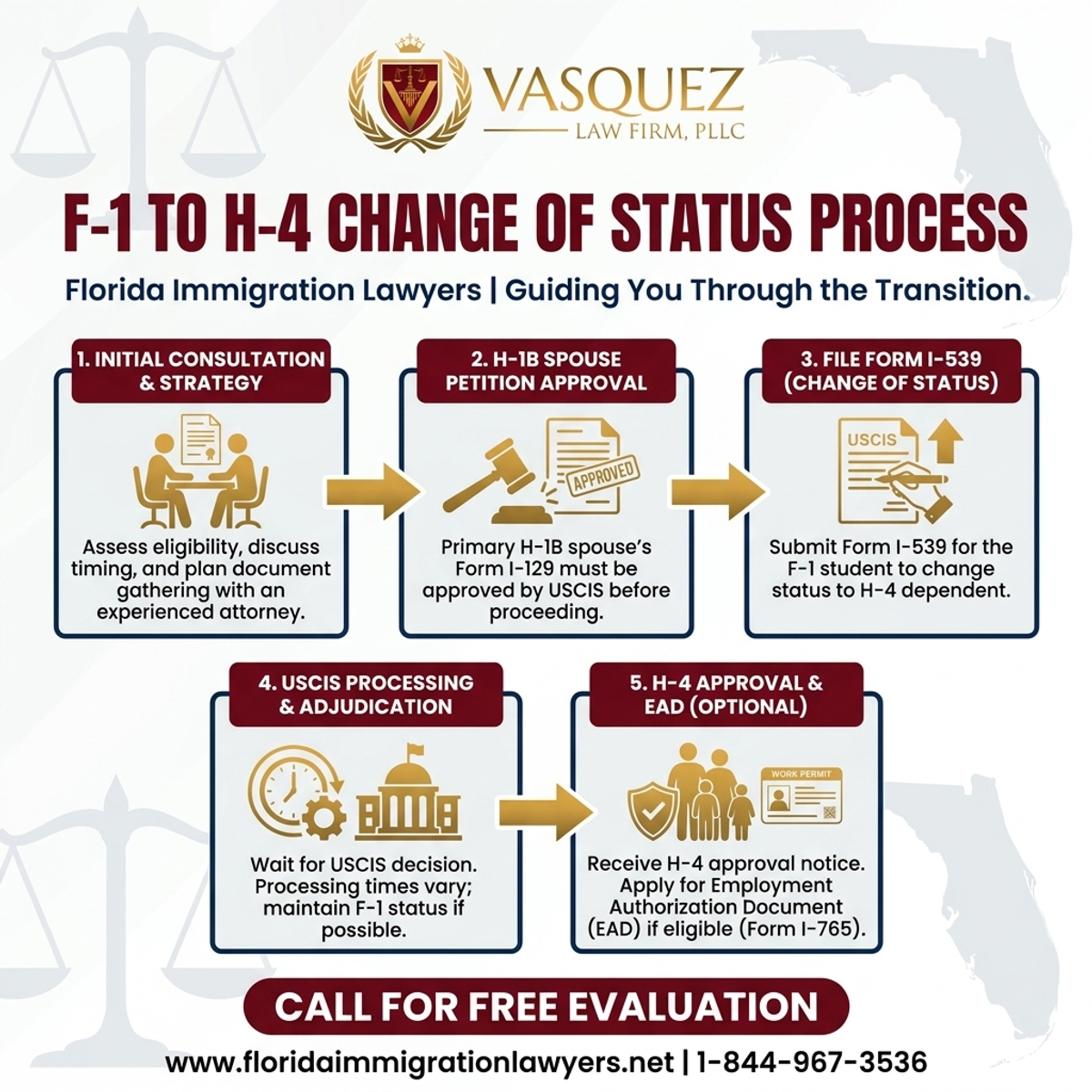
Step-by-Step Guide to Filing Form I-539
Filing Form I-539, Application to Extend/Change Nonimmigrant Status, is the cornerstone of your F-1 to H-4 change of status. Meticulous preparation and attention to detail at each step are critical to a successful outcome and to minimize potential delays.
- Gather all necessary documents, including your F-1 status proof, passport, and family member's H-1B status.
- Complete Form I-539 accurately. Mistakes can lead to delays or denials.
- Include supporting documents like financial records and proof of relationship.
- Submit the form and payment to the USCIS.
- Attend any required biometrics appointments.
When gathering documents, ensure you have copies of your most recent I-20s, EAD card (if applicable for OPT), passport biographical page, visa stamp, and I-94 arrival/departure record. For your H-1B family member, you'll need their I-797 H-1B approval notice, recent pay stubs, and potentially their employment verification letter. This comprehensive collection forms the basis of your application.
Accurate completion of Form I-539 is paramount. Double-check all dates, names, and addresses. Ensure all questions are answered, and pay particular attention to Part 3, Processing Information, where you specify the requested change of status. An attorney from Florida Immigration Lawyers can review your form to catch any potential errors before submission, significantly reducing the risk of an RFE or denial.
Document Checklist for F-1 to H-4 Change
A thorough document checklist is your best friend when preparing for an F-1 to H-4 change of status. Organizing these documents meticulously will not only streamline your application process but also demonstrate to USCIS that you are serious and prepared, reducing the chances of an RFE.
- Completed Form I-539
- Copy of current I-94
- Proof of F-1 status (e.g., I-20, EAD card if on OPT)
- Family member's H-1B approval notice (Form I-797)
- Proof of relationship (e.g., marriage certificate for spouse, birth certificate for child)
- Financial support evidence (e.g., H-1B spouse's pay stubs, employment verification letter, bank statements)
- Copy of passport biographical page and visa stamp
- Any previous immigration documents (e.g., prior I-797s, I-485 receipt if applicable)
Beyond the core documents, it's wise to include a cover letter detailing the contents of your application package. Ensure all copies are clear and legible. If any documents are not in English, they must be accompanied by a certified English translation. This attention to detail can make a significant difference in the timely processing of your application.
Remember, the goal is to present a clear and undeniable case for your eligibility for H-4 status. Any ambiguity or missing information can cause substantial delays. If you're unsure about any specific document or requirement, don't hesitate to reach out to Florida Immigration Lawyers at 1-844-YO-PELEO for expert guidance.
Key Statistics — F-1 to H-4 Change of Status Processing in Florida
Timeline and Processing Expectations
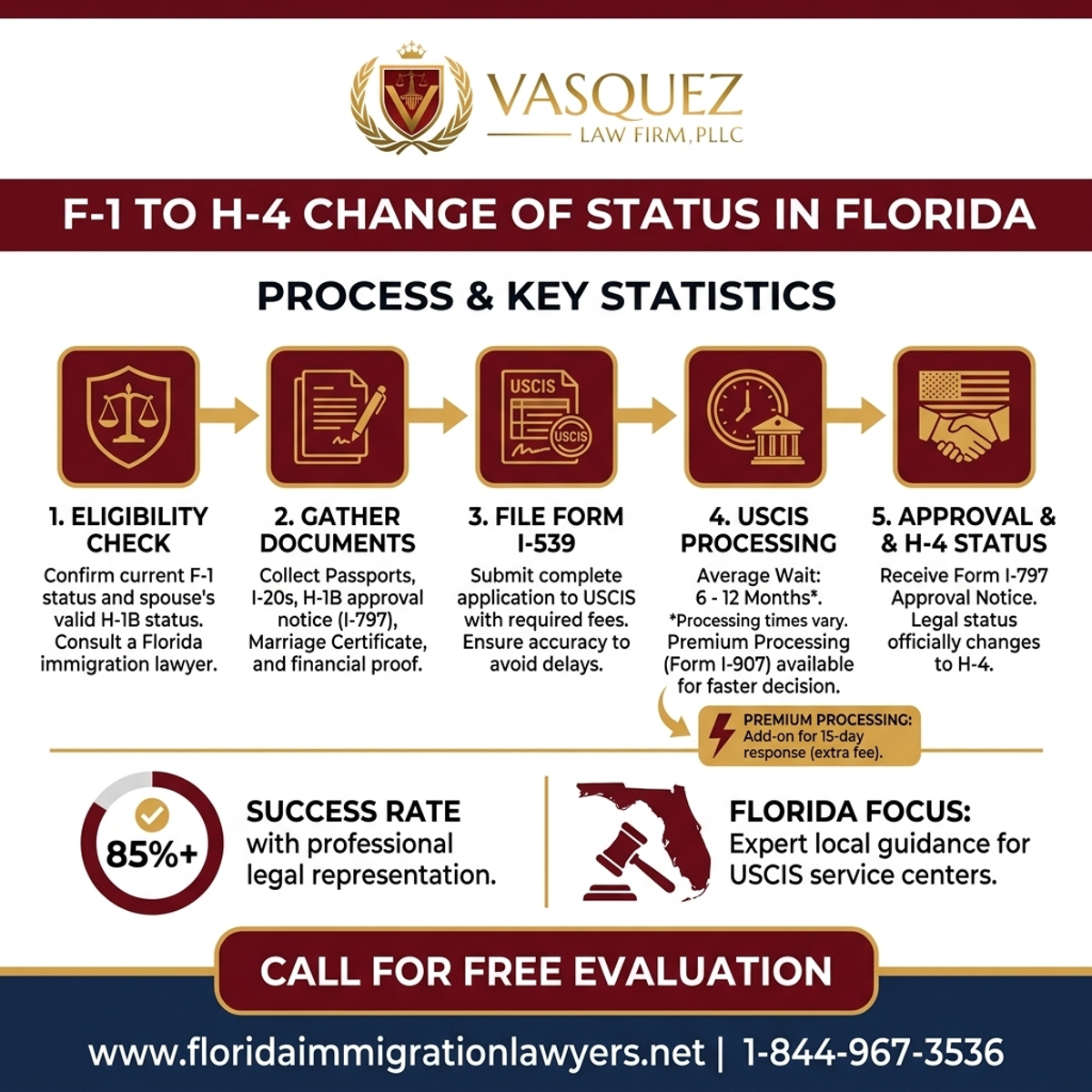
Understanding the typical timeline for an F-1 to H-4 change of status is crucial for managing expectations and planning your future in the U.S. While the table below provides general timeframes, individual cases can vary significantly.
| Stage | Typical Timeframe | Notes |
|---|---|---|
| Form Submission | 1-2 weeks | Gather all documentation first |
| Biometrics Appointment | 3-5 weeks post-submission | USCIS schedules and notifies |
| Processing Time | 6-12 months | Varies by case and volume |
After submitting your Form I-539, USCIS will first send you a receipt notice (Form I-797C) acknowledging receipt of your application. This receipt notice is important as it confirms your application is pending and allows you to track its status online. Following this, you will typically receive an appointment notice for biometrics, which involves fingerprinting and a photograph. This data is used for background checks and identity verification.
During the primary processing time, your application will be reviewed by a USCIS officer. This is the period where delays can most significantly impact applicants. It's important to remember that premium processing is generally not available for standalone I-539 applications for change of status to H-4. Therefore, careful planning regarding your F-1 status expiration and potential travel is absolutely necessary. Consulting with Florida Immigration Lawyers can provide you with the most up-to-date processing insights and help you strategize around these timelines.
Cost Factors and Fee Breakdown
The financial aspect of an F-1 to H-4 change of status is an important consideration. Beyond the mandatory USCIS filing fees, applicants should be aware of potential additional costs that may arise during the process.
| Item | Typical Fee | Notes |
|---|---|---|
| Form I-539 Filing Fee | Check USCIS for updates | Subject to change |
| Biometrics Fee | Check USCIS for updates | Additional cost |
The filing fee for Form I-539 and the biometrics fee are non-refundable, regardless of the outcome of your application. It is imperative to always verify the most current fees directly on the USCIS website (www.uscis.gov) before submitting your application, as these amounts can change. Paying an incorrect fee can lead to your application being rejected or delayed.
Beyond the government fees, applicants might incur other expenses. These can include attorney fees if you choose to seek legal assistance, which is highly recommended to ensure accuracy and compliance. Other potential costs may involve fees for obtaining certified copies of documents, translation services for non-English documents, and postage for mailing your application package. A detailed consultation with Florida Immigration Lawyers can provide a comprehensive overview of all anticipated costs, helping you budget effectively for your change of status.
Frequently Asked Questions (FAQs)
Can I travel outside the U.S. while my F-1 to H-4 change of status is pending?
Traveling outside the U.S. while your I-539 change of status application is pending is generally not recommended. Doing so can be considered an abandonment of your application. If you leave, you would typically need to apply for an H-4 visa at a U.S. consulate abroad to re-enter, which can be a lengthy process and offers no guarantee of approval. Always consult Florida Immigration Lawyers before making travel plans.
What happens if my F-1 status expires while my H-4 application is pending?
If your F-1 status expires while your H-4 change of status application is pending, you are generally considered to be in a "period of authorized stay." This means you are legally present in the U.S. even though your F-1 status has ended. However, you cannot work or attend school under F-1 rules during this period. It's crucial to avoid any unauthorized activity that could jeopardize your pending application.
Can I work on an H-4 visa?
Generally, H-4 visa holders are not authorized to work in the U.S. However, certain H-4 spouses of H-1B nonimmigrants may be eligible to apply for an Employment Authorization Document (EAD) if the H-1B principal has an approved I-140 immigrant petition or has been granted an extension under AC21. This requires a separate application (Form I-765). Florida Immigration Lawyers can assess your eligibility for an H-4 EAD.
What if I receive a Request for Evidence (RFE)?
Receiving a Request for Evidence (RFE) means USCIS requires more information or clarification to process your application. It's crucial to respond thoroughly and within the given deadline. An RFE can significantly delay your case. It is highly advisable to seek legal assistance from Florida Immigration Lawyers to help you prepare a comprehensive and timely response, ensuring all concerns are addressed accurately.
Is premium processing available for F-1 to H-4 change of status?
No, premium processing is generally not available for standalone Form I-539 applications for F-1 to H-4 change of status. Premium processing is typically reserved for certain employment-based petitions like the H-1B. Therefore, applicants must plan accordingly with the standard processing times, which can range from several months to over a year. Careful planning is essential to avoid gaps in legal status.
Can I attend school on an H-4 visa?
Yes, H-4 visa holders are generally permitted to attend school, colleges, and universities in the U.S. without needing to apply for a separate student visa. This provides a great opportunity for dependents to continue their education or pursue new academic goals while residing in the U.S. There are no restrictions on the type of program or the number of credits you can take.
Common Mistakes to Avoid
Navigating the F-1 to H-4 change of status process can be fraught with potential pitfalls. Avoiding these common mistakes is crucial for a smooth and successful transition, protecting your legal status in the U.S.
- Not maintaining F-1 status until H-4 approval can lead to deportation risks.
- Incomplete or incorrect Form I-539 filings can delay processing times.
- Failing to provide all necessary documents may result in a denial.
- Missing biometrics appointments can lead to application abandonment.
- Misunderstanding eligibility requirements for H-4 status.
- Not checking current processing times or fees on the USCIS website.
- Ignoring legal advice when out of status risks deportation.
One of the most critical errors is allowing your F-1 status to expire before USCIS approves your H-4 change of status, without having filed the I-539 in a timely manner. This can result in you being unlawfully present, leading to severe immigration consequences. Another frequent mistake is not providing a clear and consistent narrative of your relationship and financial dependency on the H-1B principal, which can raise red flags for immigration officers. Always ensure your application is comprehensive and unambiguous to prevent unnecessary complications.
When to Call a Lawyer
If you're unsure about your status or facing complications, it's crucial to seek legal advice. Situations like being out of status, having a complicated case history, or receiving a denial notice warrant professional assistance. Florida Immigration Lawyers can provide guidance and representation to protect your rights and interests.
Specific scenarios where legal counsel becomes indispensable include situations where your F-1 OPT is expiring soon, and you're cutting it close to the filing deadline, or if you have any prior immigration violations or a complex travel history. If you receive a Request for Evidence (RFE) from USCIS, a lawyer can help you formulate a strong and timely response, preventing potential denial. Even if your case seems straightforward, an attorney can offer peace of mind and ensure all legal nuances are addressed.
Don't wait until you're facing a crisis. Proactive engagement with an experienced immigration attorney can save you from significant stress, financial loss, and potential long-term immigration consequences. Florida Immigration Lawyers are adept at handling F-1 to H-4 change of status cases and can provide the personalized support you need. Call 1-844-YO-PELEO for a free consultation to discuss your unique situation.
About Florida Immigration Lawyers
Florida Immigration Lawyers is dedicated to assisting clients with all immigration matters. Our experienced attorneys provide personalized service to navigate the complexities of immigration law. Whether you need help with student visas, deportation defense, or family immigration, we are here to assist. Call us at 1-844-YO-PELEO or visit our contact page for a free consultation. Available 24/7 and serving all of Florida.
Our firm prides itself on a deep understanding of U.S. immigration laws and a compassionate approach to client service. We recognize that every individual's immigration journey is unique and often deeply personal. From initial consultation to final resolution, our team works tirelessly to advocate for your best interests, providing clear communication and strategic advice at every stage of the process.
With a strong track record of success in various immigration categories, including nonimmigrant visas, green cards, and citizenship, Florida Immigration Lawyers is your trusted partner. We are committed to empowering our clients with the knowledge and support needed to achieve their immigration goals. Let us put our expertise to work for you. Contact us today for a confidential and free case review.
Sources and References
- U.S. Citizenship and Immigration Services (USCIS)
- Executive Office for Immigration Review (EOIR)
- 8 U.S.C. Chapter 12 - Immigration and Nationality Act
Related services: immigration practice areas, family immigration services, citizenship and naturalization.
This article provides general legal information and is not intended as legal advice. Every case is unique, and outcomes depend on specific facts and circumstances. Contact an attorney for advice about your particular situation.
Call Florida Immigration Lawyers at 1-844-YO-PELEO for a free consultation. Se Habla Español - Estamos aqui para ayudarle.
If you need legal assistance, learn more about get immigration legal help today, or call us at 1-844-967-3536 for a free case review.
Do Not Navigate This Process Alone
Our experienced immigration attorneys are ready to fight for you. Get a free, confidential case review today.
Se Habla Español
Or leave your details and we’ll call you:
Free Evaluation in 24 Hours
Or talk to us right now
AI voice assistant — available 24/7
FreeFrequently Asked Questions

William J. Vásquez
Founding Attorney · Vasquez Law Firm
U.S. Air Force veteran and immigration attorney with years of hands-on U.S. immigration experience. J.D., NCCU School of Law. AILA member. Admitted to the 4th, 5th, and 11th Circuit Courts.
Available 24/7 - Free Evaluations
Reviewed for legal accuracy by William J. Vásquez
Licensed in North Carolina; U.S. immigration is federal practice.
Related Legal Services
Our Florida immigration attorneys can help you with immigration practice areas, free immigration consultation and business immigration. Call today at 1-844-YO-PELEO for a free case review.
Related Links
Related Topics
Free Legal Case Review
Discuss your case with our experienced attorneys. We're available 24/7.
Se Habla Español - Estamos aquí para ayudarle.
Related Articles
Dual Citizenship Lawyer in Florida: What You Need to Know
For Florida residents, the concept of dual citizenship, or holding two passports, offers a compelling blend of opportunities and challenges. While the U.S. generally permits dual nationality, the path to achieving this status requires a meticulous understanding of both U.S. immigration laws and the citizenship policies of your country of origin. This guide explores the definition of dual citizenship, the detailed step-by-step process for U.S. naturalization, and the significant benefits and potential pitfalls involved. We cover essential documentation, typical timelines, and cost considerations for 2026, providing crucial insights for anyone in Orlando, Miami, or across Florida considering this important legal step. Learn about common mistakes to avoid and understand when to seek professional legal counsel to navigate this complex process successfully. Florida Immigration Lawyers is here to provide expert, bilingual support for your dual citizenship journey.
Immigration Lawyer Orlando Free Consultation in Florida
For individuals and families in Orlando, Florida, navigating the complexities of U.S. immigration law requires expert guidance. An immigration lawyer in Orlando offers crucial support for everything from visa applications and green card processes to naturalization and deportation defense. This comprehensive guide details what a free consultation covers, providing a step-by-step overview of immigration pathways, essential document checklists, and expected timelines in 2026. We also highlight common mistakes to avoid, discuss the critical role of legal counsel in deportation and asylum cases, and explain why choosing a local Orlando immigration attorney is beneficial. Florida Immigration Lawyers is dedicated to serving the diverse community of Orlando with compassionate, effective legal solutions, ensuring you receive personalized advice and robust representation for a successful immigration journey.
EAD Advance Parole Combo Card in Florida 2026
For individuals with a pending Form I-485, Application to Register Permanent Residence or Adjust Status, the EAD Advance Parole Combo Card is an essential document. This single card combines the authorization to work legally in the U.S. (Employment Authorization Document - EAD) with permission to travel internationally and re-enter without abandoning your green card application (Advance Parole). This guide from Florida Immigration Lawyers provides a comprehensive overview for applicants in Florida in 2026, covering eligibility, the step-by-step application process, required documents, expected processing times, and associated costs. We also highlight common mistakes to avoid and when to seek legal counsel to ensure a smooth and successful immigration journey. Understanding this vital card is key to maintaining stability while awaiting your permanent residency approval.
H-1B Visa Florida Employers Guide 2026
Discover how Florida employers can navigate the H-1B visa sponsorship process in 2026. This guide covers essential steps, documents, and common pitfalls, providing you with the knowledge to secure international talent. For expert assistance, contact Florida Immigration Lawyers.