H-1B Visa Florida Employers Guide 2026
Discover how Florida employers can navigate the H-1B visa sponsorship process in 2026. This guide covers essential steps, documents, and common pitfalls, providing you with the knowledge to secure international talent. For expert assistance, contact Florida Immigration Lawyers.
The H-1B visa program allows U.S. employers to hire foreign workers in specialty occupations. Employers in Florida must navigate specific requirements and timelines to successfully sponsor an H-1B visa. Key takeaways include:
- Understanding the H-1B visa requirements
- Navigating the application process
- Common mistakes to avoid
- When to seek legal assistance
Introduction
In today's competitive job market, Florida employers often seek skilled foreign workers to fill specialized roles. The H-1B visa program provides a pathway for hiring international talent. However, navigating the complexities of the H-1B application process can be daunting. This guide covers essential steps for Florida employers to sponsor H-1B visas in 2026. Call Florida Immigration Lawyers at 1-844-YO-PELEO for a free case review.
Florida's economy, characterized by its booming technology sector, robust tourism industry, and growing healthcare infrastructure, consistently demands specialized expertise that sometimes exceeds the local talent pool. The H-1B visa serves as a crucial mechanism for these industries to attract and retain top global talent, ensuring continued innovation and growth. Understanding the nuances of this program is not just about compliance, but about strategic workforce planning for your business.
This comprehensive guide aims to demystify the H-1B sponsorship process for Florida employers, offering practical insights and actionable advice. From determining eligibility to managing post-approval compliance, we will walk you through each critical stage. Our goal is to equip you with the knowledge needed to successfully secure H-1B visas, helping your Florida business thrive with the best talent the world has to offer.
What is the H-1B Visa?
The H-1B visa is a non-immigrant visa that allows U.S. employers to temporarily employ foreign workers in specialty occupations. These positions typically require a bachelor's degree or higher in a specific field.
As of 2026, the H-1B visa remains a critical tool for companies in Florida seeking to hire skilled professionals, particularly in fields like technology, engineering, and healthcare. Employers must demonstrate that the job requires a specialized skill set and that the foreign worker possesses the necessary qualifications.
A 'specialty occupation' is defined by law as an occupation that requires theoretical and practical application of a body of highly specialized knowledge, and a bachelor's or higher degree in the specific specialty (or its equivalent) as a minimum for entry into the occupation in the United States. For Florida companies, this often applies to roles such as software developers in Orlando's tech hubs, biomedical engineers in Miami's burgeoning life sciences sector, or financial analysts in Jacksonville's banking industry. The key is proving that the job itself demands a specific, specialized degree.
Moreover, the H-1B program is subject to an annual cap, meaning there's a limit to the number of new H-1B visas issued each fiscal year. Due to overwhelming demand, USCIS typically conducts a lottery to select petitions, making strategic planning and timely action absolutely essential for Florida employers. This competitive landscape further underscores the importance of a meticulously prepared application and, often, the guidance of experienced legal professionals like Florida Immigration Lawyers.
How Can Employers in Florida Sponsor an H-1B Visa?
Employers in Florida must follow a series of steps to sponsor an H-1B visa successfully. The process involves obtaining a Labor Condition Application (LCA) from the Department of Labor and filing a petition with USCIS.
Determine Eligibility
Ensure the role qualifies as a specialty occupation and the candidate meets educational and professional requirements. This is the foundational step. The job must clearly require a bachelor's degree or higher in a specific field, and the prospective employee must possess that degree or its equivalent through a combination of education and experience. For example, a marketing manager role might qualify if it requires a degree in marketing analytics, but a general sales position likely would not. Florida employers should carefully review job descriptions and candidate resumes to confirm this alignment, as any discrepancy can lead to an RFE or denial. Florida Immigration Lawyers can assist in evaluating both the position and the candidate's qualifications.
File an LCA
Submit the Labor Condition Application to the Department of Labor. Before filing the H-1B petition with USCIS, employers must submit an LCA to the U.S. Department of Labor (DOL). In this application, the employer attests that they will pay the H-1B worker at least the prevailing wage for the occupation in the area of employment, or the actual wage paid to other employees with similar experience and qualifications, whichever is higher. The employer also guarantees that the H-1B worker's employment will not adversely affect the working conditions of similarly employed U.S. workers. This step is crucial for compliance and typically takes 7-10 business days for DOL certification.
Submit Form I-129
File the Petition for a Nonimmigrant Worker with USCIS. Once the LCA is certified by the DOL, the employer can file Form I-129, Petition for a Nonimmigrant Worker, with U.S. Citizenship and Immigration Services (USCIS). This petition includes extensive documentation supporting the specialty occupation nature of the job, the beneficiary's qualifications, the employer's ability to pay the required wage, and other company-specific information. It is at this stage that all supporting evidence, from educational transcripts to company financial statements, must be meticulously prepared and submitted. Incomplete or poorly organized submissions are a common cause for delays or Requests for Evidence.
Wait for Lottery Selection
Due to high demand, visas are awarded via a lottery system. For cap-subject H-1B petitions, employers must first register their prospective employees during the annual electronic registration period, typically in March. USCIS then conducts a lottery to select enough registrations to meet the annual cap. Only those selected in the lottery are invited to file the full I-129 petition. This highly competitive process means that even if all eligibility criteria are met, selection in the lottery is not guaranteed, making early preparation and strategic planning with Florida Immigration Lawyers paramount.
Prepare for RFE
Be ready to respond to a Request for Evidence if issued. A Request for Evidence (RFE) is a common occurrence where USCIS asks for additional information or clarification to support your petition. RFEs can be issued for various reasons, such as questions about the specialty occupation, the beneficiary's qualifications, the employer-employee relationship, or the prevailing wage. Receiving an RFE is not a denial, but it requires a prompt and comprehensive response with strong supporting documentation. Preparing for this possibility by having extra evidence readily available can save valuable time and reduce stress during the processing period.
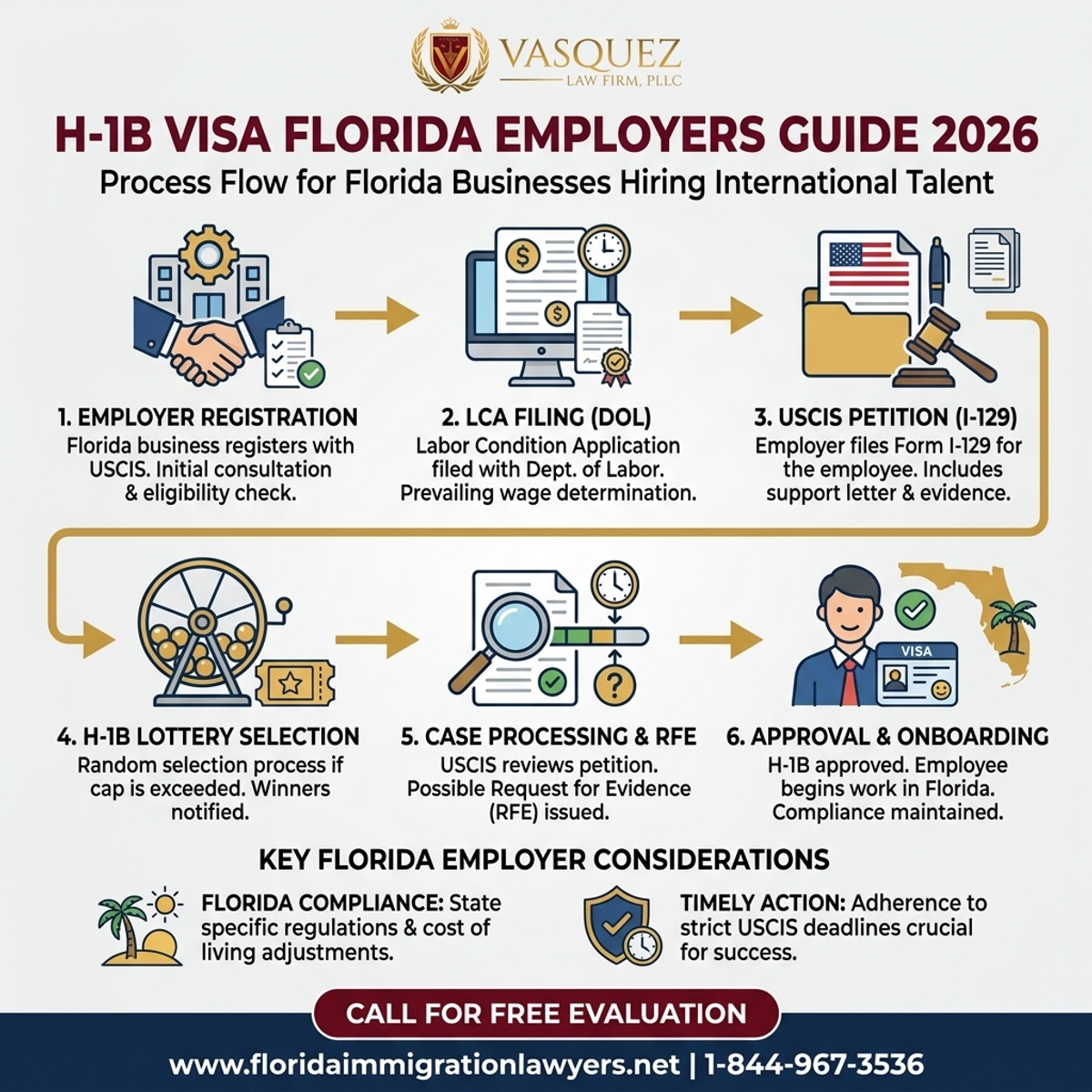
Step-by-Step Process — H-1B Visa Florida Employers Guide 2026
What Documents Do Employers Need to Sponsor an H-1B Visa?
Employers must gather a comprehensive set of documents to sponsor an H-1B visa successfully. Required materials include:
- Job description and duties
- Evidence of the candidate's qualifications
- Company financial statements
- Proof of compliance with wage laws
- Previous immigration documentation, if applicable
Thorough documentation is the backbone of a successful H-1B petition. For the job description and duties, employers should provide a detailed outline of the role, clearly articulating how its responsibilities require a specific bachelor's degree or higher. This includes specific tasks, technologies used, and the level of expertise expected. Generic job descriptions are a common pitfall that can lead to RFEs.
Evidence of the candidate's qualifications includes academic transcripts, diplomas, professional licenses, and letters of experience from previous employers. If the candidate's degree is from a foreign institution, an educational equivalency evaluation by a credential evaluation service is often required. For those relying on work experience in lieu of a degree, detailed letters from past employers describing duties and responsibilities are crucial. Florida Immigration Lawyers can help ensure all educational and professional credentials are properly documented and evaluated.
Company financial statements, such as tax returns, audited financial statements, or annual reports, demonstrate the employer's ability to pay the H-1B worker the required wage and establish the legitimacy of the business. For startups or smaller Florida businesses, additional evidence like bank statements, business plans, and client contracts might be necessary to prove financial stability. Additionally, proof of compliance with wage laws, specifically the prevailing wage determination from the Department of Labor, must be included, along with internal payroll records if applicable, to show how the employer meets or exceeds the required wage for similar positions.
Finally, any previous immigration documentation for the beneficiary, such as prior visa stamps, I-94 records, or previous H-1B approval notices, should be included. This helps USCIS track the individual's immigration history and status. Maintaining an organized and complete file of all these documents is critical throughout the entire H-1B process, from initial filing through potential RFEs, ensuring a smooth and efficient application.
What is the Timeline for H-1B Visa Processing in 2026?
Understanding the timeline for H-1B visa processing can help employers plan effectively. The process includes several stages:
| Stage | Typical Timeframe | Notes |
|---|---|---|
| LCA Approval | 7-10 days | Filed with the Department of Labor |
| USCIS Processing | 2-6 months | Regular or premium processing available |
| Lottery Selection | 1-2 months | For cap-subject petitions |
The LCA Approval stage, typically taking 7-10 business days, involves the Department of Labor reviewing the employer's attestations regarding wages and working conditions. While generally swift, any issues or errors in the LCA can cause delays, highlighting the need for accuracy from the outset. Once certified, the employer receives the approved LCA, which is a prerequisite for the next step.
For cap-subject petitions, the Lottery Selection phase is critical. The electronic registration period usually opens in early March, with results announced by the end of March. Employers then have a limited window (typically 90 days) to file the full I-129 petition for selected beneficiaries. This short timeframe demands that Florida employers have all necessary documentation and information ready well in advance of the lottery results to avoid rushing or missing the filing deadline.
Following lottery selection (if applicable) and petition filing, USCIS Processing can take anywhere from 2 to 6 months under regular processing. Employers have the option of paying an additional fee for Premium Processing, which guarantees a response from USCIS within 15 calendar days. This expedited service is invaluable for Florida businesses with urgent hiring needs, though it does add to the overall cost. It's also during this USCIS processing period that Requests for Evidence (RFEs) are often issued, which can extend the overall timeline if not addressed promptly and thoroughly.
Given the competitive nature of the H-1B lottery and the varying processing times, Florida employers should initiate their H-1B planning at least 6-9 months before the desired start date of employment, especially for fiscal year H-1B visas which typically begin on October 1st. Proactive engagement with an experienced immigration law firm, such as Florida Immigration Lawyers, can help streamline this complex timeline and mitigate potential delays.
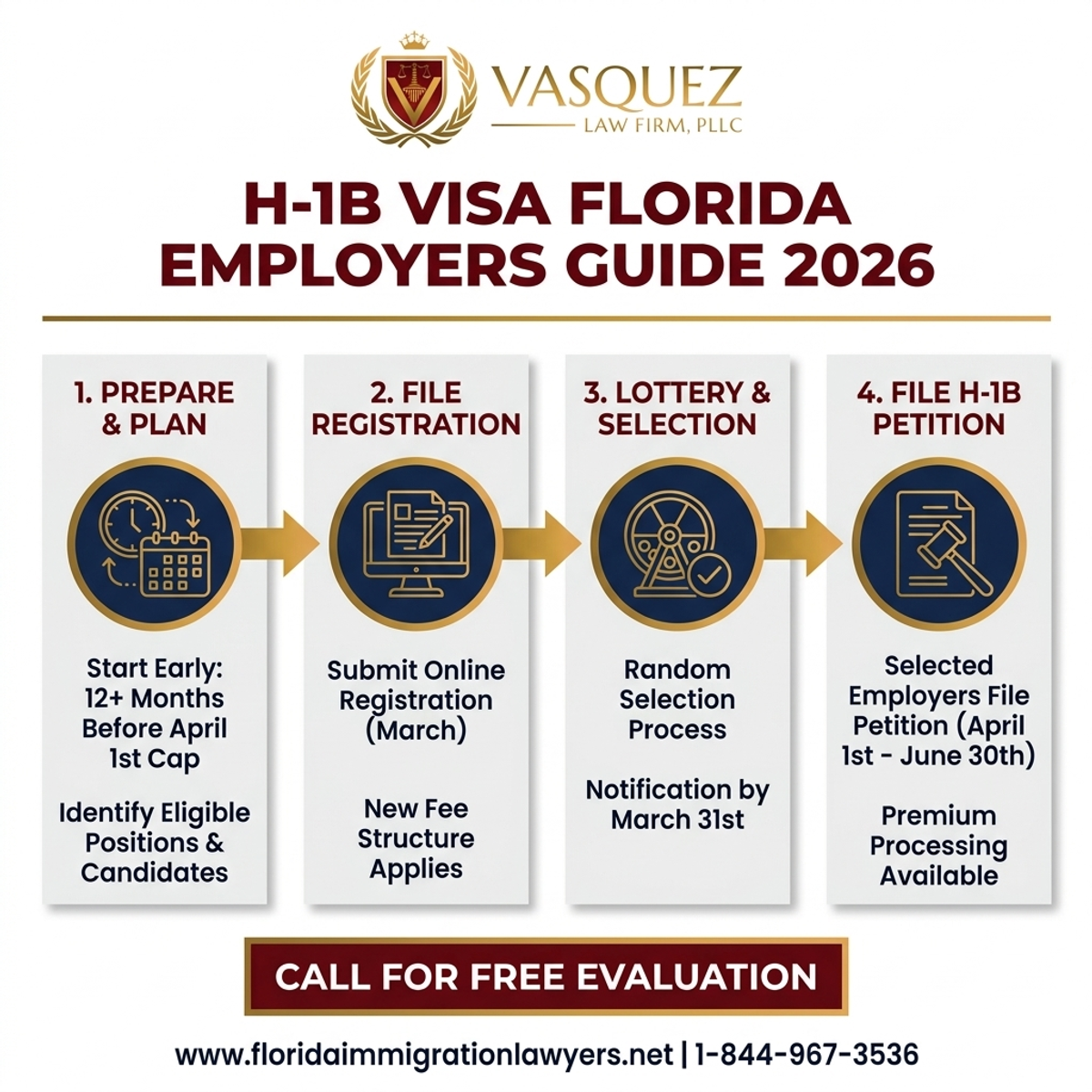
Key Statistics — H-1B Visa Florida Employers Guide 2026
What are the Costs Involved in Sponsoring an H-1B Visa?
Employers should be aware of the costs associated with sponsoring an H-1B visa. These costs vary depending on the size of the company and legal assistance required.
| Item | Typical Fee | Notes |
|---|---|---|
| Filing Fee | $460 | Form I-129 fee |
| Anti-Fraud Fee | $500 | Required for new petitions |
| Premium Processing | $2,500 | Optional for expedited processing |
Do not navigate this process alone. Contact Florida Immigration Lawyers today.
Beyond the listed government fees, employers may also incur additional costs. A significant one is the American Competitiveness and Workforce Improvement Act (ACWIA) fee, which is $750 for employers with 1-25 full-time equivalent employees, and $1,500 for employers with 26 or more full-time equivalent employees. This fee is generally required for initial H-1B petitions and for extensions or changes of employment. There's also a Public Law 111-230 fee of $4,000 for employers with 50 or more employees, where more than 50% of their workforce are on H-1B or L-1 visas, though this applies to a smaller subset of companies.
Legal fees for immigration attorneys are another substantial cost, typically ranging from $2,000 to $5,000 or more, depending on the complexity of the case and the firm's experience. While these fees are not fixed, investing in expert legal guidance from Florida Immigration Lawyers can prevent costly mistakes and delays down the line, ultimately saving money and resources. Other potential expenses include educational credential evaluations (for foreign degrees), translation services for foreign documents, and courier fees.
It's important to note that most of these fees are legally mandated to be paid by the employer, not the H-1B beneficiary. Employers in Florida must budget carefully for these expenses as part of their talent acquisition strategy. Understanding the full financial commitment upfront allows for better planning and ensures compliance with Department of Labor regulations regarding H-1B sponsorship costs.
Common Mistakes to Avoid
- Incomplete Documentation: Missing documents can delay or derail the application.
- Incorrect Job Classification: Misclassifying the job can lead to denial.
- Ignoring Wage Requirements: Failing to meet wage standards leads to compliance issues.
- Missing Deadlines: Late submissions can void the application.
- Not Preparing for an RFE: Be proactive in gathering supporting evidence.
- Failure to Consider Prevailing Wage: Incorrect wage determinations can cause problems.
- Not Consulting a Lawyer: Professional guidance is crucial for complex cases.
- Overlooking Employee Qualifications: Ensure all educational and professional credentials are verified.
Frequently Asked Questions (FAQs) for Florida H-1B Employers
What is a "specialty occupation" in the context of H-1B visas?A specialty occupation requires theoretical and practical application of a body of highly specialized knowledge, and a bachelor's degree or higher in a specific specialty (or its equivalent) as a minimum for entry into the occupation. For Florida employers, this means the job duties must be complex enough to necessitate a specific degree, not just general work experience. USCIS looks for a direct correlation between the degree and the job requirements, often verified by industry standards or previous hiring practices, making meticulous job description drafting essential.Can I sponsor an H-1B visa for someone without a bachelor's degree?While a bachelor's degree is the standard, individuals may qualify if they possess a license required for the occupation, or if they have work experience equivalent to a bachelor's degree. Generally, three years of progressive work experience in the specialty field can be considered equivalent to one year of college education. However, proving this equivalency can be complex and often requires an expert evaluation, making legal guidance from Florida Immigration Lawyers highly advisable to navigate the detailed requirements.What is the H-1B cap, and how does the lottery work?The H-1B cap is the annual limit on the number of H-1B visas issued each fiscal year, currently 65,000 for the regular cap and an additional 20,000 for the master's cap. Due to high demand, USCIS conducts an electronic lottery registration process, typically in March, to select petitions. Employers must register prospective employees during this window, and only those selected in the lottery can proceed with filing the full H-1B petition. This competitive system underscores the need for meticulous preparation and timely action.What is the prevailing wage, and why is it important?The prevailing wage is the average wage paid to similarly employed workers in a specific occupation in the geographic area of intended employment. Employers sponsoring H-1B workers must attest on the Labor Condition Application (LCA) that they will pay the H-1B worker at least the prevailing wage or the actual wage paid to other employees with similar experience and qualifications, whichever is higher. This protects both U.S. and foreign workers from wage depression and is a critical compliance aspect, requiring careful research and adherence by Florida employers.What happens if my H-1B petition receives a Request for Evidence (RFE)?An RFE is issued when USCIS requires additional information or documentation to make a decision on your petition. This is a common occurrence and not necessarily a sign of denial. RFEs often seek clarification on specialty occupation eligibility, beneficiary qualifications, employer-employee relationship, or prevailing wage issues. Responding thoroughly and promptly with compelling evidence is crucial, and legal counsel from Florida Immigration Lawyers can significantly improve the chances of a successful outcome by strategically addressing USCIS concerns.Can an H-1B employee work for multiple employers?Yes, an H-1B employee can work for multiple employers, but each employer must file a separate, independent H-1B petition on behalf of the employee. Each petition must meet all H-1B requirements, including the specialty occupation criteria and prevailing wage obligations. This is known as "concurrent H-1B employment." The employee can begin working for the second employer once the new H-1B petition is filed with USCIS, provided they are already in H-1B status, offering flexibility for both employees and Florida businesses seeking specialized talent.When to Call a Lawyer
Consider consulting an immigration attorney if you encounter complex situations, such as receiving a Request for Evidence, facing denial, or navigating compliance issues. Florida Immigration Lawyers offer comprehensive services to guide you through each step of the H-1B visa process.
Beyond the common challenges, legal assistance becomes invaluable for situations like H-1B transfers (when an H-1B worker wants to change employers), amendments due to significant changes in job duties or location, or when dealing with H-1B dependents. An attorney can also help proactively identify potential issues before filing, ensuring your petition is as strong as possible. Don't wait for a problem to arise; early consultation with Florida Immigration Lawyers can save time, money, and stress, providing peace of mind for your Florida business.
About Florida Immigration Lawyers
Florida Immigration Lawyers is dedicated to assisting clients with immigration matters. Our experienced team offers services in H-1B visa sponsorship, deportation defense, asylum, and more. We serve all of Florida and provide 24/7 support. Call 1-844-YO-PELEO for a free case review. Explore our immigration practice areas.
Our firm understands the unique needs of Florida businesses, from burgeoning tech startups in Tampa to established healthcare providers in Miami. We pride ourselves on offering personalized, strategic advice tailored to your specific H-1B sponsorship goals. With a deep understanding of evolving immigration laws and USCIS policies, we aim to make the complex H-1B process as smooth and efficient as possible for our clients, helping you secure the talent necessary for your company's success and growth within the state.
We are committed to providing exceptional legal representation, ensuring that every detail of your H-1B petition is handled with precision and expertise. Whether you're a first-time sponsor or an experienced employer, Florida Immigration Lawyers is your trusted partner in navigating the intricacies of U.S. immigration law. Our multilingual team is ready to assist you, offering clear communication and steadfast support throughout your immigration journey. Call 1-844-YO-PELEO today for a free, no-obligation case review.
Sources and References
- U.S. Citizenship and Immigration Services (USCIS)
- Executive Office for Immigration Review (EOIR)
- 8 U.S.C. Chapter 12 - Immigration and Nationality Act
Related services: H-1B specialty occupation visas, L-1 intracompany transfer visas, work visas for professionals, investment and entrepreneur visas.
This article provides general legal information and is not intended as legal advice. Every case is unique, and outcomes depend on specific facts and circumstances. Contact an attorney for advice about your particular situation.
Seize new opportunities for your company with international talent. Call 1-844-YO-PELEO for a free consultation. Se Habla Espanol - Estamos aqui para ayudarle.
If you need legal assistance, learn more about our business immigration services, or call us at 1-844-967-3536 for a free case review.
Do Not Navigate This Process Alone
Our experienced immigration attorneys are ready to fight for you. Get a free, confidential case review today.
Se Habla Español
Or leave your details and we’ll call you:
Free Evaluation in 24 Hours
Or talk to us right now

AI voice assistant — available 24/7
FreeFrequently Asked Questions

William J. Vásquez
Founding Attorney · Vasquez Law Firm
U.S. Air Force veteran and immigration attorney with years of hands-on U.S. immigration experience. J.D., NCCU School of Law. AILA member. Admitted to the 4th, 5th, and 11th Circuit Courts.
Available 24/7 - Free Evaluations
Reviewed for legal accuracy by William J. Vásquez
Licensed in North Carolina; U.S. immigration is federal practice.
Related Legal Services
Our Florida immigration attorneys can help you with business immigration, deportation defense and family immigration services. Call today at 1-844-YO-PELEO for a free case review.
Related Links
Related Topics
Free Legal Case Review
Discuss your case with our experienced attorneys. We're available 24/7.
Se Habla Español - Estamos aquí para ayudarle.
Related Articles
Dual Citizenship Lawyer in Florida: What You Need to Know
For Florida residents, the concept of dual citizenship, or holding two passports, offers a compelling blend of opportunities and challenges. While the U.S. generally permits dual nationality, the path to achieving this status requires a meticulous understanding of both U.S. immigration laws and the citizenship policies of your country of origin. This guide explores the definition of dual citizenship, the detailed step-by-step process for U.S. naturalization, and the significant benefits and potential pitfalls involved. We cover essential documentation, typical timelines, and cost considerations for 2026, providing crucial insights for anyone in Orlando, Miami, or across Florida considering this important legal step. Learn about common mistakes to avoid and understand when to seek professional legal counsel to navigate this complex process successfully. Florida Immigration Lawyers is here to provide expert, bilingual support for your dual citizenship journey.
Immigration Lawyer Orlando Free Consultation in Florida
For individuals and families in Orlando, Florida, navigating the complexities of U.S. immigration law requires expert guidance. An immigration lawyer in Orlando offers crucial support for everything from visa applications and green card processes to naturalization and deportation defense. This comprehensive guide details what a free consultation covers, providing a step-by-step overview of immigration pathways, essential document checklists, and expected timelines in 2026. We also highlight common mistakes to avoid, discuss the critical role of legal counsel in deportation and asylum cases, and explain why choosing a local Orlando immigration attorney is beneficial. Florida Immigration Lawyers is dedicated to serving the diverse community of Orlando with compassionate, effective legal solutions, ensuring you receive personalized advice and robust representation for a successful immigration journey.
EAD Advance Parole Combo Card in Florida 2026
For individuals with a pending Form I-485, Application to Register Permanent Residence or Adjust Status, the EAD Advance Parole Combo Card is an essential document. This single card combines the authorization to work legally in the U.S. (Employment Authorization Document - EAD) with permission to travel internationally and re-enter without abandoning your green card application (Advance Parole). This guide from Florida Immigration Lawyers provides a comprehensive overview for applicants in Florida in 2026, covering eligibility, the step-by-step application process, required documents, expected processing times, and associated costs. We also highlight common mistakes to avoid and when to seek legal counsel to ensure a smooth and successful immigration journey. Understanding this vital card is key to maintaining stability while awaiting your permanent residency approval.
TPS Re-Registration 2026 Deadlines in Florida
Stay informed about TPS re-registration deadlines in Florida for 2026. This article covers essential steps, timelines, and common mistakes to avoid. If you need help, Florida Immigration Lawyers is here to assist you with your immigration needs. Call 1-844-YO-PELEO for a free case review.