TPS Re-Registration 2026 Deadlines in Florida
Stay informed about TPS re-registration deadlines in Florida for 2026. This article covers essential steps, timelines, and common mistakes to avoid. If you need help, Florida Immigration Lawyers is here to assist you with your immigration needs. Call 1-844-YO-PELEO for a free case review.

- Check the USCIS website for official deadlines.
- Prepare required documents in advance.
- Consult an immigration lawyer if unsure about eligibility.
Introduction
Living in Central Florida as a TPS holder means staying on top of deadlines to ensure your status and work authorization remain valid. With changes in immigration policies, it's essential to be informed about the latest updates for re-registering TPS, especially for nationals from Honduras. This article will guide you through the process, deadlines, and necessary steps to take for TPS re-registration in 2026. For personalized assistance, call Florida Immigration Lawyers at 1-844-YO-PELEO for a free case review.
For thousands of individuals and families across Florida, Temporary Protected Status (TPS) offers a vital lifeline, providing a temporary haven from unsafe conditions in their home countries. The ability to live and work legally in the U.S. brings stability and peace of mind, allowing individuals to contribute to their communities and support their loved ones. However, this protection is not permanent and relies heavily on diligent adherence to re-registration processes set forth by U.S. Citizenship and Immigration Services (USCIS).
Understanding the specific requirements for TPS re-registration in 2026 is paramount, particularly for the significant Honduran population residing in Florida. The landscape of immigration law is constantly evolving, making it even more critical for TPS beneficiaries to remain vigilant and proactive. This comprehensive guide aims to demystify the re-registration process, highlight potential challenges, and offer practical advice to ensure your continued protection. Remember, professional legal guidance from experienced attorneys like Florida Immigration Lawyers can make all the difference in navigating these complex procedures successfully.
What is the TPS Re-Registration Deadline for 2026?
As of 2026, each country under TPS has specific re-registration periods. For Honduras, the re-registration window typically follows an 18-month cycle, announced by USCIS. Check the USCIS website for the latest information.
TPS re-registration is critical for maintaining your protection from deportation and your ability to work legally in the U.S. Missing the deadline can result in the loss of these protections.
The 18-month cycle for TPS re-registration is designed to allow beneficiaries ample time to submit their applications, but it also necessitates consistent monitoring of official USCIS announcements. These announcements detail the exact start and end dates of the re-registration period, along with any specific instructions or updated forms. It's not uncommon for these dates to shift slightly based on administrative needs or policy changes, which is why relying solely on past cycles can be risky. Always refer to the most current information published directly by USCIS or consult with Florida Immigration Lawyers for clarity.
For instance, if the re-registration period for Honduras opens on January 1, 2026, and closes on March 1, 2026, all applications must be received by USCIS within that window. A common mistake is to assume that the postmark date is sufficient; however, applications must be *received* by the deadline. Failure to re-register within the designated period can lead to severe consequences, including the expiration of your Employment Authorization Document (EAD) and the potential initiation of removal proceedings. This puts your ability to work, drive, and even remain in the U.S. at significant risk, making timely re-registration an absolute necessity.
Why is Re-Registration Important?
Re-registering for TPS ensures that your temporary status remains valid, allowing you to live and work in Orlando and the rest of the U.S. legally. TPS offers protection from deportation and work authorization, but it requires timely re-registration to remain effective.
Failure to re-register could mean losing these benefits and facing potential deportation. As immigration policies evolve, staying informed is your best defense.
Beyond the immediate benefits of protection from deportation and work authorization, maintaining your TPS status offers a crucial layer of stability for you and your family. It allows you to plan for the future, pursue educational opportunities, establish credit, and integrate more fully into your community without the constant fear of removal. For many, TPS is the foundation upon which they build their lives in the U.S., providing a sense of security that is invaluable, especially when conditions in their home country remain unsafe.
Consider a scenario where a TPS holder from Honduras, living in Florida, fails to re-register. Not only would they lose their work permit, jeopardizing their employment and financial stability, but they would also become vulnerable to deportation. This could lead to family separation, loss of assets, and immense emotional distress. The U.S. government maintains records of all TPS beneficiaries, and a lapse in re-registration will not go unnoticed. Proactively engaging with the process and seeking help from Florida Immigration Lawyers ensures that you retain these essential protections and continue to contribute positively to your life in Florida.
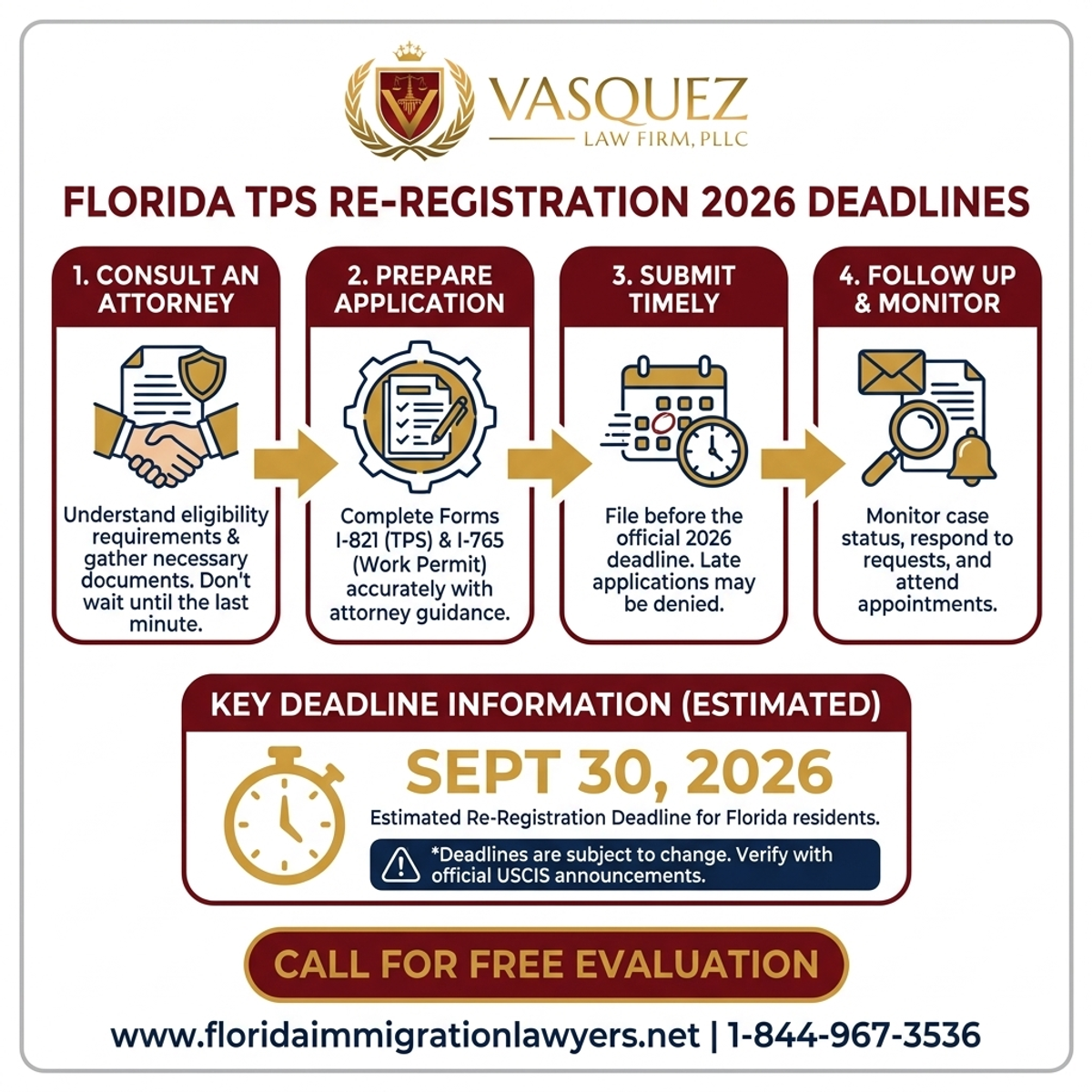
Step-by-Step Process — TPS Re-Registration 2026 Deadlines in Florida
How to Re-register for TPS: Step-by-Step Guide
Re-registering for TPS involves several key steps to ensure compliance with U.S. immigration laws.
- Verify Eligibility: Ensure you still meet the initial TPS eligibility requirements.
- Complete Form I-821: Fill out the Application for Temporary Protected Status.
- Submit Form I-765: If renewing work authorization, complete the Application for Employment Authorization.
- Gather Supporting Documents: Include any documents proving your identity and nationality.
- Pay Required Fees: Check the latest fee information on the USCIS website.
- Mail Your Application: Send your complete application package to the appropriate USCIS address.
Before beginning the re-registration process, it's crucial to confirm that you continue to meet all eligibility criteria. This includes maintaining continuous physical presence in the U.S. since your initial grant of TPS and continuous residence since the designated date for your country. Be aware that certain criminal offenses, prolonged unauthorized travel outside the U.S., or other immigration violations could jeopardize your eligibility. If you have any doubts about your current eligibility, a consultation with Florida Immigration Lawyers is highly recommended to assess your specific situation.
The Form I-821 is the primary application for TPS. It is essential to fill out this form accurately and completely, ensuring all questions are answered truthfully. Any discrepancies or omissions could lead to delays or even denial of your application. Always download the latest version of the form from the USCIS website, as older versions may be rejected. Double-check all personal information, dates, and addresses before submission.
Most TPS beneficiaries also need to renew their work authorization, which is done by filing Form I-765. This form allows you to continue working legally in the U.S. It's vital to file Form I-765 concurrently with Form I-821 to avoid any gaps in your employment authorization. USCIS often issues automatic extensions for EADs for TPS beneficiaries during the re-registration process, but you must still file the I-765 to qualify for these extensions and eventually receive your new card.
A comprehensive collection of supporting documents is critical. This typically includes proof of identity and nationality, such as a passport or birth certificate, along with any previous TPS approval notices or EADs. You may also need to provide evidence of your continuous physical presence and residence in the U.S. since your initial designation. Make sure all copies are clear and legible, and if any documents are not in English, they must be accompanied by certified translations. Organizing these documents meticulously can significantly streamline the processing of your application.
Filing fees are subject to change, so always verify the current amounts on the USCIS website or by consulting an attorney. The fees typically include a filing fee for Form I-821, a biometric services fee, and a fee for Form I-765 (if applicable). If you demonstrate an inability to pay, you may be eligible for a fee waiver, for which you would need to submit Form I-912, Request for Fee Waiver. Incorrect or missing fees are a common reason for application rejection, so ensure your payment is correct and submitted via an acceptable method.
Once all forms are completed, documents gathered, and fees prepared, the final step is to mail your application. USCIS has specific mailing addresses for TPS applications, which vary depending on your country of origin and the service center processing your case. It is crucial to send your package to the correct address. Always use a trackable mailing service, such as certified mail with a return receipt, to ensure proof of delivery. Keeping a complete copy of your entire application package for your records is also a vital best practice.
For detailed guidance and to ensure all forms are correctly filled out and submitted on time, consult with an immigration attorney from Florida Immigration Lawyers. Their expertise can prevent costly errors and provide peace of mind throughout the re-registration process.
Document Checklist for TPS Re-registration
- Completed Form I-821
- Form I-765, if applicable
- Proof of identity and nationality (e.g., passport)
- Two passport-style photographs
- Payment for application fees
Ensuring you have all necessary documents is a cornerstone of a successful re-registration. The completed Form I-821 serves as your official request for continued TPS, while Form I-765 is essential for maintaining your legal ability to work. Your proof of identity and nationality, such as a valid passport, birth certificate, or national identity card, confirms who you are and your country of origin. It's imperative that these documents are current and clearly legible.
The two passport-style photographs must meet specific USCIS requirements regarding size, background, and recency. These photos are used for identification purposes and for your new Employment Authorization Document. Finally, the correct payment for application fees, or an approved fee waiver request, is non-negotiable for your application to be processed. Always make sure to include all required components in your submission to avoid delays or rejection.
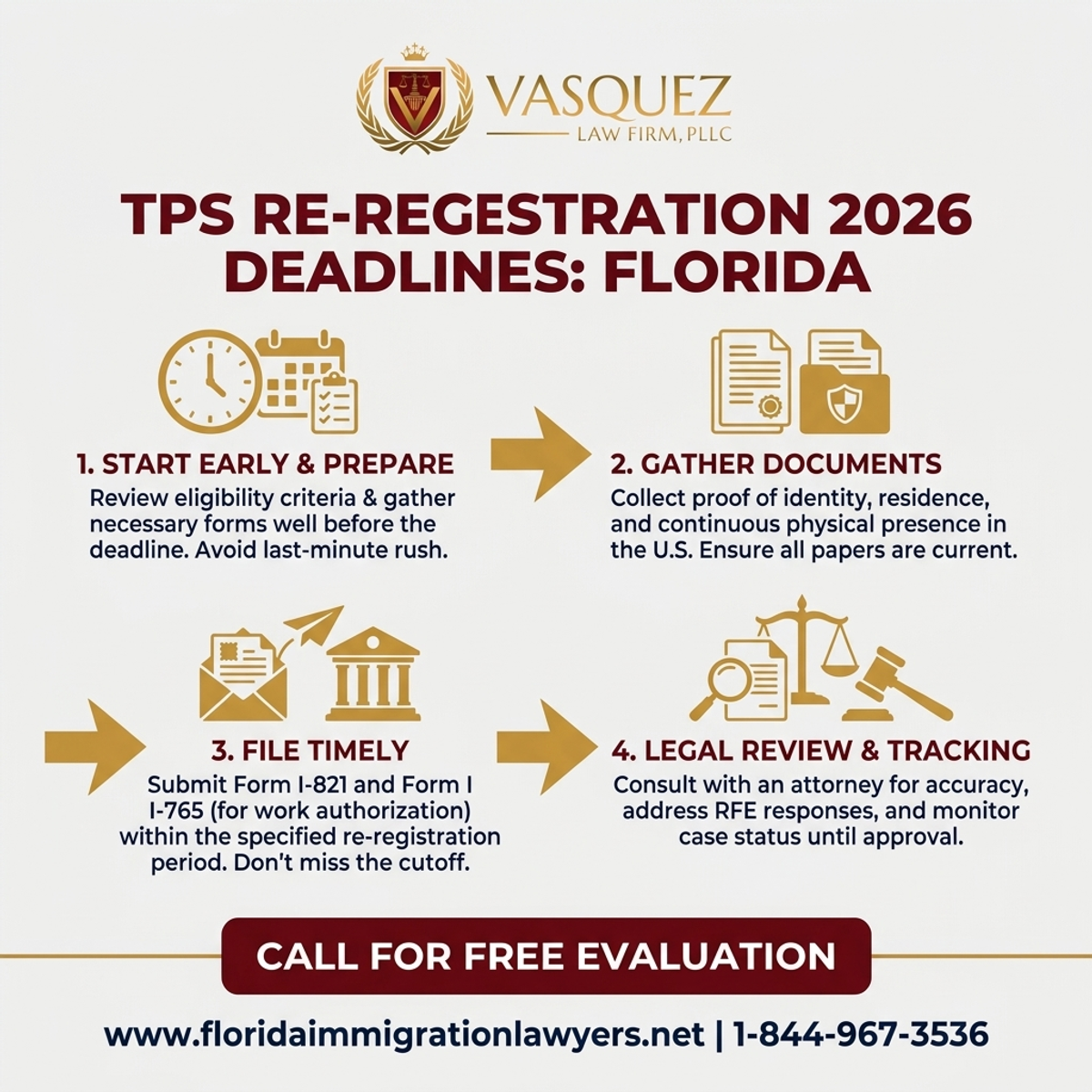
Key Statistics — TPS Re-Registration 2026 Deadlines in Florida
Timeline and Processing Expectations
| Stage | Typical Timeframe | Notes |
|---|---|---|
| Form Submission | 2-4 weeks | Ensure all documents are included |
| Biometrics Appointment | 6-8 weeks | After notice of receipt |
| Processing | 6-12 months | Varies by case complexity |
Understanding the typical timeline for TPS re-registration can help manage expectations, though it's important to remember that processing times can fluctuate based on USCIS workload and individual case complexities. After submitting your application, you should receive a receipt notice within 2-4 weeks, confirming that USCIS has received your package. This notice is crucial for tracking your case status online.
Following the receipt notice, a biometrics appointment notice is usually sent within 6-8 weeks. Attending this appointment at a local Application Support Center (ASC) is mandatory, as it involves capturing your fingerprints, photograph, and signature for background checks. Failure to attend can lead to delays or even denial. The overall processing time for a re-registration application, from submission to final decision, can range from 6 to 12 months or even longer. During this period, USCIS may issue an automatic extension of your Employment Authorization Document (EAD) if your re-registration is timely filed, allowing you to continue working legally while your application is pending. Always check the USCIS website for current processing times and specific EAD extension notices.
Do not navigate this process alone. Contact Florida Immigration Lawyers today.
Common Mistakes to Avoid
- Missing the re-registration deadline, which leads to loss of TPS benefits.
- Incorrectly filling out forms, causing delays.
- Not updating USCIS with a change of address, resulting in missed correspondence.
- Failing to include the correct application fees, leading to rejection.
- Submitting forms without required photographs, causing processing delays.
- Ignoring requests for additional information from USCIS.
- Not consulting a lawyer when unsure about eligibility, risking errors.
This is arguably the most critical error. To avoid missing the deadline, set multiple reminders, subscribe to USCIS email updates, and regularly check the official USCIS website. Procrastination can lead to severe consequences, including the expiration of your work authorization and vulnerability to deportation.
Errors on forms, such as incorrect dates, misspelled names, or unanswered questions, are a frequent cause of Requests for Evidence (RFEs) or outright rejections. Always use the latest version of the forms, read all instructions carefully, and consider having an attorney review your application before submission.
If you move, it is your responsibility to update your address with USCIS within 10 days of moving. Failure to do so can result in missed notices for biometrics appointments, RFEs, or even final decisions, which can severely impact your case. File Form AR-11 online or by mail promptly.
Fees change periodically, so always verify the exact amounts for Form I-821, Form I-765, and the biometrics fee on the USCIS website. If you are applying for a fee waiver, ensure you submit Form I-912 with sufficient supporting documentation. An incorrect payment will cause your application to be rejected and returned.
Two identical, passport-style photographs are typically required for TPS re-registration, especially if you are also renewing your EAD. Ensure they meet all USCIS specifications for size, background, and quality. Missing or non-compliant photos will lead to an RFE and delay your case.
USCIS may send a Request for Evidence (RFE) if they need more information or clarification. It is crucial to respond to RFEs promptly and comprehensively within the specified timeframe. Ignoring an RFE can lead to the denial of your application, so always open and respond to all USCIS mail.
Immigration law is complex, and individual circumstances can vary greatly. If you have any questions about your eligibility, past immigration history, or potential criminal issues, consulting an experienced immigration lawyer is invaluable. Florida Immigration Lawyers can provide expert advice, help you avoid common pitfalls, and ensure your application is as strong as possible.
When to Call a Lawyer
If you are unsure about your eligibility for TPS re-registration or have missed a previous deadline, it's critical to seek legal assistance. Legal complexities can arise, and a qualified immigration attorney can help you navigate these challenges. Florida Immigration Lawyers offer comprehensive support and are available 24/7 to assist you with your case.
There are several specific situations where the expertise of an immigration lawyer becomes indispensable. For instance, if you have any criminal history, even minor offenses, it could impact your TPS eligibility. Similarly, if you have traveled outside the U.S. without proper authorization (advance parole) while on TPS, or if you have had any previous immigration applications denied, your case may require careful legal review. An attorney can help determine if these issues make you ineligible or if there are waivers or remedies available.
Furthermore, if you are struggling to gather the necessary documents, have difficulty understanding the forms, or receive a Request for Evidence (RFE) from USCIS, professional legal guidance can be a game-changer. An attorney can help you compile a robust application, respond effectively to USCIS inquiries, and represent your best interests throughout the process. Don't risk your status by attempting to navigate complex legal waters alone; contact Florida Immigration Lawyers at 1-844-YO-PELEO for a free case review.
About Florida Immigration Lawyers
Florida Immigration Lawyers provide expert legal services to immigrants across Central Florida. Our team specializes in immigration, asylum, deportation defense, and more. We are committed to providing personalized, empathetic legal assistance. Call us at 1-844-YO-PELEO for a free case review. Visit our immigration practice areas for more information.
With years of dedicated experience serving the diverse immigrant communities of Florida, our firm understands the unique challenges and opportunities faced by TPS holders. Our attorneys are deeply knowledgeable about the nuances of TPS regulations, including re-registration cycles, eligibility requirements, and the implications of policy changes. We pride ourselves on offering compassionate and effective legal representation, ensuring that each client receives the individualized attention their case deserves.
At Florida Immigration Lawyers, we believe in empowering our clients with knowledge and providing robust advocacy. Whether you need assistance with TPS re-registration, are exploring pathways to permanent residency, or require defense against deportation, our team is equipped to help. We are conveniently located to serve clients throughout Central Florida and are always ready to answer your questions and provide strategic legal advice. Your future in the U.S. is important, and we are here to fight for it. Contact us today at 1-844-YO-PELEO for a confidential consultation.
Sources and References
- U.S. Citizenship and Immigration Services (USCIS)
- Executive Office for Immigration Review (EOIR)
- 8 U.S.C. Chapter 12 - Immigration and Nationality Act
Frequently Asked Questions About TPS Re-Registration
What is the TPS re-registration deadline for 2026 for Honduran nationals?
The exact re-registration deadline for Honduran nationals in 2026 will be officially announced by USCIS. Typically, it follows an 18-month cycle, but precise dates can vary. It's crucial to regularly check the official USCIS website or subscribe to their email alerts for the most up-to-date information. Missing this specific window can lead to a loss of your TPS benefits and work authorization, so mark your calendar as soon as the dates are published.
Why is timely TPS re-registration so important?
Timely TPS re-registration is vital because it ensures your continued protection from deportation and maintains your legal authorization to work in the U.S. A lapse in re-registration means losing these critical benefits, potentially leading to job loss, financial instability, and even removal proceedings. It provides stability for you and your family, allowing you to live and contribute to your community without constant fear. Stay informed to safeguard your status.
Can I travel outside the U.S. if I have TPS?
Traveling outside the U.S. with TPS is possible, but it requires obtaining an Advance Parole Document (Form I-131) from USCIS *before* you depart. Traveling without this document can lead to denial of re-entry and potential loss of your TPS status. Even with advance parole, re-entry is not guaranteed, and you may be subject to inspection upon return. Always consult Florida Immigration Lawyers before making international travel plans to understand the risks and requirements.
What happens if my Employment Authorization Document (EAD) expires while my re-registration is pending?
If you timely re-register for TPS, USCIS often issues an automatic extension of your expiring Employment Authorization Document (EAD) while your new EAD application is pending. This automatic extension is typically announced in a Federal Register Notice and can last for several months. You can usually present your expired EAD along with the Federal Register Notice to your employer as proof of continued work authorization. Always verify the specific extension dates and requirements on the USCIS website.
What should I do if I miss the TPS re-registration deadline?
If you miss the TPS re-registration deadline, it is crucial to contact an experienced immigration attorney immediately. While missing the deadline can lead to loss of status, there might be limited exceptions for late filing under extraordinary circumstances, though these are rare and require strong evidence. An attorney, like those at Florida Immigration Lawyers, can assess your situation, advise on any potential remedies, and help determine the best course of action to protect your immigration status.
Related services: family immigration services, citizenship and naturalization, asylum protection.
This article provides general legal information and is not intended as legal advice. Every case is unique, and outcomes depend on specific facts and circumstances. Contact an attorney for advice about your particular situation.
For assistance with TPS re-registration and other immigration issues, call Florida Immigration Lawyers at 1-844-YO-PELEO. Se Habla Espanol - Estamos aqui para ayudarle.
If you need legal assistance, learn more about our immigration legal services, or call us at 1-844-967-3536 for a free case review.
Do Not Navigate This Process Alone
Our experienced immigration attorneys are ready to fight for you. Get a free, confidential case review today.
Se Habla Español
Or leave your details and we’ll call you:
Free Evaluation in 24 Hours
Or talk to us right now

AI voice assistant — available 24/7
FreeFrequently Asked Questions

William J. Vásquez
Founding Attorney · Vasquez Law Firm
U.S. Air Force veteran and immigration attorney with years of hands-on U.S. immigration experience. J.D., NCCU School of Law. AILA member. Admitted to the 4th, 5th, and 11th Circuit Courts.
Available 24/7 - Free Evaluations
Reviewed for legal accuracy by William J. Vásquez
Licensed in North Carolina; U.S. immigration is federal practice.
Related Legal Services
Our Florida immigration attorneys can help you with family immigration services, immigration lawyer cost in Florida and experienced immigration attorneys. Call today at 1-844-YO-PELEO for a free case review.
Related Links
Related Topics
Free Legal Case Review
Discuss your case with our experienced attorneys. We're available 24/7.
Se Habla Español - Estamos aquí para ayudarle.
Related Articles
Dual Citizenship Lawyer in Florida: What You Need to Know
For Florida residents, the concept of dual citizenship, or holding two passports, offers a compelling blend of opportunities and challenges. While the U.S. generally permits dual nationality, the path to achieving this status requires a meticulous understanding of both U.S. immigration laws and the citizenship policies of your country of origin. This guide explores the definition of dual citizenship, the detailed step-by-step process for U.S. naturalization, and the significant benefits and potential pitfalls involved. We cover essential documentation, typical timelines, and cost considerations for 2026, providing crucial insights for anyone in Orlando, Miami, or across Florida considering this important legal step. Learn about common mistakes to avoid and understand when to seek professional legal counsel to navigate this complex process successfully. Florida Immigration Lawyers is here to provide expert, bilingual support for your dual citizenship journey.
Immigration Lawyer Orlando Free Consultation in Florida
For individuals and families in Orlando, Florida, navigating the complexities of U.S. immigration law requires expert guidance. An immigration lawyer in Orlando offers crucial support for everything from visa applications and green card processes to naturalization and deportation defense. This comprehensive guide details what a free consultation covers, providing a step-by-step overview of immigration pathways, essential document checklists, and expected timelines in 2026. We also highlight common mistakes to avoid, discuss the critical role of legal counsel in deportation and asylum cases, and explain why choosing a local Orlando immigration attorney is beneficial. Florida Immigration Lawyers is dedicated to serving the diverse community of Orlando with compassionate, effective legal solutions, ensuring you receive personalized advice and robust representation for a successful immigration journey.
EAD Advance Parole Combo Card in Florida 2026
For individuals with a pending Form I-485, Application to Register Permanent Residence or Adjust Status, the EAD Advance Parole Combo Card is an essential document. This single card combines the authorization to work legally in the U.S. (Employment Authorization Document - EAD) with permission to travel internationally and re-enter without abandoning your green card application (Advance Parole). This guide from Florida Immigration Lawyers provides a comprehensive overview for applicants in Florida in 2026, covering eligibility, the step-by-step application process, required documents, expected processing times, and associated costs. We also highlight common mistakes to avoid and when to seek legal counsel to ensure a smooth and successful immigration journey. Understanding this vital card is key to maintaining stability while awaiting your permanent residency approval.
F-1 to H-4 Change of Status Processing in Florida
Explore the F-1 to H-4 change of status process in Florida, including I-539 processing times, steps involved, and common pitfalls. Call Florida Immigration Lawyers for a free case review.