H-2A Visa for Agricultural Workers in Florida 2026
By William J. Vásquez, immigration attorney
Explore the H-2A visa process for agricultural workers in Florida. Learn about eligibility, application steps, and common mistakes to avoid. Florida Immigration Lawyers provide expert guidance to navigate these complexities.
Introduction
Florida's agriculture is a cornerstone of its economy, with its warm climate perfect for producing a variety of crops.
The H-2A visa plays a vital role by providing Florida growers access to temporary foreign workers to meet seasonal demand. Understanding this process is crucial for both employers and workers. Call Florida Immigration Lawyers at 1-844-YO-PELEO for a free case review.
From the lush citrus groves that define its landscape to the vast fields of strawberries, tomatoes, and bell peppers, Florida's agricultural output is immense and indispensable. However, the seasonal nature of these crops often creates significant labor shortages that domestic workers alone cannot fill. The H-2A visa program provides a legal and structured pathway for agricultural businesses to secure the workforce they need, ensuring crops are harvested, processed, and brought to market efficiently.
For many Florida farmers, the H-2A program isn't just a convenience; it's an economic lifeline. Without access to a reliable temporary workforce, many would face substantial losses due to unharvested crops, threatening their livelihoods and the state's agricultural stability. Navigating the intricate regulations of the H-2A visa, however, requires careful attention to detail and a thorough understanding of federal and state requirements. This guide aims to demystify the process for both employers seeking workers and foreign nationals hoping to contribute to Florida's vibrant agricultural sector, highlighting the critical role of expert legal assistance from firms like Florida Immigration Lawyers.
What is the H-2A Visa?
The H-2A visa is a program that allows U.S. agricultural employers to bring foreign nationals to the United States to fill temporary agricultural jobs. As of 2026, this visa remains critical for addressing labor shortages in Florida's vibrant agricultural sector, which includes citrus, strawberries, and tomatoes.
Employers must demonstrate that there are not enough U.S. workers who are able, willing, qualified, and available to do the temporary work, and that employing H-2A workers will not adversely affect the wages and working conditions of similarly employed U.S. workers.
The "temporary" nature of H-2A jobs is a key distinction. These are not permanent positions but rather seasonal or peak-load jobs that last for a defined period, typically less than one year. Examples include planting, cultivating, harvesting, and packing of fruits, vegetables, and other crops. This ensures the program supplements, rather than displaces, the domestic workforce. The Department of Labor (DOL) and U.S. Citizenship and Immigration Services (USCIS) meticulously review applications to verify this temporary need and protect the interests of both U.S. and foreign workers.
Furthermore, the H-2A program places significant responsibilities on employers, including providing adequate housing, transportation, and specific wage rates known as the Adverse Effect Wage Rate (AEWR). These stringent requirements are designed to prevent exploitation and ensure that H-2A workers receive fair treatment, wages, and working conditions comparable to those offered to domestic workers. For Florida growers, understanding and adhering to these obligations is paramount for successful participation in the program and avoiding potential legal complications. For more detailed information, visit the USCIS website.
How to Apply for the H-2A Visa in Florida?
Applying for the H-2A visa involves several steps that both the employer and prospective worker must undertake. As of 2026, the process is outlined as follows:
- Employer Registration: Florida employers must first submit a job order to the local State Workforce Agency (SWA) and file a temporary labor certification application with the Department of Labor.
- Recruitment: The employer must actively recruit U.S. workers before hiring H-2A employees.
- Visa Application: Once certification is obtained, workers apply for the visa at a U.S. consulate.
- Arrival in the U.S.: Workers can then enter the U.S. to begin employment under the terms stipulated in the certification.
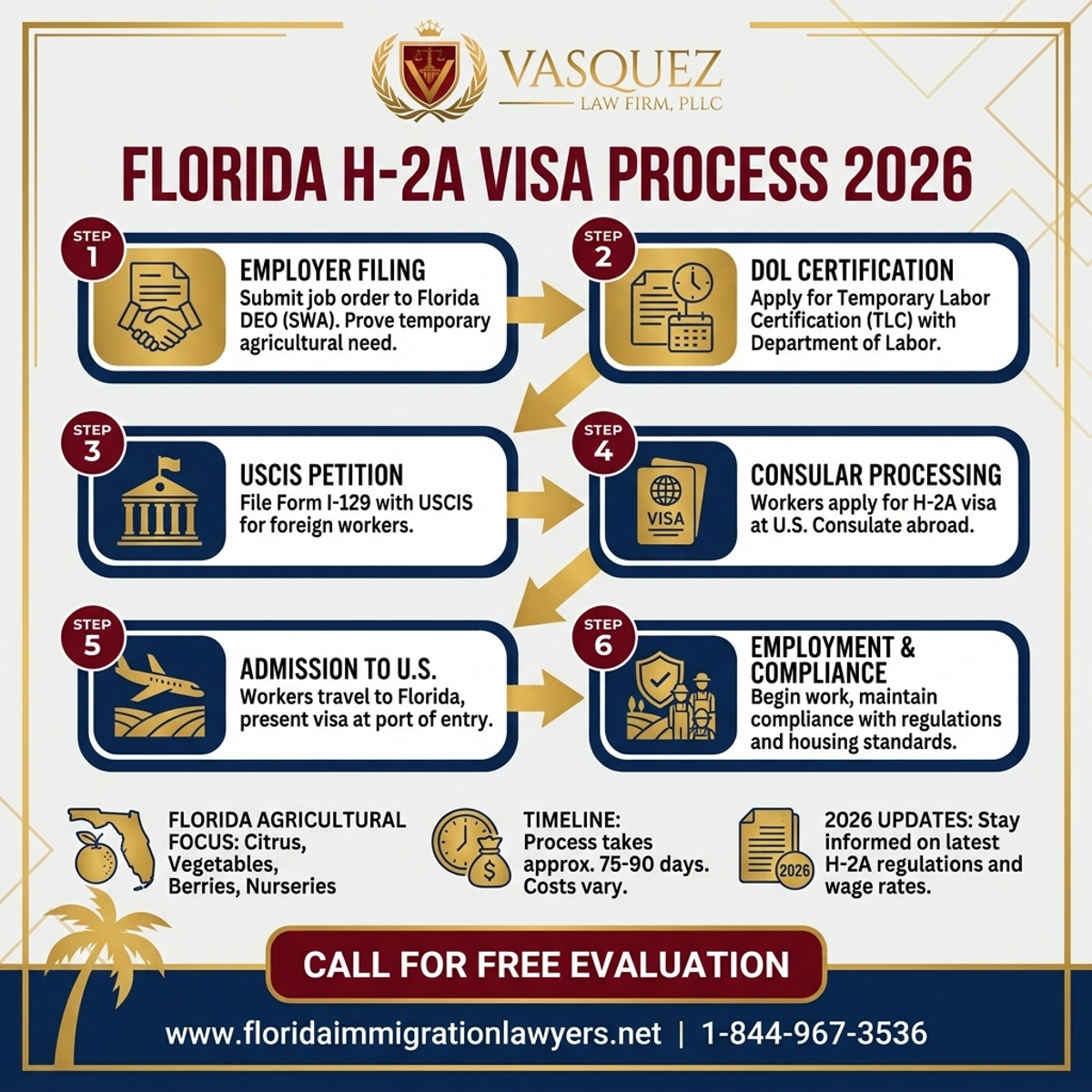
Step-by-Step Process — H-2A Visa for Agricultural Workers in Florida 2026
Employers and workers must adhere to specific timelines and requirements to avoid delays.
Let's delve deeper into each stage. During the Employer Registration phase, the job order submitted to the SWA must precisely detail the job duties, minimum requirements, and conditions of employment, including the wage offer, which must meet or exceed the Adverse Effect Wage Rate (AEWR). Simultaneously, the employer files Form ETA-9142A with the Department of Labor, initiating the temporary labor certification process. This initial step is critical, as any inaccuracies or omissions can lead to significant delays or even denial, underscoring the benefit of legal counsel from Florida Immigration Lawyers.
The Recruitment phase is arguably the most scrutinized part of the application. Employers must prove they made a good faith effort to find U.S. workers. This involves placing advertisements in newspapers, contacting former employees, and working with the SWA to refer qualified U.S. applicants. All recruitment efforts and results must be meticulously documented. For example, if a U.S. worker applies but is not qualified, the employer must keep detailed records explaining why. Failure to adequately document recruitment can be a major stumbling block.
Once the labor certification is approved, the employer can proceed with filing Form I-129, Petition for a Nonimmigrant Worker, with USCIS. After USCIS approval, the prospective Visa Application stage begins for the foreign workers. This typically involves scheduling an interview at a U.S. embassy or consulate in their home country, where they will submit required documents, undergo biometric screening, and answer questions about their intent to work temporarily in the U.S. and return home afterward. Finally, upon Arrival in the U.S., workers must pass through customs and border protection, where their visa and employment terms will be verified before they can commence their agricultural duties.
What Documents Are Needed for the H-2A Visa?
- Valid passport
- Proof of job offer from a U.S. employer
- Labor certification approval
- Form DS-160 confirmation page
- Receipt for payment of visa fees
These documents ensure that the application process proceeds smoothly and efficiently.
Each document plays a vital role in establishing eligibility and intent. A valid passport is fundamental, serving as the primary identification and travel document, and must be valid for at least six months beyond the period of intended stay in the U.S. The proof of job offer is typically the approved Form I-129 petition, which confirms USCIS has authorized the employer to hire H-2A workers. This is directly linked to the labor certification approval from the Department of Labor, which verifies the temporary labor need and that U.S. workers are unavailable.
The Form DS-160 confirmation page is generated after completing the online Nonimmigrant Visa Application, which collects essential personal and background information from the applicant. Finally, the receipt for payment of visa fees confirms that the applicant has paid the necessary consular processing charges. Beyond this core list, applicants should be prepared to provide additional supporting documents, such as proof of ties to their home country (e.g., property deeds, family responsibilities) to demonstrate their intent to return after their temporary employment. Thorough preparation of these documents, often with the guidance of Florida Immigration Lawyers, is essential to avoid delays or rejections during the consular interview.
Timeline and Processing Expectations
| Stage | Typical Timeframe | Notes |
|---|---|---|
| Employer Petition | 60-90 days | Includes labor certification |
| Visa Application | 30 days | Consular processing |
| Worker Entry | 1-2 weeks | Upon visa approval |
Understanding these timelines helps manage expectations and plan accordingly.
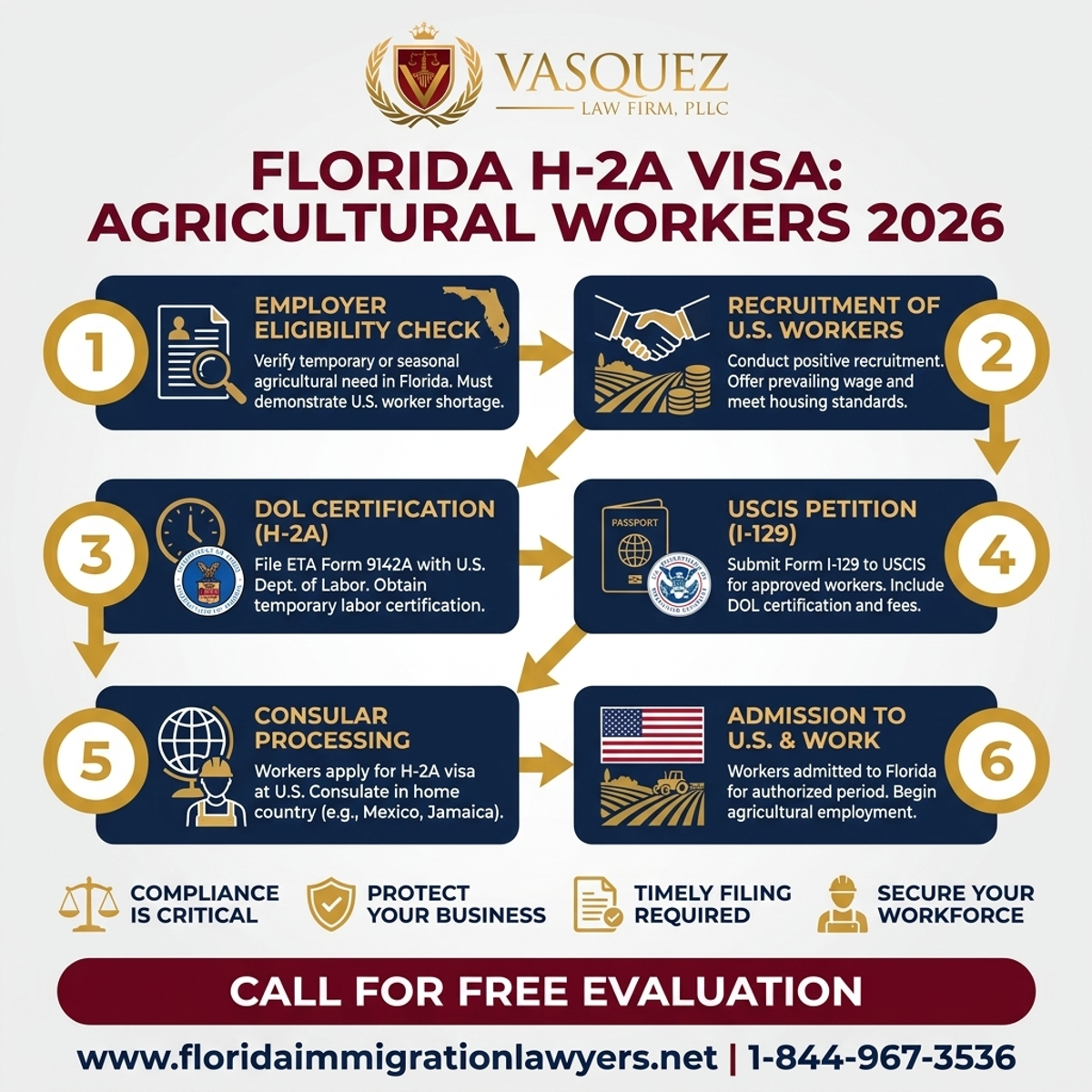
Key Statistics — H-2A Visa for Agricultural Workers in Florida 2026
It's important to note that the "Typical Timeframe" provided in the table represents an average and can fluctuate based on various factors. For instance, the Employer Petition stage, which encompasses both the Department of Labor's temporary labor certification and USCIS's I-129 petition, can be significantly impacted by the time of year. Peak agricultural seasons often see a surge in applications, potentially leading to longer processing times. Employers are strongly advised to initiate this process well in advance of their anticipated start date, ideally 4-5 months prior, to account for any unforeseen delays or requests for additional evidence.
The Visa Application stage, involving consular processing, largely depends on the specific U.S. embassy or consulate where the worker applies. Some consulates may have longer waiting times for interview appointments or require additional administrative processing. Workers should check the consulate's website for current wait times. While the Worker Entry phase is generally quick once the visa is approved, delays can occur at the port of entry if documentation is incomplete or if there are discrepancies. Proactive planning and meticulous preparation, often facilitated by experienced immigration attorneys, are crucial to navigate these timelines successfully and ensure workers arrive when they are needed most.
Cost Factors and Fee Breakdown
| Item | Typical Fee | Notes |
|---|---|---|
| USCIS Form I-129 | Varies | Non-refundable |
| Visa Application Fee | Varies | Paid by worker |
| Travel and Accommodation Costs | Varies | Employer-provided or reimbursed |
Employers should be prepared for these costs as part of the hiring process.
Beyond the direct government filing fees, there are several other financial considerations for employers utilizing the H-2A program. The USCIS Form I-129 filing fee, which the employer pays, can vary based on the number of workers included in the petition and whether premium processing (an expedited service) is requested. Premium processing, while costly, can significantly reduce USCIS processing times from months to mere weeks, a critical factor for time-sensitive agricultural operations. Employers should budget for this, especially if their season is approaching rapidly.
The Visa Application Fee, paid by the worker at the U.S. consulate, covers the cost of processing their nonimmigrant visa. While legally the worker is responsible for this, employers often assist with or reimburse this cost as part of their overall recruitment strategy. Furthermore, employers are typically responsible for travel and accommodation costs. This includes providing or reimbursing transportation for the worker from their home country to the place of employment in the U.S. and back at the end of the contract. Additionally, employers must provide free, safe, and sanitary housing for H-2A workers if they are not able to return to their permanent residence daily. These significant financial commitments underscore the importance of a well-planned and legally compliant H-2A strategy, which Florida Immigration Lawyers can help develop.
Common Mistakes to Avoid
Navigating the H-2A visa process is fraught with potential pitfalls that can lead to significant delays, denials, or even legal penalties. Avoiding common mistakes is paramount for a successful application and compliant employment period. Even minor oversights can have substantial consequences for both employers and workers.
- Not Filing on Time: Delays in submission can lead to missed seasons, as processing times can be lengthy, especially during peak periods. It's crucial to file applications several months before the projected start date.
- Incomplete Applications: Missing documents, unsigned forms, or incorrect information can cause immediate rejections or requests for evidence (RFEs), prolonging the process. Double-checking all submissions is essential.
- Not Meeting Recruitment Requirements: Failure to adequately recruit U.S. workers or properly document those efforts is a primary reason for labor certification denials. Employers must follow DOL guidelines precisely.
- Ignoring State-Specific Requirements: While H-2A is a federal program, Florida may have additional state-specific labor laws or requirements that employers must adhere to. Staying informed is vital.
- Failure to Offer Required Benefits: Employers must provide transportation from housing to worksites, and free, adequate housing if workers cannot return home daily. Failure to do so is a serious compliance violation.
- Misunderstanding Visa Duration: Overstays by workers can lead to penalties for both the worker (future visa bans) and the employer (potential debarment from the program). Clear communication and monitoring are necessary.
Sources and References
- U.S. Citizenship and Immigration Services (USCIS)
- Executive Office for Immigration Review (EOIR)
- U.S. Department of State
- Immigration and Nationality Act (INA), 8 U.S.C. Chapter 12
Do Not Navigate This Process Alone
Our experienced immigration attorneys are ready to fight for you. Get a free, confidential case review today.
Se Habla Español
Or leave your details and we’ll call you:
We will call you back within 24 hours
Free evaluation · Private and confidential · Se habla español
Helping Florida immigrant families since 2011
Or talk to us right now

AI voice assistant — available 24/7
FreeFrequently Asked Questions

William J. Vásquez
Founding Attorney · Vasquez Law Firm
U.S. Air Force veteran and immigration attorney with years of hands-on U.S. immigration experience. J.D., NCCU School of Law. AILA member. Admitted to the 4th, 5th, and 11th Circuit Courts.
Available 24/7 - Free Evaluations
Reviewed for legal accuracy by William J. Vásquez
Licensed in North Carolina; U.S. immigration is federal practice.
Related Legal Services
Our Florida immigration attorneys can help you with family immigration services, immigration lawyer cost in Florida and experienced immigration attorneys. Call today at 1-844-YO-PELEO for a free case review.
Related Links
Related Topics
Free Legal Case Review
Discuss your case with our experienced attorneys. We're available 24/7.
Se Habla Español - Estamos aquí para ayudarle.
Related Articles
EAD Advance Parole Combo Card in Florida 2026
For individuals with a pending Form I-485, Application to Register Permanent Residence or Adjust Status, the EAD Advance Parole Combo Card is an essential document. This single card combines the authorization to work legally in the U.S. (Employment Authorization Document - EAD) with permission to travel internationally and re-enter without abandoning your green card application (Advance Parole). This guide from Florida Immigration Lawyers provides a comprehensive overview for applicants in Florida in 2026, covering eligibility, the step-by-step application process, required documents, expected processing times, and associated costs. We also highlight common mistakes to avoid and when to seek legal counsel to ensure a smooth and successful immigration journey. Understanding this vital card is key to maintaining stability while awaiting your permanent residency approval.
What to Expect at Your First Immigration Consultation in Orlando
What happens at a first immigration consultation in Orlando, which documents to bring, and how to prepare for questions about visas, green cards, citizenship and court cases.
Certificate of Eligibility for Expungement in Florida: 2026
Discover how obtaining a certificate of eligibility for expungement in Florida can impact your immigration status. Learn the step-by-step process, understand the timeline, and avoid common mistakes. Contact Florida Immigration Lawyers for assistance.
TPS Honduras: Latest News & Green Card Pathways 2026
For Honduran nationals with Temporary Protected Status (TPS) in Florida, understanding the latest news for 2026 and the pathways to a Green Card is crucial. While TPS offers temporary protection, it does not directly lead to permanent residency. This comprehensive guide from Florida Immigration Lawyers explores the eligibility requirements for adjusting status, emphasizing the critical role of lawful entry and an underlying immigrant visa petition. We detail the step-by-step application process, essential documents, typical timelines, and associated costs. Special attention is given to Florida-specific considerations, including local USCIS offices and unique challenges. Learn about common mistakes to avoid and when it's imperative to seek legal counsel to secure your future in the United States.