Removal Conditional Green Card: I-751 Process in Florida
By William J. Vásquez, immigration attorney
For individuals in Florida holding a conditional green card, the process of removing conditions is a critical step towards permanent residency. This guide details the Form I-751 application, required documents, processing timelines, and associated costs as of 2026. Learn about joint filing requirements, available waivers for divorce or abuse, and common mistakes to avoid. Florida Immigration Lawyers provides expert guidance for this complex process, helping you navigate USCIS requirements and overcome potential challenges. Understand when to seek legal counsel to protect your immigration status and ensure a successful transition to unconditional permanent residency in Florida.
Removal Conditional Green Card: I-751 Process in Florida 2026
Navigating the U.S. immigration system can be a complex journey, especially when it involves transitioning from a conditional green card to permanent residency. For many individuals in Florida who obtained their green card through marriage, the conditional status is a temporary step towards full, unconditional permanent residency. This crucial next step involves filing Form I-751, Petition to Remove Conditions on Residence, with U.S. Citizenship and Immigration Services (USCIS).
As of 2026, understanding the requirements, timelines, and potential pitfalls of this process is more important than ever. The landscape of immigration law is constantly evolving, making accurate and timely filing essential. Whether you reside in Orlando or elsewhere in Central Florida, ensuring your application is complete and compelling can significantly impact your future in the United States. This guide will provide a comprehensive overview of the I-751 process, helping you understand what to expect and how to prepare.
At Florida Immigration Lawyers, we understand the anxieties and uncertainties that come with immigration procedures. Our dedicated team is committed to providing expert legal assistance to individuals and families throughout Florida. Do not risk your future by attempting to navigate this intricate process alone. Call Florida Immigration Lawyers at 1-844-YO-PELEO for a free case review and let us help you secure your permanent residency.
What is a Conditional Green Card and Why Remove Conditions?
A conditional green card, also known as a conditional permanent resident card, is issued to individuals who obtained their permanent resident status through marriage to a U.S. citizen or lawful permanent resident, and the marriage was less than two years old at the time permanent residency was granted. This conditional status is a probationary period, typically lasting two years, designed to ensure that the marriage was entered into legitimately and not solely for immigration benefits. The purpose of this two-year period is to allow USCIS to verify the authenticity of the marriage.
The Immigration and Nationality Act (INA) Section 216(a) (8 U.S.C. § 1186a(a)) mandates this conditional status. To transition from conditional to unconditional permanent residency, you must file Form I-751, Petition to Remove Conditions on Residence. Failure to remove these conditions will result in the expiration of your conditional green card, loss of your lawful permanent resident status, and could lead to deportation proceedings. In Florida, many residents face this critical juncture, and understanding the legal basis for the conditional period is the first step toward successful removal of conditions.
The removal of conditions signifies that USCIS is satisfied that your marriage is bona fide and ongoing, or that you qualify for a waiver. Once conditions are removed, you will receive a 10-year green card, providing greater stability and fewer renewal concerns. This process is a fundamental aspect of family-based immigration, directly impacting thousands of individuals across Florida each year.
How Do I Remove Conditions from My Green Card in Florida?
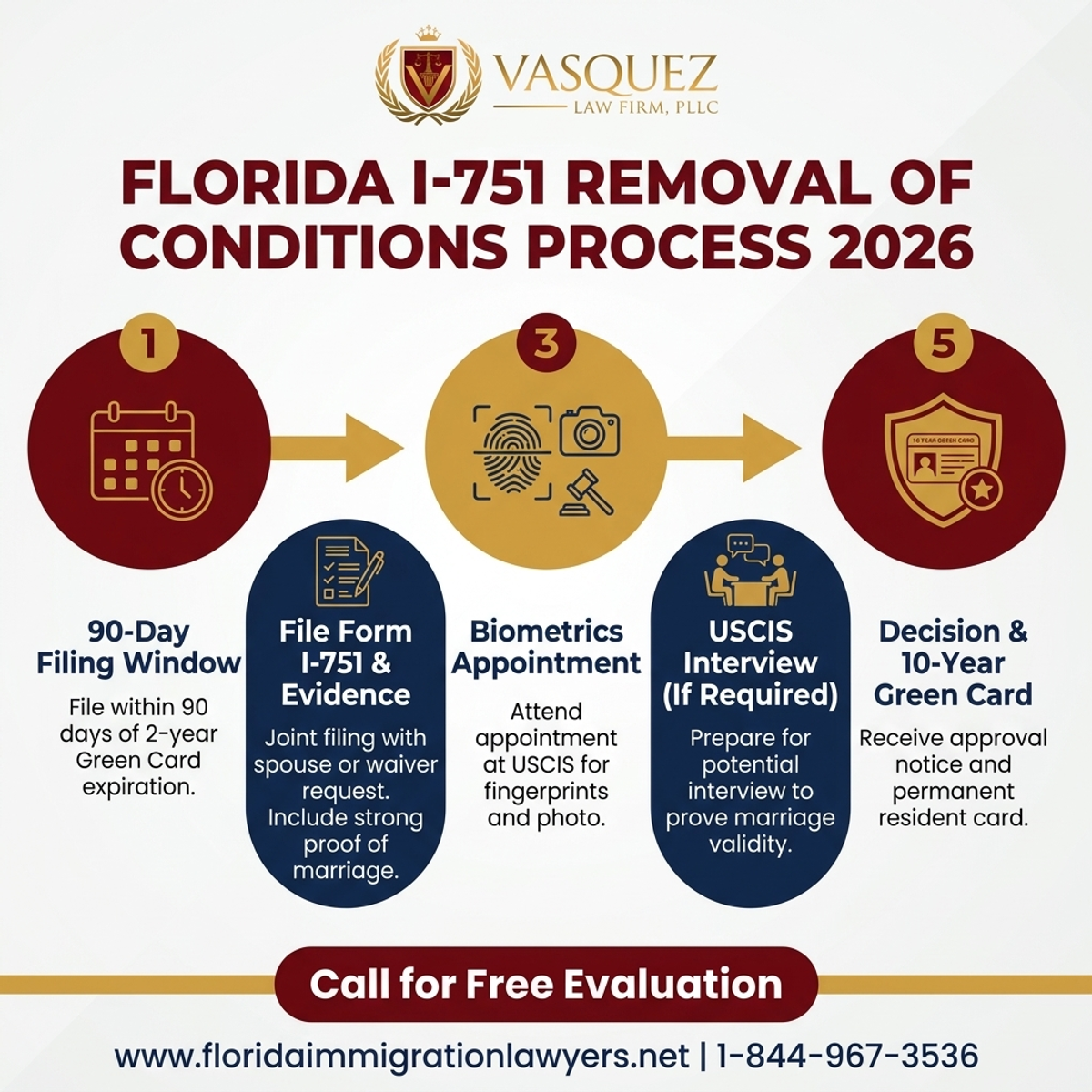
To remove conditions from your green card in Florida, you must file Form I-751, Petition to Remove Conditions on Residence, with USCIS. This petition is typically filed jointly by both spouses within the 90-day window before your conditional green card expires. It requires substantial evidence demonstrating that your marriage was, and continues to be, legitimate. The process involves several key steps, from gathering extensive documentation to attending a potential interview at a USCIS field office, such as the one in Orlando.
The goal is to prove to USCIS that your marriage was not entered into simply to obtain a green card. This requires a comprehensive submission of evidence that illustrates the commingling of your lives and shared marital journey. Careful attention to detail and adherence to all filing instructions are paramount for a successful outcome. Here is a step-by-step guide to removing the conditions:
Step-by-Step Process — Removal Conditional Green Card: I-751 Process in Florida 2026
- Gather Required Documents: Collect all necessary forms and supporting evidence, including proof of a bona fide marriage, financial commingling, and shared life. This is the most extensive part of the application.
- Complete Form I-751: Fill out Form I-751 accurately and completely. Ensure all sections are addressed and signed by both spouses, unless you are filing for a waiver.
- Prepare Supporting Evidence: Compile strong evidence of your bona fide marriage. This includes joint bank accounts, property deeds, birth certificates of children, utility bills, insurance policies, and affidavits from friends and family.
- Pay Filing Fees: Submit the correct filing fee and biometrics fee as required by USCIS. As of 2026, these fees are subject to change, so always check the official USCIS website for current amounts.
- Mail Your Application: Send your completed Form I-751 package to the appropriate USCIS Lockbox facility. It is advisable to use a mailing service that provides tracking and delivery confirmation.
- Receive Receipt Notice (Form I-797C): USCIS will send you a Form I-797C, Notice of Action, acknowledging receipt of your petition. This notice also extends your conditional permanent resident status for a specified period, typically 24-48 months, allowing you to continue working and traveling while your petition is processed.
- Attend Biometrics Appointment: You will receive a notice to attend a biometrics appointment at a local Application Support Center (ASC), such as the one in Orlando. During this appointment, your fingerprints, photograph, and signature will be collected for background checks.
- Respond to Requests for Evidence (RFE): If USCIS determines that your initial submission lacks sufficient evidence, they may issue an RFE. It is crucial to respond promptly and thoroughly to avoid delays or denials.
- Attend Interview (If Required): While many I-751 petitions are approved without an interview, USCIS may schedule one at a local field office, like the one in Orlando. Both spouses must attend and be prepared to answer questions about their marriage.
- Receive Decision: USCIS will mail you a decision notice. If approved, you will receive a new 10-year green card. If denied, you may be placed in removal proceedings, making legal counsel absolutely essential.
What Documents Do I Need for I-751 in 2026?
Filing Form I-751 requires a robust collection of documents to prove the legitimacy of your marriage. USCIS scrutinizes these submissions closely, especially for applicants in Florida, to prevent marriage fraud. As of 2026, the emphasis remains on providing comprehensive evidence that demonstrates a shared life and genuine marital relationship. The more compelling and varied your evidence, the stronger your case will be. It is not enough to simply provide one or two types of documents; USCIS looks for a consistent pattern of commingled lives.
The document checklist below outlines the types of evidence typically requested. Remember that every case is unique, and you should tailor your submission to reflect your specific circumstances. Originals should generally not be sent unless specifically requested; certified copies are usually sufficient. Keep a complete copy of everything you send to USCIS for your records.
- Proof of Joint Ownership: Deeds, leases, or mortgages showing joint ownership of property (e.g., home in Orlando).
- Financial Commingling: Joint bank account statements, credit card statements, tax returns filed jointly, joint investment accounts.
- Insurance Policies: Life insurance, health insurance, or auto insurance policies listing each other as beneficiaries or covered individuals.
- Birth Certificates of Children: Birth certificates of any children born to the marriage, showing both spouses as parents.
- Utility Bills: Joint utility bills (electricity, water, gas, internet) addressed to both spouses at the same residence.
- Affidavits from Third Parties: Sworn statements from friends, family members, or employers confirming the authenticity of your marriage and knowledge of your relationship. These should include their full name, address, date and place of birth, and relationship to you, along with how they know about your marriage.
- Photographs: A selection of photographs documenting your relationship from its inception through the present, including wedding photos, family gatherings, vacations, and daily life. Date and briefly describe each photo.
- Travel Records: Joint travel itineraries, airline tickets, hotel reservations for trips taken together.
- Other Correspondence: Joint mail, holiday cards, or other correspondence addressed to both spouses.
- Original Conditional Green Card: A copy of the front and back of your conditional permanent resident card.
- Marriage Certificate: A copy of your official marriage certificate.
- Proof of Name Change (if applicable): Any legal documents showing a name change after marriage.
How Long Does I-751 Processing Take in Florida?
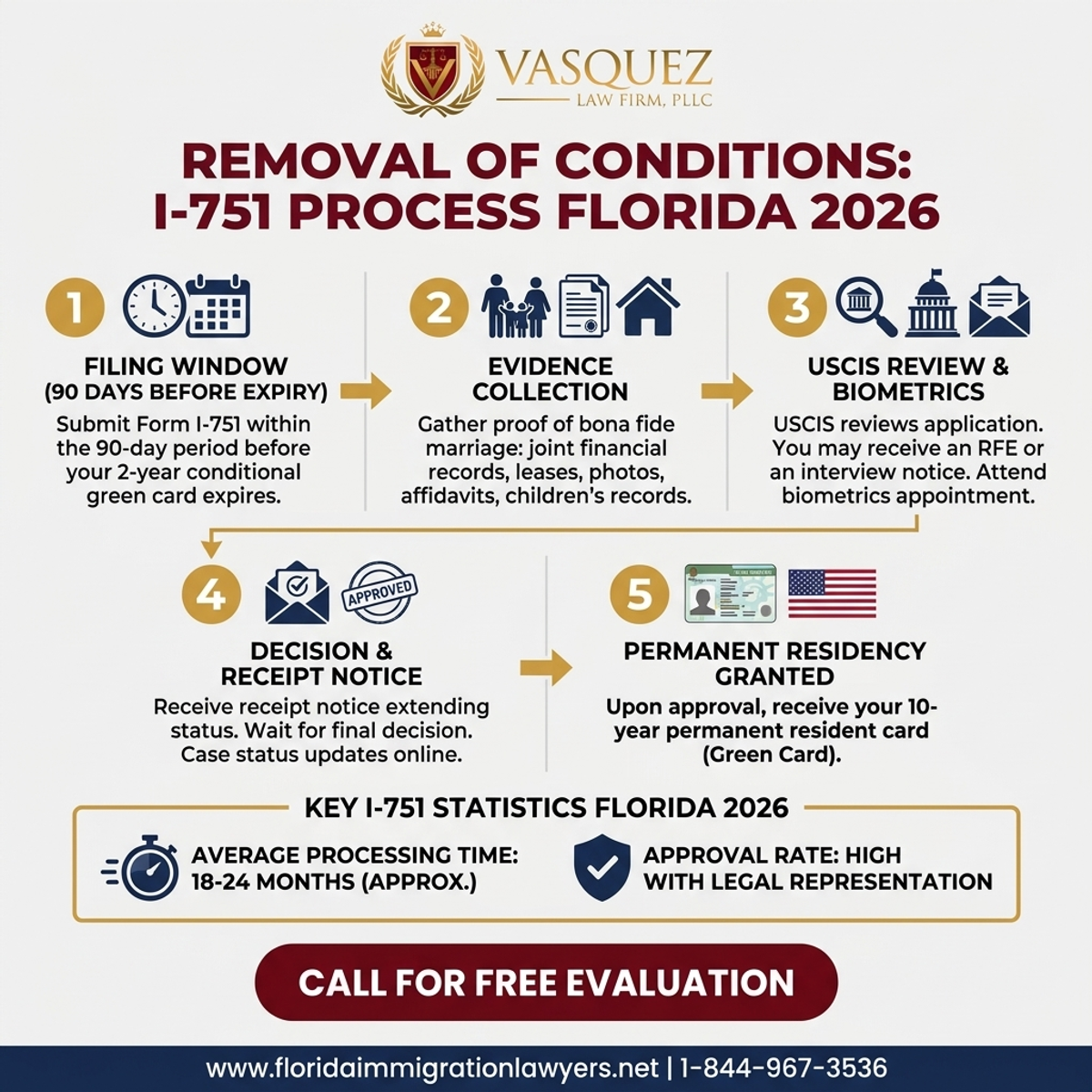
The processing time for Form I-751, Petition to Remove Conditions on Residence, can vary significantly depending on the USCIS service center handling your case, the complexity of your application, and current caseloads. As of 2026, applicants in Florida should anticipate processing times that can range from several months to over two years. It is crucial to understand that during this period, your conditional permanent resident status is typically extended by USCIS through a receipt notice (Form I-797C), allowing you to maintain employment and travel privileges.
USCIS provides estimated processing times on its website, which are updated regularly. However, these are merely estimates, and individual experiences may differ. Factors such as the completeness of your initial submission, whether you receive a Request for Evidence (RFE), or if an interview is required, can all impact the overall timeline. While waiting for a decision, it is important to keep your contact information updated with USCIS and respond promptly to any requests. The table below provides a general overview of the typical stages and timeframes involved:
| Stage | Typical Timeframe (As of 2026) | Notes |
|---|---|---|
| Filing to Receipt Notice (I-797C) | 2-4 weeks | Extends conditional status, allows continued work/travel. |
| Receipt Notice to Biometrics Appointment | 4-8 weeks | Appointment at a local Application Support Center (ASC), e.g., Orlando. |
| Biometrics to RFE/Interview Notice (if applicable) | 6-18 months | Many cases are approved without interview; RFE adds delay. |
| Interview to Decision | 1-6 months | If an interview is required, decision usually follows within months. |
| Overall Processing Time | 12-30+ months | Varies greatly by service center and case complexity. |
Key Statistics — Removal Conditional Green Card: I-751 Process in Florida 2026
It is important not to panic if your conditional green card expires while your I-751 is pending. The I-797C receipt notice serves as temporary proof of your status. However, if you need to travel internationally, ensure you carry this notice along with your expired conditional green card. Always consult with an immigration attorney if you have concerns about travel or delays.
What are the Costs for Removing Conditions on a Green Card?
The costs associated with removing conditions on a green card primarily involve USCIS filing fees and biometrics fees. As of 2026, these fees are subject to change, and it is imperative to verify the most current amounts directly on the official USCIS website before submitting your application. These fees are non-refundable, regardless of the outcome of your petition. Beyond the government fees, applicants in Florida may also incur additional costs, such as legal fees for attorney representation, document translation services, and postage.
While the government fees are standardized across the U.S., the overall financial burden can vary. For instance, if your case involves complex issues, such as a divorce or a history of prior immigration violations, the need for extensive legal assistance becomes critical, adding to the overall expense. Investing in legal counsel, however, can often prevent costly mistakes and potential denials, which can lead to even greater financial and personal burdens in the long run. The table below outlines the typical fees you might encounter:
| Item | Typical Fee (As of 2026, subject to change) | Notes |
|---|---|---|
| USCIS Form I-751 Filing Fee | Check USCIS website for current fee | Mandatory fee for processing the petition. |
| Biometrics Services Fee | Check USCIS website for current fee | Mandatory fee for fingerprinting and background checks. |
| Attorney Fees | Varies widely ($2,000 - $5,000+) | Depends on case complexity, firm, and services rendered. Highly recommended for waivers. |
| Document Translation Services | Varies (per page/document) | Required if documents are not in English. Must be certified. |
| Postage/Courier Services | $20 - $100+ | For secure mailing with tracking. |
It is important to budget for all potential costs to ensure a smooth application process. Fee waivers are generally not available for Form I-751, making financial planning essential. Always consult with an immigration attorney in Florida to get a clear understanding of all potential costs associated with your specific case.
Do not navigate this process alone. Contact Florida Immigration Lawyers today for a free case review and expert guidance tailored to your situation.
What if My Marriage Ends Before I Remove Conditions?
The requirement to file Form I-751 jointly with your spouse can become complicated if your marriage ends due to divorce, annulment, or death before the conditions on your green card are removed. Fortunately, USCIS provides waivers for the joint filing requirement under specific circumstances. If you find yourself in this situation in Florida, it is critical to understand your options and seek legal advice immediately, as failing to file for a waiver can jeopardize your immigration status.
Under 8 CFR § 216.4, you may be eligible to file Form I-751 with a waiver if:
- Death of Petitioning Spouse: Your U.S. citizen or lawful permanent resident spouse has died. You must submit a copy of the death certificate.
- Divorce or Annulment: You entered the marriage in good faith, but the marriage was terminated through divorce or annulment. You must provide evidence that the marriage was bona fide at its inception and was dissolved for reasons other than immigration fraud. This is a common situation for individuals in Florida, and requires strong documentation.
- Battered Spouse or Child: You or your child were subjected to extreme cruelty or battery by your U.S. citizen or lawful permanent resident spouse. This waiver is designed to protect victims of domestic violence and requires substantial evidence of abuse.
- Extreme Hardship: The termination of your status and removal from the United States would result in extreme hardship. This is a high legal standard and typically involves demonstrating severe medical, financial, or personal hardship that would occur if you were forced to leave the country.
When filing for a waiver, you generally do not need to wait for the 90-day window before your green card expires; you can file as soon as you meet the eligibility criteria. However, the burden of proof is significant, especially for divorce or extreme hardship waivers. You must provide compelling evidence to support your claims, such as divorce decrees, police reports, medical records, counseling reports, or detailed affidavits. An immigration attorney can help you gather and present the strongest possible case for a waiver, significantly increasing your chances of success in Florida.
Common Mistakes to Avoid When Removing Conditional Green Card Status
The process of removing conditions on your green card is fraught with potential pitfalls that can lead to significant delays or even denial. For individuals in Florida, understanding and avoiding these common mistakes is crucial for a successful outcome. Even a minor error can trigger a Request for Evidence (RFE) or, worse, a notice to appear in immigration court. Here are some critical mistakes to avoid:
- Filing Late: Failing to file Form I-751 within the 90-day window before your conditional green card expires. This is one of the most common and easily avoidable errors, leading to potential loss of status.
- Insufficient Evidence of Bona Fide Marriage: Not providing enough compelling evidence to prove that your marriage was legitimate from the outset and continues to be. USCIS looks for a consistent pattern of shared life.
- Incomplete Forms: Submitting an I-751 form that is missing required information, signatures, or sections. Every question must be answered fully and accurately.
- Incorrect Filing Fees: Sending the wrong amount for filing and biometrics fees. Always check the USCIS website for the most current fees before mailing your application.
- Failure to Respond to RFEs: Ignoring or inadequately responding to Requests for Evidence from USCIS. RFEs are serious and require prompt, thorough responses.
- Not Attending Biometrics Appointment: Missing your scheduled biometrics appointment without prior rescheduling. This can lead to your application being considered abandoned.
- Lack of Certified Translations: Submitting documents in a foreign language without certified English translations. All non-English documents must be accompanied by a full English translation and a certification from the translator.
- Discrepancies in Information: Providing inconsistent information across different immigration forms or during an interview. This can raise red flags for potential fraud.
- Filing a Joint Petition After Divorce: Attempting to file jointly if your marriage has ended in divorce or annulment. In such cases, a waiver is required, not a joint petition.
- Not Updating Address with USCIS: Failing to inform USCIS of any change of address. This can result in missed notices and significant delays.
- Assuming No Interview is Needed: While many cases are approved without an interview, assuming yours will be can lead to inadequate preparation if one is scheduled. Always be ready for an interview.
When to Call Florida Immigration Lawyers for I-751 Assistance
While some individuals may attempt to file Form I-751 on their own, the complexities and high stakes involved often make legal representation indispensable. This is particularly true in Florida, where the volume of immigration cases and the nuances of federal law require expert guidance. You should strongly consider contacting Florida Immigration Lawyers if you encounter any of the following scenarios:
- Complex Marital History: If you have a history of prior marriages, or if your current marriage has faced challenges.
- Divorce or Annulment: If your marriage ended before you could file your I-751, requiring a waiver.
- Abuse or Extreme Cruelty: If you are seeking a waiver based on battery or extreme cruelty by your spouse.
- Insufficient Documentation: If you struggle to gather compelling evidence of a bona fide marriage.
- Criminal History: If you or your spouse have any criminal record, which can complicate immigration matters.
- Late Filing: If you missed the 90-day filing window and need to explain the delay.
- Receipt of RFE or Notice of Intent to Deny: These are serious notices that require a precise and legally sound response.
- Scheduled for an Interview: Preparing for a USCIS interview is crucial, and legal counsel can help you practice and understand potential questions.
- Facing Deportation Proceedings: If your I-751 is denied and you are placed in removal proceedings, immediate legal intervention from an experienced deportation defense attorney is vital.
Our attorneys at Florida Immigration Lawyers are well-versed in the intricacies of conditional green card removal and family immigration law. We can help you prepare a thorough application, identify potential issues, and represent you throughout the process, including during interviews or in immigration court. Do not leave your future to chance.
About Florida Immigration Lawyers
Florida Immigration Lawyers is a leading law firm dedicated to providing comprehensive immigration services to individuals and families across the entire state of Florida. With an office strategically located in Central Florida, particularly serving Orlando and its surrounding communities, we are committed to offering accessible and effective legal representation. Our team of experienced attorneys understands the profound impact immigration matters have on people's lives and approaches every case with empathy, professionalism, and unwavering dedication.
We specialize in a wide range of immigration practice areas, including conditional green card removal, family-based petitions, asylum claims, naturalization and citizenship, and deportation defense. Our firm prides itself on its bilingual capabilities (English and Spanish), ensuring that clients can communicate comfortably and clearly about their legal needs. We offer free case reviews, are available 24/7, and work tirelessly to achieve the best possible outcomes for our clients. Choose Florida Immigration Lawyers for trusted legal support on your immigration journey. Visit our attorneys page to learn more about our team, or schedule a free consultation today.
Sources and References
- U.S. Citizenship and Immigration Services (USCIS)
- Executive Office for Immigration Review (EOIR)
- 8 U.S.C. Chapter 12 - Immigration and Nationality Act (INA) Section 216 (8 U.S.C. § 1186a)
- 8 CFR Part 216 - Conditional Basis of Lawful Permanent Residence Status
- U.S. Department of State
Related services: family petition process, family-based green cards, fiancé visa (K-1), marriage-based immigration.
This article provides general legal information and is not intended as legal advice. Every case is unique, and outcomes depend on specific facts and circumstances. Contact an attorney for advice about your particular situation.
Ready to secure your future in the United States? Don't delay in seeking expert legal assistance for your conditional green card removal. Call Florida Immigration Lawyers today at 1-844-YO-PELEO for your free case review. Se Habla Espanol - Estamos aqui para ayudarle.
Do Not Navigate This Process Alone
Our experienced immigration attorneys are ready to fight for you. Get a free, confidential case review today.
Se Habla Español
Or leave your details and we’ll call you:
We will call you back within 24 hours
Free evaluation · Private and confidential · Se habla español
Helping Florida immigrant families since 2011
Or talk to us right now

AI voice assistant — available 24/7
FreeFrequently Asked Questions

William J. Vásquez
Founding Attorney · Vasquez Law Firm
U.S. Air Force veteran and immigration attorney with years of hands-on U.S. immigration experience. J.D., NCCU School of Law. AILA member. Admitted to the 4th, 5th, and 11th Circuit Courts.
Available 24/7 - Free Evaluations
Reviewed for legal accuracy by William J. Vásquez
Licensed in North Carolina; U.S. immigration is federal practice.
Related Legal Services
Our Florida immigration attorneys can help you with immigration practice areas, free immigration consultation and business immigration. Call today at 1-844-YO-PELEO for a free case review.
Related Links
Related Topics
Free Legal Case Review
Discuss your case with our experienced attorneys. We're available 24/7.
Se Habla Español - Estamos aquí para ayudarle.
Related Articles
EAD Advance Parole Combo Card in Florida 2026
For individuals with a pending Form I-485, Application to Register Permanent Residence or Adjust Status, the EAD Advance Parole Combo Card is an essential document. This single card combines the authorization to work legally in the U.S. (Employment Authorization Document - EAD) with permission to travel internationally and re-enter without abandoning your green card application (Advance Parole). This guide from Florida Immigration Lawyers provides a comprehensive overview for applicants in Florida in 2026, covering eligibility, the step-by-step application process, required documents, expected processing times, and associated costs. We also highlight common mistakes to avoid and when to seek legal counsel to ensure a smooth and successful immigration journey. Understanding this vital card is key to maintaining stability while awaiting your permanent residency approval.
What to Expect at Your First Immigration Consultation in Orlando
What happens at a first immigration consultation in Orlando, which documents to bring, and how to prepare for questions about visas, green cards, citizenship and court cases.
Certificate of Eligibility for Expungement in Florida: 2026
Discover how obtaining a certificate of eligibility for expungement in Florida can impact your immigration status. Learn the step-by-step process, understand the timeline, and avoid common mistakes. Contact Florida Immigration Lawyers for assistance.
H-2A Visa for Agricultural Workers in Florida 2026
Explore the H-2A visa process for agricultural workers in Florida. Learn about eligibility, application steps, and common mistakes to avoid. Florida Immigration Lawyers provide expert guidance to navigate these complexities.