Blake Doughty: T Visa Eligibility for Florida Trafficking
For victims of human trafficking in Florida, like Blake Doughty, the T visa offers a critical pathway to safety and legal status. This comprehensive guide details the eligibility requirements, including demonstrating severe forms of trafficking, physical presence in the U.S. due to trafficking, and cooperation with law enforcement. Learn about the multi-step application process, the essential documents needed, and the typical timelines and costs involved in 2026. We also highlight common mistakes to avoid and when it's crucial to seek expert legal assistance. Florida Immigration Lawyers provides compassionate and dedicated support for T visa applicants across the state, ensuring victims receive the protection and resources they deserve. Contact us for a free consultation to understand your options and secure your future.

The T visa offers crucial immigration relief for victims of human trafficking who are physically present in the United States, including Florida, and have cooperated with law enforcement in the investigation or prosecution of human trafficking. As of 2026, eligibility requires demonstrating severe forms of trafficking, physical presence due to trafficking, compliance with reasonable law enforcement requests, and suffering extreme hardship if removed from the U.S. This visa provides temporary legal status, work authorization, and a pathway to permanent residency, offering a vital lifeline to those exploited and abused in forced labor or commercial sex acts across Florida.
- T visas protect victims of severe human trafficking.
- Eligibility includes cooperation with law enforcement and hardship if removed.
- The visa provides temporary status, work authorization, and a path to a Green Card.
- Florida is a significant hub for trafficking, making T visas critical for local victims.
- Seeking legal counsel is essential for navigating the complex application process.
In Florida, a state with bustling ports, extensive agricultural sectors, and a vibrant tourism industry, the shadow of human trafficking unfortunately looms large. Many individuals, like Blake Doughty, may find themselves or their loved ones caught in unimaginable circumstances, exploited and abused. For victims of these heinous crimes, the U.S. government offers a beacon of hope: the T visa. This nonimmigrant visa is specifically designed to provide protection and a path to recovery for those who have endured severe forms of human trafficking, ensuring they can escape their exploiters and begin rebuilding their lives.
Understanding the T visa, its eligibility requirements, and the complex application process is crucial for any victim seeking safety and legal status in the United States. This comprehensive guide, tailored for individuals in Florida, will delve into the intricacies of the T visa, outlining the steps involved, necessary documentation, and what to expect during the journey to protection. We understand the immense trauma and fear associated with human trafficking, and our goal is to provide clear, empathetic, and actionable information.
If you or someone you know is a victim of human trafficking in Florida and needs assistance, do not hesitate to seek help. The legal landscape can be daunting, but you do not have to face it alone. Call Florida Immigration Lawyers at 1-844-967-3536 for a free consultation today. Our experienced team is ready to provide the compassionate and expert legal guidance you deserve.
What is a T Visa and Who is Eligible in Florida?
A T visa, officially known as a T nonimmigrant status, provides immigration relief to victims of severe forms of human trafficking. This includes both sex trafficking and labor trafficking. The primary goal of the T visa program is to protect victims and encourage their cooperation with law enforcement in investigating and prosecuting traffickers, thereby combating these crimes more effectively. For individuals in Florida, where human trafficking is a serious concern, the T visa offers a vital pathway to safety and legal status.
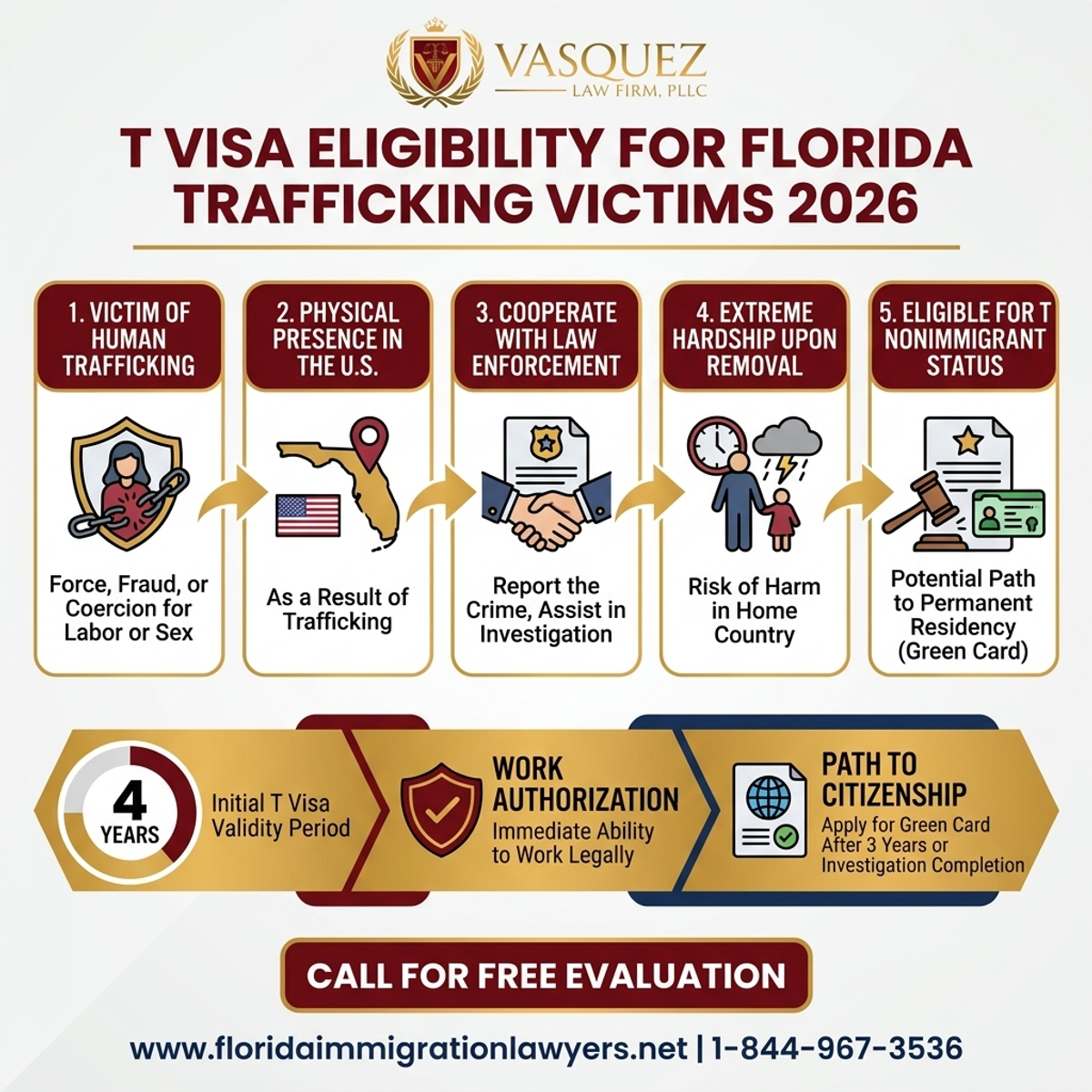
To be eligible for a T visa, an applicant must meet several strict criteria as outlined in the Immigration and Nationality Act (INA) Section 101(a)(15)(T). First, you must be a victim of a severe form of human trafficking. This definition encompasses sex trafficking, where a commercial sex act is induced by force, fraud, or coercion, or if the person is under 18 and induced to perform a commercial sex act. It also covers labor trafficking, which involves the recruitment, harboring, transportation, provision, or obtaining of a person for labor or services through the use of force, fraud, or coercion for the purpose of subjection to involuntary servitude, peonage, debt bondage, or slavery. Many victims in Florida are subjected to forced labor in agriculture, hospitality, or domestic service, particularly in areas like Naples, Miami, and Orlando.
Second, you must be physically present in the United States, American Samoa, or the Commonwealth of the Northern Mariana Islands (CNMI) on account of the trafficking. This means your presence in Florida is a direct result of being trafficked. Third, you must have complied with any reasonable request for assistance in the investigation or prosecution of human trafficking, unless you are under 18 years of age, in which case cooperation is not strictly required. Finally, you must demonstrate that you would suffer extreme hardship involving unusual and severe harm if you were removed from the United States. This hardship can be to yourself or your immediate family members. Proving these elements requires compelling evidence and often the support of law enforcement agencies and experienced legal counsel.
How Does the T Visa Application Process Work for Florida Victims?
The T visa application process is a multi-step journey designed to ensure the protection of human trafficking victims while also gathering crucial information for law enforcement. As of 2026, the process typically begins with filing Form I-914, Application for T Nonimmigrant Status, with U.S. Citizenship and Immigration Services (USCIS). This initial application is comprehensive and requires detailed personal information, a sworn statement describing the trafficking experience, and supporting evidence. Given the sensitive nature of the information, it is vital to approach this stage with extreme care and legal guidance.
Upon submission of Form I-914, USCIS will review your application for prima facie eligibility. If deemed prima facie eligible, you may receive employment authorization and a deferred action status, offering immediate relief from the threat of deportation. This is a critical step for many victims in Florida who need to work to support themselves and begin their recovery. Following this, USCIS conducts a thorough background check and may schedule an interview. The interview process is designed to verify the information provided in your application and to assess your credibility and the details of your trafficking experience. USCIS officers are trained to handle these interviews with sensitivity, understanding the trauma victims have endured.
A crucial component of the T visa application is demonstrating your cooperation with law enforcement. This is often achieved through a “Law Enforcement Endorsement” (Form I-914, Supplement B) from an agency such as the FBI, Homeland Security Investigations (HSI), or local police departments in Florida, like the Naples Police Department or the Collier County Sheriff’s Office. This endorsement confirms that you have assisted in the investigation or prosecution of human trafficking. If an endorsement is not possible, you may submit other credible evidence of cooperation. Successfully navigating these requirements is complex, and the assistance of an attorney is highly recommended to ensure all necessary documentation is properly submitted and all legal criteria are met. An attorney can also help prepare you for the interview and advocate on your behalf with USCIS.
What Documents Are Required for a T Visa Application?
A successful T visa application hinges on submitting a comprehensive set of documents that clearly establish your eligibility. As of 2026, gathering these materials can be challenging, especially for victims who may have limited access to personal records or fear their traffickers. However, with legal assistance, this process becomes more manageable. The primary document is Form I-914, Application for T Nonimmigrant Status, which must be completed accurately and thoroughly. This form is the foundation of your application and asks for detailed information about your identity, your trafficking experience, and your cooperation with law enforcement.
In addition to Form I-914, you will need to provide a compelling personal statement. This sworn statement should recount your experience as a victim of human trafficking, detailing how you were trafficked, the force, fraud, or coercion used against you, your physical presence in the U.S. due to trafficking, and the extreme hardship you would face if removed. This narrative is crucial for USCIS to understand the full scope of your situation. You will also need to submit identity documents, such as a birth certificate, passport, national identity card, or any other official identification. If you do not have these, an attorney can help explore alternative forms of evidence, like affidavits from individuals who can attest to your identity.
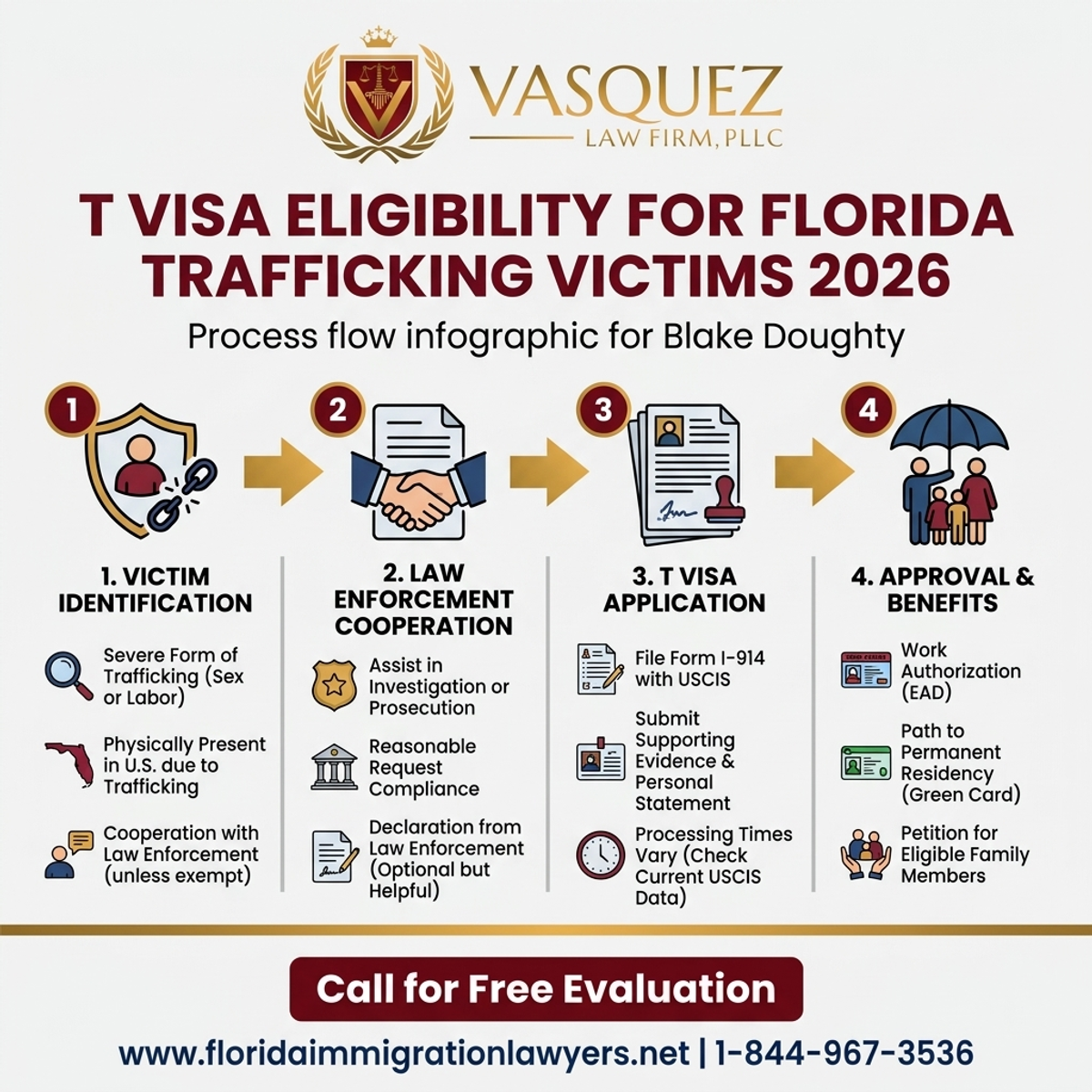
Step-by-Step Process — Blake Doughty: T Visa Eligibility for Florida Trafficking Victims 2026
Crucially, evidence of cooperation with law enforcement is required. This often comes in the form of Form I-914, Supplement B, “Declaration of a Law Enforcement Officer for Victim of Trafficking in Persons,” completed by a federal, state, or local law enforcement agency in Florida or elsewhere. If a Supplement B cannot be obtained, you must provide other credible evidence of your cooperation, such as police reports, court documents, or letters from victim service providers. Evidence of extreme hardship, such as medical records, psychological evaluations, or expert testimony regarding country conditions, is also vital. Finally, photographs and proof of family relationships (if applying for derivative family members) are necessary. A skilled immigration lawyer can help you organize these documents and strengthen your case.
What is the T Visa Timeline and Cost in 2026?
The T visa application process, while vital for victims, can involve significant waiting periods. As of 2026, applicants should prepare for a journey that can span several months to over a year, depending on various factors including USCIS workload, the complexity of the case, and the responsiveness of law enforcement agencies. Understanding this timeline is essential for managing expectations and planning your future in Florida. The initial review for prima facie eligibility for Form I-914 typically takes 3 to 6 months. If successful, this can lead to temporary work authorization, which provides a critical sense of stability for victims.
After prima facie approval, the full adjudication of the I-914 application can take anywhere from 12 to 24 months, or even longer in some complex cases. This period includes background checks, potential requests for evidence (RFEs), and interviews. The processing times can vary significantly between different USCIS service centers. Once the T visa is approved, it grants nonimmigrant status for up to four years. After three years in T nonimmigrant status, or upon reaching the age of majority if the trafficking occurred while a minor, T visa holders may be eligible to apply for adjustment of status to lawful permanent resident (Green Card) by filing Form I-485. This is a separate application with its own processing times.
The costs associated with a T visa application primarily involve USCIS filing fees and legal fees. As of 2026, there is generally no filing fee for Form I-914 itself for the principal applicant, which is a significant relief for victims. However, there are fees for derivative family members (spouses, children, and sometimes parents or siblings) who apply to join the principal T visa holder. There are also fees for the subsequent application for adjustment of status (Form I-485) and for work authorization (Form I-765) if filed separately. Legal fees for an experienced immigration attorney can range from several thousand dollars, depending on the complexity of the case and the services required. While these costs can seem substantial, many law firms, including Florida Immigration Lawyers, offer payment plans or work with non-profit organizations to help victims access legal representation. Investing in legal counsel significantly increases the chances of a successful outcome.
What Are the Protections and Benefits for T Visa Holders?
Beyond simply granting legal status, the T visa provides a comprehensive suite of protections and benefits designed to help human trafficking victims recover and reintegrate into society. A T visa holder receives legal nonimmigrant status for up to four years, which can be extended under specific circumstances. During this time, they are protected from deportation and can reside lawfully in the United States. This protection is paramount for individuals who have escaped dangerous situations and fear retaliation from their traffickers. It ensures they can live without the constant threat of removal, which is a significant relief for many in Florida who have experienced profound instability.
One of the most immediate and impactful benefits is the ability to obtain work authorization. With an Employment Authorization Document (EAD), T visa holders can legally work in the U.S., allowing them to gain financial independence and support themselves and their families. This is crucial for rebuilding lives shattered by exploitation. Additionally, T visa holders may be eligible for certain federal and state benefits, including public assistance, social services, and educational programs. These resources are designed to aid in their recovery, providing access to healthcare, housing assistance, and vocational training, which are vital for long-term stability.
Furthermore, the T visa allows for certain family members of the principal applicant to obtain derivative T nonimmigrant status. This includes spouses and unmarried children under 21 years of age. In cases where the principal applicant is under 21, parents and unmarried siblings under 18 may also be eligible. This provision helps to reunite families that have been torn apart by human trafficking, offering a holistic approach to victim support. After meeting specific criteria, typically three years of continuous physical presence in T nonimmigrant status, T visa holders can apply for lawful permanent residency (Green Card), solidifying their future in the United States and offering a pathway to U.S. citizenship. This comprehensive protection underscores the U.S. government's commitment to fighting human trafficking and supporting its victims.
The T visa is a powerful tool against human trafficking, providing a lifeline to victims who have suffered unimaginable abuse. For those in Florida, understanding and accessing this protection can be life-changing. It represents not just a legal status, but a chance for healing, safety, and a new beginning. Seeking legal counsel from firms like Florida Immigration Lawyers is a critical first step towards securing these vital protections and navigating the path to recovery.
As of 2026, the processing times for T visa applications can vary. Below is a general overview:
| Stage | Typical Timeframe | Notes |
|---|---|---|
| Initial I-914 Filing & Review | 3-6 months | Prima facie determination; may lead to work authorization. |
| Full I-914 Adjudication | 12-24+ months | Includes background checks, RFEs, and potential interviews. |
| T Visa Status Duration | Up to 4 years | Can be extended under specific conditions. |
| Adjustment of Status (I-485) Eligibility | After 3 years in T status | Separate application for Green Card. |
| I-485 Adjudication | 6-18+ months | Processing time for permanent residency application. |
The costs associated with a T visa application can be a concern for victims. Here's a breakdown:
| Item | Typical Fee (as of 2026) | Notes |
|---|---|---|
| Form I-914 (Principal Applicant) | $0 | No filing fee for the principal T visa applicant. |
| Form I-914 (Derivative Family Member) | Varies, check USCIS fee schedule | Fees apply per derivative applicant, often with fee waivers available. |
| Form I-765 (Work Authorization) | Varies, check USCIS fee schedule | Fee applies if filed separately, may be waived. |
| Form I-485 (Adjustment of Status) | Varies, check USCIS fee schedule | Required for Green Card application after T status. |
| Biometrics Services Fee | Varies, check USCIS fee schedule | Required for most applications, usually combined with I-485 fee. |
| Legal Representation | Hourly or Flat Fee (Varies) | Highly recommended for navigating complexity; payment plans often available. |
Common Mistakes to Avoid in T Visa Applications
Navigating the T visa application process is challenging, and even minor errors can lead to significant delays or denials. Being aware of common pitfalls can greatly improve your chances of success. Here are several mistakes frequently made by applicants, particularly those unfamiliar with U.S. immigration law:
-
Failing to Provide a Detailed Sworn Statement: A vague or incomplete personal narrative about the trafficking experience can weaken your case. USCIS requires a clear, consistent, and detailed account of the force, fraud, or coercion used, and how it led to your presence in the U.S. A lack of specific dates, locations, and events can raise doubts about your credibility, potentially leading to a Request for Evidence (RFE) or denial.
-
Insufficient Evidence of Cooperation with Law Enforcement: Without a strong Law Enforcement Endorsement (Form I-914, Supplement B) or other credible evidence, proving your cooperation is difficult. Simply stating you cooperated is not enough. You must provide documentation such as police reports, court records, or detailed letters from officers. Inadequate proof of cooperation can be a primary reason for denial, especially if you are over 18.
-
Missing or Incomplete Identity and Hardship Documents: Submitting an application without essential identity documents or robust evidence of extreme hardship is a critical error. While obtaining these can be difficult for victims, USCIS needs to verify your identity and understand the severe consequences of your removal. Without proper documentation, your case may be delayed or rejected outright.
-
Applying for a T Visa When U Visa is More Appropriate: Sometimes, victims of other serious crimes (like domestic violence, sexual assault, or extortion) mistakenly apply for a T visa instead of a U visa. While both are for crime victims, the specific criteria differ. Applying for the wrong visa type will result in denial and wasted time and resources. Understanding the nuanced differences is key, and a lawyer can help you determine the correct path.
-
Inconsistent Information Across Applications: Providing conflicting information in different parts of your application, or between your application and previous immigration filings, can severely damage your credibility. USCIS cross-references information, and inconsistencies can lead to accusations of misrepresentation, resulting in denial and potential bars to future immigration benefits.
Key Statistics — Blake Doughty: T Visa Eligibility for Florida Trafficking Victims 2026
-
Failing to Disclose All Immigration History: Omitting details about prior entries, visa applications, or encounters with immigration enforcement, even if seemingly minor, is a serious mistake. Transparency is crucial. Any undisclosed information discovered during background checks can lead to a finding of misrepresentation and a denial of your T visa, potentially impacting future applications.
-
Not Responding to Requests for Evidence (RFEs) in Time: USCIS often issues RFEs when they need more information or clarification. Failing to respond by the deadline, or providing an inadequate response, will almost certainly lead to a denial. These requests are time-sensitive and require careful attention to detail.
-
Attempting to Navigate the Process Without Legal Counsel: The T visa application is incredibly complex and emotionally taxing. Without an experienced immigration attorney, victims often overlook critical details, miss deadlines, or fail to present their case effectively. The consequences of denial can be severe, including continued vulnerability and potential deportation. Legal assistance significantly increases the likelihood of a positive outcome.
When to Call Florida Immigration Lawyers for T Visa Assistance
The journey to obtaining a T visa is fraught with legal complexities and emotional challenges. While the information provided here offers a valuable starting point, it is not a substitute for expert legal advice tailored to your specific situation. As a victim of human trafficking in Florida, you deserve compassionate and knowledgeable legal representation. There are several critical junctures when contacting Florida Immigration Lawyers becomes not just beneficial, but absolutely essential for your safety and success.
You should call us immediately if you suspect you or someone you know is a victim of human trafficking. Early intervention can be crucial for securing safety and preserving evidence. If you have cooperated with law enforcement, or are considering doing so, an attorney can help ensure your rights are protected throughout the process and that your cooperation is properly documented for your T visa application. We can liaise with agencies like the Executive Office for Immigration Review (EOIR) or local Florida law enforcement to facilitate this.
Furthermore, if you have already begun the application process and received a Request for Evidence (RFE) or a Notice of Intent to Deny (NOID), it is imperative to seek legal counsel. These notices indicate significant issues with your application that require a precise and timely response. Our attorneys are adept at analyzing these complex notices and formulating strong rebuttals. If you are facing deportation proceedings, a T visa application can offer a powerful defense against removal, and an attorney can help you present your case effectively in immigration court. Our firm specializes in deportation defense, providing comprehensive support to protect your future.
Even if your case seems straightforward, the emotional toll of recounting your trauma can be overwhelming. Our attorneys provide not only legal expertise but also a supportive and understanding environment, allowing you to focus on healing while we handle the legal heavy lifting. We serve all of Florida, including Naples, Miami, Orlando, and Tampa, offering free consultations to assess your case and discuss your options. Do not risk your future by navigating this alone. Your safety and legal status are too important.
About Florida Immigration Lawyers
Florida Immigration Lawyers is a leading immigration law firm dedicated to serving individuals and families across the entire state of Florida. With a deep understanding of the complexities of U.S. immigration law, our experienced attorneys provide compassionate, effective, and client-focused legal representation. We pride ourselves on offering personalized strategies tailored to each client's unique needs, ensuring they receive the highest quality of service and advocacy. Our commitment is to protect your rights and guide you through every step of your immigration journey, no matter how challenging it may seem.
Our comprehensive practice areas include T visas for human trafficking victims, asylum, citizenship, family immigration, business immigration, and deportation defense. We understand that immigration matters often involve profound personal stakes, and we approach every case with the sensitivity and dedication it deserves. Our firm is available 24/7, ensuring that help is always just a phone call away. We offer free consultations to help you understand your options without financial obligation, and our bilingual team is ready to assist you.
Sources and References
- U.S. Citizenship and Immigration Services (USCIS)
- Executive Office for Immigration Review (EOIR)
- U.S. Department of State (travel.state.gov)
- 8 U.S.C. Chapter 12 - Immigration and Nationality Act (INA), specifically INA Section 101(a)(15)(T)
- 8 CFR Part 214 - Nonimmigrant Classes
- USCIS Policy Manual, Volume 3, Part B, Chapter 7 - T Nonimmigrant Status
Related services: immigration practice areas, experienced immigration attorneys, free immigration consultation.
This article provides general legal information and is not intended as legal advice. Every case is unique, and outcomes depend on specific facts and circumstances. Contact an attorney for advice about your particular situation.
The path to safety and legal status for victims of human trafficking can be long and challenging, but you do not have to walk it alone. Florida Immigration Lawyers is here to stand by your side, offering expert legal guidance and unwavering support. Your journey to recovery and a secure future starts with a single step. Contact us today for a free consultation at 1-844-967-3536. Se Habla Espanol - Estamos aqui para ayudarle.
Do Not Navigate This Process Alone
Our experienced immigration attorneys are ready to fight for you. Get a free, confidential consultation today.
Se Habla Español
Or leave your details and we’ll call you:
Free Evaluation in 24 Hours
Or talk to us right now
AI voice assistant — available 24/7
FreeFrequently Asked Questions

William J. Vásquez
Founding Attorney · Vasquez Law Firm
U.S. Air Force veteran and immigration attorney with years of hands-on U.S. immigration experience. J.D., NCCU School of Law. AILA member. Admitted to the 4th, 5th, and 11th Circuit Courts.
Available 24/7 - Free Evaluations
Reviewed for legal accuracy by William J. Vásquez
Licensed in North Carolina; U.S. immigration is federal practice.
Related Legal Services
Our Florida immigration attorneys can help you with free immigration consultation, experienced immigration attorneys and business immigration. Call today at 1-844-967-3536 for a free consultation.
Related Links
Related Topics
Free Legal Consultation
Discuss your case with our experienced attorneys. We're available 24/7.
Se Habla Español - Estamos aquí para ayudarle.
Related Articles
DV-2027 Registration Period: Your Green Card Lottery Guide
The DV-2027 Diversity Visa (DV) lottery offers a unique pathway to permanent residency for individuals from countries with historically low immigration rates to the U.S. Expected to open in Fall 2025, the registration period requires strict adherence to eligibility criteria, including country of birth and specific education or work experience. This guide from Florida Immigration Lawyers covers the step-by-step application process, essential documents, critical timelines, and associated costs. We highlight common mistakes to avoid and explain when legal counsel is indispensable, especially for residents in Florida. Understanding the nuances of the green card lottery is vital for a successful application. Contact us for expert guidance on your DV-2027 journey.
USCIS Oath Ceremony Schedule 2026 in Florida
Navigating the USCIS oath ceremony schedule for 2026 in Florida is crucial for new citizens. This guide provides insights into planning, processing times, and what to expect in Orlando. Call Florida Immigration Lawyers at 1-844-967-3536 for a free consultation.
STEM OPT Immigration Lawyer for Florida Graduates
Explore the STEM OPT extension process for Florida graduates. Learn about eligibility, application steps, and common pitfalls to avoid. Consult Florida Immigration Lawyers for guidance.
STEM OPT Immigration Lawyer: Florida Guidance
Explore the STEM OPT extension for Florida graduates. Understand eligibility, application steps, and common mistakes. Consult Florida Immigration Lawyers for guidance.