TPS Honduras Extension 2026: What Florida Residents Need
For thousands of Honduran nationals in Florida, the Temporary Protected Status (TPS) extension through 2026 offers crucial temporary relief from deportation and the ability to work legally. This comprehensive guide, from Florida Immigration Lawyers, details everything about the TPS Honduras extension 2026, including eligibility requirements, the mandatory re-registration process, and critical timelines. We explain the necessary forms like I-821 and I-765, outline the associated USCIS filing fees, and discuss potential fee waivers. Learn about the importance of continuous physical presence and residence, and discover common mistakes to avoid during your application. Additionally, we explore potential pathways to permanent residency and emphasize when it's essential to seek legal counsel to navigate complex situations. Serving all of Florida, our firm offers expert guidance to ensure your status is protected.

Quick Answer: TPS Honduras Extension 2026
The Temporary Protected Status (TPS) for Honduran nationals has been extended through at least early 2026, offering continued temporary legal residency and work authorization in the United States. This extension provides a critical lifeline for eligible Hondurans who have continuously resided in the U.S. since the original designation, protecting them from deportation and allowing them to live and work legally. Re-registration is mandatory for current beneficiaries, and new applicants must meet strict criteria.
- Eligibility: Must meet continuous physical presence and residence requirements, and register during designated periods.
- Re-registration: Current beneficiaries must re-register with USCIS to maintain their status.
- Benefits: Protection from deportation, work authorization, and travel permission.
- Florida Impact: Significant for the large Honduran community across Florida, including Naples and surrounding areas.
- Legal Help: Consulting an immigration attorney is crucial for navigating the complex application process and avoiding common mistakes.
For many Honduran families in Florida, the news of the TPS Honduras extension 2026 brings a mix of relief and continued uncertainty. Temporary Protected Status (TPS) has been a cornerstone of humanitarian relief for eligible Honduran nationals since Hurricane Mitch devastated Central America in 1999. This crucial program allows individuals from designated countries to live and work in the U.S. temporarily when conditions in their home country prevent their safe return.
As we navigate 2026, understanding the nuances of this extension, including eligibility, the re-registration process, and potential pathways forward, is more important than ever. The decisions made regarding TPS can profoundly impact the lives of thousands of individuals and families across Florida, from Miami to Orlando, Tampa to Naples. This comprehensive guide will break down everything you need to know about the TPS Honduras extension 2026, helping you understand your rights and responsibilities.
Navigating immigration law can be daunting, but you don't have to face it alone. If you are a Honduran national in Florida with questions about your TPS status or re-registration, call Florida Immigration Lawyers at 1-844-967-3536 for a free consultation. Our experienced team is here to provide the clarity and support you need.
What is Temporary Protected Status (TPS) for Honduran Nationals?
Temporary Protected Status (TPS) is a humanitarian immigration benefit granted by the U.S. government to eligible nationals of certain countries who are unable to return safely to their home country due to conditions such as ongoing armed conflict, environmental disaster, or other extraordinary and temporary conditions. For Honduras, TPS was first designated in January 1999 following the widespread destruction caused by Hurricane Mitch. This designation has been extended multiple times since then, reflecting the persistent challenges in the country.
As of 2026, the TPS Honduras extension 2026 continues to provide vital protection. Beneficiaries are granted temporary legal status, which means they are protected from deportation and are eligible to obtain work authorization (Employment Authorization Document, EAD) and, in some cases, travel authorization. The Immigration and Nationality Act (INA) Section 244 outlines the legal framework for TPS, emphasizing its temporary nature while acknowledging the humanitarian need. This status does not automatically lead to permanent residency or U.S. citizenship, but it offers a stable, temporary solution for those who qualify.
History of TPS for Honduras
The original TPS designation for Honduras in 1999 provided relief to thousands of Hondurans already in the United States. Over the past two decades, successive administrations have reviewed and extended this status, citing ongoing recovery challenges, political instability, and natural disasters. Each extension period typically lasts for 18 months, requiring beneficiaries to re-register to maintain their status. This long history highlights the enduring need for this protection and its significant impact on the Honduran diaspora in the U.S., including the substantial community residing in Florida.
Key Benefits of TPS
The benefits of holding TPS are substantial. Firstly, it provides protection from removal (deportation) from the United States. Secondly, beneficiaries are eligible for an Employment Authorization Document (EAD), allowing them to work legally in the U.S. Thirdly, they may apply for a travel document, enabling them to travel outside the U.S. and return under certain conditions, which is critical for maintaining family ties or addressing urgent matters. These protections are invaluable for individuals and families building lives and contributing to communities, like those in Naples, Florida.
Am I Eligible for TPS Honduras Extension in 2026?
To be eligible for the TPS Honduras extension 2026, you must meet specific criteria established by U.S. Citizenship and Immigration Services (USCIS). Generally, eligibility for TPS relies on two main factors: continuous physical presence (CPP) in the United States and continuous residence (CR) in the United States since the initial designation date for Honduras. For current beneficiaries, re-registration requires you to demonstrate that you have maintained these conditions and have not committed certain crimes or become otherwise ineligible.
Specifically, individuals must have been continuously physically present in the U.S. since the effective date of the most recent TPS extension or re-designation, and continuously resided in the U.S. since the date specified in the initial designation. Any brief, casual, and innocent departures from the U.S. may not break continuous physical presence or residence, but longer or unauthorized absences can lead to disqualification. It is critical to review the exact dates provided by USCIS for the TPS Honduras extension 2026 when preparing your application or re-registration.
Continuous Physical Presence and Residence
Maintaining continuous physical presence means you have been physically present in the U.S. for the entire required period. Continuous residence means your primary dwelling has been in the U.S. for the specified duration. Both are crucial for TPS eligibility. Even a short trip outside the U.S. without proper authorization (an advance parole document) can jeopardize your status. For Honduran nationals living in Florida, ensuring these requirements are met is paramount, especially given the proximity to international travel hubs.
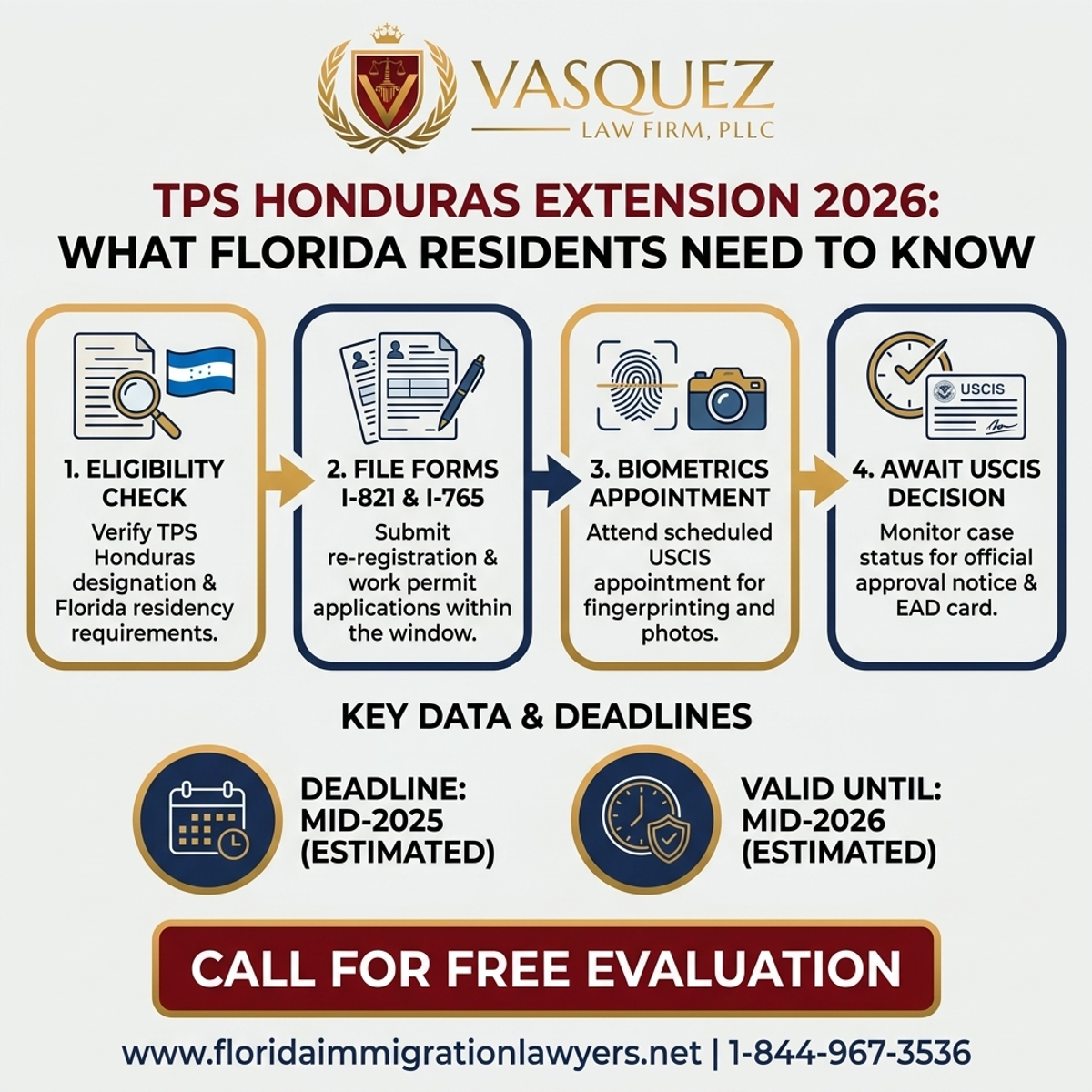
Step-by-Step Process — TPS Honduras Extension 2026: What Florida Residents Need to Know
Disqualifying Factors
Several factors can render an individual ineligible for TPS, even if they meet the presence and residence requirements. These include conviction of any felony or two or more misdemeanors committed in the U.S., engaging in persecution of others, or being found inadmissible under certain grounds of the INA. Furthermore, individuals who are subject to certain mandatory bars to asylum or other forms of relief are generally ineligible for TPS. It is vital to disclose all relevant information truthfully and accurately on your application, as omissions or misrepresentations can lead to severe consequences, including denial and potential deportation proceedings before the Executive Office for Immigration Review (EOIR).
How Do I Apply for TPS Honduras Re-registration in Florida?
Applying for the TPS Honduras extension 2026, particularly for re-registration, involves submitting specific forms and documentation to USCIS. The primary form is Form I-821, Application for Temporary Protected Status. Additionally, if you wish to obtain or renew your work authorization, you must file Form I-765, Application for Employment Authorization. If you need to travel internationally, Form I-131, Application for Travel Document, is also required. All forms must be completed accurately and submitted within the designated re-registration period.
The process begins by carefully reviewing the official USCIS announcement for the TPS Honduras extension, which will specify the re-registration window and any updated requirements. You must gather all necessary supporting documents, including proof of identity, nationality, continuous residence, and any other evidence requested. For those residing in Florida, applications are typically mailed to a designated USCIS Lockbox facility. It is crucial to send your application via certified mail with a return receipt to ensure proof of submission. Once received, USCIS will send a receipt notice, and you may be scheduled for a biometrics appointment at a local Application Support Center (ASC), such as those in Miami, Orlando, or Tampa.
Required Documents for Re-registration
To ensure a smooth re-registration process for the TPS Honduras extension 2026, gather the following documents:
- Form I-821, Application for Temporary Protected Status.
- Form I-765, Application for Employment Authorization (if seeking work permit).
- Form I-131, Application for Travel Document (if seeking advance parole).
- Proof of identity and nationality (e.g., Honduran passport, birth certificate with photo ID).
- Proof of continuous residence in the U.S. since the initial designation date (e.g., utility bills, rent receipts, school records, employment records, medical records).
- Two passport-style photographs.
- Proof of any previous TPS grants or extensions.
- Any court dispositions or police records for arrests or convictions, if applicable.
Filing with USCIS in Florida
While there are no specific USCIS field offices in Florida for initial TPS filings (applications are sent to a national lockbox), residents in Florida will interact with local USCIS Application Support Centers (ASCs) for biometrics appointments. These centers are located throughout the state, including major cities like Miami, Orlando, Tampa, and Jacksonville. It is essential to attend your biometrics appointment as scheduled, as failure to do so can lead to delays or denial of your application. Following the appointment, USCIS will process your application, which may involve background checks and further review, before issuing a decision.
What is the Timeline for TPS Honduras Extension Processing in 2026?
The timeline for processing the TPS Honduras extension 2026 applications and re-registrations can vary significantly based on USCIS workload, individual case complexity, and current policy. While USCIS aims for efficient processing, delays are common. As of 2026, applicants should anticipate processing times that can range from several months to over a year, especially for work authorization documents. It is crucial to apply as early as possible within the re-registration window to avoid lapses in work authorization.
Upon filing, you will typically receive a receipt notice within 2-4 weeks. The biometrics appointment usually follows within 1-3 months. After that, the processing of Form I-821 and Form I-765 can take anywhere from 6 to 18 months, or even longer in some instances. USCIS often issues automatic extensions of EADs for re-registrants during this period, which allows beneficiaries to continue working while their new EAD is being processed. Always check the USCIS website (USCIS TPS Honduras page) for the most current processing times and specific guidance.
USCIS Processing Centers
TPS applications are primarily processed by USCIS service centers, not local field offices. The specific service center depends on where you reside. Regardless of the processing center, all applicants in Florida will attend biometrics appointments at their nearest Application Support Center (ASC). These centers play a critical role in collecting fingerprints, photographs, and signatures necessary for background checks and identity verification. Understanding which service center handles your case can sometimes help in tracking its progress online, though direct inquiries are often limited.
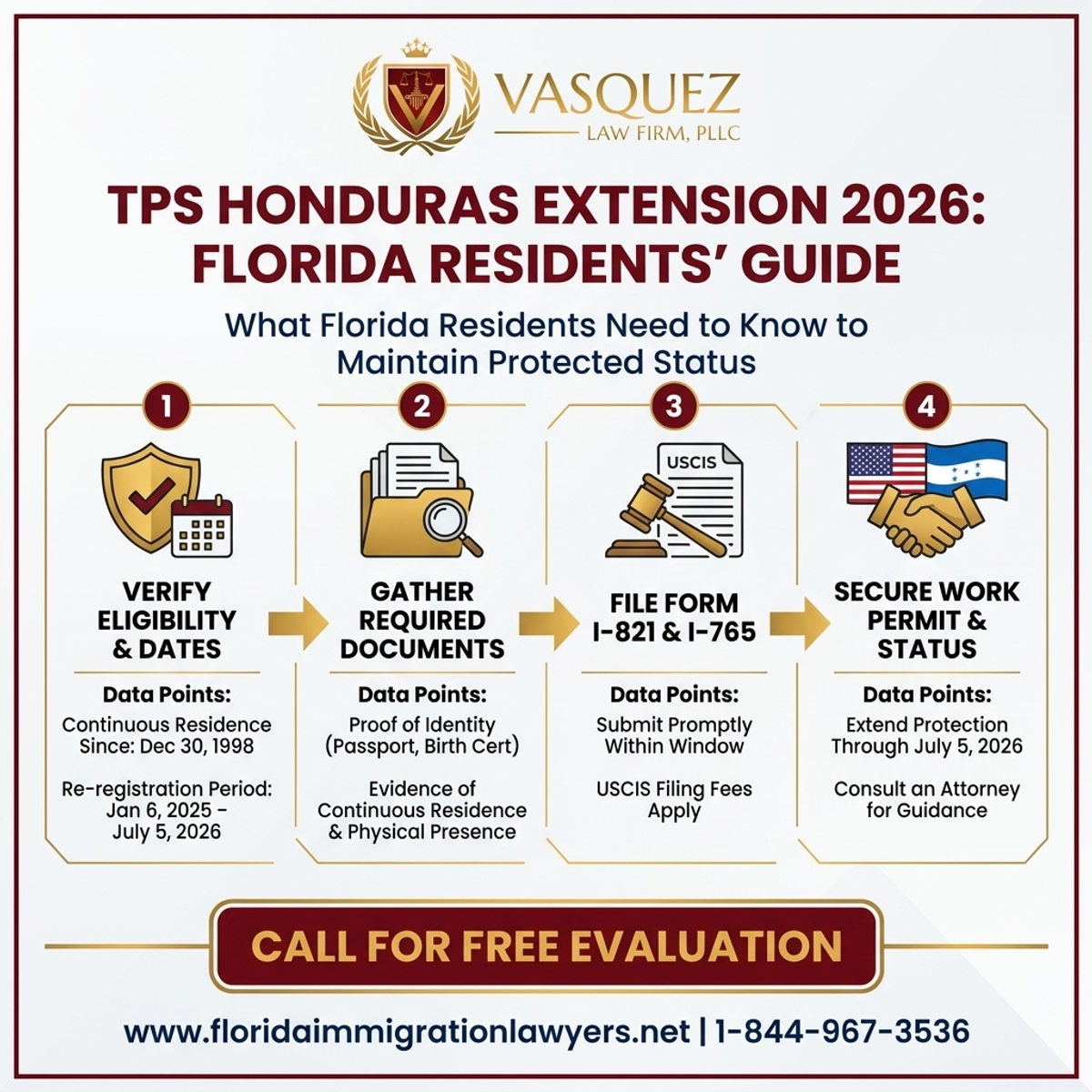
Key Statistics — TPS Honduras Extension 2026: What Florida Residents Need to Know
Work Authorization and Travel Documents
For many TPS beneficiaries, the Employment Authorization Document (EAD) is critical for their livelihood. When re-registering for the TPS Honduras extension 2026, it is vital to apply for a new EAD (Form I-765) simultaneously with your I-821. USCIS typically provides an automatic extension of existing EADs for a specified period for those who timely re-register. This allows individuals to continue working legally while awaiting their new card. Similarly, if you anticipate needing to travel internationally, filing Form I-131 for advance parole is essential, as unauthorized travel can lead to denial of TPS and potential inadmissibility upon return to the U.S. (Travel.State.Gov provides general travel advisories).
| Stage | Typical Timeframe (As of 2026) | Notes |
|---|---|---|
| Re-registration Window Opens | Specified by USCIS (e.g., 60-90 days) | Apply as early as possible to avoid lapses in status. |
| Receipt Notice from USCIS | 2-4 weeks after filing | Confirms USCIS received your application. Keep this notice safe. |
| Biometrics Appointment | 1-3 months after receipt notice | Mandatory appointment at a local Application Support Center (ASC). |
| I-821 (TPS) Processing | 6-18 months | Varies by service center and case complexity. |
| I-765 (EAD) Processing | 6-18 months (often concurrent with I-821) | Automatic EAD extension typically granted for timely re-registrants. |
| I-131 (Travel Document) Processing | 6-12 months | Required for international travel; do not travel without it. |
| Final Decision | After all reviews are complete | USCIS will mail a notice of approval or denial. |
What Are the Costs Associated with TPS Honduras Re-registration?
The costs associated with the TPS Honduras extension 2026 re-registration primarily involve USCIS filing fees. These fees are subject to change, so it is crucial to always check the official USCIS website for the most current amounts before submitting your application. As of 2026, there are generally fees for Form I-821 (Application for Temporary Protected Status), Form I-765 (Application for Employment Authorization), and biometrics services. There is also a fee for Form I-131 (Application for Travel Document) if you choose to apply for advance parole.
It is important to note that certain fee waivers may be available for individuals who can demonstrate an inability to pay. To apply for a fee waiver, you must submit Form I-912, Request for Fee Waiver, along with supporting documentation proving your financial hardship. If a fee waiver is granted, you may not have to pay some or all of the filing fees. However, legal fees for assistance from an immigration attorney are separate and depend on the complexity of your case and the services provided. These fees are an investment in ensuring your application is complete and accurate.
USCIS Filing Fees
The specific fees for TPS re-registration can be found on the USCIS website. Typically, the I-821 has a filing fee, and the I-765 has a separate fee. There is also a mandatory biometrics services fee for applicants aged 14 to 79. For example, if you are re-registering for TPS and requesting a new EAD, you would generally pay the I-821 fee, the I-765 fee, and the biometrics fee. If you also need a travel document, the I-131 fee would apply. Always send the exact amount and type of payment as specified by USCIS to avoid delays or rejection of your application.
Legal Fees and Other Costs
Beyond USCIS fees, applicants should consider the cost of legal assistance. While not mandatory, hiring an experienced immigration attorney can significantly streamline the process and reduce the risk of errors. Legal fees vary depending on the firm and the scope of services, which can include preparing forms, compiling supporting documents, responding to Requests for Evidence (RFEs), and providing general legal advice. Other potential costs might include obtaining certified translations of foreign documents, passport photos, and mailing expenses. Understanding all potential costs upfront helps in financial planning for the TPS Honduras extension 2026 re-registration.
| Item | Typical Fee (As of 2026, subject to change) | Notes |
|---|---|---|
| Form I-821 (TPS Application) | Check USCIS website for current fee | Required for TPS re-registration. Fee waivers may apply. |
| Form I-765 (EAD Application) | Check USCIS website for current fee | Required if you need work authorization. Fee waivers may apply. |
| Biometrics Services Fee | Check USCIS website for current fee | Mandatory for applicants 14-79 years old. |
| Form I-131 (Travel Document) | Check USCIS website for current fee | Optional, for international travel. Fee waivers may apply. |
| Attorney Fees | Varies by firm and services | Covers legal assistance, document preparation, and advice. |
| Translations & Postage | Varies | Costs for certified translations of foreign documents and mailing. |
What Happens After TPS Honduras Extension? Pathways to Permanent Residency.
While TPS is a temporary status, beneficiaries of the TPS Honduras extension 2026 may explore pathways to permanent residency (a Green Card) if they meet other immigration eligibility requirements. TPS itself does not directly lead to a Green Card, but it can provide a legal status that allows individuals to pursue other avenues for adjustment of status within the United States. Many TPS holders may qualify for family-based immigration options through U.S. citizen or lawful permanent resident relatives, or potentially through employment-based petitions.
For instance, a TPS beneficiary who is married to a U.S. citizen or has a U.S. citizen child over 21 years old may be able to adjust their status to a lawful permanent resident without leaving the U.S. This typically involves filing Form I-130 (Petition for Alien Relative) and Form I-485 (Application to Register Permanent Residence or Adjust Status). However, specific entry methods into the U.S. and any past immigration violations can complicate this process. Consulting with an immigration attorney is vital to determine the best strategy for your unique circumstances and to understand potential pitfalls.
Family-Based Immigration Options
Many Honduran TPS holders in Florida may have U.S. citizen or lawful permanent resident family members who can petition for them. These family-based petitions are common pathways to a Green Card. If you entered the U.S. legally and have an immediate relative (spouse, parent, or unmarried child under 21) who is a U.S. citizen, you might be eligible for adjustment of status. If you entered without inspection, the path becomes more complex, often requiring a waiver or provisional waiver, which carries significant risks and requires expert legal guidance. Understanding the intricacies of family-based immigration is crucial for a successful transition from TPS.
Employment-Based Opportunities
Some TPS beneficiaries may also find opportunities for employment-based immigration, although these are generally more challenging to obtain. This pathway typically requires a U.S. employer to sponsor the individual for a Green Card, demonstrating that no qualified U.S. workers are available for the position. Certain employment-based categories, such as those for individuals with extraordinary abilities or advanced degrees, might also be available. Given the temporary nature of TPS, exploring long-term immigration solutions like these is a proactive step, especially for those who have established roots and careers in Florida.
Do not navigate this complex process alone. The laws surrounding the TPS Honduras extension 2026 and other immigration pathways are constantly evolving. Contact Florida Immigration Lawyers today at 1-844-967-3536 for expert guidance and peace of mind.
Common Mistakes to Avoid During TPS Re-registration
Re-registering for the TPS Honduras extension 2026 can seem straightforward, but many common mistakes can lead to delays, denials, or even loss of status. Avoiding these pitfalls is crucial for maintaining your temporary protected status and work authorization.
- Missing the Re-registration Deadline: Failing to submit your application within the specified re-registration window is one of the most common and critical mistakes. Late filings are rarely accepted unless there are extraordinary circumstances.
- Incomplete Forms: Submitting forms with blank fields or missing required information can lead to a Request for Evidence (RFE) or outright denial. Double-check every section.
- Incorrect Filing Fees: Sending the wrong fee amount, an expired check, or an incorrect payment method will result in your application being rejected. Always verify current fees on the USCIS website.
- Not Disclosing All Criminal History: Even minor arrests or convictions, including those that were expunged, must be disclosed. Failure to do so is considered misrepresentation and can lead to severe immigration consequences.
- Traveling Internationally Without Advance Parole: Leaving the U.S. without an approved Form I-131 (Advance Parole) can result in a denial of your TPS application and inadmissibility upon your attempted return.
- Lack of Sufficient Supporting Documentation: Not providing adequate proof of continuous residence, identity, or nationality can cause delays or denials. Keep thorough records.
- Assuming Automatic Extension: While EADs for re-registrants often receive automatic extensions, TPS status itself requires re-registration. Do not assume your status is automatically renewed.
- Failing to Update Your Address with USCIS: If you move, you must notify USCIS within 10 days using Form AR-11. Failure to do so can result in missed notices and critical deadlines.
- Not Attending Biometrics Appointments: Missing your scheduled biometrics appointment without rescheduling can lead to your application being denied.
- Providing Inconsistent Information: Any discrepancies between your current application and previous immigration filings can raise red flags and lead to scrutiny or accusations of fraud.
- Not Seeking Legal Advice for Complex Cases: If you have a criminal record, prior immigration violations, or a complicated entry history, attempting to re-register without legal counsel significantly increases your risk.
When to Call a Lawyer for TPS Honduras Extension 2026
While some TPS re-registrations may seem straightforward, certain situations warrant immediate legal consultation. The stakes are high when it comes to your immigration status, and an experienced attorney can help navigate complex issues and prevent costly mistakes. Florida Immigration Lawyers are here to assist Honduran nationals across the state, including those in Naples and surrounding communities, with their TPS needs.
You should consider contacting an immigration lawyer if:
- You have any criminal history, even minor offenses or arrests that were dismissed.
- You have previously been denied TPS or another immigration benefit.
- You have received a Request for Evidence (RFE) from USCIS.
- You have departed the U.S. without advance parole or have a complex travel history.
- You have questions about your continuous physical presence or continuous residence requirements.
- You are considering applying for a Green Card through another pathway (e.g., family-based petition) and want to understand how TPS impacts that process.
- You are unsure about which forms to file or how to accurately complete them.
- You have received a Notice to Appear (NTA) in immigration court or are in deportation proceedings.
- You need assistance with a fee waiver application.
Our team at Florida Immigration Lawyers understands the intricacies of TPS and other immigration laws. We can help you gather the necessary documentation, accurately complete your forms, and represent you if complications arise. Protecting your status and future in the U.S. is our top priority.
About Florida Immigration Lawyers
Florida Immigration Lawyers is a leading immigration law firm dedicated to serving individuals and families throughout the entire state of Florida. Our experienced attorneys are passionate about helping immigrants navigate the complex U.S. immigration system, providing compassionate, knowledgeable, and effective legal representation. We understand the unique challenges faced by immigrant communities, including the large Honduran population in Florida, and are committed to protecting their rights and securing their future.
We offer a comprehensive range of immigration services, including assistance with Temporary Protected Status (TPS), family-based visas, employment visas, asylum claims, deportation defense, and naturalization. Our firm is proud to offer bilingual services, ensuring that all clients receive clear and culturally appropriate communication. With offices conveniently located and a commitment to being available 24/7, we strive to make legal support accessible when you need it most. Your journey through the immigration process is important to us, and we are here to guide you every step of the way.
Sources and References
- U.S. Citizenship and Immigration Services (USCIS) - TPS Honduras
- Executive Office for Immigration Review (EOIR)
- U.S. Department of State - Bureau of Consular Affairs
- Immigration and Nationality Act (INA) Section 244 - Temporary Protected Status
- 8 Code of Federal Regulations (CFR) Part 244 - Temporary Protected Status
- USCIS Policy Manual - Volume 7, Part B, Chapter 6 - Temporary Protected Status
Related services: immigration practice areas, family immigration services, citizenship and naturalization.
This article provides general legal information and is not intended as legal advice. Every case is unique, and outcomes depend on specific facts and circumstances. Contact an attorney for advice about your particular situation.
Don't leave your immigration status to chance. If you have questions about the TPS Honduras extension 2026 or need assistance with your re-registration, contact Florida Immigration Lawyers for a free consultation today. We are available 24/7 to provide the expert legal guidance you deserve. Call us at 1-844-967-3536. Se Habla Espanol - Estamos aqui para ayudarle.
If you need legal assistance, learn more about learn about our immigration practice, or call us at 1-844-967-3536 for a free consultation.
Do Not Navigate This Process Alone
Our experienced immigration attorneys are ready to fight for you. Get a free, confidential consultation today.
Se Habla Español
Or leave your details and we’ll call you:
Free Evaluation in 24 Hours
Or talk to us right now

AI voice assistant — available 24/7
FreeFrequently Asked Questions

William J. Vásquez
Founding Attorney · Vasquez Law Firm
U.S. Air Force veteran and immigration attorney with years of hands-on U.S. immigration experience. J.D., NCCU School of Law. AILA member. Admitted to the 4th, 5th, and 11th Circuit Courts.
Available 24/7 - Free Evaluations
Reviewed for legal accuracy by William J. Vásquez
Licensed in North Carolina; U.S. immigration is federal practice.
Related Legal Services
Our Florida immigration attorneys can help you with business immigration, asylum protection and deportation defense. Call today at 1-844-967-3536 for a free consultation.
Related Links
Related Topics
Free Legal Consultation
Discuss your case with our experienced attorneys. We're available 24/7.
Se Habla Español - Estamos aquí para ayudarle.
Related Articles
"Narrative of Fear" Asylum I-589 in Florida: 2026 Guide
Preparing for your asylum interview in Florida, particularly when your I-589 application hinges on a "narrative of fear," is a pivotal moment in your journey towards protection. This comprehensive guide, relevant for 2026, details how to meticulously prepare your personal testimony and gather crucial evidence. Learn about the specific requirements for proving a well-founded fear of persecution based on protected grounds, and understand the interview process at the Miami Asylum Office serving Fort Lauderdale. We cover essential documents, potential costs, and common mistakes to avoid. Florida Immigration Lawyers offers expert guidance to strengthen your case and navigate the complexities of U.S. asylum law, ensuring your story is heard effectively.
Immediate Relative Petition Tampa: A Florida Guide for 2026
Navigating an immediate relative petition in Tampa, Florida, offers U.S. citizens a direct path to sponsor spouses, unmarried children under 21, and parents for a Green Card. This comprehensive guide, updated for 2026, details the Form I-130 process, eligibility requirements, necessary documentation, and typical timelines. Unlike other family-based categories, immediate relatives are exempt from annual visa quotas, potentially speeding up their journey to permanent residency. However, the process is intricate, demanding precise form completion, thorough evidence of a bona fide relationship, and adherence to strict legal guidelines. We cover common pitfalls to avoid, such as incomplete forms or insufficient financial sponsorship, which can lead to significant delays or denials. Understanding when to seek expert legal assistance is crucial, especially for cases involving complex relationship dynamics, prior immigration violations, or criminal histories. Florida Immigration Lawyers provides dedicated support to families in Gainesville, Tampa, and across Florida, ensuring a smooth and successful application process. We offer free consultations to help you understand your options and navigate the complexities of U.S. immigration law.
Withholding of Removal: Your 2026 Florida Defense Guide
For those in Florida facing the threat of deportation, understanding withholding of removal and Convention Against Torture (CAT) protections is crucial. This comprehensive guide from Florida Immigration Lawyers explains eligibility, the complex process in immigration court, required documentation, and what to expect as of 2026. Learn about the high burden of proof, statutory bars, and the critical differences between these forms of relief. We cover the typical timeline for cases in Florida courts, associated costs, and common mistakes to avoid. With skilled legal representation, you can build a strong defense against removal and fight for your right to safety. Discover how our attorneys can assist you in navigating the intricacies of immigration law in Florida, from initial filings to appeals, ensuring your case is handled with expertise and compassion.
Parole in Place for Military Families Miami: A 2026 Guide
Explore how parole in place helps military families stay together in Miami. Understand the eligibility, process, and common mistakes to avoid. Contact Florida Immigration Lawyers for expert guidance.