Withholding of Removal: Your 2026 Florida Defense Guide
For those in Florida facing the threat of deportation, understanding withholding of removal and Convention Against Torture (CAT) protections is crucial. This comprehensive guide from Florida Immigration Lawyers explains eligibility, the complex process in immigration court, required documentation, and what to expect as of 2026. Learn about the high burden of proof, statutory bars, and the critical differences between these forms of relief. We cover the typical timeline for cases in Florida courts, associated costs, and common mistakes to avoid. With skilled legal representation, you can build a strong defense against removal and fight for your right to safety. Discover how our attorneys can assist you in navigating the intricacies of immigration law in Florida, from initial filings to appeals, ensuring your case is handled with expertise and compassion.
Withholding of removal is a form of protection granted to non-citizens who face a high probability of persecution or torture if returned to their home country. Unlike asylum, it does not lead to permanent residency but prevents deportation to the dangerous country. To qualify, an individual must prove it is more likely than not they would be persecuted or tortured, and specific bars to eligibility apply. This includes protection under the Convention Against Torture (CAT). For those in Florida, navigating this complex legal process, especially in immigration courts like those in Hialeah, requires skilled legal representation.
- Withholding of removal prevents deportation but does not grant permanent residency.
- Applicants must demonstrate a "more likely than not" risk of persecution or torture.
- Protection under the Convention Against Torture (CAT) is a related defense.
- Statutory bars, such as serious criminal history, can prevent eligibility.
- Legal counsel is crucial for presenting a strong case in Florida's immigration courts.
Facing deportation can be one of the most frightening experiences for anyone living in the United States, especially in a vibrant and diverse state like Florida. The threat of being sent back to a country where you fear for your safety, or even your life, is a heavy burden. For many non-citizens in Florida, understanding the crucial defenses available, such as withholding of removal, can be a lifeline. This legal protection offers a vital shield against returning to danger, even when other forms of relief might be unavailable.
This comprehensive guide from Florida Immigration Lawyers aims to demystify the complex process of withholding of removal, including protections under the Convention Against Torture (CAT). We will explore eligibility requirements, the application process, necessary documentation, and what to expect in Florida's immigration courts as of 2026. Our goal is to equip you with the knowledge needed to understand your options and to highlight why expert legal representation is indispensable. Do not face this challenging journey alone. Call Florida Immigration Lawyers at 1-844-967-3536 for a free consultation and take the first step towards securing your future.
What is Withholding of Removal in Florida?
Withholding of removal is a form of relief under Section 241(b)(3) of the Immigration and Nationality Act (INA), found at 8 U.S.C. § 1231. It is a mandatory form of protection for individuals who can prove that their life or freedom would be threatened in their home country on account of race, religion, nationality, membership in a particular social group, or political opinion. Unlike asylum, which is discretionary and can lead to lawful permanent residency, withholding of removal is mandatory once an applicant meets the criteria, but it only prevents deportation to the specific country where persecution is feared. It does not provide a direct path to a green card or citizenship. This makes it a critical defense for many in Florida who may be ineligible for asylum due to filing deadlines or other issues, yet still face grave danger.
For individuals in Florida, including those in Hialeah and other diverse communities, understanding this distinction is vital. While asylum offers more benefits, withholding of removal provides a fundamental safeguard against returning to a place of danger. The standard of proof for withholding of removal is higher than for asylum; applicants must demonstrate that it is "more likely than not" (a 50.1% chance) that they would be persecuted or tortured. This is a significant legal hurdle that requires compelling evidence and a well-prepared case. Our firm regularly assists clients in Florida immigration courts, such as those in Miami and Orlando, in building strong withholding of removal cases, ensuring every detail is meticulously addressed.
Who is Eligible for Withholding of Removal in 2026?
As of 2026, eligibility for withholding of removal hinges on demonstrating that your life or freedom would be threatened upon return to your country of origin due to specific protected grounds. This means proving a "more likely than not" chance of persecution based on race, religion, nationality, membership in a particular social group, or political opinion. The burden of proof is on the applicant, requiring substantial and credible evidence to convince an Immigration Judge. This high standard demands a detailed and consistent narrative, corroborated by objective evidence where possible. Many individuals in Florida seek this protection when facing deportation orders.
However, certain statutory bars can make an individual ineligible for withholding of removal, even if they meet the persecution standard. These bars include having committed a particularly serious crime, being a danger to the security of the United States, having engaged in terrorist activity, or having persecuted others. For example, a conviction for an aggravated felony can often trigger a particularly serious crime bar. Navigating these complex bars requires an in-depth understanding of immigration law. Florida Immigration Lawyers helps clients in Hialeah and across the state assess their eligibility, prepare their cases, and present robust arguments against the application of these bars in immigration court. We analyze each client's unique circumstances to determine the strongest possible defense strategy.
How Does the Withholding of Removal Process Work in Immigration Court?
The withholding of removal process typically begins when an individual is placed in removal proceedings by the Department of Homeland Security (DHS) and receives a Notice to Appear (NTA). Once in immigration court, the individual can apply for various forms of relief, including withholding of removal. This process is adversarial, with a DHS attorney arguing for deportation and the applicant (or their attorney) arguing for protection. Successfully navigating this system, especially in busy Florida courts like the Krome Service Processing Center in Miami, demands precision and strategic planning. As of 2026, court backlogs can mean a lengthy process, making consistent legal guidance essential.
Here is a step-by-step guide to the general process:
- Notice to Appear (NTA) and Master Calendar Hearings: You receive an NTA, initiating removal proceedings. Your first appearances are Master Calendar Hearings, where you acknowledge the charges, inform the judge of your intent to apply for relief (like withholding of removal), and set deadlines for filing applications.
- Filing Form I-589: You must file Form I-589, Application for Asylum and for Withholding of Removal, within the specified deadline, typically 180 days from your initial Master Calendar Hearing. This form details your fear of persecution or torture.
- Evidence Submission: Along with Form I-589, you must submit all supporting documentation, including personal affidavits, country condition reports, expert witness statements, and any evidence corroborating your claims of persecution or torture.
- Individual Hearing (Merits Hearing): This is a full evidentiary hearing where you testify about your experiences and fears. The DHS attorney can cross-examine you, and the Immigration Judge will question you. Your attorney will present evidence and arguments on your behalf.
- Decision by Immigration Judge: After the hearing, the Immigration Judge will issue a decision. If granted withholding of removal, you will not be deported to the country of feared persecution. If denied, the judge will issue an order of removal.
- Appeals: If the Immigration Judge denies your application, you typically have 30 days to file an appeal with the Board of Immigration Appeals (BIA). Further appeals can be made to a U.S. Court of Appeals.
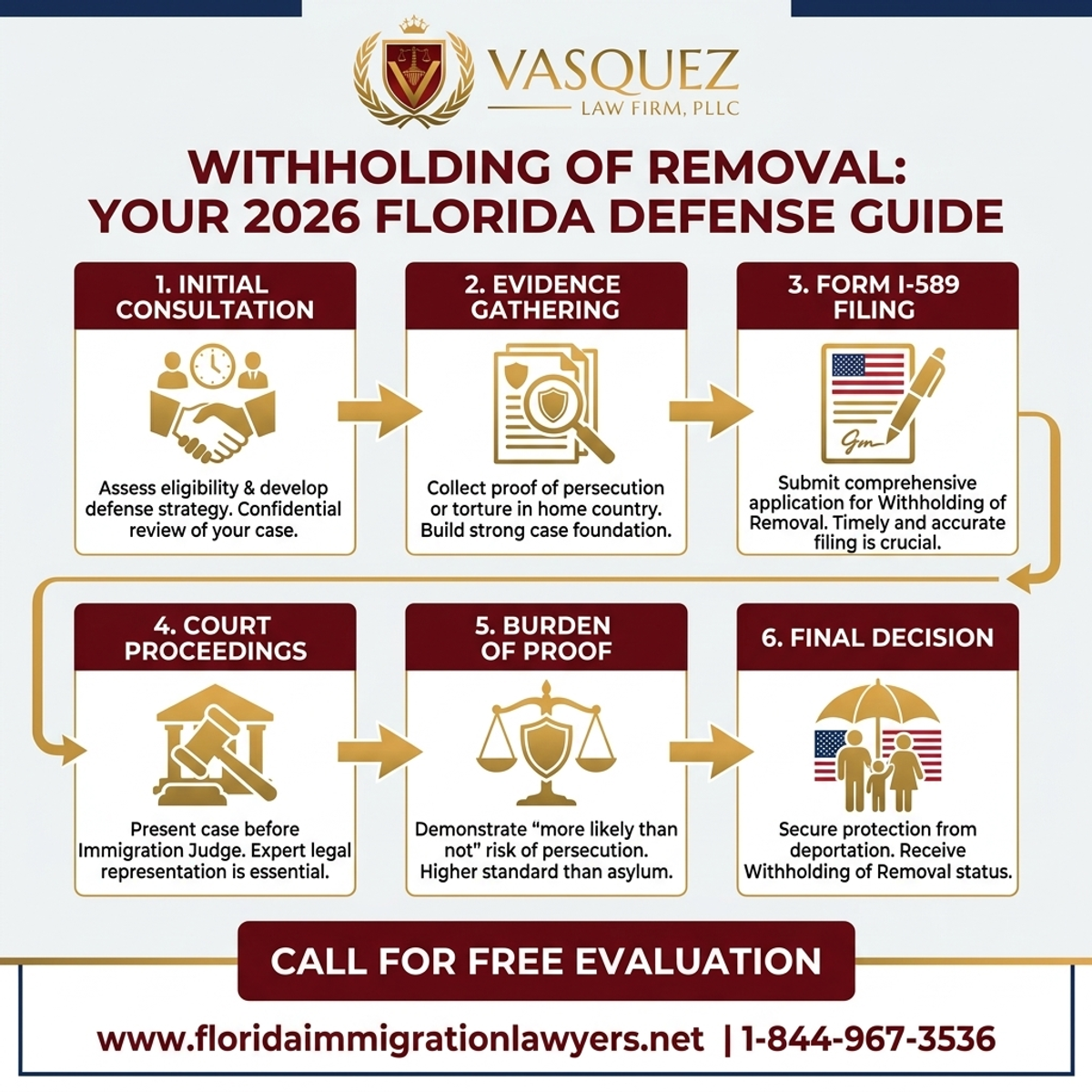
Step-by-Step Process — Withholding of Removal: Your 2026 Florida Defense Guide
Each stage of this process is critical and can significantly impact the outcome of your case. Missing deadlines or failing to present adequate evidence can have severe consequences. Florida Immigration Lawyers works diligently with clients throughout this entire process, from initial filings to complex appeals, ensuring every opportunity for protection is pursued vigorously.
What Documents Are Needed for a Withholding of Removal Application?
A successful withholding of removal application relies heavily on comprehensive and compelling documentation. Gathering the right evidence is paramount to meeting the "more likely than not" standard of proof. The stronger and more credible your evidence, the higher your chances of success in Florida's immigration courts. This often involves a blend of personal accounts and objective evidence to paint a clear picture of the dangers you face. Our firm guides clients through this often overwhelming task, ensuring no critical document is overlooked.
Key documents typically required include:
- Form I-589, Application for Asylum and for Withholding of Removal: This is the primary application form, detailing your personal information, history, and the basis of your fear.
- Personal Affidavit/Declaration: A detailed, sworn statement describing your experiences of persecution or torture, your fears, and why you cannot return to your country.
- Country Conditions Reports: Objective evidence from reputable sources (e.g., U.S. State Department, Amnesty International, Human Rights Watch) detailing human rights abuses, political instability, and persecution in your home country.
- Identity and Travel Documents: Passports, birth certificates, national ID cards, and any other documents proving your identity and nationality.
- Witness Affidavits: Sworn statements from individuals who can corroborate your story or provide insight into the conditions in your home country.
- Medical and Psychological Records: Documentation of physical injuries or psychological trauma resulting from persecution or torture.
- Police Reports or Court Documents: Any official records of incidents of persecution, arrests, or legal proceedings against you or your family.
- Membership Documentation: Proof of membership in any political, religious, or social groups that led to your persecution.
- Photographs, Videos, or News Articles: Any visual or media evidence supporting your claims.
Organizing and presenting these documents effectively is a crucial aspect of a successful defense. In Florida, our attorneys meticulously prepare these evidentiary packets, ensuring they meet the stringent requirements of the Executive Office for Immigration Review (EOIR) and are persuasive to the Immigration Judge. We understand the specific nuances that can strengthen a withholding of removal case, particularly for individuals from countries experiencing ongoing political turmoil or violence, which is often relevant to clients seeking protection in Florida.
Understanding Convention Against Torture (CAT) Protections in Florida
The Convention Against Torture and Other Cruel, Inhuman or Degrading Treatment or Punishment (CAT) provides another vital layer of protection for individuals facing deportation. Unlike withholding of removal based on persecution, CAT protection is granted to individuals who can demonstrate that it is more likely than not they would be tortured if removed to their home country. This protection applies regardless of the reason for the torture, as long as it is inflicted by or with the acquiescence of a public official or someone acting in an official capacity. This is a crucial distinction, as CAT does not require a nexus to a protected ground (like race or religion) but focuses solely on the likelihood of torture. For many individuals in Florida, including those who may have criminal convictions that bar them from other forms of relief, CAT can be their last and best hope.
To qualify for CAT protection, you must prove that you face the threat of torture, not just persecution. Torture is defined as severe physical or mental pain or suffering intentionally inflicted for purposes such as obtaining information, punishment, intimidation, or discrimination. Importantly, the government of the country of removal must be involved in or consent to the torture. This means showing that government officials, or those acting under their authority, would participate in, instigate, or acquiesce to the torture. In Florida, our firm has successfully argued CAT cases for individuals from various countries where state-sponsored violence or official impunity is rampant. We meticulously gather evidence, including expert testimony on country conditions, to meet the high burden of proof required by the regulations found in 8 CFR 208.16(c). Understanding the specific requirements of CAT is essential for a robust deportation defense, and our attorneys are adept at presenting these complex arguments.
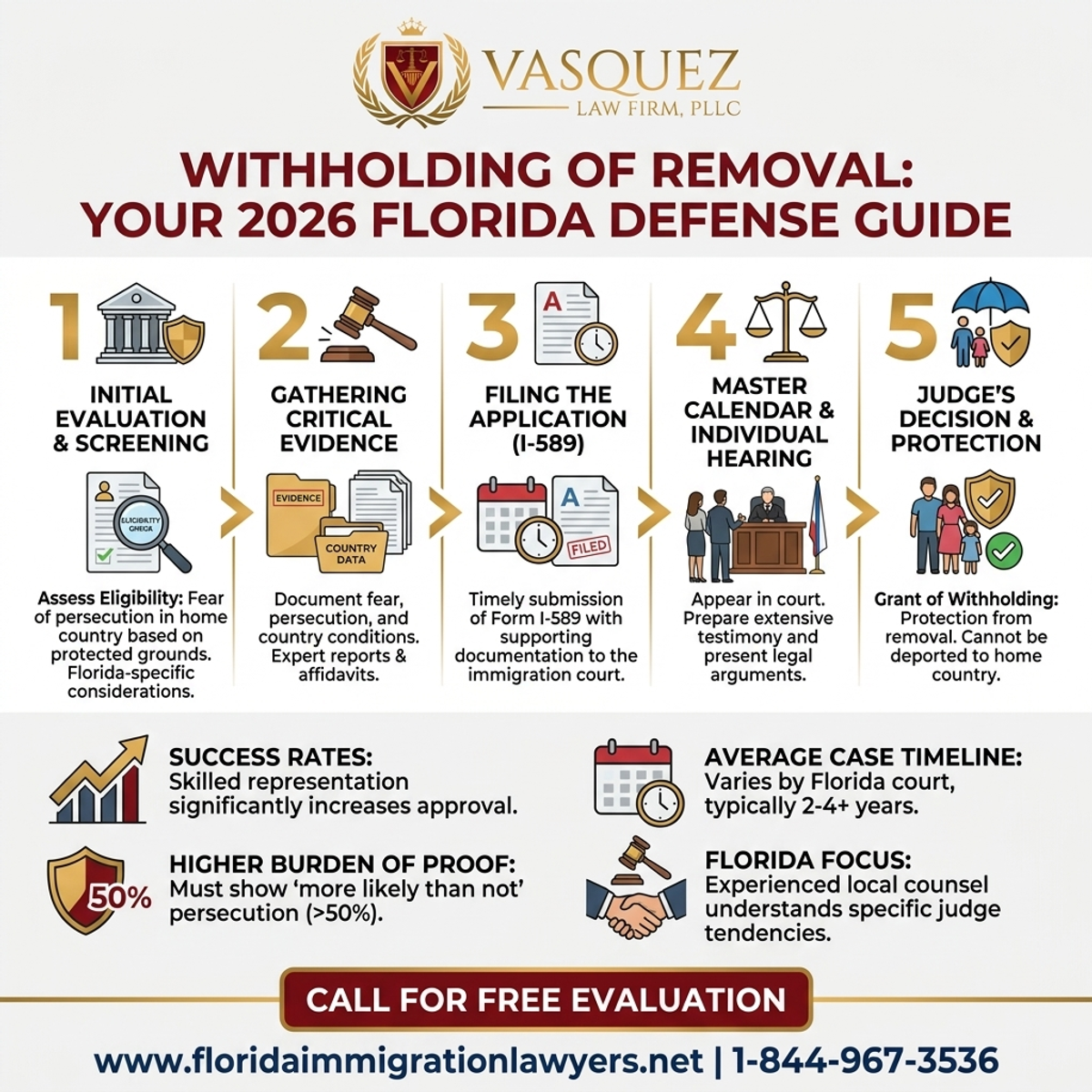
Key Statistics — Withholding of Removal: Your 2026 Florida Defense Guide
What is the Typical Timeline for Withholding of Removal Cases in 2026?
The timeline for withholding of removal cases can vary significantly based on the immigration court's caseload, the complexity of the individual case, and the availability of judges. As of 2026, immigration courts across the United States, including those in Florida, continue to experience significant backlogs. This means that from the initial Notice to Appear to a final decision, the process can span several months to several years. Understanding these potential delays is crucial for managing expectations and preparing for a prolonged legal battle. Our firm helps clients in Hialeah and throughout Florida navigate these timelines, providing consistent support and updates.
Here is a typical timeline breakdown:
| Stage | Typical Timeframe | Notes |
|---|---|---|
| Receipt of NTA to First Master Calendar Hearing | 2-6 months | Varies greatly by court location and current docket. |
| Master Calendar Hearings to Filing I-589 | 1-6 months | Judge sets deadlines for filing application and evidence. |
| Filing I-589 to Individual Hearing | 12-36 months | This is often the longest wait due to court backlogs. |
| Individual Hearing to Judge's Decision | Immediately or up to 6 months | Decision can be given orally at hearing or in writing later. |
| Decision to BIA Appeal (if applicable) | 30 days to file appeal | Strict deadline for filing Notice of Appeal. |
| BIA Decision | 6-24 months | Backlogs at the BIA can also cause significant delays. |
These timeframes are estimates and can fluctuate. For example, some cases might be expedited due to specific circumstances, while others may face longer delays. The complexity of your case, the volume of evidence, and the need for expert witnesses can all influence the overall duration. Our experienced deportation defense attorneys are committed to keeping you informed and prepared for each phase of this extended process.
What Are the Costs Associated with Withholding of Removal Cases?
Understanding the financial aspects of a withholding of removal case is important for planning and preparation. As of 2026, the U.S. Citizenship and Immigration Services (USCIS) does not charge a filing fee for Form I-589, Application for Asylum and for Withholding of Removal. This is a significant benefit, as it removes one barrier to seeking protection. However, while there are no government filing fees for the application itself, other costs are inevitably involved in preparing and presenting a strong case. These costs are primarily related to legal representation, evidence gathering, and administrative expenses. Florida Immigration Lawyers offers transparent fee structures and discusses all potential costs upfront, ensuring clients can make informed decisions.
Here is a breakdown of potential costs:
| Item | Typical Fee | Notes |
|---|---|---|
| Form I-589 Filing Fee | None | USCIS does not charge a fee for this application. |
| Attorney Fees | Varies (flat fee or hourly) | Covers preparation, court appearances, evidence review, and appeals. Complex cases typically incur higher fees. |
| Translation Services | Varies by document volume | Required for any documents not in English. Must be certified translations. |
| Expert Witness Fees | Varies (per report/testimony) | For country conditions experts, psychologists, or medical professionals. |
| Medical/Psychological Evaluations | Varies | If needed to document trauma or injuries. |
| Copying/Postage Fees | Minor | For submitting multiple copies of extensive evidence packets. |
While the cost of legal representation can be a significant investment, the potential outcome of securing protection from deportation often far outweighs the expense. Attempting to navigate the complexities of withholding of removal without experienced counsel can lead to critical errors and a higher risk of denial. Florida Immigration Lawyers understands the financial pressures many families face and strives to provide accessible, high-quality legal services. We believe that protecting your safety and future should be a priority, and we are here to discuss your options.
Do not navigate this complex process alone. The stakes are too high to risk a misstep. Contact Florida Immigration Lawyers today for a free consultation to discuss your specific situation and learn how we can help you build a strong defense against deportation.
Common Mistakes to Avoid in Withholding of Removal Cases
Navigating the legal intricacies of withholding of removal demands meticulous attention to detail. Even minor errors can lead to significant delays or, worse, a denial of your protection. Avoiding common pitfalls is crucial for a successful outcome. Here are some frequent mistakes and their potential consequences:
- Missing Filing Deadlines: Failing to submit Form I-589 or supporting documents by the judge's deadline can lead to the application being rejected or deemed abandoned.
- Insufficient Evidence: Not providing enough credible evidence to meet the "more likely than not" standard of proof for persecution or torture. This is a common reason for denial, as the burden is high.
- Inconsistent Testimony: Providing information that contradicts previous statements or application details. Inconsistencies can severely undermine your credibility with the Immigration Judge.
- Lack of Corroborating Evidence: Relying solely on your testimony without objective country conditions reports, witness affidavits, or other supporting documents. Corroboration is vital.
- Failing to Address Statutory Bars: Not understanding or adequately addressing potential bars to eligibility, such as serious criminal convictions or past persecution of others.
- Not Disclosing All Relevant Information: Hiding or omitting details about your past, especially criminal history or prior immigration encounters. This can be seen as a misrepresentation and lead to severe penalties.
- Poor Preparation for Hearing: Appearing in court unprepared for cross-examination or unable to clearly articulate your story and fears.
- Not Seeking Legal Counsel: Attempting to represent yourself in immigration court. The system is highly complex, and pro se applicants often struggle to meet legal standards.
- Ignoring Country Conditions Updates: Not staying informed about changing conditions in your home country that might impact your case, or failing to submit updated reports.
- Failing to Appeal a Denial: Missing the strict 30-day deadline to appeal a negative decision from the Immigration Judge to the Board of Immigration Appeals (BIA).
- Traveling Outside the U.S.: Leaving the country while your withholding of removal case is pending can be seen as an abandonment of your application and may lead to removal.
- Not Updating Contact Information: Failing to notify the court and DHS of any change in your address, which can result in missed notices and orders of removal issued in absentia.
Each of these mistakes can have dire consequences, potentially leading to a final order of removal. Working with an experienced immigration attorney significantly reduces the risk of these errors and strengthens your overall defense.
When to Call a Lawyer for Withholding of Removal in Florida
The decision to seek withholding of removal is rarely simple, and the process is fraught with legal complexities that are best navigated with professional guidance. You should call an experienced immigration lawyer, like those at Florida Immigration Lawyers, as soon as you are placed in removal proceedings or if you believe you may be eligible for this protection. The earlier you engage legal counsel, the more time your attorney has to prepare a robust defense, gather crucial evidence, and strategize your case. This is particularly true for individuals in Florida facing imminent deportation, as every moment counts.
Specific scenarios that strongly warrant immediate legal assistance include:
- You have received a Notice to Appear (NTA) in immigration court.
- You fear returning to your home country due to persecution or torture.
- You have a criminal record, even minor offenses, which might trigger statutory bars.
- You have previously been denied asylum or another form of relief.
- You have language barriers or difficulty understanding complex legal terminology.
- You need to gather extensive documentation, including country conditions reports or expert testimony.
- You are unsure whether you meet the eligibility criteria for withholding of removal or CAT.
- You are facing a tight deadline for filing your application or responding to court orders.
- You are detained by ICE in Florida, such as at the Krome Service Processing Center or Glades County Detention Center.
An attorney from Florida Immigration Lawyers can assess your unique situation, identify potential challenges, and develop a tailored strategy. We are committed to protecting your rights and fighting for your safety in Florida's immigration courts. Our skilled attorneys have extensive experience in asylum and withholding of removal cases, understanding the nuances of current immigration policies and legal precedents. We serve clients across Florida, including Hialeah, Miami, Orlando, and Tampa, offering comprehensive support for your deportation defense needs.
About Florida Immigration Lawyers
Florida Immigration Lawyers is a leading law firm dedicated to providing comprehensive and compassionate legal representation to immigrants across the entire state of Florida. With a deep understanding of the complexities of U.S. immigration law, our experienced attorneys are committed to helping individuals and families navigate their legal challenges, from deportation defense to family-based petitions and citizenship applications. We pride ourselves on our client-focused approach, offering personalized strategies tailored to each unique case. Our firm serves all communities in Florida, including the vibrant immigrant populations of Hialeah, Miami, Orlando, and beyond, ensuring access to justice for everyone.
We offer a wide range of immigration services, including general immigration matters, deportation defense, asylum, withholding of removal, citizenship, family immigration, and business immigration. Our team is available 24/7 to provide support and guidance, understanding that immigration issues often arise unexpectedly. We offer free consultations to discuss your case and explore your options without any upfront financial commitment. When you choose Florida Immigration Lawyers, you choose a dedicated advocate committed to achieving the best possible outcome for your immigration journey.
Sources and References
- U.S. Citizenship and Immigration Services (USCIS)
- Executive Office for Immigration Review (EOIR)
- U.S. Department of State
- Immigration and Nationality Act (INA) Section 241(b)(3) - 8 U.S.C. § 1231(b)(3)
- 8 Code of Federal Regulations (CFR) § 208.16 - Rules for asylum and withholding of removal
- United Nations Convention Against Torture and Other Cruel, Inhuman or Degrading Treatment or Punishment
Related services: immigration waivers, humanitarian protection programs, DACA renewal and applications, temporary protected status (TPS).
This article provides general legal information and is not intended as legal advice. Every case is unique, and outcomes depend on specific facts and circumstances. Contact an attorney for advice about your particular situation.
Protecting your future and ensuring your safety is our top priority. If you or a loved one is facing deportation or fears returning to their home country, do not hesitate to seek professional legal assistance. Call Florida Immigration Lawyers today at 1-844-967-3536 for a free, confidential consultation. Se Habla Espanol - Estamos aqui para ayudarle.
Do Not Navigate This Process Alone
Our experienced immigration attorneys are ready to fight for you. Get a free, confidential consultation today.
Se Habla Español
Or leave your details and we’ll call you:
Free Evaluation in 24 Hours
Or talk to us right now

AI voice assistant — available 24/7
FreeFrequently Asked Questions

William J. Vásquez
Founding Attorney · Vasquez Law Firm
U.S. Air Force veteran and immigration attorney with years of hands-on U.S. immigration experience. J.D., NCCU School of Law. AILA member. Admitted to the 4th, 5th, and 11th Circuit Courts.
Available 24/7 - Free Evaluations
Reviewed for legal accuracy by William J. Vásquez
Licensed in North Carolina; U.S. immigration is federal practice.
Related Legal Services
Our Florida immigration attorneys can help you with immigration practice areas, free immigration consultation and experienced immigration attorneys. Call today at 1-844-967-3536 for a free consultation.
Related Links
Related Topics
Free Legal Consultation
Discuss your case with our experienced attorneys. We're available 24/7.
Se Habla Español - Estamos aquí para ayudarle.
Related Articles
Immediate Relative Petition Tampa: A Florida Guide for 2026
Navigating an immediate relative petition in Tampa, Florida, offers U.S. citizens a direct path to sponsor spouses, unmarried children under 21, and parents for a Green Card. This comprehensive guide, updated for 2026, details the Form I-130 process, eligibility requirements, necessary documentation, and typical timelines. Unlike other family-based categories, immediate relatives are exempt from annual visa quotas, potentially speeding up their journey to permanent residency. However, the process is intricate, demanding precise form completion, thorough evidence of a bona fide relationship, and adherence to strict legal guidelines. We cover common pitfalls to avoid, such as incomplete forms or insufficient financial sponsorship, which can lead to significant delays or denials. Understanding when to seek expert legal assistance is crucial, especially for cases involving complex relationship dynamics, prior immigration violations, or criminal histories. Florida Immigration Lawyers provides dedicated support to families in Gainesville, Tampa, and across Florida, ensuring a smooth and successful application process. We offer free consultations to help you understand your options and navigate the complexities of U.S. immigration law.
Parole in Place for Military Families Miami: A 2026 Guide
Explore how parole in place helps military families stay together in Miami. Understand the eligibility, process, and common mistakes to avoid. Contact Florida Immigration Lawyers for expert guidance.
eb2 niw lawyer florida: Navigating the NIW Process in 2026
For highly skilled professionals in Florida, the EB-2 National Interest Waiver (NIW) offers a direct path to a green card without employer sponsorship. This comprehensive guide for 2026 details the eligibility criteria, the step-by-step application process, expected processing times, and associated costs. Learn how to demonstrate substantial merit and national importance under the Matter of Dhanasar test, avoid common pitfalls, and understand when to seek expert legal counsel. Florida Immigration Lawyers specializes in assisting innovators, researchers, and entrepreneurs across Florida, including Pembroke Pines, to successfully navigate the complex NIW petition process and achieve permanent residency.
I-140 Premium Processing Timeline in Florida: What to Know
Navigating the I-140 premium processing timeline in Florida can be challenging. Our guide covers timelines, eligibility, and steps for EB-2 and EB-3 categories. Contact Florida Immigration Lawyers for expert assistance.