I-140 Premium Processing Timeline in Florida: What to Know
Navigating the I-140 premium processing timeline in Florida can be challenging. Our guide covers timelines, eligibility, and steps for EB-2 and EB-3 categories. Contact Florida Immigration Lawyers for expert assistance.

Understanding the I-140 premium processing timeline is crucial for immigrants in Florida. Typically, it expedites the process to 15 calendar days for eligible EB-2 and EB-3 petitions. This service is available for certain employment-based visa categories, providing faster decisions but not all cases qualify. Considerations include eligibility, costs, and documentation. For a detailed breakdown, read on or contact Florida Immigration Lawyers at 1-844-967-3536 for a free consultation.
- Premium processing expedites to 15 days.
- Available for EB-2 and EB-3 categories.
- Eligibility and documentation are key.
Introduction
In the bustling city of St. Petersburg, Florida, many immigrants seeking to establish their careers opt for employment-based visas. The I-140 petition, critical for EB-2 and EB-3 categories, can be expedited through premium processing, significantly reducing wait times. This article explores the timelines, eligibility requirements, and steps involved in the I-140 premium processing in Florida. Whether you're in St. Petersburg or nearby, understanding these details can streamline your immigration journey. Call Florida Immigration Lawyers at 1-844-967-3536 for a free consultation today.
Florida's dynamic economy, particularly in sectors like technology, healthcare, and tourism, attracts a diverse pool of international talent. For skilled professionals and individuals with advanced degrees, securing an employment-based green card is often a strategic move for long-term career growth and stability in the U.S. The I-140 petition serves as the foundation for this process, establishing the employer-employee relationship and the beneficiary's qualifications for the intended role.
While standard processing for I-140 petitions can extend for many months, premium processing offers a vital advantage, dramatically accelerating the decision-making period. This expedited service is not merely a convenience; it's a strategic tool that allows employers to quickly onboard critical talent and enables beneficiaries to plan their futures with greater certainty. For both individuals and businesses in Florida, leveraging premium processing can be a game-changer in navigating the complexities of U.S. immigration law.
What is the I-140 Premium Processing Timeline in 2026?
As of 2026, the I-140 premium processing timeline allows for a decision within 15 calendar days. This service, offered by USCIS, is available for certain employment-based visa categories, such as EB-2 and EB-3. The timeline begins once USCIS receives your complete application and the premium processing request.
With immigration processes becoming increasingly stringent, as noted in recent reports, premium processing provides a valuable option for those who qualify. It is important to ensure all documentation is accurate and complete to avoid delays.
The existence of premium processing underscores the U.S. government's recognition of the critical need for businesses to secure and retain top international talent efficiently. For employers, this means faster access to skilled workers who can fill crucial roles and contribute to economic growth without enduring lengthy, unpredictable wait times. For beneficiaries, it provides a clearer path to permanent residency, allowing for better personal and professional planning, including family reunification and career advancement.
The 15-calendar-day guarantee is a cornerstone of this service. It means that USCIS is legally bound to issue a decision – an approval, a denial, or a Request for Evidence (RFE) – within this timeframe. Should USCIS fail to meet this commitment, the premium processing fee is typically refunded, and the case continues to be processed under the expedited timeline. This commitment provides a level of predictability that is invaluable in the often-uncertain world of immigration.
Eligibility for premium processing primarily extends to specific subcategories within EB-2 (Professionals Holding Advanced Degrees and Persons of Exceptional Ability) and EB-3 (Skilled Workers, Professionals, and Other Workers). It's crucial to confirm that your specific I-140 classification is eligible, as rules can sometimes change or certain subcategories might be temporarily excluded. For instance, while most EB-2 and EB-3 petitions are eligible, some National Interest Waiver (NIW) petitions, which fall under EB-2, have had varying premium processing availability. Consulting with Florida Immigration Lawyers can help clarify your eligibility.
How to Apply for Premium Processing for I-140
- Check Eligibility: Confirm that your visa category qualifies for premium processing. Typically, EB-2 and EB-3 categories are eligible.
- Prepare Documentation: Gather all necessary documentation, including your I-140 petition and supporting evidence.
- Complete Form I-907: This form is required to request premium processing. Ensure it is accurately completed.
- Submit Your Application: Send the completed I-140 and I-907 forms, along with the required fee, to the appropriate USCIS service center.
- Receive USCIS Confirmation: Once received, USCIS will issue a confirmation notice, and processing will begin.
Ensuring accuracy at each step reduces the risk of delays or requests for additional information.
Delving deeper into eligibility, it's important to understand the specific criteria for EB-2 and EB-3. For EB-2, this often involves demonstrating an advanced degree (Master's or higher, or a Bachelor's degree plus five years of progressive experience) or exceptional ability in sciences, arts, or business. EB-3 petitions generally require a U.S. job offer and a PERM Labor Certification, with categories for skilled workers (requiring at least two years of experience or training), professionals (requiring a U.S. baccalaureate degree or foreign equivalent), and other workers (unskilled labor). Not all I-140 petitions are eligible for premium processing, so verifying your specific category and any temporary restrictions is the critical first step.
The preparation of documentation is arguably the most critical phase. Beyond the I-140 petition itself, you'll need robust evidence supporting the beneficiary's qualifications and the employer's ability to pay the offered wage. This includes academic transcripts, diplomas, professional licenses, detailed letters from previous employers verifying experience, a comprehensive job offer letter, and, if applicable, the certified PERM Labor Certification. Any discrepancies or missing pieces of evidence can trigger a Request for Evidence (RFE), which pauses the premium processing clock and adds significant stress and delay.
Form I-907, the Request for Premium Processing Service, is a standalone document that must be meticulously filled out. It requires specific information about the I-140 petition it accompanies, including the petitioner's and beneficiary's details, and the correct fee. It's vital to use the most current version of Form I-907 available on the USCIS website and to ensure the fee amount is accurate, as incorrect forms or fees are common reasons for rejection or delay. Always double-check the USCIS website for the latest forms and fee schedules.
When submitting your application, precision in mailing is paramount. USCIS designates specific service centers for different types of petitions, and sending your application to the wrong center can cause substantial delays. It is highly recommended to use a reputable courier service that provides tracking and delivery confirmation, such as USPS Certified Mail, FedEx, or UPS. This provides proof of submission and allows you to monitor the delivery status, which is the starting point for your 15-calendar-day premium processing timeline.
Upon successful receipt, USCIS will send a Form I-797C, Notice of Action, acknowledging the premium processing request and providing a receipt number. This receipt number is your key to tracking the status of your case online through the USCIS website. Monitoring this status regularly is a practical tip, as it will indicate when a decision has been made, an RFE has been issued, or if other actions are required. For complex cases or to ensure every detail is handled correctly, partnering with Florida Immigration Lawyers can provide invaluable peace of mind and expert guidance throughout this intricate application process.
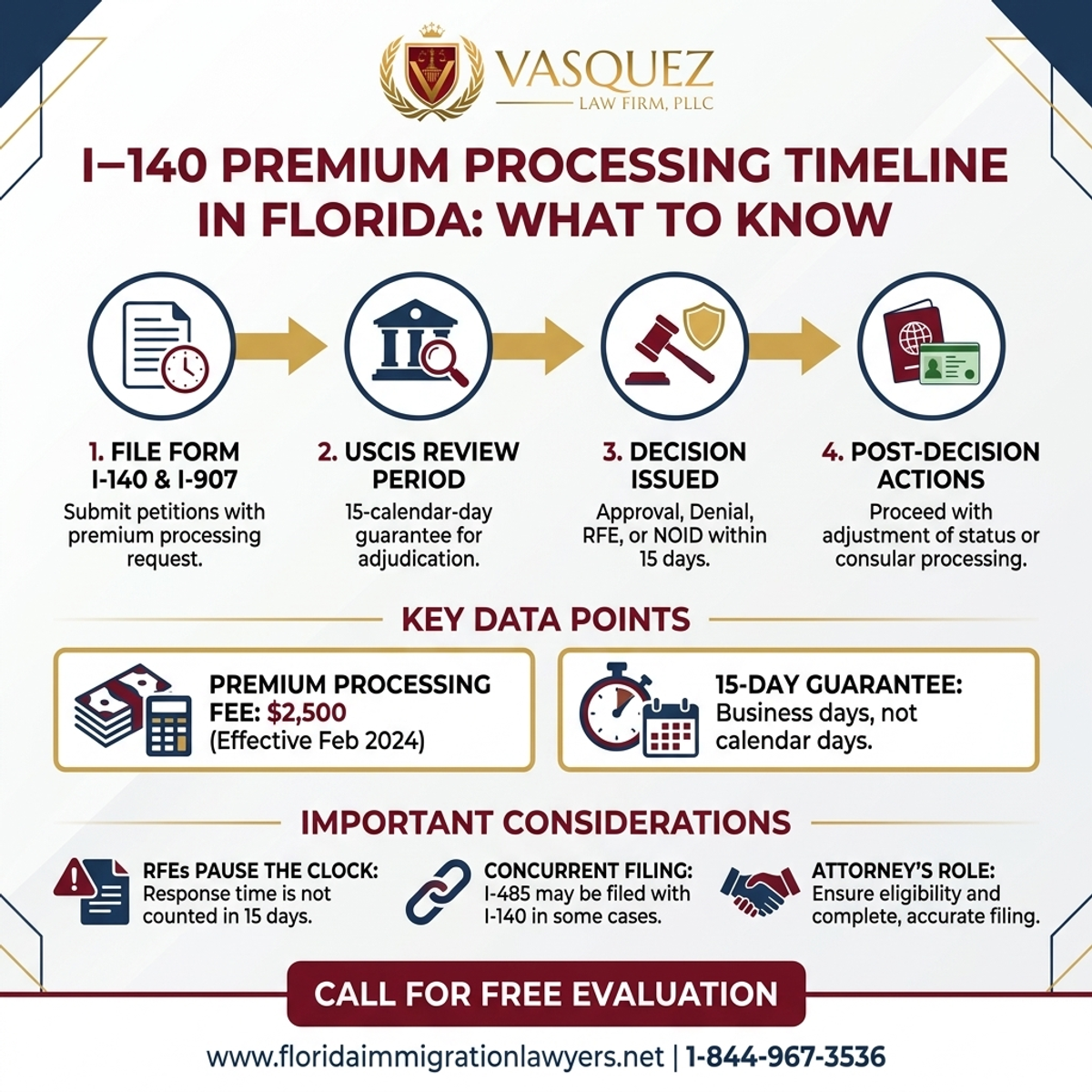
Step-by-Step Process — I-140 Premium Processing Timeline in Florida: What to Know
Document Checklist for I-140 Premium Processing
A meticulous approach to compiling your I-140 premium processing documentation is paramount. Any missing or incorrect item can lead to significant delays, including a Request for Evidence (RFE), which pauses your premium processing clock and extends the overall timeline. Ensure every piece of evidence is clearly organized and labeled to facilitate USCIS review.
- Completed Form I-140
- Completed Form I-907 for premium processing
- Proof of eligibility (e.g., labor certification, employer's letter of support)
- Filing fees (check the latest fees on USCIS)
- Supporting documentation (e.g., educational credentials, work experience letters)
For "proof of eligibility," this typically includes an approved PERM Labor Certification (Form ETA-9089) if required for your EB-2 or EB-3 category, a detailed job offer letter outlining the position, duties, and salary, and evidence of the employer's ability to pay the offered wage from the priority date. "Supporting documentation" should encompass certified copies of all academic degrees, transcripts, professional licenses, and comprehensive letters from previous employers verifying all relevant work experience. For EB-2 exceptional ability cases, evidence of sustained national or international acclaim is also crucial. Florida Immigration Lawyers can help you ensure your documentation is comprehensive and compelling.
Typical Timeline and Processing Expectations
| Stage | Typical Timeframe | Notes |
|---|---|---|
| I-140 Submission | Initial 1-2 weeks | Includes preparation and mailing time |
| USCIS Receipt | 15 calendar days | Under premium processing |
| Decision Issued | Within 15 days | Includes approval, denial, or request for evidence |
These timeframes provide a general guide but may vary based on specific case circumstances and USCIS workload.
It's important to understand the stark contrast between standard I-140 processing and premium processing. Without premium processing, I-140 petitions can languish for many months, sometimes exceeding a year, depending on the service center's workload and the specific visa category. This extended wait can create significant uncertainty for beneficiaries and employers, impacting career plans, family decisions, and business operations. Premium processing, therefore, offers a critical advantage by compressing
Sources and References
- U.S. Citizenship and Immigration Services (USCIS)
- Executive Office for Immigration Review (EOIR)
- U.S. Department of State - Bureau of Consular Affairs
- Immigration and Nationality Act (INA), 8 U.S.C. Chapter 12
Do Not Navigate This Process Alone
Our experienced immigration attorneys are ready to fight for you. Get a free, confidential consultation today.
Se Habla Español
Or leave your details and we’ll call you:
Free Evaluation in 24 Hours
Or talk to us right now
AI voice assistant — available 24/7
FreeFrequently Asked Questions

William J. Vásquez
Founding Attorney · Vasquez Law Firm
U.S. Air Force veteran and immigration attorney with years of hands-on U.S. immigration experience. J.D., NCCU School of Law. AILA member. Admitted to the 4th, 5th, and 11th Circuit Courts.
Available 24/7 - Free Evaluations
Reviewed for legal accuracy by William J. Vásquez
Licensed in North Carolina; U.S. immigration is federal practice.
Related Legal Services
Our Florida immigration attorneys can help you with deportation defense, citizenship and naturalization and family immigration services. Call today at 1-844-967-3536 for a free consultation.
Related Links
Related Topics
Free Legal Consultation
Discuss your case with our experienced attorneys. We're available 24/7.
Se Habla Español - Estamos aquí para ayudarle.
Related Articles
Unlawful Presence Waiver Florida: A 2026 Guide
Discover how the unlawful presence waiver can help immigrants in Florida stay with their families while adjusting their status. Learn about the I-601A process and eligibility criteria.
USCIS Oath Ceremony Schedule 2026: What to Expect in Florida
For those in Florida awaiting U.S. citizenship in 2026, understanding the USCIS oath ceremony schedule and naturalization processing times is vital. This guide covers the journey from application to the final oath, detailing estimated timelines, required documents, and common pitfalls. Learn about the factors influencing processing in Florida's field offices, such as Miami, Orlando, and Tampa, and what to expect during your interview and the pivotal oath ceremony. We emphasize the importance of meticulous preparation and highlight when legal assistance from Florida Immigration Lawyers can be invaluable, especially with evolving immigration rules. Prepare for your future as a U.S. citizen with confidence and expert guidance.
Immigration Lawyer Orlando Free Consultation: Your 2026
Navigating immigration court proceedings in Florida requires expert legal guidance. This comprehensive guide details the step-by-step process of removal proceedings, essential documents, and critical timelines as of 2026. Learn about the costs of representation and common mistakes to avoid. For those in Orlando, Tallahassee, or any part of Florida, securing an immigration lawyer Orlando free consultation is your first step towards understanding your rights and building a strong defense against deportation. Florida Immigration Lawyers offers compassionate and effective legal support for all immigration court challenges, ensuring you have a dedicated advocate by your side.
"Narrative of Fear" Asylum I-589 in Florida 2026
Applying for asylum in the U.S. requires a compelling "narrative of fear" – a personal statement detailing why you cannot return to your home country due to persecution. This guide provides a comprehensive overview of the I-589 asylum application process in Florida for 2026, including essential steps, required documentation, typical timelines, and associated costs. Learn how to craft a strong narrative, what evidence is crucial, and common mistakes to avoid. With specific insights into Florida's immigration landscape, from West Palm Beach to Miami, this article highlights the importance of legal counsel in navigating the intricate federal regulations and local court procedures. Florida Immigration Lawyers offers expert guidance to protect your rights and help you secure safety.