"Narrative of Fear" Asylum I-589 in Florida: 2026 Guide
Preparing for your asylum interview in Florida, particularly when your I-589 application hinges on a "narrative of fear," is a pivotal moment in your journey towards protection. This comprehensive guide, relevant for 2026, details how to meticulously prepare your personal testimony and gather crucial evidence. Learn about the specific requirements for proving a well-founded fear of persecution based on protected grounds, and understand the interview process at the Miami Asylum Office serving Fort Lauderdale. We cover essential documents, potential costs, and common mistakes to avoid. Florida Immigration Lawyers offers expert guidance to strengthen your case and navigate the complexities of U.S. asylum law, ensuring your story is heard effectively.

Quick Answer: Preparing Your Asylum Interview in Florida
Preparing for your asylum interview, especially when your case hinges on a "narrative of fear" for an I-589 application in Florida, is a critical step towards securing protection in the United States. This process demands meticulous documentation, a clear and consistent recounting of your experiences, and a deep understanding of U.S. asylum law. In 2026, applicants must focus on detailing the specific persecution or well-founded fear they face, ensuring their story aligns with the legal definition of asylum. Seeking guidance from an experienced immigration attorney in Fort Lauderdale or across Florida can significantly strengthen your case and help navigate the complexities of USCIS procedures.
- Thoroughly document your persecution experiences and gather supporting evidence.
- Prepare a detailed, consistent, and coherent "narrative of fear."
- Understand the legal definition of asylum and how your case fits.
- Practice recounting your story clearly and calmly for the USCIS interview.
- Consult with a Florida immigration lawyer for expert guidance and representation.
Preparing for Your Asylum Interview: The "Narrative of Fear" in Florida (2026)
Facing the prospect of an asylum interview can be daunting, especially when your future depends on effectively communicating a deeply personal and often traumatic "narrative of fear." For individuals seeking asylum in Florida, filing the Form I-589, Application for Asylum and for Withholding of Removal, is just the beginning. The subsequent asylum interview is where your story, supported by evidence, comes to life before a USCIS Asylum Officer. A strong asylum interview preparation is not just about recounting events; it's about presenting a legally sound and credible case that demonstrates a well-founded fear of persecution in your home country. This guide aims to provide a comprehensive overview for asylum seekers in Florida, with a particular focus on the Fort Lauderdale area, as you navigate this crucial step in 2026.
Understanding the nuances of U.S. asylum law and the specific requirements for proving a "narrative of fear" is paramount. The stakes are incredibly high, as the outcome of this interview can determine your ability to remain safely in the United States. Whether you are preparing for your initial interview or facing a renewed application, the insights provided here will help you understand the process, gather necessary documentation, and mentally prepare for what lies ahead. Do not navigate this complex legal journey alone. Call Florida Immigration Lawyers at 1-844-967-3536 for a free consultation to discuss your specific asylum case and how we can assist you in building a compelling "narrative of fear."
What is a "Narrative of Fear" in an Asylum I-589 Application?
A "narrative of fear" in an asylum I-589 application refers to the detailed, personal account of the persecution you have suffered or the well-founded fear you have of future persecution in your home country. This narrative is the core of your asylum claim, explaining why you cannot return home and why you qualify for protection under U.S. law. It must be specific, consistent, and directly link your fear to one of the five protected grounds: race, religion, nationality, membership in a particular social group, or political opinion. The strength of this narrative, supported by corroborating evidence, is crucial for a successful asylum interview.
The concept of a "narrative of fear" is central to U.S. asylum law, as defined in the Immigration and Nationality Act (INA) Section 208, also codified as 8 U.S.C. § 1158. This section outlines the eligibility requirements for asylum, emphasizing that an applicant must demonstrate either past persecution or a well-founded fear of future persecution. Your narrative must convincingly articulate this fear, providing specific dates, locations, individuals involved, and the nature of the harm or threat. It should clearly explain how these experiences are connected to one of the protected grounds, making it clear that the persecution is not merely general hardship but targeted harm. For applicants in Florida, presenting a coherent and compelling narrative is essential for USCIS Asylum Officers, who are trained to assess credibility and consistency. This includes detailing any threats, violence, arbitrary detention, or discrimination you or your family members have faced, ensuring every detail contributes to a cohesive story of why you sought refuge.
Crafting this narrative requires careful introspection and often involves revisiting painful memories. It is not enough to simply state that you are afraid; you must show why your fear is objectively reasonable and subjectively genuine. This means providing context, explaining the political or social climate in your country, and illustrating how your personal circumstances place you at risk. For instance, if your claim is based on political opinion, your narrative should describe your political activities, the government's response to such activities, and specific threats or actions taken against you. Similarly, if you claim membership in a particular social group, you must define that group and explain how you belong to it and why that membership makes you a target. An experienced attorney can help you structure this narrative effectively, ensuring it meets legal standards and resonates with the Asylum Officer reviewing your case in Florida.
How Do I Prepare for My Asylum Interview in Fort Lauderdale, Florida?
Preparing for your asylum interview in Fort Lauderdale, Florida, involves several key steps: gathering all necessary documents, meticulously reviewing your I-589 application, and practicing how you will articulate your "narrative of fear" clearly and consistently. The interview typically takes place at the USCIS Asylum Office, which for many Florida residents is the Miami Asylum Office, serving the Fort Lauderdale area. Being well-prepared is the single most important factor in presenting a strong case.
- Review Your I-589 Application Thoroughly: Your interview will primarily be based on the information you provided in your Form I-589. Read every line of your application and any supplementary statements you submitted. Ensure you remember all dates, names, and events precisely as they are written. Any inconsistencies, even minor ones, can raise questions about your credibility. For applicants in Fort Lauderdale, it's crucial that your current testimony aligns perfectly with your original application. Highlight any areas where you might need to elaborate or clarify during the interview.
- Gather and Organize All Supporting Evidence: Collect every piece of documentation that corroborates your "narrative of fear." This includes country condition reports, news articles, police reports, medical records, affidavits from witnesses, photos, and any other relevant materials. Organize these documents logically, perhaps by date or type, making them easy to reference during the interview. Having a well-indexed binder can be extremely helpful. For those in Florida, ensuring the authenticity and translation of foreign documents is vital.
- Prepare Your Personal Testimony: Practice recounting your story out loud. Focus on being clear, concise, and consistent. Emphasize the direct connection between the persecution you faced (or fear) and one of the five protected grounds. The USCIS Asylum Officer will want to hear your story in your own words. While it can be emotionally challenging, try to remain calm and composed. Consider rehearsing with a trusted friend, family member, or, ideally, your attorney.
- Anticipate Questions and Prepare Answers: Think about the types of questions an Asylum Officer might ask. These often cover your background, family history, reasons for leaving your country, experiences of persecution, and details about your fear. Be prepared for questions that delve into specific dates, locations, and individuals. Also, anticipate questions about your journey to the U.S. and your activities since arriving. Your attorney can conduct mock interviews to help you prepare for various scenarios.
- Understand the Role of the Interpreter: If you do not speak English fluently, USCIS will provide a neutral interpreter. It is crucial to speak slowly and clearly, directing your answers to the Asylum Officer, not the interpreter. If you do not understand a question, ask for clarification. If you believe the interpreter made a mistake, politely bring it to the Asylum Officer's attention.
- Familiarize Yourself with the Interview Location: If your interview is at the Miami Asylum Office, understand the location, parking, and security procedures. Plan to arrive early to avoid any last-minute stress. Knowing the logistics can help reduce anxiety on the day of your asylum interview.
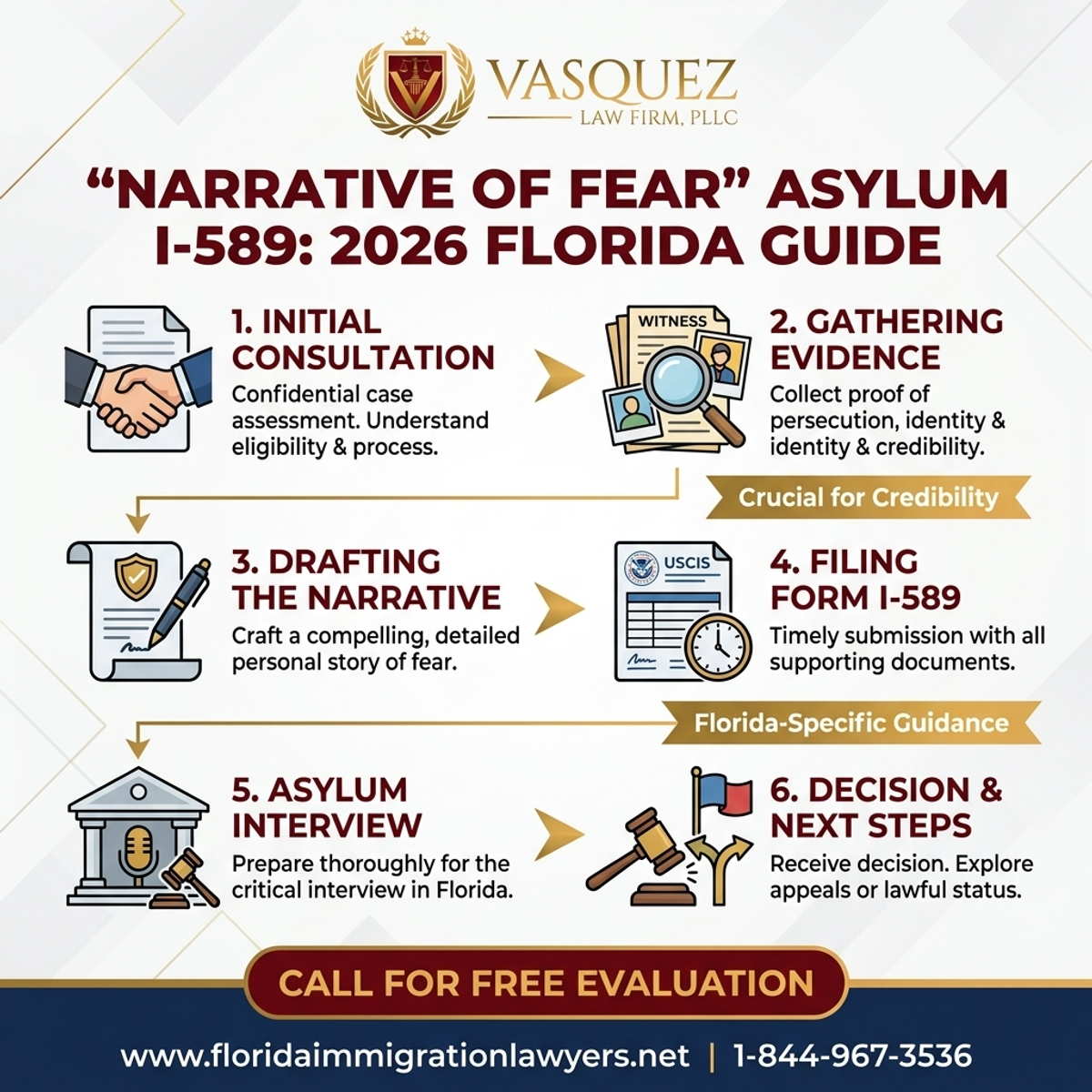
Step-by-Step Process — "Narrative of Fear" Asylum I-589 in Florida: 2026 Guide
What Documents Do I Need for My Asylum Interview?
For your asylum interview, you will need to bring a comprehensive set of documents to support your Form I-589 application and your "narrative of fear." These documents fall into several categories, including personal identification, evidence of persecution, and country conditions reports. Having all original documents, along with copies and certified translations, is crucial for a smooth interview process. The more thoroughly you can corroborate your story with objective evidence, the stronger your asylum claim will be.
Document Checklist for Your Asylum Interview:
- Personal Identification Documents:
- Original passport and travel documents (even expired ones).
- Birth certificate.
- Marriage certificate (if applicable).
- Children's birth certificates (if included in your application).
- Any other national identity cards.
- Form I-589 Application and Supplements:
- A complete copy of your filed Form I-589, including all supplementary statements and attachments.
- Any amendments or updates to your application since initial filing.
- Evidence of Persecution or Fear:
- Police reports, arrest warrants, or court documents from your home country.
- Medical records, psychological evaluations, or hospital records detailing injuries or trauma related to persecution.
- Newspaper articles, photos, videos, or social media posts showing persecution or threats against you or your family.
- Letters or affidavits from witnesses who can attest to your persecution or fear.
- Threatening letters, emails, or messages you received.
- Membership cards or evidence of political, religious, or social group affiliation.
- Country Conditions Reports:
- Reports from organizations like the U.S. Department of State (travel.state.gov), Amnesty International, Human Rights Watch, or other reputable sources.
- These reports provide objective evidence of the general human rights situation in your country and can corroborate the context of your personal narrative.
- Translations:
- All documents not in English must be accompanied by a certified English translation. The translator must certify that they are competent to translate and that the translation is accurate.
- Witnesses (if applicable):
- If you plan to bring witnesses, ensure they have valid identification and are prepared to testify. Discuss their testimony with your attorney beforehand.
What is the Asylum Interview Process and Timeline in 2026?
As of 2026, the asylum interview process generally begins after you file your Form I-589 and receive a receipt notice from USCIS. The timeline for an interview can vary significantly depending on caseloads at specific asylum offices, such as the Miami Asylum Office serving Fort Lauderdale. However, recent policies prioritize newer filings, often leading to interviews within a few months. The interview itself is a non-adversarial proceeding where an Asylum Officer assesses your credibility and the merits of your claim. Following the interview, you will typically receive a decision by mail.
The asylum interview is a crucial step in the affirmative asylum process. For those in Florida, your interview will likely be scheduled at the Miami Asylum Office. Here's a typical timeline and what to expect:
Asylum Interview Process and Timeline (As of 2026):
| Stage | Typical Timeframe | Notes |
|---|---|---|
| File Form I-589 | Day 0 | Must be filed within one year of your last arrival in the U.S., unless exceptions apply. |
| Receipt Notice & Biometrics Appointment | 1-4 weeks after filing | You will receive a receipt notice and a notice for a biometrics (fingerprinting) appointment. |
| Work Authorization Eligibility (EAD) | 150 days after I-589 filing (if no decision) | You may apply for an Employment Authorization Document (EAD) if your asylum application has been pending for at least 150 days and is not subject to any delays caused by you. |
| Asylum Interview Notice | Varies greatly; 2-12 months currently | USCIS aims to schedule interviews for recently filed cases first. You will receive a notice with the date, time, and location (e.g., Miami Asylum Office). |
| Asylum Interview | Scheduled date | Typically lasts 1-3 hours. You, your attorney, and an interpreter (if needed) will be present. The Asylum Officer will ask questions about your I-589 and your fear. |
| Decision Notification | 2-4 weeks after interview | USCIS aims to mail decisions within this timeframe. Some complex cases may take longer. You will receive a notice of intent to deny, a referral to Immigration Court (EOIR), or an approval. |
| Immigration Court Referral (if not approved) | Varies | If your asylum is not granted by USCIS, and you are not in a lawful status, your case will be referred to an Immigration Judge for de novo review. This could involve appearances at the Fort Lauderdale Immigration Court. |
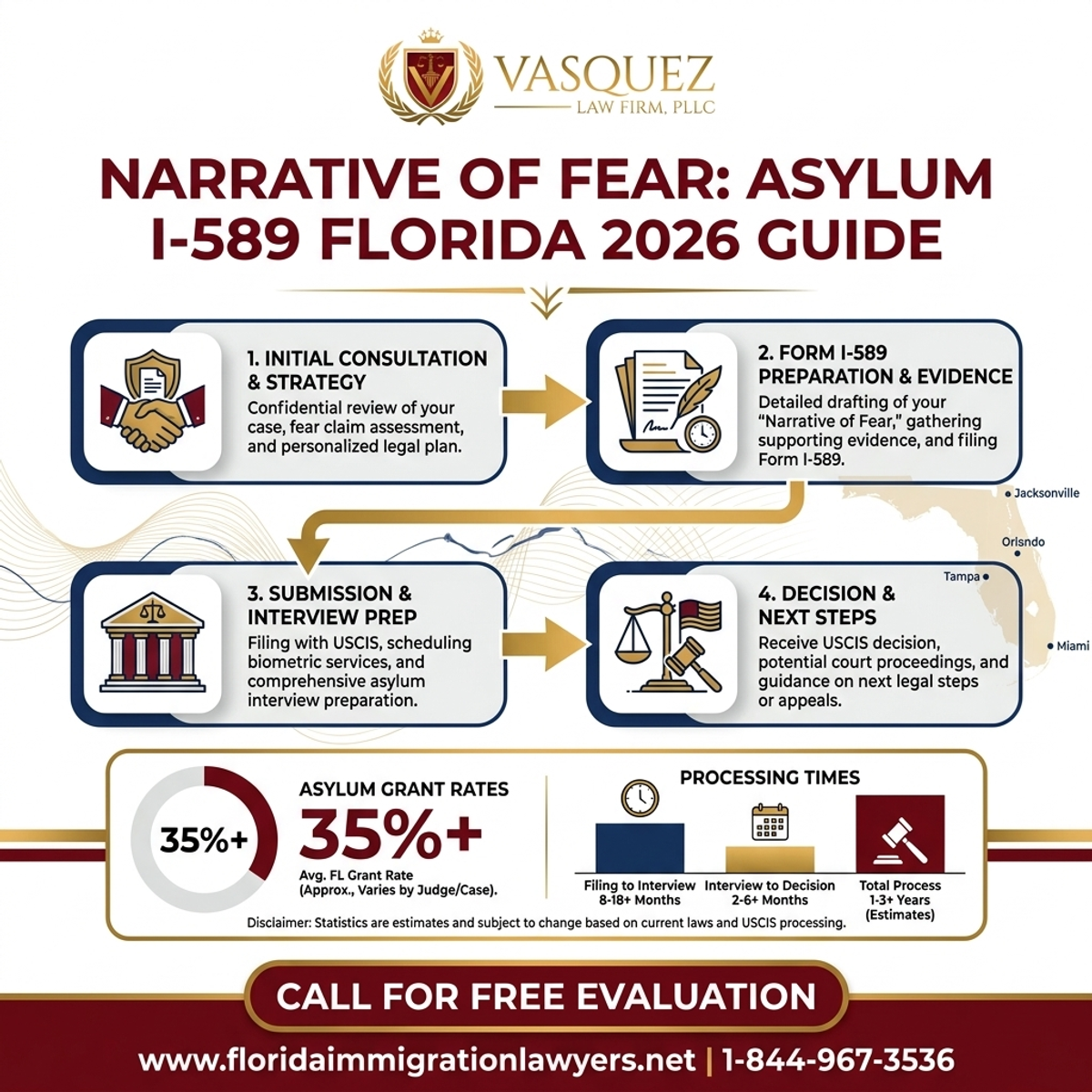
Key Statistics — "Narrative of Fear" Asylum I-589 in Florida: 2026 Guide
During the interview, the Asylum Officer will ask open-ended questions to allow you to tell your story. They will also ask specific questions to clarify details in your I-589 application and to assess your credibility. Be prepared to answer honestly and consistently. Your attorney can be present during the interview to provide legal advice, object to inappropriate questions, and help clarify your answers, but they generally do not testify on your behalf. Understanding the procedural aspects of the interview can help alleviate some anxiety and allow you to focus on presenting your compelling narrative.
Understanding Asylum Eligibility and Grounds for Persecution
Asylum eligibility in the United States requires an applicant to demonstrate a well-founded fear of persecution or proof of past persecution in their home country. This persecution must be on account of one of five specific grounds: race, religion, nationality, membership in a particular social group, or political opinion. Simply fearing general violence or economic hardship is not enough. Your "narrative of fear" must clearly link your experiences or anticipated harm to one of these protected characteristics, demonstrating that you are specifically targeted.
The legal framework for asylum is detailed under INA Section 208, which specifies these protected grounds. For example, if you claim persecution based on religion, you must show that you were targeted because of your religious beliefs or practices. This could involve being arrested for attending religious services or facing threats for converting to a different faith. Similarly, persecution based on political opinion requires evidence that you expressed a political view (even if imputed to you by persecutors) and faced harm as a direct result. This might include participation in protests, writing critical articles, or being associated with an opposition party. The key is to establish a nexus, or connection, between the harm and the protected ground. For individuals in Florida, it is important to understand how these grounds apply to your unique circumstances and how to present them effectively to USCIS.
Defining "membership in a particular social group" can be more complex, as this ground is not explicitly defined in the INA but has evolved through legal precedents and Board of Immigration Appeals (BIA) decisions, as detailed in 8 CFR Part 208. It generally refers to a group of persons who share a common immutable characteristic, or a characteristic that they cannot or should not be required to change, and who are perceived as a group by society. Examples often include individuals persecuted for their sexual orientation, gender identity, family ties, or certain occupations. The BIA often looks for social visibility and particularity of the group. A skilled immigration lawyer can help you determine if your experiences align with this evolving legal standard. Furthermore, while the news context of increased ICE fears for witnesses might seem distant, it underscores the general climate where individuals with credible fears of persecution may face additional anxieties, making strong legal advocacy even more vital. We recommend reviewing official USCIS guidelines for the most current definitions and examples of persecution grounds at USCIS Asylum Information.
What Are the Potential Costs Associated with an Asylum Case?
Generally, there are no filing fees for the Form I-589, Application for Asylum and for Withholding of Removal, itself. However, applicants should anticipate other potential costs associated with preparing and presenting a robust asylum case. These can include legal representation fees, translation services, medical or psychological evaluations, and costs for gathering supporting evidence. While the core application is free, investing in professional assistance can significantly impact the outcome of your asylum interview.
Understanding the financial aspects of an asylum case is important for planning. While USCIS does not charge a fee to file Form I-589, certain related applications and services do incur costs. For instance, if you apply for an Employment Authorization Document (EAD) using Form I-765 after your asylum application has been pending for 150 days, there is typically a filing fee, though it can sometimes be waived. The most significant expense for many asylum seekers in Florida is usually legal representation. An experienced immigration attorney provides invaluable assistance in preparing your "narrative of fear," gathering documents, and representing you at the asylum interview. While legal fees vary based on the complexity of the case and the attorney's experience, they are an investment in your future. Many firms, including Florida Immigration Lawyers, offer flexible payment plans or initial free consultations to help you understand your options.
Typical Costs Associated with an Asylum Case:
| Item | Typical Fee | Notes |
|---|---|---|
| Form I-589 Application | $0 | No filing fee for asylum applications. |
| Biometrics Services Fee | $0 | No fee for asylum applicants as of 2020. |
| Form I-765 (EAD Application) | Varies (e.g., $410 as of 2026) | Required for work authorization. Fee may be waived for low-income applicants. |
| Legal Representation | Varies widely ($3,000 - $10,000+) | Depends on case complexity, attorney experience, and services rendered (e.g., interview preparation, representation at interview, court appearances). |
| Document Translation Services | Varies ($20 - $100+ per page) | Required for all non-English documents. Costs depend on volume and language. |
| Medical/Psychological Evaluations | Varies ($500 - $2,000+) | If needed to document physical or psychological harm related to persecution. |
| Country Conditions Reports | Often free (online) or minimal cost | Access to many reports is free, but some specialized reports may incur costs. |
| Travel Expenses | Varies | To USCIS office (e.g., Miami Asylum Office from Fort Lauderdale), attorney's office, etc. |
While some costs are unavoidable, such as document translation, the investment in legal counsel can be crucial. An attorney helps ensure your application is complete, your "narrative of fear" is compelling, and you are fully prepared for the asylum interview, mitigating risks that could lead to denial or referral to immigration court. This is especially important in Florida, where the immigration landscape can be complex and ever-changing.
Do not navigate this process alone. Contact Florida Immigration Lawyers today at 1-844-967-3536 to schedule a free consultation and understand how our experience can benefit your asylum case.
Common Mistakes to Avoid in Your Asylum Interview
The asylum interview is a high-stakes event, and even minor missteps can have significant consequences for your case. Avoiding common mistakes is as important as effective preparation. These errors can undermine your credibility, weaken your "narrative of fear," and potentially lead to a denial or referral to immigration court. Being aware of these pitfalls can help you present the strongest possible asylum claim.
- Inconsistencies in Your Story: Any discrepancies between your I-589 application, supplementary statements, and your interview testimony can raise serious doubts about your credibility. Ensure your narrative is consistent across all platforms.
- Lack of Specificity: General statements about fear or persecution are insufficient. You must provide specific dates, locations, names, and detailed descriptions of events. "I was afraid" is not as compelling as "On [date], [persecutor] threatened me at [location] because of my [protected ground]."
- Failure to Provide Corroborating Evidence: A strong "narrative of fear" needs support. Not bringing or properly organizing all available evidence (medical records, police reports, news articles) can weaken your claim significantly.
- Misunderstanding the Five Protected Grounds: Many applicants fail to clearly link their persecution to race, religion, nationality, particular social group, or political opinion. Simply facing hardship or general violence is not enough for asylum.
- Poor Communication with the Interpreter: Speaking too fast, unclear articulation, or directing answers to the interpreter instead of the Asylum Officer can lead to misunderstandings or misinterpretations of your testimony.
- Arriving Late or Unprepared: Tardiness or forgetting essential documents can create a negative impression and cause unnecessary stress, impacting your ability to focus during the interview.
- Exaggerating or Fabricating Details: While tempting to strengthen a case, any exaggeration or fabrication, if discovered, will severely damage your credibility and could lead to a permanent bar from future immigration benefits.
- Failing to Disclose All Relevant Information: Omission of key facts, even if seemingly minor or embarrassing, can be seen as an attempt to deceive. Be truthful and comprehensive.
- Not Seeking Legal Counsel: Navigating asylum law is complex. Attempting to represent yourself without an experienced immigration attorney can lead to critical errors in legal strategy, evidence presentation, and interview conduct.
- Losing Composure During the Interview: While emotional, try to remain calm and answer questions clearly. Becoming overly emotional to the point of being unable to answer questions can hinder the process.
- Ignoring Country Conditions: Failing to provide or reference current country condition reports that support the context of your fear can make your personal narrative seem isolated or less credible.
- Not Understanding the Interview's Non-Adversarial Nature: While the Asylum Officer asks probing questions, the interview is generally non-adversarial. Viewing it as an interrogation rather than an opportunity to tell your story can impact your demeanor and responses.
When to Call a Florida Immigration Lawyer for Asylum Interview Preparation
You should call a Florida immigration lawyer for asylum interview preparation as soon as possible after filing your Form I-589, or ideally, even before filing. The complexities of asylum law, the specificity required for a "narrative of fear," and the high stakes of the interview make legal representation invaluable. An attorney can help you navigate the intricate legal requirements, prepare a compelling case, and represent you during the interview itself, significantly increasing your chances of success.
Consider contacting Florida Immigration Lawyers if you:
- Are unsure how to articulate your "narrative of fear" effectively.
- Need assistance gathering and organizing supporting documentation, especially if documents are in a foreign language.
- Have experienced past trauma that makes recounting your story difficult.
- Have any criminal history or previous immigration violations that could affect your eligibility.
- Received a Request for Evidence (RFE) from USCIS regarding your asylum claim.
- Are preparing for an interview at the Miami Asylum Office serving Fort Lauderdale.
- Fear returning to your country and want to understand all available protections, including withholding of removal or Convention Against Torture (CAT).
- Need help preparing for potential questions from the Asylum Officer and conducting mock interviews.
- Are concerned about the implications of current immigration policies on your case, such as those related to expedited processing or specific country conditions.
Our experienced team at Florida Immigration Lawyers understands the unique challenges faced by asylum seekers in Florida. We provide compassionate yet rigorous legal support, ensuring your story is heard and your rights are protected throughout the entire asylum process. We are committed to helping you build the strongest possible case for your asylum interview.
About Florida Immigration Lawyers
Florida Immigration Lawyers is a leading immigration law firm dedicated to serving individuals and families across the entire state of Florida. With a deep understanding of U.S. immigration law and a compassionate approach, our experienced attorneys provide comprehensive legal services for a wide range of immigration matters, including asylum, deportation defense, family immigration, business immigration, and citizenship. We are committed to protecting the rights and interests of our clients, offering personalized strategies tailored to each unique situation.
Our firm prides itself on its accessibility and client-focused service. We offer free consultations to help you understand your options without financial obligation. Our team is available 24/7, ensuring that you can reach us when you need us most. We understand the anxieties and complexities of the immigration system, and our bilingual staff is ready to assist clients in both English and Spanish, providing clear communication and support throughout your legal journey. Whether you are in Fort Lauderdale, Miami, Orlando, Tampa, or anywhere else in Florida, Florida Immigration Lawyers is here to be your trusted advocate. Visit our website at www.floridaimmigrationlawyers.net or call us today.
Sources and References
- U.S. Citizenship and Immigration Services (USCIS) - Asylum Information
- Executive Office for Immigration Review (EOIR)
- U.S. Department of State - Country Information
- Immigration and Nationality Act (INA) Section 208 (8 U.S.C. § 1158) - Asylum
- 8 CFR Part 208 - Asylum and Withholding of Removal
Related services: asylum application process, refugee status and resettlement.
This article provides general legal information and is not intended as legal advice. Every case is unique, and outcomes depend on specific facts and circumstances. Contact an attorney for advice about your particular situation.
The journey to obtaining asylum in the United States, particularly when your case relies on a compelling "narrative of fear" for your I-589 application, is profoundly personal and legally intricate. Preparing for your asylum interview in Florida requires diligence, courage, and expert guidance. By understanding the process, meticulously documenting your experiences, and preparing your testimony, you can present the strongest possible case to USCIS. Remember, you do not have to face this challenge alone. Florida Immigration Lawyers is here to provide the dedicated legal support you need every step of the way. Call us today at 1-844-967-3536 for a free, confidential consultation. Se Habla Espanol - Estamos aqui para ayudarle.
If you need legal assistance, learn more about our asylum and refugee protection services, or call us at 1-844-967-3536 for a free consultation.
Do Not Navigate This Process Alone
Our experienced immigration attorneys are ready to fight for you. Get a free, confidential consultation today.
Se Habla Español
Or leave your details and we’ll call you:
Free Evaluation in 24 Hours
Or talk to us right now
AI voice assistant — available 24/7
FreeFrequently Asked Questions

William J. Vásquez
Founding Attorney · Vasquez Law Firm
U.S. Air Force veteran and immigration attorney with years of hands-on U.S. immigration experience. J.D., NCCU School of Law. AILA member. Admitted to the 4th, 5th, and 11th Circuit Courts.
Available 24/7 - Free Evaluations
Reviewed for legal accuracy by William J. Vásquez
Licensed in North Carolina; U.S. immigration is federal practice.
Related Legal Services
Our Florida immigration attorneys can help you with experienced immigration attorneys, business immigration and asylum protection. Call today at 1-844-967-3536 for a free consultation.
Related Links
Related Topics
Free Legal Consultation
Discuss your case with our experienced attorneys. We're available 24/7.
Se Habla Español - Estamos aquí para ayudarle.
Related Articles
Immediate Relative Petition Tampa: A Florida Guide for 2026
Navigating an immediate relative petition in Tampa, Florida, offers U.S. citizens a direct path to sponsor spouses, unmarried children under 21, and parents for a Green Card. This comprehensive guide, updated for 2026, details the Form I-130 process, eligibility requirements, necessary documentation, and typical timelines. Unlike other family-based categories, immediate relatives are exempt from annual visa quotas, potentially speeding up their journey to permanent residency. However, the process is intricate, demanding precise form completion, thorough evidence of a bona fide relationship, and adherence to strict legal guidelines. We cover common pitfalls to avoid, such as incomplete forms or insufficient financial sponsorship, which can lead to significant delays or denials. Understanding when to seek expert legal assistance is crucial, especially for cases involving complex relationship dynamics, prior immigration violations, or criminal histories. Florida Immigration Lawyers provides dedicated support to families in Gainesville, Tampa, and across Florida, ensuring a smooth and successful application process. We offer free consultations to help you understand your options and navigate the complexities of U.S. immigration law.
Withholding of Removal: Your 2026 Florida Defense Guide
For those in Florida facing the threat of deportation, understanding withholding of removal and Convention Against Torture (CAT) protections is crucial. This comprehensive guide from Florida Immigration Lawyers explains eligibility, the complex process in immigration court, required documentation, and what to expect as of 2026. Learn about the high burden of proof, statutory bars, and the critical differences between these forms of relief. We cover the typical timeline for cases in Florida courts, associated costs, and common mistakes to avoid. With skilled legal representation, you can build a strong defense against removal and fight for your right to safety. Discover how our attorneys can assist you in navigating the intricacies of immigration law in Florida, from initial filings to appeals, ensuring your case is handled with expertise and compassion.
Parole in Place for Military Families Miami: A 2026 Guide
Explore how parole in place helps military families stay together in Miami. Understand the eligibility, process, and common mistakes to avoid. Contact Florida Immigration Lawyers for expert guidance.
eb2 niw lawyer florida: Navigating the NIW Process in 2026
For highly skilled professionals in Florida, the EB-2 National Interest Waiver (NIW) offers a direct path to a green card without employer sponsorship. This comprehensive guide for 2026 details the eligibility criteria, the step-by-step application process, expected processing times, and associated costs. Learn how to demonstrate substantial merit and national importance under the Matter of Dhanasar test, avoid common pitfalls, and understand when to seek expert legal counsel. Florida Immigration Lawyers specializes in assisting innovators, researchers, and entrepreneurs across Florida, including Pembroke Pines, to successfully navigate the complex NIW petition process and achieve permanent residency.