H-2A Visa for Florida Agricultural Workers in 2026
Florida's agricultural industry relies on the H-2A visa program to address temporary labor shortages. This comprehensive guide, updated for 2026, details the multi-agency application process for Florida growers seeking to employ foreign agricultural workers. Learn about eligibility, step-by-step procedures involving the DOL, USCIS, and DOS, crucial documentation, and estimated timelines. We also cover significant cost factors, common pitfalls to avoid, and when legal counsel is indispensable. Florida Immigration Lawyers provides assistance to ensure compliance and streamline the H-2A visa journey for your farm, protecting your operations and securing the necessary workforce.
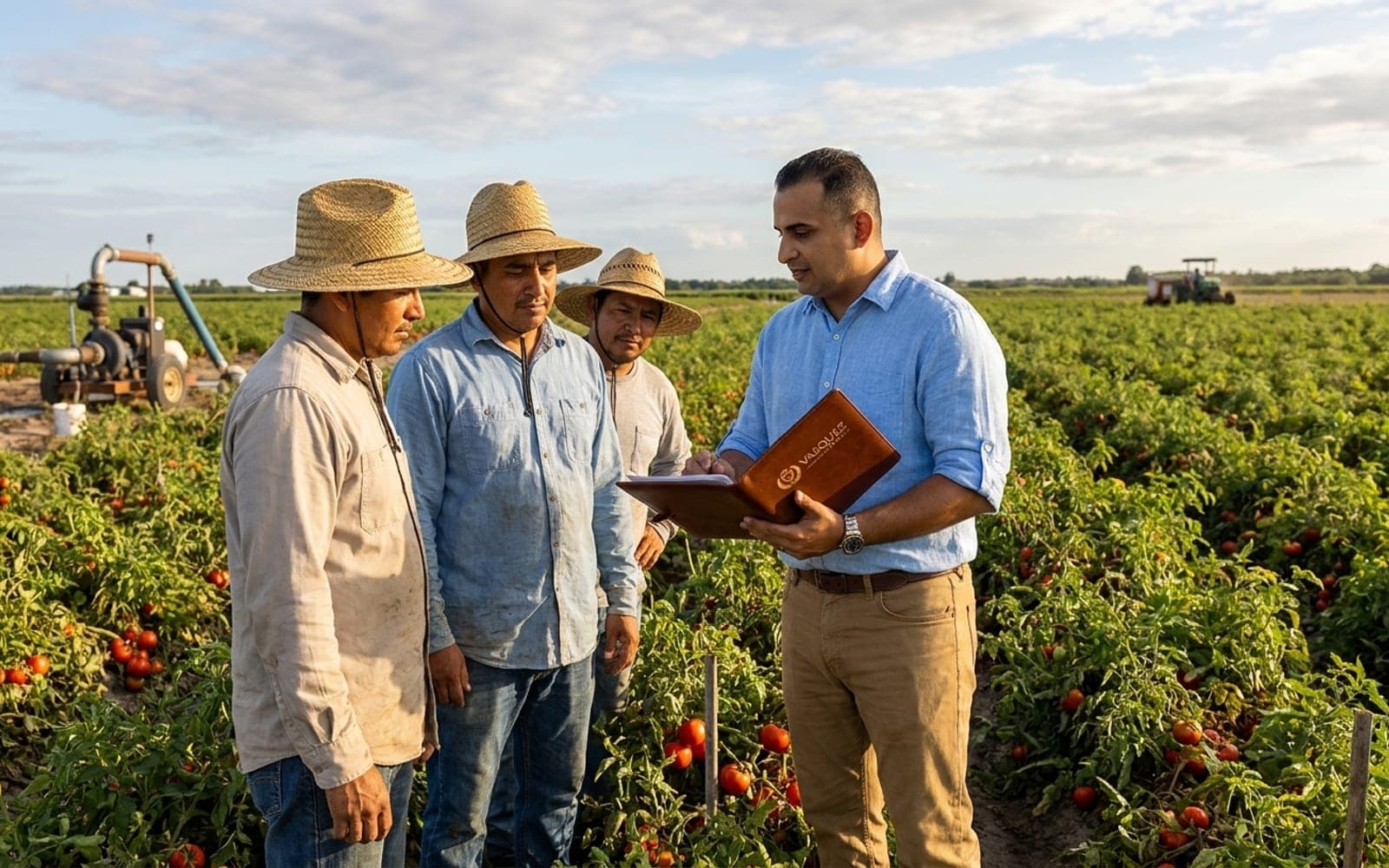
The H-2A visa program allows Florida agricultural employers to bring foreign nationals to the U.S. for temporary or seasonal agricultural work when there aren't enough U.S. workers available. As of 2026, the process involves multiple government agencies, including the Department of Labor (DOL), U.S. Citizenship and Immigration Services (USCIS), and the Department of State (DOS). Employers must demonstrate a temporary need, offer fair wages and working conditions, and actively recruit U.S. workers before seeking foreign labor. Navigating the H-2A visa process requires meticulous attention to detail and strict adherence to regulations to avoid delays or denials.
- H-2A visas address temporary agricultural labor shortages.
- Employers must prove a temporary need and recruit U.S. workers.
- The process involves DOL, USCIS, and DOS.
- Strict compliance with wage and housing regulations is mandatory.
- Legal guidance is crucial for a successful application.
Florida's vibrant agricultural sector, from citrus groves in Central Florida to vegetable farms across the state, relies heavily on a robust workforce. When domestic labor is scarce, the H-2A visa program offers a vital solution for growers to meet their seasonal demands. However, securing an H-2A agricultural worker visa in Florida is a complex undertaking, fraught with detailed regulations and strict timelines. Understanding the intricacies of this program is essential for any Florida grower looking to bring in temporary farm labor.
This comprehensive guide will walk you through the H-2A visa process, outlining eligibility, application steps, required documentation, timelines, and associated costs. We will also highlight common pitfalls to avoid and explain when seeking experienced legal counsel from Florida Immigration Lawyers can make all the difference. Our goal is to equip you with the knowledge needed to successfully navigate the H-2A visa landscape. Don't let the complexities of immigration law hinder your agricultural operations. Call Florida Immigration Lawyers at 1-844-YO-PELEO for a free case review today.
What is the H-2A Visa Program for Florida Growers?
The H-2A visa program is a nonimmigrant visa category specifically designed for U.S. agricultural employers who anticipate a shortage of domestic workers to perform temporary or seasonal agricultural labor. This program allows eligible employers to bring foreign nationals to the United States to fill these critical roles. The core principle of the H-2A program is to supplement, not supplant, the U.S. agricultural workforce. Therefore, employers must first demonstrate that there are not enough U.S. workers who are able, willing, qualified, and available to perform the work, and that employing H-2A workers will not adversely affect the wages and working conditions of similarly employed U.S. workers.
For Florida growers, understanding the specific requirements set forth by the Department of Labor (DOL) and U.S. Citizenship and Immigration Services (USCIS) is paramount. These requirements include providing adequate housing, transportation, and a guaranteed minimum number of work hours, along with paying the Adverse Effect Wage Rate (AEWR) or the prevailing wage, whichever is higher. The H-2A program is instrumental for many Florida farms, particularly those involved in labor-intensive crops like strawberries, tomatoes, and citrus, where the demand for temporary farm labor fluctuates significantly with harvest seasons. Proper planning and adherence to regulations, including those found in 8 U.S.C. § 1101(a)(15)(H)(ii)(a) and 20 CFR Part 655, are crucial for a successful H-2A petition.
The program ensures that both the employer and the temporary worker are protected under federal law. Employers must comply with strict recruitment efforts to test the U.S. labor market, including placing job advertisements in local newspapers and state workforce agencies. This meticulous process helps safeguard the integrity of the U.S. labor market while providing a legitimate pathway for Florida growers to access the necessary workforce during peak seasons. Failure to comply with any part of the H-2A regulations can lead to significant penalties, including debarment from the program. Therefore, it is advisable for Florida growers to seek legal assistance to navigate these complex requirements, ensuring their operations remain compliant and their labor needs are met.
How Do Florida Growers Apply for an H-2A Visa in 2026?
As of 2026, Florida growers initiate the H-2A visa application process by first obtaining a temporary labor certification from the U.S. Department of Labor (DOL), which confirms a legitimate need for foreign agricultural workers and that U.S. workers are unavailable. This step is critical and must be completed before filing any petition with USCIS.
Applying for an H-2A visa involves a multi-step process that requires careful planning and strict adherence to deadlines. Here is a step-by-step guide for Florida agricultural employers:
- File a Prevailing Wage Request (ETA Form 9141): The process begins by submitting ETA Form 9141 to the DOL's National Processing Center (NPC) to determine the appropriate Adverse Effect Wage Rate (AEWR) or prevailing wage for the job opportunity. This must be done at least 60 days, but not more than 150 days, before the employer's date of need.
- File an H-2A Application for Temporary Employment Certification (ETA Form 9142A): After receiving the Prevailing Wage Determination, employers must submit ETA Form 9142A to the DOL NPC. This application includes a job offer outlining the terms and conditions of employment, housing, and transportation. This form must be filed at least 45 days before the date of need.
- Conduct U.S. Worker Recruitment: Once the DOL accepts the application, employers must engage in good faith efforts to recruit qualified U.S. workers. This involves placing job orders with the State Workforce Agency (SWA) and advertising in local newspapers or other appropriate media outlets. Documentation of these recruitment efforts and their results is essential.
- Receive Temporary Labor Certification: If the DOL determines that there are no qualified U.S. workers available and that the employment of H-2A workers will not adversely affect U.S. workers, it will issue a Temporary Labor Certification (TLC).
- File Form I-129, Petition for a Nonimmigrant Worker: With the TLC in hand, the Florida grower must then file Form I-129, Petition for a Nonimmigrant Worker, with USCIS. This petition formally requests permission to bring the H-2A workers to the U.S. It must be accompanied by the approved TLC and all supporting documentation.
- Worker Visa Application and Interview: Once USCIS approves the I-129 petition, the prospective H-2A workers (if outside the U.S.) must apply for an H-2A visa at a U.S. embassy or consulate in their home country. This typically involves an interview and providing biometric data.
- Entry to the U.S. and Employment: Upon approval of the visa, the H-2A workers can then travel to Florida and begin their temporary agricultural employment as specified in the labor certification.
Throughout this process, meticulous record-keeping and strict adherence to all regulations, including those outlined in 8 CFR 214.2(h)(5) for H-2A petitions, are crucial. Given the complexity, many Florida farms, including those involved with "farmers and h-2a" program, find it beneficial to work with an experienced immigration attorney. For specific guidance on your situation, consider visiting the USCIS website.
What are the Requirements for an H-2A Agricultural Worker Visa?
The requirements for an H-2A agricultural worker visa are extensive, designed to protect both U.S. workers and the foreign temporary workers, and ensure the program is used only when genuinely needed. For Florida growers, meeting these criteria is non-negotiable for a successful application in 2026.
To qualify for the H-2A program, Florida agricultural employers must meet several key criteria, primarily proving a temporary or seasonal need for labor and offering specific conditions of employment. Here's a breakdown of the main requirements and a document checklist:
Employer Requirements:
- Temporary Need: The job must be seasonal or temporary, generally lasting no more than one year. This means the employer needs to demonstrate that the need for labor is tied to a season or a temporary event, such as a harvest.
- No U.S. Workers Available: The employer must prove that there are not enough U.S. workers who are able, willing, qualified, and available to perform the temporary agricultural work. This is demonstrated through rigorous recruitment efforts.
- No Adverse Effect: The employment of H-2A workers must not adversely affect the wages and working conditions of similarly employed U.S. workers. This is primarily addressed by paying the Adverse Effect Wage Rate (AEWR) or the prevailing wage.
- Housing: Employers must provide free, safe, and sanitary housing to all H-2A workers and to U.S. workers who are not reasonably able to return to their permanent residence daily. This housing must meet DOL and state housing standards.
- Transportation: Employers must provide transportation to and from the worksite and, in most cases, reimburse workers for their inbound and outbound transportation costs from their home country or place of recruitment.
- Tools and Supplies: All tools, supplies, and equipment required to perform the job must be provided by the employer at no cost to the worker.
- Work Guarantee: Employers must guarantee to offer each worker employment for at least 75% of the workdays in the contract period.
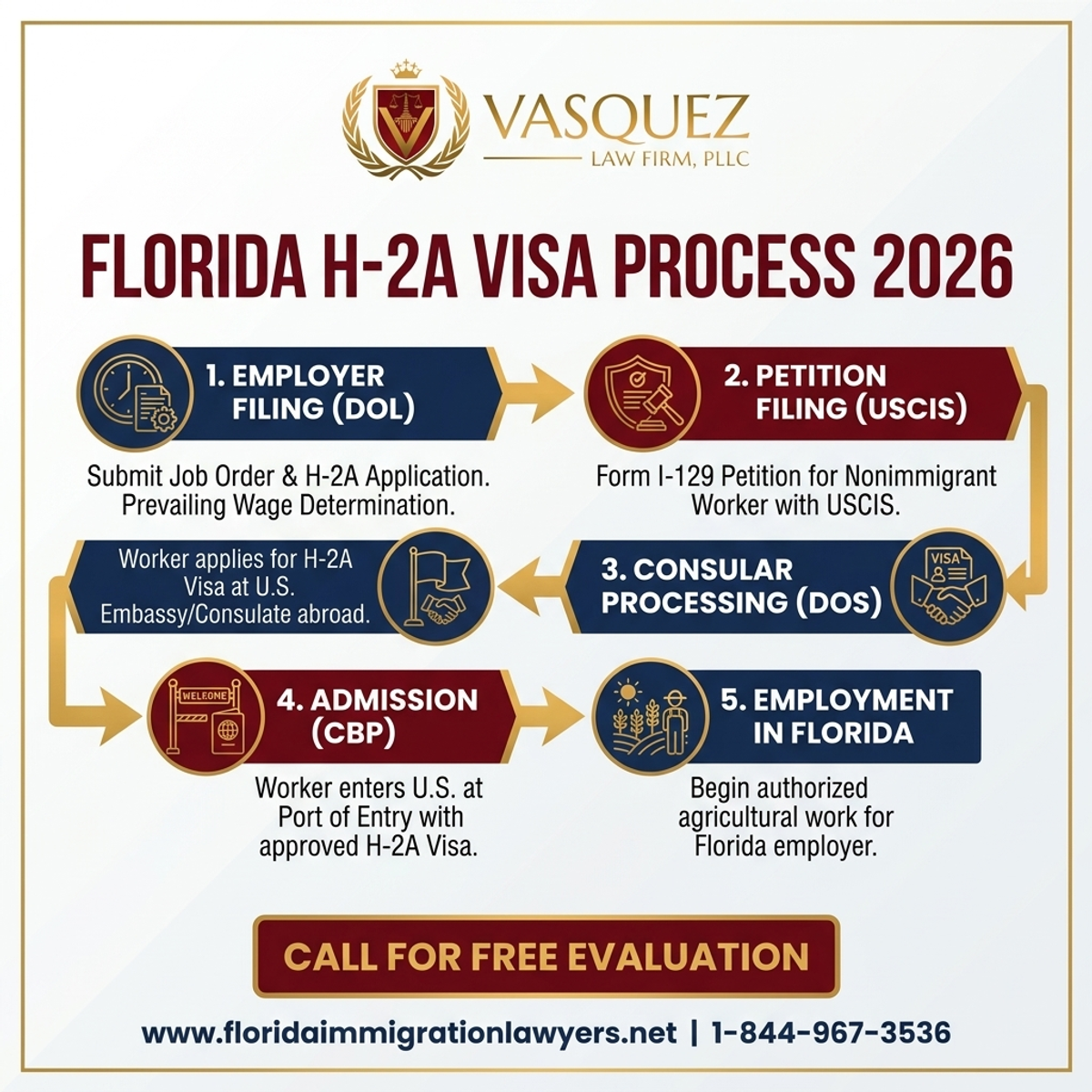
Step-by-Step Process — H-2A Visa for Florida Agricultural Workers in 2026
Document Checklist for H-2A Petitions:
- Completed ETA Form 9141, Application for Prevailing Wage Determination.
- Completed ETA Form 9142A, Application for Temporary Employment Certification.
- Approved Temporary Labor Certification from the DOL.
- Completed Form I-129, Petition for a Nonimmigrant Worker.
- H-2A Supplement to Form I-129.
- Proof of employer's legal business entity (e.g., articles of incorporation, business license).
- Detailed job description, including duties, hours, and wage offer.
- Evidence of U.S. worker recruitment efforts (e.g., newspaper ads, job orders).
- Documentation of available housing that meets federal and state standards (e.g., housing inspection reports).
- Proof of workers' eligibility (e.g., copies of passports, previous visas if applicable).
- Any required state or local permits or licenses.
- A detailed itinerary of work locations if the work involves multiple sites.
The rigorous nature of these requirements underscores the importance of precision. Any missing or incorrect documentation can lead to significant delays or even a denial of the H-2A petition, impacting Florida growers' ability to secure essential labor. For more detailed information, consult the Department of State's website on visa classifications.
How Long Does the H-2A Visa Process Take for Florida Farm Labor?
The H-2A visa process for Florida farm labor typically takes several months from the initial Prevailing Wage Request to the workers' arrival, often ranging from 3 to 6 months. This timeline can fluctuate significantly based on various factors, including the completeness of the application, agency backlogs, and the responsiveness of the employer to requests for evidence.
As of 2026, planning is critical for Florida growers, as the H-2A process involves multiple government agencies, each with its own processing times. Missing deadlines or submitting incomplete documentation can cause substantial delays, potentially jeopardizing a harvest. Here is a typical timeline:
| Stage | Typical Timeframe | Notes |
|---|---|---|
| Prevailing Wage Request (ETA Form 9141) | 60-150 days before need date | Filed with DOL. Processing can take 30-45 days. |
| Temporary Employment Certification (ETA Form 9142A) | At least 45 days before need date | Filed with DOL. DOL review and recruitment period. |
| U.S. Worker Recruitment Period | Approx. 30 days | Mandatory good faith efforts to find U.S. workers. |
| DOL Certification Decision | Within 30 days of application filing | If approved, Temporary Labor Certification is issued. |
| Form I-129 Petition Filing (USCIS) | After DOL certification | Filed with USCIS. Regular processing can take 2-3 months. |
| USCIS Premium Processing (Optional) | 15 calendar days | Available for an additional fee, guarantees faster I-129 processing. |
| Visa Interview & Processing (DOS) | Varies by consulate, typically 2-4 weeks | After I-129 approval, workers attend an interview abroad. |
| Worker Arrival in U.S. | Immediately after visa approval | Workers can enter up to 7 days before the start date. |
It is crucial for Florida growers to begin the H-2A process well in advance of their anticipated date of need, ideally 6-9 months out, to account for potential delays. The USCIS Service Centers, such as the California Service Center or Vermont Service Center, handle I-129 petitions, and their processing times can fluctuate. Employers must also be prepared to respond promptly to any Requests for Evidence (RFEs) from the DOL or USCIS. Proactive engagement with an experienced immigration lawyer can help streamline the process and mitigate potential delays, ensuring that temporary workers arrive when they are most needed on Florida farms.
What are the Costs Associated with the H-2A Visa for Temporary Workers?
The costs associated with the H-2A visa for temporary workers can be substantial and vary based on the number of workers and specific circumstances, covering application fees, recruitment, housing, and transportation. Florida growers should budget carefully for these expenses to ensure compliance and avoid financial surprises in 2026.
Employers sponsoring H-2A workers bear most of the associated costs. These expenses are mandated to protect the foreign workers and ensure the program does not negatively impact the U.S. labor market. Here is a breakdown of typical cost factors:
| Item | Typical Fee (as of 2026, approximate) | Notes |
|---|---|---|
| DOL Prevailing Wage Determination (ETA Form 9141) | No fee | Administrative process. |
| DOL Temporary Labor Certification (ETA Form 9142A) | No fee | Administrative process. |
| USCIS Form I-129 Filing Fee | Approximately $460 (subject to change) | Paid per petition, not per worker. Covers multiple workers. |
| USCIS American Competitiveness and Workforce Improvement Act (ACWIA) Fee | Varies based on employer size ($750 or $1,500) | Applicable for certain employers, consult current USCIS guidelines. |
| USCIS Fraud Prevention and Detection Fee | $150 | Paid per petition. |
| USCIS Premium Processing Fee (Optional) | Approximately $2,805 (subject to change) | Expedites I-129 processing to 15 calendar days. |
| Visa Application Fee (DS-160) | Approximately $205 per worker (subject to change) | Paid by the employer, must not be recouped from the worker. |
| Recruitment Costs | Varies ($500 - $2,000+) | Newspaper ads, job board postings, state workforce agency fees. |
| Transportation Costs | Varies ($300 - $1,000+ per worker) | Travel from home country/recruitment location to worksite, and return. |
| Housing Costs | Varies significantly (maintenance, utilities, inspections) | Employers must provide free, compliant housing. |
| Legal Fees | Varies ($3,000 - $7,000+ per petition) | For attorney consultation, preparation, and filing. |
| Wage Costs (AEWR) | Varies by state and occupation | Mandatory minimum wage, typically higher than federal minimum. |
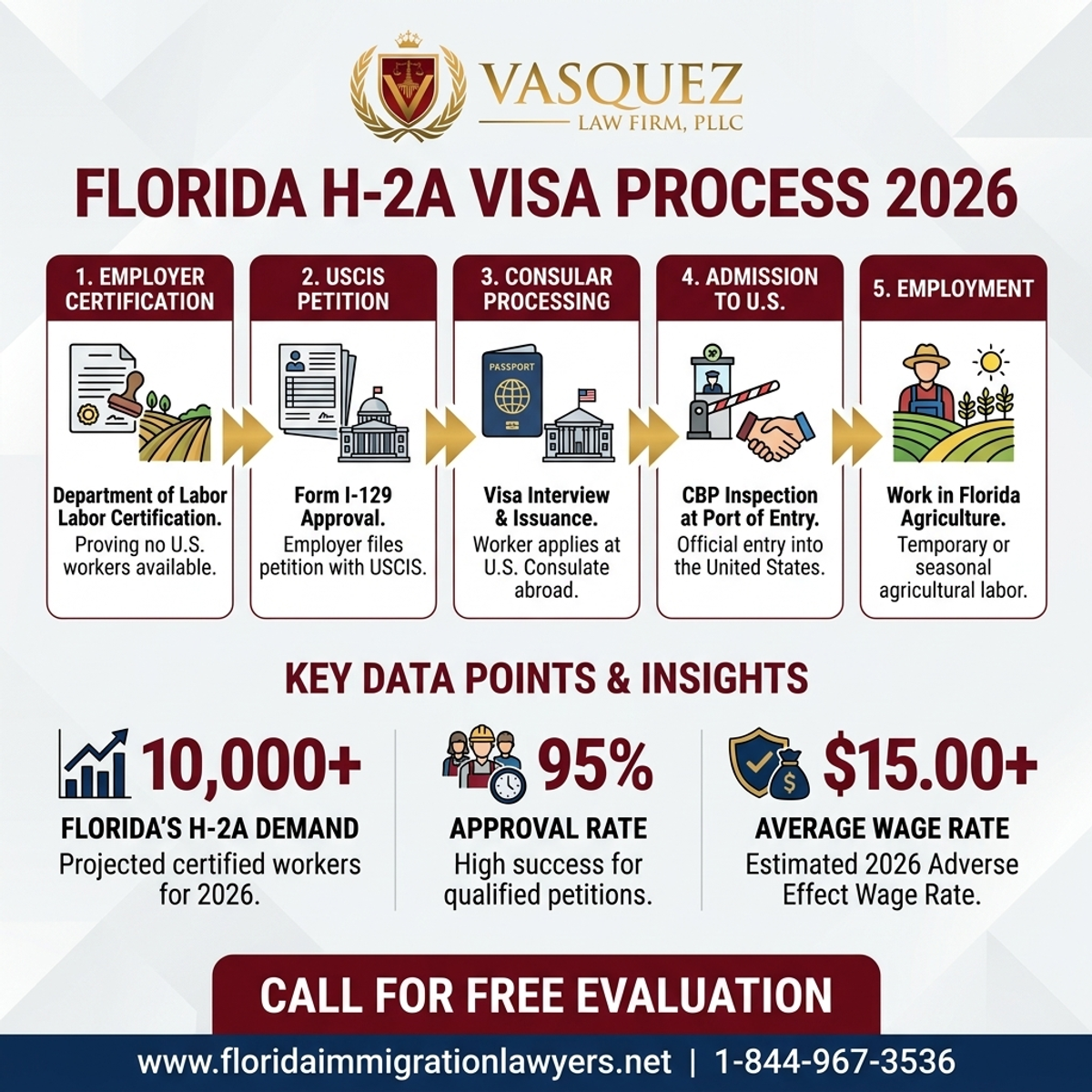
Key Statistics — H-2A Visa for Florida Agricultural Workers in 2026
It's important to note that many of these fees, particularly the visa application fees and transportation costs, cannot be passed on to the H-2A workers. Employers are responsible for these expenses. The Adverse Effect Wage Rate (AEWR) is also a significant ongoing cost, as it dictates the minimum hourly wage that must be paid to H-2A workers and similarly employed U.S. workers in the same occupation and area. For Florida, the AEWR is determined annually by the DOL. Consulting with an immigration attorney can help Florida growers accurately estimate these costs and ensure all financial obligations are met, safeguarding against potential audits or penalties from agencies like the Executive Office for Immigration Review (EOIR), which oversees immigration courts.
Common Mistakes to Avoid in the H-2A Visa Process for Florida Growers
The H-2A visa program, while beneficial, is notoriously complex. For Florida growers, a single misstep can lead to significant delays, denials, or even severe penalties. Avoiding common mistakes is crucial for a successful and compliant application.
- Failing to Meet Deadlines: The H-2A process has strict deadlines for filing forms with the DOL and USCIS. Missing these can result in automatic denials or necessitate starting the entire process over, causing critical delays for your farm labor needs.
- Inadequate U.S. Worker Recruitment: Employers must genuinely attempt to recruit U.S. workers. Insufficient advertising, failure to cooperate with State Workforce Agencies, or not documenting recruitment efforts properly can lead to a denial of labor certification.
- Incorrect Wage Rate Payment: Not paying the Adverse Effect Wage Rate (AEWR) or the prevailing wage (whichever is higher) is a frequent compliance issue. This can lead to back pay orders, fines, and debarment from the program.
- Substandard Housing: Providing housing that does not meet federal or state safety and health standards is a serious violation. Housing must be inspected and certified, and deficiencies can result in denials or costly remediation.
- Incomplete or Inaccurate Documentation: Even minor errors or omissions on forms (ETA Form 9142A, Form I-129) or missing supporting documents can trigger Requests for Evidence (RFEs) from USCIS or DOL, significantly delaying the process.
- Failure to Provide Transportation: Employers must provide transportation to and from the worksite and, in most cases, cover the cost of workers' travel to and from their home country. Failure to do so is a common violation.
- Lack of Work Guarantee: The H-2A program requires employers to guarantee at least 75% of the workdays specified in the contract. Not adhering to this guarantee can lead to breaches of contract and legal issues.
- Misunderstanding the Temporary Nature: The H-2A program is for temporary or seasonal work. Petitioning for permanent or year-round positions under H-2A can lead to denial and jeopardize future applications.
- Not Maintaining Proper Records: Employers must keep meticulous records of recruitment, payroll, housing, and other aspects for at least three years. Poor record-keeping makes it difficult to defend against audits or complaints.
- Improperly Laying Off U.S. Workers: Employers cannot lay off U.S. workers in the same occupation and area to hire H-2A workers, nor can they refuse to hire qualified U.S. workers who apply. This is a severe violation.
- Ignoring Post-Certification Obligations: The employer's responsibilities don't end with certification. Ongoing compliance with wage, housing, and working conditions throughout the contract period is crucial.
- Attempting to Recoup Employer-Mandated Fees: Charging H-2A workers for visa application fees, recruitment costs, or transportation costs that are the employer's responsibility is illegal and can result in severe penalties.
When to Call a Lawyer for Your H-2A Visa Needs
The H-2A visa process is undeniably complex, involving multiple federal agencies and stringent regulations. While some large agricultural operations may have in-house expertise, most Florida growers will significantly benefit from the guidance of an experienced immigration lawyer. You should consider calling Florida Immigration Lawyers if you are:
- New to the H-2A Program: If you've never applied for H-2A visas before, the learning curve is steep. An attorney can guide you through each step, ensuring compliance from the outset.
- Facing a Tight Deadline: If your harvest season is approaching rapidly and you need workers quickly, an attorney can help streamline the process and potentially utilize premium processing effectively.
- Received a Request for Evidence (RFE) or Notice of Intent to Deny (NOID): These indicate a problem with your application. An attorney can help you understand the issue and craft a comprehensive, well-supported response.
- Concerned About Compliance: If you're unsure about specific wage rates, housing standards, recruitment requirements, or record-keeping, an attorney can provide clarity and ensure you meet all legal obligations.
- Considering Expansion or Changes: If your farm operations are growing, or you plan to hire a large number of workers, an attorney can help scale your H-2A program efficiently and compliantly.
- Have a History of Violations or Audits: If your farm has previously faced issues with DOL or USCIS, legal counsel is essential to address past problems and ensure future compliance.
- Need Assistance with Worker Recruitment: An attorney can help develop a compliant recruitment strategy and ensure all efforts are properly documented.
- Require Assistance with Visa Interviews: While employers don't attend, an attorney can prepare workers for their consular interviews.
Florida Immigration Lawyers has extensive experience assisting agricultural employers throughout Florida, including those in Orlando and the surrounding Central Florida region, with their H-2A needs. We understand the unique challenges faced by the agricultural sector and are dedicated to providing clear, effective legal strategies. Our team can help with business immigration matters, ensuring your workforce needs are met legally and efficiently.
About Florida Immigration Lawyers
Florida Immigration Lawyers is a leading law firm dedicated to providing comprehensive and compassionate immigration legal services across the entire state of Florida. With our office strategically located in Orlando, we are uniquely positioned to serve individuals, families, and businesses throughout Central Florida and beyond. Our team of experienced attorneys understands the complexities of U.S. immigration law and is committed to guiding our clients through every step of their legal journey.
We focus on a wide range of immigration matters, including H-2A agricultural worker visas, family-based immigration, deportation defense, asylum claims, naturalization and citizenship, and various other immigration services. Our firm is available 24/7 to provide prompt assistance and offers free case reviews, ensuring that everyone has access to quality legal advice. We pride ourselves on our bilingual capabilities, with a team ready to assist clients in both English and Spanish, ensuring clear communication and understanding. Choose Florida Immigration Lawyers for dedicated advocacy and proven results. Schedule a free consultation today.
Sources and References
- U.S. Citizenship and Immigration Services (USCIS)
- Executive Office for Immigration Review (EOIR)
- U.S. Department of State (DOS)
- 8 U.S.C. Chapter 12 - Immigration and Nationality Act (INA)
- INA Section 101(a)(15)(H)(ii)(a) - Definition of H-2A Nonimmigrant
- 8 CFR Part 214.2(h) - Petitions for Nonimmigrant Workers
- 20 CFR Part 655 - Temporary Employment of H-2A Agricultural Workers in the United States
- USCIS Policy Manual
Related services: immigration practice areas, asylum protection, experienced immigration attorneys, immigration lawyer cost in Florida.
This article provides general legal information and is not intended as legal advice. Every case is unique, and outcomes depend on specific facts and circumstances. Contact an attorney for advice about your particular situation.
Securing H-2A agricultural workers is a critical process for many Florida growers. Don't leave your farm's future to chance. Contact Florida Immigration Lawyers today for a free, no-obligation case review and let our experienced team help you navigate the complexities of the H-2A visa program. Call us at 1-844-YO-PELEO. Se Habla Espanol - Estamos aqui para ayudarle.
Do Not Navigate This Process Alone
Our experienced immigration attorneys are ready to fight for you. Get a free, confidential case review today.
Se Habla Español
Or leave your details and we’ll call you:
Free Evaluation in 24 Hours
Or talk to us right now

AI voice assistant — available 24/7
FreeFrequently Asked Questions

William J. Vásquez
Founding Attorney · Vasquez Law Firm
U.S. Air Force veteran and immigration attorney with years of hands-on U.S. immigration experience. J.D., NCCU School of Law. AILA member. Admitted to the 4th, 5th, and 11th Circuit Courts.
Available 24/7 - Free Evaluations
Reviewed for legal accuracy by William J. Vásquez
Licensed in North Carolina; U.S. immigration is federal practice.
Related Legal Services
Our Florida immigration attorneys can help you with citizenship and naturalization, immigration practice areas and free immigration consultation. Call today at 1-844-YO-PELEO for a free case review.
Related Links
Related Topics
Free Legal Case Review
Discuss your case with our experienced attorneys. We're available 24/7.
Se Habla Español - Estamos aquí para ayudarle.
Related Articles
Certificate of Eligibility for Expungement in Florida 2026
For non-U.S. citizens in Florida, understanding how a state expungement impacts immigration status is critical. A certificate of eligibility for expungement in Florida allows a criminal record to be sealed or expunged under state law. However, federal immigration agencies often disregard such state-level relief, still considering the original criminal offense as a conviction for immigration purposes. This can have severe implications for visa applications, green card eligibility, naturalization, and even lead to deportation. This guide clarifies the Florida expungement process, its limited effect on federal immigration law, and key steps to protect your status in 2026. Learn about common mistakes, required documents, timelines, and when to seek expert legal counsel from Florida Immigration Lawyers to navigate these complex issues effectively.
Immigration Lawyer Orlando Free Consultation in Florida
For individuals and families in Orlando, Florida, navigating the complexities of U.S. immigration law requires expert guidance. An immigration lawyer in Orlando offers crucial support for everything from visa applications and green card processes to naturalization and deportation defense. This comprehensive guide details what a free consultation covers, providing a step-by-step overview of immigration pathways, essential document checklists, and expected timelines in 2026. We also highlight common mistakes to avoid, discuss the critical role of legal counsel in deportation and asylum cases, and explain why choosing a local Orlando immigration attorney is beneficial. Florida Immigration Lawyers is dedicated to serving the diverse community of Orlando with compassionate, effective legal solutions, ensuring you receive personalized advice and robust representation for a successful immigration journey.
Naturalization Ceremony Locations and Schedule 2026 Florida
For those in Florida aspiring to U.S. citizenship, understanding the naturalization process, including ceremony locations and schedules for 2026, is essential. This guide from Florida Immigration Lawyers details the N-400 application, eligibility requirements, and typical timelines. We cover the step-by-step journey, from initial filing and biometrics to the naturalization interview and the final Oath of Allegiance ceremony held across Florida's USCIS field offices, including Orlando, Miami, Tampa, and Jacksonville. Learn about critical documents, potential costs, and common mistakes to avoid. Our firm emphasizes the importance of accurate applications and offers expert legal assistance for complex cases, ensuring a smoother path to becoming a U.S. citizen. Get a free case review today.
Green Card Renewal Process in Florida: 2026 Guide
Renewing your green card in Florida is a vital process for maintaining your lawful permanent resident status. This comprehensive 2026 guide from Florida Immigration Lawyers breaks down the Form I-90 application, covering eligibility, step-by-step instructions, necessary documents, typical costs, and current processing timelines. We explain who needs to renew, what to expect at your biometrics appointment, and Florida-specific considerations for permanent residents. Learn how to avoid common mistakes that can delay your application and understand when professional legal assistance is crucial. Our expert attorneys are here to provide free case reviews and guide you through every stage, ensuring a smooth and secure renewal of your permanent resident card.