BIA Remand Order: What It Means for Your Florida Appeal 2026
A BIA remand order is a directive from the Board of Immigration Appeals (BIA) to send an immigration case back to an Immigration Judge (IJ) for further proceedings. This pivotal decision means your appeal is not over; instead, the case will be re-opened in Immigration Court to address specific legal errors or consider new evidence, as outlined by the BIA. For individuals in Florida, understanding the nuances of a remand is crucial for achieving a favorable immigration outcome. This comprehensive guide from Florida Immigration Lawyers explains what a BIA remand order is, why it occurs, and the critical steps you must take afterward. We detail the appeal process in Florida, outline essential documents, provide a timeline for remanded cases in 2026, and break down associated costs. Learn about common mistakes to avoid and when it is absolutely vital to seek expert legal counsel to protect your rights and future. Our firm offers dedicated, bilingual support across Florida, providing free case reviews to help you navigate this complex legal journey with confidence.

A BIA remand order occurs when the Board of Immigration Appeals (BIA) sends an immigration case back to the Immigration Judge (IJ) for further proceedings or clarification. This typically happens if the BIA finds a legal error, procedural flaw, or determines that new evidence needs to be considered. For individuals in Florida, a remand means the appeal process is not over; the case will be reopened before an IJ, requiring careful preparation and often new hearings to address the specific issues outlined by the BIA. Navigating a remand effectively is crucial for a favorable outcome.
- A BIA remand sends your case back to an Immigration Judge for reconsideration.
- It often indicates the BIA found an error or requires more evidence.
- You will likely have new hearings before an Immigration Judge in Florida.
- Careful preparation and legal counsel are essential for these renewed proceedings.
- A remand is not a final decision but an opportunity to present your case again.
Navigating the United States immigration system can be a daunting and often emotionally taxing journey, especially when facing an adverse decision. For many individuals and families in Florida, the prospect of an appeal to the Board of Immigration Appeals (BIA) represents a critical opportunity to challenge an unfavorable ruling from an Immigration Judge. However, receiving a BIA remand order can introduce a new layer of complexity and uncertainty. It is not an outright victory, nor is it a final defeat; rather, it is a directive from the BIA for your case to be sent back to the Immigration Court for further action.
Understanding what a BIA remand order entails, why it occurs, and how to effectively respond to it is paramount for anyone whose immigration future hangs in the balance. This comprehensive guide from Florida Immigration Lawyers will demystify the remand process, offering clear explanations, practical steps, and crucial insights specifically tailored for immigrants and their families across Florida. From the initial appeal to the BIA to the subsequent proceedings before an Immigration Judge, we will walk you through each stage, highlight potential pitfalls, and explain when expert legal assistance is indispensable. Our goal is to empower you with the knowledge needed to navigate this complex legal landscape. Call Florida Immigration Lawyers at 1-844-YO-PELEO for a free case review.
What is a BIA Remand Order and Why Does It Happen?
A BIA remand order is a directive from the Board of Immigration Appeals (BIA) to send an immigration case back to the Immigration Judge (IJ) for additional proceedings. This order signifies that the BIA has not issued a final decision on the merits of the appeal but has identified issues requiring further consideration at the Immigration Court level.
The Board of Immigration Appeals, housed within the Executive Office for Immigration Review (EOIR) of the U.S. Department of Justice, serves as the highest administrative body for interpreting and applying immigration laws. When an Immigration Judge renders a decision, either party (the noncitizen or the Department of Homeland Security) may appeal to the BIA. Upon review, the BIA has several options: it can affirm the IJ's decision, reverse it, or remand the case. A remand typically occurs for specific reasons, such as when the BIA finds that the IJ made a legal error, failed to consider crucial evidence, or that new evidence has emerged that warrants a fresh look. For instance, if an IJ misapplied a particular section of the Immigration and Nationality Act (INA) or did not adequately address a claim for relief, the BIA might send the case back with instructions for the IJ to correct the error or gather more facts. This action is codified under regulations like 8 CFR § 1003.1(d)(6), which grants the BIA the authority to remand cases for further proceedings. For individuals residing in Florida, a BIA remand means their case will return to one of the state's Immigration Courts, such as those in Orlando or Miami, necessitating continued engagement with the legal process.
How Does the Immigration Appeal Process Work in Florida?
The immigration appeal process in Florida typically begins with filing a Notice of Appeal (Form EOIR-26) with the BIA after an Immigration Judge's decision, followed by briefing and a potential decision, including remand.
When an Immigration Judge in Florida issues a decision, whether it's an order of removal or a denial of an application for relief, the affected party has the right to appeal to the BIA. This crucial first step involves filing Form EOIR-26, the Notice of Appeal from a Decision of an Immigration Judge, within 30 calendar days of the IJ's oral decision or the mailing date of a written decision. Strict adherence to this deadline is absolutely critical, as missing it can result in the loss of your right to appeal. After filing the notice, the appellant or their attorney must submit a comprehensive brief to the BIA, detailing the legal and factual errors made by the Immigration Judge. This brief is a critical document, as it is the primary means by which the BIA reviews the case, and it must cite relevant legal precedent and statutory provisions. The Department of Homeland Security (DHS) also has the opportunity to file a response brief. While oral arguments before the BIA are rare, they can be requested in exceptional circumstances. The BIA will then review the administrative record, the briefs, and any other submitted documents. Their decision can affirm the IJ's ruling, reverse it, or issue a BIA remand order, sending the case back for further proceedings. Understanding this process is vital for anyone in Florida seeking to challenge an adverse immigration decision. For more detailed information, you can visit the official Executive Office for Immigration Review (EOIR) website.
What Are the Key Steps After Receiving a BIA Remand Order?
After a BIA remand order, the case returns to the Immigration Judge, requiring the appellant to prepare for a new hearing, potentially gather more evidence, and address the specific issues outlined in the remand.
Receiving a BIA remand order is a pivotal moment in an immigration case, signaling a continuation of the legal battle rather than a conclusion. It means your case is being sent back to the Immigration Court, often to the same Immigration Judge who originally heard it, or sometimes to a different one. The actions you take next are crucial for the ultimate success of your case. Here are the key steps involved in navigating a remanded case:
- Review the Remand Order Carefully: The BIA's remand order will specify the exact reasons for sending the case back. It might instruct the IJ to make specific factual findings, apply a different legal standard, consider new evidence, or address procedural errors. Understanding these instructions is the first and most critical step.
- Consult with an Experienced Immigration Attorney: Immediately after receiving a remand, you should consult with your legal counsel or seek new representation. An attorney can interpret the BIA's instructions, assess the implications for your case, and help formulate a strategy for the renewed proceedings.
- Prepare for New Hearings: The Immigration Court will re-calendar your case for new hearings, which could be master calendar hearings to set a schedule or individual hearings to present evidence and testimony. Be prepared for questioning and to present your case anew, focusing on the BIA's directives.
- Gather New Evidence and Documentation: If the remand is for the consideration of new evidence or for the IJ to make specific factual findings, you will need to actively gather and prepare relevant documents. This could include updated country conditions reports, expert affidavits, financial records, medical reports, or new testimony.
- Address the BIA's Specific Issues: Your legal strategy during the remanded proceedings must directly address the BIA's instructions. Failing to do so can lead to another adverse decision and potentially further appeals or even a final order of removal.
- Attend All Scheduled Hearings: Missing an Immigration Court hearing, especially after a BIA remand, can have severe consequences, including an in absentia order of removal. Ensure you attend every scheduled court date.
- Consider Further Appeals (if necessary): If the Immigration Judge issues another unfavorable decision after remand, you may have the option to appeal again to the BIA, or even to a U.S. Circuit Court of Appeals, depending on the nature of the case and the issues involved.
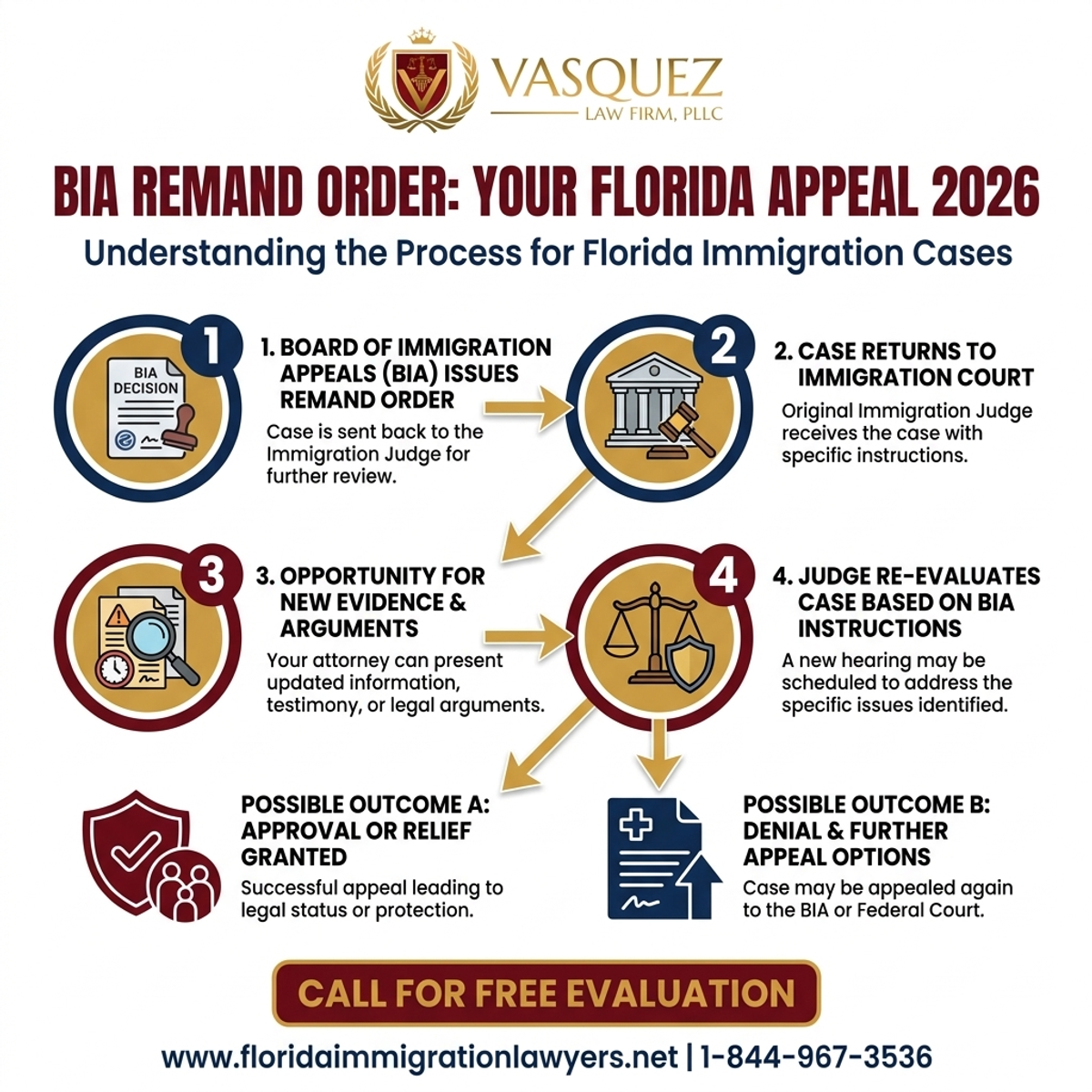
Step-by-Step Process — BIA Remand Order: What It Means for Your Florida Appeal 2026
For individuals in Central Florida, navigating the Orlando Immigration Court after a remand requires specific knowledge of local court procedures and judicial tendencies. An attorney familiar with these nuances can provide invaluable guidance.
What Documents and Evidence Are Crucial for a Remanded Case?
The specific documents and evidence required for a remanded case depend heavily on the reasons for the BIA's remand order. However, generally, a combination of original application materials, new supporting evidence addressing the BIA's directives, and updated personal documentation will be crucial.
When your case is remanded by the BIA, it signifies that the Immigration Judge needs to revisit certain aspects or consider information previously overlooked or unavailable. Therefore, your focus should be on compiling a robust and relevant evidentiary package that directly responds to the BIA's instructions. Here is a general checklist of crucial documents and evidence:
- The BIA Remand Order: This is the most important document, as it outlines the specific issues the Immigration Judge must address. Your attorney will use this to guide the strategy for the new hearings.
- Original Application Forms and Supporting Documents: Any forms you initially filed (e.g., Form I-589 for asylum, Form I-485 for adjustment of status, Form I-130 family petition) and the evidence submitted with them will be part of the administrative record. Review these for accuracy and completeness.
- New Evidence Addressing BIA's Concerns: This is often the primary reason for a remand. Examples include:
- Updated Country Conditions Reports: If your case involves asylum or withholding of removal, recent reports from reputable sources (e.g., U.S. Department of State, Amnesty International) are vital.
- Expert Witness Affidavits/Testimony: Opinions from psychologists, medical professionals, or country experts can provide crucial context or validate claims.
- New Affidavits: Statements from family, friends, or community members attesting to new facts, hardship, or specific events.
- Financial Records: Bank statements, tax returns, employment letters if economic hardship is a factor or if demonstrating eligibility for certain relief.
- Medical Records: If medical conditions or treatment are relevant to your claim for relief or hardship.
- Police Reports/Court Records: If criminal history or lack thereof is a factor being re-examined.
- Proof of Identity and Nationality: Valid passports, birth certificates, national identity documents.
- Proof of Relationship (for family-based cases): Marriage certificates, birth certificates of children, divorce decrees, photos, joint financial documents.
- Proof of Residence in Florida: Utility bills, leases, Florida driver's license, school records, employment records demonstrating your ties to the community, particularly if you are in Central Florida.
- Any Other Documents Specifically Requested by the BIA or IJ: Always follow explicit instructions from the court.
Thorough organization and presentation of these documents can significantly strengthen your case during the remanded proceedings. An experienced Florida immigration attorney can help you identify and gather all necessary evidence.
How Long Does a BIA Remand Process Typically Take in 2026?
As of 2026, the BIA remand process length varies significantly, from several months to over a year, depending on the complexity of the case, court backlogs, and the specific issues the BIA requires the Immigration Judge to address.
The timeline for a case after a BIA remand order is highly unpredictable, making it one of the most frustrating aspects for individuals awaiting a resolution. There is no fixed duration, as several factors influence how quickly your case moves through the Immigration Court system. These factors include the specific instructions from the BIA, the caseload of the Immigration Judge assigned to your case, the complexity of the new evidence or legal issues to be addressed, and the overall backlog at the Immigration Court where your case is being heard. For example, Immigration Courts in Florida, such as the Orlando Immigration Court, often experience high volumes of cases, which can contribute to delays. Furthermore, if new applications for relief are permitted or required, the processing times for those applications by U.S. Citizenship and Immigration Services (USCIS) can also add to the overall duration. It is crucial to maintain realistic expectations and understand that patience, combined with proactive legal representation, is key during this extended period. Below is a general overview of the typical stages and associated timeframes:
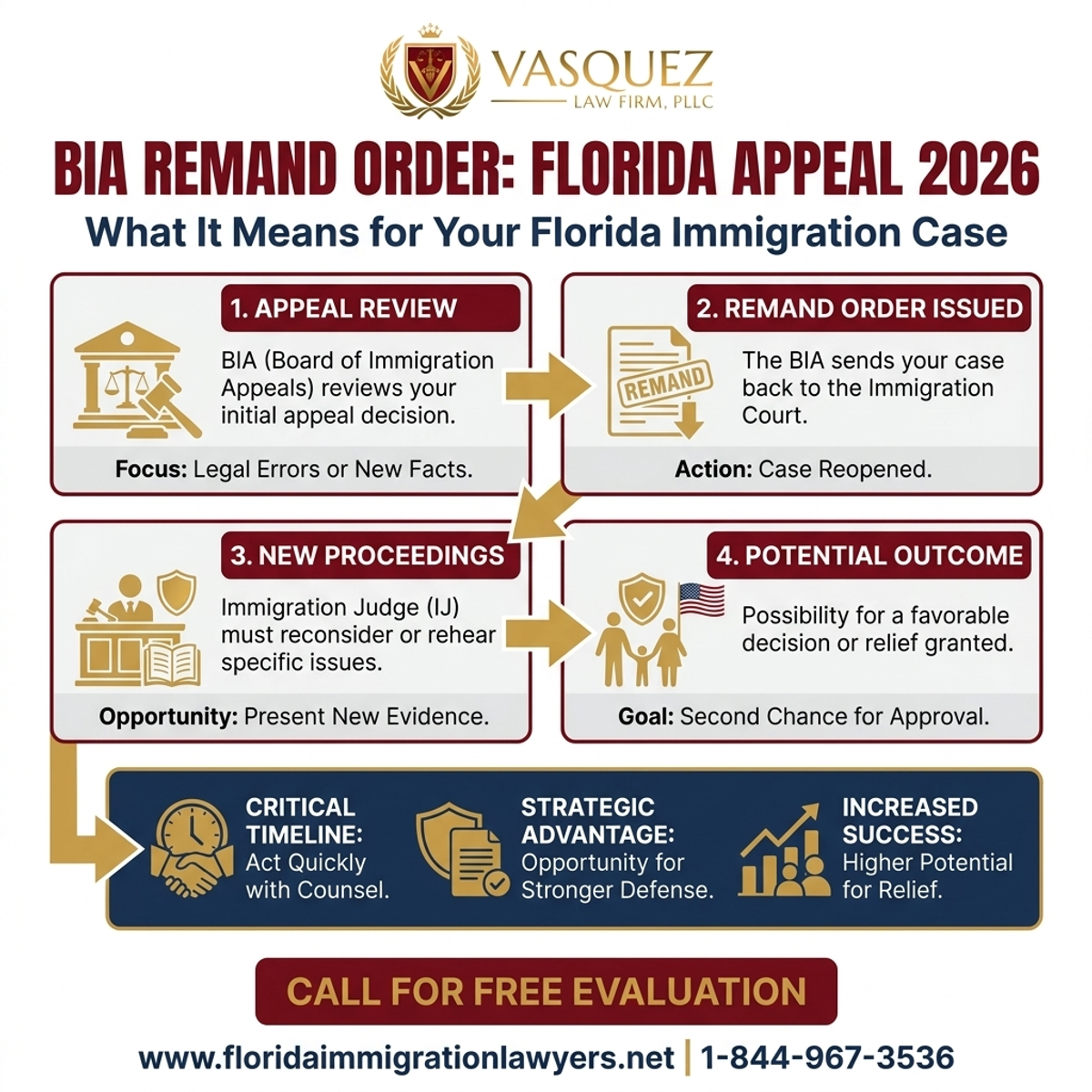
Key Statistics — BIA Remand Order: What It Means for Your Florida Appeal 2026
| Stage | Typical Timeframe | Notes |
|---|---|---|
| BIA Decision to Remand | Immediately after BIA issues order | Official order sent to parties and Immigration Court. |
| Case Docketed with IJ | 1-3 months | Case is officially sent back to the original or a new Immigration Judge for scheduling. |
| New Master Calendar Hearing | 3-9 months (after docketing) | Initial hearing to set a schedule for future proceedings, especially if new issues or applications are involved. |
| Individual Hearing(s) After Remand | 6-18+ months (after master calendar) | Depends heavily on court backlog in Florida (e.g., Orlando Immigration Court), complexity, and number of witnesses. |
| IJ Decision After Remand | Immediate to several months | Can be given orally at the end of a hearing or mailed as a written decision later. |
| Potential Further Appeal | Ongoing (30 days to appeal) | If unhappy with IJ decision post-remand, another appeal to the BIA or Circuit Court may be filed. |
What Are the Costs Associated with a BIA Remand and Appeal?
The costs associated with a BIA remand and the broader appeal process can be substantial, encompassing government filing fees, attorney fees, and potential expenses for evidence gathering. These costs vary significantly based on the complexity of the case, the specific relief sought, and the duration of the proceedings.
Understanding the financial implications of an immigration appeal and subsequent remand is crucial for planning and managing your case. While an initial Notice of Appeal (Form EOIR-26) to the BIA itself may require a filing fee (Form EOIR-29), which can sometimes be waived for those demonstrating financial hardship by filing Form EOIR-26A, the costs extend far beyond this. The most significant expense for many individuals in Florida will often be legal representation. Immigration law is notoriously complex, and navigating an appeal, especially after a BIA remand, requires specialized knowledge and experience. Attorney fees can vary widely based on the attorney's experience, the complexity of the case, and the amount of work involved in preparing new briefs, evidence, and attending multiple hearings. For example, if the remand requires extensive research into country conditions or the testimony of expert witnesses, these additional costs can quickly add up. Furthermore, if the remand allows for the filing of new applications for relief (e.g., an updated Form I-485 for adjustment of status or Form I-589 for asylum), each of these applications will have its own associated government filing fee. These fees are subject to change, so it is always advisable to check the official EOIR and USCIS websites for the most current amounts. Other potential costs include translation services for documents not in English, fees for obtaining official records, and travel expenses for court appearances, particularly if you live outside of the immediate vicinity of the Orlando or Miami Immigration Courts. Legal regulations, such as 8 CFR § 1003.8, outline the requirements for fees related to BIA appeals. A detailed discussion with your attorney about potential costs and payment structures is highly recommended.
Do not navigate this complex process alone. Contact Florida Immigration Lawyers today for expert guidance on your BIA remand and appeal. Our dedicated team is here to support you every step of the way, offering peace of mind and skilled representation. Schedule a free consultation to discuss your options.
Common Mistakes to Avoid in a BIA Remand Case
Successfully navigating a BIA remand requires meticulous attention to detail and a strategic approach. Avoiding common pitfalls can significantly impact the outcome of your case. Here are some mistakes that individuals in Florida and across the U.S. often make:
- Failing to Understand the Remand Order: Misinterpreting the BIA's specific instructions for the Immigration Judge can lead to a flawed strategy and a renewed adverse decision. Every word in the remand order carries legal weight.
- Missing Deadlines: Immigration law is unforgiving with deadlines. Missing a court appearance or a deadline for filing documents after a remand can result in an in absentia order of removal or the case being dismissed.
- Not Presenting New or Updated Evidence: If the BIA remanded the case for the consideration of new evidence, failing to gather and present it effectively is a missed opportunity. This includes updated country conditions, medical reports, or affidavits.
- Assuming Automatic Approval: A remand is not an approval. It simply means the case is being reopened for further review. You must still actively pursue your relief and prove your eligibility.
- Ignoring Procedural Requirements: Each Immigration Court has specific local operating procedures. Failing to adhere to these, such as proper formatting for filings or notice requirements, can cause delays or rejections.
- Inadequate Legal Representation: Attempting to represent yourself in a complex remanded case, especially if you have limited English proficiency or legal knowledge, can be a critical error. The stakes are too high.
- Failing to Notify USCIS/EOIR of Address Changes: If your address changes during the remand process, failing to update USCIS and EOIR promptly can result in missed notices and critical court documents, leading to adverse decisions without your knowledge.
- Not Preparing for Testimony: Even if you testified previously, you might be required to testify again. Not preparing adequately for questioning about new evidence or specific issues raised by the BIA can weaken your case.
- Submitting Irrelevant Evidence: While new evidence is often crucial, submitting voluminous documents that do not directly address the BIA's remand instructions can overwhelm the court and dilute the strength of your pertinent evidence.
- Not Considering All Available Forms of Relief: A remand might open up possibilities for new forms of relief not previously considered or available. An experienced attorney can evaluate all potential options.
- Becoming Complacent: The immigration process is lengthy and stressful. It is easy to become disheartened or complacent after a remand, but maintaining vigilance and persistence is vital.
- Engaging in Prohibited Activities: Any new criminal activity or violation of immigration laws during the remand process can severely jeopardize your case and lead to immediate deportation.
When to Call a Lawyer for a BIA Remand Case
The moment you receive a BIA remand order is precisely when you should seek or re-engage with an experienced immigration lawyer. This is not a process to navigate alone, particularly given the intricate legal details and high stakes involved. An attorney can provide immediate clarity on the remand order's implications, helping you understand the specific issues the BIA wants the Immigration Judge to address. They can also formulate a strategic response, ensuring all deadlines are met and all necessary evidence is gathered and presented effectively.
You should especially consider calling Florida Immigration Lawyers if: the remand order contains complex legal instructions you don't fully comprehend; you need to gather new or updated evidence; there are tight deadlines for filings or hearings; you face language barriers; your previous application was denied; or if you are concerned about potential deportation. Our attorneys are adept at handling cases before the BIA and Immigration Courts throughout Florida, including the Orlando and Miami courts. We can help you prepare for new hearings, present compelling arguments, and explore any new avenues for relief that may have opened up. Do not risk your immigration future by attempting to manage a remanded case without expert legal counsel. Our team is ready to provide the dedicated representation you need.
About Florida Immigration Lawyers
Florida Immigration Lawyers is a leading law firm dedicated to providing comprehensive and compassionate immigration legal services across the entire state of Florida. With a deep understanding of U.S. immigration law and a commitment to protecting the rights and futures of our clients, we stand as a beacon of hope for individuals and families navigating complex immigration challenges. Our experienced attorneys specialize in a wide range of immigration matters, including family-based petitions, employment visas, deportation defense, asylum claims, and the intricate appeals process, including cases involving BIA remand orders. We pride ourselves on offering personalized attention, strategic advocacy, and bilingual services (English and Spanish) to ensure every client feels heard, understood, and confidently represented. We understand the unique challenges faced by immigrants in Florida, from Central Florida to every corner of the state, and we are available 24/7 to offer support. We provide free case reviews to help you understand your options without financial commitment. Choose Florida Immigration Lawyers for dedicated, knowledgeable, and effective legal representation. Call us at 1-844-YO-PELEO or schedule a free consultation today.
Sources and References
- U.S. Citizenship and Immigration Services (USCIS)
- Executive Office for Immigration Review (EOIR)
- U.S. Department of State
- 8 U.S.C. Chapter 12 - Immigration and Nationality Act (INA)
- 8 CFR § 1003.1(d)(6) - Board of Immigration Appeals (BIA) Authority
- 8 CFR § 1003.8 - Fees for Appeals to the Board of Immigration Appeals
Related services: deportation defense services, asylum and refugee protection, immigration waivers, humanitarian protection programs.
This article provides general legal information and is not intended as legal advice. Every case is unique, and outcomes depend on specific facts and circumstances. Contact an attorney for advice about your particular situation.
A BIA remand order is a critical juncture in your immigration journey, offering a renewed opportunity to present your case. Do not face this complex legal challenge without experienced guidance. The dedicated team at Florida Immigration Lawyers is ready to provide the strategic and compassionate representation you need. Contact us today for a free case review and let us help you navigate the path forward. Call us at 1-844-YO-PELEO. Se Habla Espanol - Estamos aqui para ayudarle.
If you need legal assistance, learn more about immigration lawyers in Florida, or call us at 1-844-967-3536 for a free case review.
Do Not Navigate This Process Alone
Our experienced immigration attorneys are ready to fight for you. Get a free, confidential case review today.
Se Habla Español
Or leave your details and we’ll call you:
Free Evaluation in 24 Hours
Or talk to us right now

AI voice assistant — available 24/7
FreeFrequently Asked Questions

William J. Vásquez
Founding Attorney · Vasquez Law Firm
U.S. Air Force veteran and immigration attorney with years of hands-on U.S. immigration experience. J.D., NCCU School of Law. AILA member. Admitted to the 4th, 5th, and 11th Circuit Courts.
Available 24/7 - Free Evaluations
Reviewed for legal accuracy by William J. Vásquez
Licensed in North Carolina; U.S. immigration is federal practice.
Related Legal Services
Our Florida immigration attorneys can help you with asylum protection, citizenship and naturalization and immigration practice areas. Call today at 1-844-YO-PELEO for a free case review.
Related Links
Related Topics
Free Legal Case Review
Discuss your case with our experienced attorneys. We're available 24/7.
Se Habla Español - Estamos aquí para ayudarle.
Related Articles
Immigration Lawyer Orlando Free Consultation in Florida
For individuals and families in Orlando, Florida, navigating the complexities of U.S. immigration law requires expert guidance. An immigration lawyer in Orlando offers crucial support for everything from visa applications and green card processes to naturalization and deportation defense. This comprehensive guide details what a free consultation covers, providing a step-by-step overview of immigration pathways, essential document checklists, and expected timelines in 2026. We also highlight common mistakes to avoid, discuss the critical role of legal counsel in deportation and asylum cases, and explain why choosing a local Orlando immigration attorney is beneficial. Florida Immigration Lawyers is dedicated to serving the diverse community of Orlando with compassionate, effective legal solutions, ensuring you receive personalized advice and robust representation for a successful immigration journey.
Student Visa Attorney Florida: Your 2026 Guide to Study
Dreaming of studying in Florida? The student visa process can be challenging, but with the right guidance, your academic future in the Sunshine State is achievable. This comprehensive guide, updated for 2026, details the F-1 visa application steps, essential documents, financial requirements, and work limitations for international students. Learn about the crucial role a student visa attorney in Florida plays in navigating complex immigration laws, ensuring your application is meticulously prepared, and helping you avoid common pitfalls. From obtaining your I-20 to successfully clearing your consular interview, understanding each stage is vital. Discover when to seek legal counsel, especially for complex cases, previous denials, or maintaining your student status. Florida Immigration Lawyers are here to provide expert immigration help, offering free case reviews and dedicated support across Florida. Secure your educational journey with professional legal assistance.
Immigration Document Preparation Florida: 2026 Guide
Navigating immigration document preparation in Florida requires meticulous attention to detail, from identifying the correct forms to gathering extensive supporting evidence. This comprehensive 2026 guide from Florida Immigration Lawyers outlines the crucial steps for successful applications, including family-based petitions, adjustment of status, and naturalization. We cover everything from understanding form requirements and typical processing timelines to cost factors and common mistakes that can lead to delays or denials. With Florida's diverse immigrant population and specific USCIS field office operations, precise document preparation is paramount. Learn why expert legal assistance is invaluable in ensuring accuracy, mitigating risks, and streamlining your path to achieving your immigration goals in Florida.
Immigration Attorney for CR-1 Visa Orlando: Your Guide
Navigating the CR-1 and IR-1 visa process can be challenging. Learn how to apply, what documents are needed, and the typical processing timeline. Contact Florida Immigration Lawyers in Orlando for expert guidance.