H-2B Visa Process for Seasonal Workers in Florida
The H-2B visa is vital for Florida's hospitality sector, enabling employers to hire foreign seasonal workers. Learn about the application process and requirements. Call Florida Immigration Lawyers at 1-844-YO-PELEO for assistance.
The H-2B visa is essential for non-agricultural seasonal workers in Florida's hospitality sector. This visa allows employers to hire foreign nationals for temporary jobs when U.S. workers are unavailable. Key points include:
- Required for non-agricultural seasonal work.
- Helps fill labor shortages in hospitality.
- Employers must prove the need for foreign workers.
- Application involves several governmental agencies.
Introduction
Florida's hospitality sector thrives on seasonal tourism, creating a demand for temporary workers. The H-2B visa program plays a crucial role in filling this gap by allowing employers to hire foreign nationals for non-agricultural jobs. If you're navigating the complexities of the H-2B visa process, understanding the requirements and procedures is vital. Call Florida Immigration Lawyers at 1-844-YO-PELEO for a free case review.
The Sunshine State's economy is heavily reliant on industries like tourism, landscaping, and seafood processing, all of which experience significant seasonal fluctuations. During peak seasons, the demand for labor often outstrips the supply of available U.S. workers, making the H-2B program a lifeline for many businesses to maintain operations and deliver quality services. This program ensures that Florida businesses can meet their operational needs, preventing potential economic losses and supporting the state's overall prosperity.
Understanding the nuances of the H-2B visa is not just about compliance; it's about strategic workforce planning. Employers must be proactive in demonstrating their temporary need and diligent in their recruitment efforts for U.S. workers. The process can be daunting, involving multiple federal agencies and strict regulations, but with guidance from Florida Immigration Lawyers, businesses can confidently secure the workforce they need. Our team is dedicated to simplifying this intricate journey for you.
What is the H-2B Visa?
The H-2B visa is a non-immigrant visa for temporary non-agricultural workers. It caters to industries like hospitality, where there's a peak seasonal need for labor. As of 2026, employers must demonstrate a lack of available U.S. workers to fill these roles.
The process involves obtaining labor certification from the Department of Labor, filing a petition with USCIS, and ensuring workers meet visa eligibility requirements. Employers in Orlando's bustling hospitality sector frequently utilize this visa to meet staffing needs.
Beyond hospitality, the H-2B visa supports a diverse range of non-agricultural sectors. This includes landscaping services during spring and summer, seafood processing plants during fishing seasons, construction projects with specific temporary needs, and even amusement parks requiring additional staff for holiday rushes. The core requirement remains the temporary nature of the job, which can be categorized as a one-time occurrence, seasonal need, peakload need, or intermittent need, each with specific definitions and evidentiary requirements.
A critical aspect of the H-2B program is the annual cap on the number of visas issued. Congress sets this cap, which is currently 66,000 per fiscal year, split evenly between the first and second halves of the fiscal year. This cap often leads to intense competition among employers, making timely and accurate application crucial. Employers must plan well in advance and be prepared for potential lottery systems if demand exceeds the available visas. Working with experienced legal counsel like Florida Immigration Lawyers can significantly improve your chances of securing these coveted visas.
How to Apply for an H-2B Visa in Florida?
The H-2B visa application process involves several steps:
- Employer files a temporary labor certification application with the Department of Labor.
- After approval, the employer submits Form I-129 to USCIS.
- Prospective workers apply for a visa and attend an interview at a U.S. embassy or consulate.
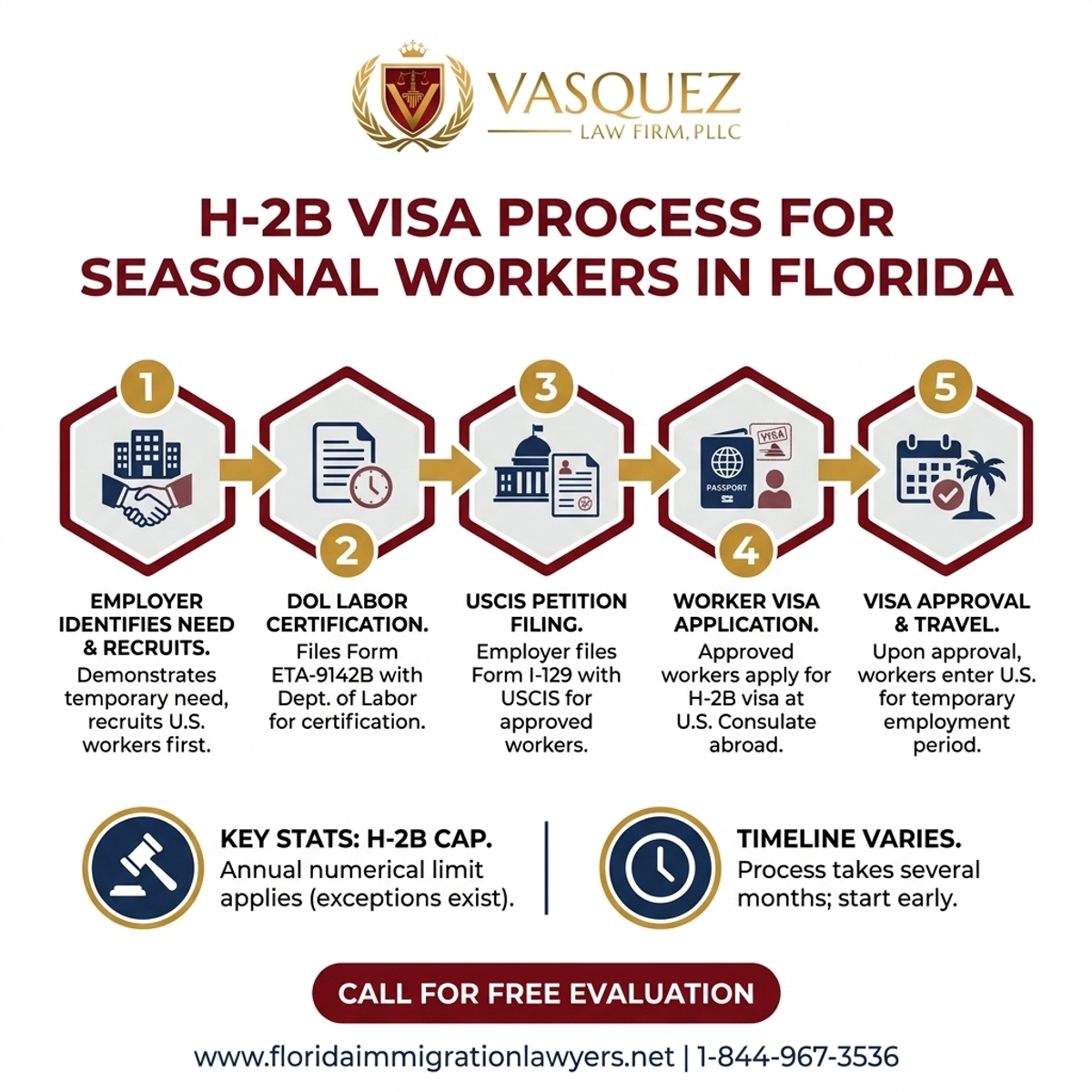
Step-by-Step Process — H-2B Visa Process for Seasonal Workers in Florida
This process can be meticulous, requiring detailed documentation and adherence to strict timelines. Employers often seek legal assistance to ensure compliance and increase the chances of approval.
Let's delve deeper into each stage. The initial step, filing a temporary labor certification application with the Department of Labor (DOL), is perhaps the most critical. Employers must conduct rigorous recruitment efforts to test the U.S. labor market, advertising the job opportunity through various channels, including state workforce agencies. They must demonstrate that there are insufficient U.S. workers who are able, willing, qualified, and available to perform the temporary work, and that employing foreign workers will not adversely affect the wages and working conditions of similarly employed U.S. workers. This involves defining the job duties, minimum requirements, and offering the prevailing wage for the occupation in the specific geographic area.
Once the DOL certifies the temporary labor need, the employer proceeds to the U.S. Citizenship and Immigration Services (USCIS) by filing Form I-129, Petition for a Nonimmigrant Worker. This petition formally requests permission to bring the foreign workers to the U.S. Supporting documentation for Form I-129 includes the approved labor certification, a detailed statement of temporary need, and any other evidence proving the employer's eligibility and the temporary nature of the job. USCIS scrutinizes these petitions carefully, and any discrepancies or missing information can lead to Requests for Evidence (RFEs) or even denials. Florida Immigration Lawyers can help you prepare a robust petition, minimizing potential setbacks.
The final stage involves the prospective workers applying for their H-2B visas at a U.S. embassy or consulate in their home country. This typically includes submitting a DS-160 online nonimmigrant visa application, paying the visa fee, and attending an interview. During the interview, consular officers assess the applicant's intent to return to their home country after the temporary employment, their qualifications for the job, and their general admissibility to the U.S. Workers must be prepared to present their passports, the approved Form I-797 (Notice of Action for the I-129 petition), and any other requested documents. Successful navigation of this multi-layered process requires precision and a thorough understanding of each agency's requirements, highlighting the benefit of experienced legal counsel.
Document Checklist for H-2B Visa Application
A successful H-2B visa application hinges on meticulous documentation. Gathering and organizing all required forms and supporting evidence well in advance is paramount to avoid delays or denials. Employers should treat this checklist as a living document, ensuring every item is accurate, complete, and submitted according to the specific instructions of the Department of Labor and USCIS.
- Proof of temporary labor certification (ETA Form 9142B)
- Form I-129, Petition for a Nonimmigrant Worker
- Evidence of seasonality or peakload need (e.g., historical payroll records, contracts, financial statements, detailed business plans)
- Worker's passport and identity documents
- Any additional supporting documents requested by DOL or USCIS, such as recruitment reports, prevailing wage determinations, and employer's federal tax ID.
Ensuring all documents are accurate and complete is crucial for a smooth application process. Errors or omissions in documentation are among the most common reasons for processing delays or outright denials. It's advisable to create a comprehensive checklist and cross-reference every item before submission. For instance, if you're a hotel in Miami needing extra staff for winter tourism, you'd need to provide detailed historical occupancy rates and staffing patterns to prove your seasonal need. Florida Immigration Lawyers can assist in compiling and reviewing this critical documentation, ensuring nothing is overlooked.
Timeline and Processing Expectations
Navigating the H-2B visa process requires a clear understanding of the typical timelines involved. While the stages are distinct, their durations can fluctuate based on government agency workloads, policy changes, and the completeness of your application. Proactive planning and submission are key to aligning with your seasonal hiring needs.
| Stage | Typical Timeframe | Notes |
|---|---|---|
| Labor Certification | 2-3 months | Department of Labor processing, including recruitment period |
| USCIS Petition | 2-4 months | After labor certification; premium processing available for an additional fee |
| Visa Issuance | 2-3 weeks | Consular processing, varies by embassy/consulate availability |
Processing times can vary based on the volume of applications and other factors. For example, during periods of high demand, such as the lead-up to the summer season, both DOL and USCIS may experience backlogs, extending typical timeframes. Employers should factor in potential delays and aim to submit applications well in advance of their projected start dates. Utilizing premium processing for the USCIS petition, though costly, can significantly expedite that particular stage, reducing the wait from months to just 15 calendar days.
It is also important to consider the potential for Requests for Evidence (RFEs) from USCIS or audits from the Department of Labor, which can add significant time to the process. A well-prepared application, ideally reviewed by experienced legal counsel from Florida Immigration Lawyers, can minimize the likelihood of such requests. Staying informed about current processing times published by USCIS and DOL is also a practical tip for managing expectations.
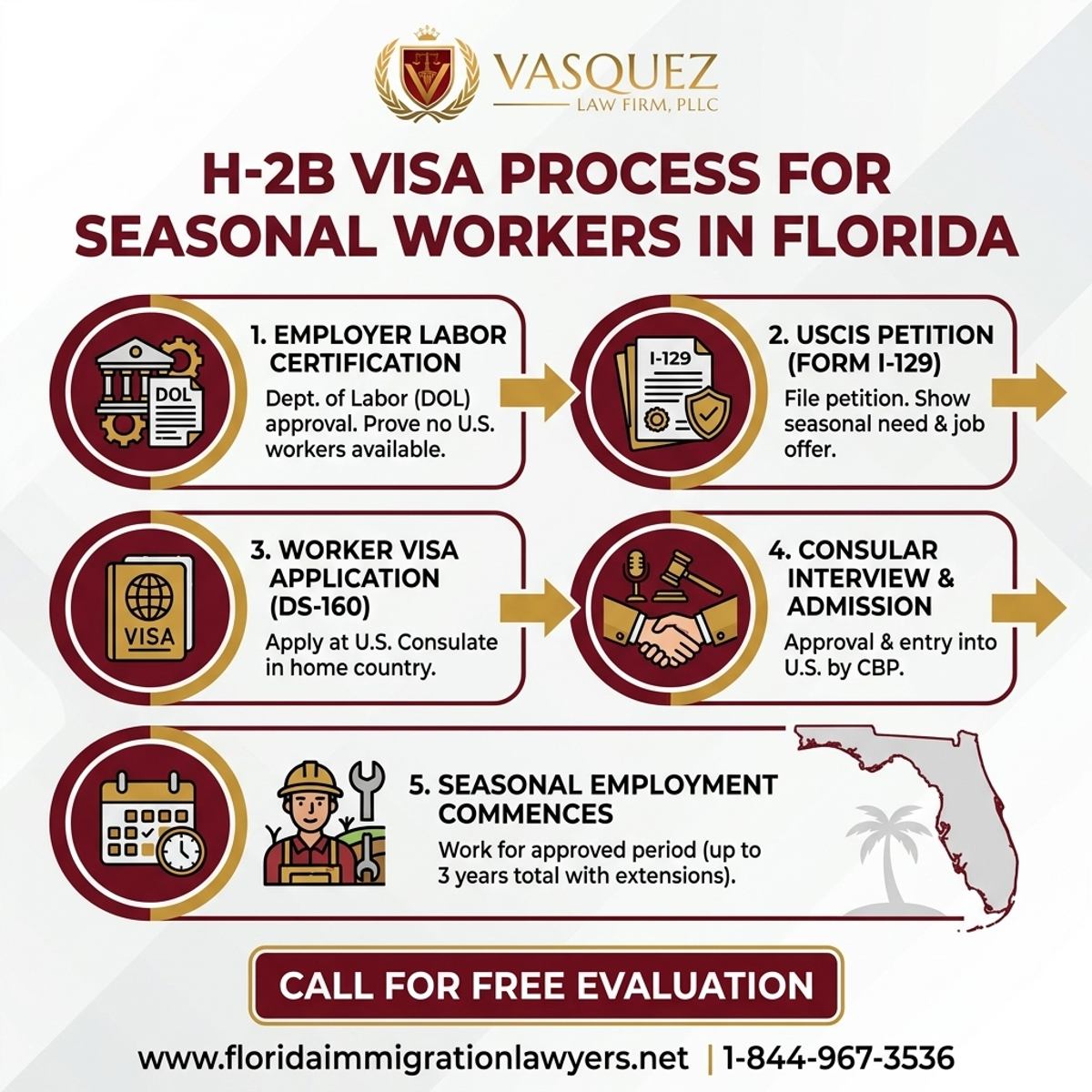
Key Statistics — H-2B Visa Process for Seasonal Workers in Florida
Cost Factors and Fee Breakdown
Understanding the financial commitment associated with the H-2B visa program is crucial for employers. The overall cost extends beyond just government filing fees, encompassing various expenses that must be budgeted for to ensure a smooth and compliant process. These costs are primarily borne by the employer, as per regulations designed to protect foreign workers.
| Item | Typical Fee
Sources and References
|
|---|
Do Not Navigate This Process Alone
Our experienced immigration attorneys are ready to fight for you. Get a free, confidential case review today.
Se Habla Español
Or leave your details and we’ll call you:
Free Evaluation in 24 Hours
Or talk to us right now

AI voice assistant — available 24/7
FreeFrequently Asked Questions

William J. Vásquez
Founding Attorney · Vasquez Law Firm
U.S. Air Force veteran and immigration attorney with years of hands-on U.S. immigration experience. J.D., NCCU School of Law. AILA member. Admitted to the 4th, 5th, and 11th Circuit Courts.
Available 24/7 - Free Evaluations
Reviewed for legal accuracy by William J. Vásquez
Licensed in North Carolina; U.S. immigration is federal practice.
Related Legal Services
Our Florida immigration attorneys can help you with experienced immigration attorneys, asylum protection and citizenship and naturalization. Call today at 1-844-YO-PELEO for a free case review.
Related Links
Related Topics
Free Legal Case Review
Discuss your case with our experienced attorneys. We're available 24/7.
Se Habla Español - Estamos aquí para ayudarle.
Related Articles
Certificate of Eligibility for Expungement in Florida 2026
For non-U.S. citizens in Florida, understanding how a state expungement impacts immigration status is critical. A certificate of eligibility for expungement in Florida allows a criminal record to be sealed or expunged under state law. However, federal immigration agencies often disregard such state-level relief, still considering the original criminal offense as a conviction for immigration purposes. This can have severe implications for visa applications, green card eligibility, naturalization, and even lead to deportation. This guide clarifies the Florida expungement process, its limited effect on federal immigration law, and key steps to protect your status in 2026. Learn about common mistakes, required documents, timelines, and when to seek expert legal counsel from Florida Immigration Lawyers to navigate these complex issues effectively.
Immigration Lawyer Orlando Free Consultation in Florida
For individuals and families in Orlando, Florida, navigating the complexities of U.S. immigration law requires expert guidance. An immigration lawyer in Orlando offers crucial support for everything from visa applications and green card processes to naturalization and deportation defense. This comprehensive guide details what a free consultation covers, providing a step-by-step overview of immigration pathways, essential document checklists, and expected timelines in 2026. We also highlight common mistakes to avoid, discuss the critical role of legal counsel in deportation and asylum cases, and explain why choosing a local Orlando immigration attorney is beneficial. Florida Immigration Lawyers is dedicated to serving the diverse community of Orlando with compassionate, effective legal solutions, ensuring you receive personalized advice and robust representation for a successful immigration journey.
Work Permit EAD Application Process in Florida 2026
Applying for a work permit, or Employment Authorization Document (EAD), in Florida is a crucial step for many non-citizens seeking to work legally in the U.S. This comprehensive guide from Florida Immigration Lawyers details the 2026 application process, including eligibility criteria, necessary documentation for Form I-765, typical processing times, and associated costs. We highlight the importance of accurate submission and offer insights into common pitfalls to avoid. Our firm, based in Orlando, Florida, provides expert legal assistance for asylum seekers, adjustment of status applicants, and other eligible individuals. Learn how to prepare for your EAD application and understand when professional legal counsel can make a significant difference in achieving a successful outcome. Secure your right to work with knowledgeable support.
Change of Status B-2 to F-1 in Florida: Key Steps
Changing your status from a B-2 tourist visa to an F-1 student visa in Florida involves several crucial steps. This guide provides a comprehensive overview, including the 2026 I-539 processing times, document requirements, and common pitfalls to avoid. Learn how to navigate the process effectively with help from Florida Immigration Lawyers.