I-360 Widow Self-Petition Eligibility in Florida 2026
Losing a U.S. citizen spouse is a devastating event, often leaving non-citizen spouses in Florida uncertain about their immigration future. The I-360 Widow Self-Petition offers a vital pathway to lawful permanent residency, allowing eligible surviving spouses to apply for a green card independently. This comprehensive guide from Florida Immigration Lawyers details the eligibility criteria, including being married to a U.S. citizen at the time of death, not remarrying, and filing within two years of the spouse's passing. We provide a step-by-step application process, an essential document checklist, and insights into current processing times and associated costs for 2026. Learn about common mistakes to avoid and when it is critical to seek legal counsel to navigate this sensitive and complex immigration journey successfully.
The I-360 Widow Self-Petition allows surviving spouses of U.S. citizens to apply for lawful permanent residency without a sponsor, provided they meet specific criteria. As of 2026, eligibility generally requires the widow(er) to have been married to a U.S. citizen at the time of their death, not to have remarried, and to file the petition within two years of the spouse's passing. This pathway is crucial for those in Florida facing the unexpected loss of a spouse, ensuring they can continue their immigration journey. The process involves submitting Form I-360 along with extensive supporting documentation to USCIS.
- File Form I-360 within two years of your U.S. citizen spouse's death.
- You must not have remarried.
- The marriage must have been bona fide (entered in good faith).
- Requires proof of your spouse's U.S. citizenship and their death.
- Consult a Florida immigration lawyer for personalized guidance.
Losing a loved one is an incredibly difficult experience, and the emotional toll can be overwhelming. For many non-citizen spouses in Florida, this profound loss is compounded by the daunting challenge of navigating the U.S. immigration system. If your U.S. citizen spouse passed away, you might feel lost about your immigration status and future in the United States. Fortunately, the law provides a pathway for surviving spouses to continue their journey toward lawful permanent residency through the I-360 Widow Self-Petition. This crucial provision allows you to apply for a green card without needing a new sponsor, offering a beacon of hope during a time of grief.
At Florida Immigration Lawyers, we understand the complexities and sensitivities involved in these cases. Our dedicated team is here to provide compassionate and legal assistance, helping you understand your rights and options under U.S. immigration law. This comprehensive guide will walk you through the eligibility requirements, the application process, necessary documents, and what to expect when filing an I-360 self-petition in Florida. We aim to empower you with the knowledge needed to make informed decisions and secure your future. Do not face this challenging time alone. Call Florida Immigration Lawyers at 1-844-YO-PELEO for a free case review today.
What is the I-360 Widow Self-Petition and Who is Eligible in 2026?
The I-360 Widow Self-Petition is an immigration benefit designed for the surviving spouses of U.S. citizens who passed away, allowing them to petition for themselves to become lawful permanent residents. This means you can apply for a green card without needing a new U.S. citizen family member to sponsor you. As of 2026, eligibility hinges on several key criteria that must be meticulously met.
To be eligible, you must have been legally married to a U.S. citizen at the time of their death. This marriage must have been bona fide, meaning it was entered into in good faith and not solely for immigration purposes. You must also not have remarried since your spouse's death. The law requires the I-360 petition to be filed within two years of your U.S. citizen spouse's passing. If your spouse died before October 28, 2009, and you were married for less than two years, different rules may apply, and it's essential to consult with an attorney. You may also include any unmarried children under 21 years of age on your petition, allowing them to receive the same immigration benefit. Understanding these nuances is critical, especially when navigating the process from Central Florida, where USCIS field offices handle numerous such cases. The I-360 petition recognizes the unique vulnerability of surviving spouses and aims to prevent further hardship by providing a path to stability.
How to File the I-360 Self-Petition: A Step-by-Step Guide for Florida Residents
Filing the I-360 self-petition involves several critical steps that must be followed precisely to avoid delays or denials. For residents in Florida, this process typically involves interacting with USCIS field offices in Orlando, Miami, or Tampa, depending on your residence. Each step requires careful attention to detail and thorough documentation.
-
Determine Eligibility: Before anything else, confirm that you meet all the basic requirements. This includes verifying your spouse's U.S. citizenship, the validity and bona fides of your marriage, the date of their death, and ensuring you have not remarried. Confirm you are filing within the two-year window from your spouse's death. This initial assessment is crucial and often benefits from legal counsel.
-
Gather Required Documents: Collect all necessary supporting evidence. This includes official certificates (marriage, death, birth for children), proof of your spouse's U.S. citizenship (birth certificate, naturalization certificate, U.S. passport), and evidence of a bona fide marriage (joint bank accounts, property deeds, insurance policies, photos, affidavits from friends/family). You will also need evidence of your good moral character, which generally means a clean criminal record. Be prepared to provide translated documents if they are not in English, certified by a competent translator.
-
Complete Form I-360, Petition for Amerasian, Widow(er), or Special Immigrant: Fill out the form accurately and completely. Ensure you select the correct category for a widow(er) of a U.S. citizen. Any errors or omissions can lead to Requests for Evidence (RFEs) or even denial. Pay close attention to all sections, providing truthful and consistent information.
-
Assemble and File Your Petition: Organize all documents neatly. Create a cover letter listing the contents of your petition. Send the completed Form I-360, along with all supporting evidence and the USCIS filing fee (or a fee waiver request, if applicable), to the correct USCIS lockbox facility. The filing location depends on where you live; for Florida residents, check the USCIS website for current mailing addresses. Keep copies of everything you submit.
-
Attend Biometrics Appointment: After filing, USCIS will send you a notice for a biometrics appointment at an Application Support Center (ASC). This appointment is for capturing your fingerprints, photograph, and signature, which are used for background checks. The Jacksonville ASC serves applicants across North Florida, while the Orlando and Miami ASCs serve Central and South Florida, respectively. Do not miss this appointment.
-
Respond to RFEs (if applicable): If USCIS requires additional information, they will send a Request for Evidence (RFE). Respond thoroughly and within the specified timeframe. Failing to do so can result in denial. An RFE is not a denial, but an opportunity to strengthen your case.
-
Attend Interview (if required): While not always required for I-360 widow(er) petitions, USCIS may schedule an interview at a local field office (e.g., Orlando, Miami) to verify information or address any concerns. Be prepared to answer questions about your marriage and eligibility. An attorney can help you prepare for this potential interview.
-
Receive Decision and Adjust Status: If your I-360 petition is approved, you become an immediate relative. You can then file Form I-485, Application to Register Permanent Residence or Adjust Status, if you are already in the U.S. and eligible to adjust status. If you are outside the U.S., you will proceed with consular processing. Upon approval of your I-485, you will receive your green card.
Essential Documents for Your I-360 Widow Self-Petition in Florida
A successful I-360 petition hinges on submitting a comprehensive and well-organized set of documents. Missing or incorrect documentation is one of the most common reasons for delays or denials. Here's a checklist of essential documents you'll need to gather for your self-petition:
- Form I-360, Petition for Amerasian, Widow(er), or Special Immigrant: The properly completed and signed form.
- Your U.S. Citizen Spouse's Death Certificate: An official, certified copy.
- Your Marriage Certificate: An official, certified copy proving your legal marriage to the deceased U.S. citizen.
- Proof of Your Spouse's U.S. Citizenship: This could include a birth certificate, naturalization certificate, or U.S. passport.
- Proof of Bona Fide Marriage: Evidence that your marriage was legitimate and not entered into solely for immigration purposes. This is crucial and can include:
- Joint bank account statements, credit card statements.
- Joint leases, mortgages, or property deeds.
- Birth certificates of children born to you and your spouse.
- Affidavits from friends, family, or employers attesting to the bona fides of the marriage.
- Photographs of you and your spouse together over time, especially from your wedding, family events, and travels.
- Joint utility bills, insurance policies (life, health, auto), or tax returns.
- Correspondence addressed to both you and your spouse.
- Your Birth Certificate: To establish your identity.
- Passport-Style Photographs: Two recent photos of yourself.
- Evidence of Good Moral Character: While not always explicitly requested upfront, USCIS considers this. Provide certified copies of court and police records for any arrests or convictions, even if they were expunged.
- Translations: Any document not in English must be accompanied by a certified English translation.
- Filing Fee: Check the current USCIS fee schedule for Form I-360. A fee waiver (Form I-912) may be available for those who qualify based on financial hardship.
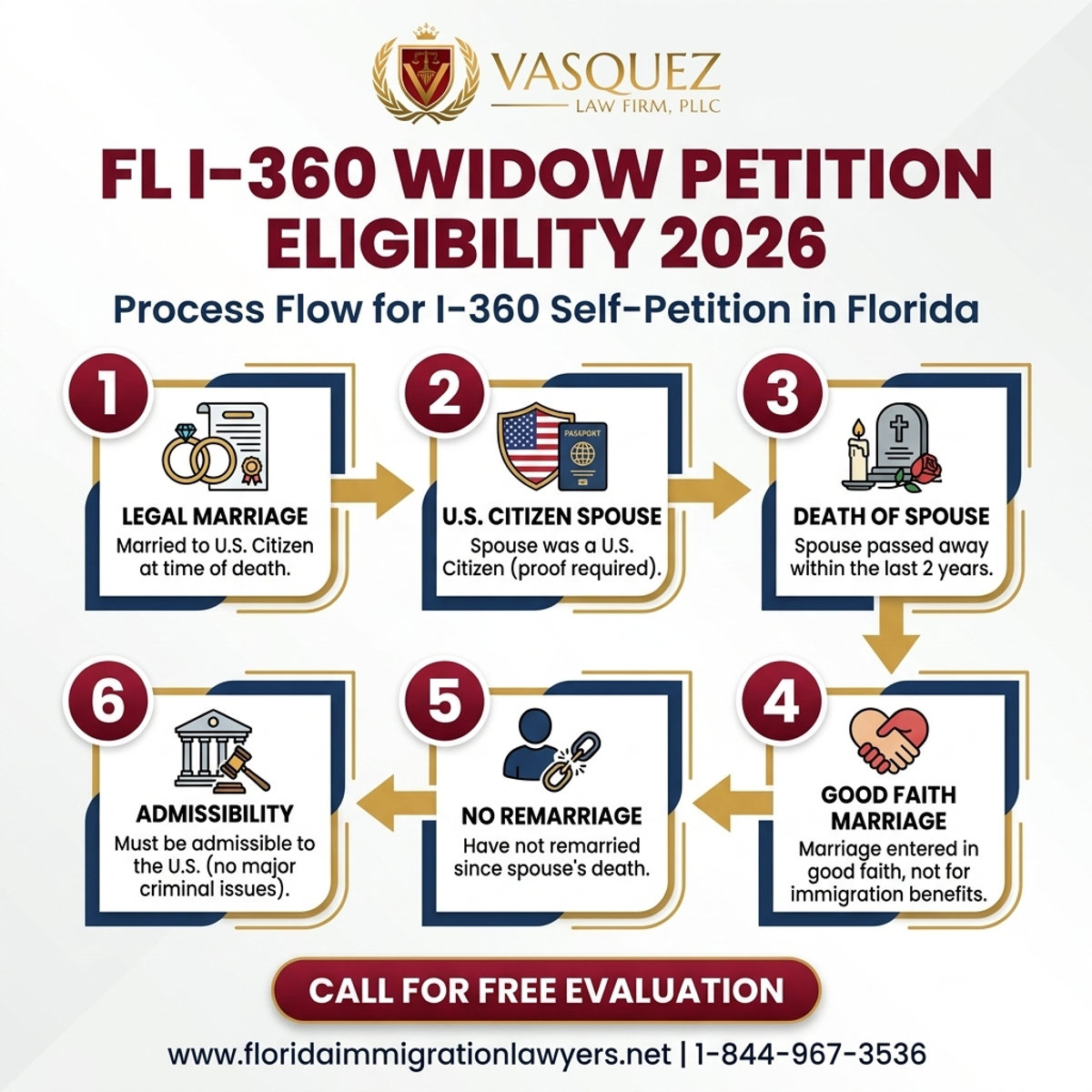
Step-by-Step Process — I-360 Widow Self-Petition Eligibility in Florida 2026
I-360 Widow Petition Processing Times and What to Expect in 2026
Understanding the typical processing times for an I-360 widow self-petition is essential for managing expectations. While USCIS strives for efficiency, various factors can influence how long your case takes. As of 2026, processing times can vary significantly based on the specific USCIS service center handling your case, the completeness of your application, and the volume of petitions being processed. Recent changes in immigration court procedures, such as those reported by the Boston Globe regarding new judges, highlight a broader landscape of administrative adjustments that can indirectly impact overall processing times across the system. It is always wise to add a buffer to any estimated timeline.
After your I-360 is approved, the next step is typically to apply for adjustment of status (Form I-485) if you are in the U.S. or consular processing if you are abroad. The I-485 process also has its own timeline, including biometrics, potential interviews at local Florida USCIS offices (like Orlando or Miami), and background checks. The entire journey from filing I-360 to receiving a green card can span over a year or more. Staying informed and prepared for each stage is key.
| Stage | Typical Timeframe (As of 2026) | Notes |
|---|---|---|
| Filing I-360 to Receipt Notice | 2-4 weeks | USCIS sends an official receipt notice (Form I-797C). |
| Biometrics Appointment | 4-8 weeks after receipt notice | Scheduled at a local Application Support Center (ASC). |
| I-360 Processing (Initial Decision) | 8-18 months | Varies by service center and case complexity. RFEs can extend this. |
| I-360 Approval to I-485 Filing | Immediate (upon I-360 approval) | If you are eligible to adjust status in the U.S. |
| I-485 Processing (Adjustment of Status) | 6-18 months | Includes biometrics, potential interview, and background checks. |
| Consular Processing (if outside U.S.) | 6-12 months after I-360 approval | Involves National Visa Center (NVC) and interview at a U.S. embassy/consulate abroad. |
Cost Factors and Fee Breakdown for the I-360 Petition in Florida
The financial aspect of filing an I-360 self-petition is an important consideration for many applicants in Florida. While government filing fees are standard across the U.S., other costs can vary. As of 2026, the primary cost is the USCIS filing fee for Form I-360 itself. This fee is subject to change, so always check the latest fee schedule on the USCIS website before filing. There are additional costs that you should budget for, which can include legal fees, document translation costs, and fees for obtaining certified copies of records.
For those facing financial hardship, USCIS offers the possibility of a fee waiver. You can apply for a fee waiver by submitting Form I-912, Request for Fee Waiver, along with your I-360 petition and supporting documentation demonstrating your inability to pay. Eligibility for a fee waiver is based on specific income guidelines or receipt of means-tested public benefits. An experienced immigration attorney can help you determine if you qualify for a fee waiver and assist you in preparing the necessary documentation. Understanding these financial components upfront can help you plan and avoid unexpected expenses during the immigration process.
| Item | Typical Fee (As of 2026) | Notes |
|---|---|---|
| USCIS Form I-360 Filing Fee | Varies (Check USCIS website) | Mandatory fee unless a waiver is granted. |
| Biometrics Fee | Included with Form I-485 (if applicable) | No separate fee for I-360 biometrics. |
| USCIS Form I-485 Filing Fee (Adjustment of Status) | Varies (Check USCIS website) | Required after I-360 approval for green card application. |
| Attorney Fees | Varies widely | Highly recommended for complex cases, document review, and representation. |
| Document Translation Fees | $20-$50 per page (approx.) | Required for any non-English documents. |
| Certified Copy Fees (e.g., Death Certificate) | $10-$30 per copy | Obtaining official copies from government agencies. |
| Medical Examination (for I-485) | $200-$500 | Required for adjustment of status by a USCIS-approved civil surgeon. |
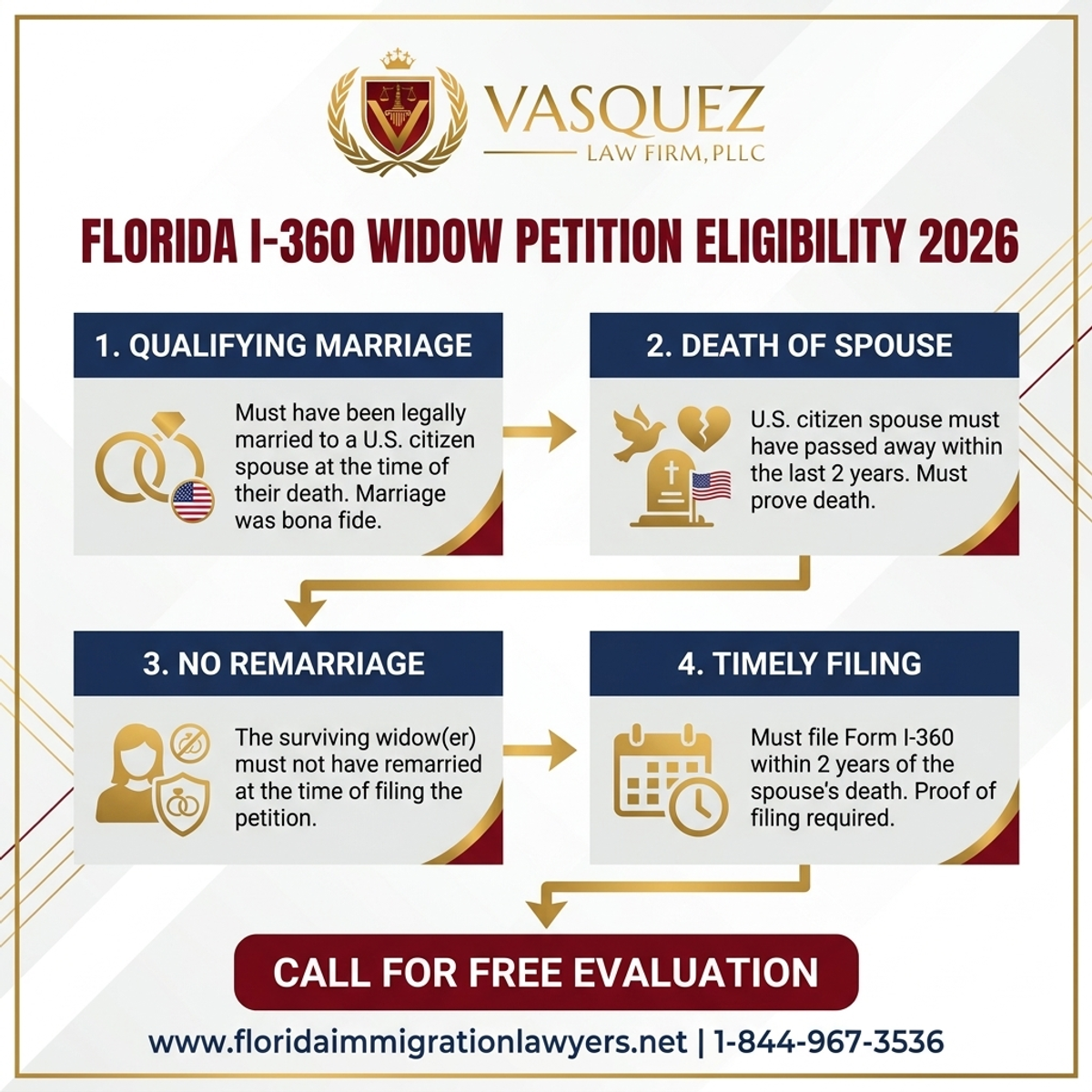
Key Statistics — I-360 Widow Self-Petition Eligibility in Florida 2026
Do not navigate this process alone. The complexities of immigration law, especially during a time of personal loss, require guidance. Contact Florida Immigration Lawyers today for a free case review and let us help you secure your future.
Common Mistakes to Avoid When Filing an I-360 Widow Self-Petition
Filing an I-360 petition requires precision and a thorough understanding of immigration law. Even minor errors can lead to significant delays, Requests for Evidence (RFEs), or even denial. Avoiding these common mistakes is crucial for a successful outcome:
-
Missing the Two-Year Filing Deadline: The law strictly requires filing the I-360 petition within two years of your U.S. citizen spouse's death. Missing this deadline, even by a day, typically results in ineligibility, unless specific exceptions apply. Always calculate carefully and aim to file well in advance.
-
Remarrying Before Filing: If you remarry before your I-360 petition is filed and approved, you become ineligible to self-petition as a widow(er). This is a critical rule that many applicants overlook or misunderstand, leading to automatic denial.
-
Insufficient Proof of Bona Fide Marriage: USCIS scrutinizes the legitimacy of the marriage. Simply submitting a marriage certificate is not enough. Failing to provide substantial evidence of a shared life and genuine marital relationship (joint finances, shared residence, photos, affidavits) is a common pitfall.
-
Incomplete or Incorrect Form I-360: Any blank fields, inconsistent information, or failure to sign the form can lead to rejection or an RFE. Double-check every section, ensuring all information is accurate and matches your supporting documents.
-
Not Providing Certified Translations: If any supporting document is not in English, it must be accompanied by a complete and certified English translation. A simple translation without certification is insufficient and will cause issues.
-
Submitting Uncertified Copies: While USCIS generally accepts copies of documents, certain critical documents like death certificates or marriage certificates often require certified copies. Know which documents need official, certified copies from the issuing authority.
-
Lack of Proof of Spouse's U.S. Citizenship: You must definitively prove your deceased spouse was a U.S. citizen at the time of their death. A birth certificate, U.S. passport, or naturalization certificate are acceptable forms of evidence. Without this, your petition will fail.
-
Failure to Respond to RFEs on Time: If USCIS sends a Request for Evidence, you must respond within the specified timeframe. Ignoring an RFE or providing an incomplete response will almost certainly lead to a denial of your petition.
-
Not Disclosing All Criminal History: Even minor arrests, charges, or convictions, regardless of their outcome or age, must be disclosed. Failure to do so can be considered misrepresentation and lead to severe immigration consequences, including findings of inadmissibility.
-
Failing to Include Children: Eligible unmarried children under 21 can be included in your I-360 petition. Forgetting to include them at the initial filing can complicate their future immigration paths.
When to Call a Florida Immigration Lawyer for Your I-360 Petition
While the I-360 self-petition offers a vital path to permanent residency, the process is intricate and fraught with potential pitfalls. Navigating U.S. immigration law, especially after a personal tragedy, can be overwhelming. Knowing when to seek professional legal assistance is crucial for a smooth and successful application. Florida Immigration Lawyers are here to provide the support and experience you need.
You should consider contacting an attorney if:
- Your Spouse's Death Occurred Close to the Two-Year Deadline: Time is critical. An attorney can help expedite document gathering and petition preparation to ensure you meet the deadline.
- You Have Concerns About Proving a Bona Fide Marriage: If you lack extensive joint documentation, an attorney can advise on alternative evidence and strategies to strengthen your case.
- You Have a Criminal Record: Any arrests or convictions, no matter how minor or old, can impact your eligibility. An attorney can assess the implications and advise on waivers or necessary disclosures.
- Your Spouse Died Before October 28, 2009: Special rules apply, and an attorney can help determine your eligibility under those specific provisions.
- You Received a Request for Evidence (RFE) or Notice of Intent to Deny (NOID): These require precise and timely responses. An attorney can review the USCIS request and formulate a comprehensive response.
- You Have Been Previously Denied an Immigration Benefit: A past denial can complicate new applications.
- You Have Children Who Need to Be Included: Ensuring derivative beneficiaries are correctly included requires careful planning.
- You Need Assistance with Fee Waiver Requests: An attorney can help prepare Form I-912 and supporting documentation.
Our firm, Florida Immigration Lawyers, focuses on family-based immigration and complex self-petitions. We are familiar with the specific requirements and procedures of USCIS field offices and immigration courts across Florida, including Orlando and Miami. We can assist you with compiling robust evidence, drafting compelling legal arguments, and representing you throughout the entire process, including potential interviews. Our goal is to alleviate your burden and guide you towards a favorable outcome. For more information on our services, visit our immigration practice areas page.
About Florida Immigration Lawyers
Florida Immigration Lawyers is a leading law firm dedicated to providing comprehensive and compassionate immigration legal services throughout the state of Florida. With an unwavering commitment to our clients, we understand the profound impact immigration matters have on individuals and families. Our experienced attorneys focus on a wide range of immigration cases, from family-based petitions like the I-360 Widow Self-Petition to complex deportation defense, asylum claims, and citizenship applications. We pride ourselves on offering personalized attention, strategic advice, and aggressive advocacy, ensuring every client receives the highest quality representation. Our Orlando-based team serves clients across Central Florida and beyond, always striving for favorable outcomes. We are available 24/7 to address your urgent legal needs and offer free case reviews to help you understand your options without financial obligation. Choose Florida Immigration Lawyers for a dedicated partner in your immigration journey. Schedule a free consultation today.
Sources and References
- U.S. Citizenship and Immigration Services (USCIS)
- Executive Office for Immigration Review (EOIR)
- U.S. Department of State
- 8 U.S.C. § 1154 (Section 204 of the Immigration and Nationality Act - INA)
- 8 CFR § 204.2(b) - Petitions for widows or widowers of U.S. citizens.
- USCIS Policy Manual, Volume 7, Part D, Chapter 3 - Widows and Widowers.
Related services: family petition process, family-based green cards, fiancé visa (K-1).
This article provides general legal information and is not intended as legal advice. Every case is unique, and outcomes depend on specific facts and circumstances. Contact an attorney for advice about your particular situation.
Navigating the I-360 Widow Self-Petition process can be complex, but you don't have to do it alone. The experienced and compassionate team at Florida Immigration Lawyers is ready to assist you every step of the way. Call us today at 1-844-YO-PELEO for a free case review. Se Habla Español - Estamos aqui para ayudarle.
If you need legal assistance, learn more about how our family immigration attorneys can help, or call us at 1-844-967-3536 for a free case review.
Do Not Navigate This Process Alone
Our experienced immigration attorneys are ready to fight for you. Get a free, confidential case review today.
Se Habla Español
Or leave your details and we’ll call you:
Free Evaluation in 24 Hours
Or talk to us right now

AI voice assistant — available 24/7
FreeFrequently Asked Questions

William J. Vásquez
Founding Attorney · Vasquez Law Firm
U.S. Air Force veteran and immigration attorney with years of hands-on U.S. immigration experience. J.D., NCCU School of Law. AILA member. Admitted to the 4th, 5th, and 11th Circuit Courts.
Available 24/7 - Free Evaluations
Reviewed for legal accuracy by William J. Vásquez
Licensed in North Carolina; U.S. immigration is federal practice.
Related Legal Services
Our Florida immigration attorneys can help you with immigration practice areas, free immigration consultation and business immigration. Call today at 1-844-YO-PELEO for a free case review.
Related Links
Related Topics
Free Legal Case Review
Discuss your case with our experienced attorneys. We're available 24/7.
Se Habla Español - Estamos aquí para ayudarle.
Related Articles
Certificate of Eligibility for Expungement in Florida 2026
For non-U.S. citizens in Florida, understanding how a state expungement impacts immigration status is critical. A certificate of eligibility for expungement in Florida allows a criminal record to be sealed or expunged under state law. However, federal immigration agencies often disregard such state-level relief, still considering the original criminal offense as a conviction for immigration purposes. This can have severe implications for visa applications, green card eligibility, naturalization, and even lead to deportation. This guide clarifies the Florida expungement process, its limited effect on federal immigration law, and key steps to protect your status in 2026. Learn about common mistakes, required documents, timelines, and when to seek expert legal counsel from Florida Immigration Lawyers to navigate these complex issues effectively.
Immigration Lawyer Orlando Free Consultation in Florida
For individuals and families in Orlando, Florida, navigating the complexities of U.S. immigration law requires expert guidance. An immigration lawyer in Orlando offers crucial support for everything from visa applications and green card processes to naturalization and deportation defense. This comprehensive guide details what a free consultation covers, providing a step-by-step overview of immigration pathways, essential document checklists, and expected timelines in 2026. We also highlight common mistakes to avoid, discuss the critical role of legal counsel in deportation and asylum cases, and explain why choosing a local Orlando immigration attorney is beneficial. Florida Immigration Lawyers is dedicated to serving the diverse community of Orlando with compassionate, effective legal solutions, ensuring you receive personalized advice and robust representation for a successful immigration journey.
Immigration Lawyer Services in Orlando, Florida 2026
Explore how immigration lawyers in Orlando, Florida can assist you with visa applications, deportation defense, and more. Learn about the immigration process and the importance of legal guidance.
Immigration Lawyer: Removal Defense in Florida
Facing removal proceedings in Florida? Learn how an immigration lawyer can assist you in navigating the complex legal process and defending your rights. Explore common defenses, timeline expectations, and the importance of professional representation. Contact Florida Immigration Lawyers for a free case review.