Dual Citizenship Lawyer: Interview Tips in Florida
Navigating the citizenship interview process in Florida can be challenging. Learn essential tips and common pitfalls to ensure a successful naturalization process. Whether you're in Orlando or elsewhere, preparing effectively can make a significant difference. Florida Immigration Lawyers offers expert guidance and support to help you achieve your citizenship goals. Call us at 1-844-967-3536 for a free consultation.

- Understanding the USCIS requirements.
- Preparing necessary documents.
- Practicing common interview questions.
- Knowing your rights during the process.
Introduction
Embarking on the journey to become a U.S. citizen in Florida is an exciting yet significant step. The citizenship interview is a critical part of this process, and preparation is key. Whether you're in Orlando or elsewhere in Florida, understanding how to navigate the USCIS interview can make all the difference. This article will provide you with essential tips, from understanding the interview structure to common pitfalls to avoid. Call Florida Immigration Lawyers at 1-844-967-3536 for a free case review.
The path to U.S. citizenship, known as naturalization, represents the culmination of years of residency, commitment, and integration into American society. For many, it's a deeply personal milestone, offering the full rights and responsibilities of citizenship, including the right to vote, hold public office, and travel with a U.S. passport. The interview serves as the primary opportunity for USCIS to verify your eligibility and ensure you meet all statutory requirements.
Given Florida's diverse population and numerous USCIS field offices, applicants across the state, from Miami to Jacksonville, share common anxieties and questions about this pivotal meeting. Proper preparation not only boosts confidence but also significantly increases the likelihood of a successful outcome. Our goal is to demystify the process, offering clear, actionable advice to help you approach your interview with assurance and readiness, ensuring your American dream in Florida becomes a reality.
What is a Citizenship Interview?
A citizenship interview is a step within the naturalization process where an applicant meets with a USCIS officer to assess their eligibility for U.S. citizenship. As of 2026, this interview typically involves questions about your application, background, and U.S. civics knowledge.
During the interview, you will be asked questions from your N-400 application and tested on your ability to read, write, and speak English, as well as your knowledge of U.S. history and government. It's crucial to be prepared to answer questions accurately and confidently.
The interview is a comprehensive assessment designed to confirm that you meet all legal requirements for naturalization. The USCIS officer will review your N-400, Application for Naturalization, in detail, asking questions to clarify information, verify your identity, and ensure the accuracy of your submitted documents. This interaction is also where your moral character, continuous residency, and attachment to the principles of the U.S. Constitution are evaluated. It's not meant to be an interrogation, but a structured conversation to determine eligibility.
Beyond the personal questions, the interview includes two crucial tests: the English proficiency test and the civics test. The English test assesses your ability to understand, speak, read, and write basic English, while the civics test evaluates your knowledge of U.S. history and government. Successfully passing these components, alongside a thorough review of your application, is essential for a positive recommendation for citizenship. Understanding the scope of these tests and practicing diligently are vital steps for any applicant in Florida.
How to Prepare for Your Citizenship Interview
As of 2026, preparing for your citizenship interview involves several steps to ensure you are ready for the questions and requirements. This preparation is not just about memorization; it's about truly understanding the information you've provided and the civic duties you're about to undertake. A well-prepared applicant demonstrates respect for the process and a genuine desire to become a contributing member of American society.
Effective preparation can significantly reduce anxiety and increase your chances of success. It involves a multi-faceted approach, addressing both the factual aspects of your application and your proficiency in English and U.S. civics. Consider this preparation phase as an investment in your future, ensuring you can confidently articulate your eligibility and commitment to the United States. Many applicants find that engaging with the material deeply helps them feel more connected to their new country.
- Review your N-400 application: Make sure all information is accurate and up-to-date. It is imperative to know every answer you provided on your N-400 form. The USCIS officer will go through it line by line, and any discrepancies or forgotten details can raise concerns. Bring a copy of your submitted application to the interview for your reference. If any information has changed since you filed (e.g., new address, travel, marital status), be prepared to explain these updates clearly and provide supporting documentation.
- Study U.S. civics: Familiarize yourself with the 100 civics questions provided by USCIS. These questions cover important topics such as American government, history, and integrated civics. USCIS provides study materials, including flashcards and audio versions, which are excellent resources. Aim to answer all 100 questions correctly, as the officer will ask up to 10 questions, and you must answer 6 correctly to pass. Regular, consistent study sessions are more effective than last-minute cramming.
- Practice English skills: Enhance your speaking, reading, and writing abilities. The English test involves three parts: speaking, reading, and writing. For speaking, the interview itself serves as the test, so practice conversing about your application and general topics. For reading, you'll need to read one out of three sentences correctly. For writing, you'll write one out of three sentences correctly. Focus on basic vocabulary and sentence structure. Engaging in daily English conversations, reading English newspapers, and writing simple sentences can greatly improve your proficiency.
- Gather supporting documents: Bring all necessary documents to the interview, such as identification and travel records. This includes your Green Card, passports, state ID, marriage certificates, divorce decrees, tax returns, and any court dispositions if applicable. Organize them neatly in a folder, making them easily accessible for the officer. Having all documents ready prevents delays and demonstrates your thoroughness.
- Consider a mock interview: Practice with a friend or a lawyer to simulate the interview experience. A mock interview can significantly boost your confidence by familiarizing you with the format, types of questions, and the pressure of the situation. Florida Immigration Lawyers offers comprehensive citizenship test preparation services, including mock interviews, to help you refine your answers and feel fully prepared for the actual event. This can highlight areas where you need further study or clarification.
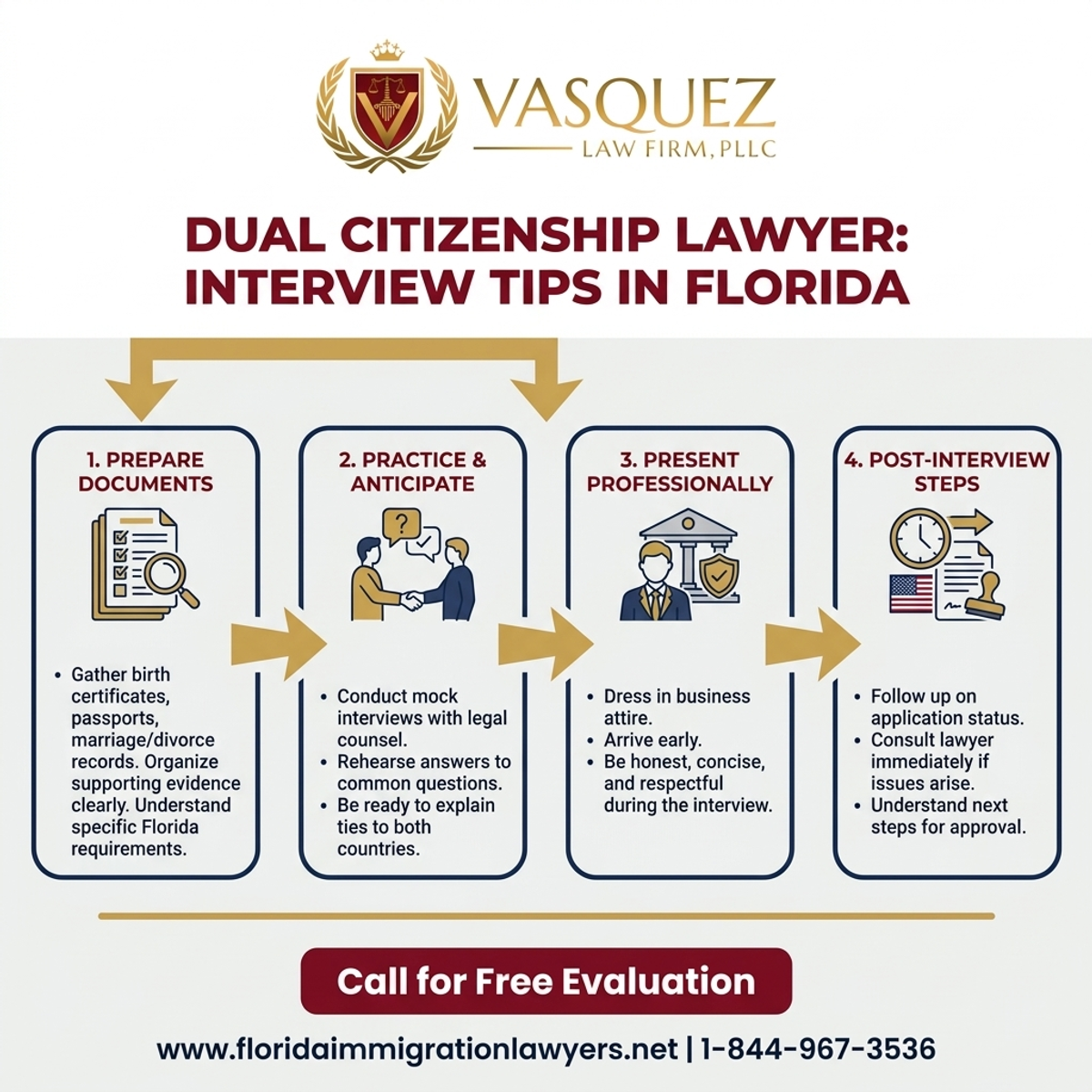
Step-by-Step Process — Dual Citizenship Lawyer: Interview Tips in Florida
Document Checklist for the Citizenship Interview
Bringing a complete and organized set of documents to your citizenship interview is non-negotiable. The USCIS officer will need to verify information provided on your N-400 application and confirm your eligibility. Failure to present required documents can lead to delays, requests for additional evidence, or even a denial of your application, necessitating a rescheduled interview or further action.
It's advisable to create a well-organized folder with original documents and copies. While the officer will primarily review originals, having copies can be helpful. Always keep your documents secure and easily accessible during the interview. If you have any doubts about specific documents, consult with Florida Immigration Lawyers at 1-844-967-3536 for personalized guidance.
- Green Card (Permanent Resident Card)
- State-issued identification (e.g., driver's license)
- Passport and travel documents (all passports, current and expired, used during your permanent residency)
- Marriage certificate (if applicable, along with divorce decrees from previous marriages for both you and your spouse)
- Tax returns for the past five years (or three years if applying under the 3-year rule based on marriage to a U.S. citizen)
- Any supporting documents related to your N-400 application (e.g., birth certificates of children, court dispositions for any arrests or citations, selective service registration proof, evidence of financial support for dependents)
- Proof of continuous residence (e.g., utility bills, lease agreements, pay stubs)
Being meticulously prepared with your documents not only streamlines the interview process but also demonstrates your diligence and respect for the immigration system. Double-check this list before heading to your appointment to avoid any last-minute stress.
Timeline and Processing Expectations
Understanding the timeline for your naturalization application is crucial for managing expectations and planning your future. While the table below provides general timeframes, it's important to remember that processing times can fluctuate based on the specific USCIS field office, current caseloads, and the complexity of individual cases. Factors such as a change of address, additional evidence requests, or background check delays can also impact your personal timeline.
USCIS regularly updates its processing times online, and applicants can check their case status using the receipt number provided after filing. Patience is key, but staying informed and prepared for each stage, especially the interview, can help alleviate some of the waiting anxiety. If your case seems to be taking an unusually long time, or if you encounter unexpected delays, consulting with Florida Immigration Lawyers can provide clarity and potential strategies for inquiry.
| Stage | Typical Timeframe | Notes |
|---|---|---|
| Application Submission | 6-12 months | Includes review and background checks |
| Interview Scheduling | 2-5 months | USCIS schedules the interview |
| Interview and Decision | 1-3 months | Decision typically follows the interview |
| Oath Ceremony | 1-2 months | Final step in becoming a citizen |
While these timeframes offer a general guide, individual experiences may vary. It’s always best to monitor your case status through the USCIS website and respond promptly to any requests for information. Maintaining an updated address with USCIS is vital to ensure you receive all correspondence, including your interview notice and oath ceremony invitation.
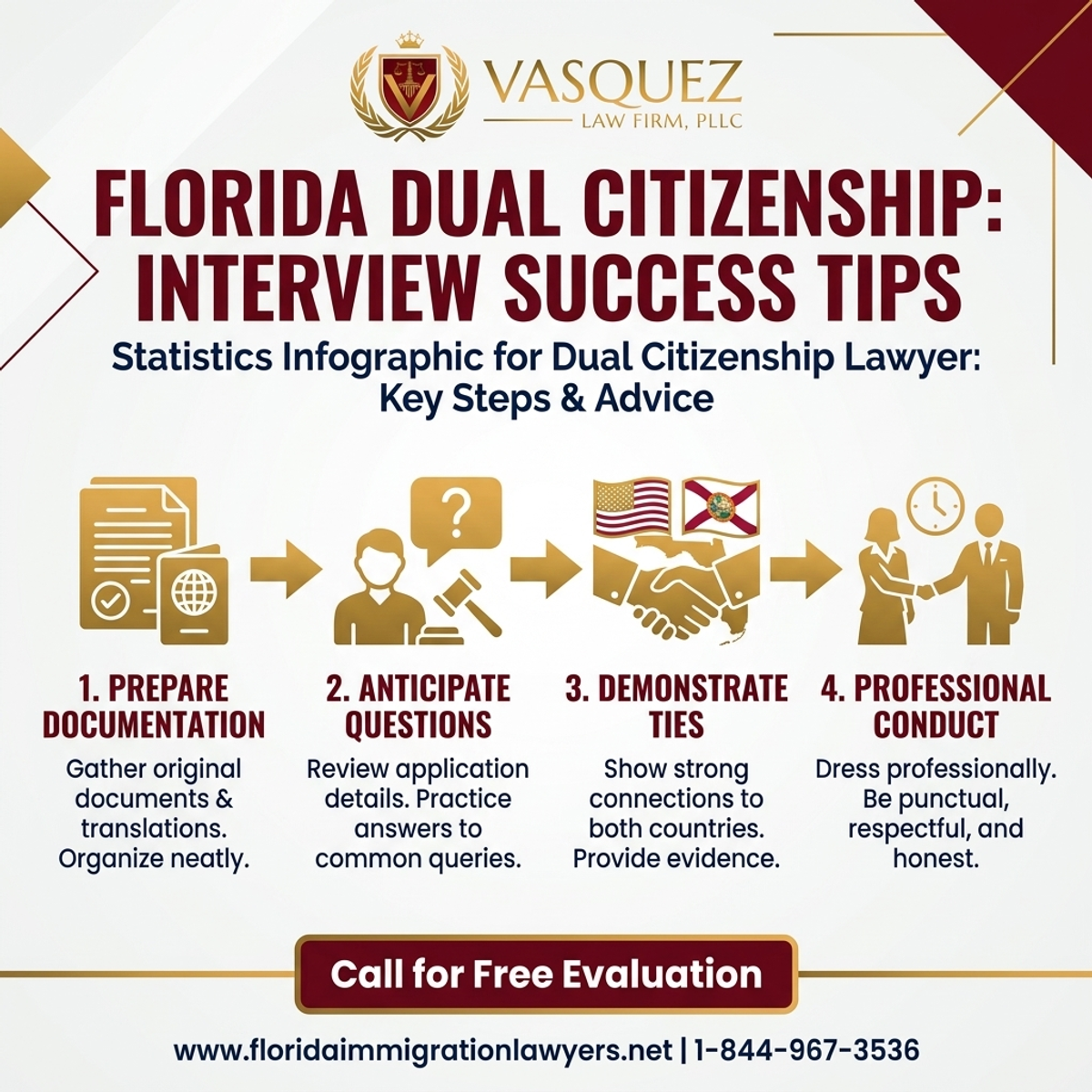
Key Statistics — Dual Citizenship Lawyer: Interview Tips in Florida
Cost Factors and Fee Breakdown
Pursuing U.S. citizenship involves various costs, and understanding these financial obligations upfront can help you budget effectively. The N-400 application fee is the most significant direct cost, and it's subject to change by USCIS. This fee often includes the biometrics service fee, which covers fingerprinting and background checks. It's important to check the most current fee schedule on the USCIS website before filing your application.
Beyond the application fee, other potential costs include legal assistance, especially if you opt for professional guidance, and travel expenses if your interview location is far from your residence. While legal fees vary based on the complexity of your case and the services required, investing in experienced legal counsel from Florida Immigration Lawyers can often prevent costly mistakes and delays, ultimately saving you time and money in the long run. USCIS also offers fee waivers for eligible low-income applicants, so it's worth exploring if you meet the criteria.
| Item | Typical Fee | Notes |
|---|---|---|
| N-400 Application Fee | Varies | Includes biometrics |
| Legal Assistance | Varies | Depends on the complexity of the case |
| Travel Expenses | Varies | If travel to an interview location is required |
Do not navigate this process alone. Contact Florida Immigration Lawyers today.
Financial planning for your naturalization journey should encompass all potential expenditures. While the application fee is a fixed amount (unless waived), costs like legal representation or travel are variable. Remember that the investment in legal assistance can be invaluable, particularly for complex cases involving criminal history, previous immigration issues, or lengthy absences from the U.S. A qualified attorney can help you understand all potential costs and navigate fee waiver options if applicable, ensuring a smoother financial pathway to citizenship.
Common Mistakes to Avoid
The naturalization process, while straightforward for many, is fraught with potential pitfalls that can lead to significant delays or even denial. Being aware of these common mistakes and actively working to avoid them is a critical component of successful interview preparation. Many of these errors stem from a lack of diligent preparation or misunderstanding of USCIS requirements.
Preventing these issues requires careful attention to detail, proactive communication, and sometimes, the expert guidance of an immigration attorney. By taking proactive steps, you can ensure your application and interview process proceed as smoothly as possible, bringing you closer to achieving U.S. citizenship in Florida.
- Not updating address changes with USCIS: It can lead to missed correspondence. USCIS communicates important updates, interview notices, and requests for evidence via mail. If your address is not current, you could miss crucial documents, leading to delays or even the closure of your application if you fail to respond or appear. Always update your address with USCIS promptly after moving.
- Failing to bring necessary documents: This can delay the interview process. As detailed in the checklist, having all original and supporting documents is essential. Forgetting even one item, such as a passport or a specific court disposition, can result in the officer issuing a Request for Evidence (RFE) or rescheduling your interview, prolonging your wait.
- Not studying for the civics test: Unpreparedness can lead to failure. The civics test is a mandatory component. While the questions are publicly available, many applicants underestimate the need for thorough study. Failing this test means you will likely be scheduled for a second interview, adding stress and delay to your process.
- Incorrect information on N-400: This can result in denials or delays. Any false statements or significant errors on your N-400 application, whether intentional or accidental, can lead to serious consequences, including denial and accusations of misrepresentation. Always review your application meticulously before submission and be prepared to clarify any information during the interview.
- Missing the interview appointment: Always reschedule if you cannot attend. Missing your scheduled interview without proper notification to USCIS can lead to the denial of your application. If an unavoidable conflict arises, contact USCIS immediately to request a reschedule, providing a valid reason.
- Overlooking language requirements: This is a crucial part of the interview. The English test (speaking, reading, writing) is fundamental unless you qualify for an exemption based on age and length of permanent residency. Many applicants focus solely on civics, neglecting to practice their English conversational skills, which are vital for the interview itself.
- Not consulting a lawyer
Sources and References
- U.S. Citizenship and Immigration Services (USCIS)
- Executive Office for Immigration Review (EOIR)
- U.S. Department of State
- Immigration and Nationality Act (INA), 8 U.S.C. Chapter 12
Do Not Navigate This Process Alone
Our experienced immigration attorneys are ready to fight for you. Get a free, confidential case review today.
Se Habla Español
Or leave your details and we’ll call you:
Free Evaluation in 24 Hours
Or talk to us right now
AI voice assistant — available 24/7
FreeFrequently Asked Questions

William J. Vásquez
Founding Attorney · Vasquez Law Firm
U.S. Air Force veteran and immigration attorney with years of hands-on U.S. immigration experience. J.D., NCCU School of Law. AILA member. Admitted to the 4th, 5th, and 11th Circuit Courts.
Available 24/7 - Free Evaluations
Reviewed for legal accuracy by William J. Vásquez
Licensed in North Carolina; U.S. immigration is federal practice.
Related Legal Services
Our Florida immigration attorneys can help you with citizenship and naturalization, immigration practice areas and free immigration consultation. Call today at 1-844-YO-PELEO for a free case review.
Related Links
Related Topics
Free Legal Case Review
Discuss your case with our experienced attorneys. We're available 24/7.
Se Habla Español - Estamos aquí para ayudarle.
Related Articles
Immigration Lawyer Orlando Free Consultation in Florida
For individuals and families in Orlando, Florida, navigating the complexities of U.S. immigration law requires expert guidance. An immigration lawyer in Orlando offers crucial support for everything from visa applications and green card processes to naturalization and deportation defense. This comprehensive guide details what a free consultation covers, providing a step-by-step overview of immigration pathways, essential document checklists, and expected timelines in 2026. We also highlight common mistakes to avoid, discuss the critical role of legal counsel in deportation and asylum cases, and explain why choosing a local Orlando immigration attorney is beneficial. Florida Immigration Lawyers is dedicated to serving the diverse community of Orlando with compassionate, effective legal solutions, ensuring you receive personalized advice and robust representation for a successful immigration journey.
Immigration Rights: Know Your Protections in Florida 2026
Understanding your immigration rights in Florida is paramount for your protection and peace of mind. This comprehensive guide details your core constitutional protections, including the right to remain silent and the right to an attorney, regardless of your immigration status. Learn essential strategies for interacting with ICE, what vital documents to carry, and a step-by-step overview of the immigration detention and removal process in Florida. We also cover common mistakes to avoid and when it's crucial to seek expert legal counsel. Florida Immigration Lawyers are dedicated to empowering you with the knowledge and support needed to navigate complex immigration challenges. Our firm offers free case reviews and serves clients across the entire state, ensuring you have access to experienced legal representation when you need it most.
EAD Advance Parole Combo Card: A Guide for Military
For military families in Florida, the EAD Advance Parole Combo Card is a pivotal document, combining work authorization and travel permission for non-citizen family members applying for a green card. This guide from Florida Immigration Lawyers explores how Parole in Place (PIP) paves the way for this card, detailing eligibility, required documents, and processing timelines. We cover the financial aspects, including potential fee waivers for military families, and highlight the critical importance of avoiding common mistakes like traveling without approved advance parole. Understanding these complex immigration benefits is crucial for maintaining family unity and stability while a loved one serves our nation. Our firm is dedicated to providing expert legal assistance to ensure a smooth and successful immigration journey for military families across Florida, from Orlando to every corner of the state. Learn how this essential card can provide peace of mind and flexibility during the adjustment of status process.
Good Moral Character for Naturalization in Florida
Exploring the role of good moral character in the Florida naturalization process, this guide provides insights into how criminal history and personal integrity affect your N-400 application. Learn the steps to demonstrate good moral character and avoid common pitfalls.