J-1 Physician Waiver for Florida Placement: Key Insights
Discover how J-1 physicians can secure waivers for placement in Florida's underserved areas. Learn about the Conrad 30 program, necessary documents, and timelines. Understand the common mistakes to avoid and when to seek legal assistance. Florida Immigration Lawyers are here to guide you through every step.
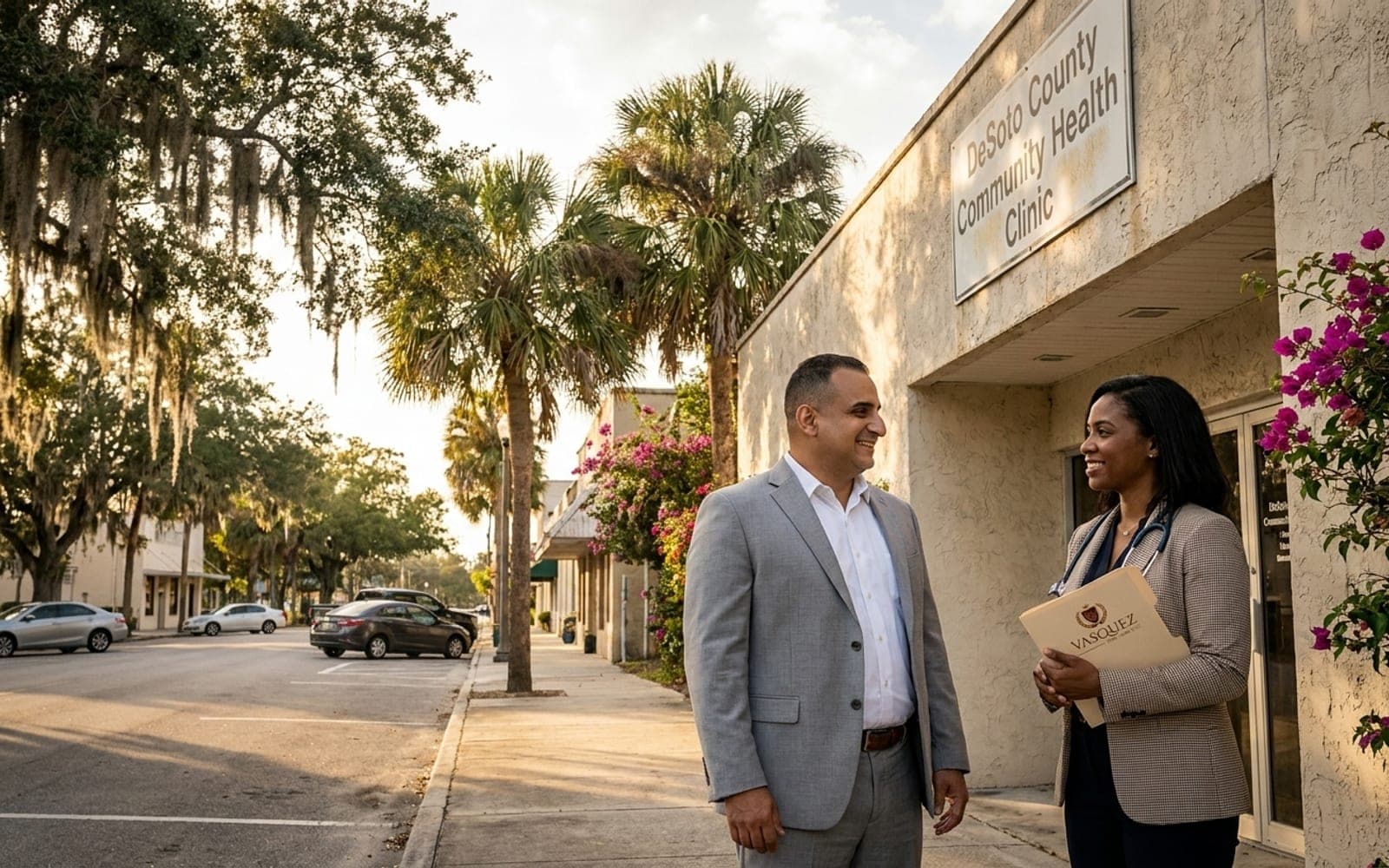
- Eligibility through the Conrad 30 program
- Focus on underserved areas
- Opportunities in Orlando
Introduction
For many J-1 physicians, securing a waiver to work in the United States is a significant step towards building a medical career. Florida, with its diverse population and growing healthcare needs, offers unique opportunities, especially in underserved areas. This article explores the process of obtaining a J-1 waiver for placement in Florida, focusing on the Conrad 30 program and the specific needs of areas like Orlando. Call Florida Immigration Lawyers at 1-844-YO-PELEO for a free case review.
Florida's unique demographics, including a rapidly growing and aging population, coupled with a vibrant tourism industry and diverse communities, create a constant and evolving demand for healthcare professionals. J-1 physicians, having completed rigorous training in the U.S., are uniquely positioned to fill these critical gaps in service. However, navigating the intricate immigration landscape, especially the J-1 waiver process, can be a complex and often daunting endeavor.
This article aims to demystify the path to securing a J-1 waiver for Florida placements, providing a comprehensive guide to the Conrad 30 program, eligibility criteria, and strategic considerations. We understand the immense dedication and sacrifice involved in pursuing a medical career, and our goal is to empower you with the knowledge needed for a successful transition from residency to practice in the Sunshine State. For personalized guidance tailored to your specific situation, remember to call Florida Immigration Lawyers at 1-844-YO-PELEO for a free case review.
What is a J-1 Physician Waiver?
A J-1 Physician Waiver allows foreign medical graduates to work in the U.S. after completing their residency. This waiver is crucial for those wishing to remain in the country, as it bypasses the two-year home residency requirement. As of 2026, the Conrad 30 program remains a popular route for obtaining this waiver, offering 30 slots per state for physicians willing to work in medically underserved areas.
The J-1 visa category is primarily for exchange visitors, and a core tenet is the requirement for participants to return to their home country for at least two years after their program ends. This "two-year home residency requirement" (INA Section 212(e)) is a significant hurdle for many foreign medical graduates who wish to continue practicing in the U.S. after completing their residencies or fellowships. The J-1 Physician Waiver provides a critical exception, allowing these highly skilled professionals to bypass this requirement and remain in the United States, often to address critical healthcare shortages.
This waiver is not merely a bureaucratic step; it represents a pivotal moment in a physician's career, enabling them to apply their U.S.-based training to serve American communities. The Conrad 30 program, specifically tailored for physicians, is a testament to the U.S. government's recognition of the immense value foreign medical graduates bring to the nation's healthcare system, particularly in areas struggling to attract and retain doctors. Successfully obtaining this waiver opens doors to long-term career stability, professional growth, and the opportunity to integrate fully into the American medical community.
Eligibility Criteria
To qualify, physicians must:
- Complete a residency in the U.S.
- Receive a job offer from a healthcare facility in an underserved area
- Commit to a minimum three-year service period
Expanding on these criteria, completing a residency in the U.S. means having successfully finished an accredited medical residency or fellowship program. The job offer must be from a qualifying healthcare facility, typically one located within a federally designated Health Professional Shortage Area (HPSA) or Medically Underserved Area (MUA). This designation is critical, as facilities outside these areas generally do not qualify for Conrad 30 waivers. Furthermore, the commitment to a minimum three-year service period is non-negotiable and must be explicitly detailed in the employment contract. This period ensures that the physician provides substantial service to the underserved community.
The type of medical practice also plays a role; while primary care physicians are often prioritized, specialists can also qualify if there's a demonstrated need in the target underserved area. For instance, a facility in rural Florida might desperately need an endocrinologist, making a specialist waiver application viable. It's imperative that the job offer aligns with the specific needs identified by the state's Department of Health, which administers Florida's Conrad 30 program. Verifying the eligibility of both the physician's specialty and the facility's location is a crucial early step.
How Does the Conrad 30 Program Work?
The Conrad 30 program allows each U.S. state to sponsor up to 30 foreign physicians annually. These physicians must commit to working in federally designated Health Professional Shortage Areas (HPSAs) or Medically Underserved Areas (MUAs).
As of 2026, the application process involves:
- Securing a job offer in an eligible area
- Applying through the state health department
- Receiving support from the sponsoring facility
- Submitting the application to the U.S. State Department
- Awaiting a decision from the USCIS
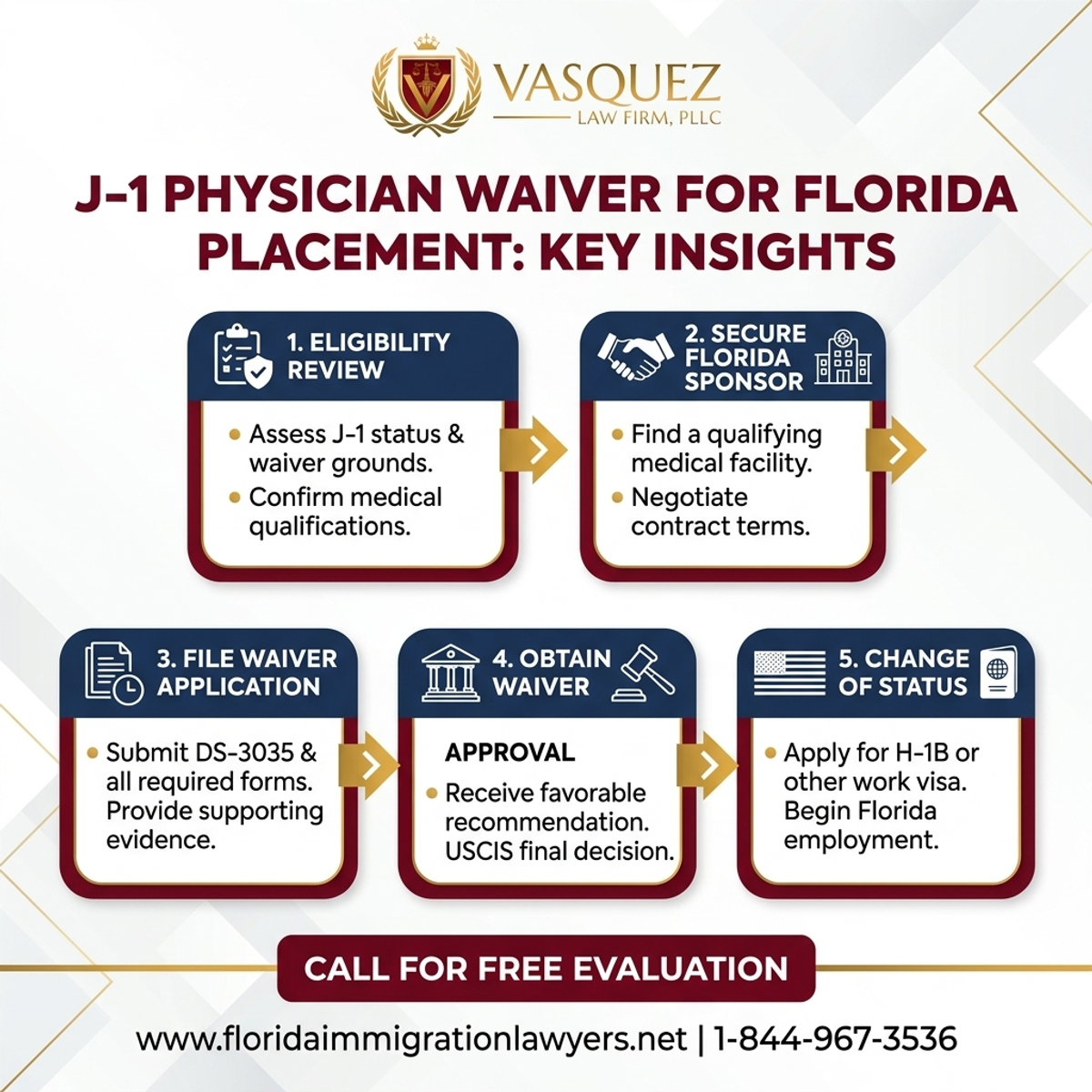
Step-by-Step Process — J-1 Physician Waiver for Florida Placement: Key Insights
Physicians in Florida benefit from the state's robust healthcare infrastructure, particularly in regions like Orlando.The Conrad 30 program is a vital mechanism for states to address their unique healthcare disparities. Each state's Department of Health is responsible for establishing its specific criteria and application process within the federal guidelines. This often involves prioritizing certain medical specialties, geographic areas, or types of facilities based on the state's most pressing needs. For Florida, with its rapidly growing and aging population, the demand for physicians in both urban and rural underserved areas is consistently high, making the 30 available slots highly competitive each year.
The process is designed to ensure that physicians are placed where they can have the most significant impact. After securing a job offer in an eligible HPSA or MUA, the physician applies through the Florida Department of Health. This application typically requires detailed documentation from both the physician and the sponsoring facility, demonstrating the critical need for the physician's services and the facility's unwavering commitment to the program. Once the state health department recommends the waiver, the application proceeds to the U.S. State Department for a "no objection" review, and finally to USCIS for the ultimate decision. Throughout this multi-layered process, securing legal counsel from firms like Florida Immigration Lawyers can be invaluable in navigating the complexities and ensuring a smooth application.
Document Checklist for J-1 Waiver Applications
- Proof of residency completion
- Employment contract with a qualifying facility
- Letter of support from the facility
- Copy of J-1 visa
- Personal statement detailing commitment
A meticulously prepared document checklist is the backbone of a successful J-1 waiver application. Beyond the basic items, each document requires careful attention to detail and accuracy to avoid delays or requests for additional evidence (RFEs). Any discrepancies or missing information can significantly impact your application's timeline.
- Proof of residency completion: This includes your diploma, certificate of completion from your U.S. medical residency or fellowship program, and official transcripts. Ensure all names and dates match your passport and other immigration documents precisely.
- Employment contract with a qualifying facility: This contract is paramount. It must clearly state the three-year commitment to full-time clinical practice, the physician's salary, benefits, and the specific duties. Crucially, it must confirm the facility's location within a federally designated HPSA or MUA and include a clause stating that the contract is contingent upon waiver approval.
- Letter of support from the facility: This letter, typically from the CEO or Medical Director, should articulate the critical need for the physician's services, the facility's location in an underserved area, and how the physician will contribute to patient care in that community. It often includes statistics on patient volume, physician-to-patient ratios, and the impact of physician shortages to underscore the urgency.
- Copy of J-1 visa and all DS-2019 forms: Provide clear copies of your current J-1 visa stamp, your passport biographical page, and all DS-2019 forms issued throughout your J-1 program, demonstrating your legal status and program history.
- Personal statement detailing commitment: This is your opportunity to convey your genuine commitment to serving an underserved community. It should explain your motivations, your understanding of the community's needs, your long-term plans to contribute, and how your skills align with the facility's mission. A compelling and heartfelt personal statement can significantly strengthen your application.
Additional documents may include a comprehensive curriculum vitae (CV), letters of recommendation from supervisors, and evidence of any previous J-1 waivers or extensions. Organizing these documents meticulously and ensuring consistency across all submissions is vital. Consulting with Florida Immigration Lawyers can help you compile a complete and compelling application package.
Timeline and Processing Expectations
| Stage | Typical Timeframe | Notes |
|---|---|---|
| Job Offer Secured | 2-3 months | Varies by facility |
| State Application | 1-2 months | Dependent on state process |
| USCIS Processing | 3-6 months | Includes background checks |
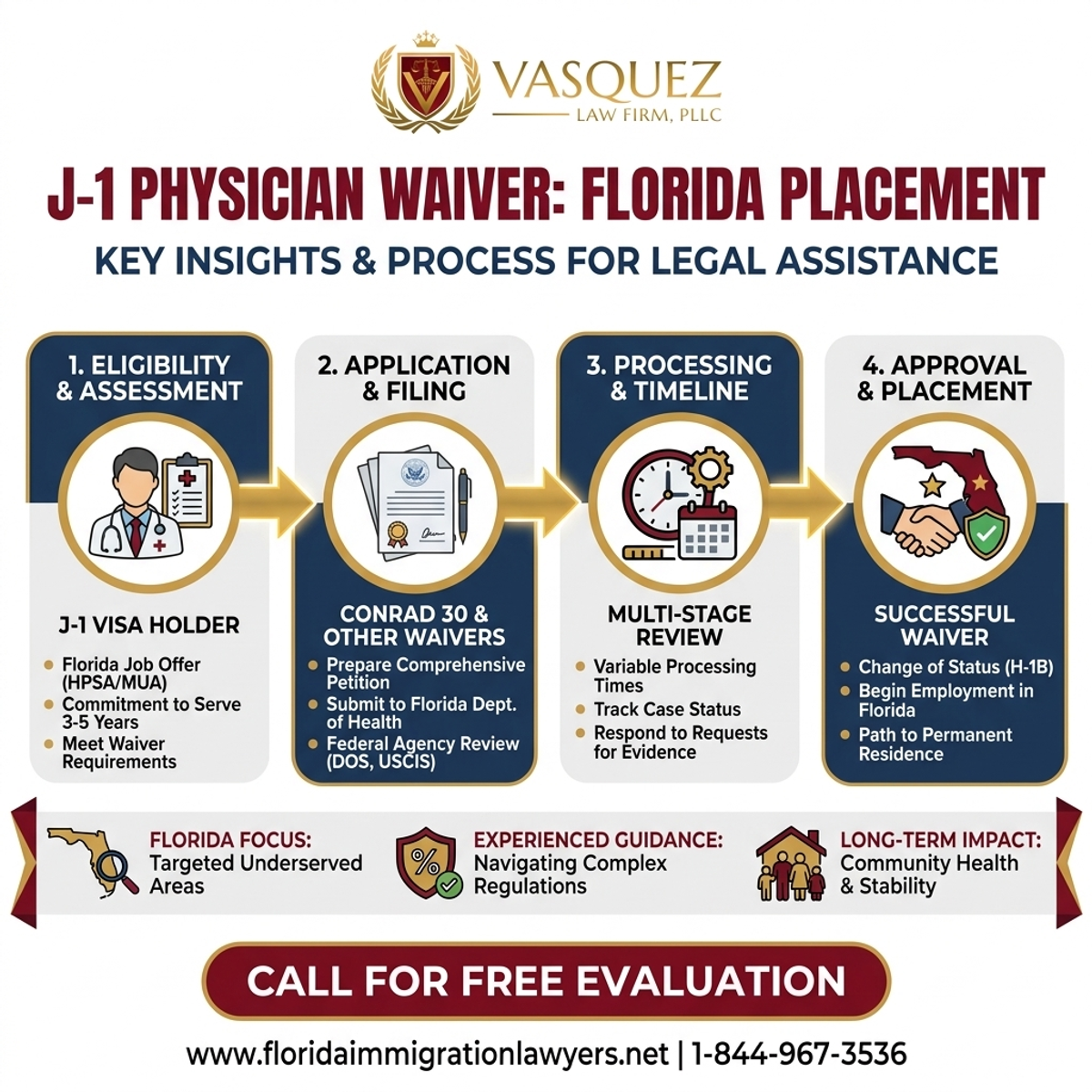
Key Statistics — J-1 Physician Waiver for Florida Placement: Key Insights
While the table provides a general overview, understanding the nuances of each stage is crucial for managing expectations and planning your professional transition effectively. These timeframes are estimates and can be influenced by various factors, including the volume of applications, state-specific processing speeds, and the complexity of individual cases.
- Job Offer Secured (2-3 months): This timeframe is highly variable. It depends on your medical specialty, networking efforts, and the specific needs of facilities in underserved areas. Some physicians may secure offers within weeks, while others might take longer, especially if they are seeking a highly specialized role or positions in less common HPSAs. Starting your job search early, ideally 6-12 months before your residency ends, is highly recommended to allow ample time for interviews and contract negotiations.
- State Application (1-2 months): Once a job offer is secured, the state application phase begins. This involves compiling all necessary documents and submitting them to the Florida Department of Health. The state then reviews the application, verifies the facility's HPSA/MUA status, and assesses the community's need. Florida's Conrad 30 program usually has specific application windows and strict deadlines, which must be adhered to. Missing a deadline could mean waiting another year, so meticulous planning is key.
- USCIS Processing (3-6 months): After the state recommends the waiver and the U.S. State Department issues a "no objection" statement, the application is forwarded to USCIS. This stage involves thorough background checks, security clearances, and a final review of all submitted documentation. During this period, USCIS may issue a Request for Evidence (RFE) if they require additional information or clarification. Responding promptly and comprehensively to an RFE is critical. While 3-6 months is typical, complex cases or periods of high application volumes can extend this timeframe. Physicians should plan for potential delays and maintain open communication with their legal counsel, such as Florida Immigration Lawyers, who can track the application status and advise on next steps.
Cost Factors and Fee Breakdown
| Item | Typical Fee | Notes |
|---|---|---|
| Application Fee | Varies | Check state-specific fees |
| Legal Assistance | Varies | Consult with an attorney |
Understanding the financial commitment involved in the J-1 waiver process is essential for proper planning and avoiding unexpected expenses. These costs can vary, so it's important to research current fees and budget accordingly.
- Application Fee (Varies): This can include a federal filing fee for the USCIS Form I-612 (Application for Waiver of the Foreign Residence Requirement), which is subject to change. Some states may also have a nominal processing fee for their Conrad 30 program application. Additionally, you might incur costs for obtaining official transcripts, certified translations of foreign documents, and secure mailing fees. It's crucial to check the most current fee schedules on the USCIS website and the Florida Department of Health's immigration program page.
- Legal Assistance (Varies): The cost of legal assistance can range significantly based on the complexity of your case, the attorney's experience, and the scope of services provided. Retaining an experienced immigration attorney, particularly one specializing in J-1 waivers like those at Florida Immigration Lawyers, can be a valuable investment. They can help prepare and review all documentation, liaise with state and federal agencies, respond to RFEs, and provide strategic advice, significantly increasing your chances of success and minimizing delays. While it represents an upfront cost, avoiding costly mistakes or denials can save you significant time and money in the long run.
Beyond these direct costs, physicians should also factor in potential relocation expenses to Florida, state medical licensing fees for the Florida Medical Board, and any initial living expenses before their first paycheck. A comprehensive financial plan is a key component of a smooth transition into your new role and community.
Do not navigate this process alone. Contact Florida Immigration Lawyers today.
Common Mistakes to Avoid
- Submitting incomplete applications: Missing documents can delay or derail your application.
- Ignoring state-specific requirements: Each state has unique rules under the Conrad 30 program.
- Failing to secure a valid job offer: An offer from a non-qualifying facility will not be accepted.
- Missing deadlines: Timely submission is critical for success.
- Not consulting with an immigration attorney: Professional guidance can prevent costly errors.
- Underestimating language requirements: Proficiency in English is essential for effective communication.
- Overlooking contract details: Ensure all employment terms are clearly understood and agreed upon.
- Assuming all facilities are eligible: Verify the facility's status as a qualifying location.
When to Call a Lawyer
Engaging with an immigration lawyer can be crucial at various stages of the J-1 waiver process. If you encounter issues with documentation, eligibility, or navigating the complex legal requirements, a legal expert can provide invaluable assistance. Florida Immigration Lawyers offer comprehensive services to support you through this journey.
While some parts of the application may seem straightforward, the complexities of immigration law often hide subtle pitfalls that can lead to significant delays or even denials. You should consider contacting a legal expert if you encounter issues with documentation, such as missing records or discrepancies, or if you are unsure about your eligibility based on your specific training or job offer. A lawyer can help clarify complex legal requirements, interpret state-specific regulations under the Conrad 30 program, and ensure your application package is robust and error-free from the outset.
Furthermore, if your application receives a Request for Evidence (RFE) from USCIS, or if you face a potential denial, immediate legal intervention is paramount. An experienced attorney can formulate a strategic response, gather additional supporting evidence, and advocate on your behalf. Even before these issues arise, a proactive consultation with Florida Immigration Lawyers can provide peace of mind and help you strategize the most effective path forward, especially if you have unique circumstances, such as prior immigration history, family considerations, or a change in employment plans. Don't wait for a problem to arise; early legal guidance can prevent many common pitfalls and streamline your path to success.
About Florida Immigration Lawyers
Florida Immigration Lawyers is a leading law firm dedicated to serving the immigration needs of individuals and families across Florida. Our experienced attorneys focus on various immigration services, including J-1 waivers, asylum, deportation defense, citizenship, and family immigration. We are available 24/7 to provide free case reviews and personalized legal support. Explore our practice areas or schedule a free consultation.
Our firm prides itself on a deep understanding of both federal immigration law and state-specific requirements for programs like the Conrad 30 waiver, ensuring our clients receive comprehensive and up-to-date advice. We understand the unique challenges faced by foreign medical professionals and are committed to providing tailored, effective legal solutions that align with your long-term career aspirations in the United States.
We are available 24/7 to provide free case reviews and personalized legal support, reflecting our commitment to accessibility and client-focused service. Our team works diligently to demystify the legal process, offering clear communication and compassionate representation every step of the way. Whether you are just beginning to explore your J-1 waiver options or are facing complex challenges, Florida Immigration Lawyers is here to guide you towards a successful outcome. Explore our practice areas or schedule a free consultation today to learn how we can assist you in achieving your professional and personal goals in Florida.
Frequently Asked Questions About J-1 Waivers in Florida
Q: Can I change employers after receiving a J-1 waiver?
A: Generally, no. The J-1 waiver is tied to the specific employer and location that sponsored you for the three-year service obligation. Changing employers during this period typically requires a new waiver application, which is rarely granted unless there are extraordinary circumstances, such as the sponsoring facility closing down or a significant breach of contract. It's crucial to fulfill your initial three-year commitment to avoid jeopardizing your immigration status. Always consult with Florida Immigration Lawyers at 1-844-YO-PELEO if you anticipate any changes.
Q: What happens if my J-1 waiver application is denied?
A: A denial can be disheartening, but it's not always the end of the road. If your J-1 waiver application is denied, it's critical to understand the reasons for the denial, which will be outlined in the USCIS decision letter. Depending on the grounds, you might be able to appeal the decision, file a motion to reopen, or reapply if the issues can be resolved. This is a complex situation where immediate legal counsel from an experienced immigration attorney is essential to explore all available options and strategize your next steps effectively.
Q: Are all medical specialties eligible for a J-1 waiver through Conrad 30?
A: While the Conrad 30 program primarily prioritizes primary care specialties (Family Medicine, Internal Medicine, Pediatrics, OB/GYN, Psychiatry) due to the widespread need in underserved areas, other specialties can also be eligible. Eligibility for specialists depends on the specific needs identified by the Florida Department of Health and the demonstrated critical shortage in the proposed practice location. The sponsoring facility must provide compelling evidence that a specialist is required and cannot be filled by a U.S. physician. It's vital to confirm your specialty's eligibility with the state program and your legal counsel.
Q: Can I apply for a Green Card while on a J-1 waiver?
A: Yes, once your J-1 waiver is approved and you begin working under its terms, you generally become eligible to pursue a Green Card (permanent residency). Most J-1 waiver physicians transition to an H-1B visa for the three-year service period. After fulfilling this obligation, or sometimes even concurrently, they can apply for an employment-based Green Card, often through the National Interest Waiver (NIW) or PERM labor certification process. Consulting with Florida Immigration Lawyers can help you plan your long-term immigration strategy effectively.
Sources and References
- U.S. Citizenship and Immigration Services (USCIS)
- Executive Office for Immigration Review (EOIR)
- 8 U.S.C. Chapter 12 - Immigration and Nationality Act
Related services: family immigration services, citizenship and naturalization, asylum protection.
This article provides general legal information and is not intended as legal advice. Every case is unique, and outcomes depend on specific facts and circumstances. Contact an attorney for advice about your particular situation.
Ready to take the next step? Call 1-844-YO-PELEO today for a free consultation. Se Habla Español - Estamos aquí para ayudarle.
If you need legal assistance, learn more about our immigration law practice, or call us at 1-844-YO-PELEO for a free case review.
Do Not Navigate This Process Alone
Our experienced immigration attorneys are ready to fight for you. Get a free, confidential case review today.
Se Habla Español
Or leave your details and we’ll call you:
Free Evaluation in 24 Hours
Or talk to us right now

AI voice assistant — available 24/7
FreeFrequently Asked Questions

William J. Vásquez
Founding Attorney · Vasquez Law Firm
U.S. Air Force veteran and immigration attorney with years of hands-on U.S. immigration experience. J.D., NCCU School of Law. AILA member. Admitted to the 4th, 5th, and 11th Circuit Courts.
Available 24/7 - Free Evaluations
Reviewed for legal accuracy by William J. Vásquez
Licensed in North Carolina; U.S. immigration is federal practice.
Related Legal Services
Our Florida immigration attorneys can help you with business immigration, deportation defense and family immigration services. Call today at 1-844-YO-PELEO for a free case review.
Related Links
Related Topics
Free Legal Case Review
Discuss your case with our experienced attorneys. We're available 24/7.
Se Habla Español - Estamos aquí para ayudarle.
Related Articles
Certificate of Eligibility for Expungement in Florida 2026
For non-U.S. citizens in Florida, understanding how a state expungement impacts immigration status is critical. A certificate of eligibility for expungement in Florida allows a criminal record to be sealed or expunged under state law. However, federal immigration agencies often disregard such state-level relief, still considering the original criminal offense as a conviction for immigration purposes. This can have severe implications for visa applications, green card eligibility, naturalization, and even lead to deportation. This guide clarifies the Florida expungement process, its limited effect on federal immigration law, and key steps to protect your status in 2026. Learn about common mistakes, required documents, timelines, and when to seek expert legal counsel from Florida Immigration Lawyers to navigate these complex issues effectively.
Immigration Lawyer Orlando Free Consultation in Florida
For individuals and families in Orlando, Florida, navigating the complexities of U.S. immigration law requires expert guidance. An immigration lawyer in Orlando offers crucial support for everything from visa applications and green card processes to naturalization and deportation defense. This comprehensive guide details what a free consultation covers, providing a step-by-step overview of immigration pathways, essential document checklists, and expected timelines in 2026. We also highlight common mistakes to avoid, discuss the critical role of legal counsel in deportation and asylum cases, and explain why choosing a local Orlando immigration attorney is beneficial. Florida Immigration Lawyers is dedicated to serving the diverse community of Orlando with compassionate, effective legal solutions, ensuring you receive personalized advice and robust representation for a successful immigration journey.
Naturalization Ceremony Locations and Schedule 2026 Florida
For those in Florida aspiring to U.S. citizenship, understanding the naturalization process, including ceremony locations and schedules for 2026, is essential. This guide from Florida Immigration Lawyers details the N-400 application, eligibility requirements, and typical timelines. We cover the step-by-step journey, from initial filing and biometrics to the naturalization interview and the final Oath of Allegiance ceremony held across Florida's USCIS field offices, including Orlando, Miami, Tampa, and Jacksonville. Learn about critical documents, potential costs, and common mistakes to avoid. Our firm emphasizes the importance of accurate applications and offers expert legal assistance for complex cases, ensuring a smoother path to becoming a U.S. citizen. Get a free case review today.
Green Card Renewal Process in Florida: 2026 Guide
Renewing your green card in Florida is a vital process for maintaining your lawful permanent resident status. This comprehensive 2026 guide from Florida Immigration Lawyers breaks down the Form I-90 application, covering eligibility, step-by-step instructions, necessary documents, typical costs, and current processing timelines. We explain who needs to renew, what to expect at your biometrics appointment, and Florida-specific considerations for permanent residents. Learn how to avoid common mistakes that can delay your application and understand when professional legal assistance is crucial. Our expert attorneys are here to provide free case reviews and guide you through every stage, ensuring a smooth and secure renewal of your permanent resident card.