Derived Citizen Status: Your Guide in Florida 2026
Derived citizenship offers a pathway for children to automatically become U.S. citizens through their parents, a crucial process for many families in Florida. This comprehensive guide details the eligibility requirements under INA Section 320, emphasizing that children must be under 18, lawful permanent residents, and in the legal and physical custody of a U.S. citizen parent. We provide a step-by-step application process for Form N-600, including a document checklist, typical timelines, and cost factors as of 2026. The article also addresses complex scenarios like adoptions and out-of-wedlock births, highlighting common mistakes to avoid. Florida Immigration Lawyers serves as a vital resource for families navigating these intricate laws, offering guidance to ensure a smooth and successful application. Understanding these nuances is key to securing a Certificate of Citizenship and confirming your child's place in the United States.
Derived citizenship allows children to automatically become U.S. citizens when their U.S. citizen parent (or parents) meet specific legal criteria, typically before the child's 18th birthday. This process, governed by the Immigration and Nationality Act (INA) Section 320, applies to children who are lawful permanent residents and residing in the U.S. in the legal and physical custody of their U.S. citizen parent. In Florida, understanding these nuanced requirements is crucial, as errors can lead to delays or denial. Consulting with an experienced immigration attorney is highly recommended to ensure all conditions are met and the application is properly filed.
- Derived citizenship is automatic upon meeting specific conditions, primarily through INA 320.
- The child must be under 18, a lawful permanent resident, and in the custody of a U.S. citizen parent.
- The N-600 Application for Certificate of Citizenship is the primary form to document this status.
- Legal guidance is essential to navigate complex family situations and ensure compliance with USCIS requirements.
- This status differs from 'acquired citizenship,' which applies to children born abroad to U.S. citizen parents.
The dream of U.S. citizenship is a powerful one, representing stability, opportunity, and a profound sense of belonging. For many families in Florida, this dream can be realized through the unique pathway of derived citizenship. This process allows eligible children to automatically become U.S. citizens based on their parent's citizenship, often without needing to go through the lengthy naturalization process themselves. However, navigating the intricate laws and regulations governing derived citizenship can be complex, especially with specific requirements about age, residency, and custody.
Whether you're a U.S. citizen parent living in Orlando or elsewhere in Florida, or a lawful permanent resident child seeking to confirm your status, understanding the nuances of derived citizenship is paramount. This comprehensive guide will explain what derived citizenship means, who qualifies, the application process, and common pitfalls to avoid. We'll provide Florida-specific context and practical advice to help you secure this vital status. Don't leave your family's future to chance; understanding your options is the first step toward peace of mind. For personalized guidance, call Florida Immigration Lawyers at 1-844-YO-PELEO for a free case review.
What is Derived Citizenship, and Who is Eligible in 2026?
Derived citizenship, primarily governed by Section 320 of the Immigration and Nationality Act (INA), refers to the automatic acquisition of U.S. citizenship by a child through the naturalization or birth of their parent(s). This is a crucial distinction from 'acquired citizenship,' which applies to children born outside the U.S. to at least one U.S. citizen parent, where citizenship is typically transmitted at birth under INA Sections 301 or 309. As of 2026, for a child to derive U.S. citizenship, several strict conditions must be met simultaneously and continuously. It's not a discretionary process; if all criteria are met, citizenship is automatically conferred by law.
The core eligibility requirements for derived citizenship under INA 320 are:
- At least one parent is a U.S. citizen: This parent must be a U.S. citizen by birth or naturalization. If one parent naturalizes, the child may derive citizenship from that parent.
- The child is under 18 years of age: This is a strict age limit. The child must meet all other requirements before their 18th birthday.
- The child is a lawful permanent resident (LPR): The child must possess a valid Green Card at the time all other conditions are met. This means they have been lawfully admitted to the U.S. for permanent residence.
- The child is residing in the U.S. in the legal and physical custody of the U.S. citizen parent: Both legal and physical custody are required. Legal custody typically means the parent has been granted custody by a court or is the biological parent in an intact marriage. Physical custody means the child lives with the U.S. citizen parent.
For families in Florida, particularly those in diverse communities like Orlando, navigating these requirements can be particularly challenging due to varied family structures. For instance, if parents are divorced, the U.S. citizen parent must demonstrate sole legal and physical custody of the child. Adoptees can also derive citizenship, but specific adoption requirements must be met, including a full and final adoption before the child's 16th birthday (with some exceptions for siblings). Understanding INA Section 320 (USCIS Policy Manual, Volume 12, Part H, Chapter 4) is critical for anyone considering this path. Given the strict conditions, any misinterpretation could lead to significant delays or a denial of citizenship, highlighting the importance of legal advice.
How Do I Apply for Derived Citizenship in Florida? A Step-by-Step Guide
While derived citizenship is automatic upon meeting the legal criteria, obtaining official proof of this status is essential for various purposes, such as applying for a U.S. passport, voting, or securing certain federal benefits. The primary method to document derived citizenship is by filing Form N-600, Application for Certificate of Citizenship, with U.S. Citizenship and Immigration Services (USCIS). This application requests a Certificate of Citizenship, which serves as official recognition of your U.S. citizenship status. The process, while seemingly straightforward, requires meticulous attention to detail and thorough documentation.
Here's a step-by-step guide for applying for derived citizenship in Florida:
-
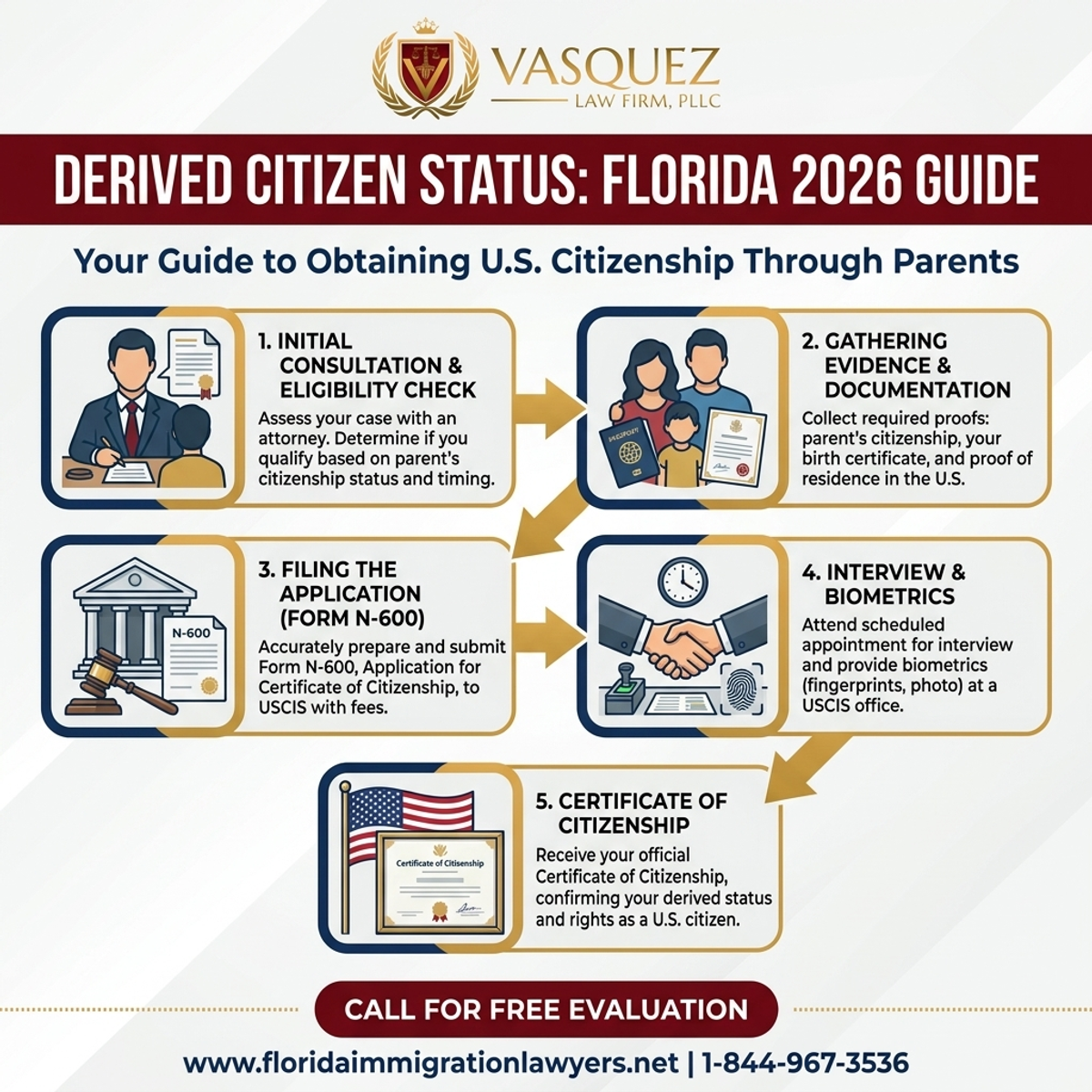
Determine Eligibility: Before starting any paperwork, thoroughly review the eligibility criteria under INA 320. Ensure that the child was under 18, a lawful permanent resident, and in the legal and physical custody of a U.S. citizen parent when all conditions were met. This is the most critical first step. Consult with an attorney if there are any doubts about meeting all criteria.
-
Gather Required Documents: Compile all necessary supporting documentation. This typically includes the child's birth certificate, the U.S. citizen parent's birth certificate or naturalization certificate, the child's Green Card (Form I-551), parents' marriage certificate (if applicable), divorce decrees or custody orders (if applicable), and any adoption decrees. Detailed lists are often provided in the N-600 instructions, but an attorney can help identify specific documents for unique situations.
-
Complete Form N-600: Accurately fill out Form N-600, Application for Certificate of Citizenship. Ensure all sections are completed, and answers are consistent with your supporting documents. Pay close attention to dates and names. Any discrepancies can trigger Requests for Evidence (RFEs) or delays. This form can be found on the USCIS website.
-
Pay the Filing Fee: As of 2026, the N-600 application has a filing fee. Check the most current fee schedule on the USCIS website (Form G-1055, Fee Schedule). Fee waivers may be available for eligible applicants, but they require a separate application (Form I-912, Request for Fee Waiver).
-
Submit the Application: Mail the completed Form N-600, all supporting documents, and the correct filing fee to the appropriate USCIS Lockbox facility. The exact mailing address depends on your state of residence (for Florida, check USCIS website instructions for N-600 filing). Keep copies of everything you submit for your records.
-
Attend Biometrics Appointment: After filing, USCIS will send a notice for a biometrics appointment at an Application Support Center (ASC). For residents of Central Florida, this might be the Orlando ASC. The child will have their fingerprints and photograph taken. It is crucial not to miss this appointment.
-
Attend Interview (if required): While not all N-600 applicants are interviewed, USCIS reserves the right to request an interview. If an interview is scheduled, both the child (if old enough) and the U.S. citizen parent(s) typically attend. The interview will take place at a local USCIS Field Office, such as the USCIS Orlando Field Office for Central Florida residents. Be prepared to answer questions about the application and provide original documents.
-
Receive Decision: USCIS will issue a decision on the N-600 application. If approved, a Certificate of Citizenship will be mailed to you. This certificate is proof of U.S. citizenship and can be used to apply for a U.S. passport.
Throughout this process, especially for families in Florida facing unique challenges or seeking to ensure all documentation is perfect, the guidance of an experienced immigration attorney can be invaluable. They can help prepare the application, organize documents, and represent you during interviews.
What Documents Do I Need for a Derived Citizenship Application?
A successful derived citizenship application hinges on providing comprehensive and accurate documentation to USCIS. The goal is to prove beyond doubt that all statutory requirements under INA 320 were met. Missing or incorrect documents are among the most common reasons for delays, Requests for Evidence (RFEs), or even denial. Therefore, meticulous organization and thoroughness are paramount. This checklist outlines the typical documents required, but individual circumstances may necessitate additional evidence.
Required Document Checklist for Form N-600:
- Child's Documents:
- Child's original birth certificate (with certified English translation if not in English).
- Child's Permanent Resident Card (Form I-551, Green Card).
- Child's foreign passport (if applicable) and U.S. entry stamp/records.
- Two identical passport-style photographs of the child (if required by instructions).
- U.S. Citizen Parent's Documents:
- Proof of U.S. citizenship: U.S. birth certificate, Certificate of Naturalization, Certificate of Citizenship, or valid U.S. passport.
- Parent's marriage certificate (if applicable).
- Previous marriage termination documents (divorce decrees, annulment, death certificates) for both parents, if applicable.
- Evidence of legal and physical custody (court orders, school records, medical records, affidavits from third parties, utility bills, lease agreements showing shared residence) if parents are divorced or legally separated.
Step-by-Step Process — Derived Citizen Status: Your Guide in Florida 2026
- Additional Documents (if applicable):
- Adoption decree (if the child was adopted).
- Evidence of name changes (court orders, marriage certificates).
- Proof of relationship for children born out of wedlock (e.g., genetic testing, acknowledgment of paternity, evidence of financial support) if specific conditions apply.
- Translated documents: Any document not in English must be accompanied by a complete and certified English translation.
It's vital to provide clear, legible copies of all documents. While USCIS generally prefers copies, be prepared to present originals at an interview if requested. For complex family situations, such as those involving step-parents, multiple marriages, or children born outside of marriage, additional specific documentation will be required to establish the qualifying relationship and custody. An immigration attorney can assist in identifying every necessary document and ensuring they meet USCIS standards, minimizing the risk of delays for Florida families.
What is the Timeline and Cost for Derived Citizenship Applications in 2026?
Understanding the potential timeline and associated costs for a derived citizenship application (Form N-600) is crucial for planning. While derived citizenship itself is automatic, the process of obtaining the Certificate of Citizenship can take several months. As of 2026, processing times can vary significantly based on the specific USCIS service center, the complexity of the case, and current caseloads. Similarly, fees are subject to change, so always verify the latest information directly from USCIS.
Typical Timeline for Form N-600 (as of 2026):
| Stage | Typical Timeframe | Notes |
|---|---|---|
| Filing to Receipt Notice | 1-3 weeks | USCIS acknowledges receipt with Form I-797C. |
| Biometrics Appointment | 3-8 weeks after receipt | Scheduled at a local Application Support Center (ASC), e.g., Orlando ASC. |
| Case Review & Interview Scheduling | 3-9 months after biometrics | USCIS reviews documents; some cases may not require an interview. |
| Interview (if required) | Variable, usually 1-2 months after scheduling | Conducted at a USCIS Field Office, such as the Orlando Field Office. |
| Decision & Certificate Issuance | 1-4 weeks after interview or final review | Approval notice followed by mailing of Certificate of Citizenship. |
| Total Processing Time | 6-18 months (on average) | Complex cases, RFEs, or high volume can extend this. |
It's important to note that these are averages, and individual cases may fall outside these ranges. USCIS provides online processing time estimates, which should be checked regularly.
Cost Factors and Fee Breakdown for N-600 (as of 2026):
| Item | Typical Fee | Notes |
|---|---|---|
| USCIS Form N-600 Filing Fee | Varies (e.g., $1,170) | Subject to change; always check USCIS website for current fee. |
| Biometrics Fee | Included in filing fee | No separate fee for N-600. |
| Attorney Legal Fees | Varies widely ($1,500 - $5,000+) | Depends on case complexity, firm's experience, and services provided. |
| Document Translation Costs | Varies ($20 - $100+ per page) | Required for any document not in English. |
| Postage/Courier Fees | Minimal ($10 - $50) | For mailing application securely. |
| Estimated Total Cost (excluding legal fees) | ~$1,200 - $1,300+ | Does not include potential travel for interviews. |
While the USCIS filing fee is a fixed cost (subject to change), legal fees for an attorney can vary substantially. Investing in experienced legal counsel can prevent costly mistakes and delays, ultimately saving time and money in the long run. For families in Florida, Florida Immigration Lawyers offers transparent fee structures and free case reviews to discuss your specific situation and potential costs.
Navigating Complex Cases: Adoptions, Out-of-Wedlock Births, and Special Circumstances
While the general rules for derived citizenship seem straightforward, many families in Florida face unique circumstances that add layers of complexity to their applications. These special situations require a deeper understanding of immigration law and often benefit significantly from legal expertise. Recognizing these nuances early can prevent significant delays or denials.
Children Born Out of Wedlock (INA 309):
For children born out of wedlock to a U.S. citizen father, establishing derived citizenship can be more challenging than for those born to a U.S. citizen mother. The INA requires additional proof of a legal relationship between the father and child. Specifically, for children born on or after November 14, 1986, the U.S. citizen father must have legitimated the child under the laws of the child's residence or domicile, acknowledged paternity in writing under oath, or had paternity established by a competent court. Furthermore, the father must have agreed in writing to provide financial support for the child until they reach 18, and the child must be under 18 at the time all conditions are met. These requirements are distinct from derived citizenship under INA 320, often falling under 'acquired citizenship' rules but illustrating the complexities of parental ties.
Adopted Children:
Adopted children can also derive citizenship, but specific conditions apply. The adoption must be full and final, and typically must have occurred before the child's 16th birthday. There are also specific rules for 'orphan' petitions (Form I-600) and 'Hague Convention Adoptee' petitions (Form I-800) for children adopted abroad. The child must reside with and be in the legal and physical custody of the U.S. citizen parent(s) subsequent to the adoption. For example, a family in Orlando who adopted a child internationally would need to ensure all legal requirements for the adoption were met and properly documented for USCIS purposes. The legal complexities here often demand precise legal interpretation.
Children of U.S. Military Members:
Special provisions exist for children of U.S. military members serving abroad. In some cases, these children may be able to complete the naturalization process while overseas, or they may automatically acquire citizenship. For example, a child born abroad to a U.S. citizen military parent who has spent a certain period in the U.S. might acquire citizenship at birth. However, if the child later becomes an LPR and the parent naturalizes, the child could derive citizenship. These cases often involve coordination with the State Department and specific military benefits. For Florida military families, understanding these unique pathways is vital.
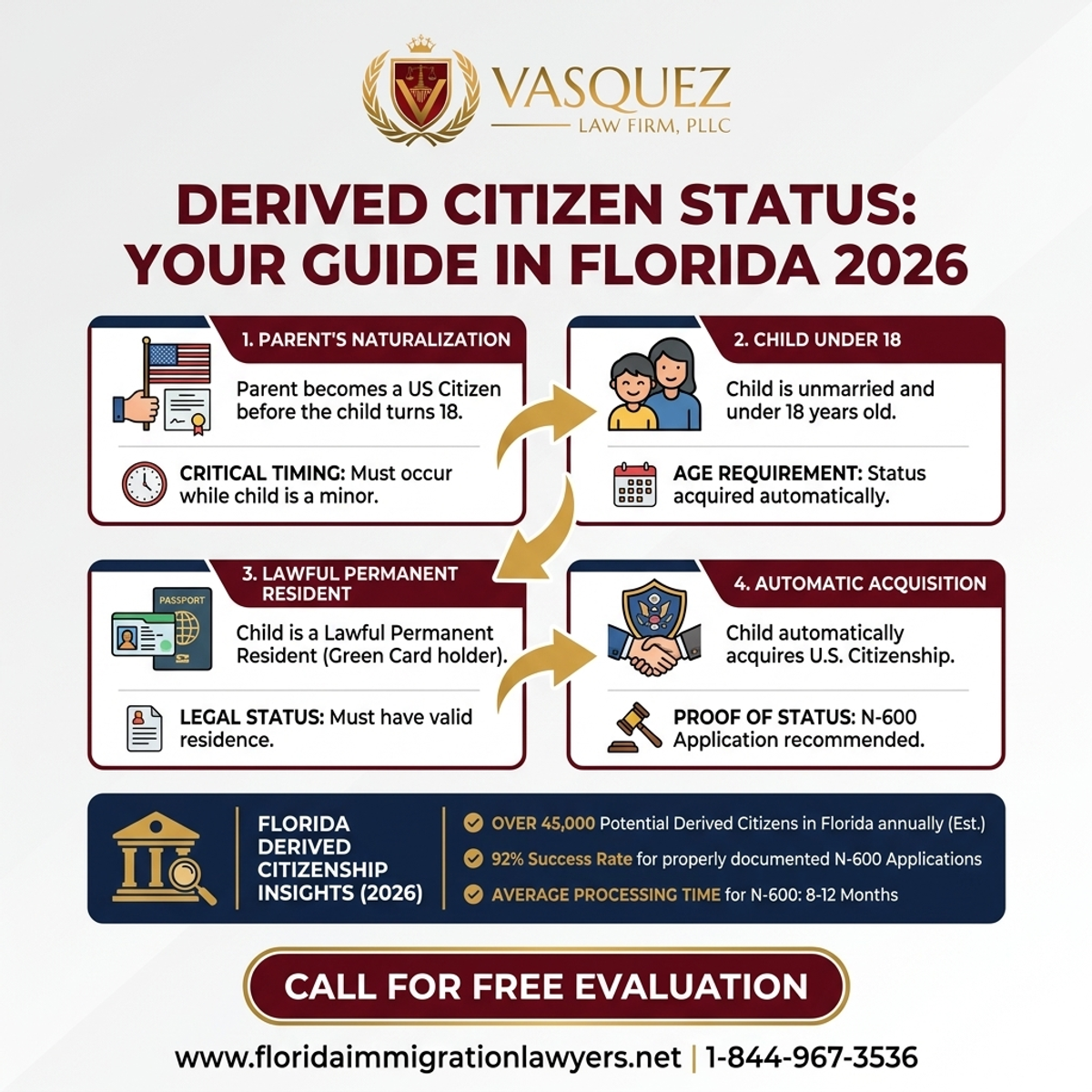
Key Statistics — Derived Citizen Status: Your Guide in Florida 2026
Stepchildren and Other Relationships:
Generally, stepchildren cannot derive U.S. citizenship through a stepparent unless they are legally adopted by the U.S. citizen stepparent. The law requires a biological or legally adopted parent-child relationship. This is a common misconception and a frequent source of error in applications. Furthermore, situations involving parents who become citizens after the child turns 18, or where the child does not have LPR status, will not qualify for derived citizenship under INA 320. Each of these scenarios requires careful analysis to determine the correct pathway to citizenship, if any, and often necessitates the expertise of an immigration lawyer familiar with Florida's diverse family dynamics.
Do not navigate this process alone. The intricacies of derived citizenship, especially in complex family scenarios, can be overwhelming. Contact Florida Immigration Lawyers today to ensure your application is handled correctly and efficiently.
Common Mistakes to Avoid in Derived Citizenship Cases
Applying for derived citizenship can be a life-changing process, but it's fraught with potential pitfalls that can lead to significant delays, Requests for Evidence (RFEs), or even outright denial. Being aware of these common mistakes, particularly for families in Florida, can help you prepare a stronger application and increase your chances of success.
-
Misunderstanding Eligibility Criteria: Many applicants mistakenly believe their child qualifies when one or more of the strict INA 320 conditions (age, LPR status, custody, U.S. citizen parent) are not met. Forgetting the child must be under 18 when ALL conditions are met is a frequent error. This fundamental misunderstanding can lead to filing an application that is destined for denial.
-
Failing to Prove Legal and Physical Custody: If parents are divorced or separated, the U.S. citizen parent must demonstrate sole legal and physical custody. Simply having the child live with the U.S. citizen parent is not enough; court orders or other legal documentation proving custody are essential. In Florida, specific family court orders are often required.
-
Incomplete or Inaccurate Documentation: Submitting an N-600 without all required supporting documents, or with documents containing errors or inconsistencies, is a major cause of delays. This includes missing birth certificates, naturalization certificates, marriage/divorce decrees, or proper translations. USCIS will issue an RFE, significantly prolonging the process.
-
Missing the Child's 18th Birthday Deadline: Derived citizenship is automatic once all conditions are met, but the child must be under 18 at that exact moment. If a parent naturalizes, or the child obtains LPR status, on or after their 18th birthday, they cannot derive citizenship under INA 320. Seeking the Certificate of Citizenship (N-600) can be done after 18 if the conditions were met before.
-
Not Providing Certified English Translations: Any document submitted to USCIS that is not in English must be accompanied by a complete and certified English translation. Failing to provide this will result in an RFE and delay the application.
-
Incorrectly Distinguishing Between Derived and Acquired Citizenship: These are distinct legal concepts. Derived citizenship (INA 320) applies to LPR children whose parents later become citizens. Acquired citizenship (INA 301/309) applies to children born abroad to U.S. citizen parents who transmit citizenship at birth. Applying for the wrong type of citizenship or using the wrong form can cause significant issues.
-
Failing to Disclose All Information: Omitting information, even if seemingly minor, can raise red flags with USCIS. This includes previous marriages, arrests (even if expunged), or periods of non-residence. Full transparency is always the best policy.
-
Assuming Automatic Proof of Citizenship: While citizenship is automatic, proving it requires the N-600. Without a Certificate of Citizenship or a U.S. passport, the child may face difficulties asserting their rights or obtaining benefits, especially when dealing with federal or state agencies in Florida.
When to Call a Florida Immigration Lawyer for Derived Citizenship
While the concept of derived citizenship might appear straightforward on the surface, the application process and underlying legal requirements are often complex and filled with nuances. Even a minor error or omission can lead to significant delays, a Request for Evidence (RFE), or even a denial of the application, forcing you to restart the process. Knowing when to seek professional legal assistance can save you considerable time, stress, and potential heartache.
You should strongly consider contacting Florida Immigration Lawyers if any of the following scenarios apply to your situation:
- Complex Family Structures: If the child was born out of wedlock, adopted, or if the parents are divorced, separated, or have remarried, establishing legal and physical custody or the biological/legal relationship can be challenging. An attorney can help gather the necessary court orders, affidavits, and other evidence.
- Uncertain Eligibility: If you are unsure whether your child meets all the criteria for derived citizenship, particularly regarding age, LPR status, or the precise timing of events, a lawyer can assess your specific facts against the INA.
- Past Immigration Issues: If the child or either parent has any prior immigration violations, criminal history (even minor offenses), or issues with their LPR status, these can complicate the application. An attorney can advise on how to address these issues and whether they impact eligibility.
- Received a Request for Evidence (RFE) or Notice of Intent to Deny (NOID): If USCIS has sent you an RFE or NOID, it means they have questions or concerns about your application. Responding correctly and comprehensively is critical, and an attorney can help formulate a strong response.
- Documentation Challenges: If you are struggling to obtain necessary documents (e.g., foreign birth certificates, old marriage decrees) or need certified translations, an attorney's office often has resources and experience to assist.
- Approaching 18th Birthday: If the child is nearing their 18th birthday and the conditions for derived citizenship have just been met, time is of the essence. An attorney can help expedite the process to ensure the N-600 is filed correctly and promptly.
- Desire for Peace of Mind: Even if your case seems straightforward, having an experienced lawyer review your application and documents provides an invaluable layer of security and confidence. For families in Central Florida, our attorneys have extensive experience with the Orlando USCIS Field Office and local procedures.
Florida Immigration Lawyers has extensive experience with derived citizenship cases across Florida. We understand the specific challenges and requirements unique to families in our state. Our team can help you navigate the complexities of immigration law, prepare a meticulous application, and represent your interests throughout the process. Don't risk your child's future; let our knowledgeable legal team ensure your application is handled with precision and care.
About Florida Immigration Lawyers
Florida Immigration Lawyers is an immigration law firm dedicated to serving individuals and families across the entire state of Florida. With a deep understanding of the complexities of U.S. immigration law and a compassionate approach, we strive to make the immigration journey as smooth and successful as possible for our clients. Our team of experienced attorneys is committed to providing personalized, effective legal representation for a wide range of immigration matters, from family-based petitions and business immigration to asylum and deportation defense.
Located in Orlando, we are strategically positioned to assist clients throughout Central Florida and beyond, leveraging our knowledge of local USCIS offices and immigration courts. We pride ourselves on clear communication, thorough preparation, and unwavering advocacy for our clients' rights and futures. We offer a comprehensive suite of services, including assistance with citizenship applications, family-based immigration petitions, visa applications, Green Cards, and much more. Our commitment to excellence and client satisfaction has made us a trusted resource for the Florida immigrant community.
We understand that every immigration case is unique and profoundly impacts lives. That's why we offer free case reviews to discuss your specific situation, answer your questions, and outline the best path forward. Our dedicated team is available 24/7 to provide the support and guidance you need. Choose Florida Immigration Lawyers for experienced, compassionate, and results-driven legal representation. Call us today at 1-844-YO-PELEO to begin your journey.
Sources and References
- U.S. Citizenship and Immigration Services (USCIS)
- Executive Office for Immigration Review (EOIR)
- U.S. Department of State
- Immigration and Nationality Act (INA) Section 320 (8 U.S.C. § 1431) - Children Born Outside the United States and Residing Permanently in the United States; Conditions for Automatic Citizenship.
- Immigration and Nationality Act (INA) Section 301 (8 U.S.C. § 1401) - Nationals and Citizens of United States at Birth.
- Immigration and Nationality Act (INA) Section 309 (8 U.S.C. § 1409) - Children Born Out of Wedlock.
- USCIS Policy Manual, Volume 12, Part H, Chapter 4 - Children of U.S. Citizens.
- Code of Federal Regulations (CFR) Title 8, Part 320 - Children of Citizen Parents.
Related services: citizenship test preparation, dual citizenship guidance, citizenship test resources.
This article provides general legal information and is not intended as legal advice. Every case is unique, and outcomes depend on specific facts and circumstances. Contact an attorney for advice about your particular situation.
Securing your child's derived citizenship is a critical step toward their future in the United States. Don't leave this important process to chance. Trust the experienced team at Florida Immigration Lawyers to guide you through every step, ensuring accuracy and compliance with all legal requirements. We are here to help your family achieve their immigration goals. Schedule a free case review today by calling 1-844-YO-PELEO. Se Habla Español - Estamos aqui para ayudarle.
Do Not Navigate This Process Alone
Our experienced immigration attorneys are ready to fight for you. Get a free, confidential case review today.
Se Habla Español
Or leave your details and we’ll call you:
Free Evaluation in 24 Hours
Or talk to us right now
AI voice assistant — available 24/7
FreeFrequently Asked Questions

William J. Vásquez
Founding Attorney · Vasquez Law Firm
U.S. Air Force veteran and immigration attorney with years of hands-on U.S. immigration experience. J.D., NCCU School of Law. AILA member. Admitted to the 4th, 5th, and 11th Circuit Courts.
Available 24/7 - Free Evaluations
Reviewed for legal accuracy by William J. Vásquez
Licensed in North Carolina; U.S. immigration is federal practice.
Related Legal Services
Our Florida immigration attorneys can help you with family immigration services, immigration lawyer cost in Florida and experienced immigration attorneys. Call today at 1-844-YO-PELEO for a free case review.
Related Links
Related Topics
Free Legal Case Review
Discuss your case with our experienced attorneys. We're available 24/7.
Se Habla Español - Estamos aquí para ayudarle.
Related Articles
Certificate of Eligibility for Expungement in Florida 2026
For non-U.S. citizens in Florida, understanding how a state expungement impacts immigration status is critical. A certificate of eligibility for expungement in Florida allows a criminal record to be sealed or expunged under state law. However, federal immigration agencies often disregard such state-level relief, still considering the original criminal offense as a conviction for immigration purposes. This can have severe implications for visa applications, green card eligibility, naturalization, and even lead to deportation. This guide clarifies the Florida expungement process, its limited effect on federal immigration law, and key steps to protect your status in 2026. Learn about common mistakes, required documents, timelines, and when to seek expert legal counsel from Florida Immigration Lawyers to navigate these complex issues effectively.
Immigration Lawyer Orlando Free Consultation in Florida
For individuals and families in Orlando, Florida, navigating the complexities of U.S. immigration law requires expert guidance. An immigration lawyer in Orlando offers crucial support for everything from visa applications and green card processes to naturalization and deportation defense. This comprehensive guide details what a free consultation covers, providing a step-by-step overview of immigration pathways, essential document checklists, and expected timelines in 2026. We also highlight common mistakes to avoid, discuss the critical role of legal counsel in deportation and asylum cases, and explain why choosing a local Orlando immigration attorney is beneficial. Florida Immigration Lawyers is dedicated to serving the diverse community of Orlando with compassionate, effective legal solutions, ensuring you receive personalized advice and robust representation for a successful immigration journey.
How to Apply for VAWA in Florida: A 2026 Guide
Discover how to apply for VAWA in Florida, offering crucial immigration relief for abuse victims. Learn the process, requirements, and how Florida Immigration Lawyers can assist you.
USCIS Office Near Me: Florida Locations & Appointments 2026
Navigating USCIS processes in Florida can be complex, from finding the right field office to preparing for critical appointments. This comprehensive guide provides essential information for individuals seeking immigration services in 2026, including a step-by-step process for locating your nearest USCIS office in Florida, understanding its services, and efficiently scheduling appointments. We detail the necessary documents for interviews, outline typical processing timelines, and break down associated costs. Furthermore, we highlight common pitfalls to avoid and crucial situations when consulting an experienced Florida immigration lawyer is indispensable. Whether you're in Orlando or elsewhere, empower your immigration journey with expert advice and practical strategies. Learn how Florida Immigration Lawyers can assist you.