How to Apply for VAWA in Florida: A 2026 Guide
Discover how to apply for VAWA in Florida, offering crucial immigration relief for abuse victims. Learn the process, requirements, and how Florida Immigration Lawyers can assist you.
Applying for VAWA in Tampa involves submitting Form I-360 to USCIS, allowing abuse victims to seek immigration relief without the abuser's knowledge. Key points include:
- Eligibility for those facing violence in the U.S.
- Confidential application process.
- Potential for work authorization and green card.
- Legal support is advisable for best outcomes.
- Available to both women and men facing abuse.
Introduction
For many immigrants facing violence at home, the Violence Against Women Act (VAWA) provides a lifeline. If you're in Orlando or anywhere in Florida, understanding how to apply for VAWA can be crucial. Florida Immigration Lawyers are here to guide you through this process, ensuring you have the support you need. Call us at 1-844-YO-PELEO for a free case review.
Navigating the complex landscape of immigration law while dealing with the trauma of domestic abuse can feel overwhelming. VAWA offers a unique pathway to legal status, specifically designed to protect victims from their abusers and empower them to build a new, safer life in the United States. This federal law recognizes the severe vulnerability of immigrant victims who might otherwise be trapped in abusive relationships due to fear of deportation or lack of independent legal status.
Our mission at Florida Immigration Lawyers is to provide compassionate and expert legal assistance to individuals seeking VAWA relief across Florida. We understand the sensitive nature of these cases and are committed to ensuring your safety and confidentiality throughout the entire application process. From gathering critical evidence to preparing a compelling personal statement, our team will stand by you, advocating for your rights and helping you achieve the security you deserve.
What is VAWA and Who Qualifies?
VAWA, or the Violence Against Women Act, provides immigration relief to abuse victims. It allows them to self-petition for legal status without notifying the abuser. As of 2026, this protection extends to women, men, and children who have suffered domestic abuse by a U.S. citizen or lawful permanent resident.
Eligibility for VAWA requires proof of the relationship with the abuser, evidence of abuse, and residence in the U.S. The process is confidential, protecting the applicant's information from the abuser.
Beyond physical violence, VAWA recognizes various forms of abuse, including emotional, psychological, financial, and sexual abuse. For instance, an abuser might control all finances, isolate the victim from friends and family, constantly belittle them, or threaten deportation to maintain control. These non-physical forms of abuse are often harder to document but are equally valid grounds for a VAWA petition. Our team at Florida Immigration Lawyers can help you understand what constitutes abuse under VAWA and how to effectively document your experiences.
Crucially, the law requires that the marriage to the abuser (if applicable) was entered into in good faith, meaning it was not solely for immigration purposes. However, even if the abuser claims the marriage was fraudulent, VAWA self-petitioners can still qualify if they can demonstrate the good faith nature of the marriage and the subsequent abuse. Furthermore, if you are the parent of a U.S. citizen or LPR child who has abused you, or if you are a child abused by a U.S. citizen or LPR parent, you may also be eligible to self-petition under VAWA, expanding its protective scope to a wider range of family relationships.
How to Apply for VAWA in Tampa?
To apply for VAWA in Tampa, begin by completing Form I-360, Petition for Amerasian, Widow(er), or Special Immigrant. This form is submitted to the USCIS. The process involves several key steps:
- Gather Evidence: Collect documents proving your relationship and the abuse.
- Complete Form I-360: Ensure accuracy and completeness.
- File the Form: Submit to USCIS with supporting documents.
- Await Decision: USCIS will review and decide on your petition.
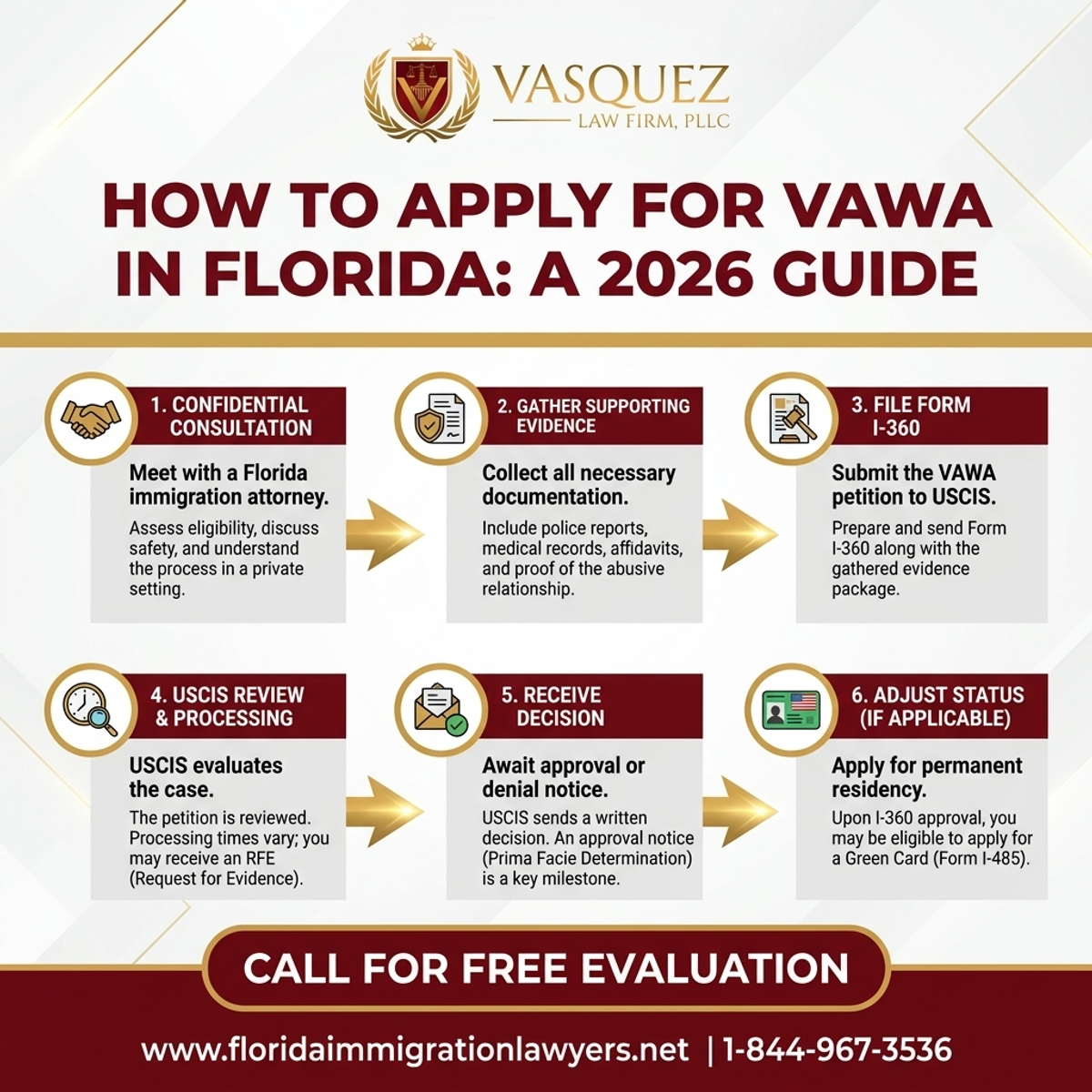
Step-by-Step Process — How to Apply for VAWA in Florida: A 2026 Guide
It's advisable to seek legal assistance to ensure the best outcome, given the complexities involved.
When gathering evidence, think broadly. Beyond official documents like police reports or medical records, personal journals, text messages, emails, photos, and affidavits from friends, family, or counselors who witnessed the abuse can be incredibly powerful. A detailed personal statement, written from your perspective, is also a cornerstone of the application, allowing you to narrate your experience of abuse and your good faith marriage (if applicable). This statement helps USCIS understand the full scope of your situation.
Completing Form I-360 requires meticulous attention to detail. Any inaccuracies or omissions can lead to delays or even denial. This is where the expertise of Florida Immigration Lawyers becomes invaluable. We meticulously review every section of your form and all supporting documents to ensure everything is accurate, complete, and presented in the strongest possible light. Our goal is to submit a comprehensive and compelling petition that leaves no room for doubt about your eligibility.
Once filed, the waiting period can be anxious. USCIS will send a receipt notice, and in some cases, may request additional evidence (Request for Evidence – RFE) or schedule an interview. Having legal counsel means you'll be prepared for every stage, understanding what to expect and how to respond effectively. We continuously monitor your case status and communicate any updates, providing peace of mind during this critical time.
Document Checklist for VAWA Applicants
A comprehensive and well-organized set of documents is paramount for a successful VAWA petition. The more evidence you can provide to support your claims of a qualifying relationship and the abuse suffered, the stronger your case will be. Remember, USCIS officers are looking for a clear and consistent narrative backed by verifiable proof.
- Proof of relationship (marriage certificate, birth certificates).
- Evidence of abuse (police reports, medical records, affidavits).
- Proof of shared residence (lease agreements, utility bills).
- Personal statement describing the abuse.
- Any relevant legal documents.
Beyond this core list, consider including psychological evaluations, records from domestic violence shelters or support groups, photos of injuries or property damage, and even financial records demonstrating the abuser's control. Each piece of evidence helps paint a complete picture for USCIS. Florida Immigration Lawyers can assist you in identifying all potential evidence and organizing it effectively to strengthen your petition.
Timeline and Processing Expectations for VAWA
Understanding the timeline for VAWA applications is crucial for managing expectations, though it's important to remember that processing times can vary significantly based on USCIS workload, policy changes, and the complexity of individual cases. While the table below provides general estimates, always refer to the official USCIS website for the most current processing times.
| Stage | Typical Timeframe | Notes |
|---|---|---|
| Form I-360 Submission | 6-12 months | Processing times vary; check USCIS updates. |
| Work Authorization | 3-4 months after approval | Conditional upon approval of I-360. |
| Green Card Application | 1-2 years | Depends on visa availability. |
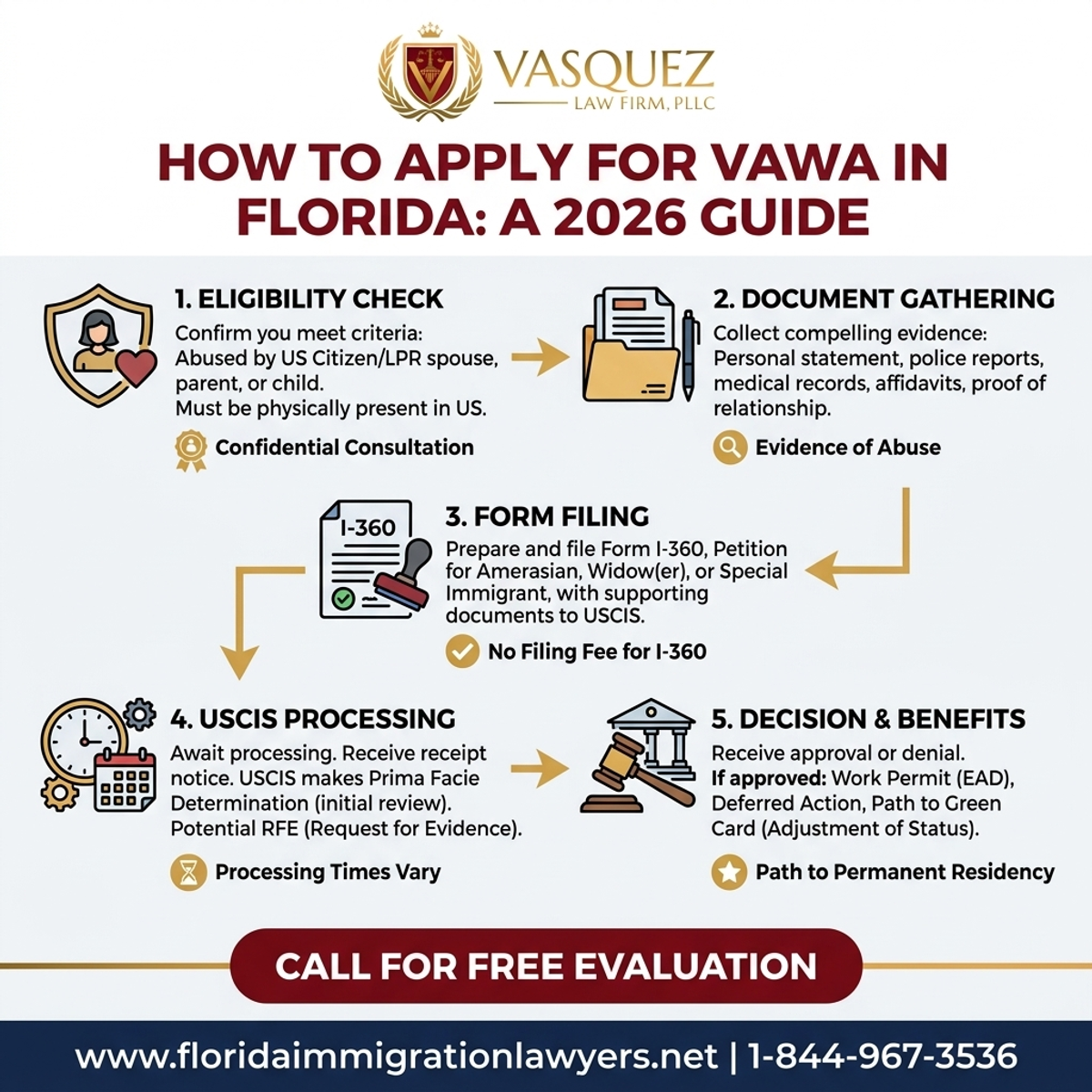
Key Statistics — How to Apply for VAWA in Florida: A 2026 Guide
It's important to note that the approval of Form I-360 is a critical first step. Once approved, you become eligible to apply for a work permit (Form I-765) and, in most cases, adjust your status to that of a lawful permanent resident (Form I-485). The path to a green card often involves an interview at a USCIS office. Throughout this multi-stage process, Florida Immigration Lawyers will keep you informed and prepared, helping you navigate each waiting period with confidence.
Costs and Fees for VAWA Applications
While the prospect of legal fees can be daunting, especially for victims of abuse who may face financial hardship, it's important to know that VAWA applications often come with provisions to alleviate this burden. USCIS offers fee waivers for many forms associated with the VAWA process, recognizing the vulnerable circumstances of applicants.
| Item | Typical Fee | Notes |
|---|---|---|
| Form I-360 | Varies | Fee waivers available based on financial hardship. |
| Work Authorization | Varies | Fees apply unless waived. |
| Adjustment of Status | Varies | Includes biometrics fees. |
Do not navigate this process alone. Contact Florida Immigration Lawyers today.
To apply for a fee waiver, you typically need to submit Form I-912, Request for Fee Waiver, along with supporting documentation demonstrating your inability to pay. This could include proof of receiving a means-tested benefit, household income below 150% of the Federal Poverty Guidelines, or financial hardship that makes it impossible to pay the fee. Our team at Florida Immigration Lawyers can help you determine your eligibility for fee waivers and prepare the necessary documentation, ensuring that financial constraints do not prevent you from seeking the protection you deserve.
Common Mistakes to Avoid
Applying for VAWA is a high-stakes process where even minor errors can lead to significant delays or outright denial. Understanding and proactively avoiding common pitfalls can dramatically increase your chances of a successful outcome. The emotional toll of abuse can make careful attention to detail challenging, which is why professional legal guidance is so crucial.
- Incomplete Documentation: Missing evidence can delay or deny your petition.
- Incorrect Form Submission: Errors on Form I-360 can lead to rejections.
- Not Seeking Legal Help: Professional guidance can increase your chances of success.
- Ignoring Deadlines: Missing deadlines can jeopardize your application.
- Providing False Information: This can result in severe legal consequences.
- Failure to Prove Abuse: Lack of evidence can lead to denial.
- Overlooking Fee Waivers: Eligible applicants should apply for waivers to reduce costs.
Beyond these points, another common mistake is understating the abuse or failing to provide a coherent narrative. Victims often minimize their experiences, but for a VAWA petition, it's vital to clearly and comprehensively articulate the abuse you endured. Florida Immigration Lawyers can help you prepare a detailed personal statement and organize your evidence to present the strongest possible case, ensuring that your story is heard and understood by USCIS.
When to Call a Lawyer
If you're uncertain about eligibility, facing complex situations, or have had a previous application denied, it's time to consult a lawyer. Legal professionals can navigate the intricacies of VAWA applications and help present your case effectively. Florida Immigration Lawyers offer comprehensive support throughout Florida, ensuring you receive the help you need.
Specific scenarios that warrant immediate legal consultation include having a prior deportation order, any criminal history (even minor offenses), or if your abuser is actively trying to interfere with your immigration process. These complexities require a nuanced understanding of immigration law and strategy that only an experienced attorney can provide. Attempting to handle such issues alone can inadvertently jeopardize your entire case.
Consider the case of a client, Maria, who was hesitant to apply for VAWA because her abuser had threatened to report her to immigration for a minor visa overstay years ago. She feared that seeking help would lead to deportation. Our team at Florida Immigration Lawyers was able to assess her full immigration history, address the abuser's threats, and successfully file her VAWA petition, ultimately securing her a path to a green card. This highlights how crucial it is to get professional advice early on, especially when your abuser uses immigration status as a tool for control. Don't hesitate to call us at 1-844-YO-PELEO for a free case review.
About Florida Immigration Lawyers
At Florida Immigration Lawyers, we specialize in immigration relief for abuse victims. Our experienced team is dedicated to providing empathetic, effective legal services. With a focus on Orlando and Central Florida, we offer free case reviews and are available 24/7. Schedule a free consultation or explore our immigration practice areas today. Phone: 1-844-YO-PELEO.
Sources and References
- U.S. Citizenship and Immigration Services (USCIS)
- Executive Office for Immigration Review (EOIR)
- 8 U.S.C. Chapter 12 - Immigration and Nationality Act
Related services: family immigration services, citizenship and naturalization, deportation defense, asylum protection.
This article provides general legal information and is not intended as legal advice. Every case is unique, and outcomes depend on specific facts and circumstances. Contact an attorney for advice about your particular situation.
Se Habla Español - Estamos aquí para ayudarle. Contact us at 1-844-YO-PELEO for a free consultation.
If you need legal assistance, learn more about learn about our immigration practice, or call us at 1-844-967-3536 for a free case review.
Do Not Navigate This Process Alone
Our experienced immigration attorneys are ready to fight for you. Get a free, confidential case review today.
Se Habla Español
Or leave your details and we’ll call you:
Free Evaluation in 24 Hours
Or talk to us right now

AI voice assistant — available 24/7
FreeFrequently Asked Questions

William J. Vásquez
Founding Attorney · Vasquez Law Firm
U.S. Air Force veteran and immigration attorney with years of hands-on U.S. immigration experience. J.D., NCCU School of Law. AILA member. Admitted to the 4th, 5th, and 11th Circuit Courts.
Available 24/7 - Free Evaluations
Reviewed for legal accuracy by William J. Vásquez
Licensed in North Carolina; U.S. immigration is federal practice.
Related Legal Services
Our Florida immigration attorneys can help you with experienced immigration attorneys, asylum protection and citizenship and naturalization. Call today at 1-844-YO-PELEO for a free case review.
Related Links
Related Topics
Free Legal Case Review
Discuss your case with our experienced attorneys. We're available 24/7.
Se Habla Español - Estamos aquí para ayudarle.
Related Articles
Certificate of Eligibility for Expungement in Florida 2026
For non-U.S. citizens in Florida, understanding how a state expungement impacts immigration status is critical. A certificate of eligibility for expungement in Florida allows a criminal record to be sealed or expunged under state law. However, federal immigration agencies often disregard such state-level relief, still considering the original criminal offense as a conviction for immigration purposes. This can have severe implications for visa applications, green card eligibility, naturalization, and even lead to deportation. This guide clarifies the Florida expungement process, its limited effect on federal immigration law, and key steps to protect your status in 2026. Learn about common mistakes, required documents, timelines, and when to seek expert legal counsel from Florida Immigration Lawyers to navigate these complex issues effectively.
Immigration Lawyer Orlando Free Consultation in Florida
For individuals and families in Orlando, Florida, navigating the complexities of U.S. immigration law requires expert guidance. An immigration lawyer in Orlando offers crucial support for everything from visa applications and green card processes to naturalization and deportation defense. This comprehensive guide details what a free consultation covers, providing a step-by-step overview of immigration pathways, essential document checklists, and expected timelines in 2026. We also highlight common mistakes to avoid, discuss the critical role of legal counsel in deportation and asylum cases, and explain why choosing a local Orlando immigration attorney is beneficial. Florida Immigration Lawyers is dedicated to serving the diverse community of Orlando with compassionate, effective legal solutions, ensuring you receive personalized advice and robust representation for a successful immigration journey.
USCIS Office Near Me: Florida Locations & Appointments 2026
Navigating USCIS processes in Florida can be complex, from finding the right field office to preparing for critical appointments. This comprehensive guide provides essential information for individuals seeking immigration services in 2026, including a step-by-step process for locating your nearest USCIS office in Florida, understanding its services, and efficiently scheduling appointments. We detail the necessary documents for interviews, outline typical processing timelines, and break down associated costs. Furthermore, we highlight common pitfalls to avoid and crucial situations when consulting an experienced Florida immigration lawyer is indispensable. Whether you're in Orlando or elsewhere, empower your immigration journey with expert advice and practical strategies. Learn how Florida Immigration Lawyers can assist you.
Immigration Appeal Process with BIA in Florida
Facing an immigration appeal in Florida? Learn about the Board of Immigration Appeals process, essential steps, and when to seek legal help. Call Florida Immigration Lawyers at 1-844-YO-PELEO for a free case review.