USCIS Office Near Me: Florida Locations & Appointments 2026
Navigating USCIS processes in Florida can be complex, from finding the right field office to preparing for critical appointments. This comprehensive guide provides essential information for individuals seeking immigration services in 2026, including a step-by-step process for locating your nearest USCIS office in Florida, understanding its services, and efficiently scheduling appointments. We detail the necessary documents for interviews, outline typical processing timelines, and break down associated costs. Furthermore, we highlight common pitfalls to avoid and crucial situations when consulting an experienced Florida immigration lawyer is indispensable. Whether you're in Orlando or elsewhere, empower your immigration journey with expert advice and practical strategies. Learn how Florida Immigration Lawyers can assist you.
To find a USCIS office near you in Florida, you typically need to use the official USCIS online tools or contact their national customer service line. Most services, including scheduling appointments, are now managed through online accounts or phone calls rather than walk-in visits. USCIS field offices in Florida, like those in Miami, Orlando, and Tampa, primarily handle interviews for various immigration benefits, such as naturalization and adjustment of status. As of 2026, it's crucial to confirm whether your specific service requires an in-person appointment and to prepare all necessary documents meticulously.
- USCIS field offices in Florida handle interviews and specific in-person services.
- Appointments are generally required and scheduled through USCIS online or phone.
- Florida has major field offices in Miami, Orlando, and Tampa.
- Always check the official USCIS website for the most current information and requirements.
- Preparation is key for any in-person visit, including bringing all requested documents.
Navigating the complex landscape of U.S. immigration can be an overwhelming journey, especially when you're trying to understand where and how to interact with government agencies. For individuals and families in Florida, understanding the role and locations of U.S. Citizenship and Immigration Services (USCIS) field offices is a crucial step in their immigration process. Whether you're applying for a green card, seeking naturalization, or simply need to attend an interview, knowing your local USCIS office and its procedures is paramount.
This comprehensive guide will detail the services offered by USCIS field offices in Florida, explain how to locate the one nearest to you, and walk you through the process of scheduling and preparing for an appointment in 2026. We'll also cover common mistakes to avoid and highlight when it's essential to seek professional legal assistance. Our goal is to empower you with the knowledge needed to confidently manage your immigration journey in the Sunshine State. If you feel lost or overwhelmed, remember you don't have to face it alone. Call Florida Immigration Lawyers at 1-844-YO-PELEO for a free case review.
What is a USCIS Field Office and What Services Does It Provide?
A USCIS field office is a local branch of the U.S. Citizenship and Immigration Services, responsible for handling various in-person immigration services within a specific geographic area. These offices play a critical role in the adjudication process for many immigration benefits. While much of the initial application filing and processing occurs at USCIS Service Centers, field offices are where applicants often complete the final stages of their journey.
The primary services provided by a USCIS field office include conducting interviews for naturalization (citizenship) applications, adjustment of status (green card) applications, and asylum claims. They also provide information services, although many general inquiries are now directed to the USCIS Contact Center or online resources. Field offices may also process specific emergency requests, accept certain applications, and facilitate oath ceremonies for new citizens. For instance, the Orlando field office serves many Central Florida residents for their final interviews, making it a pivotal location for those seeking to establish permanent residency or citizenship. Understanding the distinction between field offices, Application Support Centers (ASCs) which handle biometrics, and Service Centers which process initial paperwork, is vital for a smooth process. USCIS is the official body for these services, and their website (USCIS) is the authoritative source for all information.
Florida, with its diverse and significant immigrant population, has several key USCIS field offices strategically located to serve residents across the state. These offices are staffed by immigration officers who review applications, conduct interviews, and make decisions on various immigration benefits. Their work ensures compliance with the Immigration and Nationality Act (INA), found in 8 U.S.C. Chapter 12. The specific services available at each field office can vary slightly, but generally revolve around direct applicant interaction for the final stages of case processing. It's crucial for applicants to confirm the services offered at their specific local USCIS office before planning a visit, as not all services are available on a walk-in basis or at every location.
How Do I Find My Nearest USCIS Office in Florida and Schedule an Appointment?
To find your nearest USCIS office in Florida and schedule an appointment, you should utilize the USCIS online tools or contact their customer service. Most in-person appointments, known as InfoPass appointments, have been phased out, and visits are now scheduled directly by USCIS or initiated via phone.
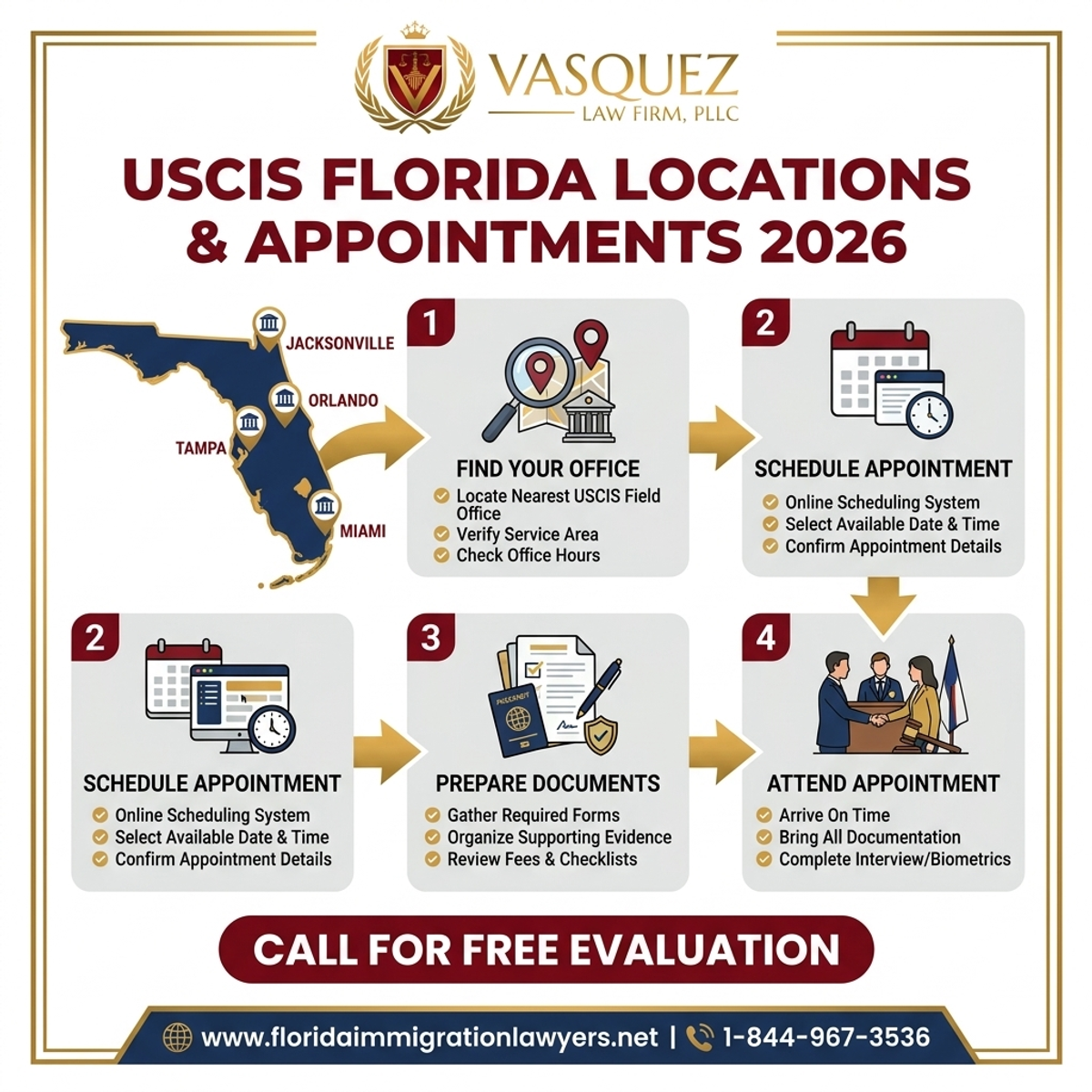
Finding the correct USCIS field office and understanding its appointment system is essential for any immigration applicant in Florida. Here's a step-by-step guide to help you navigate this process effectively in 2026:
-
Identify Your Service Needs: Determine precisely why you need to visit a USCIS office. Are you scheduled for an interview? Do you need to respond to a Request for Evidence (RFE) in person? Or do you have an urgent inquiry? The reason for your visit will dictate the process. For example, most biometrics appointments are scheduled at Application Support Centers (ASCs), not field offices.
-
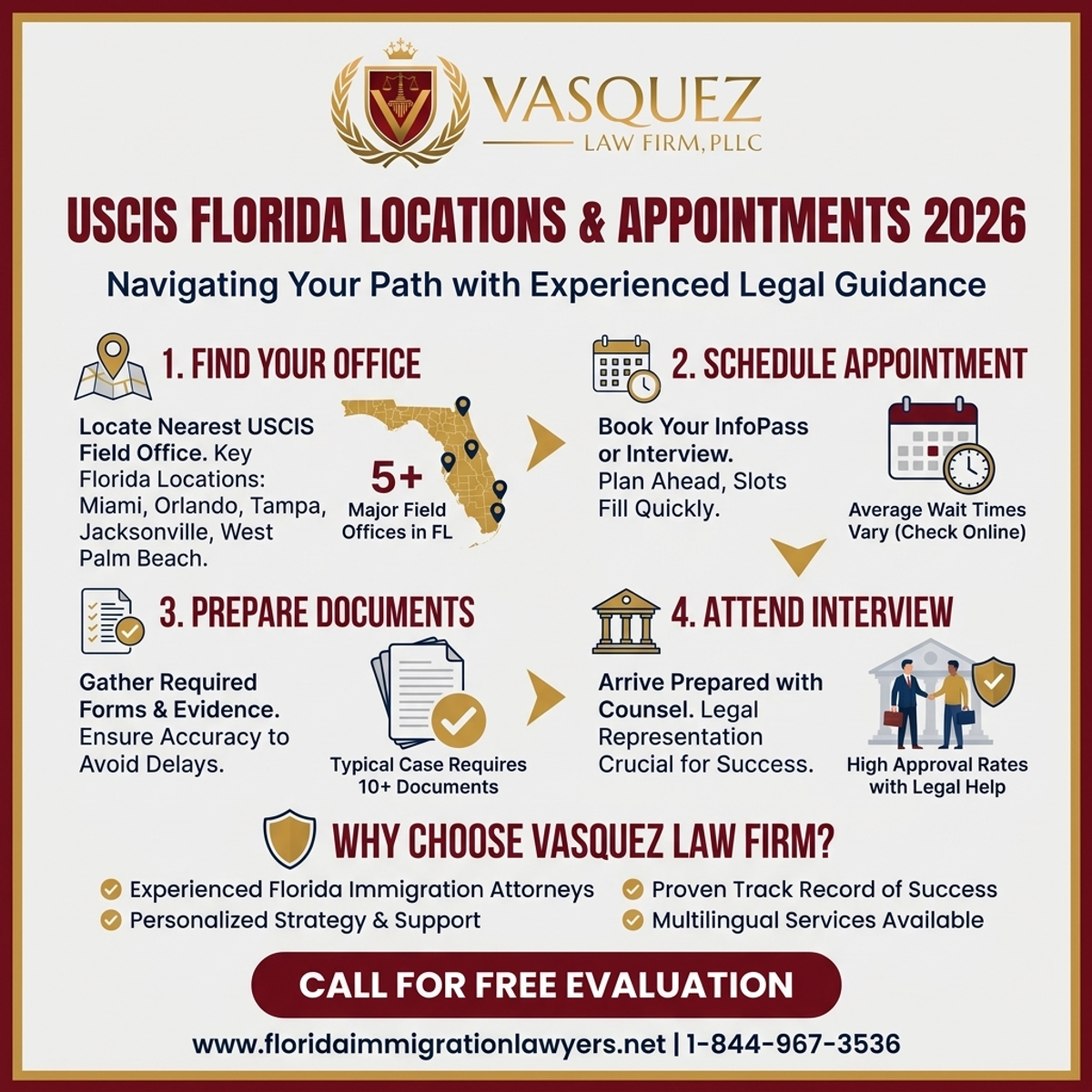
Use the USCIS Field Office Locator: Visit the official USCIS website and use their 'Find a USCIS Office' tool. You can input your zip code to find the nearest field office and Application Support Center. This tool will provide the address, office hours, and specific services offered at that location. Florida has major field offices in Miami, Orlando, and Tampa, each serving a broad geographic area. For example, residents of Orlando and Central Florida would typically be served by the Orlando Field Office.
-
Understand Appointment Requirements: As of 2026, USCIS generally requires appointments for most in-person services. Walk-ins are rarely permitted, except in rare emergency situations pre-approved by the USCIS Contact Center. If you have an interview scheduled, USCIS will send you an Interview Notice (Form I-797C) with the date, time, and location of your appointment.
-
Contact the USCIS Contact Center: For general inquiries, to request an emergency appointment, or if you haven't received an appointment notice, call the USCIS Contact Center at 1-800-375-5283 (TTY 1-800-767-1833). Be prepared with your Alien Registration Number (A-Number) and case receipt number. The representatives can provide information, update case statuses, and sometimes schedule appointments for certain services. This is your primary point of contact for most non-interview related issues.
-
Prepare for Your Visit: Once you have a confirmed appointment, ensure you know the office location, parking options, and security procedures. Arrive early to allow for security checks. Always bring your appointment notice, valid government-issued identification, and all original documents requested in your notice or application. For more complex situations, consider consulting with an immigration attorney before your visit. For assistance, contact Florida Immigration Lawyers.
What Documents Should I Prepare for a USCIS Interview or Appointment?
For any USCIS office interview or appointment, meticulous document preparation is crucial for a successful outcome. You should prepare your appointment notice, valid identification, and all original documents that were submitted with your application, along with any additional evidence requested.
A well-organized set of documents can significantly streamline your USCIS interview or appointment. Immigration officers rely on these documents to verify your eligibility and the truthfulness of your application. Failing to bring requested items can lead to delays, Requests for Evidence (RFEs), or even a denial of your benefit. Here is a comprehensive checklist of documents you should typically prepare, though specific requirements vary by case type:
- Appointment Notice (Form I-797C): This is your official invitation and proof of your scheduled appointment. Do not forget it.
- Valid Government-Issued Identification: Bring your passport, driver's license, state ID, or other official identification. Ensure it is current and matches the name on your application.
- Originals of All Documents Submitted: You must bring the original versions of all documents you submitted as copies with your application. This includes birth certificates, marriage certificates, divorce decrees, police clearance certificates, and any other supporting evidence.
- Translations of Foreign Documents: Any document not in English must be accompanied by a certified English translation. The translator must certify that they are competent to translate and that the translation is accurate.
- Any Additional Evidence Requested: If USCIS sent you a Request for Evidence (RFE) or a notice asking for specific additional documents, ensure you bring those items. This could include updated financial records, proof of ongoing relationship, or employment verification.
- Evidence of Financial Support: For many applications, especially adjustment of status, you will need to demonstrate financial support. This might include Form I-864 (Affidavit of Support), recent tax returns, pay stubs, and employment verification letters.
- Medical Exam Results (Form I-693): If applicable, ensure your sealed medical exam results from a USCIS-approved civil surgeon are current and in a sealed envelope. Do not open it yourself.
- Photographs: Bring several passport-style photographs that meet USCIS specifications, even if you submitted them with your initial application.
- Copies of Everything: It's always wise to bring a complete set of photocopies of all originals and supporting documents for your own records and in case the officer needs them.
Step-by-Step Process — USCIS Office Near Me: Florida Locations & Appointments 2026
Always review your specific appointment notice and the USCIS website for a precise list of required documents for your case. Preparing thoroughly can help ensure a smooth and successful interview process. For personalized guidance on document preparation, consider seeking legal counsel from Florida Immigration Lawyers.
How Long Do USCIS Processes and Appointments Typically Take in Florida (2026)?
As of 2026, the typical processing times for USCIS applications and appointments in Florida can vary significantly, ranging from several months to over two years, depending on the application type, the specific field office workload, and individual case complexities.
Understanding the timeline for your immigration application is crucial for planning your future. USCIS processing times are influenced by various factors, including the type of application, the volume of cases at a particular service center or field office, and the completeness of your submitted documentation. While it's impossible to provide exact dates, here's a general overview of what applicants in Florida might expect in 2026:
| Stage | Typical Timeframe (as of 2026) | Notes |
|---|---|---|
| Initial Filing & Receipt Notice | 2-6 weeks | You receive Form I-797C, Notice of Action, acknowledging receipt. |
| Biometrics Appointment | 3-6 months after filing | Scheduled at an Application Support Center (ASC) near your Florida residence. |
| Interview Scheduling (e.g., Green Card, Naturalization) | 6-18 months after biometrics | Highly variable; depends on the specific USCIS office (e.g., Orlando, Miami, Tampa) workload and case type. |
| Decision After Interview | Weeks to several months | Some decisions are made on the spot; others require further review or an RFE. |
| Overall Process (e.g., Adjustment of Status) | 1-3+ years | Varies greatly by case complexity, RFE issuance, and agency backlogs. |
| Naturalization (N-400) | 9-18 months from filing to oath ceremony | Can be faster or slower depending on the field office. |
These timeframes are estimates, and individual cases may proceed faster or slower. You can check the current processing times for specific forms and field offices on the USCIS website's processing times tool. Factors that can impact your timeline include the completeness of your application, responses to RFEs, criminal history, and any changes in immigration policy. For instance, recent news about public charge rule changes or work permit auto-renewal policies can affect processing indirectly by shifting agency priorities or requiring new forms, as detailed in 8 CFR Part 103. Persistent delays or unexpected requests should prompt a consultation with an experienced immigration attorney, especially if you have concerns about your case status or potential issues. Our firm can help you with citizenship applications.
What Are the Costs Associated with USCIS Applications and Appointments?
The costs associated with USCIS applications and appointments typically include various filing fees for specific forms, biometrics fees, and potential legal or medical examination expenses. These fees are subject to change, so always verify the latest amounts on the official USCIS website.
Navigating the financial aspect of immigration is as crucial as understanding the procedural steps. USCIS fees are a significant component of the overall cost, but they are not the only expenses you might encounter. It's essential to budget for all potential charges to avoid financial strain or unexpected delays in your application process. As of 2026, here’s a breakdown of typical cost factors:
| Item | Typical Fee (as of 2026) | Notes |
|---|---|---|
| Form I-485 (Adjustment of Status) | Varies, check USCIS site | Includes biometrics fee. This fee is for applying for a green card. |
| Form I-130 (Petition for Alien Relative) | Varies, check USCIS site | Filed by a U.S. citizen or LPR on behalf of a relative. |
| Form N-400 (Application for Naturalization) | Varies, check USCIS site | Includes biometrics fee. This fee is for becoming a U.S. citizen. |
| Biometrics Services Fee | Varies, check USCIS site | Often included with primary application fees, but may be separate for certain forms. |
| Attorney Fees | Highly variable | Depends on the complexity of your case, services required, and attorney's experience. |
| Medical Examination (Form I-693) | $200 - $500+ | Paid directly to a USCIS-approved civil surgeon. Not a USCIS fee. |
| Translation Fees | Variable (per document/page) | For documents not in English, requiring certified translation. |
| Postage/Courier Fees | Minor, but adds up | For mailing applications and supporting documents securely. |
Key Statistics — USCIS Office Near Me: Florida Locations & Appointments 2026
It is critical to note that USCIS fees can change. The most accurate and up-to-date fee schedule is always available on the USCIS website. Some applicants may be eligible for fee waivers based on their income or receipt of certain public benefits. Carefully review the eligibility criteria for fee waivers (Form I-912, Request for Fee Waiver) if you believe you qualify. Unexpected costs can arise, such as needing to refile an application due to errors, so having a contingency plan is advisable. For assistance with business immigration or family-based petitions, our team is here to help.
Do not navigate this process alone. Contact Florida Immigration Lawyers today.
Common Mistakes to Avoid When Dealing with USCIS
Dealing with immigration matters requires precision and attention to detail. Even minor errors can lead to significant delays or even denial of your application. Here are some common mistakes applicants make when interacting with USCIS, along with their potential consequences:
-
Missing Deadlines: Failing to submit applications or responses to RFEs by the specified deadline can lead to immediate denial or case closure. USCIS deadlines are strict and generally non-negotiable.
-
Incomplete Forms or Missing Documents: Submitting an application with blank fields or without all required supporting documents is a common reason for rejection or an RFE, significantly delaying your process. USCIS forms must be filled out completely and accurately.
-
Providing Inaccurate Information: Any false or misleading information, even if unintentional, can be considered fraud and lead to severe penalties, including deportation or a permanent bar from future immigration benefits. Always be truthful and accurate.
-
Ignoring Requests for Evidence (RFEs) or Notices of Intent to Deny (NOIDs): These notices are critical. Failing to respond fully and on time will almost certainly result in a denial of your application. An RFE means USCIS needs more information to make a decision.
-
Attending Appointments Unprepared: Arriving at a USCIS office interview without all original documents, copies, and a clear understanding of your application can lead to rescheduling, delays, or an unfavorable decision. Preparation is key.
-
Communicating Directly with USCIS Without Counsel (for complex cases): While you can contact USCIS directly, for complex cases involving criminal history, previous denials, or nuanced legal issues, navigating communication without an attorney can lead to missteps or unintended admissions. An attorney can protect your rights.
-
Not Updating Your Address: If you move, failing to update your address with USCIS within 10 days can result in missed notices, appointment letters, or even a decision on your case that you never received. This is a critical requirement under 8 CFR Part 103.
-
Assuming All Offices Offer the Same Services: Each USCIS field office and Application Support Center has specific functions. Assuming you can get any service at any location without prior verification can lead to wasted time and frustration.
-
Failing to Understand Local Office Jurisdiction: Your application will be processed by a specific field office based on your residence. Submitting to the wrong office or failing to appear at the correctly assigned one can cause significant delays or rejection.
-
Not Seeking Legal Advice for Complex Situations: Many immigration cases have unique complexities that only an experienced attorney can properly assess. Attempting to manage a difficult case alone often leads to preventable errors and poor outcomes. This is particularly true for asylum claims or deportation defense.
When to Call a Florida Immigration Lawyer
While some immigration processes appear straightforward, many situations warrant the expertise of a qualified immigration attorney. Deciding when to seek legal counsel can make a significant difference in the outcome of your case. Florida Immigration Lawyers are here to provide the guidance you need, whether you are in Orlando or elsewhere in Central Florida.
You should consider calling an immigration lawyer if you encounter any of the following scenarios:
- Complex Case History: If you have prior immigration denials, a criminal record, or any past legal issues, an attorney can help navigate these complexities and present your case effectively.
- Deportation or Removal Proceedings: If you or a loved one are facing deportation, immediate legal intervention is critical. An attorney can represent you in immigration court (Executive Office for Immigration Review - EOIR) and explore all possible defense strategies.
- Asylum Claims: Asylum law is intricate and requires detailed evidence and compelling arguments. An attorney can help prepare your application, gather evidence, and represent you during interviews.
- Requests for Evidence (RFEs) or Notices of Intent to Deny (NOIDs): Receiving an RFE or NOID indicates that USCIS has concerns about your application. An attorney can help you understand the issues and formulate a strong, timely response.
- Difficulty Understanding Forms or Requirements: Immigration forms and legal requirements can be confusing. An attorney can ensure all forms are completed accurately and all necessary documentation is submitted.
- Strategic Planning: For long-term immigration goals, such as family-based petitions or business visas, an attorney can help develop a strategic plan to achieve your objectives efficiently and legally.
- Unexplained Delays or Lost Documentation: If your case is experiencing unusual delays or USCIS claims to have lost documentation, an attorney can help investigate and advocate on your behalf.
Florida Immigration Lawyers offer comprehensive legal services for all types of immigration matters. Our experienced team can assist with visa applications, green card processes, naturalization, and provide robust deportation defense. We are committed to protecting your rights and guiding you through every step of your immigration journey.
About Florida Immigration Lawyers
Florida Immigration Lawyers is a leading immigration law firm dedicated to serving individuals and families across the entire state of Florida. With a deep understanding of U.S. immigration law and a commitment to our clients, we strive to provide exceptional legal representation and compassionate support. Our team of experienced attorneys is well-versed in the nuances of federal immigration regulations and state-specific considerations, ensuring that our clients receive tailored and effective legal strategies.
We offer a wide range of immigration services, including family-based immigration, employment visas, deportation defense, asylum claims, naturalization, and assistance with various USCIS applications. Our firm prides itself on its client-centered approach, offering personalized attention and clear communication throughout the legal process. We understand the challenges and anxieties that come with immigration matters, and we are here to provide steadfast advocacy. We are available 24/7, offer free case reviews, and proudly serve clients throughout Florida, including those in Orlando and the wider Central Florida region. For dedicated assistance, explore our immigration practice areas or schedule a free consultation.
Sources and References
- U.S. Citizenship and Immigration Services (USCIS)
- Executive Office for Immigration Review (EOIR)
- U.S. Department of State
- 8 U.S.C. Chapter 12 - Immigration and Nationality Act (INA)
- 8 CFR Part 103 - Powers and Duties of Service Officials; Availability of Records
- USCIS Policy Manual
Related services: immigration waivers, humanitarian protection programs, DACA renewal and applications, temporary protected status (TPS).
This article provides general legal information and is not intended as legal advice. Every case is unique, and outcomes depend on specific facts and circumstances. Contact an attorney for advice about your particular situation.
Your immigration journey is important, and having reliable legal support can make all the difference. Don't leave your future to chance. Contact Florida Immigration Lawyers today at 1-844-YO-PELEO for your free case review. Se Habla Espanol - Estamos aqui para ayudarle.
Do Not Navigate This Process Alone
Our experienced immigration attorneys are ready to fight for you. Get a free, confidential case review today.
Se Habla Español
Or leave your details and we’ll call you:
Free Evaluation in 24 Hours
Or talk to us right now

AI voice assistant — available 24/7
FreeFrequently Asked Questions

William J. Vásquez
Founding Attorney · Vasquez Law Firm
U.S. Air Force veteran and immigration attorney with years of hands-on U.S. immigration experience. J.D., NCCU School of Law. AILA member. Admitted to the 4th, 5th, and 11th Circuit Courts.
Available 24/7 - Free Evaluations
Reviewed for legal accuracy by William J. Vásquez
Licensed in North Carolina; U.S. immigration is federal practice.
Related Legal Services
Our Florida immigration attorneys can help you with deportation defense, family immigration services and immigration lawyer cost in Florida. Call today at 1-844-YO-PELEO for a free case review.
Related Links
Related Topics
Free Legal Case Review
Discuss your case with our experienced attorneys. We're available 24/7.
Se Habla Español - Estamos aquí para ayudarle.
Related Articles
Immigration Lawyer Orlando Free Consultation in Florida
For individuals and families in Orlando, Florida, navigating the complexities of U.S. immigration law requires expert guidance. An immigration lawyer in Orlando offers crucial support for everything from visa applications and green card processes to naturalization and deportation defense. This comprehensive guide details what a free consultation covers, providing a step-by-step overview of immigration pathways, essential document checklists, and expected timelines in 2026. We also highlight common mistakes to avoid, discuss the critical role of legal counsel in deportation and asylum cases, and explain why choosing a local Orlando immigration attorney is beneficial. Florida Immigration Lawyers is dedicated to serving the diverse community of Orlando with compassionate, effective legal solutions, ensuring you receive personalized advice and robust representation for a successful immigration journey.
Immigration Appeal Process with BIA in Florida
Facing an immigration appeal in Florida? Learn about the Board of Immigration Appeals process, essential steps, and when to seek legal help. Call Florida Immigration Lawyers at 1-844-YO-PELEO for a free case review.
Consular Processing Lawyer for Florida Applicants in 2026
Consular processing is a key step for Florida immigrants seeking an immigrant visa. Learn about the process, including the embassy interview and preparation tips. Call Florida Immigration Lawyers at 1-844-YO-PELEO for assistance.
Immigration Rights in Florida: Know Your Rights
Understanding your immigration rights in Florida is crucial. From ICE encounters to navigating immigration courts, this comprehensive guide provides essential information for safeguarding your future. Learn about legal protections, common mistakes to avoid, and when to seek professional legal advice. Florida Immigration Lawyers are here to help.