Special Immigrant Juvenile Status in Florida 2026
Discover how Special Immigrant Juvenile Status (SIJS) in Florida can help minors facing abuse, neglect, or abandonment obtain legal residency. Understand the application process, eligibility requirements, and common mistakes to avoid. Contact Florida Immigration Lawyers for a free case review.
- SIJS provides a pathway to a green card.
- Eligibility requires a state court order.
- It involves both state and federal processes.
- Consulting with an immigration lawyer is highly recommended.
Introduction
For many young immigrants in Florida, Special Immigrant Juvenile Status (SIJS) offers a lifeline. This status is crucial for minors who have experienced abuse, neglect, or abandonment. Navigating SIJS can be complex, involving both state and federal processes. If you or someone you know is seeking SIJS, understanding the steps involved is essential. Call Florida Immigration Lawyers at 1-844-YO-PELEO for a free case review.
These vulnerable children, often without parental protection or guidance, face immense challenges in a new country. SIJS provides a crucial pathway to safety and stability, allowing them to rebuild their lives free from fear. It acknowledges that some parents fail in their fundamental duty, and the state must step in to protect the child's best interests.
The journey through the SIJS process, while life-changing, demands meticulous attention to detail and a thorough understanding of both state family law and federal immigration regulations. From the initial state court petition to the final green card application, each stage carries specific requirements and potential pitfalls. This guide aims to demystify the process, offering clarity and practical advice for young individuals and their advocates in Florida.
Given the complexities and the profound impact on a minor's future, professional legal assistance is not just recommended but often vital. Florida Immigration Lawyers are dedicated to guiding eligible youth through every phase, ensuring their rights are protected and their applications are as strong as possible. Don't hesitate to seek the expert support you need for this critical journey.
What is Special Immigrant Juvenile Status?
Special Immigrant Juvenile Status (SIJS) is a federal designation that allows minors who have been abused, abandoned, or neglected to apply for lawful permanent residency in the U.S. As of 2026, this status remains a critical option for young immigrants in Florida.
SIJS requires a state court order stating that reunification with one or both parents is not viable due to abuse or neglect. The process involves both the state court and the U.S. Citizenship and Immigration Services (USCIS).
At its core, SIJS is a humanitarian provision, recognizing the severe trauma experienced by children who cannot safely return to their parents. The terms "abuse," "abandonment," and "neglect" are defined broadly under immigration law and state statutes. Abuse can include physical, sexual, or emotional harm. Abandonment might mean a parent's complete failure to provide financial or emotional support, or their disappearance. Neglect encompasses a parent's failure to provide necessary care, such as food, shelter, medical attention, or supervision.
A key component of SIJS is the state court's determination that it is not in the child's "best interest" to return to their home country or to their abusive, abandoned, or neglectful parent. This assessment looks at various factors, including the child's safety, stability, educational opportunities, and overall well-being. The state court's role is to make these crucial findings, which then form the foundation of the federal immigration application. This dual-agency approach ensures that the child's immediate safety and long-term immigration stability are addressed comprehensively.
Understanding the specific definitions and evidentiary requirements for abuse, abandonment, or neglect in Florida family courts is paramount. Each case presents unique circumstances, and gathering compelling evidence is essential to secure the necessary state court order. This initial step is often the most challenging, as it involves detailing traumatic experiences, but it is a non-negotiable prerequisite for federal SIJS eligibility. Florida Immigration Lawyers possess the expertise to help you navigate these sensitive state court proceedings effectively.
How to Apply for SIJS in Florida?
Applying for SIJS involves several steps, starting with obtaining a state court order. Here's a step-by-step guide:
- File a petition in Florida family court to obtain a special findings order.
- The court must determine that it is not in the child's best interest to return to their home country.
- Submit Form I-360, Petition for Amerasian, Widow(er), or Special Immigrant, to USCIS.
- If approved, apply for adjustment of status to become a lawful permanent resident.
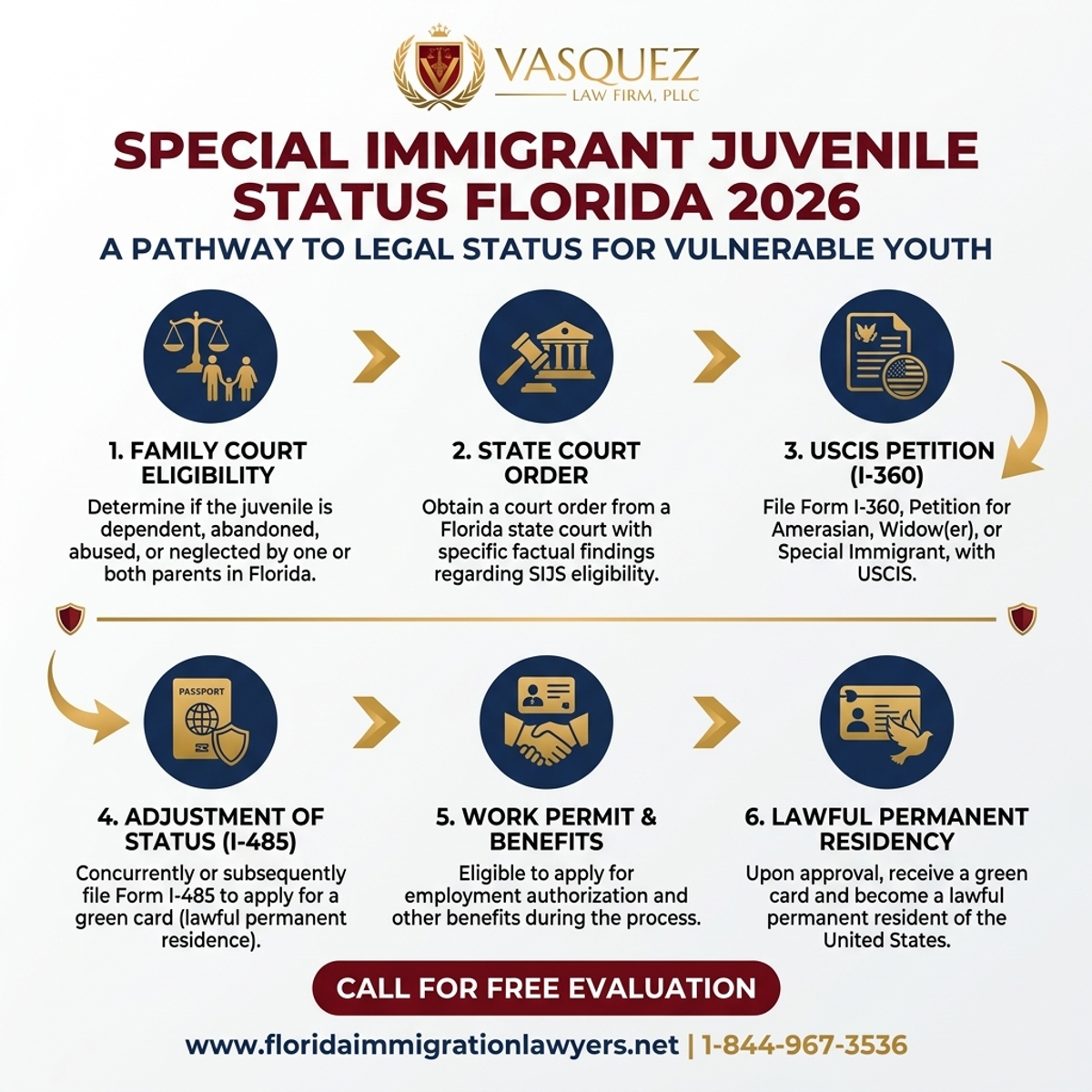
Step-by-Step Process — Special Immigrant Juvenile Status in Florida 2026
Each step requires careful documentation and attention to detail, underscoring the importance of legal guidance.
The initial filing in Florida family court can be complex, often involving a dependency petition or a guardianship petition, depending on the child's specific situation and age. The "special findings" order is paramount; it must explicitly state that the child is dependent on a state court, that reunification with one or both parents is not possible due to abuse, abandonment, or neglect, and that it is not in the child's best interest to return to their country of origin. This order essentially "certifies" the child for SIJS purposes, and its precise wording is critical for USCIS approval.
Once the state court order is secured, the next major hurdle is preparing and submitting Form I-360 to USCIS. This petition is where you formally request SIJS classification. It requires comprehensive documentation, including the certified state court order, the child's birth certificate, and any other evidence supporting the claims of abuse, abandonment, or neglect. USCIS meticulously reviews these petitions, and any discrepancies or missing information can lead to delays or even a Request for Evidence (RFE), prolonging the process significantly.
Upon approval of the I-360, the minor becomes eligible to apply for adjustment of status using Form I-485, which is the application for a green card. This stage typically involves biometrics appointments, a medical examination by a USCIS-approved civil surgeon, and potentially an interview with an immigration officer. For example, consider "Maria," a 16-year-old who fled severe neglect. With the help of Florida Immigration Lawyers, she obtained a state court order recognizing her situation. Her I-360 was approved, and she is now preparing for her adjustment of status interview, a crucial step towards her permanent residency. This final phase focuses on ensuring the applicant is admissible to the U.S. and meets all requirements for a green card.
Throughout these intricate stages, having the support of an experienced immigration attorney from Florida Immigration Lawyers can make a profound difference. They can help identify the correct state court pathway, draft the necessary legal documents, prepare you for interviews, and respond effectively to any challenges that may arise, ensuring the strongest possible case for the minor.
Document Checklist for SIJS Application
Preparing the right documents is crucial for a successful SIJS application. Below is a checklist of commonly required documents:
- Birth certificate of the minor
- State court order with special findings
- Form I-360
- Evidence of abuse, abandonment, or neglect
- Affidavits or statements from family or social workers
Beyond these core documents, a thorough application often requires a broader array of supporting evidence to paint a complete picture for both the state court and USCIS. For instance, the minor's birth certificate is essential for verifying age and identity, and if it's not in English, a certified translation is mandatory. The state court order is the cornerstone, so ensuring it contains all the specific "special findings" required by federal law is non-negotiable.
When gathering evidence of abuse, abandonment, or neglect, think broadly. This could include police reports, medical records, school records (showing attendance issues or behavioral changes due to trauma), court documents from any prior dependency proceedings, or even sworn affidavits from teachers, counselors, or community members who have witnessed the child's circumstances. The more comprehensive and corroborating your evidence, the stronger your case will be.
Additional documents often include proof of the minor's identity and nationality (like a passport or national ID), evidence of their physical presence in the United States, and potentially guardianship documents if a guardian has been appointed. If the minor wishes to work while their adjustment of status is pending, an application for an Employment Authorization Document (EAD) – Form I-765 – can be filed concurrently. Florida Immigration Lawyers can help you meticulously compile and organize all necessary documentation, ensuring nothing is overlooked.
Timeline and Processing Expectations
The timeline for an SIJS application can vary based on several factors, including court schedules and USCIS processing times. Here is a typical timeline:
| Stage | Typical Timeframe | Notes |
|---|---|---|
| State Court Order | 3-6 months | Depends on court availability |
| USCIS Processing of I-360 | 6-12 months | Subject to change based on USCIS backlogs |
| Adjustment of Status | 8-14 months | Requires USCIS approval of I-360 |
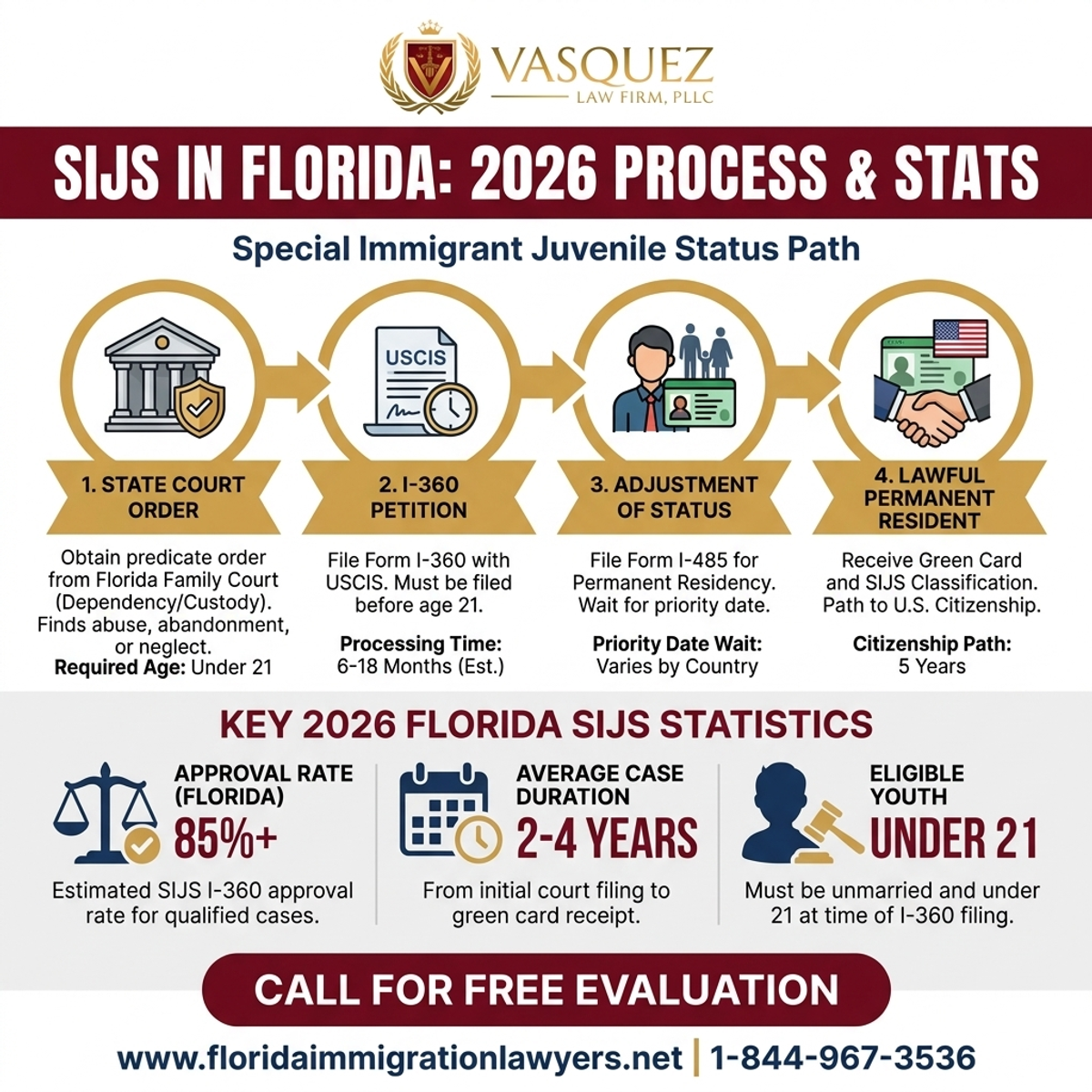
Key Statistics — Special Immigrant Juvenile Status in Florida 2026
It's important to understand that these timeframes are estimates and can fluctuate significantly. Factors such as the specific Florida county court's caseload, the complexity of the child's family situation, the availability of witnesses, and the current USCIS processing backlogs all play a role. For example, a court might expedite a case if the child is in immediate danger, while a complex case requiring multiple hearings could take longer.
After the state court order, the USCIS processing of Form I-360 is a critical waiting period. USCIS publishes average processing times on its website, but these can change without much notice. Responding promptly and thoroughly to any Requests for Evidence (RFEs) from USCIS is crucial to avoid further delays. Similarly, the adjustment of status phase, which culminates in the green card, involves several steps, each with its own processing time.
While the process can feel lengthy, continuous monitoring and proactive engagement are key. Florida Immigration Lawyers regularly track USCIS processing times and communicate with clients about potential delays or necessary actions. Managing expectations and understanding that patience is often required can help alleviate stress during this important journey toward permanent residency.
Cost Factors and Fee Breakdown
Cost is an important consideration when applying for SIJS. While some fees may be waived, here is an overview of potential costs:
| Item | Typical Fee | Notes |
|---|---|---|
| Filing of State Court Order | Varies | Depends on court fees |
| Form I-360 | N/A | No filing fee for SIJS |
| Adjustment of Status | Varies | Fee may be waived |
Do not navigate this process alone. Contact Florida Immigration Lawyers today.
While the federal government waives the filing fee for Form I-360 for SIJS applicants, there are other potential costs involved. State court fees for filing a dependency or guardianship petition can vary by county in Florida, though many courts offer fee waivers for indigent individuals. Additionally, costs might arise from obtaining certified copies of documents, translations, or expert witness fees if required in the state court proceedings.
The application for adjustment of status (Form I-485) typically carries a significant filing fee, as well as a biometrics fee. However, SIJS applicants are often eligible for a fee waiver for the I-485 and biometrics, which can be requested by submitting Form I-912, Application for Fee Waiver. Eligibility for a fee waiver is usually based on household income falling below 150% of the Federal Poverty Guidelines, receipt of a means-tested benefit, or financial hardship.
Beyond government fees, the most significant investment for many applicants is legal representation. While it's possible to file without an attorney, the complexity of both state and federal processes, the sensitive nature of the evidence, and the potential for errors make professional guidance invaluable. Florida Immigration Lawyers offer transparent fee structures and, importantly, a free case review, allowing you to understand the potential costs and benefits of legal support without initial financial commitment. Investing in expert legal counsel can ultimately save time, prevent costly mistakes, and significantly increase the likelihood of a successful outcome.
Common Mistakes to Avoid
Navigating the SIJS process is fraught with potential pitfalls that can lead to significant delays or even denial. For vulnerable minors seeking protection, even a small error can have devastating consequences. Being aware of these common mistakes and taking proactive steps to avoid them is just as important as understanding the correct procedures.
- Filing incorrect forms: Ensure all forms are correct to avoid delays.
- Missing deadlines: Be aware of all deadlines to prevent application rejection.
- Incomplete documentation: Submit all required documents to support your case.
- Failing to obtain a court order: SIJS requires a specific state court order.
- Ignoring legal guidance: An attorney can provide critical support and advice.
- Misunderstanding eligibility: Not all minors qualify; ensure you meet all criteria.
- Skipping interviews: Attend all required interviews with immigration officials.
- Ignoring updates: Stay informed about policy changes and updates.
Each of these errors, from a seemingly minor typo to a missed court date, can derail an otherwise strong application. For example, failing to obtain a state court order with the precise "special findings" language required by USCIS is a common reason for I-360 denials. Similarly, submitting an I-485 without a medical exam or a properly filed fee waiver will lead to immediate rejection.
The emotional toll of rejections and delays can be immense for young applicants. This is why the guidance of experienced professionals, like those at Florida Immigration Lawyers, is invaluable. They can help you meticulously prepare your application, ensure all deadlines are met, and represent your best interests at every stage, significantly reducing the risk of these common and costly mistakes.
When to Call a Lawyer
Obtaining SIJS is a complex process that often requires legal expertise. Consider contacting a lawyer if:
- You are unsure of the eligibility requirements.
- You need assistance with court proceedings or documentation.
- You face challenges with the USCIS process.
Florida Immigration Lawyers offer comprehensive services to guide you through every step.
The decision to seek legal counsel is often the most critical step in a successful SIJS application. While the basic framework might seem straightforward, the nuances of state family law and federal immigration statutes can be overwhelming, especially for a minor or their temporary guardian. A lawyer can assess your unique situation, confirm eligibility, and advise on the strongest legal strategy.
Beyond initial eligibility, a lawyer's expertise becomes indispensable when navigating the state court system. They can help identify the appropriate court, draft the necessary petitions, present compelling evidence of abuse, abandonment, or neglect, and advocate for the "special findings" order. Without this expertly crafted state court order, the federal SIJS petition cannot proceed.
Furthermore, an attorney from Florida Immigration Lawyers can prepare you for USCIS interviews, respond to complex Requests for Evidence (RFEs), and represent you in any appeals if your application faces a denial. They can also assist with concurrent applications for work permits (EADs) and ensure that all deadlines are met, providing peace of mind and significantly increasing the chances of a favorable outcome for the young applicant. Call 1-844-YO-PELEO for a free consultation.
About Florida Immigration Lawyers
Florida Immigration Lawyers is dedicated to serving the immigrant community in Orlando and beyond. Our experienced attorneys specialize in various immigration matters, including SIJS, asylum, and family immigration. With 24/7 availability, we provide free case reviews and personalized legal services. Schedule a free consultation today or explore our immigration practice areas.
Our commitment extends to providing compassionate and effective legal representation for the most vulnerable members of our community, especially young individuals seeking safety and a new beginning through programs like SIJS. We understand the profound impact that legal status has on a child's development and future, which is why we approach each case with the utmost care and dedication. Our team is fluent in Spanish, ensuring that language is never a barrier to receiving expert legal guidance. We are here to fight for your rights and help secure a brighter future for you or your loved one.
Frequently Asked Questions About SIJS
Q: Who is eligible for Special Immigrant Juvenile Status (SIJS)?
A: Eligibility for SIJS requires you to be under 21 years old and unmarried at the time of filing your I-360 petition. Crucially, a state court must have issued an order finding that you have been abused, abandoned, or neglected by one or both parents, and that it is not in your best interest to return to your home country. You must also be physically present in the U.S. when applying. Consulting Florida Immigration Lawyers can help determine if you meet these specific criteria.
Q: Can I apply for SIJS if I'm over 18 but under 21?
A: Yes, you can apply for SIJS if you are over 18 but under 21 years old, provided you were under 21 when the state court issued the special findings order and when you filed your Form I-360 petition. The "age-out" provision is critical, so acting quickly once the state court order is obtained is essential. Florida Immigration Lawyers can assist in expediting your federal application to ensure you meet all age requirements.
Sources and References
- U.S. Citizenship and Immigration Services (USCIS)
- Executive Office for Immigration Review (EOIR)
- U.S. Department of State
- Immigration and Nationality Act (INA), 8 U.S.C. Chapter 12
Do Not Navigate This Process Alone
Our experienced immigration attorneys are ready to fight for you. Get a free, confidential case review today.
Se Habla Español
Or leave your details and we’ll call you:
Free Evaluation in 24 Hours
Or talk to us right now

AI voice assistant — available 24/7
FreeFrequently Asked Questions

William J. Vásquez
Founding Attorney · Vasquez Law Firm
U.S. Air Force veteran and immigration attorney with years of hands-on U.S. immigration experience. J.D., NCCU School of Law. AILA member. Admitted to the 4th, 5th, and 11th Circuit Courts.
Available 24/7 - Free Evaluations
Reviewed for legal accuracy by William J. Vásquez
Licensed in North Carolina; U.S. immigration is federal practice.
Related Legal Services
Our Florida immigration attorneys can help you with asylum protection, citizenship and naturalization and immigration practice areas. Call today at 1-844-YO-PELEO for a free case review.
Related Links
Related Topics
Free Legal Case Review
Discuss your case with our experienced attorneys. We're available 24/7.
Se Habla Español - Estamos aquí para ayudarle.
Related Articles
Immigration Lawyer Orlando Free Consultation in Florida
For individuals and families in Orlando, Florida, navigating the complexities of U.S. immigration law requires expert guidance. An immigration lawyer in Orlando offers crucial support for everything from visa applications and green card processes to naturalization and deportation defense. This comprehensive guide details what a free consultation covers, providing a step-by-step overview of immigration pathways, essential document checklists, and expected timelines in 2026. We also highlight common mistakes to avoid, discuss the critical role of legal counsel in deportation and asylum cases, and explain why choosing a local Orlando immigration attorney is beneficial. Florida Immigration Lawyers is dedicated to serving the diverse community of Orlando with compassionate, effective legal solutions, ensuring you receive personalized advice and robust representation for a successful immigration journey.
Fiance Visa in Miami: 2026 Process Guide for Florida
For U.S. citizens in Florida, bringing a foreign fiancé(e) to the U.S. requires navigating the K-1 Fiance Visa process. This guide details the 2026 requirements, step-by-step application, essential documents, and expected timelines. Learn about filing Form I-129F with USCIS, consular interviews, and the crucial Adjustment of Status after marriage. We cover typical fees, common mistakes to avoid, and when to seek legal assistance. Florida Immigration Lawyers offers expert guidance for couples in Miami, Orlando, and across Florida, ensuring a smooth path to uniting with your loved one. Get a free case review today.
Immigration Lawyer Services in Orlando, Florida
Explore immigration consultation services in Orlando, Florida, with a qualified immigration lawyer. Learn what to expect and understand your options for family and business immigration needs.
Fraud Prevention and Detection Fee: What to Know in Florida
Explore the fraud prevention and detection fee essential for immigration processes in Florida. Discover how it impacts applications like the I-601 waiver and learn key steps to navigate this requirement effectively.